
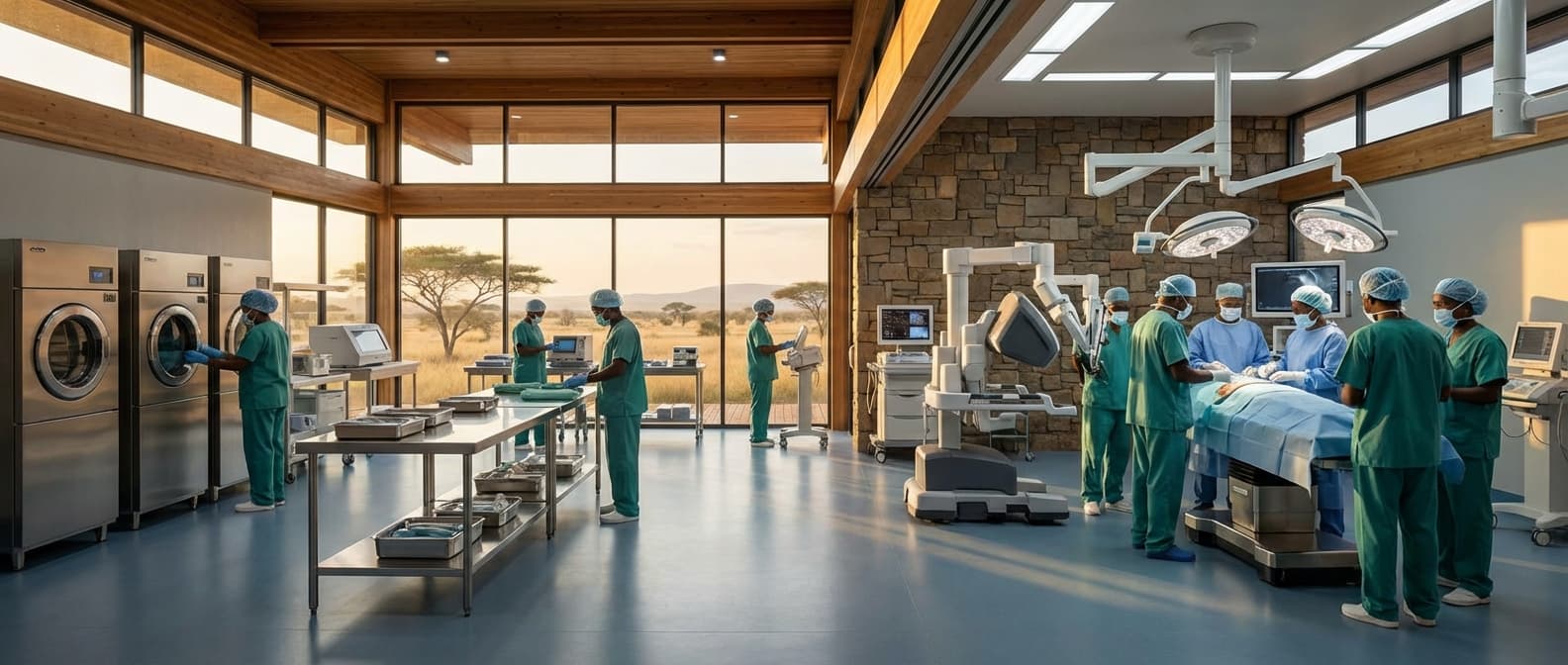
CSSD Design & Validation in Zambia
Engineering Excellence & Technical Support
CSSD workflow design, validation and process development High-standard technical execution following OEM protocols and local regulatory frameworks.
Optimized Sterilization Workflow Design
Implementing evidence-based CSSD layouts and workflows that minimize cross-contamination risks and maximize efficiency, ensuring adherence to international standards (e.g., ISO 13485) and Zambian healthcare regulations for Central Sterile Supply Departments.
Advanced Sterilization Process Validation & Monitoring
Designing and executing rigorous validation protocols for all sterilization equipment (autoclaves, ethylene oxide sterilizers, etc.) and processes, including biological and chemical indicator testing, to guarantee the safety and efficacy of sterilized medical devices in Zambian healthcare facilities.
Traceability & Data Management Systems Implementation
Integrating robust traceability systems (e.g., barcode scanning, RFID) for instruments and sterile loads within CSSD operations. This ensures complete lifecycle tracking from decontamination to patient use, enhancing patient safety and facilitating regulatory compliance in line with Zambian health guidelines.
What Is Cssd Design & Validation In Zambia?
CSSD Design & Validation in Zambia refers to the comprehensive process of planning, configuring, and verifying Central Sterile Supply Department (CSSD) facilities and their associated workflows to meet stringent national and international standards for infection prevention and control. This service is critical for ensuring the safe and effective reprocessing of medical devices, thereby preventing healthcare-associated infections (HAIs). It encompasses architectural design considerations, equipment selection and layout, workflow optimization, sterilization validation, and quality assurance protocols tailored to the Zambian healthcare landscape.
| Who Needs CSSD Design & Validation? | Typical Use Cases | |
|---|---|---|
| Hospitals (Public and Private) | Design of new CSSD facilities or upgrades to existing ones. | Ensuring compliance with national infection control guidelines for reprocessing surgical instruments. |
| Surgical Centers & Day Surgery Units | Validation of new sterilization equipment or processes. | Optimizing workflow for efficient turnaround of reusable medical devices. |
| Specialized Clinics (e.g., Dental, Ophthalmology, Endoscopy) | Establishing robust protocols for reprocessing complex medical devices. | Implementing validated cleaning and disinfection procedures for high-risk items. |
| Medical Device Manufacturers (for in-house sterilization) | Validation of sterilization processes for their own products. | Designing and equipping dedicated sterilization suites within manufacturing facilities. |
| Government Health Agencies & Regulatory Bodies | Developing and enforcing standards for sterile processing across the nation. | Providing guidance and oversight for CSSD operations in public healthcare facilities. |
Key Components of CSSD Design & Validation:
- Needs Assessment & Facility Planning: Determining the required capacity, scope of services (e.g., surgical instruments, endoscopes, implants), and integration with existing hospital infrastructure.
- Architectural & Engineering Design: Developing detailed blueprints that adhere to infection control principles, including unidirectional workflow, appropriate ventilation (negative pressure for dirty areas, positive for sterile areas), material flow, and ergonomic considerations.
- Equipment Specification & Selection: Identifying and procuring appropriate sterilization equipment (autoclaves, low-temperature sterilizers), washer-disinfectors, ultrasonic cleaners, packaging systems, and environmental monitoring devices, considering local maintenance and power availability.
- Workflow Development & Optimization: Designing efficient, logical workflows that minimize the risk of cross-contamination, including decontamination, cleaning, inspection, assembly, packaging, sterilization, sterile storage, and distribution.
- Sterilization Process Validation: Conducting rigorous validation studies (IQ - Installation Qualification, OQ - Operational Qualification, PQ - Performance Qualification) for all sterilization cycles and equipment to demonstrate consistent efficacy in eliminating microbial contamination.
- Quality Management System (QMS) Implementation: Establishing comprehensive QMS policies and procedures, including standard operating procedures (SOPs), staff training, competency assessment, documentation, record-keeping, and incident reporting.
- Regulatory Compliance: Ensuring adherence to relevant Zambian Ministry of Health regulations, international standards (e.g., ISO 13485, ISO 11135, ISO 17665), and best practices in sterile processing.
- Commissioning & Handover: Final verification of all systems and processes before operational use and provision of comprehensive documentation and training.
Who Needs Cssd Design & Validation In Zambia?
In Zambia, the design and validation of Central Sterile Services Departments (CSSDs) are crucial for maintaining the highest standards of infection prevention and control across various healthcare settings. A well-designed and validated CSSD ensures that surgical instruments and medical devices are properly cleaned, disinfected, and sterilized, thereby preventing healthcare-associated infections (HAIs). This is particularly important in a developing healthcare landscape where resources and expertise can be challenging to access, making robust and reliable CSSD processes a necessity for patient safety and effective healthcare delivery.
| Target Customer Segment | Key Departments/Users Involved | Specific Needs/Benefits of CSSD Design & Validation |
|---|---|---|
| Public Hospitals | Operating Theatres, Outpatient Departments, Emergency Wards, Nursing Services, Biomedical Engineering | Ensuring consistent sterilization for high patient volumes, compliance with national health standards, cost-effectiveness through efficient workflows, reducing HAIs and associated treatment costs. |
| Private Hospitals & Clinics | Surgical Suites, Diagnostic Imaging, Dental Clinics, Endoscopy Units, Infection Control Teams | Maintaining reputation for quality and safety, attracting patients seeking specialized procedures, optimizing equipment lifespan, meeting international accreditation standards, ensuring patient confidence. |
| Surgical Centers | Surgeons, Anesthesiologists, Surgical Nurses, CSSD Technicians | Streamlining instrument turnaround for elective procedures, minimizing delays due to improperly sterilized items, ensuring availability of sterile instruments for critical surgeries, enhancing surgical team efficiency. |
| Diagnostic Laboratories | Laboratory Technicians, Microbiologists, Quality Assurance Personnel | Ensuring sterility of tools and equipment used in diagnostic testing, preventing cross-contamination, maintaining accuracy of test results, adhering to laboratory accreditation requirements. |
| Maternity Units | Obstetricians, Midwives, Neonatal Intensive Care Units (NICUs) | Guaranteeing sterile instruments for deliveries and postpartum care, preventing infections in mothers and newborns, crucial for critical procedures like C-sections. |
Who Needs CSSD Design & Validation in Zambia?
- Hospitals (Public and Private)
- Specialized Clinics (e.g., dental, ophthalmology, endoscopy)
- Surgical Centers
- Diagnostic Laboratories requiring sterile equipment
- Maternity Units
Cssd Design & Validation Process In Zambia
The design and validation process for Central Sterile Services Departments (CSSDs) in Zambia follows a structured workflow, ensuring adherence to international standards and local regulations for safe and effective sterilization. This process typically begins with an initial inquiry and culminates in the operational validation of the facility. Key stages include needs assessment, conceptual design, detailed design, procurement, construction, commissioning, and validation.
| Stage | Description | Key Activities | Deliverables/Outcomes | Responsible Parties |
|---|---|---|---|---|
| Initial Inquiry & Needs Assessment | Understanding the client's requirements and the scope of the CSSD project. | Site visit, stakeholder consultations, equipment needs analysis, existing facility review (if applicable). | Needs assessment report, preliminary scope definition. | Client (Hospital/Clinic Management), Healthcare Consultants, Design Team. |
| Conceptual Design & Feasibility Study | Developing the overall layout, workflow, and preliminary equipment selection. | Space planning, workflow diagramming, initial equipment list, budget estimation, regulatory review (e.g., Ministry of Health guidelines). | Conceptual design drawings, preliminary budget, feasibility report. | Design Team (Architects, Engineers), Healthcare Consultants. |
| Detailed Design & Engineering | Developing comprehensive architectural, mechanical, electrical, and plumbing (MEP) designs. | Production of detailed drawings, specifications for equipment and materials, HVAC design (critical for sterile areas), utility requirements, fire safety design. | Full set of construction drawings and specifications, Bill of Quantities (BOQ). | Design Team (Architects, MEP Engineers), Structural Engineers, Specialist CSSD Consultants. |
| Procurement of Equipment & Materials | Sourcing and purchasing all necessary CSSD equipment and construction materials. | Tendering process, vendor selection, equipment specification adherence, material quality checks. | Procured equipment and materials meeting specifications. | Procurement Department, Project Management Team, Technical Advisors. |
| Construction & Installation | Building the CSSD facility and installing all equipment. | Civil works, MEP installations, cleanroom construction, installation of sterilizers, washer-disinfectors, sterile storage units, etc. | Completed CSSD facility with installed equipment. | Contractors, Subcontractors, Site Engineers, Equipment Installers. |
| Commissioning & Initial Testing | Verifying that all installed systems and equipment function as intended. | Pre-functional checks, functional performance tests (FPT) of individual equipment, utility system testing (water, electricity, steam, HVAC). | Commissioning reports, FPT reports, initial performance data. | Equipment Manufacturers/Suppliers, Commissioning Engineers, Technical Team. |
| Operational Validation & Handover | Confirming that the CSSD operates according to specified requirements and standards, and is ready for use. | Installation Qualification (IQ), Operational Qualification (OQ), Performance Qualification (PQ) for sterilization processes, staff training, development of Standard Operating Procedures (SOPs), final inspections. | Validation reports (IQ/OQ/PQ), operational manuals, trained staff, handover certificate. | Validation Team (internal or external), CSSD Staff, Quality Assurance Personnel, Project Management Team. |
CSSD Design & Validation Process in Zambia: Workflow
- Initial Inquiry & Needs Assessment
- Conceptual Design & Feasibility Study
- Detailed Design & Engineering
- Procurement of Equipment & Materials
- Construction & Installation
- Commissioning & Initial Testing
- Operational Validation & Handover
Cssd Design & Validation Cost In Zambia
Designing and validating a Central Sterile Services Department (CSSD) in Zambia involves a complex process with significant cost implications. The pricing is highly variable and depends on a multitude of factors, ranging from the scale and complexity of the facility to the specific services offered and the chosen equipment. This discussion outlines the key pricing factors and provides estimated cost ranges in Zambian Kwacha (ZMW).
| Cost Component | Estimated Range (ZMW) | Notes |
|---|---|---|
| CSSD Design Consultancy | 15,000 - 75,000+ | Varies by consultant's experience and project complexity. Can be a percentage of total project cost. |
| Equipment Procurement (Autoclaves, Washer-Disinfectors, etc.) | 250,000 - 2,000,000+ | Highly dependent on the number, size, and technological sophistication of units. Includes smaller ancillary equipment. |
| Infrastructure Upgrades (Plumbing, Electrical, HVAC) | 50,000 - 300,000+ | Depends heavily on existing building conditions and specific equipment requirements. Specialized ventilation can be costly. |
| Validation & Testing Services (IQ/OQ/PQ) | 30,000 - 150,000+ | Includes documentation, testing, and certification. May involve multiple equipment types. |
| Staff Training | 10,000 - 50,000+ | Covers operation, maintenance, and infection control protocols. |
| Project Management (if outsourced) | 5% - 15% of total project cost | Can be integrated into design fees or a separate line item. |
| Ancillary Items (Baskets, Trays, Storage Systems) | 20,000 - 100,000+ | Essential for organization and sterile storage. |
| Contingency (Recommended) | 10% - 20% of sub-total | Crucial for unforeseen expenses. |
| Total Estimated Project Cost (Small to Medium Scale CSSD) | 375,000 - 1,500,000+ | This is a broad estimate. Larger, more complex facilities will exceed this significantly. |
Key Pricing Factors for CSSD Design & Validation in Zambia
- Facility Size and Scope: The overall square footage of the CSSD and the range of sterilization services it will provide (e.g., general surgical instruments, specialized equipment, endoscopes) directly impact design complexity and equipment needs.
- Equipment Selection: The type, brand, and quantity of sterilization equipment (autoclaves, washer-disinfectors, instrument processing equipment, sterile storage solutions) are major cost drivers. High-end, automated systems will be more expensive than basic manual ones.
- Infrastructure Requirements: This includes the need for specialized plumbing, ventilation (HVAC systems with HEPA filtration), electrical upgrades, and data networking to support the equipment and workflow. Existing building infrastructure will influence these costs.
- Regulatory Compliance & Standards: Adhering to national and international standards (e.g., ISO, local health regulations) requires specific design considerations, material choices, and validation protocols, all of which add to the cost.
- Consultancy Fees: Engaging experienced CSSD designers, engineers, and validation specialists is crucial. Their fees are based on their expertise, the project duration, and the scope of their involvement.
- Validation and Testing Services: Post-installation, rigorous validation (IQ, OQ, PQ) is mandatory. This involves specialized testing, documentation, and reporting, often performed by third-party accredited laboratories or validation experts.
- Training: Comprehensive training for CSSD staff on equipment operation, infection control protocols, and quality management systems is an essential component of validation and operational readiness.
- Project Management: Effective project management is vital to ensure timely completion and cost control. This can be an in-house function or outsourced.
- Geographical Location within Zambia: While not as significant a factor as the others, localized costs for materials, labor, and transportation can have minor variations across different provinces.
- New Construction vs. Renovation: Building a new CSSD from scratch will generally be more expensive than renovating and retrofitting an existing space.
Affordable Cssd Design & Validation Options
Designing and validating a Central Sterile Services Department (CSSD) can be a significant investment. However, by exploring affordable options and strategic approaches, healthcare facilities can achieve high-quality sterile processing without breaking the bank. This document outlines value bundles and cost-saving strategies to help you optimize your CSSD design and validation processes.
| Cost-Saving Strategy | Description | Benefit |
|---|---|---|
| Phased Implementation | Instead of a complete overhaul, implement changes in stages. Prioritize critical areas or equipment upgrades based on need and budget. | Spreads out capital expenditure, allows for learning and adjustment, and minimizes disruption. |
| Modular Design & Scalability | Design the CSSD with flexibility in mind, allowing for future expansion or adaptation without major structural changes. | Reduces future renovation costs, accommodates growth, and adapts to new technologies. |
| Used or Refurbished Equipment | Explore high-quality, certified used or refurbished sterilizers, washers, and other equipment from reputable suppliers. | Significant upfront cost savings compared to new equipment, with often comparable performance. |
| Strategic Outsourcing | Consider outsourcing specific non-core functions like equipment calibration or specialized decontamination if it proves more cost-effective than in-house management. | Reduces operational overhead, leverages external expertise, and ensures compliance for specific tasks. |
| Energy-Efficient Equipment Selection | When purchasing new equipment, prioritize models with lower energy consumption. Look for ENERGY STAR certifications. | Reduces long-term utility costs and contributes to environmental sustainability. |
| Lean Workflow Analysis | Conduct a thorough analysis of your current CSSD workflow to identify and eliminate waste (e.g., unnecessary movement, delays, reprocessing). | Improves throughput, reduces labor costs, and minimizes errors. |
| Consolidated Purchasing Power | If part of a larger healthcare network, leverage group purchasing organizations (GPOs) for discounts on equipment, supplies, and validation services. | Achieves better pricing through bulk purchasing and negotiation. |
| Preventive Maintenance Programs | Implement a robust preventive maintenance schedule for all equipment to avoid costly breakdowns and extend equipment lifespan. | Reduces unexpected repair costs, minimizes downtime, and ensures consistent performance. |
Value Bundles for Affordable CSSD Design & Validation
- Comprehensive Design & Workflow Optimization Bundle: This bundle typically includes initial consultation, space planning, equipment selection advisory, and workflow analysis. It focuses on maximizing efficiency and minimizing redundancies from the outset, reducing the need for costly retrofits later.
- Equipment Procurement & Integration Support Bundle: Rather than simply buying equipment, this bundle offers guidance on selecting cost-effective, reliable instruments and sterilizers, along with support for their seamless integration into the existing or new CSSD layout. It often includes vendor negotiation assistance.
- Validation Protocol Development & Execution Bundle: This bundle covers the creation of detailed validation protocols (IQ, OQ, PQ) tailored to your specific equipment and processes. It may also include the execution of these validations by experienced technicians, ensuring compliance with regulatory standards efficiently.
- Training & Competency Assessment Bundle: Investing in well-trained staff is crucial for sterile processing. This bundle provides comprehensive training programs for CSSD personnel, covering best practices, equipment operation, and infection control. Competency assessments ensure staff are proficient, reducing errors and reprocessing costs.
- Ongoing Compliance & Auditing Support Bundle: For sustained quality, this bundle offers periodic audits of CSSD processes and documentation, ensuring continued compliance with evolving regulations. It helps identify potential issues before they become major problems, saving on potential fines or corrective actions.
Verified Providers In Zambia
Finding reliable and trustworthy healthcare providers in Zambia is paramount for ensuring quality care. This document highlights Franance Health as a leading example of a verified provider, detailing their credentials and the reasons why they stand out as the best choice for your health needs. Franance Health is dedicated to delivering exceptional medical services through a commitment to excellence, patient-centered care, and adherence to the highest ethical standards. Their rigorous internal processes and external accreditations ensure that every patient receives safe, effective, and compassionate treatment.
| Credential/Standard | Description/Significance | Franance Health's Compliance |
|---|---|---|
| Ministry of Health Accreditation (Zambia) | Official recognition by the Zambian Ministry of Health, signifying adherence to national healthcare regulations and standards. | Fully accredited and compliant with all Ministry of Health regulations. |
| Professional Body Certifications | Verification of individual medical practitioners' qualifications and licenses by relevant Zambian professional bodies (e.g., Medical Council of Zambia). | All medical staff hold current and valid certifications from recognized professional bodies. |
| International Healthcare Standards (e.g., WHO Guidelines) | Adherence to globally recognized best practices and guidelines set forth by organizations like the World Health Organization. | Integrates WHO guidelines and international best practices into its operational protocols. |
| Internal Quality Management Systems | Robust internal processes for monitoring, evaluating, and improving the quality of care provided. | Employs comprehensive internal quality assurance and continuous improvement programs. |
| Patient Safety Protocols | Implementation of strict protocols to ensure the safety and well-being of patients during all stages of care. | Dedicated patient safety initiatives and rigorous protocol adherence. |
| Data Privacy and Security Measures | Commitment to protecting patient information in accordance with relevant data protection laws. | Strict adherence to data privacy regulations and secure handling of patient records. |
Why Franance Health is the Best Choice:
- Highly Qualified Medical Professionals: Franance Health boasts a team of experienced and certified doctors, nurses, and specialists with a proven track record in various medical fields.
- State-of-the-Art Facilities and Technology: Equipped with modern medical equipment and advanced diagnostic tools, ensuring accurate diagnoses and effective treatments.
- Comprehensive Range of Services: Offering a wide spectrum of medical services, from general consultations and preventative care to specialized treatments and surgeries.
- Patient-Centric Approach: Prioritizing patient comfort, clear communication, and involvement in treatment decisions.
- Commitment to Ethical Practice: Upholding the highest ethical standards in all aspects of healthcare delivery, ensuring patient privacy and confidentiality.
- Robust Quality Assurance Programs: Implementing strict quality control measures to consistently deliver superior healthcare outcomes.
- Positive Patient Testimonials and Outcomes: A consistent history of positive patient experiences and successful treatment results.
- Affiliation with Recognized Health Organizations: Adherence to national and international healthcare guidelines and best practices.
- Continuous Professional Development: Investing in ongoing training and education for their staff to stay abreast of the latest medical advancements.
- Accessible and Responsive Care: Ensuring timely appointments and prompt attention to patient needs.
Scope Of Work For Cssd Design & Validation
This document outlines the Scope of Work (SOW) for the Design & Validation of a Central Sterile Supply Department (CSSD). It details the technical deliverables required and references standard specifications to ensure the CSSD meets regulatory requirements, operational efficiency, and patient safety standards. The scope covers all phases from initial conceptualization and detailed design to validation and handover.
| Technical Deliverable | Description | Associated Standard Specification(s) |
|---|---|---|
| Functional Program Document | Detailed description of departmental functions, workflows, spatial requirements, and operational needs. | HTM 01-01 (UK), AS/NZS 4187 (Australia/New Zealand), NSF/ANSI 49 (USA - Laminar Flow Clean Air Devices), Local Building Codes. |
| Architectural Drawings | Floor plans, elevations, sections, and details showing room layouts, adjacencies, traffic flow, and finishes. | Local Building Codes, Fire Safety Regulations, Accessibility Standards (e.g., ADA in the US). |
| MEP Design Drawings & Specifications | Detailed drawings and specifications for HVAC, plumbing, electrical, and lighting systems, including specific requirements for sterile environments. | ASHRAE Standards (e.g., 170 for Healthcare Facilities), NFPA Standards (e.g., 99 for Health Care Facilities), local electrical and plumbing codes. |
| Equipment Specifications | Detailed technical specifications for all CSSD equipment (e.g., washers, disinfectors, sterilizers, storage cabinets), including performance, safety, and utility requirements. | Manufacturer's specifications, relevant ISO standards (e.g., ISO 13485 for Medical Device Quality Management), FDA regulations (if applicable). |
| Infection Control Risk Assessment (ICRA) Report | Assessment of infection control risks during design, construction, and operation, with mitigation strategies. | Guidelines from CDC (USA), WHO, local public health authorities. |
| Validation Protocols (IQ, OQ, PQ) | Protocols for Installation Qualification (IQ), Operational Qualification (OQ), and Performance Qualification (PQ) of equipment and processes. | ISO 13485, FDA 21 CFR Part 11 (Electronic Records; Electronic Signatures), Manufacturer's validation guidelines, industry best practices. |
| Validation Reports | Documented evidence that the CSSD and its processes meet the defined specifications and are fit for purpose. | As per validation protocols, ISO 13485, regulatory requirements. |
| Standard Operating Procedures (SOPs) | Development of SOPs for all CSSD processes, including cleaning, disinfection, sterilization, storage, and distribution. | Manufacturer's instructions, relevant ISO standards (e.g., ISO 17665 for Sterilization of healthcare products — Moist heat, ISO 11135 for Sterilization of healthcare products — Ethylene oxide), AAMI Standards. |
| Training Materials | Comprehensive training materials for CSSD staff on equipment operation, safety procedures, and infection control protocols. | Manufacturer's manuals, relevant standards, regulatory guidelines. |
| As-Built Drawings | Finalized drawings reflecting the actual installed systems and configurations. | As per contract requirements and local building codes. |
Key Stages and Activities
- Phase 1: Conceptualization & Planning
- Needs assessment and functional requirements definition
- Site evaluation and space planning
- Preliminary workflow analysis
- Budget estimation and feasibility study
- Phase 2: Detailed Design
- Architectural design (layout, room adjacencies, traffic flow)
- Mechanical, Electrical, and Plumbing (MEP) design (ventilation, HVAC, water supply, drainage, power distribution, lighting)
- Equipment selection and specification
- Material and finishes selection
- IT and communication infrastructure planning
- Safety and infection control considerations
- Phase 3: Procurement & Construction Support
- Tender documentation preparation
- Contractor selection support
- Construction supervision and quality control
- Site inspections and progress reporting
- Phase 4: Commissioning & Validation
- Installation verification
- Equipment testing and calibration
- Process validation (cleaning, disinfection, sterilization cycles)
- Performance qualification (PQ)
- Staff training
- Phase 5: Handover & Post-Occupancy
- As-built drawings and documentation
- Operation and maintenance manuals
- Post-occupancy evaluation (optional)
Service Level Agreement For Cssd Design & Validation
This Service Level Agreement (SLA) outlines the performance standards for Central Sterile Services Department (CSSD) design and validation services. It defines response times for critical issues and uptime guarantees for critical systems during the validation process.
| Service Component | Response Time (Critical Issue) | Uptime Guarantee (During Validation) |
|---|---|---|
| CSSD Design Consultation & Support | 4 Business Hours (for critical design clarification impacting validation schedule) | N/A (Service is advisory) |
| Validation Protocol Review & Approval Support | 1 Business Day (for urgent feedback impacting validation start date) | N/A (Service is advisory) |
| Installation Qualification (IQ) Support | 4 Business Hours (for critical installation failures preventing OQ commencement) | 95% |
| Operational Qualification (OQ) Support | 4 Business Hours (for critical equipment malfunctions preventing test execution) | 98% |
| Performance Qualification (PQ) Support | 4 Business Hours (for critical equipment malfunctions impacting sterility assurance) | 99% |
| Post-Validation Documentation Support | 1 Business Day (for urgent data or report clarification requests) | N/A (Service is advisory) |
Definitions
- CSSD Design: The comprehensive process of planning, specifying, and detailing the layout, equipment, workflows, and infrastructure of a CSSD.
- CSSD Validation: The documented process of establishing by objective evidence that a system or process consistently produces a result meeting pre-determined specifications and quality attributes. For CSSD, this includes IQ (Installation Qualification), OQ (Operational Qualification), and PQ (Performance Qualification).
- Critical System: Essential equipment and processes within the CSSD that directly impact patient safety and the sterility of instruments. This includes sterilizers (steam, EtO, etc.), washer-disinfectors, and critical workflow areas.
- Downtime: A period during which a critical system is unavailable or non-operational, preventing its intended use in validation activities.
- Response Time: The maximum time allowed for the service provider to acknowledge and begin working on a reported issue.
- Uptime Guarantee: The minimum percentage of time a critical system is expected to be operational and available for validation activities within a defined period.
Frequently Asked Questions

Ready when you are
Let's scope your CSSD Design & Validation in Zambia project in Zambia.

Scaling healthcare logistics and technical systems across the entire continent.