
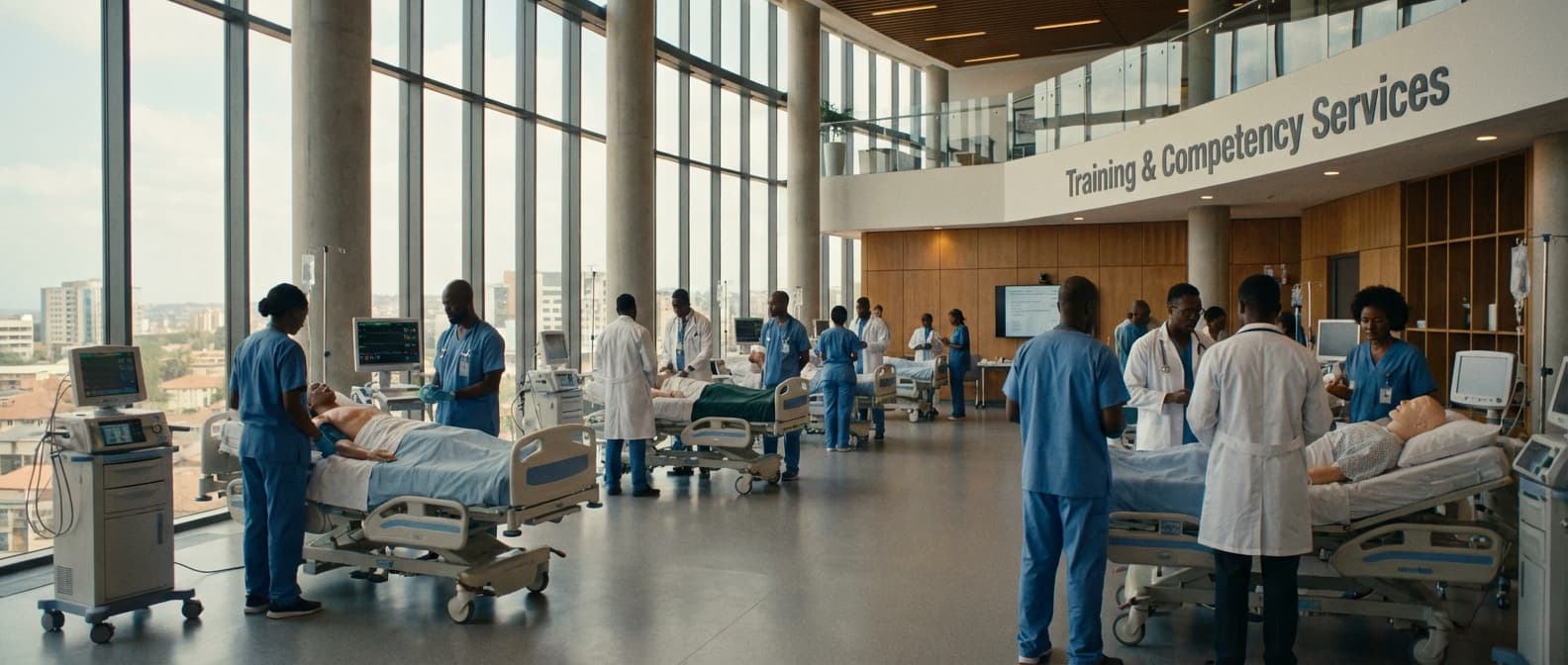
CT Operator Training Service (Radiographers) in Uganda
Engineering Excellence & Technical Support
CT Operator Training Service (Radiographers) High-standard technical execution following OEM protocols and local regulatory frameworks.
Advanced Imaging Techniques & Protocols
Master cutting-edge CT imaging protocols and advanced techniques, including multi-detector CT (MDCT), dual-energy CT, and iterative reconstruction, ensuring diagnostic accuracy and optimal radiation dose management for Ugandan healthcare professionals.
Radiation Safety & Dose Optimization
Gain comprehensive training in radiation physics, patient dosimetry, and the latest ALARA (As Low As Reasonably Achievable) principles, empowering radiographers to ensure patient and staff safety within Ugandan healthcare facilities.
Localised Case Studies & Best Practices
Benefit from training modules featuring real-world Ugandan patient cases and disease prevalence, enabling practical application of learned skills and adherence to internationally recognized best practices within the local context.
What Is Ct Operator Training Service (Radiographers) In Uganda?
CT Operator Training Service (Radiographers) in Uganda refers to specialized educational programs designed to equip radiographers with the requisite knowledge and practical skills for operating Computed Tomography (CT) imaging systems. This service is crucial for ensuring the safe, efficient, and effective acquisition of diagnostic CT scans. It encompasses theoretical instruction on CT physics, image formation, radiation safety principles, and patient care, alongside hands-on training with CT scanners. The objective is to enable radiographers to perform a wide range of CT examinations, including cross-sectional imaging of various anatomical regions, to aid in diagnosis, treatment planning, and disease monitoring. The training adheres to established international standards and local regulatory requirements for medical imaging professionals in Uganda.
| Who Needs CT Operator Training Service? | Typical Use Cases | ||||||||
|---|---|---|---|---|---|---|---|---|---|
| Registered Radiographers in Uganda seeking to specialize in CT imaging. | Acquisition of diagnostic CT scans for trauma assessment (e.g., head injuries, fractures). | Imaging of the head and neck for neurological conditions (e.g., stroke, tumors). | Evaluation of the chest for pulmonary diseases (e.g., pneumonia, lung nodules). | Abdominal and pelvic imaging for a wide range of pathologies (e.g., appendicitis, kidney stones, cancers). | CT angiography for vascular imaging (e.g., aneurysms, stenosis). | Interventional CT procedures (e.g., biopsies, drainages). | Monitoring treatment response in oncology patients. | Pre-operative planning for surgical interventions. | Screening programs (e.g., lung cancer screening where applicable). |
| Newly qualified Radiographers entering the field of medical imaging. | Radiographers working in hospitals and diagnostic centers equipped with CT scanners. | Healthcare institutions in Uganda aiming to enhance their diagnostic imaging capabilities. | Medical professionals seeking advanced training or continuing professional development in CT technology. |
Key Components of CT Operator Training Service:
- CT Physics and Principles: Understanding X-ray generation, attenuation, detectors, reconstruction algorithms, and image artifacts.
- CT Scanner Operation: Familiarization with hardware components, console operation, patient positioning techniques, and protocol selection.
- Radiation Safety and Protection: Principles of ALARA (As Low As Reasonably Achievable), dose monitoring, shielding, and emergency procedures.
- Image Quality Optimization: Techniques for achieving diagnostic image quality, including parameter selection, artifact reduction, and image post-processing.
- Patient Care and Management: Pre-scan preparation, patient comfort, contrast media administration protocols, and management of potential adverse reactions.
- Pathology Recognition (Basic): Introduction to common anatomical variants and pathologies visualized on CT scans.
- Quality Assurance and Control: Understanding routine checks and maintenance of CT equipment.
- Legal and Ethical Aspects: Compliance with Ugandan healthcare regulations and ethical considerations in medical imaging.
Who Needs Ct Operator Training Service (Radiographers) In Uganda?
CT Operator Training Service (Radiographers) in Uganda is crucial for enhancing the quality and accessibility of diagnostic imaging services across the nation. This specialized training aims to equip radiographers with the advanced skills and knowledge required to operate CT scanners effectively, interpret images accurately, and adhere to safety protocols. The demand for such a service stems from the increasing adoption of CT technology in healthcare facilities and the need to ensure a competent workforce capable of utilizing this sophisticated equipment. This training is vital for both public and private healthcare sectors looking to improve patient care and diagnostic capabilities.
| Target Customer Type | Specific Departments/Roles | Rationale for Training Need |
|---|---|---|
| Public Healthcare Sector | Ministry of Health (MoH), Regional Referral Hospitals, District Hospitals, Health Center IVs | To ensure consistent and high-quality CT services across public facilities, improve diagnostic accuracy for a wider patient population, and meet national health objectives. |
| Private Healthcare Sector | Private Hospitals, Private Clinics, Diagnostic Imaging Centers, Specialty Hospitals | To maintain a competitive edge, offer advanced diagnostic imaging services, attract more patients, and ensure compliance with evolving technological standards and patient safety regulations. |
| Academic & Training Institutions | Universities with Medical Imaging/Radiography Programs, Technical Colleges, Allied Health Institutes | To enhance the curriculum, produce highly skilled graduates prepared for the demands of modern medical imaging, and contribute to the overall knowledge base of radiography in Uganda. |
| Individual Radiographers | Employed Radiographers, Freelance Radiographers, Aspiring CT Operators | For career advancement, specialization, to gain proficiency in operating specific CT scanner models, and to ensure up-to-date knowledge of CT protocols and safety. |
Target Customers for CT Operator Training Service (Radiographers) in Uganda
- Radiographers and Radiologic Technologists seeking to specialize in CT imaging or update their skills.
- New graduates from radiography programs who require hands-on CT operational training.
- Healthcare facilities (both public and private) looking to train their existing radiography staff on CT scanners.
- Medical imaging departments within hospitals and clinics.
- Diagnostic imaging centers and private radiology practices.
- Government health ministries and agencies responsible for healthcare worker training and capacity building.
- International aid organizations and NGOs involved in improving healthcare infrastructure and training in Uganda.
- Academic institutions offering radiography programs that wish to integrate advanced CT training into their curriculum.
Ct Operator Training Service (Radiographers) Process In Uganda
This document outlines the standard workflow for CT Operator Training Services for Radiographers in Uganda, from the initial inquiry to the successful completion and certification of the training. The process is designed to be transparent, efficient, and ensure that trainees receive high-quality, comprehensive education in CT operation.
| Stage | Description | Key Activities | Responsible Parties | Deliverables/Outcomes |
|---|---|---|---|---|
| The process begins with an individual radiographer or an institution expressing interest in CT operator training. | Initial contact via phone, email, or website form. Discussion of specific training needs, desired outcomes, existing skill levels, and organizational requirements. Clarification of the target audience and any specialized CT modalities. | Prospective Trainee/Institution, Training Provider Sales/Advisory Team | Understanding of training requirements, preliminary identification of suitable course modules. |
| Based on the needs assessment, the training provider prepares a detailed proposal. | Development of a customized training curriculum. Outlining of training objectives, content, duration, methodology, and assessment plan. Preparation of a detailed cost breakdown and quotation, including any applicable taxes or fees. | Training Provider Technical & Sales Team | Formal training proposal, detailed quotation. |
| Once the proposal is accepted, a formal agreement is established. | Review of the proposal and quotation by both parties. Negotiation of terms and conditions. Signing of a training agreement or contract, outlining responsibilities, payment schedules, and service level agreements. | Prospective Trainee/Institution, Training Provider Management | Signed training agreement/contract. |
| Activities to ensure a smooth start to the training program. | Scheduling of training dates and logistics. Confirmation of venue (if applicable), equipment availability, and access to CT scanners. Communication of pre-reading materials or foundational knowledge requirements to trainees. Enrollment and registration of trainees. | Training Provider Logistics Team, Trainee/Institution | Confirmed training schedule, organized logistics, registered trainees. |
| The core of the service where knowledge and skills are imparted. | Delivery of theoretical sessions covering CT physics, anatomy, pathology, image acquisition protocols, radiation safety, and quality assurance. Practical hands-on training on CT scanners, including patient positioning, scan parameter selection, image reconstruction, and troubleshooting. Case study reviews and simulations. | Certified CT Trainers/Instructors | Trainees gain theoretical knowledge and practical skills in CT operation. |
| Measuring the trainee's understanding and competency. | Conducting theoretical assessments (quizzes, exams). Practical assessments evaluating scan execution, protocol adherence, and image quality. Feedback sessions with trainees on their performance. Pre and post-training competency assessments. | Certified CT Trainers/Assessors, Trainees | Assessment reports, identification of areas for improvement. |
| Formal recognition of successful completion and ongoing assistance. | Issuance of certificates of completion to trainees who meet the required standards. Providing post-training support, such as answering queries, offering refresher sessions (if included in the agreement), and sharing updates on CT technology advancements. Collection of feedback on the training program for continuous improvement. | Training Provider Administration, Certified Trainers, Trainees | Certificates of completion, post-training support, program evaluation report. |
Key Stages of CT Operator Training Service Workflow:
- Inquiry and Needs Assessment
- Proposal Development and Quotation
- Agreement and Contract Finalization
- Pre-Training Preparations
- Training Delivery (Theoretical & Practical)
- Assessment and Evaluation
- Certification and Post-Training Support
Ct Operator Training Service (Radiographers) Cost In Uganda
Estimating the precise cost of CT Operator Training (Radiographers) in Uganda can be challenging due to a variety of factors that influence pricing. These factors typically include the duration and intensity of the training, the reputation and accreditation of the training institution, the qualifications and experience of the instructors, the inclusion of practical/hands-on sessions, and the availability of necessary equipment and simulation tools. Training can be offered as comprehensive certification courses, specialized workshops, or as part of larger academic programs. Costs are generally presented in Ugandan Shillings (UGX).
| Training Type/Duration | Estimated Cost Range (UGX) | Notes |
|---|---|---|
| Basic CT Theory/Awareness Workshop (1-3 days) | UGX 200,000 - UGX 700,000 | Focuses on fundamental principles, safety, and basic protocols. Limited practical exposure. |
| Intermediate CT Operator Course (1-2 weeks) | UGX 800,000 - UGX 2,500,000 | Covers a broader range of CT protocols, image acquisition techniques, and basic quality control. May include limited simulator or observation time. |
| Comprehensive CT Certification Program (4-8 weeks or part-time equivalent) | UGX 3,000,000 - UGX 8,000,000+ | Includes in-depth theoretical knowledge, extensive practical training on simulators or actual scanners, case study analysis, and preparation for professional certification. Costs can vary significantly based on institution and hands-on access. |
| Specialized CT Modules (e.g., CT Angiography, CT Perfusion, Pediatric CT) (2-5 days) | UGX 500,000 - UGX 1,500,000 | Focuses on advanced techniques and specific clinical applications. Often offered to already qualified radiographers. |
Key Factors Influencing CT Operator Training Costs in Uganda
- Training Institution: Public institutions like universities or government-affiliated training centers may offer more affordable options compared to private, specialized training providers. The institution's accreditation and recognition by relevant professional bodies (e.g., Uganda Allied Health Professionals Council) can also impact cost.
- Course Duration and Depth: A short, introductory workshop will be significantly cheaper than a full certification course or a specialized module focusing on advanced CT techniques.
- Instructor Expertise: Highly experienced radiographers or specialized CT technologists with international experience may command higher fees, which are reflected in the training cost.
- Practical/Hands-on Component: The availability and quality of access to actual CT scanners or high-fidelity simulators for practical training are crucial. Extensive hands-on experience often increases the training cost.
- Curriculum and Resources: The comprehensiveness of the curriculum, including theoretical modules, case studies, and supplementary learning materials (e.g., textbooks, online resources), contributes to the overall price.
- Certification and Examination Fees: The cost of formal examinations and the issuance of certificates by recognized bodies are usually bundled into the training fee or charged separately.
- Location and Overhead: The operational costs of the training institution, including facility rental, equipment maintenance, and administrative overhead, are factored into the pricing.
- Class Size and Format: Smaller class sizes might offer more personalized attention but could be more expensive per participant. Online or blended learning formats might also have different pricing structures.
Affordable Ct Operator Training Service (Radiographers) Options
This document outlines affordable CT operator training service options for radiographers, focusing on value bundles and cost-saving strategies. Investing in specialized CT training is crucial for radiographers to enhance their skills, ensure patient safety, and improve diagnostic accuracy. We explore various training modalities and pricing structures designed to be accessible to individuals and healthcare facilities.
| Training Model | Description | Value Proposition / Cost-Saving Strategy | Typical Cost Range (Indicative) |
|---|---|---|---|
| Basic Online Course (Self-Paced) | Comprehensive theoretical knowledge delivered through online modules. Focuses on core principles, protocols, and safety. | Cost-Saving: Lowest initial investment, eliminates travel and accommodation costs. High flexibility for busy schedules. | $200 - $500 per course |
| Bundled Online Modules (Specialty Focus) | Combines several online courses covering a specific area (e.g., CT Angiography, Cardiac CT). | Value Bundle: Discounted pricing for purchasing multiple related courses. Provides a more specialized skill set at a reduced overall cost. | $600 - $1200 for a bundle |
| Hybrid Training (Online + Live Webinar/Q&A) | Combines self-paced online modules with scheduled live webinars for interactive Q&A sessions with instructors. | Value Bundle: Balances flexibility with direct expert interaction. More cost-effective than purely in-person training. | $400 - $800 per course |
| In-Person Workshop (1-2 Days) | Intensive, hands-on training in a classroom setting with practical exercises and simulations. | Cost-Saving Strategy: Negotiate group discounts for multiple attendees from the same facility. Can be more efficient for rapid skill acquisition. | $800 - $2000 per attendee |
| Facility-Specific On-site Training | Training delivered at the healthcare facility, customized to their equipment and protocols. | Value Bundle: Maximizes ROI by training a team simultaneously, reducing downtime and travel costs for staff. Can include equipment-specific modules. | Customized pricing, often per day or per group |
| Subscription-Based Learning Platform | Access to a library of CT training modules and resources for a recurring fee. | Cost-Saving Strategy: Ideal for continuous learning and keeping skills updated. Predictable monthly or annual costs. Can include access to new content as it's released. | $50 - $150 per month/year per user |
| 'Train-the-Trainer' Programs | Empowers experienced staff within a facility to train new CT operators. | Cost-Saving Strategy: Significant long-term cost reduction by internalizing training capabilities. Ensures consistent training aligned with facility standards. | Varies widely based on program scope |
Key CT Operator Training Service Components
- Core CT Principles & Physics: Understanding the fundamental science behind CT imaging.
- Image Acquisition Protocols: Mastering the selection and optimization of scan parameters.
- Patient Positioning & Safety: Ensuring optimal patient comfort and minimizing radiation exposure.
- Image Reconstruction & Artifact Management: Developing skills to produce high-quality images.
- Contrast Administration & Management: Safe and effective use of contrast media.
- Advanced CT Applications: Introduction to specialized CT techniques (e.g., CT angiography, cardiac CT).
- Regulatory Compliance & Quality Assurance: Adherence to industry standards and best practices.
- Hands-on Simulation/Practical Sessions: Practical application of learned skills in a controlled environment.
- Online Learning Modules: Flexible, self-paced educational content.
- In-person Workshops/Seminars: Interactive training with expert instructors.
- Mentorship Programs: Guidance from experienced CT professionals.
Verified Providers In Uganda
In Uganda's evolving healthcare landscape, identifying reliable and credible health service providers is paramount. Verified providers are those who have undergone rigorous checks, ensuring they meet established standards of quality, ethics, and professionalism. Among these, Franance Health stands out, not just as a provider, but as a benchmark for excellence. This document outlines Franance Health's credentials and explains why they represent the best choice for your healthcare needs in Uganda.
| Credential/Attribute | Franance Health's Offering | Benefit to Patients |
|---|---|---|
| Regulatory Compliance | Fully licensed and accredited by Ugandan Ministry of Health and relevant bodies. | Ensures legal and ethical operation, safeguarding patient rights and safety. |
| Medical Expertise | employs experienced doctors, nurses, and specialists with diverse specializations. | Access to high-quality medical advice and treatment across a wide range of health issues. |
| Technological Advancement | Utilizes modern diagnostic and treatment equipment. | Facilitates accurate diagnoses, more effective treatments, and better patient outcomes. |
| Patient Care Philosophy | Prioritizes patient comfort, dignity, and informed decision-making. | A reassuring and respectful healthcare experience tailored to individual needs. |
| Service Accessibility | Offers a range of services designed to meet diverse healthcare needs. | Convenient access to comprehensive medical care in one trusted location. |
Franance Health's Key Credentials and Why They Matter
- {"title":"Accreditation and Licensing","description":"Franance Health facilities and personnel hold all necessary licenses and accreditations from Uganda's Ministry of Health and other relevant regulatory bodies. This ensures adherence to national healthcare standards and operational protocols."}
- {"title":"Qualified and Experienced Medical Professionals","description":"The team at Franance Health comprises highly qualified doctors, nurses, specialists, and support staff with extensive experience in their respective fields. Continuous professional development and ongoing training are core to their practice."}
- {"title":"Advanced Medical Technology and Infrastructure","description":"Franance Health invests in state-of-the-art medical equipment and maintains modern, well-equipped facilities. This commitment to technology allows for accurate diagnostics, effective treatments, and a comfortable patient experience."}
- {"title":"Patient-Centric Approach and Ethical Practices","description":"At the heart of Franance Health's operations is a deep commitment to patient well-being. They uphold the highest ethical standards in patient care, ensuring privacy, informed consent, and compassionate treatment."}
- {"title":"Strong Community Reputation and Testimonials","description":"Franance Health has built a strong reputation within the Ugandan community for its reliability, quality of care, and positive patient outcomes. Numerous testimonials and positive feedback from satisfied patients underscore their commitment."}
- {"title":"Commitment to Continuous Improvement","description":"Franance Health actively seeks feedback and engages in quality improvement initiatives to constantly enhance its services and adapt to the latest advancements in healthcare."}
Scope Of Work For Ct Operator Training Service (Radiographers)
This Scope of Work (SOW) outlines the requirements for providing comprehensive CT Operator Training Services for Radiographers. The training will equip radiographers with the necessary knowledge and practical skills to safely and effectively operate Computed Tomography (CT) scanners, adhering to all relevant technical specifications and standard operating procedures. The objective is to ensure high-quality image acquisition, patient safety, and optimal utilization of CT equipment.
| Training Module | Description | Key Topics Covered | Duration (Estimated) | Assessment Method |
|---|---|---|---|---|
| Module 1: CT Physics and Principles | Theoretical foundation of CT imaging. | X-ray production, beam filtration, attenuation, detectors, image reconstruction algorithms (filtered back-projection, iterative reconstruction), Hounsfield units, contrast resolution, spatial resolution. | 4 Hours | Written Quiz |
| Module 2: CT Scanner Anatomy and Controls | Familiarization with specific CT scanner hardware and software. | Gantry, couch, console interface, workstation operation, patient table controls, emergency stop, safety features, menu navigation. | 6 Hours | Practical Demonstration & Quiz |
| Module 3: Patient Preparation and Positioning | Techniques for preparing patients for CT scans and ensuring optimal positioning. | Patient history, contraindications, contrast media administration (if applicable), immobilization techniques, body habitus considerations, specific anatomical positioning (head, chest, abdomen, pelvis, extremities). | 8 Hours | Practical Observation & Scenario-based Assessment |
| Module 4: CT Protocols and Image Acquisition | Understanding and selecting appropriate imaging protocols. | Anatomical protocols, contrast-enhanced protocols, low-dose CT techniques, scan parameters (kVp, mAs, slice thickness, pitch, rotation time), field of view (FOV), reconstruction parameters. | 12 Hours | Protocol Selection Exercise & Practical Scan Acquisition |
| Module 5: Radiation Safety in CT | Principles and practices for minimizing radiation exposure. | ALARA principle, dose monitoring, shielding, patient dose reduction strategies, staff dose monitoring, regulatory requirements. | 4 Hours | Written Quiz & Practical Radiation Safety Check |
| Module 6: Image Quality and Artifact Management | Identifying and mitigating common imaging artifacts. | Beam hardening, metal artifacts, motion artifacts, partial volume averaging, streak artifacts, noise reduction techniques, image post-processing basics. | 6 Hours | Image Analysis & Artifact Identification Exercise |
| Module 7: Quality Control and Maintenance | Basic quality assurance procedures for CT scanners. | Daily, weekly, monthly QC checks, phantom scanning, equipment logs, basic troubleshooting. | 3 Hours | Practical QC Demonstration & Documentation Review |
| Module 8: Emergency Procedures and PACS Integration | Responding to emergencies and integrating with Picture Archiving and Communication Systems (PACS). | Equipment malfunctions, patient emergencies, radiation incidents, basic PACS operation, image archiving and retrieval. | 3 Hours | Scenario-based Drills & PACS Navigation Test |
Training Program Objectives
- Develop a foundational understanding of CT physics and principles.
- Master the operation of specific CT scanner models (manufacturer and model to be specified).
- Implement appropriate patient positioning and protocol selection techniques.
- Ensure radiation safety principles are applied for both patients and staff.
- Develop skills in image acquisition, reconstruction, and basic artifact recognition.
- Understand quality control procedures for CT imaging.
- Familiarize trainees with emergency procedures related to CT operations.
- Enhance diagnostic image quality and workflow efficiency.
Service Level Agreement For Ct Operator Training Service (Radiographers)
This Service Level Agreement (SLA) outlines the agreed-upon service levels for the CT Operator Training Service provided to radiographers. It defines the expected response times for support requests and uptime guarantees for the training platform. This SLA aims to ensure timely and effective training delivery and support.
| Service Component | Uptime Guarantee | Response Time (Support Request) | Response Time (Critical System Failure) |
|---|---|---|---|
| CT Operator Training Platform Access | 99.5% per month | Within 4 business hours | Within 1 business hour (acknowledgement); Resolution target within 4 business hours |
| Online Training Modules and Resources | 99.5% per month | Within 4 business hours | Within 1 business hour (acknowledgement); Resolution target within 4 business hours |
| Technical Support (General Inquiries) | N/A (covered by response times) | Within 8 business hours | N/A |
| Technical Support (Platform Issues) | N/A (covered by response times) | Within 4 business hours | Within 1 business hour (acknowledgement); Resolution target within 4 business hours |
Key Performance Indicators (KPIs)
- Response Time: The maximum time taken by the service provider to acknowledge and initiate action on a support request.
- Uptime: The percentage of time the CT Operator Training Service platform is accessible and functional for users.
Frequently Asked Questions

Ready when you are
Let's scope your CT Operator Training Service (Radiographers) in Uganda project in Uganda.

Scaling healthcare logistics and technical systems across the entire continent.