
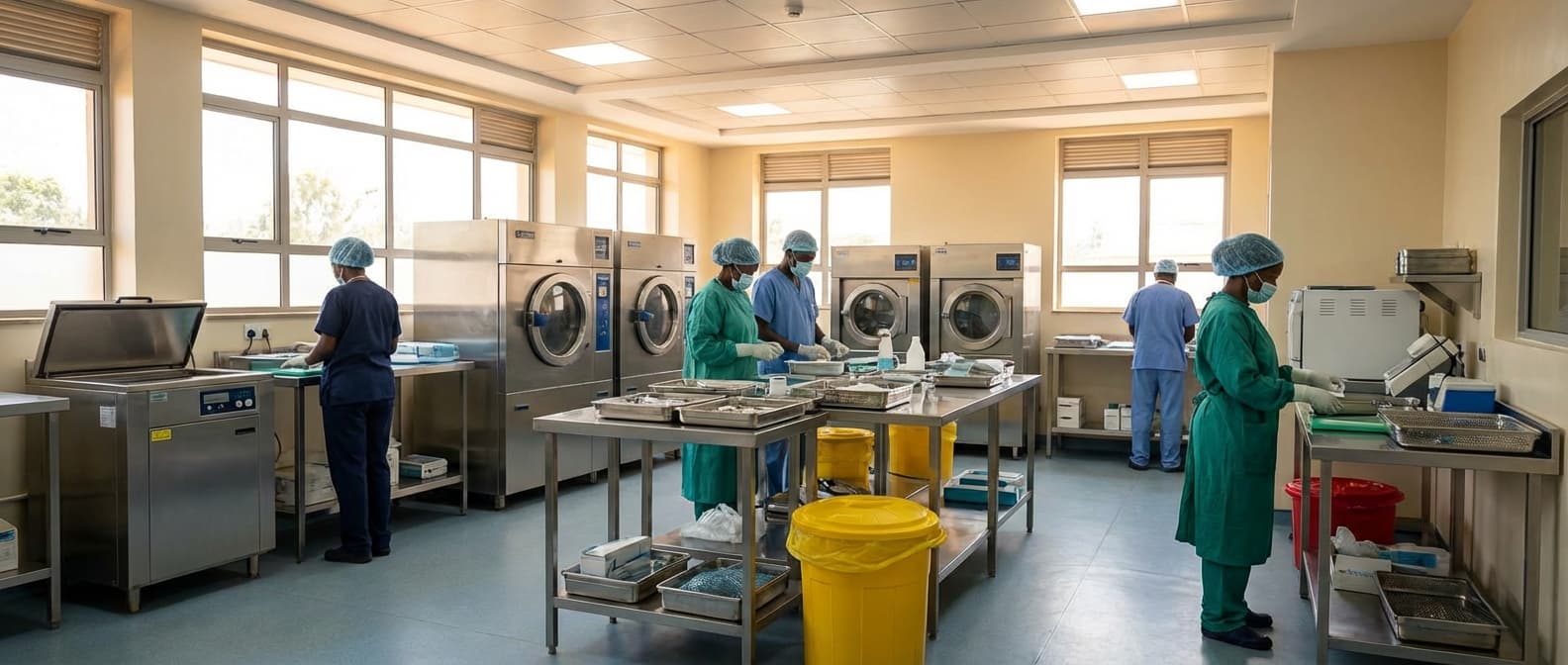
Infection-Control Readiness Support Service for Reusable Equipment in Uganda
Engineering Excellence & Technical Support
Infection-Control Readiness Support Service for Reusable Equipment High-standard technical execution following OEM protocols and local regulatory frameworks.
Advanced Sterilization Validation
Our service utilizes state-of-the-art validation techniques, including biological and chemical indicators, alongside robust process monitoring, to ensure the highest efficacy of sterilization for all reusable medical equipment, guaranteeing patient safety and compliance with international standards in Ugandan healthcare facilities.
On-Site Training & Capacity Building
We provide comprehensive, hands-on training for local healthcare professionals on best practices for cleaning, disinfection, and sterilization of reusable equipment. This empowers Ugandan healthcare teams to independently maintain infection control standards, reducing reliance on external support and enhancing long-term readiness.
Data-Driven Quality Assurance
Our service implements a robust data collection and analysis system to track equipment reprocessing cycles, sterilization success rates, and incident reporting. This allows for proactive identification of trends, performance optimization, and continuous improvement of infection control protocols tailored to the unique challenges faced by Ugandan health facilities.
What Is Infection-control Readiness Support Service For Reusable Equipment In Uganda?
Infection-Control Readiness Support Service for Reusable Equipment in Uganda refers to a specialized consultancy and operational support framework designed to ensure that healthcare facilities effectively manage and mitigate infection risks associated with the reprocessing and reuse of medical devices and instruments. This service addresses the critical need for robust infection prevention and control (IPC) practices, particularly in resource-limited settings where the availability of sterile single-use items may be constrained, necessitating the safe and effective reprocessing of reusable medical equipment. The core objective is to enhance the capacity of healthcare providers to implement and sustain evidence-based protocols for cleaning, disinfection, sterilization, storage, and handling of reusable items, thereby preventing healthcare-associated infections (HAIs) and ensuring patient safety.
| Who Needs the Service? | Typical Use Cases | |||||||
|---|---|---|---|---|---|---|---|---|
| Public and Private Healthcare Facilities: Hospitals (tertiary, secondary, primary), health centers, clinics, and dental practices that utilize reusable medical equipment for patient care. | Central Sterile Supply Departments (CSSDs) or equivalent: Facilities responsible for the centralized reprocessing of surgical instruments, endoscopes, anaesthetic equipment, and other medical devices. | Specific Departments: Operating theatres, emergency departments, intensive care units, maternity wards, and outpatient clinics where immediate reprocessing of reusable items is crucial. | Healthcare Providers Experiencing High HAI Rates: Institutions seeking to investigate and address the root causes of infections linked to inadequate reprocessing. | New Healthcare Facility Start-ups: Organizations requiring the establishment of robust IPC systems from inception. | Healthcare Facilities Undergoing Accreditation or Certification: Institutions preparing for external audits and quality assessments. | Government Health Ministries and Regulatory Bodies: For policy development, guideline dissemination, and national IPC program strengthening. | ||
| Pre-operative Sterilization Assurance: Ensuring surgical instruments are adequately sterilized to prevent surgical site infections (SSIs). | Post-operative Instrument Management: Establishing protocols for the safe collection, transport, and reprocessing of used instruments. | Endoscope Reprocessing: Implementing validated procedures for high-level disinfection or sterilization of flexible and rigid endoscopes to prevent transmission of pathogens (e.g., C. difficile, M. tuberculosis). | Management of Anesthetic Equipment: Ensuring the safe reprocessing of reusable components of ventilators, masks, and tubing. | Dental Instrument Sterilization: Maintaining strict IPC standards for drills, forceps, and other dental instruments. | Laboratory Equipment Decontamination: Providing guidance on the reprocessing of glassware, metal instruments, and other reusable items used in diagnostic laboratories. | Outbreak Investigation Support: Assisting in identifying potential breaches in reprocessing protocols as a contributing factor to an infectious disease outbreak. | Training on New Sterilization Technologies: Educating staff on the safe and effective use of advanced sterilization equipment and methods. | Development of a CSSD Improvement Plan: Creating a roadmap for enhancing efficiency, safety, and compliance within a reprocessing unit. |
Key Components of the Service:
- Assessment and Gap Analysis: Comprehensive evaluation of current IPC practices, infrastructure, equipment, and human resource capacity related to reusable equipment reprocessing.
- Policy and Protocol Development/Enhancement: Formulation, review, and implementation of standardized operating procedures (SOPs) aligned with national and international guidelines (e.g., WHO, CDC) for cleaning, disinfection, sterilization (steam, chemical, etc.), and sterile storage.
- Equipment Assessment and Maintenance Guidance: Evaluation of the functionality and suitability of existing sterilization and disinfection equipment, with recommendations for maintenance, calibration, and potential upgrades.
- Training and Capacity Building: Targeted training programs for healthcare personnel (nurses, technicians, sterilization staff) on aseptic techniques, proper handling of contaminated items, and the principles of reprocessing.
- Supply Chain Management Support: Guidance on the procurement and management of appropriate cleaning agents, disinfectants, sterilants, and indicator systems.
- Quality Assurance and Monitoring: Establishment of systems for routine monitoring of sterilization processes, including biological and chemical indicators, and development of audit tools for assessing compliance.
- Infrastructure Review and Recommendations: Assessment of dedicated reprocessing areas (CSSD - Central Sterile Supply Department or equivalent), ventilation, water quality, and waste management systems.
- Regulatory Compliance Support: Assistance in navigating and adhering to national regulations and standards pertaining to medical device reprocessing and infection control in Uganda.
Who Needs Infection-control Readiness Support Service For Reusable Equipment In Uganda?
Infection-control readiness support for reusable medical equipment in Uganda is crucial for ensuring patient safety and preventing the spread of healthcare-associated infections (HAIs). This service is particularly vital for facilities that rely heavily on reusable items like surgical instruments, endoscopes, and sterilization equipment. The target customers are diverse, encompassing various healthcare facilities and the departments within them that manage and utilize these reusable items. The primary goal is to enhance the capacity of these entities to safely reprocess and manage reusable medical equipment, adhering to national and international standards.
| Customer Type | Key Departments/Units Involved | Specific Needs/Challenges |
|---|---|---|
| Public Hospitals (National Referral, Regional, District) | Sterilization and Central Supply Department (CSD/CSSD), Operating Theatres/Surgical Wards, Outpatient Departments (OPD), Maternity Wards, Laboratories, Dental Units | Limited access to up-to-date reprocessing equipment, inconsistent availability of consumables (disinfectants, detergents), staff training gaps in advanced sterilization techniques, lack of robust quality assurance monitoring for reprocessing, high volume of patients leading to pressure on equipment availability and reprocessing cycles. |
| Private Hospitals and Clinics | Sterilization Room, Operating Rooms, Endoscopy Units, Dental Clinics, Outpatient Clinics | Varying levels of infection control adherence, potential for overlooking specific reprocessing guidelines for specialized equipment (e.g., flexible endoscopes), need for standardized protocols, ensuring staff competency with new technologies, managing diverse equipment types from different manufacturers. |
| NGO Healthcare Facilities (e.g., those serving marginalized communities) | Surgical Units, Primary Healthcare Centers, Reproductive Health Clinics | Resource constraints (funding, infrastructure), geographical remoteness impacting supply chains for consumables and spare parts, limited access to specialized training, need for context-specific solutions, reliance on manual cleaning and disinfection methods. |
| Medical Training Institutions (Universities, Nursing Schools, Clinical Officer Training Institutes) | Simulation Labs, Clinical Skills Training Centers, Departments of Surgery, Nursing, and Midwifery | Ensuring training aligns with current best practices in sterilization and disinfection, providing hands-on experience with safe reprocessing of reusable medical devices for students, maintaining a sterile environment for training purposes, updating curriculum to reflect evolving technologies and guidelines. |
Target Customers and Departments for Reusable Equipment Infection-Control Readiness Support in Uganda
- Public Healthcare Facilities
- Private Healthcare Facilities
- Non-Governmental Organization (NGO) Healthcare Facilities
- Medical Training Institutions with Clinical Attachments
Infection-control Readiness Support Service For Reusable Equipment Process In Uganda
This document outlines the workflow for the Infection-Control Readiness Support Service for Reusable Equipment Processing in Uganda. This service aims to enhance the capacity of healthcare facilities in Uganda to safely reprocess reusable medical equipment, thereby reducing healthcare-associated infections (HAIs). The workflow spans from the initial inquiry to the final execution and follow-up.
| Stage | Key Activities | Deliverables | Responsible Parties |
|---|---|---|---|
| Needs identification, preliminary assessment. | Expression of interest, preliminary assessment report. | Healthcare Facility, Service Provider |
| Proposal creation, negotiation, contract signing. | Service proposal, signed agreement. | Service Provider, Healthcare Facility |
| Site evaluation, SOP review, practice observation. | Baseline assessment report, gap analysis document. | Service Provider, Healthcare Facility Staff |
| Curriculum development, procurement planning. | Training materials, procurement list, implementation plan. | Service Provider |
| Training delivery, technical assistance, SOP revision, equipment supply. | Trained staff, revised SOPs, installed equipment, supplied consumables. | Service Provider, Healthcare Facility Staff |
| On-site visits, data collection, progress reviews. | Monitoring reports, KPI data, meeting minutes. | Service Provider, Healthcare Facility |
| Local champion training, mentorship program setup. | Trained focal persons, mentorship framework, sustainability plan. | Service Provider, Healthcare Facility Management |
| Final evaluation, report writing, handover. | Final report, project closure documentation. | Service Provider, Healthcare Facility |
Workflow Stages and Activities
- {"title":"1. Inquiry and Initial Assessment","substeps":["Facility expresses interest via official request or outreach.","Service provider conducts a preliminary needs assessment (e.g., via questionnaire, brief site visit).","Assessment identifies current practices, challenges, and available resources related to reusable equipment processing.","Determine the scope and specific needs for support (e.g., training, equipment, policy development)."],"description":"Healthcare facilities express interest in the service and undergo an initial assessment."}
- {"title":"2. Proposal Development and Agreement","substeps":["Service provider develops a detailed proposal outlining services, timelines, expected outcomes, and costs.","Proposal is reviewed by the facility and relevant stakeholders.","Negotiation and refinement of the proposal.","Formal agreement (Memorandum of Understanding or Service Contract) is signed.","Formation of a joint implementation team from the facility and the service provider."],"description":"A tailored support plan is developed and formalized."}
- {"title":"3. Baseline Assessment and Gap Analysis","substeps":["In-depth site assessment focusing on all aspects of reusable equipment processing (e.g., infrastructure, equipment, supplies, human resources, waste management, documentation).","Review of existing Standard Operating Procedures (SOPs) and infection control policies.","Observation of actual processing practices.","Identification of specific gaps and deficiencies against national and international standards.","Data collection for baseline performance indicators."],"description":"A comprehensive evaluation of the facility's current state."}
- {"title":"4. Development of Support Interventions","substeps":["Based on the gap analysis, develop tailored training modules, SOPs, and checklists.","Identify and procure necessary equipment, consumables, and infrastructure improvements.","Develop a detailed implementation plan for interventions."],"description":"Designing and preparing the specific interventions."}
- {"title":"5. Implementation of Support Interventions","substeps":["Conduct training sessions for healthcare workers on safe reprocessing practices.","Provide technical assistance for equipment installation, calibration, and maintenance.","Assist in developing or revising SOPs and facility policies.","Supply essential consumables and ensure proper storage.","Support infrastructure modifications if required.","Pilot testing of new procedures or equipment."],"description":"Delivering the planned support to the facility."}
- {"title":"6. Monitoring and Evaluation","substeps":["Regular on-site monitoring visits by the service provider.","Collection of data on key performance indicators (KPIs) (e.g., sterilization success rates, adherence to SOPs, reduction in equipment failure).","Mid-term review meetings with the facility team.","Feedback mechanisms for continuous improvement.","Assessment of user satisfaction and impact."],"description":"Tracking progress and assessing the effectiveness of interventions."}
- {"title":"7. Capacity Building and Sustainability","substeps":["Train local champions or focal persons within the facility to oversee reprocessing.","Establish a system for ongoing supervision and mentorship.","Develop a plan for future equipment maintenance and supply chain management.","Integrate infection control principles into regular facility management and quality improvement cycles.","Knowledge transfer and handover to facility staff."],"description":"Ensuring the facility can maintain improved practices long-term."}
- {"title":"8. Final Reporting and Closure","substeps":["Conduct a final evaluation of the project against agreed-upon objectives.","Prepare a comprehensive final report detailing achievements, challenges, lessons learned, and recommendations.","Conduct a formal handover and closure meeting with the facility.","Archive project documentation and data.","Discuss potential for continued collaboration or follow-up support."],"description":"Concluding the support period and formalizing outcomes."}
Infection-control Readiness Support Service For Reusable Equipment Cost In Uganda
This document outlines the pricing factors and estimated cost ranges for an Infection-Control Readiness Support Service for Reusable Equipment in Uganda. Such a service is crucial for healthcare facilities to ensure the safe and effective reprocessing of reusable medical devices, thereby preventing healthcare-associated infections (HAIs). The cost is influenced by several key variables, impacting the overall investment required by healthcare providers.
| Service Component | Estimated Cost Range (UGX) | Notes |
|---|---|---|
| Basic Training & Policy Development (per facility) | 1,000,000 - 3,000,000 | Covers initial foundational training and guideline formulation. |
| Comprehensive Audit & Monitoring (per visit) | 500,000 - 1,500,000 | Includes on-site assessment, process review, and initial reporting. |
| Ongoing Technical Support & Troubleshooting (monthly retainer) | 300,000 - 1,000,000 | For regular consultation, remote support, and minor issue resolution. |
| Equipment Validation & Calibration Support (per instrument type) | 200,000 - 800,000 | Cost varies significantly based on the complexity and number of instruments. |
| Customized Advanced Training (per session) | 400,000 - 1,200,000 | For specialized equipment or advanced protocols. |
| Digital Reporting Platform Subscription (annual) | 500,000 - 2,000,000 | Access to a platform for data management and trend analysis. |
| Full-Service Package (annual, for a small clinic) | 3,000,000 - 7,000,000 | Includes regular audits, training refreshers, and basic support. |
| Full-Service Package (annual, for a medium-sized hospital) | 7,000,000 - 20,000,000+ | Comprehensive support tailored to a larger facility with more complex needs. |
Key Pricing Factors for Infection-Control Readiness Support Service:
- {"item":"Scope of Services:","details":"The breadth of support offered is a primary cost driver. This can range from basic training and policy development to comprehensive audit, monitoring, and equipment maintenance services. More extensive services naturally command higher prices."}
- {"item":"Number and Type of Reusable Equipment:","details":"The volume and complexity of reusable equipment within a facility directly influence the service cost. Facilities with a larger inventory or specialized, intricate instruments will require more time, expertise, and potentially specific consumables or testing equipment, leading to higher costs."}
- {"item":"Frequency of Support:","details":"The regularity of support visits (e.g., monthly, quarterly, bi-annually) will affect the total cost. More frequent interventions for ongoing monitoring and reinforcement will be more expensive than periodic check-ins."}
- {"item":"Training Needs and Customization:","details":"The level of existing staff knowledge and the need for customized training modules for specific equipment or protocols will impact the cost. Bespoke training programs require more development time and resources."}
- {"item":"Technology and Reporting:","details":"The use of digital platforms for data collection, reporting, and real-time monitoring can add to the cost, but also provides significant benefits in terms of efficiency and transparency. Advanced analytics and dashboard features will increase the price."}
- {"item":"Geographic Location and Accessibility:","details":"While Uganda has a relatively uniform currency, travel costs to more remote or difficult-to-access health facilities can increase overhead for service providers, potentially reflecting in higher prices."}
- {"item":"Provider Expertise and Reputation:","details":"Highly experienced and reputable infection control consultants or service providers may charge a premium for their specialized knowledge and proven track record."}
- {"item":"Materials and Consumables:","details":"If the service includes the provision of specific disinfectants, testing strips, or maintenance supplies, these costs will be factored into the overall pricing."}
Affordable Infection-control Readiness Support Service For Reusable Equipment Options
Our Affordable Infection-Control Readiness Support Service is designed to empower healthcare facilities and other organizations that utilize reusable equipment to maintain rigorous infection control standards without prohibitive costs. We understand the critical importance of preventing healthcare-associated infections (HAIs) and the challenges associated with procuring, maintaining, and validating infection prevention processes for reusable items. Our service offers a tiered approach with flexible value bundles and strategic cost-saving measures.
| Cost-Saving Strategy | Description | Benefit |
|---|---|---|
| Preventative Maintenance Focus | Our service emphasizes proactive measures, including regular assessments and training, to prevent equipment failures and reprocessing errors that can lead to costly rework or patient harm. | Reduced downtime of critical equipment, minimized reprocessing errors, and lower risk of HAIs, ultimately saving on remediation costs and potential litigation. |
| Standardized Protocols | We help develop and implement standardized, evidence-based decontamination and sterilization protocols, ensuring consistency and efficiency across your organization. | Streamlined workflows, reduced training time for new staff, and consistent results, leading to improved productivity and fewer deviations from best practices. |
| Resource Optimization | By providing expert guidance and tools, we help you optimize the use of your existing cleaning and sterilization equipment, and make informed decisions about future investments. | Extended equipment lifespan, reduced need for premature replacement, and informed purchasing decisions, leading to significant capital and operational savings. |
| Remote Monitoring & Support | Leveraging technology for remote assessments and monitoring reduces the need for frequent on-site visits, saving on travel and associated expenses. | Lower service delivery costs, faster issue identification, and quicker resolution of minor problems, resulting in direct cost savings. |
| Scalable Pricing | Our tiered value bundles allow you to select the level of support that aligns with your budget and specific needs, avoiding overspending on unnecessary services. | Flexibility to manage costs effectively, ensuring you pay only for the services you require, making advanced infection control accessible to a wider range of organizations. |
Value Bundles to Suit Your Needs
- {"title":"Essential Readiness Bundle","details":["Basic equipment decontamination protocol development and training","Periodic assessment of cleaning and disinfection processes (remote)","Access to a curated library of infection control best practices and regulatory updates"],"description":"Our foundational offering, perfect for smaller facilities or those prioritizing core infection control needs. Includes."}
- {"title":"Enhanced Preparedness Bundle","details":["On-site training for staff on advanced decontamination techniques","Remote monitoring and auditing of cleaning equipment functionality","Support for development of sterilization validation documentation","Access to a dedicated infection control specialist for limited consultations"],"description":"A comprehensive solution for organizations requiring more in-depth support. Builds upon the Essential Bundle by adding."}
- {"title":"Premier Compliance Bundle","details":["Full-scale on-site infection control assessments and gap analysis","Development of custom decontamination and sterilization workflows","Assistance with regulatory audit preparation and response","Proactive risk identification and mitigation strategies","Unlimited access to a dedicated infection control expert for strategic guidance"],"description":"Our most robust package, designed for facilities with complex reusable equipment needs or facing stringent regulatory scrutiny. Includes all features of the Enhanced Bundle plus."}
Verified Providers In Uganda
In the quest for reliable healthcare in Uganda, identifying 'Verified Providers' is paramount. These are healthcare professionals and institutions that have undergone rigorous checks to ensure they meet specific standards of quality, safety, and ethical practice. Franance Health stands out as a leading example of a verified provider, offering a compelling combination of comprehensive services, patient-centric care, and a commitment to excellence. This guide explores what makes a provider 'verified' in Uganda and highlights why Franance Health's credentials position them as the best choice for your healthcare needs.
| Franance Health Credential | Significance for Patients | Why it Represents the Best Choice |
|---|---|---|
| Licensed & Accredited Facility | Ensures compliance with national health standards and a safe environment. | Provides peace of mind knowing you are receiving care in a regulated and approved setting. |
| Experienced & Certified Medical Staff | Access to skilled doctors, nurses, and specialists with proven expertise. | Guarantees competent diagnosis, effective treatment, and personalized care from qualified professionals. |
| Comprehensive Service Offering | A wide range of medical services, from primary care to specialized treatments. | Offers convenience and continuity of care, often eliminating the need to seek services from multiple providers. |
| Patient-Centric Approach & Feedback Mechanisms | Prioritizes patient comfort, communication, and actively seeks feedback for improvement. | Fosters trust and ensures your healthcare experience is focused on your needs and well-being. |
| Commitment to Affordable & Transparent Pricing | Clear and honest billing practices with competitive pricing. | Allows for informed financial decisions and removes the stress of hidden costs. |
| Investment in Modern Technology & Equipment | Utilizes up-to-date medical technology for accurate diagnostics and effective treatments. | Enhances the accuracy of diagnoses, improves treatment outcomes, and offers access to advanced medical solutions. |
What Makes a Healthcare Provider 'Verified' in Uganda?
- Regulatory Compliance: Adherence to national health regulations and licensing requirements set by the Uganda Ministry of Health and relevant professional bodies.
- Quality Assurance Standards: Implementation of internal quality control measures, patient safety protocols, and continuous improvement initiatives.
- Professional Accreditation: Holding accreditations from recognized national or international healthcare organizations that signify a commitment to high standards.
- Patient Feedback and Reviews: A track record of positive patient experiences and a transparent approach to addressing feedback.
- Ethical Practice: Demonstrated commitment to ethical medical practices, patient confidentiality, and fair pricing.
- Qualified Personnel: Employing licensed and experienced medical professionals with ongoing professional development.
Scope Of Work For Infection-control Readiness Support Service For Reusable Equipment
This Scope of Work (SOW) outlines the services to be provided for Infection Control Readiness Support related to reusable medical equipment. The objective is to ensure that healthcare facilities have robust processes, documentation, and staff training in place to effectively manage the cleaning, disinfection, and sterilization of reusable equipment, thereby minimizing the risk of healthcare-associated infections (HAIs).
| Technical Deliverable | Description | Standard Specifications / Content Requirements |
|---|---|---|
| Current State Assessment Report | A comprehensive report detailing the existing processes, equipment, and staff knowledge regarding reusable equipment reprocessing. Includes identification of gaps and areas for improvement. | Analysis of workflow mapping, equipment inventory and condition, staff competency levels, existing documentation (SOPs, logs), and adherence to manufacturer's instructions for use (IFUs) and relevant guidelines (e.g., CDC, AAMI, local regulations). |
| Revised/New Standard Operating Procedures (SOPs) | Detailed, evidence-based SOPs for the entire reprocessing cycle of critical, semi-critical, and non-critical reusable equipment. | Each SOP should include: Equipment identification, detailed step-by-step instructions for manual cleaning, automated cleaning, disinfection (high-level, intermediate, low-level), sterilization (steam, chemical, etc.), drying, storage, and transport. Specifications for required materials, cleaning agents, disinfectants, and sterilization parameters. Inclusion of IFU cross-references. Clear responsibility assignments. |
| Equipment and Supplies Recommendations Report | A report recommending appropriate reprocessing equipment, cleaning agents, disinfectants, and sterilization methods based on identified needs and regulatory requirements. | Includes rationale for recommendations, compatibility checks with equipment, efficacy data, safety considerations, cost-benefit analysis, and compliance with relevant standards (e.g., EPA registration for disinfectants, FDA clearance for medical devices). |
| Training Materials and Competency Assessment Tools | Development of educational materials and assessment tools for staff involved in reusable equipment reprocessing. | Includes presentations, handouts, practical demonstration guides, quizzes, and observed practice checklists. Content covers principles of infection control, specific reprocessing techniques, use of equipment and chemicals, and documentation requirements. Competency assessment should verify understanding and practical application of SOPs. |
| Monitoring and Audit Program Framework | A framework for ongoing monitoring and auditing of reusable equipment reprocessing processes to ensure consistent quality and compliance. | Includes checklists for process observation, record review templates (e.g., sterilization cycle logs, cleaning validation logs), frequency of audits, reporting mechanisms for findings, and corrective action planning procedures. Specifications for tracking compliance rates and identifying trends. |
| Regulatory Compliance Checklist/Gap Analysis | A document outlining requirements from relevant regulatory bodies and accreditation organizations concerning reusable equipment reprocessing, with a gap analysis against current practices. | Covers requirements from: CMS, Joint Commission, OSHA, EPA, FDA, and state/local health departments. Includes a matrix for mapping existing policies and procedures to regulatory mandates and identifying any deficiencies. |
Key Service Components
- Assessment of current reusable equipment reprocessing workflows and practices.
- Development and/or enhancement of Standard Operating Procedures (SOPs) for cleaning, disinfection, and sterilization.
- Review and recommendations for appropriate equipment, disinfectants, and sterilization agents.
- Staff training and competency assessment on reprocessing procedures.
- Development of monitoring and auditing tools for process validation and compliance.
- Guidance on regulatory compliance and accreditation readiness related to reusable equipment reprocessing.
Service Level Agreement For Infection-control Readiness Support Service For Reusable Equipment
This Service Level Agreement (SLA) outlines the response times and uptime guarantees for the Infection-Control Readiness Support Service for Reusable Equipment. This service ensures that critical reusable equipment is maintained in a state of readiness, minimizing downtime and ensuring compliance with infection control protocols.
| Service Component | Response Time Target | Uptime Guarantee | Criticality Level |
|---|---|---|---|
| Emergency Support (Critical Equipment Failure) | Within 1 hour of notification | 99.9% uptime for critical equipment | High |
| Urgent Support (Equipment Anomaly Affecting Readiness) | Within 4 business hours of notification | 99.5% uptime for semi-critical equipment | Medium |
| Routine Support (Preventative Maintenance, Calibration) | Scheduled within agreed timeframe (e.g., within 1 week of due date) | N/A (focus on preventative measures) | Low |
| General Inquiries & Technical Assistance | Within 1 business day of notification | N/A | Low |
Key Service Components
- Proactive monitoring of equipment status and maintenance schedules.
- Rapid response to equipment failures or anomalies impacting infection control readiness.
- Timely execution of scheduled maintenance and calibration.
- Availability of trained technical personnel for immediate support.
Frequently Asked Questions

Ready when you are
Let's scope your Infection-Control Readiness Support Service for Reusable Equipment in Uganda project in Uganda.

Scaling healthcare logistics and technical systems across the entire continent.