
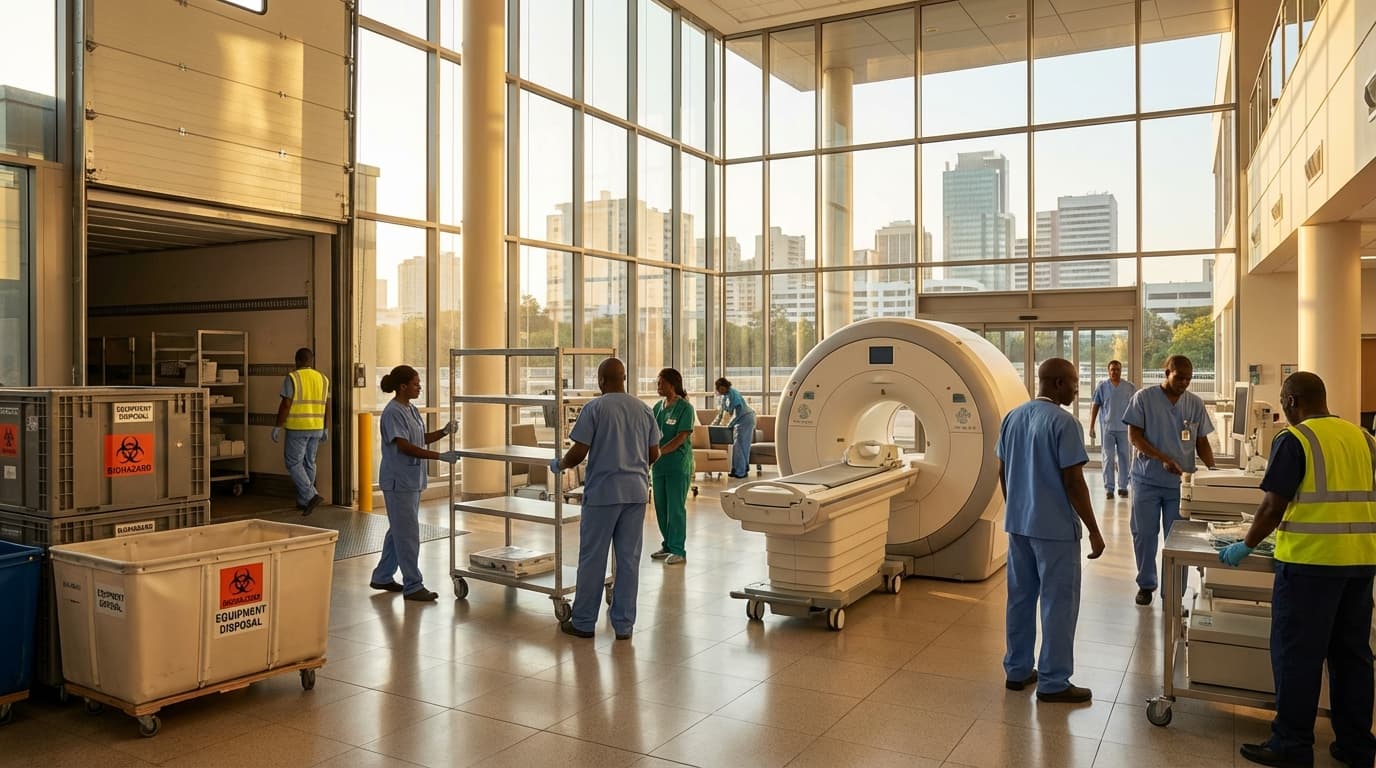
Medical Equipment Relocation Service (Move & Re-Install) in Uganda
Engineering Excellence & Technical Support
Medical Equipment Relocation Service (Move & Re-Install) High-standard technical execution following OEM protocols and local regulatory frameworks.
Specialized Medical Equipment Transport
We employ climate-controlled, shock-absorbent vehicles and utilize custom-built crating and bracing solutions to ensure the safe, secure transit of your sensitive medical machinery across Uganda, from delicate diagnostic tools to large-scale surgical units.
Certified Re-Installation & Calibration
Our team comprises manufacturer-certified technicians who meticulously re-install and calibrate your medical equipment to original specifications, guaranteeing optimal performance, accuracy, and compliance with all regulatory standards.
Comprehensive Risk Mitigation & Insurance
We conduct thorough site surveys, implement stringent safety protocols, and provide comprehensive insurance coverage throughout the relocation process, minimizing risks and ensuring your valuable medical assets are protected from damage or loss.
What Is Medical Equipment Relocation Service (Move & Re-install) In Uganda?
Medical Equipment Relocation Service (Move & Re-Install) in Uganda refers to a specialized, end-to-end logistical and technical process for the safe and operational transfer of medical devices and systems within or between healthcare facilities in Uganda. This service encompasses the entire lifecycle of relocation, from meticulous planning and de-installation to secure transportation and precise re-installation, followed by comprehensive testing and calibration to ensure full functionality and adherence to regulatory standards.
| Who Needs Medical Equipment Relocation Services? | Typical Use Cases | ||||
|---|---|---|---|---|---|
| Hospitals (Public and Private) | Renovation or expansion of departments (e.g., moving an MRI suite, expanding an ICU). | Consolidation of services or facilities. | Upgrading or replacing existing infrastructure. | Establishing new healthcare centers or clinics. | Relocation of specialized diagnostic or therapeutic equipment (e.g., CT scanners, linear accelerators, surgical robots). |
| Diagnostic Imaging Centers | Moving imaging equipment during facility upgrades or lease changes. | Transferring equipment to a new branch location. | |||
| Laboratories (Clinical and Research) | Relocating sensitive analytical instruments and biosafety cabinets during lab expansions or moves. | Transferring equipment between research facilities. | |||
| Medical Training Institutions | Moving simulation equipment or anatomical models for new curriculum development or facility redesign. | ||||
| Government Health Agencies | Transferring equipment between regional health facilities for resource optimization or upgrades. | ||||
| Non-Governmental Organizations (NGOs) and Humanitarian Organizations | Establishing or relocating medical infrastructure in remote or disaster-affected areas. |
Key Components of Medical Equipment Relocation Services:
- Site Assessment and Planning: Detailed evaluation of both origin and destination sites to identify logistical challenges, infrastructure requirements (power, HVAC, data connectivity), and any necessary modifications. Development of a comprehensive relocation plan, including timelines, resource allocation, and risk mitigation strategies.
- Specialized De-installation: Professional disconnection, dismantling (if applicable), and labeling of medical equipment by trained technicians. This involves careful handling of sensitive components, power cords, data cables, and any integrated systems to prevent damage.
- Secure Packaging and Transportation: Utilization of custom-designed crating, shock-absorbent materials, and climate-controlled vehicles to protect equipment from environmental factors, vibration, and physical impact during transit. Adherence to strict handling protocols and chains of custody.
- Re-installation and Integration: Precise reassembly and re-connection of equipment at the new location, ensuring all components are correctly positioned and integrated with existing facility infrastructure. This often requires specialized tools and expertise for complex systems.
- Testing, Calibration, and Validation: Rigorous functional testing of all relocated equipment to verify performance against manufacturer specifications. Calibration of sensitive instruments and validation of imaging systems or laboratory analyzers to ensure accuracy and reliability. Performance qualification (PQ) may be conducted.
- Technical Documentation and Training: Provision of updated equipment manuals, service records, and commissioning reports. If necessary, on-site training for facility staff on the operation and basic maintenance of the re-installed equipment.
- Regulatory Compliance: Ensuring all relocation activities comply with relevant Ugandan healthcare regulations, safety standards, and licensing requirements for medical devices.
Who Needs Medical Equipment Relocation Service (Move & Re-install) In Uganda?
Healthcare facilities in Uganda, from bustling city hospitals to remote rural clinics, often face the challenge of relocating essential medical equipment. This can be due to renovations, expansions, acquisitions, or even temporary closures. Moving sophisticated medical machinery requires specialized knowledge, careful handling, and precise re-installation to ensure its functionality and patient safety. This is where a dedicated Medical Equipment Relocation Service (Move & Re-Install) becomes invaluable.
| Target Customer | Typical Departments Involved | Reasons for Relocation |
|---|---|---|
| Large Hospitals (e.g., Mulago National Referral Hospital, private city hospitals) | Radiology, Cardiology, Oncology, Surgery, ICU, Central Sterilization, Laboratories, Pharmacy, IT Department, Estates/Facilities Management | Renovations, technology upgrades, departmental re-organization, new wings/buildings, equipment procurement/decommissioning. |
| Medium-sized Hospitals and Clinics | Outpatient, Inpatient, Laboratory, Pharmacy, Minor Surgery, Administration | Expansion of services, relocation to new premises, replacement of older facilities, equipment upgrades. |
| Rural Health Centers and District Hospitals | Maternal & Child Health, General Outpatient, Pharmacy, Basic Laboratory | Government initiatives for infrastructure improvement, consolidation of services, replacement of damaged equipment, transition to new management. |
| Diagnostic Laboratories (e.g., private pathology labs, university labs) | Hematology, Biochemistry, Microbiology, Histopathology, Molecular Diagnostics | Upgrading to larger or more sophisticated equipment, relocation to larger lab space, merging of facilities, installation of new automated systems. |
| Specialty Medical Centers (e.g., Imaging centers, Dialysis units) | Radiology (MRI, CT scanners), Cardiology (echo machines), Nephrology (dialysis machines) | Acquisition of new, larger equipment, relocation to more accessible or specialized facilities, expansion of patient capacity. |
| Medical Training Institutions (Universities, Training Colleges) | Anatomy, Physiology, Pathology, Simulation Labs, Clinical Skills Labs | Setting up new training facilities, upgrading simulation equipment, relocation of departments, installation of new teaching aids. |
| Government Health Ministries/Agencies | Procurement, Planning, Infrastructure Development, Regional Offices | Centralized equipment relocation for national health programs, movement of equipment to new government health facilities, asset management. |
Who Needs Medical Equipment Relocation Service (Move & Re-Install) in Uganda?
- Hospitals (Public and Private)
- Clinics and Health Centers
- Diagnostic Laboratories
- Specialty Medical Centers (e.g., imaging centers, dialysis units)
- Research Institutions with medical equipment
- Medical Training Institutions
- Government Health Ministries and Agencies
- Non-Governmental Organizations (NGOs) operating healthcare facilities
- Manufacturers and Suppliers of medical equipment needing to move inventory or demo units.
- Companies undertaking large-scale healthcare project developments.
Medical Equipment Relocation Service (Move & Re-install) Process In Uganda
This document outlines the comprehensive workflow for a Medical Equipment Relocation Service (Move & Re-Install) in Uganda, covering the entire process from initial inquiry to successful execution.
| Step | Description | Key Activities | Responsible Party | Deliverables/Outcomes |
|---|---|---|---|---|
| Client contacts the relocation service provider with a need to move medical equipment. | Receive inquiry, gather basic information (equipment type, quantity, locations). | Client, Relocation Service Provider | Acknowledgement of inquiry, initial understanding of client needs. |
| Discuss client requirements in detail and gather preliminary information. | Understand equipment types, models, sizes, weights, specific handling needs, origin and destination addresses, desired timeline. | Relocation Service Provider, Client | List of equipment, preliminary timeline, understanding of scope. |
| On-site assessment of both locations to identify logistical challenges and requirements. | Evaluate access points, doorways, stairwells, elevator availability, parking, power sources, environmental conditions (temperature, humidity). Assess potential risks and required safety measures. | Relocation Service Provider (Survey Team) | Detailed site survey report, identification of potential risks and challenges, confirmation of feasibility. |
| Analyze identified risks and develop mitigation strategies. | Identify potential damage, safety hazards, regulatory compliance issues. Plan for specialized handling, protective packaging, and transportation methods. | Relocation Service Provider (Logistics & Safety Team) | Risk assessment report, detailed move plan, safety protocols. |
| Develop a comprehensive quotation and service proposal. | Outline scope of work, equipment to be moved, detailed process, timelines, insurance coverage, pricing, terms and conditions. | Relocation Service Provider | Formal quotation and service proposal. |
| Client reviews and approves the proposal, leading to a formal agreement. | Client approval, contract negotiation (if necessary), signing of the service agreement. | Client, Relocation Service Provider | Signed service agreement, confirmation of booking. |
| Finalize the move date and time, coordinating with all stakeholders. | Confirm move date with client, schedule specialized teams (technicians, movers), inform relevant departments at both locations. | Relocation Service Provider | Confirmed move schedule, coordination plan. |
| Prepare equipment for safe dismantling and packaging. | Disconnecting utilities, safe dismantling (if required), cleaning, applying protective coverings, securing moving parts. | Relocation Service Provider (Technicians & Movers) | Equipment prepared for transport, documented pre-move condition. |
| Securely package and load equipment onto transport vehicles. | Use of specialized packaging materials, secure loading onto appropriately equipped vehicles, adherence to weight and balance regulations. | Relocation Service Provider (Movers & Packers) | Equipment safely packaged and loaded, loading manifest. |
| Safely transport equipment from origin to destination. | Adherence to predetermined route, secure transport with trained drivers, real-time tracking (if applicable). | Relocation Service Provider (Transportation Team) | Equipment transported safely and on schedule. |
| Unload and carefully place equipment at the designated location. | Careful unloading, precise placement in accordance with client's floor plan. | Relocation Service Provider (Movers) | Equipment safely unloaded and placed. |
| Reassemble and connect equipment at the new location. | Expert re-installation of dismantled components, connection to utilities (power, water, data), adherence to manufacturer specifications. | Relocation Service Provider (Technicians) | Equipment re-installed and connected. |
| Calibrate and perform thorough testing to ensure functionality. | Perform calibration procedures, conduct functional tests, verify all parameters and performance metrics against manufacturer standards. | Relocation Service Provider (Certified Technicians) | Equipment calibrated and tested, performance verification report. |
| Client inspects the re-installed equipment and provides formal sign-off. | Client review of re-installed equipment, confirmation of satisfactory performance, signing of completion certificate. | Client, Relocation Service Provider | Client's acceptance of relocated and re-installed equipment. |
| Provide all relevant documentation and formally hand over the equipment. | Submission of testing reports, warranty information, user manuals, and any other agreed-upon documentation. | Relocation Service Provider | Complete documentation package provided to the client. |
| Follow up with the client to ensure ongoing satisfaction and address any post-move concerns. | Address any client inquiries or issues, provide information on maintenance or support services. | Relocation Service Provider | Client satisfaction confirmed, resolution of any outstanding issues. |
Medical Equipment Relocation Service (Move & Re-Install) Process in Uganda
- {"title":"Phase 1: Inquiry & Initial Consultation","description":"The process begins when a client expresses interest in relocating medical equipment."}
- {"title":"Phase 2: Site Survey & Assessment","description":"A crucial step involving on-site evaluation of both the origin and destination."}
- {"title":"Phase 3: Quotation & Proposal Generation","description":"Based on the assessment, a detailed plan and cost estimate are provided."}
- {"title":"Phase 4: Agreement & Scheduling","description":"Formalizing the commitment and setting the timeline."}
- {"title":"Phase 5: Pre-Relocation Preparation","description":"All necessary steps taken before the actual move."}
- {"title":"Phase 6: Relocation Execution","description":"The physical movement of the medical equipment."}
- {"title":"Phase 7: Re-Installation & Calibration","description":"Setting up and ensuring the equipment's functionality at the new location."}
- {"title":"Phase 8: Testing & Handover","description":"Final verification and formal transfer of responsibility."}
- {"title":"Phase 9: Post-Relocation Support","description":"Ongoing assistance after the primary relocation is complete."}
Medical Equipment Relocation Service (Move & Re-install) Cost In Uganda
Relocating medical equipment in Uganda can be a complex undertaking, involving careful planning, specialized handling, and professional re-installation to ensure the continued functionality and safety of sensitive machinery. The cost of such a service is not fixed and varies significantly based on several key factors. This guide aims to provide an overview of these factors and offer estimated cost ranges in Ugandan Shillings (UGX) to help you budget effectively for your medical equipment relocation project.
| Equipment Category (Example) | Estimated Cost Range (UGX) | Notes |
|---|---|---|
| Small Diagnostic/Laboratory Equipment (e.g., microscopes, centrifuges, basic blood analyzers) | 300,000 - 1,500,000 | Includes basic packing, loading, transport (short distance), and unloading. Re-installation might be minimal. |
| Medium-Sized Equipment (e.g., ultrasound machines, digital X-ray units, dental chairs) | 1,000,000 - 5,000,000 | May involve partial dismantling, specialized packing, careful handling, and basic calibration upon re-installation. Distance dependent. |
| Large/Complex Imaging Equipment (e.g., MRI, CT Scanners, high-end surgical robots) | 5,000,000 - 20,000,000+ | Requires specialized rigging, professional dismantling and re-installation, expert technicians, potential for custom crating, and significant travel/logistics. Costs can escalate rapidly with specific requirements. |
| Specialized Surgical/Operating Room Equipment (e.g., advanced operating tables, anesthesia machines, laser systems) | 2,000,000 - 10,000,000+ | Similar to large imaging, emphasizes precision dismantling, secure transport, and expert re-calibration. May involve specialized electrical or gas line connections. |
| General Hospital Furniture & Fixtures (e.g., patient beds, examination couches, trolleys - if part of a larger move) | 100,000 - 500,000 per unit | Typically more straightforward, but costs can increase if they require disassembly/reassembly or are moved in very large quantities. |
Key Pricing Factors for Medical Equipment Relocation in Uganda:
- Type and Size of Equipment: Larger, heavier, and more delicate equipment (e.g., MRI machines, CT scanners, X-ray units, specialized surgical tables) will naturally incur higher costs due to the need for specialized lifting gear, larger transport vehicles, and more skilled personnel. Smaller items like standard examination tables or centrifuges will be less expensive.
- Distance of Relocation: The geographical distance between the old and new location is a primary cost driver. Longer distances translate to higher fuel costs, increased labor hours, and potentially overnight stays for the relocation team.
- Accessibility of Locations: The ease of access to both the pickup and delivery sites plays a crucial role. Locations with narrow doorways, steep stairs, limited parking, or requiring transport through difficult terrain will increase the complexity and cost of the move.
- Dismantling and Re-installation Complexity: Some medical equipment requires expert dismantling before transport and precise re-installation and calibration at the new site. The more intricate the process, the higher the labor and technical expertise required, leading to increased costs.
- Specialized Handling and Packing Requirements: Medical equipment often has specific packing needs to protect against damage from vibration, temperature changes, or impact. Use of specialized crates, custom padding, and climate-controlled transport will add to the overall expense.
- Insurance Coverage: While not always a direct service charge, securing adequate insurance for high-value medical equipment during transit is highly recommended and will add to the overall project cost.
- Urgency of the Move: Rush services or moves requiring weekend or after-hours work typically come with a premium charge.
- Additional Services: This can include services like disposal of old equipment, storage during the transition, or minor repairs/servicing after re-installation.
- Service Provider's Reputation and Expertise: Established companies with a proven track record in handling medical equipment, possessing the necessary certifications, and employing highly trained technicians generally command higher prices due to their reliability and quality of service.
Affordable Medical Equipment Relocation Service (Move & Re-install) Options
Relocating medical equipment requires specialized handling and expertise to ensure safety, functionality, and compliance. Our affordable Medical Equipment Relocation Service offers comprehensive move and re-installation solutions designed to minimize disruption and maximize value. We understand the unique challenges associated with transporting sensitive and high-value medical assets. We provide tailored services that can include disassembly, secure packing, transportation, re-assembly, calibration checks, and functional testing at your new location.
| Service Component | Standard Bundle | Premium Bundle | Specialty Bundle |
|---|---|---|---|
| Disassembly & Packing | ✓ | ✓ | ✓ (Specialized) |
| Secure Transportation | ✓ | ✓ | ✓ (Climate Controlled if needed) |
| Re-assembly | ✓ | ✓ | ✓ (Manufacturer Protocols) |
| Basic Functional Verification | ✓ | ✓ | ✓ |
| Pre-Move Site Assessment | — | ✓ | ✓ |
| Post-Installation Orientation | — | ✓ | ✓ |
| Calibration Checks | — | ✓ | ✓ (As per manufacturer) |
| Dedicated Project Manager | — | ✓ | ✓ |
Value Bundles & Cost-Saving Strategies
- {"title":"Value Bundles Explained","description":"Our value bundles are designed to offer a holistic and cost-effective solution by combining essential services. These bundles are often priced at a discount compared to individual service bookings, providing better overall value and predictability for your relocation budget."}
- {"title":"Standard Move & Re-Install Bundle","description":"Includes professional disassembly, expert packing, secure transportation, re-assembly at the new site, and basic functional verification. Ideal for routine relocations."}
- {"title":"Premium Comprehensive Bundle","description":"Expands on the standard bundle by adding pre-move site assessment, specialized environmental controls during transit (if needed), initial calibration checks, and post-installation user orientation. Best for highly sensitive or complex equipment."}
- {"title":"Specialty Equipment Bundle","description":"Tailored for specific types of medical equipment (e.g., imaging systems, laboratory analyzers). Includes industry-specific handling protocols, specialized tools, and manufacturer-recommended re-installation procedures."}
- {"title":"Cost-Saving Strategies","description":"We employ several strategies to ensure our services remain affordable without compromising quality or safety."}
- {"title":"Off-Peak Scheduling","description":"Scheduling your relocation during less busy periods can often lead to reduced rates. Discuss flexible dates with our team."}
- {"title":"Equipment Grouping","description":"Consolidating multiple equipment moves into a single service call can reduce transportation and labor costs per item."}
- {"title":"Pre-Move Preparation","description":"When clients assist with basic preparation (e.g., clearing pathways, ensuring power is accessible), it can streamline the process and potentially lower labor charges."}
- {"title":"Long-Term Contracts","description":"For healthcare facilities with ongoing relocation needs, we offer discounted rates and priority scheduling through long-term service agreements."}
- {"title":"Insurance Optimization","description":"We can advise on appropriate insurance coverage to protect your assets during transit, ensuring you have adequate protection without overpaying."}
- {"title":"Bundled Service Discounts","description":"As mentioned, our value bundles are inherently cost-saving, offering bundled pricing that is more economical than purchasing services individually."}
Verified Providers In Uganda
In Uganda's evolving healthcare landscape, identifying trusted and qualified medical practitioners is paramount for patient well-being. Franance Health stands out as a leading platform dedicated to connecting individuals with verified healthcare providers. Their rigorous credentialing process ensures that all listed professionals meet high standards of expertise, ethical practice, and regulatory compliance, offering peace of mind to those seeking medical care.
| Provider Type | Key Credentials Verified | Benefits of Choosing a Franance Health Verified Provider |
|---|---|---|
| Doctors (General & Specialists) | Medical Degree (MBChB/MD), Specialist Certifications, Annual Practicing License | Expert diagnosis and treatment, access to specialized care, trusted medical advice |
| Nurses | Nursing Diploma/Degree, Professional Registration Certificate, Competency Assessments | Quality patient care, adherence to safety protocols, medication administration expertise |
| Pharmacists | Pharmacy Degree, Pharmaceutical Society of Uganda Registration, Wholesale/Retail License | Accurate prescription dispensing, drug interaction checks, professional pharmaceutical advice |
| Therapists (Physio, Occupational, etc.) | Relevant Degree/Diploma, Professional Body Registration, Specialized Training | Rehabilitation services, improved mobility and function, personalized therapy plans |
| Dentists | Dental Degree, Uganda Dental Association Membership, Practicing License | Oral health expertise, preventive care, cosmetic dentistry options |
Why Franance Health Providers are the Best Choice:
- Rigorous Verification Process: Franance Health meticulously checks the licenses, certifications, and educational backgrounds of every provider.
- Specialty Matching: The platform facilitates easy searching and filtering based on medical specialties, ensuring you find the right expert for your needs.
- Patient Reviews and Ratings: Transparent feedback from other patients helps in making informed decisions.
- Accessibility and Convenience: Book appointments and access medical information conveniently through their user-friendly interface.
- Commitment to Quality: Franance Health champions a culture of continuous improvement and adherence to best medical practices.
Scope Of Work For Medical Equipment Relocation Service (Move & Re-install)
This Scope of Work (SOW) outlines the requirements for a Medical Equipment Relocation Service (Move & Re-Install) for [Client Name] at [Location(s) of Move]. The service encompasses the safe and professional disconnection, transportation, and re-installation of specified medical equipment. The objective is to ensure minimal disruption to patient care and operational continuity. The service provider will be responsible for all aspects of the relocation, adhering to strict safety protocols and technical standards.
| Category | Description | Standard Specifications / Technical Deliverables | ||||
|---|---|---|---|---|---|---|
| Equipment Assessment & Planning | Initial site survey and detailed inventory of equipment to be moved. | Develop a detailed relocation plan including timelines, resource allocation, and risk assessment. Provide a pre-move equipment checklist and condition report. | Identify specific handling requirements for each equipment type (e.g., temperature sensitivity, vibration control). | |||
| Disconnection | Safe and proper disconnection of all power, data, pneumatic, and other connections. | Use of appropriate tools and techniques to prevent damage to equipment and surrounding infrastructure. | Labeling of all disconnected cables and components for ease of re-installation. | Emptying of fluid reservoirs and sterilization of any contact surfaces as per manufacturer guidelines. | ||
| Packing & Protection | Secure packing and protection of all equipment during transit. | Use of specialized anti-static, shock-absorbent, and climate-controlled packaging materials as required. | Protection of sensitive components and surfaces from physical damage, dust, and moisture. | Securing of all movable parts and accessories. | ||
| Transportation | Safe and timely transport of equipment to the new location. | Use of appropriately equipped vehicles (e.g., climate-controlled, air-ride suspension, secure tie-downs). | Adherence to all traffic regulations and safe driving practices. | Real-time tracking and communication during transit (if specified). | ||
| Re-Installation | Precise re-installation of equipment in the designated new locations. | Connection of all power, data, pneumatic, and other services. | Verification of correct orientation and alignment. | Re-attachment of all components and accessories. | ||
| Testing & Calibration | Functional testing and calibration of all re-installed equipment. | Perform manufacturer-recommended diagnostic tests and performance checks. | Ensure equipment meets all operational specifications and accuracy standards. | Provide test reports and certificates of successful installation and testing. | On-site calibration if required and specified. | |
| Documentation & Handover | Comprehensive documentation of the entire relocation process. | Post-relocation condition report. | Detailed re-installation and testing reports for each equipment item. | As-built diagrams or updated schematics if modifications were made. | Formal handover to the client with a demonstration of functionality. | Inclusion of any new user manuals or operational guides. |
| Safety & Compliance | Adherence to all applicable safety regulations and standards (e.g., OSHA, HIPAA for data security). | Use of Personal Protective Equipment (PPE) by all personnel. | Implementation of risk mitigation strategies to prevent accidents and damage. | Compliance with all manufacturer's installation and maintenance guidelines. | Proper disposal of any packaging materials or waste generated. | |
| Personnel Qualifications | All personnel involved in the relocation must be experienced and trained in medical equipment handling and installation. | Technicians must possess relevant certifications and licenses as required. | Background checks and screening for all personnel may be required. |
Key Objectives
- Safe and secure disconnection of all specified medical equipment.
- Careful and protected transportation of equipment to the new location.
- Professional and accurate re-installation of equipment in the designated areas.
- Testing and verification of equipment functionality post-installation.
- Minimization of downtime for critical medical services.
- Adherence to all relevant safety, regulatory, and manufacturer guidelines.
- Comprehensive documentation of the relocation process.
Service Level Agreement For Medical Equipment Relocation Service (Move & Re-install)
This Service Level Agreement (SLA) outlines the response times and uptime guarantees for the Medical Equipment Relocation Service (Move & Re-Install) provided by [Provider Name] to [Client Name]. This SLA is an integral part of the Master Service Agreement (MSA) between the parties.
| Service Element | Description | Target |
|---|---|---|
| Initial Response Time (Emergency) | Time taken to acknowledge and begin active diagnosis/troubleshooting for an Emergency issue. | Within 1 hour of notification during Business Hours; Within 2 hours outside of Business Hours. |
| Initial Response Time (Non-Emergency) | Time taken to acknowledge and begin active diagnosis/troubleshooting for a Non-Emergency issue. | Within 4 business hours of notification. |
| Resolution Time (Emergency) | Time taken to restore Affected Equipment to full operational status for an Emergency issue. | Within 4 business hours of initial response. |
| Resolution Time (Non-Emergency) | Time taken to restore Affected Equipment to full operational status for a Non-Emergency issue. | Within 1 business day of initial response. |
| Uptime Guarantee (Post Re-Installation) | Guaranteed operational availability of relocated and re-installed equipment. | 99.5% during the first 30 days post re-installation. Specific uptime for critical equipment will be detailed in Appendix A. |
| Proactive Monitoring (Post Re-Installation) | [Provider Name]'s commitment to monitoring equipment performance after re-installation. | Remote monitoring for critical equipment for the first 7 days post re-installation (if equipment is compatible). |
| Notification of Issues | How clients should report issues. | Via designated email address ([support@provider.com]) or phone number ([Phone Number]). |
Definitions
- Affected Equipment: Medical equipment that is being relocated or has been relocated and is experiencing issues impacting its intended operational use.
- Downtime: The period during which Affected Equipment is unavailable for its intended medical purpose due to issues arising directly from the relocation or re-installation process, excluding scheduled maintenance or client-induced issues.
- Emergency: A situation where Affected Equipment failure poses an immediate and critical threat to patient care or safety.
- Non-Emergency: A situation where Affected Equipment failure requires attention but does not pose an immediate threat to patient care or safety.
- Response Time: The maximum time allowed for [Provider Name] to acknowledge and begin working on a reported issue.
- Resolution Time: The maximum time allowed for [Provider Name] to resolve an issue and restore Affected Equipment to its operational state.
- Uptime: The percentage of time that Affected Equipment is available for its intended medical purpose.
- Business Hours: Monday to Friday, 9:00 AM to 5:00 PM, excluding public holidays.
Frequently Asked Questions

Ready when you are
Let's scope your Medical Equipment Relocation Service (Move & Re-Install) in Uganda project in Uganda.

Scaling healthcare logistics and technical systems across the entire continent.