
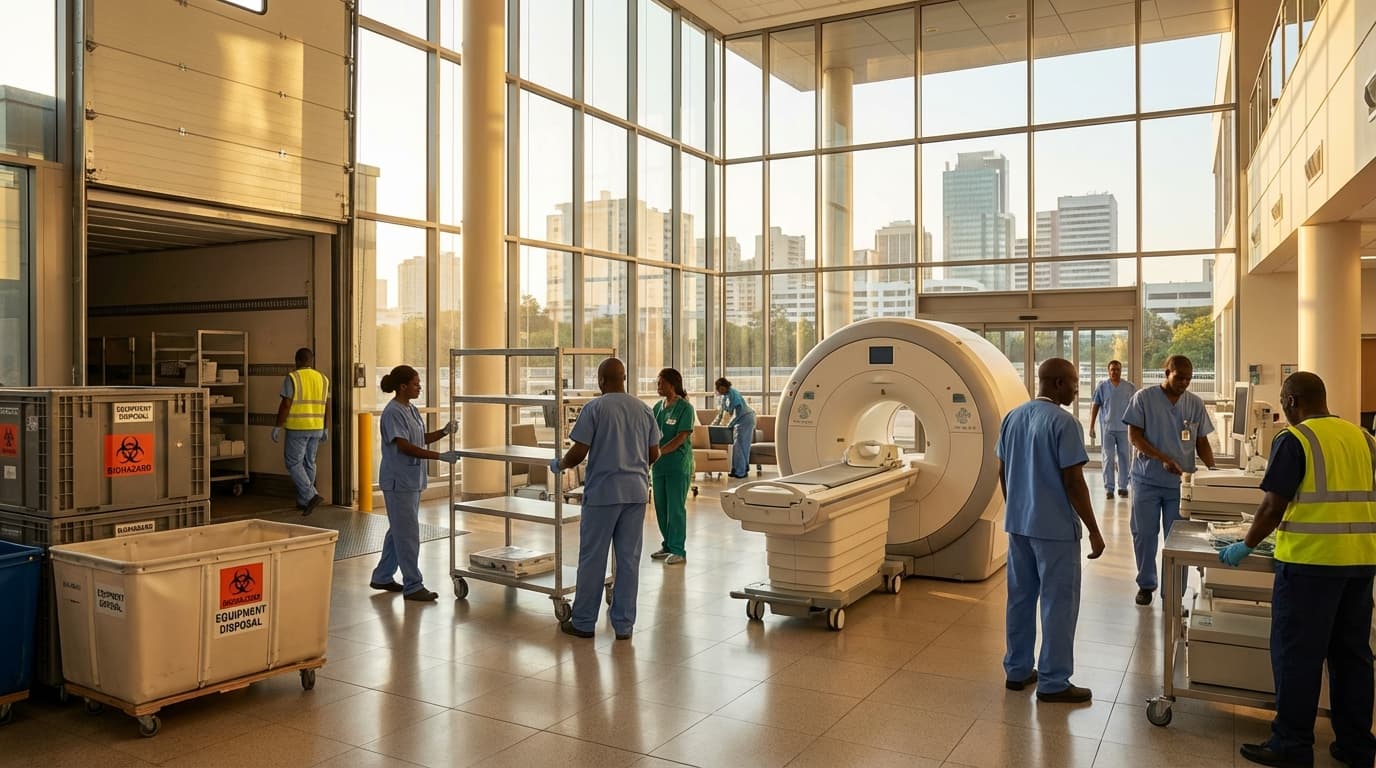
Medical E-Waste Handling & Recycling Coordination Service in Uganda
Engineering Excellence & Technical Support
Medical E-Waste Handling & Recycling Coordination Service High-standard technical execution following OEM protocols and local regulatory frameworks.
Specialized Medical Waste Logistics
Our service ensures the compliant and secure transportation of hazardous medical waste from healthcare facilities across Uganda. We utilize dedicated, temperature-controlled vehicles and trained personnel to prevent environmental contamination and public health risks during transit.
Advanced Segregation & Tracking
We implement rigorous, facility-level segregation protocols for various medical waste streams (infectious, cytotoxic, sharps, etc.). Each batch is meticulously documented and tracked from collection to final disposal, guaranteeing transparency and accountability throughout the recycling and destruction process.
Environmentally Sound Recycling & Disposal
Partnering with certified facilities, we coordinate the safe and environmentally responsible recycling of non-hazardous medical components and the complete destruction of hazardous materials through methods like autoclaving and incineration, minimizing Uganda's environmental footprint.
What Is Medical E-waste Handling & Recycling Coordination Service In Uganda?
Medical e-waste handling and recycling coordination services in Uganda represent a specialized domain focused on the management, collection, transportation, treatment, and environmentally sound disposal/recycling of electronic and electrical waste (e-waste) originating from the healthcare sector. This service is critical for mitigating the environmental and health risks associated with hazardous components found in medical devices, while also seeking to recover valuable materials and ensure compliance with national and international regulations. The coordination aspect implies a structured approach to orchestrating various stakeholders, including healthcare facilities, e-waste collectors, transporters, treatment/recycling facilities, regulatory bodies, and the public, to achieve efficient and safe e-waste lifecycle management.
The core functions of this service encompass::
- Assessment and Auditing: Evaluating the types, quantities, and hazardous potential of medical e-waste generated by healthcare facilities.
- Collection and Segregation Strategies: Developing and implementing protocols for the safe collection and segregation of medical e-waste from general waste streams, ensuring proper labeling and containment.
- Logistics and Transportation Management: Arranging for secure, compliant, and efficient transportation of collected medical e-waste to designated treatment or recycling facilities, adhering to hazardous materials transport regulations.
- Treatment and Disposal Pathways: Facilitating access to or direct provision of licensed and environmentally sound treatment technologies (e.g., shredding, dismantling, material recovery) and disposal methods for non-recyclable or residual hazardous components.
- Recycling and Resource Recovery: Identifying and coordinating with specialized e-waste recyclers capable of extracting valuable materials (e.g., precious metals, plastics) from medical e-waste, promoting a circular economy approach.
- Regulatory Compliance and Reporting: Ensuring all activities adhere to Ugandan environmental laws, health regulations, and international best practices, and providing necessary documentation and reporting to relevant authorities.
- Stakeholder Engagement and Training: Educating healthcare personnel on proper e-waste handling procedures, raising awareness among the public, and fostering collaboration among all involved parties.
- Data Management and Monitoring: Establishing systems for tracking e-waste flows, volumes, and disposal/recycling outcomes for continuous improvement and accountability.
| Use Case Category | Specific Scenario | Service Involvement |
|---|---|---|
| Healthcare Facility Operations | A large public hospital upgrading its imaging equipment, generating obsolete X-ray machines, MRI scanners, and associated electronic components. | Assessment of e-waste volume and hazardous content, development of a collection and segregation plan, coordination of specialized transport to a licensed recycling facility, and ensuring documentation for NEMA compliance. |
| Healthcare Facility Operations | A private clinic disposing of expired diagnostic equipment such as blood analyzers and ECG machines. | Guidance on proper segregation and temporary storage, arranging for scheduled collection by a certified e-waste handler, and confirming environmentally sound disposal. |
| Regulatory Compliance | NEMA requiring all healthcare institutions to demonstrate responsible disposal of medical e-waste. | Developing standardized reporting templates, conducting audits of facility waste management practices, and advising on the selection of compliant service providers. |
| Resource Recovery | Identifying valuable metals (e.g., gold, silver, copper) within discarded medical electronics. | Partnering with specialized recyclers to dismantle and process e-waste, maximizing material recovery rates, and promoting a circular economy for electronics. |
| Public Health & Environmental Protection | Preventing the improper disposal of medical e-waste (e.g., landfilling, informal dismantling) that can leach hazardous substances (lead, mercury, cadmium) into the environment and pose health risks. | Implementing public awareness campaigns, enforcing regulations on hazardous e-waste handling, and coordinating remediation efforts in case of environmental contamination. |
| Supply Chain Management | Medical device distributors receiving returned end-of-life equipment from healthcare providers. | Establishing take-back programs, coordinating logistics for return shipments, and ensuring proper processing of returned devices. |
| Capacity Building | Training healthcare staff on the specific protocols for handling and segregating medical e-waste. | Developing training modules, conducting workshops, and providing ongoing support to ensure consistent adherence to best practices. |
Who Needs Medical E-Waste Handling & Recycling Coordination Service in Uganda?
- Hospitals (Public and Private)
- Clinics and Health Centers
- Diagnostic Laboratories
- Medical Research Institutions
- Pharmaceutical Companies (with R&D facilities)
- Medical Device Manufacturers and Importers (for end-of-life products)
- Government Ministries and Agencies (e.g., Ministry of Health, National Environment Management Authority - NEMA)
- Waste Management Companies (seeking to specialize in medical e-waste)
- International Organizations and NGOs involved in healthcare and environmental protection
- E-waste Recycling and Treatment Facility Operators
Who Needs Medical E-waste Handling & Recycling Coordination Service In Uganda?
This service addresses the critical need for responsible management and recycling of medical e-waste in Uganda. Medical e-waste, encompassing discarded electronic and electrical equipment from healthcare facilities, poses significant environmental and health risks if not handled properly. Proper coordination is essential to ensure safe collection, transportation, treatment, and disposal or recycling, minimizing the release of hazardous substances and maximizing resource recovery.
| Customer Type | Specific Departments/Roles Responsible | Key Needs/Interests |
|---|---|---|
| Hospitals (Public and Private) | Administration, Biomedical Engineering Department, Estates/Facilities Management, Environmental Health & Safety Officer, Procurement Department | Safe disposal of obsolete medical equipment (e.g., X-ray machines, lab analysers, monitors), compliance with regulations, cost-effective solutions, data security for disposed devices, environmental responsibility. |
| Clinics and Health Centers | Clinic Management, Administration, Procurement | Small-scale disposal of essential medical electronics (e.g., BP monitors, thermometers, basic diagnostic equipment), affordability, accessibility of services, awareness of proper handling procedures. |
| Laboratories (Medical and Research) | Lab Management, Research Coordinators, Safety Officers, Procurement | Disposal of specialized laboratory equipment (e.g., centrifuges, microscopes, PCR machines, analytical instruments), handling of potentially hazardous residues, data sanitization, compliance with research protocols. |
| Pharmaceutical Companies | Quality Control/Assurance, Manufacturing, Environmental Health & Safety | Disposal of quality control testing equipment, manufacturing process electronics, compliance with Good Manufacturing Practices (GMP), environmental impact reduction. |
| Medical Equipment Manufacturers and Suppliers | Product Support, After-Sales Service, Logistics, Corporate Social Responsibility | End-of-life management for their products, take-back programs, compliance with Extended Producer Responsibility (EPR) principles, sustainable product design, brand reputation. |
| Government Ministries and Agencies | Ministry of Health (e.g., Directorate of Clinical Services, Public Health Emergency Preparedness), National Environment Management Authority (NEMA), Ministry of Science, Technology and Innovation | Policy development and enforcement, regulatory oversight, national e-waste strategies, public health protection, environmental conservation, establishing national recycling infrastructure, awareness campaigns. |
| Non-Governmental Organizations (NGOs) involved in healthcare | Program Management, Logistics, Operations, Finance | Sustainable management of e-waste generated from donated or implemented healthcare projects, cost-effective disposal for resource-limited settings, alignment with project sustainability goals. |
| Waste Management Companies (specializing in hazardous waste) | Operations, Business Development, Compliance Officers | Partnerships for specialized treatment and transportation, expertise in handling hazardous components, opportunities for service expansion, regulatory compliance. |
| Recycling Facilities (with e-waste capabilities) | Operations, Business Development, Material Recovery | Securing a consistent supply of medical e-waste, access to specialized handling equipment, market for recovered materials, compliance with environmental standards. |
| Research and Academic Institutions | Department Heads, Research Project Leaders, Procurement, Facilities Management | Disposal of research equipment, handling of specialized electronic waste, compliance with institutional safety policies, contribution to circular economy initiatives. |
Target Customers and Departments for Medical E-Waste Handling & Recycling Coordination Service in Uganda
- Hospitals (Public and Private)
- Clinics and Health Centers
- Laboratories (Medical and Research)
- Pharmaceutical Companies
- Medical Equipment Manufacturers and Suppliers
- Government Ministries and Agencies
- Non-Governmental Organizations (NGOs) involved in healthcare
- Waste Management Companies (specializing in hazardous waste)
- Recycling Facilities (with e-waste capabilities)
- Research and Academic Institutions
Medical E-waste Handling & Recycling Coordination Service Process In Uganda
This document outlines the workflow for the Medical E-Waste Handling & Recycling Coordination Service Process in Uganda, detailing the steps from initial inquiry to successful execution. The service aims to ensure the safe and environmentally responsible management of obsolete and end-of-life medical electronic waste generated by healthcare facilities and related organizations in Uganda.
| Phase | Step | Description | Key Activities | Responsible Parties | Deliverables |
|---|---|---|---|---|---|
| 1.1 Receiving Inquiry | Initial contact from a healthcare facility or organization seeking medical e-waste management services. | Phone call, email, website form submission. | Potential Client, Service Provider (Coordination Team) | Acknowledgement of inquiry. |
| 1.2 Preliminary Discussion | Understanding the client's needs, type and estimated volume of medical e-waste, and location. | Answering questions, gathering basic information. | Service Provider (Coordination Team), Potential Client | Basic understanding of client's requirements. | |
| 2.1 Site Visit Scheduling | Arranging a visit to the client's premises to physically assess the waste and its storage. | Agreeing on date and time, confirming access. | Service Provider (Coordination Team), Potential Client | Scheduled site visit. |
| 2.2 On-site Assessment | Detailed examination of the medical e-waste (type, quantity, condition, potential hazards). | Visual inspection, inventory, photographing waste, identifying hazardous components (if any). | Service Provider (Coordination Team - Waste Management Specialist) | Waste inventory, preliminary hazard assessment. | |
| 2.3 Waste Characterization Report | Documenting the types, quantities, and potential hazards of the identified medical e-waste. | Categorizing waste (e.g., CRT monitors, medical imaging equipment, laboratory devices, batteries). | Service Provider (Coordination Team - Waste Management Specialist) | Detailed Waste Characterization Report. | |
| 3.1 Proposal Formulation | Developing a customized proposal based on the assessment, outlining services, timelines, and costs. | Costing for collection, transportation, recycling, disposal, reporting; outlining service scope. | Service Provider (Coordination Team) | Draft service proposal. |
| 3.2 Proposal Presentation & Negotiation | Presenting the proposal to the client and discussing any modifications or concerns. | Clarifying services, addressing queries, negotiating terms. | Service Provider (Coordination Team), Potential Client | Agreed-upon proposal. | |
| 3.3 Contract/Agreement Signing | Formalizing the service agreement with clearly defined terms, responsibilities, and pricing. | Signing of service contract, Memorandum of Understanding (MOU). | Service Provider (Coordination Team), Client | Signed Service Agreement. | |
| 4.1 Collection Scheduling | Arranging a specific date and time for waste collection based on the agreement. | Confirming logistics, notifying client of collection date. | Service Provider (Coordination Team), Logistics Partner | Collection schedule confirmed. |
| 4.2 Secure Collection | Safe and compliant collection of medical e-waste from the client's premises. | Trained personnel, appropriate handling equipment, secure packaging (if necessary), adherence to safety protocols. | Service Provider (Coordination Team), Trained Collection Crew | E-waste collected from client site. | |
| 4.3 Transportation | Transporting the collected e-waste to a designated sorting facility or recycling partner. | Use of licensed and appropriate transport vehicles, compliance with transport regulations (e.g., for potentially hazardous materials). | Service Provider (Coordination Team), Licensed Transporter | E-waste transported to facility. | |
| 5.1 Receiving & Inventory | Receiving the transported e-waste at the sorting facility and re-confirming the inventory. | Unloading, initial inspection, verification against manifest. | Service Provider (Coordination Team), Sorting Facility Staff | Received e-waste, updated inventory. |
| 5.2 Sorting & Segregation | Separating different types of medical e-waste for appropriate processing. | Manual and/or mechanical sorting to separate components (metals, plastics, PCBs, batteries, glass). | Sorting Facility Staff | Segregated e-waste streams. | |
| 6.1 Material Recovery & Recycling | Processing segregated waste streams to recover valuable materials (metals, plastics). | Shredding, smelting, material separation by specialized recyclers. | Certified Recycling Partners | Recovered raw materials. |
| 6.2 Hazardous Component Treatment | Safe and compliant treatment or disposal of hazardous components (e.g., mercury, lead, batteries). | Specialized hazardous waste treatment facilities. | Certified Hazardous Waste Disposal Facilities | Treated or disposed hazardous waste. | |
| 6.3 Non-Recyclable Waste Disposal | Environmentally sound disposal of any non-recyclable residual waste. | Approved landfills with appropriate containment measures. | Approved Waste Disposal Sites | Disposed non-recyclable waste. | |
| 7.1 Data Compilation | Gathering data on waste quantities, types, and processing methods. | Tracking waste movement, processing records. | Service Provider (Coordination Team), Recycling/Disposal Partners | Collected processing data. |
| 7.2 Final Report Generation | Creating a comprehensive report detailing the entire e-waste management process. | Including waste origin, quantities, recycling/disposal methods, environmental impact assessment (if applicable). | Service Provider (Coordination Team) | Final E-Waste Management Report. | |
| 7.3 Certification Issuance | Providing certificates of destruction/recycling to the client as proof of responsible disposal. | Certificate of Recycling/Disposal. | Service Provider (Coordination Team) | Certificate of Recycling/Disposal. | |
| 8.1 Invoicing | Issuing an invoice to the client for services rendered based on the signed agreement. | Detailed invoice reflecting agreed costs. | Service Provider (Coordination Team) | Service Invoice. |
| 8.2 Payment Processing | Receiving payment from the client. | Bank transfer, cheque, or other agreed-upon payment methods. | Client, Service Provider (Coordination Team) | Payment received. | |
| 8.3 Client Feedback & Follow-up | Seeking feedback on the service and offering ongoing support. | Customer satisfaction survey, follow-up calls/emails. | Service Provider (Coordination Team), Client | Client feedback, potential for future engagement. |
Service Workflow: Medical E-Waste Handling & Recycling Coordination in Uganda
- Inquiry & Initial Consultation
- Site Assessment & Waste Characterization
- Proposal Development & Agreement
- Collection & Transportation
- Sorting & Segregation
- Recycling & Disposal
- Reporting & Certification
- Payment & Follow-up
Medical E-waste Handling & Recycling Coordination Service Cost In Uganda
The cost of Medical E-Waste Handling & Recycling Coordination Services in Uganda is influenced by several factors, leading to a range of pricing. These services are crucial for ensuring the safe and environmentally responsible disposal of electronic and electrical equipment (EEE) generated by healthcare facilities. The specific pricing will depend on the volume and type of e-waste, the geographical location within Uganda, the required level of service (e.g., collection, transportation, data destruction, recycling processing), and the chosen service provider's operational efficiency and certifications.
Key pricing factors include:
- Volume and Weight of E-Waste: Larger quantities naturally incur higher costs due to increased handling, transportation, and processing efforts. The weight is also a significant factor for transportation logistics.
- Type of E-Waste: Different types of medical e-waste (e.g., old diagnostic machines, computers, monitors, batteries, specialized medical equipment) have varying recycling complexities and potential hazardous material content, impacting processing costs.
- Geographical Location: Services in major urban centers like Kampala might be more competitively priced due to a higher concentration of providers and infrastructure. Remote or hard-to-reach areas may incur additional transportation surcharges.
- Collection and Transportation Logistics: The distance from the healthcare facility to the recycling facility, the accessibility of the collection point, and the type of transport required (e.g., dedicated trucks for larger volumes) all contribute to costs.
- Data Destruction Requirements: If electronic devices contain sensitive patient data, specialized data destruction services (physical shredding or secure wiping) will add to the overall cost.
- Recycling Processing Fees: The actual cost of dismantling, sorting, and processing e-waste for material recovery or safe disposal by certified recyclers is a primary driver. This can vary based on the market value of recovered materials.
- Certification and Compliance: Providers who adhere to international environmental standards and possess relevant certifications may command higher prices due to their commitment to best practices.
- Service Level Agreements (SLAs): Customized SLAs that include regular pick-ups, detailed reporting, and specific environmental impact assessments will influence the pricing.
Pricing Ranges in Local Currency (Ugandan Shillings - UGX):
It's important to note that these are approximate ranges and can fluctuate. For accurate quotes, direct engagement with service providers is recommended.
- Small Scale (e.g., a few computers, printers): UGX 150,000 - UGX 500,000 per pickup, depending on distance and type.
- Medium Scale (e.g., several office-sized electronics, small medical devices): UGX 500,000 - UGX 2,000,000 per pickup, with potential for per-kilogram charges (e.g., UGX 5,000 - UGX 15,000 per kg for general e-waste, higher for specialized items).
- Large Scale (e.g., significant volume of diverse medical equipment): Contracts often negotiated, potentially starting from UGX 2,000,000 and extending to tens of millions of shillings, especially for facilities with extensive equipment lifecycles.
- Data Destruction Services: An additional fee, typically ranging from UGX 50,000 to UGX 200,000 per device or a percentage of the overall service cost, depending on the method.
Additional Considerations:
- Some providers may offer discounted rates for long-term contracts or for waste streams that yield valuable recyclable materials.
- The lack of widespread, certified e-waste recycling infrastructure in Uganda can sometimes lead to higher costs compared to more developed economies.
- Government regulations and potential future incentives or penalties related to e-waste management could influence pricing dynamics.
| Service Scope | Approximate Cost Range (UGX) | Notes |
|---|---|---|
| Small Scale (e.g., few computers, printers) | 150,000 - 500,000 per pickup | Varies by distance and type of items. |
| Medium Scale (e.g., office electronics, small medical devices) | 500,000 - 2,000,000 per pickup | May include per-kilogram charges (UGX 5,000 - 15,000/kg for general, higher for specialized). |
| Large Scale (e.g., extensive medical equipment) | Starting from 2,000,000 upwards (contractual) | Significant investment, often for large hospitals or chains. |
| Data Destruction Services | 50,000 - 200,000 per device (or as % of total) | Depends on the chosen destruction method. |
Key Factors Influencing Medical E-Waste Handling & Recycling Coordination Service Costs in Uganda
- Volume and Weight of E-Waste
- Type of E-Waste (e.g., diagnostic machines, computers, batteries)
- Geographical Location of Healthcare Facility
- Collection and Transportation Logistics (Distance, Accessibility)
- Data Destruction Requirements
- Recycling Processing Fees
- Provider Certification and Compliance Standards
- Service Level Agreements (SLAs)
- Potential for Recyclable Material Recovery
- Contract Duration and Volume Commitments
Affordable Medical E-waste Handling & Recycling Coordination Service Options
This document outlines affordable medical e-waste handling and recycling coordination service options, emphasizing the value of bundled services and cost-saving strategies. Medical electronic waste (e-waste) poses significant environmental and health risks if not managed properly. Our coordinated service aims to provide a compliant, secure, and cost-effective solution for healthcare facilities, from collection to final disposition, including certified data destruction.
| Cost-Saving Strategy | Description | Impact on Cost |
|---|---|---|
| Volume Discounts | Larger quantities of e-waste collected and processed over a set period often qualify for reduced per-unit pricing. | Significant reduction |
| Scheduled Pickups | Consolidating pickups into regular, planned routes reduces transportation costs and logistical inefficiencies compared to frequent, ad-hoc collections. | Moderate reduction |
| Bundled Service Packages | Opting for a value bundle that includes collection, data destruction, and recycling in one package often offers a lower overall price than sourcing each service individually. | Moderate to significant reduction |
| Pre-sorting by Facility | Having the facility pre-sort e-waste into defined categories (e.g., batteries, cables, intact devices) can streamline processing at the recycling facility and potentially reduce sorting fees. | Minor to moderate reduction |
| Long-Term Contracts | Committing to a multi-year contract can secure more favorable pricing due to guaranteed volume and reduced vendor acquisition costs. | Significant reduction |
| Partnerships with Certified Recyclers | Leveraging our established network of certified and vetted recycling partners ensures compliance and access to potentially more competitive pricing for commodity materials. | Moderate reduction |
Key Value Bundles for Medical E-Waste Handling & Recycling Coordination
- {"title":"Basic Compliance Bundle","description":"Includes scheduled collection of pre-sorted medical e-waste, chain-of-custody documentation, and certificates of destruction/recycling for non-sensitive items."}
- {"title":"Enhanced Security Bundle","description":"Adds on-site data wiping/shredding for devices with potential data storage, alongside all services in the Basic Compliance Bundle. Ideal for imaging equipment, computers, and other data-bearing medical devices."}
- {"title":"Comprehensive Sustainability Bundle","description":"Encompasses all services from the Enhanced Security Bundle, plus detailed impact reporting (e.g., materials recovered, carbon footprint reduction) and support for any specialized or regulated medical e-waste streams."}
- {"title":"Ad-Hoc & Emergency Response","description":"For facilities needing immediate or unscheduled e-waste removal, with priority scheduling and expedited processing."}
Verified Providers In Uganda
In Uganda's burgeoning healthcare landscape, identifying reliable and accredited medical facilities is paramount for individuals seeking quality care. Verified providers not only guarantee adherence to stringent medical standards but also offer peace of mind regarding patient safety and treatment efficacy. Among these trusted institutions, Franance Health stands out as a beacon of excellence, consistently demonstrating a commitment to high-quality healthcare services. This document outlines the credentials that make Franance Health a premier choice for medical needs in Uganda.
| Credential Type | Significance for Patients | Franance Health's Commitment |
|---|---|---|
| National Health Accreditation | Ensures compliance with Ugandan healthcare regulations and quality standards. | Actively maintains and exceeds all mandatory national health accreditation requirements. |
| International Quality Standards (if applicable) | Demonstrates adherence to global best practices in healthcare delivery and patient safety. | Strives to align its services with recognized international quality benchmarks. |
| Specialty Certifications | Confirms expertise and advanced training in specific medical fields. | Employs specialists holding recognized certifications in their respective areas. |
| Continuous Medical Education (CME) Programs | Guarantees that medical staff are up-to-date with the latest medical knowledge and techniques. | Invests significantly in ongoing training and development for all its healthcare professionals. |
| Advanced Medical Equipment Certifications | Validates the proper functioning, calibration, and safety of medical technology. | Ensures all medical equipment is regularly serviced, calibrated, and certified for optimal performance. |
Why Franance Health is the Best Choice:
- Accreditation and Certification: Franance Health has undergone rigorous assessment and met the demanding standards set by national and international health regulatory bodies. This includes (mention specific relevant accreditations if known, e.g., Ministry of Health Uganda, Joint Commission International, ISO certifications - if these apply, otherwise keep it general).
- Qualified Medical Professionals: The institution boasts a team of highly experienced and board-certified doctors, nurses, and specialists across various disciplines. Continuous professional development and training ensure their medical staff are at the forefront of medical advancements.
- State-of-the-Art Facilities and Technology: Franance Health is equipped with modern medical equipment and diagnostic tools, enabling accurate diagnoses and effective treatment plans. Investment in advanced technology underscores their commitment to providing comprehensive and cutting-edge healthcare.
- Patient-Centric Approach: A core philosophy of Franance Health is placing the patient at the center of their care. This translates to compassionate service, clear communication, and personalized treatment tailored to individual needs and circumstances.
- Comprehensive Service Offerings: From primary care to specialized treatments and surgical procedures, Franance Health offers a wide spectrum of medical services, making it a one-stop solution for diverse healthcare requirements.
- Commitment to Ethical Practices: Upholding the highest ethical standards in medical practice is a non-negotiable principle at Franance Health, ensuring transparency, integrity, and respect for patient confidentiality.
- Positive Patient Outcomes and Testimonials: A strong track record of successful treatments and positive feedback from satisfied patients further solidifies Franance Health's reputation as a trusted healthcare provider.
Scope Of Work For Medical E-waste Handling & Recycling Coordination Service
This Scope of Work (SOW) outlines the requirements for a Medical E-Waste Handling & Recycling Coordination Service. The service provider will be responsible for the safe, compliant, and environmentally sound collection, transportation, and recycling of medical electronic waste (e-waste) generated by the client. This document details the technical deliverables expected from the service provider and the standard specifications that must be adhered to throughout the process.
| Category | Deliverable | Standard Specification | Frequency/Timeline | Key Performance Indicators (KPIs) |
|---|---|---|---|---|
| Collection & Logistics | Scheduled E-Waste Pickups | On-demand or scheduled pickups based on client inventory. Secure, labeled containers provided. Trained personnel for handling and loading. | As per agreed schedule (e.g., weekly, bi-weekly, monthly) or upon request. | Pickup completion rate within X hours of scheduled time. Zero damage to client property during pickup. |
| Collection & Logistics | Manifest Generation & Tracking | Detailed manifests for each pickup, including waste type, quantity, origin, destination, and transporter information. Real-time tracking of shipments. | Upon each pickup. | 100% manifest accuracy. Real-time tracking availability for 99.9% of shipments. |
| Processing & Recycling | Secure E-Waste Processing | On-site or off-site processing facilities equipped for secure dismantling, data destruction (if applicable), and material segregation. Adherence to R2 or e-Stewards certification standards. | Continuous operation at certified facilities. | 95% of collected e-waste diverted from landfill. Data destruction success rate of 100% (if applicable). |
| Processing & Recycling | Material Recovery & Recycling | Maximize recovery of valuable materials (metals, plastics, etc.). Partnership with certified downstream recyclers for specialized components. Full compliance with hazardous waste regulations. | Continuous. | Achieve a minimum material recovery rate of X% by weight. Zero non-compliant disposal incidents. |
| Reporting & Documentation | Monthly/Quarterly Reports | Comprehensive reports detailing total e-waste collected, breakdown by waste category, recycling destinations, weights, and environmental impact metrics. Certificates of destruction/recycling for each shipment. | Monthly or Quarterly, as agreed. | Report delivery within 5 business days of the reporting period end. All required documentation included. |
| Reporting & Documentation | Regulatory Compliance Audit Support | Provide all necessary documentation and support for internal or external regulatory compliance audits. | As required. | Availability of all requested documentation within 48 hours. |
| Data Security (if applicable) | Secure Data Destruction Services | Physical destruction (shredding, crushing) or secure erasure of data-bearing components in accordance with NIST 800-88 or equivalent standards. | As per client request for specific devices. | Certified data destruction reports for all processed devices. |
| Emergency Response | Contingency Plan for Spills/Incidents | Development and execution of a plan to address accidental spills or incidents during collection, transportation, or processing, including environmental remediation. | Available on demand. | Response time to incidents within 2 hours. Resolution of incidents within agreed timelines. |
Key Objectives
- Ensure compliance with all local, state, and federal regulations pertaining to medical e-waste management.
- Minimize environmental impact through responsible recycling and disposal practices.
- Provide a secure and documented chain of custody for all medical e-waste.
- Optimize cost-effectiveness of e-waste management processes.
- Provide timely and accurate reporting on e-waste volumes, destinations, and recycling certificates.
Service Level Agreement For Medical E-waste Handling & Recycling Coordination Service
This Service Level Agreement (SLA) outlines the response times and uptime guarantees for the Medical E-Waste Handling & Recycling Coordination Service. This service aims to ensure efficient, compliant, and environmentally responsible management of medical electronic waste from initiation of a service request to its final confirmation of recycling or disposal.
| Service Component | Uptime Guarantee | Response Time (Standard Request) | Response Time (Urgent/Emergency Request) | Definition of Uptime |
|---|---|---|---|---|
| Service Request Portal/Platform Availability | 99.9% (24/7) | N/A (Platform is always available) | N/A (Platform is always available) | The online portal or primary communication channel for initiating service requests is accessible and functional. |
| Initial Service Request Acknowledgement | N/A (Defined by response time) | Within 4 business hours | Within 1 business hour | Confirmation of receipt of a service request and initial assessment of requirements. |
| Collection Scheduling Confirmation | N/A (Defined by response time) | Within 24 business hours of request acknowledgement | Within 8 business hours of request acknowledgement | Confirmation of scheduled date and estimated time window for waste collection. |
| Transportation Coordination Updates | N/A (Defined by response time) | Within 2 business hours of confirmation of pickup completion | Within 1 business hour of confirmation of pickup completion | Notification regarding the status and progress of waste transportation to the designated facility. |
| Recycling/Disposal Confirmation Notification | N/A (Defined by response time) | Within 5 business days of waste receipt at facility | Within 3 business days of waste receipt at facility | Notification confirming the successful recycling or disposal of the medical e-waste, accompanied by relevant certificates. |
| Emergency Response Coordination | N/A (Defined by response time) | N/A (Handled as urgent) | Within 30 minutes of notification | Immediate engagement and coordination of necessary resources and personnel in the event of an unexpected incident or critical need. |
| Customer Support Availability | 99.5% (Business Hours: Mon-Fri, 9 AM - 5 PM Local Time) | Within 8 business hours for non-urgent inquiries | N/A (Handled via urgent response channels) | Availability of designated support staff to address inquiries, issues, or provide guidance related to the service. |
Key Service Components Covered
- Service Request Initiation & Confirmation
- Waste Collection Scheduling
- Transportation Coordination
- Recycling/Disposal Partner Management
- Documentation & Reporting
- Emergency Response Coordination
Frequently Asked Questions

Ready when you are
Let's scope your Medical E-Waste Handling & Recycling Coordination Service in Uganda project in Uganda.

Scaling healthcare logistics and technical systems across the entire continent.