
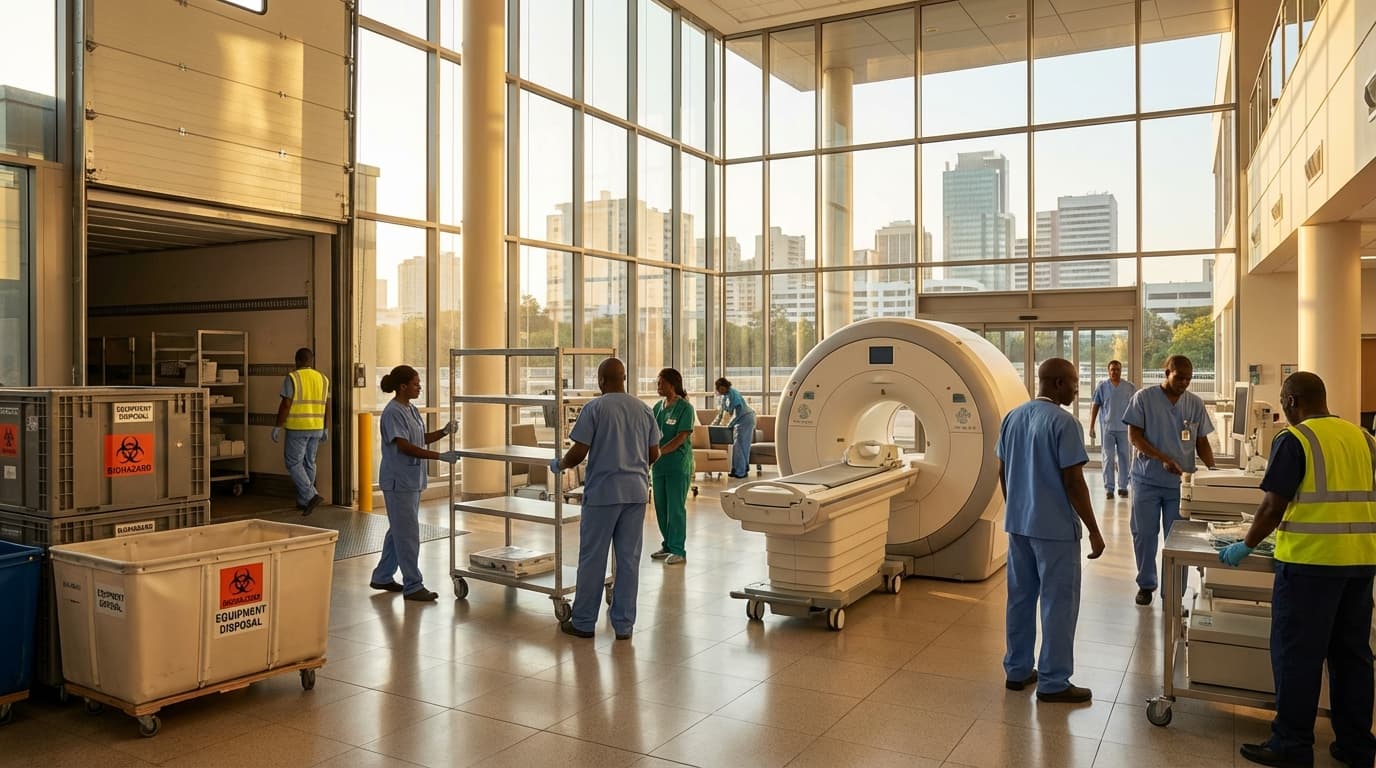
Heavy Medical Equipment De-Installation Service (MRI/CT/Cath Lab) in Uganda
Engineering Excellence & Technical Support
Heavy Medical Equipment De-Installation Service (MRI/CT/Cath Lab) High-standard technical execution following OEM protocols and local regulatory frameworks.
Precision De-Installation Engineering
Leveraging advanced robotic arm technology and specialized tools, our highly skilled technicians ensure the safe, systematic, and damage-free de-installation of complex MRI, CT, and Cath Lab equipment. We meticulously document each step, maintaining the integrity of components for optimal reinstallation or resale.
Regulatory Compliance & Safety Assurance
We adhere strictly to all international and local safety protocols (e.g., radiation safety for CT/MRI, sterile procedures for Cath Labs) and environmental regulations. Our rigorous de-installation process minimizes risks to personnel, equipment, and the environment, ensuring full compliance for Uganda's healthcare sector.
End-to-End Logistics & Secure Transport
From initial disconnection to secure packing and transportation within Uganda, our comprehensive service covers every logistical challenge. We manage site preparation, specialized rigging, climate-controlled transport, and final delivery, ensuring your valuable medical assets arrive safely at their destination.
What Is Heavy Medical Equipment De-installation Service (Mri/ct/cath Lab) In Uganda?
Heavy Medical Equipment De-Installation Service (MRI/CT/Cath Lab) in Uganda refers to the specialized process of safely and systematically dismantling, disconnecting, and preparing large-scale, high-value medical imaging and interventional diagnostic equipment for relocation, disposal, or storage. This service is critical for managing the lifecycle of complex medical technology, ensuring its integrity is maintained throughout the de-installation process and minimizing risks to personnel and the facility. The scope of work involves meticulous planning, controlled disassembly, precise disconnection of electrical, cooling, and data interfaces, and appropriate packaging and handling of components. This is a highly technical and safety-sensitive operation, requiring certified technicians with expertise in the specific equipment being serviced, adherence to manufacturer guidelines, and compliance with local safety and environmental regulations.
| Who Needs the Service | Typical Use Cases | ||||||||||
|---|---|---|---|---|---|---|---|---|---|---|---|
| Hospitals and Diagnostic Centers: Requiring equipment upgrades, relocation within the facility, or decommissioning of old units. | Medical Equipment Manufacturers/Distributors: Performing de-installations as part of trade-in programs, service agreements, or end-of-life management. | Healthcare Facility Management Companies: Overseeing asset lifecycle management for multiple healthcare institutions. | Regulatory Bodies/Auditors: Ensuring compliance with decommissioning standards for public health and safety. | Third-Party Service Providers: Specializing in the maintenance and relocation of advanced medical technology. | Insurance Companies: In cases of damage requiring equipment removal or assessment. | Decommissioning Projects: For facilities undergoing complete closure or renovation. | Equipment Relocation: Moving MRI, CT, or Cath Lab suites to a new wing, building, or geographic location. | Upgrades and Replacements: De-installing an older model to make way for a newer, more advanced system. | End-of-Life Disposal: Preparing equipment for responsible recycling or disposal according to environmental regulations. | Temporary Storage: De-installing equipment for storage during facility construction or renovation. | Asset Auditing and Verification: For inventory management and financial reporting purposes. |
Key Aspects of Heavy Medical Equipment De-Installation Service
- Planning and Risk Assessment: Comprehensive site surveys, detailed de-installation plans, and hazard identification are paramount.
- Controlled Disassembly: Sequential dismantling of the equipment by trained technicians, following manufacturer schematics and best practices.
- Precise Disconnection: Safely isolating and disconnecting all power, cooling (e.g., liquid helium, chilled water), data, and pneumatic lines.
- Component Handling and Packaging: Securely handling and packaging individual components to prevent damage during transit and storage.
- Environmental Controls: Managing any hazardous materials or refrigerants according to regulatory requirements.
- Documentation: Thorough record-keeping of the de-installation process, including photographic evidence and asset tagging.
- Safety Protocols: Strict adherence to occupational health and safety standards for all personnel involved.
- Logistics Coordination: Planning for transportation and temporary storage if required.
Who Needs Heavy Medical Equipment De-installation Service (Mri/ct/cath Lab) In Uganda?
Heavy medical equipment de-installation, particularly for high-end imaging and interventional systems like MRI, CT scanners, and Cath Labs, is a specialized and critical service. In Uganda, this need arises from various scenarios, primarily revolving around facility upgrades, relocations, and the introduction of newer technologies. The complexity and weight of these machines, combined with their sensitive components, demand expert handling to prevent damage and ensure safe removal. This service is not a routine maintenance task but a project-based undertaking requiring a skilled technical team, specialized tools, and adherence to stringent safety protocols. The successful de-installation directly impacts the continuity of patient care, the efficiency of hospital operations, and the financial implications of equipment management.
| Scenario for De-Installation | Impact on Facilities | Specific Equipment Categories |
|---|---|---|
| Technology Upgrades | Replacement of older, less efficient machines with newer models offering advanced features and improved diagnostic accuracy. | MRI, CT Scanners, Cath Labs |
| Facility Relocation/Expansion | Moving equipment to a new wing, a different floor, or an entirely new facility. Requires careful planning to ensure equipment integrity during transit and re-installation. | MRI, CT Scanners, Cath Labs |
| Renovations and Reconfiguration | Clearing space for structural changes, modernization of rooms, or optimizing workflow within existing departments. | MRI, CT Scanners, Cath Labs |
| Equipment Retirement/Disposal | Safe and compliant removal of equipment that has reached the end of its lifecycle or is no longer economically viable to maintain. | MRI, CT Scanners, Cath Labs |
| Consolidation of Services | Combining imaging or interventional services from multiple locations into a single, more efficient center. | MRI, CT Scanners, Cath Labs |
Target Customers and Departments for Heavy Medical Equipment De-Installation in Uganda
- {"title":"Hospitals (Public and Private)","departments":["Radiology/Medical Imaging Departments","Cardiology Departments","Surgical Departments","Outpatient Departments (for imaging suites)","Facility Management/Engineering Departments"],"description":"Hospitals are the primary consumers of this service. They often undergo renovations, expansions, or technology upgrades that necessitate the removal of existing heavy medical equipment to make way for new installations or to reconfigure existing spaces. This includes both large public referral hospitals and well-equipped private healthcare facilities."}
- {"title":"Diagnostic Imaging Centers","departments":["Imaging Operations Management","Technical Services"],"description":"Standalone or specialized diagnostic centers that focus on imaging services are key clients. As technology advances, these centers may replace older MRI, CT, or Cath Lab equipment to offer more sophisticated diagnostic capabilities, requiring the de-installation of the old units."}
- {"title":"Medical Equipment Manufacturers/Suppliers","departments":["Field Service Engineering","Sales and Logistics"],"description":"Companies that sell and install new MRI, CT, and Cath Lab systems in Uganda often partner with specialized de-installation services. They may offer to remove old equipment as part of a trade-in program or to facilitate the installation of their new machines."}
- {"title":"Government Health Institutions","departments":["Ministry of Health (Planning and Infrastructure Departments)","Hospital Administration and Engineering"],"description":"Government-funded health facilities, including national referral hospitals and regional centers, may require de-installation services during upgrades, renovations, or when consolidating services across different locations. This is often linked to national health infrastructure development projects."}
- {"title":"Research and Educational Institutions with Medical Faculties","departments":["Medical Imaging Research Units","University Engineering and Facilities Management"],"description":"Universities and institutions that house medical schools and conduct research may have dedicated imaging or interventional suites that require de-installation services for equipment upgrades or changes in research focus."}
- {"title":"Medical Equipment Refurbishment/Resale Companies","departments":["Acquisition and Logistics","Technical Appraisal"],"description":"Companies that purchase, refurbish, and resell used medical equipment would require de-installation services to acquire the machines they intend to process. This is crucial for businesses looking to leverage the secondary market for medical technology."}
Heavy Medical Equipment De-installation Service (Mri/ct/cath Lab) Process In Uganda
This document outlines the comprehensive workflow for the heavy medical equipment de-installation service (MRI/CT/Cath Lab) in Uganda. It details the process from the initial client inquiry to the successful execution of the de-installation, emphasizing safety, precision, and adherence to international standards.
| Stage | Description | Key Activities | Responsible Party | Key Deliverables/Outcomes |
|---|---|---|---|---|
| Inquiry & Initial Consultation | The process begins when a client contacts the service provider with a need for de-installation. | Receive inquiry, understand equipment type and location, initial discussion on project scope and timeline. | Client, Service Provider Sales/Technical Team | Understanding of client needs, preliminary project scope. |
| Site Survey & Risk Assessment | A detailed on-site visit to assess the equipment, surrounding environment, and potential challenges. | Physical inspection of the equipment, assessment of access routes, power supply, structural integrity, safety hazards, environmental factors, and necessary clearances. | Service Provider Technical Team, Site Representative | Detailed site assessment report, identification of special requirements, safety protocols, preliminary equipment condition report. |
| Quotation & Contract Finalization | Based on the site survey, a detailed proposal and cost estimate are provided. | Preparation of a comprehensive quotation detailing services, timeline, costs, terms, and conditions. Contract negotiation and signing. | Service Provider Sales/Project Management, Client | Formal quotation, signed service agreement/contract. |
| Planning & Scheduling | Developing a meticulous plan for the de-installation process. | Creating a detailed de-installation plan, including step-by-step procedures, resource allocation (personnel, tools, specialized equipment), and a precise timeline. Coordination with site stakeholders. | Service Provider Project Manager, Technical Team Lead | Approved de-installation plan, detailed schedule, resource mobilization plan. |
| Pre-De-installation Preparations | Ensuring all necessary prerequisites are met before commencing de-installation. | Coordination of necessary permits, disconnection of power and other utilities by qualified personnel, securing the work area, assembling specialized tools and equipment, and briefing the de-installation team. | Service Provider Project Manager, Technical Team, Site Management | All utilities safely disconnected, work area secured, team briefed, all required equipment on-site. |
| Equipment De-installation | The core phase where the medical equipment is carefully dismantled and disconnected. | Following the approved plan, systematically de-energizing, disconnecting all interfaces (power, data, cooling), and carefully dismantling modular components of the equipment using specialized tools and techniques. Adherence to safety protocols is paramount. | Service Provider Technical De-installation Team | Equipment safely and systematically disassembled, all components identified and secured. |
| Dismantling & Packaging | Properly preparing the dismantled equipment for storage or transport. | Further dismantling into manageable sections if required. Careful cleaning and packaging of each component using appropriate protective materials to prevent damage during transit and storage. Labeling of all packages. | Service Provider Technical Team | All components securely and appropriately packaged and labeled. |
| Logistics & Transportation (if applicable) | Arranging for the movement of the de-installed equipment. | If required, coordinating with specialized logistics providers for safe and compliant transportation of the de-installed equipment to a new location or storage facility. This includes proper handling and securing of heavy and sensitive items. | Service Provider Project Manager, Logistics Partner | Equipment safely loaded and en route to its next destination. |
| Site Handover & Documentation | Concluding the de-installation and formally handing over the site. | Final inspection of the de-installed area, removal of all project-related materials, thorough site cleanup, and provision of a comprehensive de-installation report to the client, including photographs and documentation of the process and any relevant certifications. | Service Provider Project Manager, Site Representative | Cleaned de-installation site, comprehensive de-installation report, all project documentation. |
| Post-De-installation Support | Providing ongoing assistance to the client after the de-installation is complete. | Addressing any post-de-installation queries or concerns from the client. Providing any requested follow-up documentation or information. | Service Provider Project Manager/Customer Support | Client satisfaction, resolution of any outstanding issues. |
De-Installation Workflow Stages
- Inquiry & Initial Consultation
- Site Survey & Risk Assessment
- Quotation & Contract Finalization
- Planning & Scheduling
- Pre-De-installation Preparations
- Equipment De-installation
- Dismantling & Packaging
- Logistics & Transportation (if applicable)
- Site Handover & Documentation
- Post-De-installation Support
Heavy Medical Equipment De-installation Service (Mri/ct/cath Lab) Cost In Uganda
De-installing heavy medical equipment like MRI, CT scanners, and Cath Labs is a complex and specialized process. It requires trained technicians, specialized tools, and adherence to strict safety and environmental protocols. The cost of this service in Uganda is influenced by several key factors, leading to a considerable range in pricing. This document outlines these factors and provides estimated cost ranges in Ugandan Shillings (UGX).
| Equipment Type | Estimated Cost Range (UGX) | Notes |
|---|---|---|
| Low-Field MRI Scanner | 15,000,000 - 30,000,000 | Simpler magnets, fewer components. |
| High-Field MRI Scanner (e.g., 1.5T, 3T) | 30,000,000 - 70,000,000+ | Complex cryogen management, heavy magnets, extensive shielding. |
| Single-Slice CT Scanner | 10,000,000 - 25,000,000 | Relatively less complex than multi-slice. |
| Multi-Slice CT Scanner (e.g., 4-slice, 16-slice, 64-slice) | 20,000,000 - 45,000,000 | More intricate gantry systems and detector arrays. |
| Basic Cardiac Catheterization (Cath Lab) System | 25,000,000 - 50,000,000 | Includes imaging systems, tables, and associated hardware. |
| Advanced Cath Lab System (with robotic arms, etc.) | 40,000,000 - 80,000,000+ | Higher complexity, more components to disconnect and handle. |
| Ancillary Heavy Medical Equipment (e.g., X-ray generators, linear accelerators) | 10,000,000 - 40,000,000 | Varies significantly based on size and technical requirements. |
Factors Influencing De-installation Costs:
- Equipment Type and Size: Larger and more complex machines (e.g., high-field MRI vs. low-field MRI, multi-slice CT vs. single-slice CT) will naturally incur higher de-installation costs due to the increased time, expertise, and specialized equipment required.
- Accessibility and Site Conditions: The ease of access to the equipment's location within the hospital or clinic plays a significant role. Difficult access, narrow corridors, multiple floors, or the need for structural modifications (e.g., temporary wall removal) will increase labor and time, thus raising the cost.
- Dismantling Complexity: The number of components, the intricacy of their connections, and the need for specialized tools for each component will affect the de-installation time and cost. MRI magnets, for example, require extreme caution and specialized handling.
- Technical Expertise Required: Certified and experienced technicians with specific knowledge of the particular equipment brand and model are essential. The rarity of such expertise in the local market can drive up labor costs.
- Logistics and Transportation: The cost of safely transporting the de-installed components to a new location or to a disposal/recycling facility needs to be factored in. This includes specialized transport vehicles and potentially lifting equipment.
- Time Sensitivity: Urgent de-installation requests might incur premium charges. Planned de-installations allowing for efficient scheduling are generally more cost-effective.
- Additional Services: This can include secure packaging, temporary storage, site restoration, or waste disposal, all of which add to the overall cost.
- Brand and Model Specifics: Different manufacturers have proprietary designs and installation/de-installation procedures, which can influence the complexity and therefore the cost.
- Geographical Location within Uganda: While major urban centers might have more service providers, transportation costs to remote areas can increase the final price.
Affordable Heavy Medical Equipment De-installation Service (Mri/ct/cath Lab) Options
De-installing heavy medical equipment like MRI, CT scanners, and Cath Labs is a complex process requiring specialized expertise, strict safety protocols, and careful logistics. Choosing the right de-installation service provider can significantly impact your budget and operational continuity. This guide explores affordable options, valuable service bundles, and effective cost-saving strategies to help you navigate this critical decision.
| Cost Factor | Description | Potential Cost Savings Strategy |
|---|---|---|
| Labor (Technicians, Riggers) | Highly skilled professionals are essential for safe and efficient de-installation. Costs vary based on experience, team size, and geographical location. | Bundle Services: Opt for providers offering comprehensive de-installation, decommissioning, and site remediation. Long-Term Contracts: Negotiate discounted rates for repeat clients or ongoing service agreements. |
| Specialized Equipment & Tools | Cranes, forklifts, specialized dismantling tools, and safety gear are required. | Pre-site Assessment: A thorough site assessment by the provider can identify necessary equipment beforehand, avoiding on-site delays and rush orders for rentals. |
| Logistics & Transportation | Moving large, heavy components requires specialized trucks, permits, and experienced drivers. | Efficient Routing & Scheduling: Coordinate de-installation with equipment relocation or disposal to optimize transportation costs. Local Providers: Consider local or regional de-installation companies to reduce travel expenses. |
| Disposal/Relocation | Costs associated with recycling, scrapping, or transporting equipment to a new location. | Resale Value: If equipment has resale value, work with the de-installation company to facilitate a smoother sale. Recycling Programs: Inquire about providers who partner with reputable recycling facilities to minimize disposal fees. |
| Site Remediation & Restoration | Repairing any damage to the facility caused during de-installation. | Clear Communication: Establish clear expectations regarding site condition post-de-installation to avoid unexpected repair costs. |
| Permitting & Regulatory Compliance | Obtaining necessary permits and ensuring adherence to environmental and safety regulations. | Provider Expertise: Choose providers with a strong track record in regulatory compliance; they can navigate these processes efficiently and avoid costly fines. |
Understanding the De-installation Process & Potential Costs
- Complexity: These systems are intricate, often large, and require specialized tools and trained personnel for safe disassembly and removal. Factors like building access, site preparation, and environmental considerations play a crucial role.
- Specialized Skills: De-installation requires certified technicians with experience in handling high-voltage equipment, cryogenics (for MRI), and sensitive imaging components.
- Logistics: Transportation, rigging, and disposal/relocation of components add significant layers to the overall cost.
- Safety Regulations: Adherence to strict safety standards (OSHA, etc.) is paramount and influences the resources required.
- Downtime: The duration of the de-installation directly impacts the loss of revenue or service availability for the facility.
Verified Providers In Uganda
Navigating the healthcare landscape in Uganda can be challenging. Ensuring you receive quality care means choosing providers who are not only skilled but also have verified credentials. Franance Health stands out as a premier choice for medical services in Uganda, backed by a rigorous vetting process that guarantees the highest standards of professionalism and expertise. Our commitment to patient well-being is reflected in our stringent credentialing of every healthcare professional and facility within our network.
| Credential Type | Franance Health Verification Process | Significance for Patients |
|---|---|---|
| Medical Licenses & Registrations | Primary source verification with regulatory bodies (e.g., Uganda Medical and Dental Practitioners Council) to confirm active and unencumbered licenses. | Ensures providers are legally authorized and qualified to practice medicine in Uganda. |
| Educational Background & Degrees | Verification of degrees and diplomas from accredited institutions, cross-referenced with official transcripts and university records. | Confirms that providers have received formal and recognized medical training. |
| Specialty Certifications & Fellowships | Validation of all specialty board certifications and fellowship completion from reputable organizations. | Guarantees that providers have specialized knowledge and advanced training in their respective fields. |
| Professional Experience & References | Thorough review of past employment records and collection of professional references from previous employers and peers. | Assesses practical skills, performance history, and professional conduct. |
| Criminal Background Checks | Standard background checks to ensure patient safety and trust. | Provides an added layer of security and peace of mind for patients. |
| Continuing Medical Education (CME) | Confirmation of ongoing participation in CME activities to ensure providers stay updated with the latest medical advancements. | Ensures that providers are current with best practices and new treatments. |
Why Franance Health is Your Best Choice for Verified Healthcare in Uganda:
- Uncompromising Credential Verification: We go beyond basic checks, meticulously verifying medical licenses, certifications, educational backgrounds, and professional experience of all our affiliated providers.
- Commitment to Quality and Safety: Our network comprises only those practitioners and facilities that meet and exceed national and international standards for patient care and safety protocols.
- Patient-Centric Approach: We prioritize your health and comfort by connecting you with providers who are not only medically competent but also demonstrate empathy and excellent communication skills.
- Access to Leading Specialists: Franance Health provides access to a wide range of medical specialists across various disciplines, ensuring you find the right expertise for your specific needs.
- Streamlined Healthcare Experience: We simplify your healthcare journey, making it easier to find, book appointments with, and receive treatment from trusted, verified professionals.
Scope Of Work For Heavy Medical Equipment De-installation Service (Mri/ct/cath Lab)
This Scope of Work (SOW) details the requirements for the de-installation and preparation for transport of heavy medical equipment, specifically Magnetic Resonance Imaging (MRI) scanners, Computed Tomography (CT) scanners, and Cardiac Catheterization (Cath Lab) systems. The objective is to safely and efficiently disconnect, dismantle, and prepare these complex systems for relocation or storage, adhering to all relevant safety regulations and manufacturer specifications.
| Deliverable | Description | Standard Specifications / Requirements |
|---|---|---|
| De-installation Plan | A detailed document outlining the entire de-installation process, including timelines, personnel roles, safety protocols, equipment requirements, and risk mitigation strategies. | Must be reviewed and approved by the client prior to commencement. Shall include manufacturer-specific procedures where applicable. |
| Qualified Personnel | Certified and experienced technicians with proven expertise in de-installing MRI, CT, and Cath Lab systems. | Technicians must hold relevant certifications (e.g., manufacturer-specific, biomedical engineering). Minimum of [X] years of experience required for lead technicians. |
| Tooling and Equipment | All necessary specialized tools, lifting equipment, protective gear, and consumables required for safe and efficient de-installation. | Must include manufacturer-recommended tools, appropriate PPE (e.g., lead shielding for X-ray components), calibration tools, and spill containment kits. |
| Cryogen Management (MRI) | Safe and responsible handling, removal, and storage/disposal of liquid helium and/or nitrogen from MRI systems. | Adherence to all environmental and safety regulations for cryogen handling. Precise measurement and documentation of removed cryogen quantity. |
| Cooling System Purge (CT/Cath Lab) | Safe and complete purging of cooling fluids (e.g., deionized water, glycol) from CT and Cath Lab systems. | Use of manufacturer-specified purging procedures. Proper containment and disposal of purged fluids. |
| Electrical System Disconnection | Safe and systematic disconnection of all power supplies and electrical components. | Following manufacturer's lockout/tagout procedures. Testing for residual voltage. |
| Component Dismantling | Disassembly of the main equipment (e.g., gantry, magnet, X-ray tube) and ancillary components (e.g., control consoles, patient tables, generators) into transportable units. | Strict adherence to manufacturer's de-installation manuals. Minimization of stress on components. |
| Packaging and Protection | Appropriate wrapping, padding, and crating of dismantled components to prevent damage during transport. | Use of high-quality, non-abrasive protective materials. Custom crating may be required for sensitive components. Clear labeling of all packaged items. |
| De-installation Verification Report | A comprehensive report detailing the completion of each de-installation phase, including photographs, checklists, and any deviations from the plan. | Signed off by client representative. Includes serial numbers of equipment de-installed. |
| Site Cleanup and Restoration | Removal of all debris, tools, and equipment, leaving the de-installation site clean, safe, and orderly. | Return the site to a condition suitable for subsequent activities as agreed upon with the client. |
| Safety Compliance | Adherence to all local, state, and federal safety regulations and industry best practices. | Conducting pre-work safety briefings, performing hazard assessments, and ensuring all personnel are trained and equipped for safe operation. |
Key Objectives and Phases
- De-installation Planning: Comprehensive site assessment, risk analysis, and development of a detailed de-installation plan.
- Equipment Assessment and Preparation: Verifying equipment status, identifying required tools and materials, and preparing the immediate work area.
- System Decommissioning: Safely powering down, disconnecting, and purging all associated systems (e.g., cryogen, cooling, power).
- Component Dismantling: Carefully disassembling the main equipment and ancillary components according to manufacturer guidelines.
- Packaging and Securing: Protecting and securing all dismantled components for transport.
- Site Restoration: Returning the de-installation area to a safe and orderly state.
- Documentation and Reporting: Providing detailed records of the de-installation process.
Service Level Agreement For Heavy Medical Equipment De-installation Service (Mri/ct/cath Lab)
This Service Level Agreement (SLA) outlines the agreed-upon response times and uptime guarantees for the De-Installation Service of Heavy Medical Equipment, specifically Magnetic Resonance Imaging (MRI), Computed Tomography (CT), and Cardiac Catheterization Laboratory (Cath Lab) systems. This SLA aims to ensure minimal disruption and efficient service delivery during the de-installation process.
| Service Component | Response Time | Uptime Guarantee | Notes |
|---|---|---|---|
| Initial Contact / Service Request Acknowledgment | Within 2 business hours of notification. | N/A (This is for acknowledgment, not service commencement). | Service requests received outside of business hours will be acknowledged on the next business day. |
| On-Site Technician Arrival (for Scheduled De-Installation) | As per mutually agreed-upon schedule. Typically within 5 business days of contract signing, unless otherwise specified. | N/A (Uptime is not applicable to the de-installation process itself, but rather the readiness of the equipment for de-installation). | Schedule subject to technician availability and site access confirmation. |
| De-Installation Commencement (after on-site arrival) | Within 4 business hours of technician arrival and site readiness confirmation. | N/A (Focus is on timely commencement, not uptime of the equipment being de-installed). | Assumes all necessary permits, site clearances, and customer-provided support are in place. |
| Completion of De-Installation | Within the timeframe specified in the individual project scope or contract. Typical timeframe: 1-5 business days depending on equipment complexity and site conditions. | N/A | Timeframe is an estimate and can be affected by unforeseen site-specific challenges. |
| Technical Support / Issue Resolution (during de-installation) | For critical issues impacting de-installation progress: within 4 business hours. | N/A | Critical issues are defined as those preventing or significantly delaying the de-installation process. |
| Post-De-Installation Documentation Delivery | Within 3 business days of completion. | N/A | Includes a de-installation report and relevant photographs. |
Scope of Service
- De-installation of specified MRI, CT, and Cath Lab equipment at the designated site.
- Safe and secure disconnection of all power, data, and ancillary connections.
- Dismantling of major components as per manufacturer guidelines and industry best practices.
- Packaging and preparation of components for transport.
- Documentation of the de-installation process.
Frequently Asked Questions

Ready when you are
Let's scope your Heavy Medical Equipment De-Installation Service (MRI/CT/Cath Lab) in Uganda project in Uganda.

Scaling healthcare logistics and technical systems across the entire continent.