
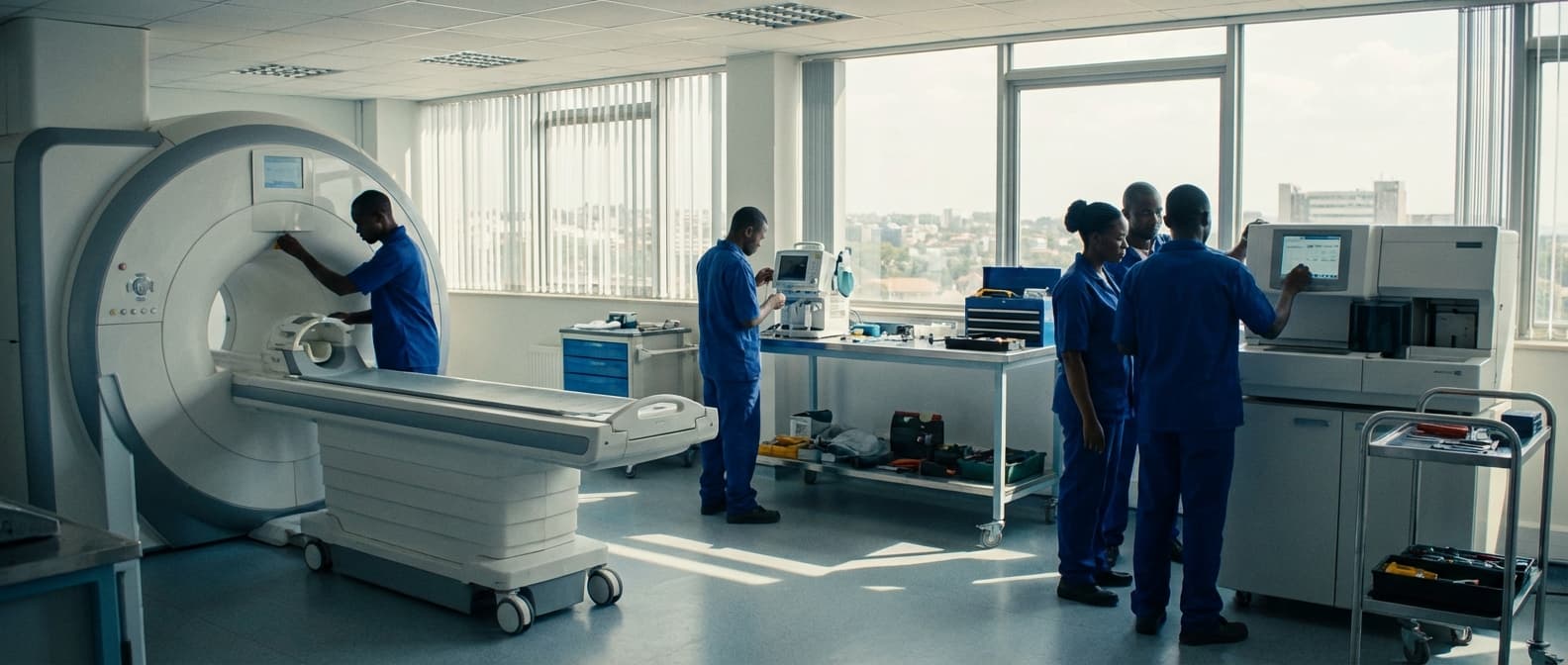
Comprehensive Maintenance Contract (CMC) Management Service (Parts & Labor) in Uganda
Engineering Excellence & Technical Support
Comprehensive Maintenance Contract (CMC) Management Service (Parts & Labor) High-standard technical execution following OEM protocols and local regulatory frameworks.
Guaranteed Uptime: All-Inclusive Parts & Labor
Ensure peak operational efficiency with our CMC covering all critical parts replacements and expert labor. We guarantee minimal downtime, keeping your essential equipment running smoothly across Uganda, backed by proactive maintenance strategies.
Predictable Budgeting: Fixed CMC Costs, No Hidden Fees
Gain complete control over your maintenance expenditure. Our comprehensive CMC offers fixed, transparent pricing for both parts and labor, eliminating unexpected repair bills and allowing for precise financial planning for your Ugandan operations.
Expert Technicians & Rapid Response
Leverage our team of certified, on-the-ground technicians in Uganda for swift, expert service. Our CMC ensures rapid response times for all maintenance and repair needs, minimizing disruptions and maximizing the lifespan of your valuable assets.
What Is Comprehensive Maintenance Contract (Cmc) Management Service (Parts & Labor) In Uganda?
Comprehensive Maintenance Contract (CMC) Management Service (Parts & Labor) in Uganda refers to a specialized service that oversees and administers contracts for the complete upkeep of equipment and assets. This service encompasses the proactive and reactive maintenance of machinery, infrastructure, and other critical assets, ensuring their optimal operational status. The 'Parts & Labor' designation explicitly includes the procurement and provision of necessary spare parts, as well as the skilled personnel required for all repair and maintenance activities. Effectively, it's an outsourced, end-to-end solution for managing the lifecycle maintenance of physical assets, mitigating risks associated with equipment failure and ensuring operational continuity.
| Who Needs It? | Typical Use Cases | |||||||
|---|---|---|---|---|---|---|---|---|
| Organizations with significant capital investments in physical assets: This includes companies relying on machinery, specialized equipment, or critical infrastructure for their operations. | Manufacturing Plants: Maintenance of production lines, CNC machines, robotic arms, and ancillary equipment to ensure continuous output. | Healthcare Facilities: Upkeep of diagnostic imaging equipment (MRI, CT scanners), surgical instruments, laboratory analyzers, and building services (HVAC, power generation). | Telecommunications Companies: Maintenance of base stations, switching centers, fiber optic networks, and power backup systems. | Energy Sector (Oil & Gas, Power Generation): Management of turbines, generators, pumps, drilling equipment, and pipeline infrastructure. | Transportation and Logistics: Maintenance of vehicle fleets (trucks, buses), railway rolling stock, and warehouse automation systems. | Large-Scale Hospitality and Real Estate: Maintaining HVAC systems, elevators, generators, and plumbing in hotels, commercial buildings, and residential complexes. | Government and Public Sector Agencies: Managing the upkeep of infrastructure, fleet vehicles, and specialized operational equipment. | Businesses seeking to reduce in-house maintenance overhead and risk: Outsourcing CMC management allows focus on core competencies. |
Key Components of CMC Management Service (Parts & Labor)
- Contract Administration: Establishing, negotiating, and managing the terms and conditions of CMC agreements with third-party service providers.
- Preventive Maintenance Scheduling and Execution: Developing and implementing systematic schedules for routine inspections, servicing, and minor repairs to preempt major failures.
- Corrective Maintenance Response: Rapid deployment of technical teams and spare parts for emergency repairs and troubleshooting of unexpected breakdowns.
- Spare Parts Management: Inventory control, procurement, and logistics for all required genuine or equivalent replacement parts, ensuring availability and cost-effectiveness.
- Labor Resource Management: Sourcing, vetting, and managing skilled technicians, engineers, and support staff for all maintenance activities.
- Performance Monitoring and Reporting: Tracking key performance indicators (KPIs) such as uptime, response times, repair success rates, and cost per maintenance event, providing regular reports to stakeholders.
- Quality Assurance and Compliance: Ensuring all maintenance activities adhere to manufacturer specifications, industry standards, and relevant regulatory requirements.
- Budget Management and Cost Optimization: Financial oversight of maintenance expenditures, identifying opportunities for cost savings through efficient resource allocation and strategic procurement.
Who Needs Comprehensive Maintenance Contract (Cmc) Management Service (Parts & Labor) In Uganda?
A Comprehensive Maintenance Contract (CMC) Management Service (Parts & Labor) is crucial for organizations in Uganda that rely on specialized equipment and machinery for their operations. These services ensure the optimal performance, longevity, and cost-effectiveness of vital assets by providing proactive maintenance, timely repairs, and access to spare parts. The goal is to minimize downtime, prevent costly breakdowns, and maximize the return on investment for their equipment.
| Target Customer Type | Key Departments/Functions Benefiting | Reason for Requiring CMC Management (Parts & Labor) |
|---|---|---|
| Manufacturing Plants | Production, Operations, Engineering, Maintenance | Ensuring continuous production, minimizing costly breakdowns, maintaining equipment lifespan, access to specialized parts. |
| Hospitals | Biomedical Engineering, Clinical Operations, Facilities Management | Critical medical equipment uptime (life-saving devices), patient safety, regulatory compliance, rapid response for repairs. |
| Telecommunication Providers | Network Operations, Field Maintenance, Infrastructure Management | Ensuring network availability, preventing service disruptions, managing specialized network hardware. |
| Energy and Power Generation | Operations & Maintenance, Engineering, Plant Management | High availability of power generation units, safety, preventing grid instability, managing complex power plant machinery. |
| Government Ministries/Public Utilities | Procurement, Technical Services, Operations | Ensuring service delivery, cost-efficiency in asset management, public infrastructure reliability, long-term operational planning. |
| Mining and Quarrying | Operations, Maintenance, Engineering, Safety | Heavy machinery uptime, safety of personnel, cost of specialized parts and labor, harsh operating environments. |
Target Customers and Departments in Uganda Requiring CMC Management Service (Parts & Labor)
- {"items":["Manufacturing Plants (Food & Beverage, Textiles, Pharmaceuticals, Construction Materials, etc.)","Mining and Quarrying Operations","Energy and Power Generation Facilities (Hydro, Thermal, Renewable)","Oil and Gas Exploration and Processing","Water Treatment and Sanitation Plants"],"title":"Industries with Critical Equipment"}
- {"items":["Hospitals (Public and Private)","Specialized Clinics and Diagnostic Centers","Medical Research Institutions"],"title":"Healthcare Sector"}
- {"items":["Mobile Network Operators","Internet Service Providers","Data Centers","IT Outsourcing Companies"],"title":"Telecommunications and IT Infrastructure"}
- {"items":["Airlines (Aircraft Maintenance)","Large Fleet Operators (Trucking, Bus Companies)","Port and Airport Authorities"],"title":"Transportation and Logistics"}
- {"items":["Government Ministries (e.g., Ministry of Health, Ministry of Works and Transport)","Public Utilities (e.g., UMEME, NWSC)","Military and Defense Forces","Educational Institutions (Universities, large Vocational Schools with specialized labs)"],"title":"Government and Public Sector"}
- {"items":["Large-scale Commercial Farms with specialized machinery","Agro-processing Plants"],"title":"Agriculture and Agribusiness"}
- {"items":["Large Hotels and Resorts with complex HVAC, elevators, and kitchen equipment","Commercial Office Complexes with advanced building management systems"],"title":"Real Estate and Hospitality"}
Comprehensive Maintenance Contract (Cmc) Management Service (Parts & Labor) Process In Uganda
This document outlines the comprehensive workflow for managing Comprehensive Maintenance Contracts (CMC) for parts and labor in Uganda. It covers the entire process from initial inquiry to successful contract execution and ongoing service delivery, ensuring client satisfaction and efficient resource allocation.
| Stage | Description | Key Activities | Responsible Party | Output/Deliverable | Potential Challenges |
|---|---|---|---|---|---|
| Inquiry and Initial Consultation | Receiving and understanding the client's maintenance needs for their assets. | Receiving inquiries (phone, email, website), understanding asset types, scope of coverage, client expectations. | Sales/Business Development Team, Technical Sales Representative | Initial understanding of client needs, preliminary assessment of feasibility. | Vague client requirements, lack of detailed asset information. |
| Proposal Development and Negotiation | Creating a tailored maintenance plan and cost estimate based on the client's requirements. | Site visits (if necessary), asset assessment, defining service levels (SLAs), costing of parts and labor, developing a comprehensive proposal. | Technical Sales Representative, Costing/Estimating Department, Service Delivery Manager | Detailed CMC proposal, including scope of work, pricing, SLAs, terms and conditions. | Accurate cost estimation, competitive pricing, aligning services with client budget. |
| Contract Drafting and Agreement | Formalizing the agreed-upon terms and conditions into a legally binding contract. | Reviewing proposal, drafting the CMC agreement, legal review, client review and negotiation, finalization and signing of the contract. | Legal Department, Sales/Business Development Team, Client Representative | Signed Comprehensive Maintenance Contract (CMC). | Legal complexities, lengthy negotiation periods, unclear contractual obligations. |
| Onboarding and Asset Registration | Integrating the client and their assets into the service provider's management system. | Setting up client account, registering all covered assets with serial numbers, model numbers, installation dates, warranty information, and current condition. | Service Delivery Team, Operations Department, Client IT/Asset Manager | Client and Asset Database updated, unique asset IDs assigned. | Inaccurate asset data, difficulty in accessing asset information, resistance from client staff. |
| Preventive Maintenance Scheduling and Execution | Proactively maintaining assets to prevent breakdowns and ensure optimal performance. | Developing preventive maintenance schedules based on manufacturer recommendations and asset usage, assigning qualified technicians, performing scheduled inspections, cleaning, lubrication, and minor adjustments. | Service Delivery Manager, Field Service Technicians, Planning Department | Completed preventive maintenance reports, updated asset maintenance logs. | Scheduling conflicts, availability of spare parts for preventive tasks, technician availability. |
| Breakdown Maintenance and Repair | Responding to and resolving equipment failures or performance issues within agreed SLAs. | Receiving breakdown notification (phone, email, ticketing system), diagnosing the fault, dispatching technicians, performing repairs, replacing faulty parts, testing functionality. | Service Desk/Call Center, Field Service Technicians, Parts Department | Successful repair completion reports, updated asset maintenance logs, minimal downtime for the client. | Quickly diagnosing complex issues, availability of specialized tools, technician expertise for specific equipment. |
| Parts Management | Ensuring the availability of necessary spare parts for both preventive and breakdown maintenance. | Inventory management of common spare parts, sourcing specialized parts from manufacturers or authorized distributors, managing stock levels, tracking part usage and costs. | Parts Manager, Procurement Department, Warehouse Staff | Adequate stock of critical spare parts, timely procurement of required parts, accurate parts inventory records. | Long lead times for specialized parts, fluctuating part prices, managing obsolescence. |
| Labor Management | Efficiently allocating and managing skilled technicians for maintenance tasks. | Resource planning and scheduling of technicians based on expertise and workload, monitoring technician performance, training and development, managing travel and logistics. | Service Delivery Manager, Field Service Supervisors, HR Department | Optimized technician deployment, skilled workforce available for all service needs, efficient travel and time management. | Technician skill gaps, absenteeism, managing geographically dispersed assets, burnout. |
| Reporting and Performance Monitoring | Providing regular updates to the client on maintenance activities and asset performance. | Generating monthly/quarterly performance reports, including uptime statistics, number of service calls, average response and resolution times, parts and labor costs, recommendations for asset improvement. | Service Delivery Manager, Administration Department | Comprehensive performance reports, client feedback, data for contract review and improvement. | Data accuracy and integrity, timely report generation, demonstrating value to the client. |
| Invoicing and Payment | Billing the client for services rendered according to the contract. | Generating accurate invoices based on contract terms (e.g., monthly retainer, parts usage, labor hours), processing payments, managing outstanding invoices. | Finance Department, Administration Department | Timely and accurate invoices, reconciled payments. | Discrepancies in billing, delayed payments, dispute resolution. |
| Contract Renewal and Review | Assessing the existing contract and negotiating terms for continuation or modification. | Reviewing contract performance, discussing client satisfaction, identifying areas for improvement, negotiating new terms and pricing, re-registering assets if necessary. | Sales/Business Development Team, Service Delivery Manager, Client Representative | Renewed CMC agreement, updated asset register, adjusted service plans. | Client dissatisfaction with previous service, resistance to price increases, changing client needs. |
Key Stages of the CMC Management Process
- Inquiry and Initial Consultation
- Proposal Development and Negotiation
- Contract Drafting and Agreement
- Onboarding and Asset Registration
- Preventive Maintenance Scheduling and Execution
- Breakdown Maintenance and Repair
- Parts Management
- Labor Management
- Reporting and Performance Monitoring
- Invoicing and Payment
- Contract Renewal and Review
Comprehensive Maintenance Contract (Cmc) Management Service (Parts & Labor) Cost In Uganda
Comprehensive Maintenance Contract (CMC) management services for parts and labor in Uganda are crucial for ensuring the longevity and optimal performance of various assets, from industrial machinery and medical equipment to IT infrastructure and vehicles. The cost of these services is not a fixed figure and is influenced by a multitude of factors, leading to a wide range of pricing. Understanding these determinants is essential for businesses to budget effectively and negotiate favorable terms. The pricing typically involves a combination of a base service fee and charges for actual parts and labor, though some contracts may opt for an all-inclusive annual fee.
| Asset Category (Examples) | Estimated Annual CMC Cost Range (UGX) | Notes on Cost Influences |
|---|---|---|
| General Office Equipment (Printers, Laptops, Desktops) | 50,000 - 300,000 per unit | Depends on brand, age, warranty status, and number of units. Higher end for premium brands or extended support. |
| Basic IT Infrastructure (Servers, Networking Gear - Entry Level) | 200,000 - 1,000,000 per unit | Cost influenced by server specs, storage, network complexity, and required uptime SLAs. |
| Industrial Machinery (Manufacturing Equipment - Medium Scale) | 1,000,000 - 10,000,000+ per year | Highly variable based on machine type, complexity, criticality, and frequency of use. Includes specialized technicians and parts. |
| Medical Equipment (Diagnostic Imaging - e.g., X-ray, Ultrasound) | 5,000,000 - 30,000,000+ per year | Very high cost due to specialized technology, precise calibration, trained personnel, and imported parts. Critical for patient safety. |
| Vehicles (Fleet of Company Cars/Trucks) | 200,000 - 1,500,000 per vehicle per year | Factors include vehicle type (car vs. truck), usage, age, and the scope of services (routine checks, minor repairs, major overhauls, tires). |
| Specialized Laboratory Equipment | 1,000,000 - 15,000,000+ per year | Similar to medical equipment, depends on precision, calibration needs, and specific consumables/parts. |
| Power Generators (Medium to Large Scale) | 500,000 - 5,000,000+ per year | Dependent on generator capacity (kVA), engine type, fuel, and required response time during power outages. |
Key Pricing Factors for CMC Management Services in Uganda
- Asset Type and Complexity: The nature of the equipment being maintained significantly impacts cost. Highly specialized, intricate, or technologically advanced equipment (e.g., advanced medical imaging machines, complex industrial robots) will naturally command higher maintenance fees due to the specialized skills, tools, and parts required.
- Age and Condition of Assets: Older or poorly maintained assets often require more frequent and extensive servicing, leading to higher costs. Proactive maintenance on newer, well-kept assets can be more predictable and cost-effective.
- Scope of Services: The breadth of the contract is a primary cost driver. A basic CMC might cover routine inspections and minor repairs, while a comprehensive one includes preventive maintenance, emergency call-outs, parts replacement, labor, diagnostic services, and even software updates.
- Frequency of Maintenance: Contracts that stipulate more frequent inspections and preventive maintenance will generally have higher upfront costs but can lead to lower long-term expenses by minimizing breakdowns.
- Downtime Tolerance and Response Time: Businesses with critical operations that cannot afford significant downtime will opt for contracts with guaranteed rapid response times and potentially 24/7 support. This premium service comes at a higher price.
- Geographic Location and Accessibility: The location of the assets within Uganda can influence costs. Remote areas might incur additional charges for travel and logistical challenges for technicians and spare parts.
- Parts Availability and Cost: The cost and availability of spare parts are critical. For equipment using imported or specialized parts, the associated import duties, shipping costs, and potential currency fluctuations will affect the overall contract price.
- Service Provider's Reputation and Expertise: Established service providers with a proven track record, highly skilled technicians, and access to genuine parts often charge a premium for their reliability and quality of service.
- Contract Duration and Payment Terms: Longer-term contracts may offer slight discounts. Flexible payment terms, such as quarterly or annual payments, can also be negotiated.
- Included Services (e.g., Software Updates, Training): Contracts that include value-added services like software updates, operator training, or remote monitoring will naturally be priced higher.
- Number and Type of Assets: A larger portfolio of assets generally leads to economies of scale, potentially reducing the per-unit cost. However, a diverse range of asset types can increase complexity and cost.
Affordable Comprehensive Maintenance Contract (Cmc) Management Service (Parts & Labor) Options
Managing maintenance contracts effectively is crucial for controlling operational costs and ensuring the longevity of your equipment. Our Comprehensive Maintenance Contract (CMC) Management Service offers flexible options to suit your needs, covering both parts and labor. We focus on delivering value through intelligently designed bundles and proactive cost-saving strategies, minimizing downtime and maximizing your return on investment.
| Value Bundle Name | Description | Included Services (Parts & Labor) | Cost-Saving Strategies | Ideal For |
|---|---|---|---|---|
| Essential Care Bundle | Our foundational package for basic, regular maintenance needs. | Scheduled preventive maintenance (inspections, lubrication, filter replacements), minor adjustments, emergency call-outs (labor only for unscheduled issues). | Bulk purchasing of common spare parts, standardized maintenance procedures, preventative scheduling to avoid costly breakdowns. | Businesses with predictable maintenance schedules and a focus on core operational uptime. |
| Advanced Protection Bundle | A more comprehensive option including parts coverage for common wear-and-tear items. | All Essential Care services plus replacement of designated wear-and-tear parts (e.g., seals, gaskets, belts), priority response times, remote diagnostics support. | Strategic stocking of frequently replaced parts, tiered labor rates based on technician expertise, proactive part replacement based on usage data. | Organizations requiring a balance of scheduled maintenance and protection against common part failures. |
| Total Assurance Bundle | Our premium offering providing all-inclusive parts and labor coverage for maximum peace of mind. | All Advanced Protection services plus full parts replacement (excluding consumables and accidental damage), full labor coverage for all repairs (scheduled and unscheduled), firmware updates, performance optimization, on-site technician availability. | Long-term parts procurement agreements, predictive maintenance leveraging AI and IoT sensors, dedicated service teams for critical equipment, reduced administrative overhead through consolidated billing. | Businesses with critical operations, high-value equipment, and a desire to completely outsource maintenance responsibilities. |
| Customized Solutions | Tailored packages designed to meet unique operational and budgetary requirements. | Configurable levels of parts and labor coverage, flexible service level agreements (SLAs), integration with existing internal maintenance teams. | Flexible contract terms, performance-based incentives, collaborative planning with client to identify specific cost-saving opportunities. | Organizations with highly specialized equipment, unique operating environments, or specific financial constraints. |
Key Benefits of Our CMC Management Service
- Proactive Risk Mitigation: Identifying potential issues before they cause breakdowns.
- Optimized Resource Allocation: Ensuring maintenance is performed efficiently and effectively.
- Predictable Budgeting: Understanding and controlling maintenance expenses.
- Extended Equipment Lifespan: Proper maintenance prevents premature wear and tear.
- Reduced Downtime: Minimizing operational disruptions and lost productivity.
- Access to Expertise: Leveraging our team of skilled technicians and maintenance specialists.
- Streamlined Administration: Simplifying the management of multiple contracts.
- Negotiated Favorable Terms: Benefiting from our established relationships with parts suppliers and service providers.
Verified Providers In Uganda
In Uganda's burgeoning healthcare landscape, identifying truly verified and competent healthcare providers is paramount for ensuring quality and trustworthy medical services. Franance Health stands out as a beacon of reliability, offering a curated network of healthcare professionals and facilities that have undergone rigorous credentialing processes. This commitment to verification not only safeguards patient well-being but also fosters confidence in the healthcare system. When seeking medical care in Uganda, understanding what makes a provider 'verified' and why Franance Health excels in this regard is crucial for making informed decisions.
| Franance Health Advantage | What It Means for You | Why It's the Best Choice |
|---|---|---|
| Rigorous Credentialing Process | You are assured of receiving care from licensed, qualified, and experienced professionals. | Reduces the risk of encountering unqualified practitioners and ensures a higher standard of care. |
| Curated Network of Providers | Access to a pre-vetted selection of reputable doctors, specialists, clinics, and hospitals. | Saves you time and effort in searching for trustworthy healthcare, offering peace of mind. |
| Commitment to Quality and Safety | Franance Health prioritizes patient well-being by ensuring adherence to strict medical and ethical standards. | Provides a safer and more reliable healthcare experience, minimizing potential complications. |
| Transparency and Trust | Clear information about provider qualifications and facility accreditations. | Empowers you to make informed decisions about your health, fostering a trusting relationship with your provider. |
| Access to Specialized Care | Often includes access to specialists who may be harder to find through general searches. | Ensures you can get the specific medical expertise you need, when you need it. |
Key Elements of Verified Providers on Franance Health:
- Professional Licensure and Certification: All healthcare professionals affiliated with Franance Health are confirmed to hold current and valid licenses and certifications from recognized Ugandan medical boards and regulatory bodies. This ensures they meet the minimum standards of education, training, and ethical practice.
- Educational Background Verification: Franance Health meticulously verifies the academic qualifications and training of its providers, ensuring they have completed accredited medical programs and specialized training relevant to their practice.
- Experience Assessment: Beyond qualifications, Franance Health considers the practical experience of healthcare providers, looking for a track record of successful patient care and a demonstrated ability to manage various medical conditions.
- Reputation and Background Checks: A thorough vetting process includes checks on professional conduct, patient feedback (where applicable and ethically permissible), and any disciplinary actions. This helps to build a network of trusted and reputable practitioners.
- Facility Accreditation and Standards: For healthcare facilities listed on Franance Health, accreditation by relevant Ugandan health authorities and adherence to international best practices in hygiene, equipment, and patient safety are rigorously assessed.
- Continuous Professional Development (CPD) Compliance: Franance Health encourages and often requires providers to engage in ongoing learning and development to stay abreast of the latest medical advancements and techniques.
Scope Of Work For Comprehensive Maintenance Contract (Cmc) Management Service (Parts & Labor)
This Scope of Work (SOW) outlines the requirements for a Comprehensive Maintenance Contract (CMC) Management Service, encompassing both parts and labor. The service aims to ensure the optimal performance, reliability, and longevity of specified equipment and systems through proactive, reactive, and corrective maintenance activities. This document details the technical deliverables and standard specifications to be adhered to by the service provider.
| Category | Deliverable | Description | Standard Specification |
|---|---|---|---|
| Preventive Maintenance (PM) | PM Schedule Development & Execution | Regularly scheduled inspections, cleaning, lubrication, adjustments, and part replacements based on manufacturer recommendations and operational history. | Adherence to manufacturer's PM schedules. Development of site-specific PM checklists and frequencies. PM completion within +/- 10% of scheduled dates. |
| Preventive Maintenance (PM) | PM Reports | Detailed reports after each PM visit, documenting all activities performed, parts used, measurements taken, and any findings or recommendations. | Reports submitted within 5 business days of PM completion. Reports to include technician's name, date, time spent, equipment ID, checklist status (Pass/Fail/Needs Attention), and photographic evidence for significant findings. |
| Corrective Maintenance (CM) | Breakdown Response & Repair | Immediate response to equipment failures and malfunctions, including diagnosis, part replacement, and repair to restore functionality. | Response time: < 4 hours for critical equipment, < 8 hours for non-critical equipment from notification. Repair completion within 24 hours of part availability for critical, 48 hours for non-critical. |
| Corrective Maintenance (CM) | Troubleshooting & Diagnosis | Systematic identification of the root cause of equipment issues. | Root cause analysis (RCA) to be performed for all major failures. Diagnostic reports to be submitted within 4 hours of initial diagnosis. |
| Corrective Maintenance (CM) | Parts Management | Procurement, stocking, and management of spare parts required for maintenance and repair. | Maintain an inventory of critical and frequently used spare parts as per agreed-upon levels. Lead time for non-stocked parts: < 7 business days. All parts to be OEM or approved equivalent quality. |
| Corrective Maintenance (CM) | Labor Management | Provision of qualified and trained technicians for all maintenance activities. | Technicians to possess relevant certifications and experience. Minimum skill levels for specific equipment types to be defined and maintained. |
| Condition Monitoring | Performance Monitoring & Analysis | Continuous or periodic monitoring of equipment performance parameters to detect early signs of degradation. | Parameters to be monitored include vibration, temperature, pressure, flow rates, power consumption, etc. Deviations from baseline to be reported within 24 hours. |
| Condition Monitoring | Predictive Maintenance (PdM) Recommendations | Identification of potential future failures based on condition monitoring data and recommendations for proactive interventions. | Proactive intervention recommendations submitted with a minimum of 2 weeks lead time before predicted failure. |
| Reporting & Documentation | Monthly/Quarterly Performance Reports | Comprehensive reports summarizing maintenance activities, equipment status, downtime incidents, KPIs, and financial expenditures. | Reports to include MTBF, MTTR, availability, PM compliance, CM cost per equipment, and recommendations for improvement. Submitted by the 10th of the following month. |
| Reporting & Documentation | Asset Register & Maintenance History | Maintenance and update of a detailed asset register and a complete history of all maintenance performed on each piece of equipment. | Asset register to be updated within 48 hours of new equipment addition or significant modification. Maintenance history to be accessible through a provided portal. |
| Reporting & Documentation | Warranty Management | Assistance with warranty claims for parts and equipment. | Identify and flag equipment under warranty for any repairs. Assist client in submitting and tracking warranty claims. |
| Safety & Compliance | Adherence to Safety Standards | All maintenance activities to be performed in strict accordance with relevant health, safety, and environmental regulations. | Compliance with OSHA, local safety regulations, and client-specific safety policies. Mandatory safety training for all personnel. |
| Safety & Compliance | Environmental Compliance | Proper handling and disposal of waste materials generated during maintenance. | Compliance with all environmental regulations regarding hazardous and non-hazardous waste disposal. Documentation of waste disposal. |
| Service Management | Service Level Agreement (SLA) Management | Ensuring all maintenance activities meet or exceed agreed-upon service level agreements. | Regular review of SLA performance. Escalation procedures for SLA breaches. |
| Service Management | Client Communication & Coordination | Maintaining open and effective communication with the client regarding all maintenance activities. | Designated point of contact for the client. Regular (e.g., weekly/monthly) review meetings. |
Key Objectives of CMC Management Service
- Minimize equipment downtime and ensure high availability.
- Extend the operational lifespan of assets.
- Maintain equipment performance within specified technical parameters.
- Ensure compliance with all relevant safety and environmental regulations.
- Optimize maintenance costs through efficient resource allocation and proactive strategies.
- Provide timely and effective resolution of equipment failures.
- Maintain accurate and up-to-date maintenance records.
Service Level Agreement For Comprehensive Maintenance Contract (Cmc) Management Service (Parts & Labor)
This Service Level Agreement (SLA) outlines the guaranteed response times and uptime for the Comprehensive Maintenance Contract (CMC) Management Service, covering both parts and labor. This agreement ensures timely resolution of issues and maximum operational availability for the client's assets.
| Service Level Tier | Severity Level | Response Time Guarantee | Resolution Time Guarantee (Parts & Labor) | Uptime Guarantee |
|---|---|---|---|---|
| Critical | System Failure (Production Halting) | Within 30 Minutes | Within 4 Business Hours | 99.9% |
| High | Significant Performance Degradation (Major Functionality Impaired) | Within 1 Business Hour | Within 8 Business Hours | 99.5% |
| Medium | Partial Functionality Loss (Minor Impact) | Within 4 Business Hours | Within 2 Business Days | 99.0% |
| Low | Non-critical Issue (Cosmetic or Minor Anomaly) | Within 1 Business Day | Within 5 Business Days | 98.5% |
Key Performance Indicators (KPIs)
- Response Time: The time taken by the Service Provider to acknowledge a reported issue and initiate troubleshooting steps.
- Resolution Time: The time taken to resolve a reported issue and restore the affected asset to its operational state.
- Uptime Guarantee: The percentage of time the client's assets are expected to be operational and functioning correctly, excluding scheduled maintenance.
- Parts Availability: The commitment to having necessary replacement parts readily available to minimize downtime.
Frequently Asked Questions

Ready when you are
Let's scope your Comprehensive Maintenance Contract (CMC) Management Service (Parts & Labor) in Uganda project in Uganda.

Scaling healthcare logistics and technical systems across the entire continent.