
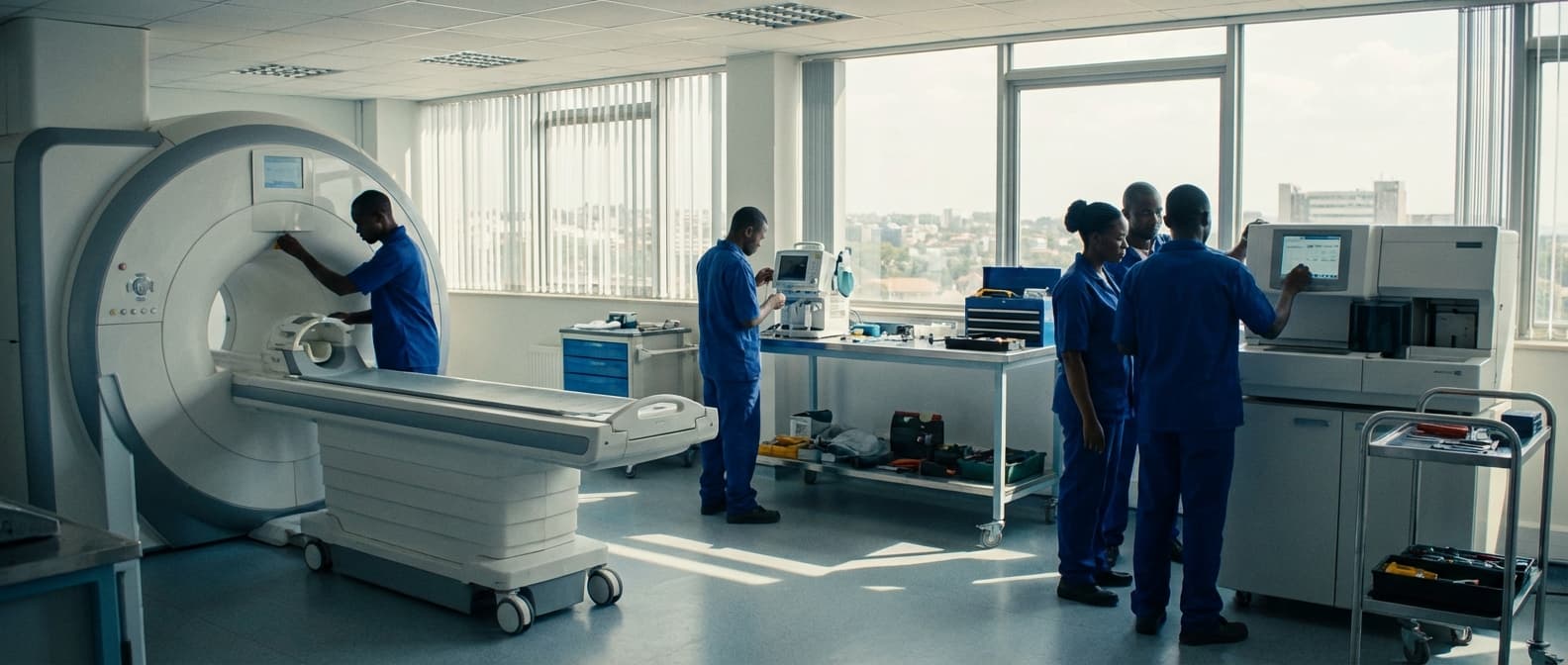
Annual Maintenance Contract (AMC) Management Service (Labor-Only) in Uganda
Engineering Excellence & Technical Support
Annual Maintenance Contract (AMC) Management Service (Labor-Only) High-standard technical execution following OEM protocols and local regulatory frameworks.
Proactive Preventative Maintenance Scheduling
Our Uganda-based AMC service leverages advanced scheduling tools to meticulously plan and execute preventative maintenance tasks. We minimize downtime and prevent costly breakdowns by adhering to optimized maintenance calendars tailored to your specific equipment and operational needs.
Certified & Localized Technical Expertise
Gain peace of mind with our team of certified, Ugandan technicians. Their deep understanding of local operating conditions and regulatory compliance ensures efficient and effective labor-only maintenance, addressing your unique challenges with specialized skill and dedication.
Transparent Work Order & Reporting System
We provide a transparent and detailed work order system for all labor provided. You'll receive comprehensive reports on completed tasks, labor hours, and any recommendations, ensuring full visibility and accountability for your AMC investment in Uganda.
What Is Annual Maintenance Contract (Amc) Management Service (Labor-only) In Uganda?
Annual Maintenance Contract (AMC) Management Service (Labor-Only) in Uganda refers to a specialized outsourced service focused on the administration and execution of labor-intensive maintenance activities for an organization's assets, as defined within an Annual Maintenance Contract. This service excludes the provision of spare parts, materials, consumables, or any components that would typically fall under a comprehensive or full-service AMC. The core offering is the skilled human resource capacity and the management thereof, ensuring scheduled and unscheduled maintenance tasks are performed according to the agreed contractual terms and service level agreements (SLAs). This service is crucial for organizations in Uganda seeking to optimize their operational efficiency, maintain asset reliability, and control maintenance expenditures without the administrative burden of managing a direct maintenance workforce or engaging in the procurement of materials.
The service involves the planning, scheduling, deployment, supervision, and reporting of qualified technicians and engineers to perform specific maintenance operations. This encompasses preventive maintenance (PM), corrective maintenance (CM), and sometimes predictive maintenance (PdM) tasks. The vendor provides the necessary labor, tools (where applicable and agreed), and expertise, while the client retains responsibility for procuring and supplying all required spare parts and consumables. The scope is strictly defined by the labor component of the AMC.
| Typical Use Cases | Description of Service Application |
|---|---|
| Industrial Machinery Maintenance: | Routine lubrication, inspection, calibration, and minor repairs of production machinery, assembly lines, and material handling equipment. This includes ensuring all labor for these tasks is provided, but the client supplies lubricants and specific wear parts. |
| **HVAC System Maintenance: | Scheduled checks, filter replacements, cleaning of coils, and basic troubleshooting of air conditioning, heating, and ventilation units in commercial buildings and facilities. The service covers technician labor for these tasks; filter media and refrigerant would be client-provided. |
| **Electrical Equipment Servicing: | Preventive inspections of transformers, switchgear, generators, and distribution panels, including cleaning, tightening connections, and basic functional tests. Labor for these inspections and minor adjustments is provided; any replacement fuses, breakers, or minor electrical components are supplied by the client. |
| **IT Infrastructure Support (Hardware Maintenance): | On-site labor for routine checks, cleaning, and minor troubleshooting of servers, network devices, and workstations. This excludes the replacement of faulty hardware components, which would be managed and supplied by the client. |
| **Building & Facility Maintenance: | Labor for scheduled checks of elevators, escalators, plumbing systems, and basic structural inspections. This covers the personnel for the maintenance activities, with consumables like seals or minor repair materials being the client's responsibility. |
| **Telecommunications Tower & Equipment Maintenance: | Labor for visual inspections, cleaning, and routine checks of antennas, cables, and base station equipment. The provision of replacement cables, connectors, or specific electronic components remains with the client. |
Who Needs Annual Maintenance Contract (AMC) Management Service (Labor-Only) in Uganda?
- Organizations with significant capital investments in physical assets: This includes manufacturing plants, power generation facilities, telecommunications infrastructure, commercial buildings, and transportation companies.
- Companies seeking cost optimization for maintenance operations: By outsourcing labor management, organizations can reduce overheads associated with recruitment, training, benefits, and management of in-house maintenance staff.
- Businesses requiring specialized technical expertise: Accessing a pool of skilled technicians and engineers for specific equipment or systems that may not be readily available in-house.
- Entities with fluctuating maintenance demands: The service allows for flexible scaling of labor resources based on operational needs, without the commitment of permanent employment.
- Organizations prioritizing operational uptime and asset longevity: Ensuring regular and professional maintenance to minimize breakdowns and extend the lifespan of critical equipment.
- SMEs lacking dedicated maintenance departments: Providing access to professional maintenance services without the need to establish and manage a full-time team.
- Government agencies and public sector bodies: For managing maintenance of public infrastructure, utilities, and assets where specialized labor is required.
- Facilities management companies: Subcontracting labor-only AMC services to complement their broader facilities management offerings.
Who Needs Annual Maintenance Contract (Amc) Management Service (Labor-only) In Uganda?
In Uganda, businesses and organizations of all sizes can benefit from Annual Maintenance Contract (AMC) Management Services, particularly those that are labor-only focused. These services are designed to streamline the process of managing service providers, ensuring that equipment and infrastructure are consistently maintained without the business needing to hire and manage a full-time maintenance team. This is especially crucial for organizations where the cost and complexity of in-house maintenance are prohibitive or where specialized skills are required periodically.
| Customer Type | Key Need for Labor-Only AMC Management | Relevant Departments |
|---|---|---|
| SMEs | Cost-effective maintenance management, access to specialized skills without full-time hiring. | Operations, Administration, Procurement |
| Large Corporations | Centralized control over dispersed assets, standardization of maintenance practices, cost optimization. | Operations, Facilities Management, Procurement, IT |
| Government Agencies | Ensuring service continuity for public infrastructure, efficient use of public funds, compliance. | Operations, Facilities Management, Procurement, Administration |
| NGOs | Maximizing budget efficiency, focusing resources on core mission, reliable asset performance. | Operations, Administration, Finance |
| Educational Institutions | Maintaining optimal learning/research environments, managing diverse equipment, budget constraints. | Facilities Management, IT, Operations, Administration |
| Healthcare Facilities | Uninterrupted medical services, equipment reliability, patient safety, compliance with health regulations. | Operations, Engineering, IT, Facilities Management |
| Manufacturing & Industrial | Minimizing production downtime, ensuring machinery efficiency, proactive risk management. | Operations, Engineering, Facilities Management, Procurement |
Target Customers and Departments in Uganda for Labor-Only AMC Management Services
- {"items":["Small and Medium-sized Enterprises (SMEs): Often lack the resources for dedicated maintenance departments and can benefit from outsourced management of critical equipment upkeep.","Large Corporations: May have diverse and geographically dispersed assets, making centralized AMC management essential for efficiency and cost control.","Government Agencies & Public Institutions: Responsible for a wide range of public infrastructure and equipment, requiring reliable maintenance to ensure uninterrupted service delivery.","Non-Governmental Organizations (NGOs): Frequently operate with limited budgets and can leverage AMC management to optimize maintenance spending and focus on their core mission.","Educational Institutions (Schools, Universities): Rely on a variety of technical equipment and facilities that need regular servicing to support learning and research.","Healthcare Facilities (Hospitals, Clinics): Essential services depend on the continuous operation of specialized medical equipment, making proactive maintenance critical.","Manufacturing & Industrial Plants: Downtime can be extremely costly; efficient management of maintenance contracts for machinery is paramount.","Hospitality Sector (Hotels, Resorts): Guest experience is directly linked to the functioning of amenities, HVAC, and other systems, necessitating robust maintenance.","Real Estate Developers & Property Managers: Responsible for the upkeep of numerous properties, requiring efficient coordination of maintenance for various building systems.","Technology-Dependent Businesses: Organizations heavily reliant on IT infrastructure, telecommunications, and specialized software require consistent maintenance for optimal performance."],"title":"Target Customers"}
- {"items":["Operations Department: Directly responsible for the day-to-day functioning of equipment and facilities.","Facilities Management Department: Oversees the maintenance and upkeep of buildings, infrastructure, and related systems.","Procurement Department: Involved in sourcing and managing service contracts, including AMCs.","IT Department: Manages the maintenance of computer hardware, software, networks, and other technological assets.","Engineering Department: Often responsible for the technical aspects of equipment maintenance and repair.","Administration Department: May be involved in contract management, vendor liaison, and budget oversight for maintenance services.","Finance Department: Oversees budget allocation and expenditure for maintenance services.","Compliance Department: Ensures that maintenance activities meet regulatory and safety standards."],"title":"Target Departments"}
Annual Maintenance Contract (Amc) Management Service (Labor-only) Process In Uganda
This document outlines the typical workflow for an Annual Maintenance Contract (AMC) Management Service (Labor-Only) in Uganda, from initial customer inquiry to the successful execution of maintenance tasks. This process emphasizes clarity, efficiency, and customer satisfaction within the Ugandan context.
| Stage | Description | Key Activities | Key Stakeholders | Typical Timelines (Uganda) |
|---|---|---|---|---|
| Inquiry & Initial Consultation | The customer expresses interest in AMC services for their equipment or assets. | Receive inquiry (phone, email, website). Understand customer needs and asset details. Initial site visit (optional) for assessment. Discuss service scope (labor-only). | Prospective Customer, Service Provider Sales Team | 1-3 business days |
| Proposal & Quotation | The service provider prepares a detailed proposal and cost estimate based on the consultation. | Develop scope of work. Estimate labor hours and rates. Prepare formal proposal document. Include terms and conditions. Provide quotation. | Service Provider Technical Team, Sales Team, Prospective Customer | 2-5 business days |
| Contract Negotiation & Agreement | Both parties agree on the terms and conditions of the AMC. | Review proposal and quotation. Negotiate pricing, scope, service level agreements (SLAs), payment terms. Sign the AMC contract. Legal review (if necessary). | Prospective Customer, Service Provider Management, Legal (optional) | 3-10 business days (can vary significantly) |
| Onboarding & Asset Registration | Formalizing the client relationship and documenting the assets covered. | Client onboarding process. Detailed inventory and registration of all covered assets (make, model, serial number, location). Create maintenance history file for each asset. | Service Provider Operations Team, Customer's Facility Manager | 1-7 business days (post-contract signing) |
| Preventive Maintenance Planning | Scheduling routine maintenance to prevent breakdowns. | Develop a preventive maintenance schedule based on manufacturer recommendations and asset usage. Communicate schedule to the customer. Book technician availability. | Service Provider Operations Team, Customer's Facility Manager | Ongoing (quarterly/annually) |
| Reactive Maintenance (Breakdown Response) | Responding to unexpected equipment failures. | Receive breakdown notification from customer. Log the issue. Assess urgency. Dispatch technician. Provide estimated time of arrival (ETA). | Customer's Operations Team, Service Provider Operations Center/Dispatch | Immediate notification to dispatch (within 1-2 hours) |
| Execution of Maintenance Services | Performing scheduled preventive or unscheduled corrective maintenance. | Technician arrives on-site. Performs diagnostic checks. Carries out repairs/servicing using customer-provided parts (for labor-only). Tests equipment functionality. Obtains customer sign-off. | Service Provider Technicians, Customer's Equipment Operator | Varies based on complexity (e.g., 2-8 hours for routine tasks, longer for complex repairs) |
| Reporting & Documentation | Keeping records of all maintenance activities performed. | Generate service reports detailing work done, time spent, findings, and recommendations. Update asset maintenance history. Submit reports to the customer. | Service Provider Technicians, Service Provider Administration | Within 24-48 hours of service completion |
| Invoicing & Payment | Billing the customer for services rendered. | Generate invoices based on agreed rates and actual labor hours (or periodic AMC fees). Submit invoices to the customer's accounts department. Track payments and follow up on overdue invoices. | Service Provider Finance Department, Customer's Finance Department | Monthly/Quarterly, based on contract terms |
| Performance Review & Contract Renewal | Assessing the effectiveness of the AMC and planning for the future. | Conduct periodic performance reviews with the customer. Discuss feedback, identify areas for improvement. Initiate renewal discussions well in advance of contract expiry. Offer updated service packages. | Service Provider Management, Customer Management, Sales Team | 3-6 months before contract expiry |
Key Stages in AMC Management Service (Labor-Only) Workflow
- Inquiry & Initial Consultation
- Proposal & Quotation
- Contract Negotiation & Agreement
- Onboarding & Asset Registration
- Preventive Maintenance Planning
- Reactive Maintenance (Breakdown Response)
- Execution of Maintenance Services
- Reporting & Documentation
- Invoicing & Payment
- Performance Review & Contract Renewal
Annual Maintenance Contract (Amc) Management Service (Labor-only) Cost In Uganda
Managing Annual Maintenance Contracts (AMCs) for labor-only services in Uganda involves a nuanced approach to pricing. Unlike contracts that include parts or consumables, labor-only AMCs focus on the expertise, time, and skills of technicians and engineers. The cost is primarily driven by the complexity of the equipment or systems being maintained, the required skill level, the frequency of maintenance, and the geographical location of the service provider and client within Uganda. This service is crucial for ensuring the optimal performance, longevity, and reliability of various assets, from IT infrastructure and industrial machinery to building systems and specialized equipment.
Several key factors influence the pricing of labor-only AMC services in Uganda. These include:
- Type and Complexity of Equipment/Systems: High-tech, specialized, or critical equipment requiring advanced technical expertise will naturally command higher labor rates. Simple machinery or standard IT equipment will be less expensive to maintain.
- Skill Level and Experience of Technicians: The more specialized the skills, the higher the demand and thus the cost of the labor. Certified technicians or engineers with extensive experience in a particular field will have higher rates.
- Frequency and Scope of Maintenance: The number of scheduled visits per year (e.g., quarterly, semi-annually, annually) and the depth of the maintenance tasks (e.g., routine checks, diagnostic assessments, minor adjustments) directly impact the total labor hours and cost.
- Response Time and Availability: Contracts that guarantee rapid response times for emergency calls or offer 24/7 availability will incur premium pricing due to the on-call nature and potential for unscheduled work.
- Geographical Location: Service providers operating in major urban centers like Kampala might have slightly higher overheads, which could be reflected in their pricing compared to those in more rural areas. However, travel costs for remote locations can also significantly increase the overall AMC price.
- Duration of the Contract: Longer-term contracts often come with slight discounts compared to shorter, one-year agreements, as they provide service providers with more predictable revenue.
- Service Provider's Reputation and Overhead: Established companies with a strong reputation, robust support infrastructure, and comprehensive insurance may charge more for their services.
| Service Category | Estimated Annual Cost Range (UGX) | Typical Scope/Notes |
|---|---|---|
| Basic IT Support (Desktops, Laptops, Printers) | 250,000 - 800,000 | Scheduled check-ups, troubleshooting, basic software support, virus removal (labor only). |
| Network Infrastructure (Routers, Switches, Wi-Fi) | 400,000 - 1,500,000 | Performance monitoring, firmware updates, basic troubleshooting, cable checks (labor only). |
| Servers and Data Storage | 600,000 - 2,500,000+ | Hardware health checks, performance tuning, basic OS troubleshooting, preventive maintenance (labor only). |
| Office Equipment (Photocopiers, Projectors) | 150,000 - 500,000 | Scheduled cleaning, calibration, basic operational checks, troubleshooting minor issues (labor only). |
| Small Industrial Machinery/Tools | 500,000 - 2,000,000+ | Routine inspections, lubrication, minor adjustments, safety checks (labor only). |
| Building Systems (HVAC - Basic Checks) | 300,000 - 1,000,000 | Filter checks, basic operational tests, visual inspections (labor only). Extensive HVAC would be more. |
| Specialized Electronic Equipment (e.g., Medical, Lab) | 1,000,000 - 5,000,000+ | Requires highly specialized technicians, calibration, complex diagnostics (labor only). |
| On-Call/Emergency Response (per incident/hour, in addition to AMC) | 50,000 - 150,000 (hourly rate) | Separate charges for unscheduled emergency visits, often with a call-out fee. |
Factors Influencing Labor-Only AMC Costs in Uganda
- Type and Complexity of Equipment/Systems
- Skill Level and Experience of Technicians
- Frequency and Scope of Maintenance
- Response Time and Availability
- Geographical Location
- Duration of the Contract
- Service Provider's Reputation and Overhead
Affordable Annual Maintenance Contract (Amc) Management Service (Labor-only) Options
Our Affordable Annual Maintenance Contract (AMC) Management Service focuses on optimizing your labor costs for equipment and system upkeep. We provide a labor-only solution, allowing you to source your own parts and consumables, giving you maximum control and potential for significant savings. This approach is ideal for organizations seeking to reduce operational expenses without compromising on essential maintenance and support.
| Value Bundle | Description | Ideal For | Estimated Cost Savings (vs. Full-Service) |
|---|---|---|---|
| Basic Care Bundle | Covers routine preventive maintenance, scheduled inspections, and basic troubleshooting for non-critical equipment. | Organizations with in-house procurement capabilities and lower risk tolerance for critical system failures. | 15-30% Savings |
| Proactive Plus Bundle | Includes Basic Care plus enhanced performance monitoring, priority response for minor issues, and detailed maintenance reporting. | Businesses seeking a balance between cost control and enhanced operational oversight. | 20-40% Savings |
| Critical Support Bundle | Encompasses Proactive Plus features with guaranteed faster response times for critical equipment and emergency call-outs. | Companies with high-dependency systems where minimizing downtime is paramount. | 25-50% Savings |
Key Features of Our Labor-Only AMC Management Service
- Flexible Service Scope: Tailor maintenance schedules and types to your specific needs.
- Dedicated Technician Access: Access skilled professionals for routine checks, troubleshooting, and minor repairs.
- Preventive Maintenance Planning: Proactive scheduling to minimize unexpected downtime and costly emergency repairs.
- Emergency Support Options: Choose from tiered response times for critical issues.
- Performance Monitoring & Reporting: Receive regular updates on maintenance activities and equipment status.
- Parts Procurement Autonomy: You manage and purchase parts, allowing for competitive sourcing.
- Simplified Billing: Clear and transparent invoicing for labor services rendered.
Verified Providers In Uganda
In Uganda's burgeoning healthcare landscape, identifying truly verified and reputable providers is paramount for ensuring quality and safety. Franance Health stands out as a leading name, distinguished by its rigorous credentialing process and unwavering commitment to patient well-being. This dedication to excellence makes them a clear choice for individuals seeking reliable and high-standard healthcare services. Their comprehensive approach to provider verification goes beyond mere certification, encompassing a thorough evaluation of qualifications, experience, ethical practices, and adherence to international healthcare standards. This meticulous vetting process ensures that every healthcare professional associated with Franance Health is not only licensed and competent but also deeply committed to patient-centered care. Choosing Franance Health means opting for a healthcare experience built on trust, transparency, and a demonstrable track record of delivering exceptional medical outcomes.
| Credentialing Aspect | Franance Health's Approach | Benefit to Patients |
|---|---|---|
| Licensing and Certifications | Verified against official Ugandan medical council records and recognized international bodies. | Ensures providers meet minimum legal and professional standards of practice. |
| Educational Background | Confirmed degrees and training from accredited institutions. | Guarantees a strong foundational knowledge and specialized training. |
| Clinical Experience | Evaluated through references, past employer checks, and documented case reviews. | Provides confidence in the provider's practical skills and ability to handle diverse medical situations. |
| Ethical Standards and Professional Conduct | Screening for disciplinary actions and adherence to a strict code of ethics. | Promotes patient trust, respect, and protection from malpractice or misconduct. |
| Specialization Validation | Confirmation of specific training and experience in chosen medical fields. | Ensures patients are referred to and treated by the most appropriate experts for their condition. |
| Continuing Medical Education (CME) | Requirement and tracking of ongoing professional development. | Guarantees providers are up-to-date with the latest medical advancements and techniques. |
Why Franance Health Credentials Matter in Uganda
- Rigorous verification process for all healthcare professionals.
- Emphasis on up-to-date qualifications and continuous professional development.
- Thorough background checks and verification of past performance.
- Adherence to both national and international healthcare standards and best practices.
- Commitment to ethical conduct and patient-centered care principles.
- Access to a network of specialists and facilities with proven expertise.
- Transparent information regarding provider credentials and specializations.
- Enhanced patient safety through a selection of highly vetted medical practitioners.
Scope Of Work For Annual Maintenance Contract (Amc) Management Service (Labor-only)
This Scope of Work (SOW) outlines the labor-only services to be provided under an Annual Maintenance Contract (AMC) for the management of technical infrastructure. The objective is to ensure the optimal performance, reliability, and longevity of the client's assets through proactive and reactive maintenance activities executed by skilled personnel.
| Maintenance Category | Description | Frequency/Trigger | Standard Specification/Methodology |
|---|---|---|---|
| Preventive Maintenance (PM) | Scheduled inspections, cleaning, lubrication, calibration, and minor adjustments to prevent failures. | As per OEM recommendations or agreed PM schedule (e.g., daily, weekly, monthly, quarterly, annually). | Utilize manufacturer-provided checklists, industry best practices (e.g., ISO standards), and internal asset management protocols. Document all actions taken and readings recorded. |
| Corrective Maintenance (CM) | On-demand repair or replacement of faulty components or systems to restore functionality. | Upon equipment failure, malfunction, or customer reporting of an issue. | Swift diagnosis using standardized troubleshooting procedures, fault isolation techniques, and manufacturer-specific repair manuals. Use of genuine or approved replacement parts. |
| System Monitoring | Proactive monitoring of system parameters, performance metrics, and event logs to detect potential issues early. | Continuous (24/7 or as defined in SLA) or scheduled monitoring. | Utilize established network monitoring tools (e.g., SNMP, WMI), performance analysis software, and log aggregation platforms. Define alert thresholds and escalation procedures. |
| Troubleshooting & Diagnosis | Identifying the root cause of technical problems. | Upon identification of a fault or reported issue. | Apply systematic troubleshooting methodologies (e.g., divide and conquer, process of elimination). Utilize diagnostic tools and equipment relevant to the system/equipment. |
| Component Replacement | Replacing worn-out, damaged, or obsolete components. | As required during PM or CM. | Use of OEM-specified or equivalent quality replacement parts. Ensure proper installation and compatibility. |
| Software Updates & Patching | Applying necessary software updates and security patches to systems. | As released by vendors or scheduled by the client. | Pre-deployment testing in a sandbox environment (if feasible). Follow vendor guidelines for deployment. Document version control and successful application. |
| Configuration Management | Documenting and maintaining the current state of system configurations. | Upon initial setup, after significant changes, or as part of scheduled audits. | Utilize configuration management databases (CMDBs), version control systems, and standardized configuration templates. |
| Safety & Environmental Compliance | Ensuring all maintenance activities are conducted safely and in compliance with relevant regulations. | Throughout all maintenance activities. | Adherence to OSHA standards, local environmental laws, and client-specific safety policies. Use of Personal Protective Equipment (PPE) as required. |
| Reporting | Providing regular updates and detailed reports on maintenance activities and system status. | Daily, weekly, monthly, or as per SLA. | Standardized report templates covering work performed, issues found, resolutions, parts used, time spent, and recommendations. |
Technical Deliverables
- Regular preventive maintenance inspections and servicing of all covered equipment and systems.
- On-demand breakdown maintenance and repair services to address emergent issues.
- Troubleshooting and diagnosis of technical faults and malfunctions.
- Component replacement and repair as necessitated by wear and tear or failure.
- System health checks and performance monitoring reports.
- Software updates and patching for relevant systems (if applicable and within scope).
- Configuration management and documentation of system settings.
- Root Cause Analysis (RCA) reports for recurring or critical incidents.
- Emergency response and on-site support within agreed-upon Service Level Agreements (SLAs).
- Post-maintenance verification and testing to ensure full functionality.
- Logbook maintenance and recording of all service activities.
- Adherence to all safety protocols and environmental regulations during maintenance activities.
- Regular reporting on maintenance activities, issues encountered, and recommendations.
Service Level Agreement For Annual Maintenance Contract (Amc) Management Service (Labor-only)
This Service Level Agreement (SLA) outlines the response times and uptime guarantees for the Annual Maintenance Contract (AMC) Management Service, provided on a labor-only basis. It defines the expected performance standards for our service delivery to ensure timely and efficient support for your maintenance operations.
| Service Component | Priority Level | Response Time Target | Resolution Time Target (Best Effort) | Uptime Guarantee |
|---|---|---|---|---|
| AMC Planning & Scheduling Support | High (Critical System Downtime Prevention) | 1 Business Hour | 4 Business Hours | 99.5% |
| AMC Planning & Scheduling Support | Medium (Routine Maintenance Scheduling, Minor Adjustments) | 4 Business Hours | 2 Business Days | 99.5% |
| AMC Planning & Scheduling Support | Low (Information Requests, Non-Urgent Queries) | 8 Business Hours | 5 Business Days | 99.5% |
| Vendor Coordination & Communication | High (Urgent Vendor Engagement for Repairs) | 1 Business Hour | 2 Business Hours | 99.5% |
| Vendor Coordination & Communication | Medium (Routine Vendor Follow-ups, Status Updates) | 4 Business Hours | 1 Business Day | 99.5% |
| Vendor Coordination & Communication | Low (Information Gathering, General Inquiries) | 8 Business Hours | 3 Business Days | 99.5% |
| Documentation & Reporting (AMC Status, History) | High (Urgent Audit/Compliance Needs) | 4 Business Hours | 8 Business Hours | 99.5% |
| Documentation & Reporting (AMC Status, History) | Medium (Regular Performance Reviews, Trend Analysis) | 1 Business Day | 3 Business Days | 99.5% |
| Documentation & Reporting (AMC Status, History) | Low (Ad-hoc Report Requests) | 2 Business Days | 5 Business Days | 99.5% |
| Proactive Monitoring & Risk Identification | All | Real-time alerts to designated personnel | N/A | 99.5% |
| Platform Availability (AMC Management System) | All | N/A | N/A | 99.5% |
| Communication Channels (Email, Designated Portal) | All | N/A | N/A | 99.5% |
Key Service Level Objectives
- Response Time: The time taken by our support team to acknowledge and begin addressing a reported issue or request.
- Resolution Time: The time taken to resolve a reported issue or complete a requested task to a satisfactory level.
- Uptime Guarantee: The percentage of time the AMC management platform and associated communication channels are available and operational.
- Escalation Procedures: Defined steps for raising critical issues to higher support tiers when initial response or resolution targets are not met.
Frequently Asked Questions

Ready when you are
Let's scope your Annual Maintenance Contract (AMC) Management Service (Labor-Only) in Uganda project in Uganda.

Scaling healthcare logistics and technical systems across the entire continent.