
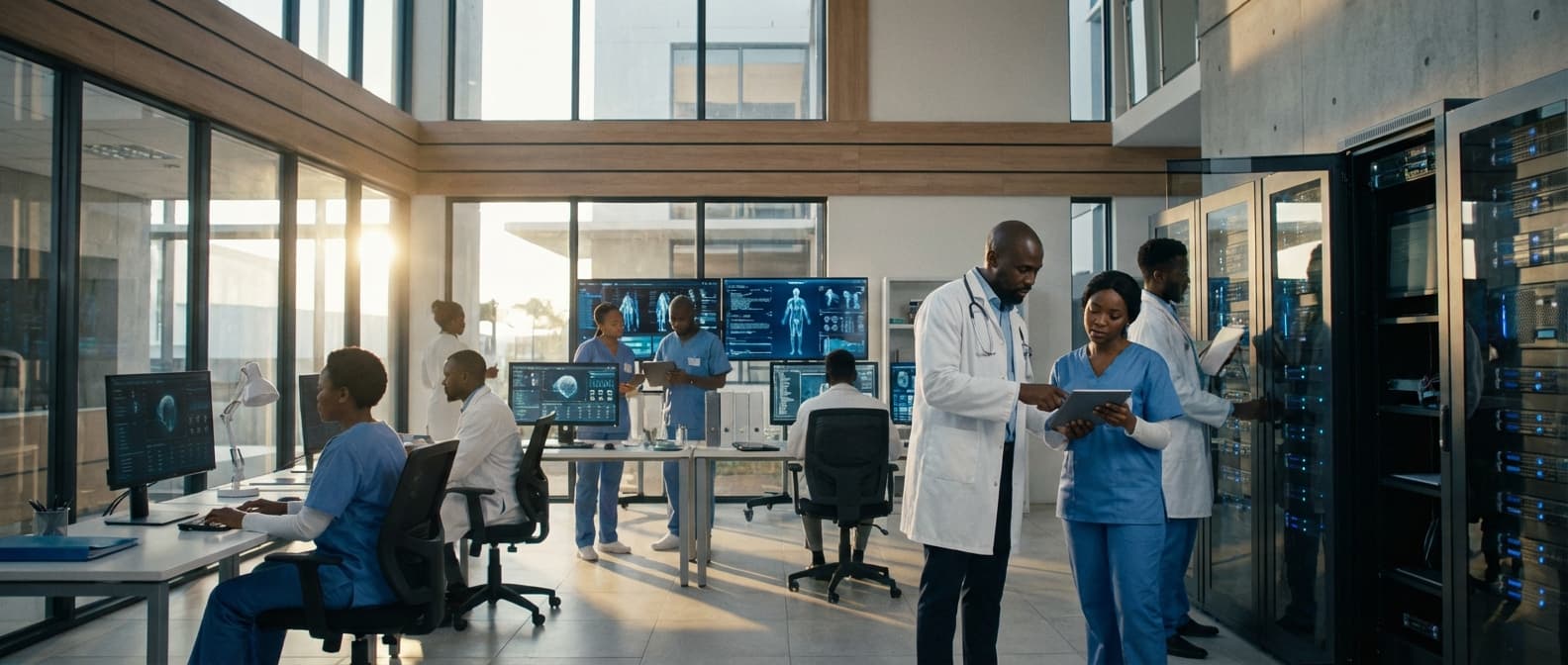
Tele-Radiology in Uganda
Engineering Excellence & Technical Support
24/7 access to certified radiologists providing rapid, accurate remote interpretation of diagnostic imaging studies. High-standard technical execution following OEM protocols and local regulatory frameworks.
Expanding Access to Diagnostic Imaging
Tele-radiology services bridge geographical gaps, enabling remote communities across Uganda to access vital diagnostic imaging reports. This empowers local healthcare providers with timely and accurate interpretations, crucial for patient diagnosis and treatment planning.
Strengthening Local Radiologist Expertise
Through remote collaboration and image sharing, Ugandan radiologists can consult with international specialists, participate in continuing education, and gain exposure to diverse case studies. This fosters skill development and elevates the overall quality of radiology services within the country.
Optimizing Resource Utilization in Healthcare Facilities
Tele-radiology reduces the need for on-site specialized radiologists, especially in underserved areas. This allows healthcare facilities to optimize their existing infrastructure and human resources, focusing on patient care while ensuring efficient and cost-effective access to expert radiological interpretations.
What Is Tele-radiology In Uganda?
Tele-radiology in Uganda refers to the practice of transmitting radiological images (such as X-rays, CT scans, and MRIs) from one geographical location to another for the purpose of radiological interpretation. This service leverages telecommunications technology to enable radiologists to review and report on these images remotely, thereby overcoming geographical barriers and improving access to diagnostic imaging services, particularly in underserved areas. The core of this service involves a robust IT infrastructure for image acquisition, secure transmission, storage, and interpretation.
| Who Needs Tele-Radiology? | Typical Use Cases in Uganda | |||||||
|---|---|---|---|---|---|---|---|---|
| Patients in Rural and Remote Areas: Limited or no access to on-site radiologists, requiring travel to urban centers for interpretation. | Emergency Department Consultations: Rapid interpretation of critical imaging studies (e.g., head CT for stroke, chest X-ray for trauma) when a radiologist is not immediately available at the facility. | Primary Healthcare Centers: Facilities that possess imaging equipment but lack dedicated radiological expertise for interpretation. | Tertiary Referral Hospitals: Augmenting existing radiology departments with specialized expertise or managing high workloads. | Understaffed Radiology Departments: Addressing shortages of radiologists, particularly in public health institutions. | Specialty Consultations: Facilitating access to subspecialty radiologists (e.g., neuroradiology, pediatric radiology) for complex cases. | Screening Programs: Efficiently managing large volumes of images generated by public health screening initiatives (e.g., tuberculosis screening via chest X-rays). | On-call Services: Providing 24/7 radiological interpretation, especially for critical care and emergency cases. | Training and Education: Enabling junior radiologists or radiographers to receive real-time feedback and training from experienced mentors. |
Key Components and Stakeholders of Tele-Radiology in Uganda
- Image Acquisition: Standard radiological equipment (X-ray machines, CT scanners, MRI scanners) at remote or local healthcare facilities.
- Image Transmission: Secure and high-speed internet connectivity (fiber optics, VSAT) for efficient transfer of large image files (DICOM format).
- Picture Archiving and Communication System (PACS): A system for storing, retrieving, managing, and distributing medical images.
- Radiological Information System (RIS): A system for managing radiology data, including patient scheduling, billing, and reporting.
- Remote Reading Stations: Workstations equipped with high-resolution medical displays and specialized software for radiologists to interpret images.
- Radiologists: Licensed medical professionals specializing in the interpretation of medical images, working remotely or at a central hub.
- Referring Physicians: Healthcare professionals who order radiological examinations and receive the interpretation reports.
- Healthcare Facilities: Hospitals, clinics, and health centers, both public and private, that provide diagnostic imaging services.
Who Needs Tele-radiology In Uganda?
Tele-radiology, the practice of interpreting medical images remotely, offers a significant opportunity to bridge the gap in radiology services across Uganda. While major urban centers may have existing radiology departments, numerous rural and underserved areas struggle with a severe shortage of qualified radiologists. This deficit leads to delayed diagnoses, inadequate patient care, and a reliance on general practitioners for image interpretation, often resulting in misdiagnosis or missed findings. Tele-radiology can democratize access to expert radiological interpretation, ensuring that patients in remote locations receive the same quality of diagnostic services as those in the cities. This technology can also serve as a vital training and support tool for existing healthcare professionals, enhancing their diagnostic capabilities and fostering a more robust radiology ecosystem within the country.
| Customer Segment | Key Needs | Benefits of Tele-Radiology |
|---|---|---|
| Rural Hospitals & Health Centers | Access to expert interpretation, reduced referral times, improved patient outcomes. | Bridging the radiologist shortage, faster diagnosis, enhanced patient care, reduced patient travel. |
| District & Regional Hospitals | Increased capacity, specialized interpretation for complex cases, support for general practitioners. | Improved diagnostic accuracy, reduced workload for existing staff, access to subspecialty expertise. |
| Private Clinics & Diagnostic Centers | Cost-effective access to radiology services, wider range of imaging modalities support, competitive service offering. | Eliminates the need for in-house radiologists, provides a scalable solution, enables offering comprehensive diagnostic services. |
| Emergency Departments | 24/7 availability of expert interpretation, rapid turnaround times for critical imaging. | Faster decision-making in emergencies, improved management of trauma and acute conditions, potential for life-saving interventions. |
| Maternity/Obstetrics | Timely and accurate interpretation of ultrasounds, improved prenatal care, management of complications. | Enhanced maternal and fetal health monitoring, early detection of abnormalities, better management of high-risk pregnancies. |
| Surgical & Oncology Departments | Pre-operative planning, post-operative monitoring, accurate staging and treatment response assessment. | Optimized surgical planning, improved patient management, more effective cancer treatment strategies. |
| Public Health Programs | Extending diagnostic reach to remote populations, supporting screening programs (e.g., TB). | Increased access to diagnostics for underserved communities, enhanced public health surveillance and intervention. |
Target Customers and Departments for Tele-Radiology in Uganda
- Hospitals in Rural and Remote Areas: These facilities often lack in-house radiologists and rely on general practitioners or travel to distant centers for image interpretation.
- District and Regional Hospitals: Even in areas with some medical infrastructure, the demand for radiology services can outstrip the available expertise.
- Private Clinics and Diagnostic Centers: Smaller, independent facilities that cannot afford to employ full-time radiologists can leverage tele-radiology for their imaging needs.
- Maternity and Obstetric Units: Crucial for prenatal care and managing obstetric emergencies, requiring timely interpretation of ultrasounds and other imaging.
- Emergency Departments/Accident & Emergency (A&E) Units: Rapid diagnosis of trauma, fractures, and acute medical conditions is critical, and tele-radiology can provide immediate expert input.
- Surgical Departments: Pre-operative planning and post-operative monitoring often rely heavily on radiological imaging.
- Oncology Departments: Accurate staging and monitoring of cancer progression require expert radiological analysis.
- Pediatric Departments: Specialized interpretation of pediatric imaging is essential for accurate diagnosis and treatment planning in children.
- Infectious Disease Control Units: Diagnosis and monitoring of conditions like tuberculosis (TB) and other widespread infectious diseases often involve chest X-rays and other imaging modalities.
- Public Health Initiatives and Mobile Clinics: Tele-radiology can extend diagnostic reach to populations served by mobile health units or during public health campaigns.
- Medical Training Institutions: To supplement teaching and provide real-time case studies for radiology residents and medical students.
Tele-radiology Process In Uganda
Tele-radiology in Uganda is a growing field aimed at extending access to diagnostic imaging services, particularly in remote or underserved areas. The process typically involves a referring healthcare facility initiating an inquiry, followed by the transmission of medical images, interpretation by a radiologist, and the delivery of a diagnostic report back to the referring facility. This workflow ensures that patients receive timely and accurate diagnoses, even when specialized radiologists are not physically present at their local healthcare centers.
| Stage | Description | Key Actors | Technology/Tools | Challenges |
|---|---|---|---|---|
| Inquiry & Referral Initiation | A patient presents with symptoms requiring radiological imaging. The local clinician determines the need for a radiology report and initiates a request for tele-radiology services. | Referring Clinician, Patient, Local Healthcare Facility Staff | Patient records, Referral forms | Lack of awareness of tele-radiology services, clinician training on appropriate referrals |
| Image Acquisition & Preparation | Medical images (X-ray, CT, MRI, Ultrasound) are acquired using available equipment at the referring facility. Images are then anonymized and prepared for digital transmission. | Radiographer/Technician, Local Healthcare Facility IT Staff | Imaging equipment (X-ray machine, CT scanner, MRI scanner, Ultrasound), DICOM software, PACS (Picture Archiving and Communication System) at the local facility | Outdated or malfunctioning imaging equipment, inconsistent image quality, lack of trained radiographers, limited PACS infrastructure |
| Image Transmission | The digital medical images are securely transmitted from the referring facility to the tele-radiology service provider. This is often done via a secure internet connection or a dedicated network. | Local Healthcare Facility IT Staff, Tele-radiology Service Provider IT Staff | Secure internet connectivity, VPNs (Virtual Private Networks), Tele-radiology software platforms, Cloud-based PACS | Unreliable internet connectivity, low bandwidth, data security concerns, high transmission costs |
| Radiologist Assignment & Review | Upon receiving the images, the tele-radiology platform assigns the case to an available and qualified radiologist. The radiologist reviews the images and patient clinical information. | Tele-radiology Platform Administrator, Radiologist | Tele-radiology platform software, PACS at the service provider, workstation with high-resolution monitors | Radiologist workload, availability of specialized radiologists for complex cases, language barriers if applicable |
| Report Generation | The radiologist interprets the images and dictates or types a comprehensive diagnostic report, including findings, impressions, and recommendations. | Radiologist, Medical Transcriptionist (if applicable) | Speech recognition software, typing software, reporting templates | Accuracy of interpretation, completeness of reports, time taken for report generation |
| Report Delivery & Action | The final diagnostic report is transmitted back to the referring healthcare facility. The referring clinician reviews the report and incorporates it into the patient's management plan. | Tele-radiology Service Provider, Referring Clinician, Local Healthcare Facility Staff | Secure communication channels, Electronic Health Records (EHR) integration, fax (less common) | Delays in report delivery, lack of integration with local EHR systems, clinician understanding of the report |
| Quality Assurance & Feedback | Processes are in place to ensure the quality of interpretations and reports. Feedback mechanisms allow referring clinicians to provide input on the service. | Tele-radiology Service Provider Management, Referring Clinician | Quality control audits, feedback forms, performance metrics | Lack of standardized quality control measures, limited formal feedback loops, difficulty in tracking long-term patient outcomes |
Tele-Radiology Workflow in Uganda: From Inquiry to Execution
- Inquiry & Referral Initiation
- Image Acquisition & Preparation
- Image Transmission
- Radiologist Assignment & Review
- Report Generation
- Report Delivery & Action
- Quality Assurance & Feedback
Tele-radiology Cost In Uganda
Tele-radiology services in Uganda are still an emerging field, and pricing can vary significantly based on several factors. The cost is primarily influenced by the complexity of the imaging modality, the subspecialty of the radiologist required, the turnaround time for the report, and the provider's operational overhead. As the adoption of tele-radiology grows, it's expected that pricing will become more standardized. Currently, most pricing is negotiated directly with healthcare providers or institutions.
| Service Type (Typical Modality) | Estimated Cost Range (UGX) | Notes |
|---|---|---|
| X-ray Interpretation | 80,000 - 250,000 | Standard X-rays (chest, limb, etc.). May vary for specialized views. |
| Ultrasound Interpretation (General) | 100,000 - 300,000 | Includes abdominal, pelvic, and superficial scans. Obstetric scans might have slightly different pricing. |
| CT Scan Interpretation (Basic) | 250,000 - 700,000 | Covers basic CTs like head, chest, abdomen without contrast or complex reconstructions. |
| MRI Scan Interpretation (Basic) | 500,000 - 1,500,000+ | Basic MRIs (e.g., knee, lumbar spine). Costs escalate for brain, abdominal, or specialized MRIs. |
| Subspecialty Interpretation (Per Study) | 150,000 - 500,000+ | Additional to the base modality cost, depending on the subspecialty and complexity. |
| Urgent/Expedited Reporting Fee | 50,000 - 150,000 | Added fee for reports required within a few hours (e.g., 1-4 hours). |
Key Factors Influencing Tele-Radiology Costs in Uganda
- Imaging Modality: X-rays are generally the least expensive, followed by ultrasounds, CT scans, and then MRIs, which are the most costly due to equipment and expertise requirements.
- Subspecialty Expertise: Reports requiring a subspecialist (e.g., neuroradiology, pediatric radiology, musculoskeletal radiology) will command higher fees than general radiology reads.
- Turnaround Time (TAT): Expedited reporting for urgent cases typically incurs an additional charge. Standard reporting times are more economical.
- Volume of Work: Healthcare facilities with a higher volume of imaging studies may be able to negotiate bulk discounts or lower per-study rates.
- Technology Infrastructure: The cost of implementing and maintaining the necessary IT infrastructure for secure image transmission and reporting can be factored into pricing, especially for smaller providers.
- Provider's Location and Overhead: Whether the tele-radiology provider is based locally in Uganda or operates remotely from an international hub can impact costs due to differences in operational expenses and currency exchange rates.
- Service Package: Some providers offer bundled services that might include reporting, consultations, and even basic PACS (Picture Archiving and Communication System) solutions, affecting the overall cost.
Affordable Tele-radiology Options
Tele-radiology offers a flexible and often cost-effective solution for medical imaging interpretation. Affordable tele-radiology options are becoming increasingly accessible, especially for smaller practices, rural hospitals, and organizations facing radiologist shortages. Key to understanding these options are 'value bundles' and strategic cost-saving measures that optimize resource utilization and financial outlay. Value bundles in tele-radiology are typically pre-defined service packages that offer a set of services for a fixed price, often providing more predictable budgeting and potentially lower overall costs compared to per-study billing. Cost-saving strategies involve leveraging technology, optimizing workflow, and choosing providers that align with specific budget constraints and service needs.
| Value Bundle Type | Description | Potential Cost Savings |
|---|---|---|
| All-Inclusive Monthly Package | Covers unlimited reads (or a very high volume) for specific modalities (e.g., X-ray, CT, MRI) within a defined period, often including 24/7 coverage. | Predictable budgeting, significant discounts for high volume, reduced administrative overhead of per-study billing. |
| Triage & After-Hours Bundle | Focuses on initial review of studies during non-business hours or for flagging critical findings, with in-house radiologists handling definitive reads. | Lower per-study cost compared to full interpretation, efficient use of in-house resources. |
| Specialty-Specific Bundles | Packages tailored to specific imaging specialties like neuroradiology, musculoskeletal, or mammography. | Potentially better pricing for specialized needs, access to sub-specialists at a predictable cost. |
| Tiered Volume Packages | Pricing scales down as the monthly or quarterly volume of studies increases, with defined thresholds for discounts. | Direct cost savings for practices with growing or high imaging volumes. |
| Technology & Service Bundles | Includes tele-radiology interpretation along with integrated PACS viewer, reporting tools, and technical support. | Streamlined workflow, reduced IT burden, potential for consolidated vendor management. |
Key Cost-Saving Strategies for Affordable Tele-Radiology
- Negotiate Package Deals (Value Bundles): Instead of paying per image or per study, explore providers offering bundled services for a fixed monthly or annual fee. These bundles might include a certain volume of studies, specific modality coverage (e.g., X-ray, CT, MRI), or 24/7 coverage. Bundles can provide significant discounts for predictable volumes.
- Volume-Based Pricing: If your practice has a consistent and high volume of studies, negotiate tiered pricing where the cost per study decreases as the volume increases.
- Off-Peak Hours & Triage Services: Consider using tele-radiology services for after-hours reads or to triage less complex cases, allowing your in-house or contracted radiologists to focus on more critical interpretations. Some providers offer lower rates for off-peak hours.
- Dedicated vs. Shared Radiologist Pools: Understand the provider's model. A dedicated radiologist pool might offer more personalized service but could be more expensive. Shared pools, where radiologists read for multiple clients, can be more cost-effective due to economies of scale.
- Technology Integration & Workflow Optimization: Choose providers with seamless integration capabilities with your existing PACS (Picture Archiving and Communication System) and EMR (Electronic Medical Record) systems. Efficient workflow reduces turnaround times and associated costs.
- Focus on Specific Modalities or Specialties: If you only need interpretation for certain types of imaging (e.g., basic X-rays), look for providers specializing in those areas, as they may offer more competitive pricing.
- Leverage AI-Powered Triage and Preliminary Reads: Some tele-radiology solutions incorporate AI to flag critical findings or perform preliminary reads. This can speed up the process and allow human radiologists to focus on confirmation and detailed interpretation, potentially reducing the overall reading time and cost per study.
- Consider Offshore vs. Onshore Providers (with caution): While offshore providers may offer lower prices, carefully evaluate their quality, turnaround times, and compliance with regulatory standards (e.g., HIPAA). Onshore providers might have higher costs but often offer better communication and regulatory adherence.
- Long-Term Contracts & Commitment: Providers may offer discounts for longer-term service agreements. Weigh the benefits of potential cost savings against the flexibility of shorter contracts.
- Data Security & Compliance: Ensure any chosen provider has robust security measures and is fully compliant with relevant regulations. While not a direct cost-saving strategy, non-compliance can lead to significant penalties and reputational damage.
Verified Providers In Uganda
In Uganda's evolving healthcare landscape, identifying reliable and credentialed providers is paramount for ensuring quality care. Franance Health stands out as a leading organization, distinguished by its rigorous credentialing process and commitment to excellence. This dedication to verification makes Franance Health the optimal choice for individuals and organizations seeking trustworthy healthcare services in Uganda.
| Credentialing Area | Franance Health's Approach | Benefit to Patients |
|---|---|---|
| Professional Licenses & Certifications | Verification of all current and valid licenses and certifications from recognized bodies. | Ensures providers are legally qualified and meet industry standards. |
| Education & Training | Thorough review of academic records and postgraduate training. | Guarantees a strong foundation of knowledge and specialized skills. |
| Work History & Experience | Verification of past employment and detailed assessment of relevant clinical experience. | Confirms practical application of skills and ability to handle diverse medical situations. |
| Professional References | Contact and evaluation of professional references from peers and supervisors. | Provides insights into a provider's performance, reliability, and collegiality. |
| Background Checks | Comprehensive checks to ensure a clean professional record. | Safeguards against any history of malpractice or unethical conduct. |
| Specialty Competency | Assessment of specific competencies for specialized medical fields. | Ensures patients receive care from truly expert specialists. |
Why Franance Health is the Best Choice:
- Rigorous Credentialing: Franance Health employs a multi-stage credentialing process that goes beyond basic requirements, meticulously vetting each healthcare professional and facility.
- Focus on Expertise and Experience: We prioritize providers with proven track records, specialized skills, and a deep understanding of the Ugandan healthcare context.
- Commitment to Ethical Practices: All Franance Health-affiliated providers adhere to strict ethical guidelines, ensuring patient well-being and trust.
- Patient-Centric Approach: Our network comprises professionals dedicated to delivering compassionate, accessible, and high-quality care tailored to individual needs.
- Continuous Quality Improvement: Franance Health actively monitors and evaluates its providers to maintain the highest standards of healthcare delivery.
Scope Of Work For Tele-radiology
This document outlines the Scope of Work (SOW) for the provision of Tele-Radiology services. It details the technical deliverables expected from the service provider and the standard specifications that must be adhered to. The objective is to ensure seamless integration, high-quality image interpretation, and efficient workflow for remote radiological assessments.
| Specification Category | Parameter | Requirement | Compliance Standard/Metric |
|---|---|---|---|
| Image Transmission | Protocol | DICOM (Digital Imaging and Communications in Medicine) | DICOM Part 10 |
| Image Transmission | Security | Encrypted transmission (TLS 1.2 or higher) | AES-256 encryption |
| Image Transmission | Bandwidth Requirement | Minimum 5 Mbps per concurrent user (negotiable based on study volume) | Latency < 200ms for real-time interaction |
| Reporting System | Report Format | Structured reporting with predefined templates and free text capability | HL7 integration for report push to EMR/EHR |
| Reporting System | Turnaround Time (TAT) | Routine: 24 hours; Urgent: 2-4 hours; STAT: 1 hour (from image receipt to report availability) | Service Level Agreement (SLA) dependent |
| Reporting System | Digital Signature | Secure, auditable digital signature for all reports | HIPAA/GDPR compliant |
| Workstations | Monitor Resolution | Minimum 3MP for grayscale and 8MP for color diagnostic displays | Grayscale: 2048x1536; Color: 3840x2160 |
| Workstations | Calibrations | Regular luminance and contrast calibration | DICOM Part 14 compliant |
| Platform Security | Access Control | Role-based access control (RBAC) with strong authentication | Multi-factor authentication (MFA) recommended |
| Platform Security | Data Storage | Secure, encrypted storage of images and reports | HIPAA/GDPR compliant data centers |
| Platform Security | Auditing | Comprehensive audit logs of all user activities | Logs retained for minimum 7 years |
| Integration | PACS Integration | Bidirectional HL7 and DICOM integration | Testing with client's PACS environment |
| Integration | EMR/EHR Integration | Bi-directional HL7 integration for patient demographics and report retrieval | API documentation provided |
Technical Deliverables
- Secure and reliable tele-radiology platform for image transmission and reporting.
- Integration capabilities with existing PACS (Picture Archiving and Communication System) and EMR/EHR (Electronic Medical Record/Electronic Health Record) systems.
- High-resolution medical image viewing workstations with appropriate diagnostic monitors.
- Real-time communication tools (video conferencing, chat) for radiologist-clinician collaboration.
- Robust data security and HIPAA/GDPR compliance measures.
- Comprehensive audit trails and reporting functionalities.
- Scalable infrastructure to accommodate fluctuating workload demands.
- 24/7 technical support and maintenance for the platform and associated hardware.
- Disaster recovery and business continuity plan.
- Training and ongoing support for clinical staff utilizing the tele-radiology platform.
Service Level Agreement For Tele-radiology
This Service Level Agreement (SLA) outlines the performance expectations and guarantees for the tele-radiology services provided by [Provider Name] to [Client Name]. It covers critical aspects like report turnaround times and system availability.
| Service Component | Service Level Objective (SLO) | Measurement Method | Reporting Frequency | Remedy/Service Credit |
|---|---|---|---|---|
| Routine Reads (Non-Urgent) | 95% of reports delivered within 48 business hours. | Time of report finalization (timestamp) vs. time of image upload (timestamp). | Monthly | 2% service credit for each 1% deviation below the 95% SLO for a given month. |
| STAT Reads (Urgent) | 98% of reports delivered within 60 minutes from the time of critical alert confirmation. | Time of report finalization (timestamp) vs. time of critical alert confirmation (timestamp). | Monthly | 5% service credit for each 1% deviation below the 98% SLO for a given month. |
| System Uptime | 99.9% availability of the tele-radiology platform (viewing, reporting, and communication modules). | Monitoring of platform accessibility via automated tools, excluding scheduled maintenance. | Monthly | For every hour or partial hour of downtime exceeding 0.1% of monthly availability, a 1% service credit will be applied. |
| Image Upload Success Rate | 99.5% successful image uploads to the platform. | Tracking of image transfer success from PACS to tele-radiology platform. | Monthly | 1% service credit for each 0.5% deviation below the 99.5% SLO. |
| Data Security and Privacy | Adherence to HIPAA and other relevant data protection regulations. | Regular security audits, penetration testing, and incident response reports. | Quarterly (or upon incident) | Breach remediation at provider's expense, potential contract termination for repeated severe violations. |
Key Performance Indicators (KPIs)
- Report Turnaround Time (TAT)
- System Uptime
- Data Security and Compliance
- Image Quality
Frequently Asked Questions

Ready when you are
Let's scope your Tele-Radiology in Uganda project in Uganda.

Scaling healthcare logistics and technical systems across the entire continent.