
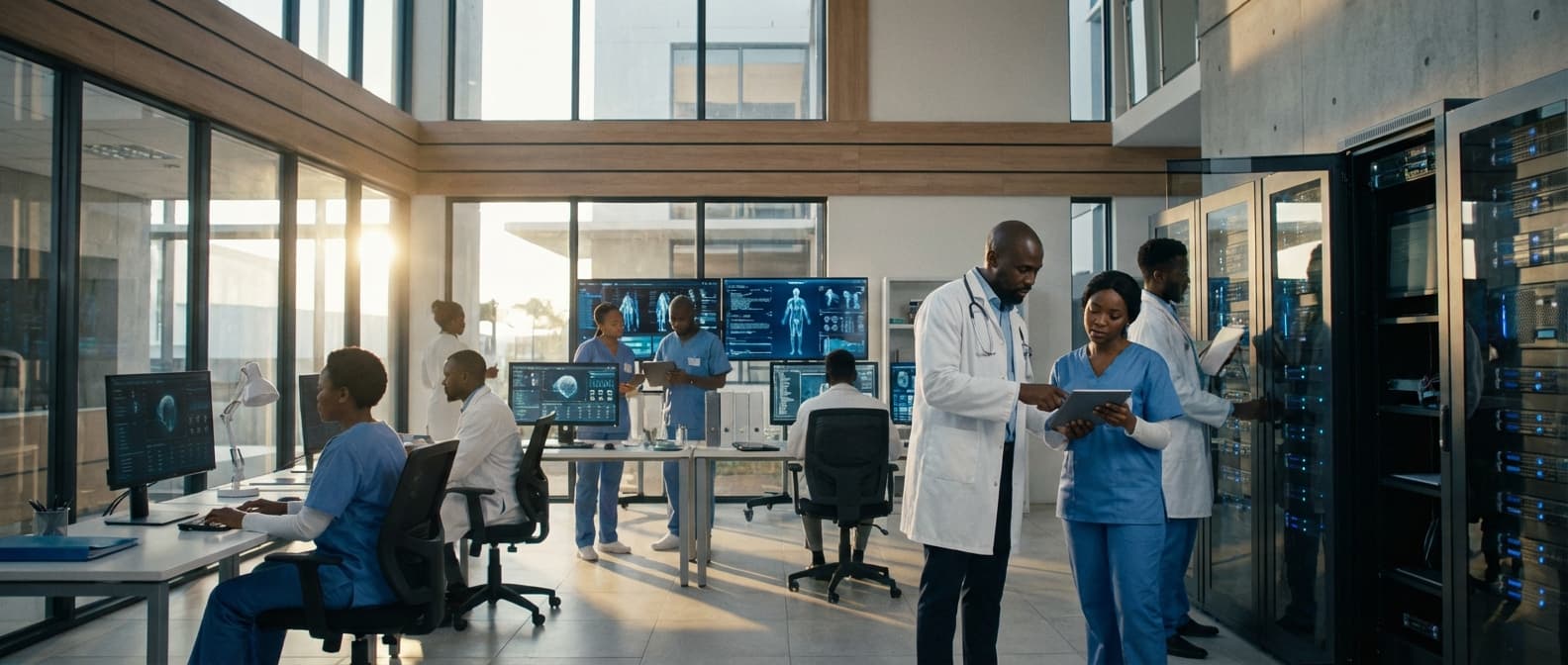
Medical IT Consultation in Uganda
Engineering Excellence & Technical Support
Strategic technology consulting to optimize healthcare operations, streamline workflows, and integrate cutting-edge medical information systems. High-standard technical execution following OEM protocols and local regulatory frameworks.
Robust Data Security & Compliance
We implement and fortify medical IT infrastructure with advanced security measures, ensuring compliance with Uganda's data privacy regulations and international standards to protect sensitive patient information.
Scalable EMR/EHR System Deployment
Our expertise lies in deploying and optimizing Electronic Medical Record (EMR) and Electronic Health Record (EHR) systems tailored for the Ugandan healthcare landscape, enhancing efficiency, accessibility, and data integrity.
Reliable Healthcare Network Infrastructure
We design and manage resilient and secure network infrastructures for hospitals and clinics, ensuring seamless communication, system uptime, and reliable access to critical healthcare applications across Uganda.
What Is Medical It Consultation In Uganda?
Medical IT Consultation in Uganda refers to the provision of expert advice and strategic guidance on the implementation, optimization, and management of information technology (IT) systems within healthcare organizations. This service is critical for enhancing operational efficiency, improving patient care outcomes, ensuring data security, and facilitating regulatory compliance in the Ugandan healthcare landscape. It encompasses a broad spectrum of IT-related challenges and opportunities specific to the local context, including infrastructure assessment, software selection and deployment, cybersecurity strategy development, health data analytics, and digital transformation roadmapping. The objective is to leverage technology effectively to address the unique needs and constraints of Ugandan healthcare providers, ranging from large public hospitals to smaller private clinics and non-governmental organizations.
| Who Needs Medical IT Consultation in Uganda? | Typical Use Cases |
|---|---|
| Hospitals (Public and Private): Seeking to modernize patient management, improve diagnostic capabilities, enhance administrative efficiency, and comply with evolving healthcare standards. | Implementing or upgrading Electronic Health Records (EHR) systems; establishing Picture Archiving and Communication Systems (PACS) for medical imaging; optimizing hospital information systems (HIS) for billing, inventory, and scheduling. |
| Clinics and Health Centers: Aiming to digitize patient records, streamline appointment scheduling, improve communication with patients, and gain better insights into patient demographics and health trends. | Adopting cloud-based practice management software; setting up secure patient portals; implementing basic IT infrastructure for record keeping and communication. |
| Non-Governmental Organizations (NGOs) and Faith-Based Organizations (FBOs): Working on public health initiatives, often in resource-constrained settings, requiring efficient data management for program monitoring, impact assessment, and reporting to donors. | Developing data collection and reporting systems for disease surveillance; implementing mobile health (mHealth) solutions for remote patient monitoring and outreach programs; establishing IT infrastructure for project management and coordination. |
| Ministry of Health and Regional Health Authorities: Requiring strategic IT planning for national health programs, data standardization, interoperability between different health facilities, and the development of national health information systems. | Designing and implementing national health information exchange platforms; developing policies for health data security and privacy; strategizing for the nationwide rollout of digital health initiatives. |
| Medical Training Institutions: Needing to integrate digital learning tools, manage student records, and provide students with exposure to modern healthcare IT practices. | Setting up virtual learning environments; implementing student information systems; providing access to digital medical resources and simulation software. |
Key Components of Medical IT Consultation in Uganda
- Needs Assessment and Gap Analysis: Evaluating existing IT infrastructure, workflows, and challenges to identify areas for improvement and strategic alignment with organizational goals.
- Technology Strategy Development: Formulating a comprehensive IT roadmap that aligns with the organization's mission, vision, and operational objectives, considering scalability and future growth.
- System Selection and Procurement: Advising on the selection and acquisition of appropriate hardware, software (e.g., Electronic Health Records - EHRs, Picture Archiving and Communication Systems - PACS), and network solutions, factoring in budget constraints and local support availability.
- Implementation and Integration: Overseeing the deployment of new IT systems and ensuring seamless integration with existing infrastructure and workflows to minimize disruption.
- Cybersecurity and Data Protection: Developing and implementing robust security policies, protocols, and technologies to safeguard sensitive patient data and comply with relevant data privacy regulations.
- Network Infrastructure Design and Management: Optimizing network architecture, connectivity, and bandwidth to ensure reliable and secure access to IT resources.
- Health Information Exchange (HIE) and Interoperability: Facilitating the secure and efficient sharing of health information between different healthcare entities and systems.
- IT Governance and Policy Development: Establishing clear IT governance frameworks, policies, and procedures to ensure accountability, compliance, and effective resource management.
- Training and Capacity Building: Providing training to healthcare staff on the effective use of new technologies and fostering digital literacy within the organization.
- Disaster Recovery and Business Continuity Planning: Developing strategies and plans to ensure the continued operation of critical IT systems in the event of unforeseen disruptions or emergencies.
Who Needs Medical It Consultation In Uganda?
In Uganda's rapidly evolving healthcare landscape, medical IT consultation is becoming indispensable for organizations seeking to optimize their operations, enhance patient care, and ensure data security. The demand spans a diverse range of healthcare providers and governmental bodies.
| Customer Type | Key Departments/Needs | Specific IT Challenges/Opportunities |
|---|---|---|
| Public Hospitals | Administration, Clinical Departments (e.g., Wards, OPD, ER), Pharmacy, Laboratory, Records Management, IT Department | Legacy system integration, EMR/EHR implementation, Network infrastructure upgrades, Data security & privacy (HIPAA compliance considerations), Telemedicine feasibility, Training for diverse user base, Budget constraints. |
| Private Hospitals & Larger Clinics | All departments, with emphasis on Patient Registration, Billing, Pharmacy, Laboratory, Radiology, Surgery, Administration, IT Management | Advanced EMR/EHR customization & integration, PACS/RIS implementation, Inventory management, CRM for patient engagement, Cybersecurity, Cloud migration strategy, Business intelligence & analytics, Scalability for growth. |
| Small to Medium Clinics & Health Centers | Front Desk/Reception, Clinical Staff, Pharmacy, Records | Affordable EMR/EHR solutions, Basic networking & Wi-Fi, Data backup & recovery, Digital appointment scheduling, Telehealth pilot programs, Training on new technologies, Cost-effective hardware upgrades. |
| Pharmacies | Inventory Management, Sales & POS, Records, Pharmacy Management Software | Stock control optimization, Prescription management, Integration with healthcare providers, Compliance with regulations, Customer loyalty programs, E-commerce integration. |
| Diagnostic Laboratories | Sample Tracking, LIMS (Laboratory Information Management System), Reporting, Billing, IT Support | Streamlining sample workflow, Accurate result reporting, Integration with EMRs, Data integrity & audit trails, Barcoding & automation, Remote access to results. |
| Medical Research Institutions | Data Management, Research IT Support, Analytics, Collaboration Tools, Secure Data Storage | Secure storage & management of sensitive research data, Statistical analysis software implementation, Data sharing platforms, Collaboration tools for dispersed teams, Compliance with research ethics & data governance. |
| Government Health Ministries/Agencies | Public Health Surveillance, Health Information Systems, Data Analysis, Policy Development, IT Infrastructure | Developing national health information systems (e.g., DHIS2 customization & scaling), Disease surveillance & outbreak response IT support, Data standardization & interoperability, Training for regional health workers, Cybersecurity for national health data, E-health strategy development. |
| NGOs in Health | Program Management, Data Collection, M&E (Monitoring & Evaluation), Field Operations IT | Developing mobile data collection tools, Setting up IT infrastructure in remote areas, Data analysis for impact assessment, Training for field staff, Secure data management for donor reporting, E-learning platforms for capacity building. |
| Healthcare Insurance Providers | Claims Processing, Policy Management, Customer Service, Data Analytics, IT Security | Automating claims processing, Secure handling of patient and policy data, CRM for member engagement, Data analytics for risk assessment & fraud detection, Integration with healthcare provider systems, Compliance with financial and health regulations. |
| Medical Training Institutions | IT Infrastructure for learning, E-learning Platforms, Simulation Labs, IT Support for Students & Faculty | Implementing and managing Learning Management Systems (LMS), Providing robust Wi-Fi and network access, Setting up and maintaining simulation software and hardware, Cybersecurity for student data, IT support for blended learning environments. |
Target Customers & Departments
- Hospitals (Public & Private)
- Clinics & Health Centers
- Pharmacies
- Diagnostic Laboratories
- Medical Research Institutions
- Government Health Ministries/Agencies
- Non-Governmental Organizations (NGOs) in Health
- Healthcare Insurance Providers
- Medical Training Institutions
Medical It Consultation Process In Uganda
The Medical IT Consultation Process in Uganda outlines the structured workflow followed by IT service providers when engaging with healthcare facilities. This process ensures that client needs are thoroughly understood, appropriate solutions are designed and implemented, and ongoing support is provided. The workflow typically begins with an initial inquiry and culminates in the successful execution and maintenance of IT systems tailored to the unique demands of the Ugandan healthcare sector.
| Stage | Description | Key Activities | Deliverables |
|---|---|---|---|
| Inquiry and Initial Contact | The healthcare facility or relevant stakeholder reaches out to an IT service provider with a need or interest in medical IT solutions. | Initial phone call, email, or website contact. Understanding the basic nature of the inquiry. | Acknowledgement of inquiry, preliminary information gathering. |
| Needs Assessment and Requirements Gathering | A deep dive into the specific IT challenges, goals, and existing infrastructure of the healthcare facility. | On-site visits, stakeholder interviews, review of existing systems, documentation analysis. | Detailed needs assessment report, documented functional and technical requirements. |
| Solution Design and Proposal Development | Based on the gathered requirements, the IT provider designs a tailored IT solution. | Conceptualizing hardware, software, network infrastructure, and security measures. Cost estimation, timeline planning. | Technical solution design document, comprehensive project proposal with budget and timeline. |
| Client Review and Approval | The healthcare facility reviews the proposed solution and budget, providing feedback and making a decision. | Presentation of proposal, Q&A sessions, negotiation of terms. | Signed contract or letter of agreement. |
| Implementation and Deployment | The IT solution is installed, configured, and made operational within the healthcare facility. | Hardware installation, software deployment and configuration, network setup, data migration (if applicable). | Fully installed and configured IT systems. |
| Testing and Quality Assurance | Ensuring the implemented solution functions as per requirements and is free of defects. | Unit testing, integration testing, user acceptance testing (UAT). | Test reports, bug tracking and resolution logs. |
| Training and Handover | Educating the healthcare facility's staff on how to use and manage the new IT systems. | Developing training materials, conducting training sessions, providing user manuals. | Trained staff, comprehensive user manuals and documentation. |
| Post-Implementation Support and Maintenance | Ongoing assistance and system upkeep to ensure continued functionality and address any emerging issues. | Helpdesk support, system monitoring, software updates, hardware maintenance, security patching. | Service Level Agreements (SLAs), ongoing support tickets and resolutions, system performance reports. |
Medical IT Consultation Workflow Stages
- Inquiry and Initial Contact
- Needs Assessment and Requirements Gathering
- Solution Design and Proposal Development
- Client Review and Approval
- Implementation and Deployment
- Testing and Quality Assurance
- Training and Handover
- Post-Implementation Support and Maintenance
Medical It Consultation Cost In Uganda
The cost of medical IT consultation in Uganda is influenced by a variety of factors, making it challenging to provide a single fixed price. These consultations are crucial for healthcare facilities looking to optimize their technology infrastructure, implement electronic health records (EHRs), enhance cybersecurity, or improve overall IT efficiency. The pricing structure typically reflects the expertise of the consultant, the complexity of the project, the duration of the engagement, and the specific services required. Understanding these elements is key to budgeting effectively for medical IT solutions in Uganda.
| Service Category | Estimated Price Range (UGX) | Notes |
|---|---|---|
| Initial IT Assessment/Audit | 500,000 - 2,500,000 | Covers a basic review of existing IT infrastructure, systems, and processes. May involve a short on-site visit. |
| EHR/HIS System Selection & Planning | 1,000,000 - 5,000,000 | Includes needs analysis, vendor research, system evaluation, and preliminary planning. Can be more if detailed RFPs are involved. |
| EHR/HIS Implementation & Customization (per module/phase) | 3,000,000 - 15,000,000+ | Highly variable. Depends on the chosen EHR, customization needs, data migration complexity, and the number of users. This is often a significant investment. |
| Cybersecurity Assessment & Strategy | 1,000,000 - 7,000,000 | Includes vulnerability scanning, policy review, and developing a roadmap for security improvements. |
| Network Design & Optimization | 700,000 - 4,000,000 | Focuses on improving connectivity, speed, and reliability of the network. |
| Data Migration Services | 1,500,000 - 10,000,000+ | Depends on the volume and complexity of data being transferred from old systems to new. |
| IT Staff Training (per session/group) | 500,000 - 2,000,000 | Covers training on specific software, hardware, or IT best practices. |
| Project Management (ongoing, monthly retainer) | 2,000,000 - 10,000,000+ | For consultants overseeing larger IT projects, often a percentage of the project cost or a fixed monthly fee. |
| Hourly Consultation Rate (Expert) | 150,000 - 500,000 | For ad-hoc advice, troubleshooting, or specific expert opinions. This rate can vary significantly based on the consultant's seniority. |
Key Pricing Factors for Medical IT Consultation in Uganda:
- Consultant's Expertise and Experience: Highly specialized consultants with a proven track record in healthcare IT, particularly within the Ugandan context, will command higher rates. This includes experience with local regulations, common healthcare challenges, and existing IT landscapes.
- Scope and Complexity of the Project: A simple IT audit will be less expensive than a comprehensive EHR implementation or the development of a custom healthcare management system. The number of systems to be integrated, the size of the facility, and the specific technological requirements all contribute to complexity.
- Duration of Engagement: Consultations can range from a few hours for an initial assessment to several months for large-scale project management and implementation. The longer the engagement, the higher the overall cost.
- Specific Services Required: This can include needs assessments, system selection and procurement, EHR/HIS implementation and customization, data migration, cybersecurity assessments and implementation, network design and optimization, IT policy development, and staff training. Each service has its own associated cost.
- Geographic Location and Travel: While most consultations might be conducted remotely or on-site within a major city like Kampala, travel to more remote areas or extensive on-site work can incur additional travel and accommodation expenses.
- Technology Stack and Vendor Relationships: If the consultation involves specific proprietary software or hardware, the consultant's familiarity and potential partnerships with those vendors might influence pricing.
- Urgency of the Project: Expedited consultations or project timelines may sometimes involve premium charges.
- Market Demand and Competition: The availability of skilled medical IT consultants in Uganda and the level of competition among them can also impact pricing.
Affordable Medical It Consultation Options
Navigating the complexities of medical IT can be daunting, especially for practices seeking cost-effective solutions. Fortunately, various affordable medical IT consultation options exist. These often revolve around understanding and leveraging value bundles and implementing smart cost-saving strategies. Value bundles typically package a set of IT services and support at a predetermined price, offering predictability and often a discount compared to individual service purchases. Cost-saving strategies focus on optimizing existing resources, adopting cloud-based solutions, and prioritizing essential IT needs. By carefully considering these approaches, medical practices can secure robust and reliable IT infrastructure without breaking the bank.
| Cost-Saving Strategy | Description | Potential Benefit |
|---|---|---|
| Leverage Cloud-Based Solutions | Migrate data, applications, and services to cloud platforms (e.g., EHR, practice management software, email). | Reduces upfront hardware investment, offers scalability, and often lowers ongoing maintenance costs. |
| Prioritize Essential IT Needs | Focus consultation on critical systems first (e.g., EHR, patient portal) and defer non-essential upgrades. | Manages budget by addressing the most impactful IT requirements initially. |
| Negotiate Vendor Contracts | Actively review and negotiate terms with current and potential IT vendors for better pricing or service level agreements. | Secures more favorable rates and potentially improved service quality. |
| Implement Managed IT Services (MSP) Bundles | Subscribe to bundled IT support packages that cover proactive maintenance, monitoring, and helpdesk services. | Predictable monthly costs, reduced downtime through proactive support, and access to expertise. |
| Utilize Open-Source Software (where appropriate) | Explore open-source alternatives for certain software needs (e.g., office suites, some server management tools). | Eliminates licensing fees, though may require more internal technical expertise for implementation and support. |
| Phased Technology Upgrades | Instead of a complete overhaul, plan and implement IT upgrades in stages based on budget and necessity. | Spreads capital expenditure over time, making it more manageable for smaller practices. |
| Remote Workforce Support Planning | If applicable, develop a cost-effective strategy for supporting remote employees and telehealth services. | Minimizes the need for extensive on-site infrastructure and potentially reduces office space requirements. |
Key Value Bundle Components in Medical IT Consultation
- Remote IT Support & Helpdesk: On-demand technical assistance for troubleshooting hardware, software, and network issues.
- Proactive System Monitoring & Maintenance: Continuous oversight of servers, workstations, and network devices to prevent issues before they arise.
- Cybersecurity Essentials: Basic measures like antivirus management, firewall configuration, and security awareness training.
- Data Backup & Disaster Recovery Planning: Regular backups and a tested plan to restore data in case of an emergency.
- Software Patching & Updates: Ensuring all systems are running the latest, most secure versions of their software.
- Vendor Management: Assistance in coordinating with third-party IT vendors for specialized services.
- HIPAA Compliance Guidance: Basic advisory services to help practices meet regulatory requirements.
Verified Providers In Uganda
In Uganda's evolving healthcare landscape, identifying truly verified and high-quality healthcare providers is paramount for patient safety and effective treatment. Franance Health stands out as a leading organization committed to establishing and maintaining rigorous standards for medical professionals and facilities. This dedication to verification and quality assurance makes Franance Health a trusted partner for individuals seeking the best possible medical care in Uganda.
| Credential/Aspect | Franance Health's Standard | Benefit to Patients |
|---|---|---|
| Medical Licensure & Registration | Verification of current and valid licenses with the Uganda Medical and Dental Practitioners Council (UMDC) and relevant professional bodies. | Ensures providers are legally authorized to practice and meet minimum professional standards. |
| Educational Background & Qualifications | Thorough review of degrees, diplomas, and specialized training from accredited institutions. | Confirms providers possess the necessary foundational knowledge and expertise. |
| Clinical Experience & Specialization | Assessment of years of practical experience and specific areas of expertise. | Helps patients identify specialists best suited for their condition. |
| Professional Ethics & Conduct | Adherence to a strict code of medical ethics and a system for reporting and addressing misconduct. | Promotes a trustworthy and respectful patient-provider relationship. |
| Facility Standards (if applicable) | Evaluation of infrastructure, equipment, hygiene, and safety protocols in healthcare facilities. | Guarantees a safe and well-equipped environment for treatment. |
| Patient Feedback & Reviews | Incorporation of verified patient feedback mechanisms to gauge satisfaction and identify areas for improvement. | Provides real-world insights into provider performance and patient experience. |
Why Franance Health Credentials Matter in Uganda:
- Rigorous Vetting Process: Franance Health employs a comprehensive vetting process that goes beyond basic licensing. This includes scrutinizing educational qualifications, professional experience, peer reviews, and adherence to ethical guidelines.
- Commitment to Patient Safety: By ensuring that all listed providers meet stringent safety protocols and quality benchmarks, Franance Health significantly reduces the risk of medical errors and malpractice.
- Access to Specialized Expertise: Franance Health's network encompasses a wide range of specialists, allowing patients to find the most qualified professionals for their specific medical needs.
- Continuous Professional Development: The organization often emphasizes or encourages ongoing training and development for its accredited providers, ensuring they remain up-to-date with the latest medical advancements and best practices.
- Transparency and Trust: Franance Health's clear accreditation process and publicly available credentials foster transparency, building essential trust between patients and healthcare providers.
- Improved Healthcare Outcomes: The focus on verified and competent providers directly contributes to better diagnosis, treatment, and overall patient outcomes.
Scope Of Work For Medical It Consultation
This Scope of Work (SOW) outlines the services to be provided by [Consultant Name] (hereinafter referred to as "Consultant") to [Client Name] (hereinafter referred to as "Client") for Medical IT Consultation. The primary objective is to assess, recommend, and implement improvements to the Client's existing IT infrastructure and systems, focusing on enhancing operational efficiency, data security, regulatory compliance (e.g., HIPAA, HITECH), and patient care delivery. This SOW details the technical deliverables, standard specifications, and the overall engagement process.
| Deliverable | Description | Standard Specifications/Requirements | Timeline (Estimated) |
|---|---|---|---|
| Current State IT Assessment Report | Comprehensive analysis of existing hardware, software, network infrastructure, cybersecurity posture, and compliance adherence. | Includes network topology diagrams, asset inventory, vulnerability assessment findings, and current data flow mapping. Adherence to industry best practices for IT assessment. | Weeks 1-2 |
| Gap Analysis Report | Identifies discrepancies between the current state and desired future state, including regulatory requirements and organizational goals. | Prioritized list of risks and areas for improvement. Recommendations for addressing compliance gaps. | Week 3 |
| IT Strategy and Roadmap Document | Detailed plan for achieving the desired IT future state, including technology recommendations, budget estimates, and implementation timelines. | Includes recommendations for EMR/EHR optimization, telehealth solutions, data analytics platforms, cloud migration strategies, and cybersecurity enhancements. Aligned with organizational strategic objectives. | Weeks 4-6 |
| Vendor Selection Criteria and Evaluation Matrix | Guidelines for selecting new IT solutions and vendors, ensuring suitability for healthcare environments. | Criteria to include HIPAA compliance, interoperability, scalability, vendor support, and total cost of ownership. | Week 5 |
| System Design and Architecture Documentation | Detailed blueprints for proposed IT systems, including network architecture, server configurations, and software integration plans. | Clear documentation of system components, data flows, security controls, and disaster recovery mechanisms. Follows established IT architecture principles. | Weeks 7-9 |
| Implementation Plan | Step-by-step guide for deploying new systems and upgrading existing ones, including change management protocols. | Includes detailed tasks, responsibilities, dependencies, rollback procedures, and communication plans. Adheres to project management best practices. | Week 9 |
| Configured and Deployed Systems | Successful installation and configuration of recommended IT solutions (e.g., EMR/EHR modules, cybersecurity tools, network upgrades). | Systems configured according to approved design specifications, meeting performance benchmarks and security requirements. Verified through user acceptance testing (UAT). | Weeks 10-18 (dependent on scope) |
| Training Materials and Sessions | Development of user-friendly training materials and delivery of comprehensive training to Client staff. | Materials tailored to specific user roles and system functionalities. Training sessions to be interactive and outcome-oriented. | Weeks 19-20 |
| Post-Implementation Support Plan | Outline of ongoing support, maintenance, and troubleshooting procedures. | Includes service level agreements (SLAs) for issue resolution, proactive monitoring strategies, and escalation procedures. | Week 21 |
| Final Project Report and Recommendations | Summary of project outcomes, lessons learned, and ongoing recommendations for IT optimization. | Includes key performance indicators (KPIs) achieved, ROI analysis (if applicable), and strategic recommendations for future IT investments. | Week 22 |
Project Phases and Key Activities
- Phase 1: Discovery and Assessment
- Phase 2: Strategy and Planning
- Phase 3: Implementation and Integration
- Phase 4: Training and Handover
- Phase 5: Post-Implementation Support and Optimization
Service Level Agreement For Medical It Consultation
This Service Level Agreement (SLA) outlines the commitment of [Consultant Name/Company] (hereinafter referred to as "Provider") to [Client Name/Institution] (hereinafter referred to as "Client") regarding medical IT consultation services. This SLA specifies response times for critical issues and uptime guarantees for any managed services or systems directly provided and maintained by the Provider.
| Service Type | Priority Level | Response Time Guarantee | Resolution Target (Best Effort) |
|---|---|---|---|
| Medical IT Consultation (Issue Reporting) | Critical Incident | Within 1 hour during Business Hours; Within 2 hours outside Business Hours | N/A (Consultation is about diagnosis and recommendations, not direct resolution of external systems) |
| Medical IT Consultation (Issue Reporting) | High Priority Incident | Within 2 hours during Business Hours; Within 4 hours outside Business Hours | N/A |
| Medical IT Consultation (Issue Reporting) | Normal Priority Incident | Within 4 business hours during Business Hours | N/A |
| Managed Medical IT Services (if applicable) | Critical Incident | N/A (Response applies to reporting and initial assessment) | 99.5% Uptime during Business Hours; 99.0% Uptime 24x7 |
| Managed Medical IT Services (if applicable) | High Priority Incident | N/A (Response applies to reporting and initial assessment) | 99.8% Uptime during Business Hours; 99.5% Uptime 24x7 |
Key Definitions
- Critical Incident: An event that renders a critical medical system or service unusable, impacting patient care or business operations significantly.
- High Priority Incident: An event that significantly degrades the performance of a medical system or service, causing minor disruption to patient care or business operations.
- Normal Priority Incident: An event that causes minor inconvenience or affects non-critical systems and services.
- Business Hours: [Specify Business Hours, e.g., Monday to Friday, 8:00 AM to 5:00 PM, excluding public holidays].
- Uptime: The percentage of time that a specific managed service or system is available and operational, excluding scheduled maintenance.
- Scheduled Maintenance: Pre-planned downtime for system updates, upgrades, or repairs, communicated to the Client in advance.
Frequently Asked Questions

Ready when you are
Let's scope your Medical IT Consultation in Uganda project in Uganda.

Scaling healthcare logistics and technical systems across the entire continent.