
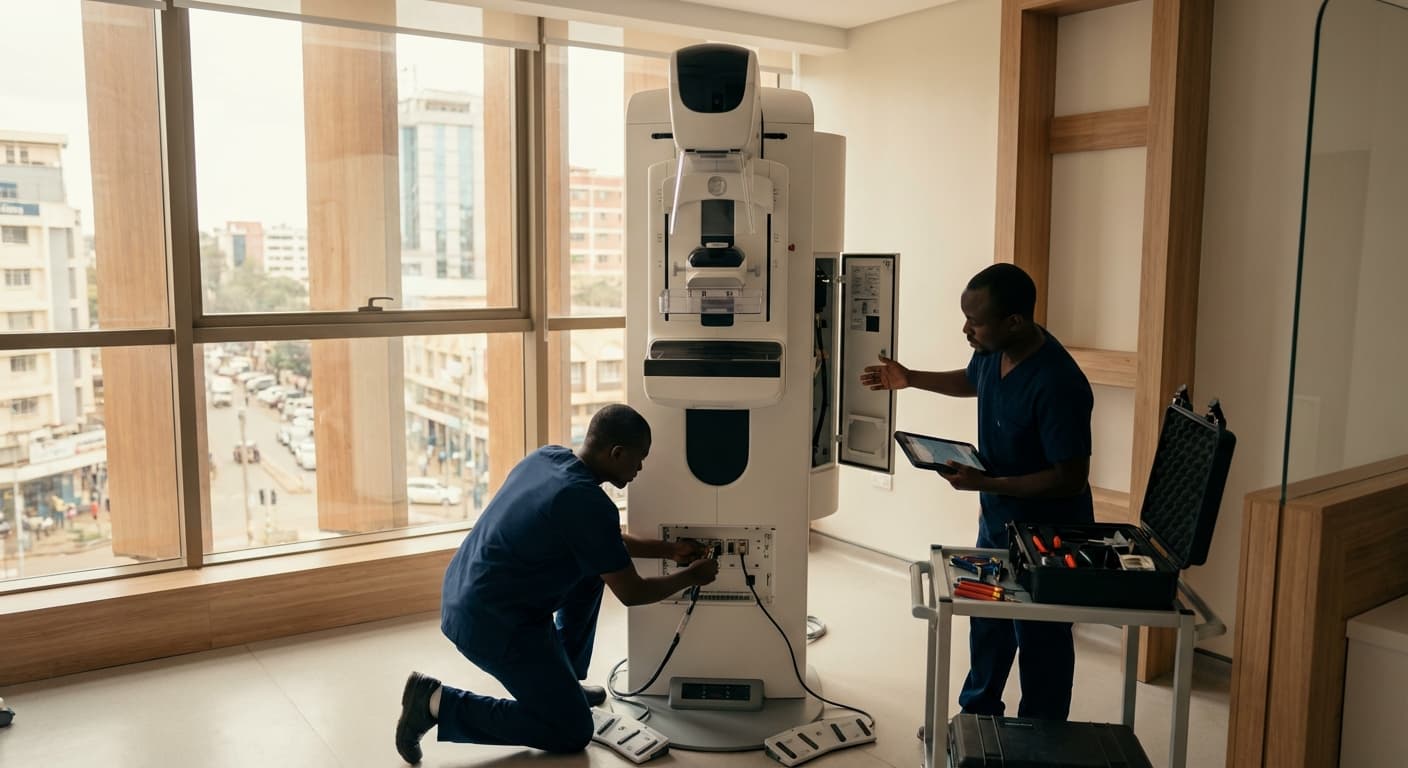
Mammography Installation Service in Uganda
Engineering Excellence & Technical Support
Mammography Installation Service High-standard technical execution following OEM protocols and local regulatory frameworks.
Advanced Imaging Calibration
Ensuring optimal image quality and diagnostic accuracy through meticulous calibration of state-of-the-art mammography equipment, adhering to international imaging standards.
Radiation Safety Compliance
Implementing robust radiation safety protocols and training for healthcare professionals, guaranteeing patient and staff well-being in line with Uganda's regulatory guidelines.
Seamless System Integration
Expert installation and integration of mammography units with existing PACS and RIS systems, facilitating efficient workflow, data management, and rapid reporting for enhanced patient care.
What Is Mammography Installation Service In Uganda?
Mammography Installation Service in Uganda refers to the comprehensive process of setting up, configuring, and validating mammography equipment within healthcare facilities across Uganda. This service ensures that advanced imaging technology for breast cancer screening and diagnosis is operational, calibrated, and compliant with local regulations and international standards. The primary objective is to enable accurate and reliable mammographic examinations, thereby enhancing early detection rates and improving patient outcomes for breast-related conditions.
| Who Needs Mammography Installation Service? | Typical Use Cases | |||||||
|---|---|---|---|---|---|---|---|---|
| Public and private hospitals | Screening mammography for asymptomatic individuals | Diagnostic mammography for evaluating suspicious findings | Breast imaging centers and specialized clinics | Research institutions and academic medical centers | Government health ministries and public health programs | Non-governmental organizations (NGOs) involved in women's health | Follow-up imaging for patients with a history of breast cancer | Interventional mammography (biopsy guidance) |
Key Components of Mammography Installation Service
- Site assessment and preparation
- Equipment delivery and unboxing
- Physical installation and integration
- Electrical and network connectivity setup
- Calibration and quality assurance testing
- Software installation and configuration
- User training and familiarization
- Documentation and certification
- Post-installation support and maintenance planning
Who Needs Mammography Installation Service In Uganda?
Mammography installation services are crucial for ensuring the proper functioning and accuracy of mammography equipment. This specialized service ensures that these vital diagnostic tools are set up correctly, calibrated to international standards, and integrated seamlessly into existing healthcare infrastructure. The need for such services in Uganda is driven by the increasing focus on early cancer detection and the expansion of diagnostic capabilities within the country's healthcare sector. Proper installation is not merely about physical placement; it encompasses technical expertise, adherence to safety protocols, and understanding of the specific environmental and power requirements of advanced medical imaging equipment. This directly impacts the reliability of diagnostic results and the overall patient care experience.
| Customer Type | Description of Need | Relevant Departments |
|---|---|---|
| Public Hospitals (e.g., Mulago National Referral Hospital) | Upgrading existing facilities, expanding diagnostic services, and ensuring equitable access to cancer screening for the general population. | Radiology, Oncology, Surgical, Biomedical Engineering |
| Private Hospitals & Clinics (e.g., Nakasero Hospital, Kampala Hospital) | Investing in advanced medical technology to offer comprehensive diagnostic services, attract patients, and maintain high standards of care. | Radiology, Oncology, Surgical, Administration/Procurement |
| Dedicated Diagnostic Imaging Centers | Establishing new centers or expanding existing ones to provide specialized imaging services, including mammography, to a wider patient base. | Radiology, Technical Operations, Quality Assurance |
| Cancer Treatment Foundations & NGOs (e.g., Uganda Cancer Institute, various cancer support groups) | Setting up or improving diagnostic capabilities as part of their broader mission to combat cancer through screening, diagnosis, and treatment. | Medical Services, Program Management, Technical Support |
| Ministry of Health/Government Health Programs | Implementing national cancer control strategies, equipping public health centers, and standardizing diagnostic equipment across the country. | Public Health, Planning & Investment, Biomedical Engineering Department |
Who Needs Mammography Installation Service in Uganda? Target Customers and Departments
- {"items":["Hospitals (Public and Private)","Diagnostic Imaging Centers","Specialized Cancer Treatment Centers","Non-Governmental Organizations (NGOs) focused on healthcare","Government Health Agencies (for public health facilities)"],"title":"Primary Target Customers"}
- {"items":["Radiology/Medical Imaging Department: This is the core department responsible for the operation of mammography machines and the interpretation of results.","Oncology Department: Clinicians in this department rely heavily on accurate mammography for diagnosis, staging, and monitoring of breast cancer patients.","Surgical Department (specifically Breast Surgery): Surgeons require reliable imaging for pre-operative planning and post-operative assessment.","Preventive Medicine/Screening Programs: Departments or units managing public health screening initiatives will require these services for new or upgraded equipment.","Procurement/Biomedical Engineering Department: These departments are responsible for acquiring and maintaining medical equipment, and thus will be involved in the installation process."],"title":"Key Departments within Target Institutions"}
Mammography Installation Service Process In Uganda
This document outlines the typical workflow for mammography installation services in Uganda, covering the entire process from initial client inquiry to the successful execution and handover of the installed equipment. The process is designed to ensure a smooth, efficient, and compliant installation that meets the specific needs of healthcare facilities.
| Stage | Description | Key Activities | Responsible Parties | Typical Timeline (Days/Weeks) |
|---|---|---|---|---|
| Initial Inquiry and Consultation | The client expresses interest in a mammography installation service. This stage involves understanding their needs and providing initial information. | Contacting the service provider, initial discussion of requirements (type of mammography unit, facility capacity, budget), sharing brochures/information, initial site overview. | Client (Hospital/Clinic Management, Radiology Department), Service Provider (Sales/Technical Team) | 1-3 Days |
| Site Assessment and Planning | A thorough evaluation of the intended installation location to ensure it meets all technical and environmental requirements for the mammography equipment. | Site visit, measuring room dimensions, assessing power supply, ventilation, radiation shielding needs, environmental conditions (temperature, humidity), identifying access routes for equipment. | Service Provider (Technical Team, Project Manager), Client (Facility Engineer, Radiology Staff) | 3-7 Days |
| Quotation and Contract Finalization | Based on the assessment, a detailed proposal and quotation are provided, followed by contract negotiation and signing. | Developing a comprehensive quotation (equipment cost, installation fees, training, warranties), presenting the quotation, clarifying terms and conditions, legal review, contract signing. | Service Provider (Sales Team, Legal Department), Client (Procurement Department, Management) | 5-14 Days |
| Equipment Procurement and Logistics | The ordered mammography equipment is purchased and transported to the installation site in Uganda. | Placing the order with the manufacturer, coordinating shipping and customs clearance, arranging local transportation to the facility. | Service Provider (Procurement Department, Logistics Team), Manufacturer | 4-12 Weeks (variable based on equipment availability and shipping) |
| Pre-Installation Preparation | Ensuring the installation site is fully prepared and ready to receive the mammography equipment. | Civil works (if required for shielding or room modifications), electrical wiring and outlet installation, HVAC system checks, necessary infrastructure setup. | Client (Contractors, Facility Management), Service Provider (Supervising Team) | 2-6 Weeks (can run concurrently with logistics) |
| Installation and Setup | The physical installation and assembly of the mammography unit at the prepared site. | Unpacking and moving equipment into position, connecting components, installing software, initial configuration. | Service Provider (Installation Technicians, Biomedical Engineers) | 2-5 Days |
| Testing and Calibration | Rigorous testing and calibration of the mammography system to ensure optimal performance and safety. | Functional testing of all components, image quality checks, radiation output calibration, phantom testing, compliance with national safety standards. | Service Provider (Qualified Technicians, Medical Physicist if required) | 2-4 Days |
| Training and Handover | Providing comprehensive training to the client's staff on the operation and basic maintenance of the mammography unit. | Training sessions for radiologists, radiographers, and biomedical engineers, provision of user manuals and technical documentation, Q&A sessions, formal handover of the installed system. | Service Provider (Application Specialists, Technical Trainers), Client (Radiology Department, Biomedical Engineering Department) | 3-7 Days |
| Post-Installation Support and Maintenance | Ongoing support and maintenance services to ensure the continued reliable operation of the mammography equipment. | Warranty period support, scheduled preventive maintenance, emergency repair services, spare parts management, service contract management. | Service Provider (Service Department, Technical Support Team), Client (Facility Management, Biomedical Engineering) | Ongoing (as per service agreement) |
Key Stages of Mammography Installation Service in Uganda
- Initial Inquiry and Consultation
- Site Assessment and Planning
- Quotation and Contract Finalization
- Equipment Procurement and Logistics
- Pre-Installation Preparation
- Installation and Setup
- Testing and Calibration
- Training and Handover
- Post-Installation Support and Maintenance
Mammography Installation Service Cost In Uganda
Installing a mammography machine is a complex process that involves specialized expertise, equipment, and adherence to stringent regulations. The cost of mammography installation services in Uganda can vary significantly due to a multitude of factors. These include the type and brand of the mammography machine, the complexity of the installation site, the need for specialized electrical or structural modifications, and the service provider's experience and reputation. Additionally, the scope of the service, such as whether it includes calibration, initial training, or ongoing maintenance agreements, will impact the final price. It's crucial for healthcare facilities to obtain detailed quotes from reputable installation service providers to accurately budget for this essential medical equipment.
| Service Component | Estimated Cost Range (UGX) | Notes |
|---|---|---|
| **Basic Installation (Digital Mammography) | 8,000,000 - 15,000,000 | Includes machine placement, connection to power, basic functional checks. Assumes minimal site modifications. |
| **Standard Installation (Digital Mammography with Site Prep) | 12,000,000 - 25,000,000 | Includes basic installation plus minor electrical upgrades, basic shielding, and initial calibration. |
| **Advanced Installation (3D Tomosynthesis/High-End Digital) | 18,000,000 - 40,000,000+ | Involves more complex site modifications, advanced radiation shielding, specialized cooling, and extensive calibration. Can be significantly higher for extensive renovations or highly specialized equipment. |
| **Radiation Shielding (Per Room) | 3,000,000 - 8,000,000 | Cost varies based on the extent of shielding required (e.g., lead-lined walls, doors). |
| **Electrical Upgrades (Dedicated Circuit) | 1,000,000 - 3,000,000 | For dedicated, stable power supply if existing infrastructure is insufficient. |
| **Initial Calibration & Testing | 1,500,000 - 3,000,000 | Ensures accuracy and compliance. Often bundled with installation. |
| **On-site Training (Radiographers/Technicians) | 2,000,000 - 5,000,000 | Per session or per group, depending on the provider and scope. |
| **Travel & Accommodation (Out-of-Town) | Varies (Negotiable) | Dependent on distance and duration of the installation. |
Key Pricing Factors for Mammography Installation Services in Uganda:
- Type and Brand of Mammography Machine: Advanced digital mammography units (including 3D tomosynthesis) are generally more expensive to install than older analog or basic digital models.
- Site Preparation and Modifications: This can include structural reinforcement of the room, specialized lead shielding for radiation protection, and dedicated HVAC systems. The existing infrastructure of the facility plays a significant role here.
- Electrical Requirements: Mammography machines require dedicated, stable power supply with specific voltage and amperage. Upgrades or new installations of electrical infrastructure can add to the cost.
- Radiation Safety Compliance: Ensuring the installation meets all local and international radiation safety standards, including proper shielding and ventilation, is a critical and often costly component.
- Calibration and Testing: Professional calibration and rigorous testing by certified technicians are essential for accurate diagnosis and are included in installation costs.
- Initial Training: Providing comprehensive training for radiographers and technicians on the operation and maintenance of the new mammography unit is often part of the installation package.
- Geographical Location within Uganda: Travel and accommodation expenses for the installation team can vary depending on the remoteness of the facility.
- Service Provider's Reputation and Expertise: Highly experienced and certified installation companies may command higher fees due to their proven track record and specialized knowledge.
- Warranty and Maintenance Agreements: Some installation packages include extended warranties or initial maintenance contracts, which will influence the overall price.
- Ancillary Equipment: Costs related to integrating the mammography machine with Picture Archiving and Communication Systems (PACS) or other imaging networks.
Affordable Mammography Installation Service Options
Investing in a mammography unit is a critical step for any healthcare facility, ensuring vital diagnostic capabilities for patient care. However, the initial installation can represent a significant capital expense. This guide explores affordable mammography installation service options, focusing on value bundles and cost-saving strategies to make this essential technology more accessible. We'll delve into how bundled services can offer comprehensive solutions at a reduced overall cost and outline practical approaches to minimize expenses without compromising quality or compliance.
| Cost-Saving Strategy | Description | Potential Savings |
|---|---|---|
| Negotiate Bundle Discounts | Actively negotiate with installation service providers for discounts when purchasing a comprehensive package. Highlight your facility's long-term potential or multiple equipment needs. | Can range from 5% to 20% or more depending on the scope of the bundle. |
| Phased Installation Planning | Break down the installation into critical phases. If immediate full functionality isn't required, prioritize essential components and schedule less critical installations for a later date, potentially leveraging off-peak pricing. | Allows for better cash flow management and can potentially reduce rush fees. |
| Compare Independent vs. Manufacturer Services | While manufacturer-installed units offer manufacturer-specific expertise, independent third-party installers may offer more competitive pricing, especially for older or refurbished equipment. Ensure they are certified and experienced. | Can lead to significant cost differences, especially for non-OEM installations. |
| Lease vs. Purchase Considerations | Explore leasing options for mammography equipment. While not directly an installation cost, it can free up capital for installation services and often includes installation and maintenance in the lease agreement. | Reduces upfront capital expenditure, making installation costs more manageable within operational budgets. |
| Leverage Existing Infrastructure | If your facility has pre-existing infrastructure suitable for mammography (e.g., shielded rooms, adequate power), inform potential installers. This can reduce the scope and cost of modifications. | Minimizes construction or retrofitting costs. |
| Source Refurbished Equipment with Installation Packages | Purchasing certified refurbished mammography units often comes with bundled installation and warranty services at a lower price point than new equipment. | Significantly lower equipment and potential installation costs. |
| Consider Regional Installers | Smaller, regional installation companies may have lower overhead costs than national providers, potentially translating to more affordable service fees. | Often offer more competitive rates due to lower operating expenses. |
| Bundle with Training and Maintenance | Integrating initial user training and a short-term maintenance contract into the installation bundle can provide a holistic solution and often comes with a discount. | Offers a more complete operational setup at a reduced combined price. |
Understanding Value Bundles
- Definition: Value bundles combine multiple services related to mammography installation into a single package. This can include site assessment, equipment delivery, physical installation, calibration, initial training, and even ongoing maintenance contracts.
- Benefits:
- Cost Savings: Providers often offer discounted pricing when multiple services are purchased together compared to individual service arrangements.
- Streamlined Process: A single point of contact for all installation-related needs simplifies logistics and project management.
- Integrated Expertise: Bundled services ensure seamless coordination between different specialists, reducing the risk of errors or delays.
- Predictable Budgeting: A fixed price for the bundle provides greater financial certainty.
- Comprehensive Coverage: Ensures all necessary steps are covered, from initial planning to operational readiness.
Verified Providers In Uganda
In Uganda's evolving healthcare landscape, identifying trustworthy and competent medical professionals is paramount for patient well-being. 'Verified Providers' signifies a commitment to quality, ethical practice, and demonstrable expertise. This document will highlight Franance Health, detailing their credentials and outlining why they stand out as a superior choice for healthcare services in Uganda.
| Credential/Attribute | Franance Health's Commitment | Why it Matters for Patients |
|---|---|---|
| Qualified Medical Professionals: | Franance Health rigorously vets all its affiliated doctors, nurses, and specialists, ensuring they possess valid medical degrees, relevant specializations, and current licenses from recognized Ugandan medical councils. | Guarantees access to healthcare professionals who are not only academically sound but also legally permitted to practice, ensuring competence and adherence to regulatory standards. |
| Specialized Expertise & Continuous Training: | The network comprises professionals with diverse specializations, and Franance Health encourages and supports ongoing professional development, workshops, and advanced training for its providers. | Ensures patients receive care tailored to their specific needs by experts in their field, and that providers are up-to-date with the latest medical advancements and treatment protocols. |
| Ethical Practice & Patient-Centered Care: | Franance Health places a strong emphasis on ethical conduct, patient confidentiality, and a compassionate approach to care among its providers. They often have internal quality assurance measures. | Builds trust and fosters a positive patient experience, where individuals feel respected, informed, and cared for with dignity and integrity. |
| State-of-the-Art Facilities & Technology: | Where applicable, Franance Health partners with or operates facilities equipped with modern medical equipment and diagnostic tools, aligned with international standards. | Enhances diagnostic accuracy, treatment efficacy, and the overall quality of medical interventions, leading to better health outcomes. |
| Accessibility & Network Reach: | Franance Health strives to build a comprehensive network of verified providers across various regions and specialties in Uganda. | Provides patients with convenient access to a wide range of healthcare services, reducing geographical barriers and ensuring timely medical attention when needed. |
Understanding Verified Providers
- Definition: Verified Providers are healthcare professionals or institutions that have undergone rigorous screening and validation processes. This typically includes checks on their educational qualifications, professional licenses, certifications, and a history of ethical conduct.
- Importance: Verification ensures that patients receive care from qualified individuals who adhere to established medical standards and best practices. It reduces the risk of encountering unqualified practitioners and promotes a safer healthcare environment.
- Key Indicators of Verification: Look for accredited institutions, registered professional bodies, and clear evidence of ongoing professional development. Patient testimonials and positive reviews can also offer insights, though they should be considered alongside formal verification.
Scope Of Work For Mammography Installation Service
This Scope of Work (SOW) details the requirements for the installation of a new mammography system. It outlines the technical deliverables, standard specifications, and the responsibilities of the service provider to ensure a successful and compliant installation that meets all clinical and regulatory requirements. This document serves as the basis for project planning, execution, and acceptance.
| Section | Description | Technical Deliverables | Standard Specifications |
|---|---|---|---|
| Ensuring the installation site meets all physical and environmental requirements for the mammography system. | Site readiness report, detailed floor plan review, confirmation of power, HVAC, shielding, and network connectivity. | Compliance with manufacturer's site preparation guide; local building codes; radiation shielding standards (e.g., NCRP Report No. 147); environmental control (temperature, humidity, dust levels). |
| Receipt, inspection, and safe unpacking of all components of the mammography system. | Delivery manifest, visual inspection report of all components for damage, inventory of all delivered items. | Manufacturer's approved handling and unpacking procedures; damage reporting protocol. |
| Physical installation of the mammography unit, detectors, workstation, and associated peripherals. | Installed and secured system components, connection of power and network cables, integration with ancillary equipment (e.g., printers). | Manufacturer's installation manual; adherence to electrical safety standards (e.g., IEC 60601 series); network cabling standards (e.g., TIA/EIA-568). |
| Installation and configuration of system software, including operating system, application software, and network interfaces. | Fully functional system software, configured workstations, operational network connectivity (PACS/RIS integration). | Manufacturer's software installation guide; DICOM standards for imaging and communication; HL7 standards for healthcare information exchange. |
| Performing all necessary calibrations and initial QA tests to ensure optimal system performance and image quality. | Calibration certificates, completed QA test reports, baseline image quality metrics. | Manufacturer's calibration procedures; ACR (American College of Radiology) mammography accreditation program standards; FDA regulations for mammography equipment. |
| Verification of radiation shielding effectiveness and compliance with radiation safety regulations. | Radiation survey report confirming shielding adequacy and compliance with occupational dose limits. | NCRP Report No. 147; state and local radiation control regulations; ALARA (As Low As Reasonably Achievable) principles. |
| Comprehensive testing of all system functionalities and performance against specified criteria. | System test reports, image quality assessment results, workflow validation reports. | Manufacturer's performance specifications; clinical imaging protocols; user acceptance testing (UAT) criteria. |
| Seamless integration of the mammography system with the hospital's Picture Archiving and Communication System (PACS), Radiology Information System (RIS), and Hospital Information System (HIS). | Successful transmission and retrieval of images and patient data between systems; validated DICOM and HL7 interfaces. | DICOM 3.0 standards; HL7 v2.x or FHIR standards; hospital IT department's integration protocols. |
| Provision of comprehensive training for clinical and technical staff on system operation, maintenance, and basic troubleshooting. | Training materials (manuals, presentations), attendance records, post-training assessment reports. | Manufacturer's training curriculum; role-based training modules. |
| Provision of all required documentation for system operation, maintenance, and regulatory compliance, followed by formal system handover. | Final installation report, system operation manuals, maintenance logs, warranty information, training records, acceptance certificate. | Manufacturer's documentation requirements; hospital's record-keeping policies; regulatory documentation requirements. |
| Defining the scope and duration of post-installation support and warranty services. | Service level agreement (SLA) for post-installation support, warranty terms and conditions. | Manufacturer's warranty period; agreed-upon response times and resolution targets for support calls. |
Key Objectives
- To successfully install the mammography system according to manufacturer specifications and industry best practices.
- To ensure the system is fully operational and calibrated for clinical use.
- To provide all necessary documentation, training, and certifications for system handover.
- To comply with all relevant healthcare regulations and safety standards.
- To integrate the mammography system with existing hospital IT infrastructure (PACS, RIS, HIS) as required.
Service Level Agreement For Mammography Installation Service
This Service Level Agreement (SLA) outlines the guaranteed response times and uptime for the Mammography Installation Service provided by [Your Company Name]. This SLA is an integral part of the contract between [Your Company Name] and [Client Name] for the installation of mammography equipment.
| Service Level Metric | Guarantee | Measurement Period | Remedy for Failure |
|---|---|---|---|
| Response Time (Critical Issues) | 4 Business Hours | From acknowledgement of reported critical issue | 5% Service Credit per incident of exceeding the Response Time by more than 2 hours. Maximum 20% Service Credit per month for Response Time failures. |
| Response Time (Non-Critical Issues) | 1 Business Day | From acknowledgement of reported non-critical issue | N/A (Service Credits not applicable for non-critical issues, but prompt resolution is still expected) |
| Uptime Guarantee | 99.5% | Per Calendar Month | For every full 0.1% below the 99.5% Uptime Guarantee, a Service Credit of 2% of the monthly service fee will be applied. Maximum 20% Service Credit per month for Uptime failures. |
Definitions
- Installation Service: The end-to-end process of setting up and configuring a new mammography unit, including site preparation, equipment delivery, physical installation, calibration, and initial testing.
- Downtime: The period during which the installed mammography unit is unavailable for use due to a failure in the installed system that is attributable to the installation process or components directly supplied and installed by [Your Company Name], excluding third-party equipment or software not part of the core installation.
- Response Time: The maximum time from when a critical issue is reported to [Your Company Name]'s support desk until a qualified technician begins work to diagnose and resolve the issue.
- Uptime Guarantee: The percentage of time the installed mammography unit is expected to be operational and available for use, measured over a calendar month.
- Service Credit: A monetary credit applied to the client's account as compensation for failing to meet the guaranteed response times or uptime.
- Critical Issue: A malfunction or failure of the installed mammography system that renders the unit completely inoperable and prevents its use for patient examinations. Non-critical issues include performance degradation, minor errors, or cosmetic issues that do not prevent the unit's core functionality.
Frequently Asked Questions

Ready when you are
Let's scope your Mammography Installation Service in Uganda project in Uganda.

Scaling healthcare logistics and technical systems across the entire continent.