
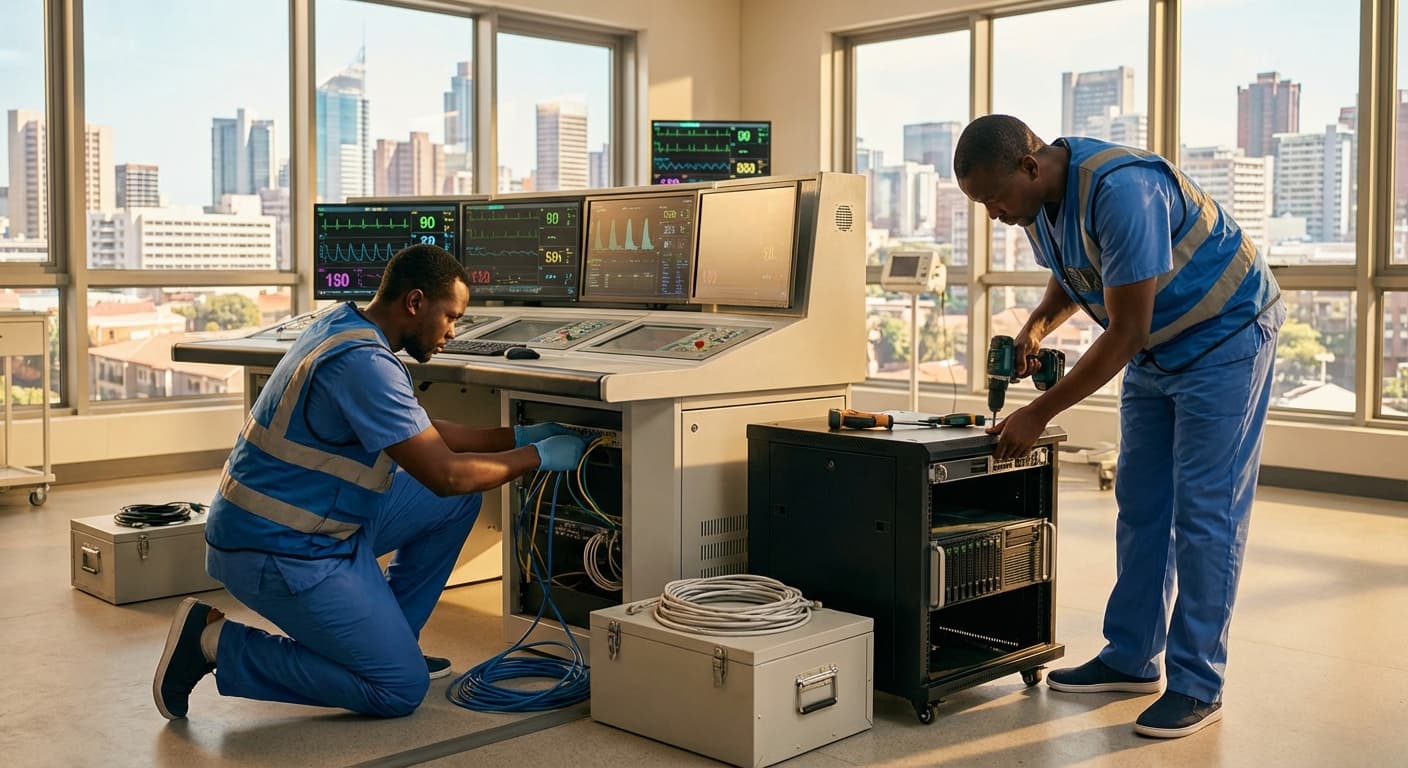
ICU Central Monitoring Station Installation Service in Uganda
Engineering Excellence & Technical Support
ICU Central Monitoring Station Installation Service High-standard technical execution following OEM protocols and local regulatory frameworks.
Robust Network Infrastructure
We design and deploy high-availability, secure network infrastructure for your ICU central monitoring station, ensuring seamless, real-time data transmission and minimal latency. Our solutions prioritize redundancy and scalability to meet the demanding needs of critical care environments in Uganda.
Advanced Data Security & Compliance
Protecting sensitive patient data is paramount. Our installations adhere to international data security protocols and Ugandan healthcare regulations, implementing robust encryption, access controls, and audit trails for ultimate data integrity and privacy.
Scalable & Future-Proof Solutions
We engineer ICU central monitoring systems that grow with your hospital. Our installations are designed for seamless integration with existing and future medical devices, ensuring long-term usability and adaptability to evolving technological advancements in critical care in Uganda.
What Is Icu Central Monitoring Station Installation Service In Uganda?
ICU Central Monitoring Station Installation Service in Uganda refers to the comprehensive process of setting up and integrating a centralized command and control hub for critical care monitoring within healthcare facilities. This service encompasses the physical installation of hardware, software configuration, network integration, and the establishment of protocols for real-time patient data acquisition, display, and alarm management. The objective is to enhance patient safety and clinical responsiveness in Intensive Care Units (ICUs) by providing clinicians with a consolidated view of vital signs and other physiological parameters from multiple patients simultaneously.
| Who Needs This Service? | Typical Use Cases | ||||||
|---|---|---|---|---|---|---|---|
| Hospitals and Healthcare Facilities in Uganda: Primarily those with existing or planned Intensive Care Units (ICUs), High Dependency Units (HDUs), or Surgical Intensive Care Units (SICUs). This includes public, private, and non-governmental healthcare providers. | Real-time Patient Surveillance: Enabling continuous monitoring of vital signs (heart rate, blood pressure, respiratory rate, oxygen saturation, temperature, etc.) for multiple critically ill patients from a central location. | Early Detection of Patient Deterioration: Facilitating prompt identification of critical events or adverse trends in patient physiology through immediate alarm notification. | Enhanced Clinical Team Communication: Providing a unified platform for the multidisciplinary ICU team to access and interpret patient data, fostering improved collaboration and decision-making. | Workflow Optimization: Streamlining the process of patient data review and management, allowing nursing staff to monitor a larger number of patients more effectively. | Data-Driven Clinical Management: Supporting evidence-based patient care by enabling the analysis of patient data trends for treatment adjustments and outcome evaluation. | Compliance and Quality Improvement: Assisting in meeting accreditation standards and facilitating quality improvement initiatives through comprehensive data monitoring and reporting. | Disaster Preparedness and Surge Capacity: Enabling efficient management of patient loads during mass casualty events or outbreaks by centralizing monitoring capabilities. |
Key Components of ICU Central Monitoring Station Installation Service
- Hardware Installation: Physical placement and connection of central monitoring servers, workstations, display screens, network switches, and ancillary equipment.
- Software Deployment and Configuration: Installation and setup of the central monitoring software, including patient database configuration, alarm parameter definition, trend analysis modules, and user access controls.
- Network Integration: Seamless integration of the central monitoring system with the hospital's existing Local Area Network (LAN) and Wide Area Network (WAN), ensuring secure and reliable data transmission from bedside monitors to the central station.
- Bedside Monitor Connectivity: Establishment of communication links between individual bedside patient monitors (e.g., ventilators, ECG monitors, SpO2 sensors, NIBP devices) and the central monitoring system.
- Alarm System Setup and Calibration: Configuration of audible and visual alarms based on predefined clinical thresholds, ensuring timely and effective alerts to nursing staff.
- Data Archiving and Retrieval: Implementation of mechanisms for storing historical patient data for review, analysis, and research purposes.
- System Testing and Validation: Comprehensive testing of all system functionalities, including data accuracy, alarm responsiveness, network stability, and user interface usability.
- User Training and Handover: Provision of training to clinical and IT personnel on system operation, maintenance, and troubleshooting.
- Documentation and Support: Delivery of detailed system documentation, including network diagrams, configuration manuals, and ongoing technical support agreements.
Who Needs Icu Central Monitoring Station Installation Service In Uganda?
The installation of ICU Central Monitoring Station services is a critical requirement for healthcare facilities in Uganda aiming to enhance patient care, improve clinical outcomes, and optimize resource allocation within their Intensive Care Units (ICUs). These stations are designed to centralize the monitoring of multiple ICU patients, providing a single point of observation for nurses and physicians to track vital signs, alarms, and trends in real-time. This not only allows for quicker response to critical events but also frees up nursing staff to attend to patients directly, rather than constantly checking individual monitors. The service encompasses the entire installation process, from site assessment and system design to hardware and software deployment, integration with existing hospital infrastructure, and comprehensive training for medical personnel.
| Customer Type | Typical Departments Requiring Service | Rationale for Need |
|---|---|---|
| Public Hospitals | General ICU, Medical ICU, Surgical ICU, Pediatric ICU, Neonatal ICU | High patient volume, need for efficient resource management, often resource-constrained environments requiring centralized oversight for optimal staff utilization and early detection of patient deterioration. |
| Private Hospitals | General ICU, Cardiac ICU, Neuro ICU, Surgical ICU | Commitment to advanced patient care, competitive market demands for high-quality services, need to enhance patient safety, reduce adverse events, and improve clinical efficiency for better patient outcomes. |
| Tertiary Care Centers | All specialized ICUs (e.g., Trauma, Burn, Transplant, Oncology ICUs) | Management of complex and critically ill patients requires continuous, high-fidelity monitoring and rapid intervention. Centralized monitoring is essential for coordinating care across multiple specialized units. |
| Specialty Hospitals (e.g., Cardiac, Neurological, Pediatric ICUs) | Dedicated ICU units for specific patient populations | These units often have unique monitoring needs. Central stations allow for specialized staff to oversee multiple high-risk patients requiring continuous observation of specific parameters and rapid response to critical changes. |
| Large Clinic Networks with ICU Capabilities | Dedicated ICU wards within larger healthcare complexes | Expansion of critical care services within a network necessitates standardized and efficient monitoring systems to ensure consistent quality of care across different locations and patient acuity levels. |
Target Customers for ICU Central Monitoring Station Installation Service in Uganda
- Public Hospitals
- Private Hospitals
- Tertiary Care Centers
- Specialty Hospitals (e.g., Cardiac, Neurological, Pediatric ICUs)
- Large Clinic Networks with ICU Capabilities
Icu Central Monitoring Station Installation Service Process In Uganda
The ICU Central Monitoring Station Installation Service Process in Uganda outlines the comprehensive steps involved from a healthcare facility's initial interest to the final operationalization of a centralized monitoring system for Intensive Care Units. This workflow is designed to ensure a smooth and efficient installation, adhering to Ugandan healthcare standards and best practices.
| Stage | Description | Key Activities | Responsible Parties | Deliverables |
|---|---|---|---|---|
| Inquiry and Initial Consultation | The process begins when a healthcare facility expresses interest in installing an ICU Central Monitoring Station. | Contacting the service provider, initial discussions on needs and expectations, understanding the facility's current infrastructure. | Healthcare Facility (Inquirer), Service Provider (Sales/Consulting Team) | Initial understanding of project scope, confirmation of interest. |
| Site Assessment and Requirements Gathering | A thorough evaluation of the ICU environment and specific monitoring needs. | Site visits to ICU wards, assessing existing network infrastructure, power availability, space, and specific monitoring equipment requirements (e.g., number of beds, types of monitors). | Service Provider (Technical Team, Project Manager), Healthcare Facility (ICU Staff, IT Department, Administration) | Detailed site survey report, comprehensive list of required hardware, software, and network specifications. |
| Proposal Development and Quotation | Based on the assessment, a tailored proposal is created, outlining the solution and costs. | Developing a detailed technical proposal including equipment list, software configuration, installation plan, timelines, and a comprehensive cost quotation. | Service Provider (Technical Team, Sales Team, Project Manager) | Formal proposal document, detailed quotation, project timeline. |
| Contract Negotiation and Agreement | Formalizing the terms and conditions of the service engagement. | Reviewing the proposal and quotation, negotiating pricing and payment terms, signing the service agreement. | Service Provider (Management, Legal Team), Healthcare Facility (Administration, Legal Department) | Signed service contract, agreed payment schedule. |
| Procurement and Logistics | Acquiring and transporting all necessary equipment and materials to the site. | Ordering hardware and software from manufacturers, managing import/customs clearance (if applicable), coordinating delivery to the Uganda site. | Service Provider (Procurement Team, Logistics Team) | All necessary equipment and materials delivered to the site. |
| Installation and Configuration | The physical setup and software configuration of the central monitoring station. | Installing central servers, workstations, network cabling, power supply units, and configuring the monitoring software to integrate with existing bedside monitors. | Service Provider (Installation Engineers, Network Specialists, Software Engineers) | Physically installed hardware, configured software, network connectivity established. |
| Testing and Commissioning | Ensuring the entire system functions correctly and meets the defined specifications. | Performing system diagnostics, testing data flow from bedside monitors to the central station, verifying alarm functionalities, stress testing the system. | Service Provider (Testing Engineers, Project Manager), Healthcare Facility (ICU Staff, IT Department) | System test reports, confirmed functionality of all components, commissioning certificate. |
| Training and Handover | Equipping the facility's staff with the knowledge to operate and manage the system. | Conducting comprehensive training sessions for ICU nurses, doctors, and IT personnel on system operation, troubleshooting, and basic maintenance. Formal handover of the installed system and documentation. | Service Provider (Training Specialists, Project Manager), Healthcare Facility (ICU Staff, IT Department) | Trained staff, handover documentation (manuals, guides), operational central monitoring station. |
| Post-Installation Support and Maintenance | Providing ongoing assistance and ensuring the long-term optimal performance of the system. | Offering technical support, remote monitoring, software updates, hardware maintenance, and on-site troubleshooting as per the service agreement. | Service Provider (Support Team, Maintenance Engineers), Healthcare Facility (Users) | Ongoing system reliability, prompt technical assistance, scheduled maintenance. |
Workflow Stages
- Inquiry and Initial Consultation
- Site Assessment and Requirements Gathering
- Proposal Development and Quotation
- Contract Negotiation and Agreement
- Procurement and Logistics
- Installation and Configuration
- Testing and Commissioning
- Training and Handover
- Post-Installation Support and Maintenance
Icu Central Monitoring Station Installation Service Cost In Uganda
Installing an ICU Central Monitoring Station (CMS) in Uganda is a critical investment for any healthcare facility aiming to provide advanced patient care. The cost of this service is influenced by a variety of factors, leading to a broad price range. Understanding these elements is crucial for accurate budgeting and planning. The complexity of the installation, the specific features and brand of the CMS, the number of patient beds to be monitored, and the existing infrastructure of the hospital all play significant roles in determining the final cost. Furthermore, the expertise and reputation of the installation service provider, along with any necessary upgrades to power, network, or existing medical equipment, will impact the overall expenditure. Given these variables, the pricing can fluctuate considerably across different healthcare institutions in Uganda.
| Cost Component | Estimated Range (UGX) | Notes |
|---|---|---|
| Central Monitoring Station Hardware (Console) | 15,000,000 - 50,000,000+ | Varies significantly by brand, screen size, and processing power. |
| Bedside Patient Monitors (per unit) | 5,000,000 - 20,000,000+ | Depends on the number of parameters monitored (ECG, SpO2, NIBP, etc.) and brand. |
| Cabling and Network Infrastructure | 2,000,000 - 10,000,000+ | Includes Ethernet cables, patch panels, switches, and potential conduit installation. |
| Installation Labor and Project Management | 5,000,000 - 25,000,000+ | Dependent on the complexity, duration, and number of technicians required. |
| System Integration and Configuration | 2,000,000 - 15,000,000+ | Connecting bedside monitors, configuring software, and integrating with other systems. |
| Staff Training | 1,000,000 - 5,000,000 | Training for nurses, doctors, and IT staff on system operation and maintenance. |
| Site Survey and Assessment | 500,000 - 2,000,000 | Initial evaluation of the hospital's readiness and infrastructure. |
| Contingency (10-15%) | Variable | Recommended for unforeseen issues or scope changes. |
Key Pricing Factors for ICU Central Monitoring Station Installation in Uganda
- System Complexity and Features: Basic systems for a few beds will be less expensive than advanced, feature-rich systems capable of handling a large number of complex patient data streams.
- Brand and Model of Equipment: Different manufacturers offer varying levels of quality, technology, and support, which directly affects the hardware and software costs.
- Number of Patient Beds Monitored: Each monitored bed requires a dedicated bedside monitor and connection to the central station, increasing hardware and installation labor costs.
- Existing Infrastructure Assessment and Upgrades: Hospitals may require upgrades to their power supply, network cabling, or even HVAC systems to support the CMS, adding to the total cost.
- Installation Service Provider Expertise: Reputable and experienced installers, particularly those with specialized medical equipment installation experience, may command higher fees.
- Integration with Existing Medical Equipment: If the CMS needs to integrate with existing ventilators, anesthesia machines, or other devices, this requires specialized knowledge and potentially additional hardware/software.
- Training and Support Packages: Post-installation training for medical staff and ongoing technical support contracts are often bundled or offered as add-ons, impacting the overall price.
- Geographical Location within Uganda: While less significant than other factors, accessibility and logistical challenges in remote areas could slightly influence installation costs.
- Warranty and Maintenance Agreements: The duration and scope of warranty and maintenance services included in the installation package will affect the initial outlay.
Affordable Icu Central Monitoring Station Installation Service Options
Installing an Intensive Care Unit (ICU) Central Monitoring Station is a critical investment for any healthcare facility. This system allows for continuous, real-time surveillance of multiple patient vital signs, enabling proactive medical interventions and improving patient outcomes. When considering installation, it's essential to explore affordable options that don't compromise on quality or functionality. This guide outlines key value bundles and cost-saving strategies to help you make an informed decision.
| Value Bundle Option | Description | Typical Cost Range (USD) | Cost-Saving Strategies |
|---|---|---|---|
| Basic Monitoring Package | Includes essential bedside monitors, a central display unit for a limited number of beds, and basic networking. Focuses on core vital signs. | $15,000 - $40,000 | Opt for refurbished equipment, choose open-source software solutions (if applicable and compliant), negotiate bulk purchase discounts for monitors. |
| Standard Integrated System | Offers a more comprehensive set of bedside monitors with advanced features, a larger central display, and robust data management software. Supports more beds and integrates with EMR systems. | $40,000 - $80,000 | Consider leased equipment to spread costs, utilize existing network infrastructure where possible, train in-house IT staff for basic configuration to reduce reliance on external technicians. |
| Advanced & Scalable Solution | Features high-end patient monitors with specialized parameters, a scalable central station capable of handling a large number of beds, advanced analytics, and seamless EMR integration. Often includes extensive training and support. | $80,000 - $150,000+ | Phased implementation: Start with a core unit and expand over time, explore vendor financing options, compare multiple vendor quotes meticulously, prioritize essential features over 'nice-to-haves'. |
Key Components of an ICU Central Monitoring Station
- Central Monitoring Unit (Display Console): The main interface for viewing patient data.
- Patient Monitoring Devices (Bedside Monitors): Collect vital signs like ECG, SpO2, NIBP, respiration, etc.
- Networking Infrastructure: Cabling, switches, and servers to transmit data.
- Software and Data Management System: For data logging, trend analysis, and alarm management.
- Installation and Configuration Services: Professional setup and integration.
- Training: For clinical staff on system operation.
- Ongoing Maintenance and Support: For long-term reliability.
Verified Providers In Uganda
Finding reliable and qualified healthcare providers in Uganda can be a challenge. When seeking quality medical services, it's crucial to look for 'Verified Providers'. This designation signifies that a healthcare professional or institution has undergone a rigorous credentialing process, ensuring they meet established standards of competence, ethics, and patient care. Franance Health stands out as a prime example of such verified providers, consistently demonstrating excellence and a commitment to patient well-being. Their comprehensive credentialing process goes beyond basic qualifications, assessing experience, continuous professional development, and patient feedback, making them a trusted choice for healthcare in Uganda.
| Verification Aspect | Franance Health's Commitment | Benefit to Patients |
|---|---|---|
| Medical Qualifications | Ensures all practitioners possess accredited degrees and specialized training. | Confirms a strong foundation of medical knowledge and expertise. |
| Professional Experience | Evaluates practical experience in relevant medical fields. | Guarantees hands-on skills and a proven track record of successful treatments. |
| Ethical Standards | Upholds strict adherence to medical ethics and professional conduct. | Promotes trust, transparency, and patient confidentiality. |
| Continuous Professional Development (CPD) | Mandates ongoing training and skill enhancement for all providers. | Ensures access to the latest medical knowledge and treatment modalities. |
| Patient Feedback Mechanisms | Actively collects and analyzes patient feedback. | Drives continuous improvement in service delivery and patient satisfaction. |
Why Franance Health is the Best Choice for Verified Healthcare in Uganda
- Rigorous Credentialing Process: Franance Health's verification goes beyond standard licensing, encompassing a thorough review of qualifications, experience, and adherence to ethical guidelines.
- Commitment to Continuous Improvement: Verified providers like Franance Health are dedicated to ongoing professional development, ensuring they stay abreast of the latest medical advancements and best practices.
- Patient-Centric Approach: The credentialing often includes evaluation of patient satisfaction and feedback mechanisms, highlighting a focus on delivering exceptional patient experiences.
- Trust and Reliability: 'Verified Provider' status offers peace of mind, assuring patients they are receiving care from competent and trustworthy healthcare professionals.
- Access to Expertise: Franance Health's network comprises a diverse range of specialists, all meeting stringent verification criteria, providing access to high-quality care across various medical disciplines.
Scope Of Work For Icu Central Monitoring Station Installation Service
This Scope of Work (SOW) outlines the services required for the installation of an Intensive Care Unit (ICU) Central Monitoring Station (CMS). The scope includes the assessment of the existing infrastructure, procurement and installation of all necessary hardware and software, configuration, testing, and commissioning of the CMS to ensure seamless integration with existing ICU patient monitoring devices and hospital information systems. The goal is to provide real-time patient data, alarms, and trending capabilities to a centralized location, enhancing patient care and staff efficiency within the ICU.
| Category | Description | Technical Deliverables | Standard Specifications/Requirements |
|---|---|---|---|
| Site Assessment & Planning | Evaluation of the existing ICU network infrastructure, power, and physical space for CMS installation. | Detailed site survey report, including network topology diagrams, power outlet availability, and physical space allocation. | Compliance with hospital IT infrastructure standards; assessment of network bandwidth and latency; evaluation of existing patient monitoring devices for compatibility. |
| Hardware Procurement & Installation | Supply and installation of all required CMS server hardware, workstations, displays, network switches, cabling, and UPS. | Installed and configured server(s), workstation(s), high-resolution display(s), network infrastructure, and uninterruptible power supply (UPS). | Server specifications: High availability, sufficient processing power, memory, and storage for data logging. Workstation specifications: Minimum resolution for clear data display. Network: CAT6a or higher cabling, gigabit Ethernet switches. UPS: Sized to provide adequate runtime for CMS components. |
| Software Installation & Configuration | Installation and configuration of the CMS software, including database, middleware, and user interface. | Fully installed and configured CMS software with established patient data acquisition modules and user accounts. | Latest stable version of the CMS software; adherence to vendor's installation and configuration guidelines; robust database management system; secure user authentication and authorization protocols. |
| Device Integration & Connectivity | Establishing network connectivity and data acquisition from all ICU patient monitoring devices (e.g., ventilators, ECG monitors, NIBP, SpO2). | Successful bidirectional data flow from each connected patient monitoring device to the CMS, with data displayed in real-time. | Compatibility with existing patient monitoring devices using standard protocols (e.g., HL7, DICOM, proprietary vendor protocols); secure and reliable network connections; verification of data integrity and accuracy. |
| Alarm Management & Notification | Configuration and testing of the alarm management system for critical patient parameters. | Configured alarm thresholds, audible and visual alarms, and notification pathways (e.g., pagers, SMS, workstation alerts) for critical events. | Configurable alarm priorities and delays; adherence to clinical best practices for alarm fatigue mitigation; integration with hospital-wide alert systems if applicable. |
| Hospital Information System (HIS) Integration | Integration of the CMS with the hospital's Electronic Medical Record (EMR/EHR) system and other relevant systems. | Seamless data exchange between CMS and HIS, allowing for patient demographic synchronization and data archival. | Compliance with HL7 standards for data exchange; secure API integration; validation of data accuracy and timeliness. |
| Testing & Commissioning | Comprehensive testing of all CMS functionalities, including data acquisition, display, alarm management, and HIS integration. | Commissioning report detailing all test results, performance metrics, and successful system validation. | Unit testing, integration testing, system testing, user acceptance testing (UAT); performance benchmarks for data latency and system uptime. |
| Training | Training for ICU nurses, physicians, biomedical engineers, and IT support staff. | Trained personnel capable of operating, monitoring, and performing basic troubleshooting of the CMS. | Training materials, hands-on practical sessions, and post-training support. Curriculum to cover system overview, daily operations, alarm management, troubleshooting, and maintenance. |
| Documentation & Handover | Provision of all necessary documentation and handover of the installed system. | Complete system documentation, including installation guides, user manuals, administration guides, network diagrams, and maintenance procedures. Signed handover certificate. | Documentation in electronic and/or hard copy format as specified by the hospital; compliance with regulatory record-keeping requirements. |
| Post-Installation Support | Initial period of support following the commissioning of the CMS. | On-site or remote support to address any issues arising during the initial operational phase. | Defined warranty period and service level agreement (SLA) for critical issue resolution. |
Key Objectives
- To successfully install and commission a fully functional ICU Central Monitoring Station.
- To ensure reliable and real-time data acquisition and display from all connected ICU patient monitoring devices.
- To implement robust alarm management and notification systems.
- To integrate the CMS with relevant hospital information systems (e.g., EMR/EHR, PACS).
- To provide comprehensive training to clinical and IT staff on the operation and maintenance of the CMS.
- To ensure compliance with all relevant healthcare IT security and data privacy regulations.
Service Level Agreement For Icu Central Monitoring Station Installation Service
This Service Level Agreement (SLA) outlines the response times and uptime guarantees for the installation services provided by [Your Company Name] for the ICU Central Monitoring Station. This agreement is effective as of [Start Date] and will remain in effect until [End Date], unless terminated earlier in accordance with the Master Services Agreement.
| Service Component | Response Time | Uptime Guarantee | Definition/Notes |
|---|---|---|---|
| Installation Completion | Within [X] business days of site readiness confirmation. | N/A | Refers to the physical installation and initial configuration of the ICU Central Monitoring Station hardware and software. Site readiness includes, but is not limited to, power, network connectivity, and physical space availability as per [Your Company Name]'s pre-installation checklist. |
| Post-Installation System Verification | Within [Y] business hours of installation completion. | N/A | This includes the initial testing and verification of all core functionalities of the ICU Central Monitoring Station to ensure it is operational and meeting specified requirements. |
| Critical System Failure (Post-Installation, During Warranty Period) | Within [Z] hours of confirmed critical failure notification. | 99.9% Uptime | A critical failure is defined as the complete inability of the ICU Central Monitoring Station to receive, process, or display patient vital signs data from connected devices. Uptime is calculated monthly, excluding scheduled maintenance windows. |
| Non-Critical System Malfunction (Post-Installation, During Warranty Period) | Within [A] business days of confirmed non-critical malfunction notification. | N/A | A non-critical malfunction is defined as a partial degradation of functionality that does not prevent the core purpose of the ICU Central Monitoring Station but may impact secondary features or reporting. |
| Scheduled Maintenance | Notice to be provided at least [B] days in advance. | N/A | Scheduled maintenance will be performed during off-peak hours to minimize disruption. All scheduled maintenance windows will be communicated and agreed upon with the client. |
Key Service Commitments
- The following sections detail the specific response times for critical events and the guaranteed uptime for the installed ICU Central Monitoring Station.
- This SLA applies to all completed installations of the ICU Central Monitoring Station by [Your Company Name] technicians.
- Any deviations from these commitments will be addressed as per the escalation and resolution procedures outlined in this document.
Frequently Asked Questions

Ready when you are
Let's scope your ICU Central Monitoring Station Installation Service in Uganda project in Uganda.

Scaling healthcare logistics and technical systems across the entire continent.