
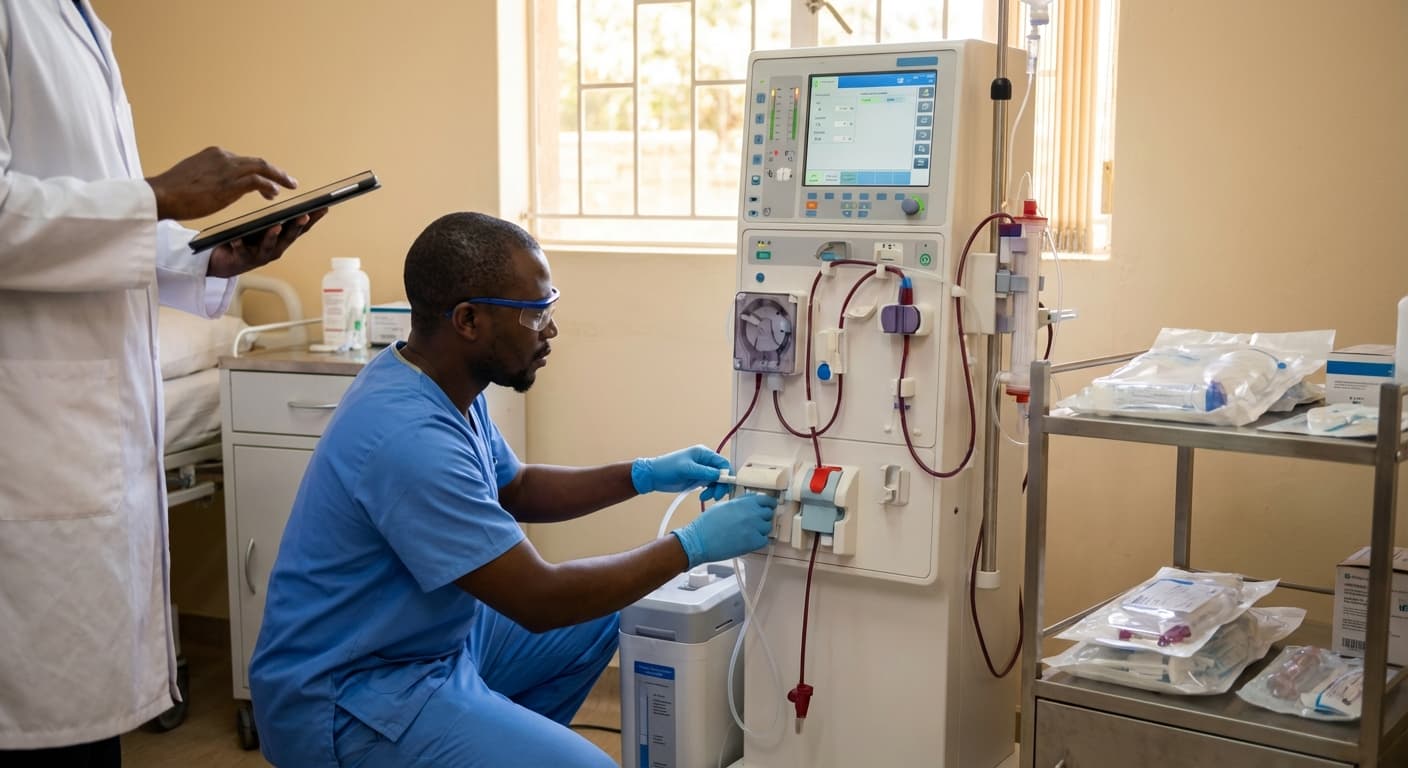
Hemodialysis Machine Installation Service in Uganda
Engineering Excellence & Technical Support
Hemodialysis Machine Installation Service High-standard technical execution following OEM protocols and local regulatory frameworks.
Expert Biomedical Engineering Installation
Our certified biomedical engineers possess extensive experience in installing and calibrating hemodialysis machines to meet stringent Uganda health standards. We ensure optimal performance and patient safety from the outset.
Comprehensive Site Assessment & Preparation
We conduct thorough site assessments, including water quality analysis and electrical infrastructure evaluation, to guarantee a seamless and compliant installation for your hemodialysis unit in Uganda.
On-Site Training & Ongoing Support
Beyond installation, we provide comprehensive on-site training for your clinical staff on machine operation and maintenance, backed by responsive technical support for uninterrupted service delivery in Uganda.
What Is Hemodialysis Machine Installation Service In Uganda?
Hemodialysis machine installation service in Uganda refers to the comprehensive process of setting up, configuring, and validating hemodialysis equipment for clinical use. This service ensures that the machinery is operational, safe, and compliant with relevant healthcare standards and regulations within the Ugandan context. It encompasses the physical placement of the machine, its integration with essential utilities (water, electricity, drainage), and the calibration of its various components to facilitate efficient and effective extracorporeal blood purification. The service typically includes initial training for biomedical technicians and nursing staff on the operation and basic maintenance of the installed units.
| Service Recipient | Need for Installation | Typical Use Cases |
|---|---|---|
| Hospitals (Public and Private): | Essential for establishing or expanding hemodialysis units to manage patients with End-Stage Renal Disease (ESRD) and acute kidney injury (AKI). Installation is required for new dialysis centers, replacement of aging equipment, or upgrades to accommodate increased patient volume. | Managing chronic kidney disease (CKD) patients requiring regular dialysis sessions. Treating acute renal failure due to various medical conditions (e.g., sepsis, drug overdose). Providing supportive care for critically ill patients with renal compromise. |
| Specialized Nephrology Clinics: | Crucial for standalone clinics offering comprehensive renal care. Installation is necessary for new clinic openings or when expanding existing facilities to serve a larger patient population. | Routine hemodialysis for a dedicated patient cohort. Offering outpatient dialysis services. Facilitating specialized dialysis treatments. |
| Government Health Facilities: | Necessary for public healthcare infrastructure development aimed at increasing access to essential renal replacement therapy, particularly in underserved regions. Installation supports national health mandates and disease management programs. | Providing affordable and accessible dialysis treatment to the general population. Addressing the growing burden of kidney disease in Uganda. Equipping regional referral hospitals with dialysis capabilities. |
| Medical Equipment Suppliers/Distributors: | Part of the value-added service offered when selling new hemodialysis machines. Ensures the equipment is correctly installed and functional, meeting client expectations and warranty requirements. | Delivering and commissioning newly purchased hemodialysis machines to healthcare providers. Facilitating the transition from old to new equipment. |
Key Stages of Hemodialysis Machine Installation Service:
- Site Assessment and Planning: Evaluation of the clinical environment to determine optimal placement, power requirements, water quality and availability, and waste disposal infrastructure.
- Equipment Delivery and Unpacking: Secure transportation of the hemodialysis machine and associated accessories to the installation site, followed by careful unpacking and inspection for any transit damage.
- Physical Placement and Mounting: Positioning the machine in its designated location, ensuring stability and accessibility for operation and maintenance.
- Utility Connections: Establishing secure and compliant connections to the electrical supply, purified water system (often involving a dedicated water treatment unit), and medical waste drainage.
- System Configuration and Calibration: Programming machine parameters, performing functional tests on all modules (e.g., blood pump, dialysate delivery, air detection), and calibrating sensors to ensure accurate performance.
- Water Treatment System Integration: Connecting and testing the water purification system (e.g., reverse osmosis) to ensure it meets the stringent requirements for hemodialysis water quality as per national and international standards.
- Pre-use System Checks and Disinfection: Thorough flushing and disinfection of the entire system to eliminate potential contaminants before patient use.
- Performance Validation and Documentation: Conducting rigorous testing protocols to confirm the machine operates within specified tolerances and generating comprehensive documentation of the installation and validation process.
- Operator Training and Handover: Providing initial training to healthcare personnel on machine operation, patient setup, troubleshooting, and basic preventive maintenance. Formal handover of the installed system is then completed.
Who Needs Hemodialysis Machine Installation Service In Uganda?
The installation of hemodialysis machines is a critical service for ensuring the effective delivery of renal care in Uganda. This service is primarily needed by healthcare facilities that are either establishing new dialysis units, expanding existing ones, or replacing outdated equipment. The successful and safe operation of a hemodialysis machine is contingent upon expert installation, calibration, and initial setup, which require specialized knowledge and adherence to stringent medical device standards.
| Target Customer Category | Key Departments Involved in Installation | Specific Needs/Considerations |
|---|---|---|
| Public Hospitals | Nephrology Department, Biomedical Engineering Department, Estates/Facilities Management | High volume of patients, need for durable and cost-effective solutions, integration with existing infrastructure, staff training. |
| Private Hospitals and Clinics | Nephrology Department, Administration, Biomedical Engineering/IT, Facilities Management | Focus on patient comfort and advanced features, integration with electronic health records, aesthetic considerations, rapid deployment. |
| NGO Supported Health Facilities | Clinical Department, Logistics/Procurement, Biomedical Technicians, Local Healthcare Management | Equipment suitability for local conditions, ease of maintenance, availability of spare parts, comprehensive training for local staff. |
| University Teaching Hospitals | Nephrology Department, Biomedical Engineering, Medical Education Department, IT Department | Latest technology for training, integration with simulation labs, support for research activities, data management capabilities. |
| New Healthcare Ventures | Project Management Team, Clinical Leadership, Biomedical Engineering Consultants, Architects/Builders | Complete infrastructure planning, compliance with all regulatory standards, early engagement with installation service providers for optimal design. |
Target Customers and Departments in Uganda Needing Hemodialysis Machine Installation Service:
- {"title":"Public Hospitals","description":"Government-funded hospitals, especially those designated as regional or national referral centers, are major recipients of hemodialysis machines. They often serve a large patient population with limited financial resources and require robust, reliable dialysis services."}
- {"title":"Private Hospitals and Clinics","description":"Well-established private healthcare institutions that offer comprehensive medical services, including specialized care like nephrology and dialysis. These facilities cater to patients with private insurance or the ability to self-pay."}
- {"title":"Non-Governmental Organization (NGO) Supported Health Facilities","description":"Hospitals and clinics run or heavily supported by local and international NGOs focused on improving healthcare access and quality in underserved areas. These facilities often receive donations of medical equipment, including dialysis machines."}
- {"title":"University Teaching Hospitals","description":"Hospitals affiliated with medical schools, which not only provide patient care but also serve as training grounds for future healthcare professionals. They require state-of-the-art equipment for both clinical practice and education."}
- {"title":"New Healthcare Ventures","description":"Newly established hospitals or specialized dialysis centers that are entering the market and require the complete setup of their dialysis infrastructure from scratch."}
Hemodialysis Machine Installation Service Process In Uganda
This document outlines the typical workflow for Hemodialysis Machine Installation Service in Uganda, from the initial client inquiry to the final execution and handover. It is designed to provide a clear understanding of the steps involved, ensuring a smooth and efficient installation process.
| Step | Description | Key Activities | Responsible Party | Estimated Timeframe |
|---|---|---|---|---|
| The process begins with a client expressing interest in installing a hemodialysis machine. | Client contacts service provider, discusses specific needs (type of machine, location, number of units), receives initial quote and proposal, clarifies technical specifications and requirements. | Client (Hospital/Clinic), Service Provider (Sales/Technical Team) | 1-3 business days |
| A thorough assessment of the installation site is conducted to ensure it meets all necessary requirements. | Technical team visits the site, checks for adequate power supply (voltage, amperage), water quality and supply, drainage, ventilation, space, and access for equipment. Identifies any potential challenges and outlines required modifications. | Service Provider (Technical Team), Client (Facility Management) | 2-5 business days |
| The hemodialysis machine(s) are transported to the client's facility and carefully unpacked. | Logistics arrangement for transportation, secure loading and unloading, inspection of packaging for damage, careful unpacking of the machine and all accessories, initial visual inspection of the machine for any physical damage. | Service Provider (Logistics/Technical Team), Client (Receiving Staff) | 1-2 business days (depending on distance and quantity) |
| The hemodialysis machine is physically set up and connected to the facility's infrastructure. | Positioning the machine in its designated location, connecting to power outlets, water supply (including any pre-treatment systems), and drainage. Installation of any accompanying peripherals (e.g., dialysis chairs, water treatment units). | Service Provider (Certified Technicians) | 1-3 business days per machine |
| The machine undergoes rigorous testing to ensure it functions correctly and according to specifications. | Performing initial power-on tests, running diagnostic checks, calibrating sensors and flow rates, testing safety features, simulating dialysis sessions (without a patient initially), verifying all parameters are within acceptable ranges. | Service Provider (Certified Technicians) | 1-2 business days per machine |
| The client's clinical staff are trained on the operation and basic maintenance of the new hemodialysis machine. | Providing hands-on training sessions covering machine setup, patient connection procedures, dialyzer setup, program selection, monitoring during treatment, troubleshooting common issues, and basic cleaning protocols. Demonstration of all key functionalities. | Service Provider (Clinical Application Specialist/Trainer), Client (Clinical Staff) | 1-3 business days |
| All relevant documentation is provided to the client, and formal handover of the installed machine is completed. | Providing user manuals, service logs, warranty information, training materials, and any relevant certifications. Formal sign-off by both parties confirming successful installation and readiness for use. | Service Provider (Project Manager/Lead Technician), Client (Authorized Representative) | 0.5-1 business day |
| Ongoing support is provided to ensure the smooth operation of the hemodialysis machine. | Offering technical support, remote troubleshooting, scheduled preventive maintenance checks, and access to spare parts as per warranty agreements. Addressing any emergent issues or questions. | Service Provider (Technical Support Team/Service Engineers), Client (Clinical Staff) | Ongoing (as per contract/warranty) |
Hemodialysis Machine Installation Service Workflow in Uganda
- Inquiry and Needs Assessment
- Site Survey and Preparation
- Machine Delivery and Unpacking
- Installation and Connection
- Testing and Calibration
- Training and Demonstration
- Documentation and Handover
- Post-Installation Support
Hemodialysis Machine Installation Service Cost In Uganda
Installing a hemodialysis machine in Uganda involves several cost components. The overall price will vary significantly based on the type of machine, the complexity of the installation, the specific location within Uganda, and the service provider chosen. Factors influencing the cost include the machine's brand and model, required electrical and plumbing modifications, water treatment system integration, training for staff, and any ongoing maintenance agreements.
| Service Component | Estimated Cost Range (UGX) |
|---|---|
| Basic Machine Installation & Setup (excluding water treatment) | 2,000,000 - 5,000,000 |
| Advanced Machine Installation with Integrated Controls | 4,000,000 - 8,000,000 |
| Water Treatment System Installation (RO/Deionization) | 5,000,000 - 15,000,000+ |
| Electrical & Plumbing Modifications (variable) | 1,000,000 - 4,000,000 |
| Staff Training (per session/group) | 500,000 - 2,000,000 |
| Site Assessment & Consultation | 200,000 - 500,000 |
| Transportation & Logistics (local) | 100,000 - 300,000 |
| Full Turnkey Installation (Machine + Water + Setup + Training) | 10,000,000 - 30,000,000+ |
Key Pricing Factors for Hemodialysis Machine Installation in Uganda:
- Machine Type and Brand: High-end, feature-rich machines from reputable international brands will naturally command higher installation costs.
- Infrastructure Requirements: Existing facility infrastructure dictates the extent of modifications needed. This can include upgrades to electrical systems (capacity, grounding), plumbing (water supply, drainage), and dedicated space allocation.
- Water Treatment System: Hemodialysis requires highly purified water. The cost of installing and integrating a suitable water purification system (e.g., reverse osmosis, deionization) is a significant factor.
- Ancillary Equipment: This can include dialysis chairs, trolleys, monitors, and other essential accessories that may be bundled with the installation service or procured separately.
- Logistics and Transportation: The cost of transporting the machine and installation team to the facility, especially if it's in a remote area of Uganda.
- Labor and Expertise: The fees charged by certified technicians and engineers for the installation, calibration, and initial testing of the machine.
- Training: The cost of training clinical staff (nurses, technicians) on the operation and basic maintenance of the hemodialysis machine.
- Service Provider: Different companies and individuals will have varying pricing structures based on their overhead, experience, and reputation.
- Warranty and Support: The inclusion of installation warranties and ongoing technical support packages can influence the initial cost.
Affordable Hemodialysis Machine Installation Service Options
Installing a hemodialysis machine is a critical step for healthcare facilities aiming to provide life-sustaining treatment. This guide explores affordable options, emphasizing the value of bundled services and effective cost-saving strategies for successful and economical installation.
| Cost-Saving Strategy | Description | Potential Savings |
|---|---|---|
| Negotiate Bundled Discounts | Inquire about package deals that include the machine, water treatment, installation labor, and initial training. Larger bundles often come with greater percentage discounts. | 5-15% on individual service costs |
| Leasing vs. Purchasing | Consider leasing options for the hemodialysis machine, which can reduce upfront capital expenditure. Maintenance and service are often included in lease agreements. | Lower initial investment, predictable monthly costs |
| Phased Installation | If budget is a major constraint, explore the possibility of phasing the installation. Start with essential components and add others as funds become available. | Spreads out capital expenditure |
| Local vs. National Installers | While national providers offer broad reach, local certified technicians or smaller regional companies might offer more competitive pricing for installation and ongoing maintenance. | Potentially 10-20% lower labor costs |
| Bulk Purchasing of Consumables | If the installation service includes initial consumables, negotiate a discounted price for larger quantities if you plan to purchase from the same vendor long-term. | 3-8% on initial consumable costs |
| Explore Refurbished Equipment | For less critical components or if budget is extremely tight, consider certified refurbished hemodialysis machines or water purification systems. Ensure they come with a warranty. | 20-40% less than new equipment |
| Utilize Existing Infrastructure | Assess your current facility's plumbing and electrical infrastructure. If upgrades are minimal, you can save on labor and material costs for installation. | Varies based on facility condition |
| Long-Term Service Agreements | Signing a multi-year service and maintenance contract as part of the installation package can often yield better rates than annual renewals. | 5-10% discount on annual service fees |
Understanding Value Bundles
- {"title":"What are Value Bundles?","description":"Value bundles in hemodialysis machine installation refer to a package deal that combines multiple essential services and components at a potentially reduced overall cost compared to purchasing them individually. These bundles are designed to offer comprehensive solutions and streamline the procurement and setup process."}
- {"title":"Typical Components of a Value Bundle","description":"Common elements included in hemodialysis machine installation bundles are: the hemodialysis machine itself, water purification systems (RO units), plumbing and electrical infrastructure setup, initial training for medical staff, maintenance contracts, and sometimes even consumables for a limited period."}
- {"title":"Benefits of Choosing a Value Bundle","description":"Opting for a value bundle can lead to significant cost savings through bulk purchasing discounts, simplified logistics and coordination, a single point of contact for all installation needs, and often a more predictable overall budget. It also ensures compatibility between different system components."}
- {"title":"Customization Options","description":"While bundles offer pre-defined packages, many providers allow for some level of customization to tailor the bundle to the specific needs and capacity of your facility, ensuring you're not paying for unnecessary components."}
Verified Providers In Uganda
In Uganda's healthcare landscape, distinguishing between legitimate and fraudulent providers is paramount. Verified providers ensure quality, safety, and ethical practices. Franance Health stands out as a leading example of a credible and trustworthy healthcare entity. This document outlines the credentials that make Franance Health the best choice for your healthcare needs in Uganda.
| Credential/Aspect | Franance Health's Status | Implication for Patients |
|---|---|---|
| Government Recognition & Licensing | Fully licensed and regulated by the Ministry of Health, Uganda. | Ensures adherence to legal and ethical healthcare standards. |
| Professional Certifications of Staff | All medical personnel hold valid and recognized professional certifications. | Guarantees competence and expertise in medical services. |
| Quality Management Systems | Implements robust quality assurance and control protocols. | Minimizes errors and maximizes patient safety and satisfaction. |
| Patient Feedback & Grievance Redressal | Established mechanisms for patient feedback and effective grievance resolution. | Provides a voice for patients and ensures continuous improvement. |
| Partnerships with Reputable Institutions | Collaborates with recognized local and international health organizations. | Access to broader medical knowledge, resources, and referral networks. |
| Investment in Medical Technology | Regularly upgrades medical equipment and technology. | Facilitates accurate diagnoses and advanced treatment options. |
Why Franance Health is the Best Choice:
- Rigorous Accreditation and Licensing: Franance Health undergoes stringent evaluation processes by Ugandan health authorities. This includes adherence to national health standards, regulatory compliance, and operational excellence.
- Experienced and Qualified Medical Professionals: The organization employs a team of highly skilled and certified doctors, nurses, and specialists who have undergone extensive training and possess proven experience in their respective fields.
- Commitment to Patient-Centric Care: Franance Health prioritizes patient well-being, offering personalized treatment plans, compassionate care, and a strong emphasis on patient education and empowerment.
- State-of-the-Art Facilities and Technology: Investments in modern medical equipment and infrastructure ensure accurate diagnoses and effective treatments, aligning with global best practices.
- Transparent and Ethical Practices: Franance Health operates with a high degree of transparency in its billing, service delivery, and ethical conduct, building trust and confidence with its patients.
- Community Engagement and Outreach: The organization actively participates in community health initiatives, demonstrating a commitment to improving public health outcomes beyond its immediate patient base.
Scope Of Work For Hemodialysis Machine Installation Service
This Scope of Work (SOW) outlines the requirements for the professional installation of hemodialysis machines at designated healthcare facilities. It details the technical deliverables, standard specifications, and responsibilities of the service provider to ensure a safe, functional, and compliant installation. The objective is to integrate the hemodialysis machines seamlessly into the existing medical infrastructure, ensuring optimal performance and patient safety.
| Item | Description | Standard Specifications/Requirements | Deliverable |
|---|---|---|---|
| 1 | Site Preparation & Assessment | Pre-installation site visit to assess power, water, drainage, ventilation, and network connectivity. Verification of sufficient space and environmental conditions as per manufacturer guidelines. | Site readiness report, including any identified risks or required modifications. |
| 2 | Machine Unpacking & Positioning | Careful unpacking of hemodialysis machines and accessories. Precise positioning of machines in designated locations as per facility layout and ergonomic considerations. | Successfully positioned and secured hemodialysis machines. |
| 3 | Electrical Connections | Secure and compliant connection of machines to dedicated, grounded, and properly rated electrical outlets. Use of surge protectors and RCDs where required. Verification of voltage and current. | Electrically connected and powered hemodialysis machines, with all connections verified. |
| 4 | Water Treatment System Integration | Connection of machines to the facility's approved water treatment system (e.g., RO system). Ensuring proper water flow rate, pressure, and purity as per machine and water system specifications. Installation of necessary adapters and tubing. | Water lines connected and verified for pressure and flow rate. Water quality checks performed as per specifications. |
| 5 | Drainage System Integration | Connection of machines to the facility's wastewater drainage system. Ensuring adequate drainage capacity and preventing backflow or leaks. Use of appropriate piping and fittings. | Drain lines connected and verified for proper flow and leak-free operation. |
| 6 | Medical Gas Connections (if applicable) | Connection of machines to medical gas supply (e.g., oxygen, compressed air) as per manufacturer specifications, if required for the specific model. Ensuring secure and leak-free connections. | Medical gas lines connected and pressure verified (if applicable). |
| 7 | Network Connectivity (if applicable) | Connection of machines to the facility's IT network for data logging and remote monitoring, if supported. Configuration of network settings according to IT policy. | Network connection established and tested (if applicable). |
| 8 | Pre-installation Testing & Calibration | Running self-tests and diagnostic routines as per the manufacturer's manual. Initial calibration of sensors and parameters. Verification of alarm systems. | Machine diagnostics passed. Initial calibration completed and verified. |
| 9 | Functional Testing & Performance Verification | Simulated dialysis runs using test cartridges or dialysate. Verification of all operational modes, safety features, and performance parameters against manufacturer specifications. | All operational modes tested and verified. Safety features confirmed functional. Performance metrics met. |
| 10 | Staff Training | On-site training for designated biomedical engineers and nursing staff on basic operation, daily checks, troubleshooting of common issues, and safety procedures. | Training sessions conducted. Trainees demonstrate understanding of key functions. |
| 11 | Documentation & Handover | Provision of a comprehensive installation report, including serial numbers, connection diagrams, test results, calibration certificates, and any deviations. Handover of user manuals and service records. | Installation report, test results, and all relevant documentation provided. Formal handover to facility representative. |
| 12 | Compliance & Safety Checks | Ensuring all installations adhere to relevant healthcare safety standards, electrical codes, and infection control protocols. Final safety inspection. | Installation certified compliant with safety regulations. Final sign-off by facility representative. |
Key Objectives and Deliverables
- Successful and safe installation of specified hemodialysis machines.
- Verification of all connections and functionalities against manufacturer specifications.
- Comprehensive testing and calibration of the installed machines.
- Provision of detailed documentation of the installation process and machine status.
- Training for facility staff on basic operation and maintenance.
- Ensuring compliance with all relevant local and national healthcare regulations.
Service Level Agreement For Hemodialysis Machine Installation Service
This Service Level Agreement (SLA) outlines the performance standards and guarantees for the Hemodialysis Machine Installation Service provided by [Your Company Name] to [Client Name]. This SLA covers response times for reported issues and uptime guarantees for the installed Hemodialysis machines.
| Service Element | Response Time Target | Resolution Time Target | Uptime Guarantee |
|---|---|---|---|
| Critical Installation Issues (e.g., machine not powering on, core functionality impaired) | 2 Business Hours | 8 Business Hours | N/A (Focus on immediate resolution) |
| Non-Critical Installation Issues (e.g., minor calibration errors, accessory not functioning) | 4 Business Hours | 16 Business Hours | N/A (Focus on timely resolution) |
| Post-Installation Technical Support (reported within 30 days of installation) | 4 Business Hours | 8 Business Hours | 99.5% during operational hours (defined as Monday-Friday, 8 AM - 6 PM local time, excluding public holidays) |
Scope of Service
- Installation of new hemodialysis machines.
- Configuration and testing of installed machines.
- On-site technical support for initial setup and troubleshooting.
- Training for client staff on machine operation and basic maintenance.
Frequently Asked Questions

Ready when you are
Let's scope your Hemodialysis Machine Installation Service in Uganda project in Uganda.

Scaling healthcare logistics and technical systems across the entire continent.