
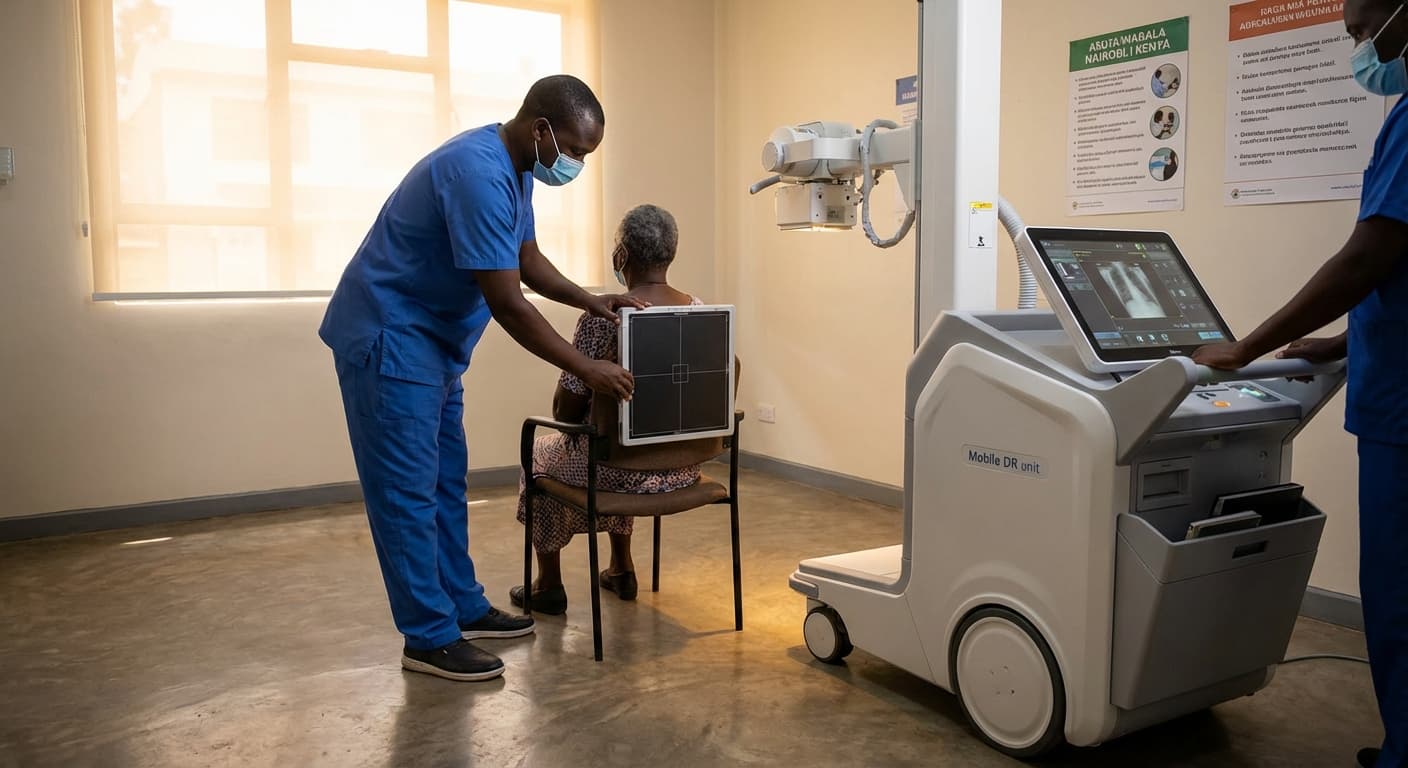
Digital X-Ray Installation Service (Mobile DR) in Uganda
Engineering Excellence & Technical Support
Digital X-Ray Installation Service (Mobile DR) High-standard technical execution following OEM protocols and local regulatory frameworks.
Advanced Mobile DR Technology Integration
We specialize in the seamless integration of state-of-the-art Mobile DR units, ensuring optimal performance and image quality tailored for diverse Ugandan healthcare settings, from bustling urban clinics to remote rural outreach programs.
Robust On-Site Installation & Calibration
Our certified technicians provide meticulous on-site installation and calibration of Digital X-Ray systems across Uganda, guaranteeing compliance with international standards and ensuring maximum uptime and reliability for your diagnostic imaging services.
Seamless PACS & Network Connectivity Solutions
We offer comprehensive solutions for integrating your new Mobile DR with Picture Archiving and Communication Systems (PACS) and existing hospital networks, facilitating efficient data management, remote access, and improved workflow for healthcare professionals nationwide.
What Is Digital X-ray Installation Service (Mobile Dr) In Uganda?
A Digital X-ray Installation Service (Mobile DR) in Uganda refers to the specialized process of deploying and configuring a Digital Radiography (DR) system that is integrated into a mobile platform. This service encompasses the complete lifecycle of bringing a mobile DR unit into operational status, from initial site assessment and infrastructure preparation to system calibration, testing, and user training. Mobile DR systems, unlike fixed X-ray installations, offer the flexibility to provide diagnostic imaging services in diverse and often remote locations where fixed radiology departments may be absent or inaccessible. The "DR" designation signifies the use of direct radiography detectors, which capture X-ray images digitally without the need for film or computed radiography plates, leading to faster image acquisition, improved image quality, and reduced radiation dose to patients. This service is critical for enhancing diagnostic capabilities and healthcare accessibility across Uganda's varied geographical and socioeconomic landscape.
| Stakeholder Group | Needs Addressed | Typical Use Cases |
|---|---|---|
| Rural Health Centers & Clinics: | Lack of fixed radiology infrastructure, need for on-site diagnostics to reduce patient travel, early disease detection. | Mobile X-ray screening for tuberculosis (TB), pneumonia, fractures in remote communities. Diagnostic imaging for general medical conditions where fixed facilities are unavailable. |
| Field Hospitals & Disaster Response Units: | Rapid deployment of imaging services in emergency situations, ability to provide diagnostic support in temporary medical settings. | Trauma imaging following natural disasters (e.g., floods, earthquakes), battlefield medical support, public health emergencies (e.g., pandemics requiring chest X-rays). |
| Mobile Health Screening Programs: | Outreach programs for public health initiatives, screening large populations in diverse locations. | Mass screening for lung diseases, bone density assessments, pre-employment medical examinations in industrial settings, community health campaigns. |
| Specialized Medical Outreach: | Providing diagnostic imaging for specific medical specialties in underserved areas, follow-up imaging for patients discharged from hospitals. | Orthopedic assessments for mobile clinics, pediatric imaging in mobile units, post-operative follow-up imaging in areas with limited access to hospital-based radiology. |
| Mining & Industrial Sites: | On-site medical support for workers in remote operational areas, occupational health monitoring. | Respiratory health screening for mine workers, injury assessments, routine medical surveillance for personnel working in isolated locations. |
Key Components of Digital X-Ray Installation Service (Mobile DR) in Uganda
- Site Assessment & Preparation: Evaluating the intended operational environment for the mobile DR unit. This includes assessing power availability (e.g., generator, stable grid connection), network connectivity for PACS integration, environmental conditions (temperature, humidity, dust), and physical space for deployment and patient positioning.
- System Delivery & Unpacking: Transporting the mobile DR unit and its associated components (X-ray generator, detector, imaging workstation, power supply, protective shielding) to the designated location and carefully unpacking them.
- Hardware Installation & Integration: Physically installing and connecting all hardware components. This involves mounting the X-ray tube, detector, and workstation, and ensuring seamless integration with the mobile platform's power and control systems.
- Software Configuration & Calibration: Installing and configuring the Digital Imaging and Communications in Medicine (DICOM) compliant Picture Archiving and Communication System (PACS) software, Digital Radiography (DR) acquisition software, and any necessary medical imaging viewer applications. Precise calibration of the X-ray generator and detector is performed to ensure accurate dose delivery and optimal image quality.
- Network & PACS Integration: Establishing reliable network connectivity to enable the transfer of images to a PACS server for storage, retrieval, and interpretation. This may involve configuring Wi-Fi, Ethernet, or cellular data connections.
- Quality Assurance & Testing: Conducting comprehensive tests to verify system functionality, image quality, radiation safety compliance, and data integrity. This includes phantom imaging, dose checks, and workflow simulation.
- User Training & Handover: Providing thorough training to radiographers, technicians, and other relevant personnel on the operation of the mobile DR system, including patient positioning, image acquisition protocols, system maintenance, and basic troubleshooting.
- Documentation & Compliance: Ensuring all necessary documentation, including installation reports, calibration certificates, and user manuals, is provided. Compliance with local radiation safety regulations and standards is paramount.
Who Needs Digital X-ray Installation Service (Mobile Dr) In Uganda?
Mobile Digital Radiography (DR) systems offer a significant advancement in diagnostic imaging, bringing advanced X-ray capabilities directly to patients. In Uganda, the need for mobile DR installation services is driven by a desire to improve healthcare access, efficiency, and diagnostic accuracy across various settings. These systems are particularly valuable in overcoming infrastructure challenges, reaching remote populations, and enhancing the flexibility of diagnostic services within healthcare facilities.
| Customer/Department | Specific Needs & Use Cases | Benefits of Mobile DR Installation |
|---|---|---|
| Hospitals (Public and Private) | Radiology Departments: Overcoming backlogs, enhancing patient throughput, providing bedside imaging for immobile patients, supporting emergency departments, and for use in temporary medical facilities during outbreaks or disasters. Orthopedics Departments: Rapid imaging for fracture diagnosis and post-operative checks, reducing patient movement. Emergency Departments: Immediate imaging for trauma patients, stroke assessments, and critically ill individuals. Intensive Care Units (ICUs): Bedside imaging for patients unable to be transported to the X-ray room, monitoring line placements, and diagnosing respiratory conditions. | Increased diagnostic capacity, reduced patient waiting times, improved patient comfort and safety, enhanced flexibility in workflow, potential for revenue generation through expanded services. |
| District Hospitals and Health Centers | Providing essential X-ray services in areas with limited infrastructure or specialized personnel, extending diagnostic reach beyond urban centers, supporting primary healthcare initiatives. | Democratizing access to diagnostic imaging, reducing patient referrals to distant facilities, improving early disease detection and management, empowering local healthcare providers. |
| Mobile Clinics and Outreach Programs | Delivering diagnostic imaging services to remote and underserved communities, supporting public health campaigns (e.g., TB screening), providing healthcare in hard-to-reach areas. | Extending healthcare reach, facilitating mass screening programs, providing essential diagnostics in nomadic or dispersed populations, enabling proactive health interventions. |
| Emergency Medical Services (EMS) | On-scene assessment of trauma patients, pre-hospital diagnosis of fractures and other conditions, facilitating rapid decision-making in critical situations. | Faster patient assessment and triage, improved pre-hospital care, better informed transfer decisions, potentially reducing time to definitive treatment. |
| Specialized Clinics (e.g., Tuberculosis, Orthopedics) | Tuberculosis Clinics: Mass screening for TB, monitoring treatment response, diagnosing pulmonary conditions. Orthopedics Clinics: On-site imaging for assessments, post-operative follow-ups, and sports medicine injuries. | Streamlined patient care, efficient screening processes, improved diagnostic accuracy for specific conditions, reduced patient travel for specialized imaging. |
| Military and Security Forces | Providing diagnostic imaging in field hospitals, forward operating bases, and during deployments, supporting medical readiness and casualty care. | Enhanced medical support in challenging environments, rapid diagnosis for military personnel, improved operational readiness. |
| Research Institutions and Universities | Facilitating research studies requiring imaging data, supporting medical education and training for radiography students and professionals, enabling clinical trials. | Advancing medical research, providing hands-on training opportunities, enhancing the educational infrastructure for future healthcare professionals. |
Target Customers and Departments for Mobile DR Installation in Uganda:
- Hospitals (Public and Private)
- District Hospitals and Health Centers
- Mobile Clinics and Outreach Programs
- Emergency Medical Services (EMS)
- Specialized Clinics (e.g., Tuberculosis, Orthopedics)
- Military and Security Forces
- Research Institutions and Universities
Digital X-ray Installation Service (Mobile Dr) Process In Uganda
This document outlines the typical workflow for a Digital X-Ray (Mobile DR) installation service in Uganda, from initial inquiry to successful execution and handover.
| Stage | Description | Key Activities | Responsible Party |
|---|---|---|---|
| Inquiry & Consultation | Initial contact and understanding of client needs. | Receive inquiry, discuss requirements, preliminary needs assessment. | Client, Service Provider |
| Site Assessment | Evaluating the installation location. | Physical space evaluation, power assessment, network readiness check, environmental factors. | Service Provider (Technical Team) |
| Proposal & Quotation | Presenting the solution and costs. | Developing detailed proposal, equipment specs, pricing, timeline, contract drafting. | Service Provider |
| Contracting & Deposit | Formalizing the agreement. | Client review and signing of contract, initial payment/deposit. | Client, Service Provider |
| Procurement & Delivery | Acquiring and transporting the equipment. | Ordering Mobile DR unit, logistics, delivery to site. | Service Provider |
| Pre-Installation Preparation | Ensuring site readiness. | Preparing power outlets, network points, necessary infrastructure modifications. | Client, Service Provider |
| Installation | Physical setup of the Mobile DR system. | Unpacking, component assembly, wiring, mounting of detectors and generator. | Service Provider (Installation Technicians) |
| Testing & Calibration | Verifying equipment functionality. | Image quality testing, radiation safety checks, system calibration. | Service Provider (Technical Team) |
| Software Setup & Integration | Configuring the digital imaging system. | OS installation, DR software setup, PACS/RIS integration (if applicable). | Service Provider (IT/Software Specialists) |
| Training | Educating end-users. | Hands-on training for radiographers, technicians, and IT staff on operation and basic maintenance. | Service Provider (Trainers) |
| Acceptance & Handover | Client's formal approval. | User acceptance testing (UAT), demonstration of functionality, handover documentation. | Client, Service Provider |
| Final Payment & Support | Concluding the transaction and ongoing assistance. | Processing final payment, providing warranty information, outlining support options. | Client, Service Provider |
Digital X-Ray Installation Service (Mobile DR) Process in Uganda: Workflow
- The process begins with an interested healthcare facility or individual contacting the service provider.
- This initial contact can be through phone, email, or an online inquiry form.
- The provider acknowledges the inquiry and gathers preliminary information about the client's needs and existing infrastructure.
- A site assessment is crucial to evaluate the physical space, power supply, and network connectivity requirements for the Mobile DR unit.
- Based on the assessment and client requirements, a detailed proposal is developed, including equipment specifications, pricing, installation timelines, and warranty information.
- The client reviews the proposal and, if satisfactory, proceeds to sign a contract and make an initial deposit.
- Upon receiving the deposit, the Mobile DR unit is ordered or prepared for delivery.
- Pre-installation activities include ensuring the site is ready, as per the assessment, and any necessary electrical or structural modifications are completed.
- The Mobile DR unit and its accessories are delivered to the client's site.
- Qualified technicians perform the physical installation, including setting up the X-ray generator, detector, workstation, and any networking components.
- Rigorous testing and calibration are conducted to ensure the equipment functions optimally and meets diagnostic standards.
- Software installation and configuration are performed, including PACS (Picture Archiving and Communication System) integration if required.
- Comprehensive training is provided to the healthcare staff on the operation of the Mobile DR system, image acquisition, and basic troubleshooting.
- The client formally accepts the installation after all tests and training are completed successfully.
- The final payment is processed according to the contract terms.
- Post-installation support is offered, which may include warranty services, maintenance contracts, and ongoing technical assistance.
Digital X-ray Installation Service (Mobile Dr) Cost In Uganda
The cost of installing a digital X-ray (Mobile DR) system in Uganda can vary significantly based on several factors. This technology represents a substantial investment for healthcare facilities, offering improved diagnostic capabilities and workflow efficiency compared to traditional film-based systems. Understanding these pricing factors is crucial for accurate budgeting and decision-making.
| Cost Component | Estimated Range (UGX) |
|---|---|
| Mobile DR System (Unit Cost) | 150,000,000 - 500,000,000+ |
| Installation & Configuration | 5,000,000 - 20,000,000 |
| Software & PACS Integration | 10,000,000 - 40,000,000 |
| Training (Radiographers/Technicians) | 3,000,000 - 15,000,000 |
| Ancillary Equipment (e.g., shielding, workstations) | 5,000,000 - 25,000,000 |
| Warranty & Initial Service Contract (1-2 years) | 10,000,000 - 30,000,000 |
| Import Duties, Taxes & Clearing | Variable (estimated 15-30% of CIF value) |
| Total Estimated Installation Cost (Excluding VAT) | 200,000,000 - 700,000,000+ |
Key Pricing Factors for Mobile DR Installation in Uganda:
- System Type and Manufacturer: Different brands and models of Mobile DR systems come with varying price points. High-end systems with advanced features and superior image quality will naturally be more expensive.
- Number of Detectors/Acquisition Units: The cost will increase if the installation requires multiple detectors or acquisition units to cover different X-ray rooms or mobile needs.
- Software and PACS Integration: The cost includes specialized imaging software for image processing, manipulation, and storage. Integration with existing Picture Archiving and Communication Systems (PACS) or the establishment of a new PACS can add to the overall expense.
- Training and Support: Comprehensive training for radiographers and technicians is essential for effective use of the new system. Ongoing technical support and maintenance contracts also contribute to the cost.
- Installation and Infrastructure Requirements: This includes the physical installation of the Mobile DR unit, any necessary modifications to existing X-ray rooms (e.g., power upgrades, structural considerations), and network infrastructure for data transfer.
- Ancillary Equipment: Depending on the specific needs, additional equipment like lead shielding, workstations for image review, and printers might be required.
- Warranty and Service Agreements: The duration and scope of the warranty, along with optional service and maintenance packages, will influence the initial and ongoing costs.
- Supplier and Negotiation: Prices can differ between various suppliers and distributors of medical equipment in Uganda. Negotiation plays a significant role in securing a favorable price.
- Import Duties and Taxes: As most advanced medical equipment is imported, applicable import duties, taxes, and clearing fees will impact the final cost.
Affordable Digital X-ray Installation Service (Mobile Dr) Options
Investing in a Digital Radiography (DR) system offers significant advantages over traditional film-based X-rays, including faster imaging, improved image quality, reduced radiation dose, and streamlined workflow. For facilities seeking affordable mobile DR solutions, understanding value bundles and cost-saving strategies is crucial. Mobile DR units bring diagnostic imaging directly to patients, ideal for hospitals, clinics, long-term care facilities, and even veterinary practices. This service focuses on providing comprehensive installation, integration, and training for these portable systems. Value bundles often combine the DR detector, acquisition software, PACS integration, and essential accessories, offering a more cost-effective package than purchasing components individually. Cost-saving strategies extend beyond the initial purchase to include maintenance plans, training options, and financing. Our service aims to demystify these options and ensure you receive the best possible return on your investment.
| Value Bundle Type | Typical Inclusions | Target Audience | Cost-Saving Aspect |
|---|---|---|---|
| Starter Bundle | 1 Wireless DR Detector (Medium Size), Basic Acquisition Software, Basic PACS Viewer, Installation, 1-Day Training | Small clinics, private practices, mobile imaging startups | Lower upfront cost, essential functionality |
| Standard Bundle | 1 Wireless DR Detector (Medium/Large), Advanced Acquisition Software with Dose Monitoring, Full PACS Integration, Mobile Cart, Installation, 2-Day Training, 1-Year Basic Support | Medium-sized clinics, hospitals with growing imaging needs | Integrated solution, enhanced workflow, predictable support costs |
| Premium Bundle | 2 DR Detectors (e.g., 1 wireless, 1 wired for specific applications), Comprehensive Acquisition Software with Advanced Tools, Full PACS Integration & Archiving Solution, High-End Mobile Cart, On-site Installation & Comprehensive Training, 2-Year Extended Support & Maintenance | Larger hospitals, busy imaging centers, facilities with diverse imaging requirements | Maximum efficiency, long-term reliability, bundled maintenance |
| Veterinary Bundle | 1 Wireless DR Detector (Veterinary-specific size/features), Veterinary Acquisition Software, Veterinary PACS Integration, Mobile Cart, Installation, Training tailored for veterinary applications | Veterinary clinics and hospitals | Specialized functionality at a bundled price |
Key Components of an Affordable Mobile DR Installation Service
- DR Detector: The core of the digital system, converting X-ray photons into a digital signal. Options range in size, resolution, and wireless/wired capabilities.
- Acquisition Software: User-friendly software for image capture, processing, and preliminary analysis. Often includes features for patient management and DICOM output.
- PACS Integration: Seamless integration with your existing Picture Archiving and Communication System (PACS) for efficient image storage, retrieval, and sharing.
- Mobile Cart/Stand: A robust and maneuverable cart designed to securely house the DR detector and associated electronics for easy patient positioning.
- Installation & Calibration: Professional setup, connection of all components, and precise calibration of the system for optimal image quality and radiation accuracy.
- Training: Comprehensive training for radiographers and technologists on system operation, image acquisition techniques, and basic troubleshooting.
- Post-Installation Support: Ongoing technical assistance and troubleshooting to ensure continued smooth operation of the DR system.
Verified Providers In Uganda
Finding reliable and trustworthy healthcare providers in Uganda is paramount for ensuring quality medical care. This is where Franance Health distinguishes itself. Franance Health is a dedicated platform that meticulously vets and verifies healthcare professionals and facilities across Uganda. Their rigorous credentialing process goes beyond basic registration, ensuring that all listed providers meet stringent standards for expertise, ethics, and patient safety. By choosing a Franance Health verified provider, individuals gain access to a network of healthcare professionals who have undergone a thorough due diligence process. This verification signifies their commitment to professional excellence, adherence to regulatory guidelines, and a proven track record of delivering high-quality patient care. Franance Health's dedication to transparency and accountability empowers patients with the confidence to make informed decisions about their health and well-being.
| Verification Aspect | What Franance Health Ensures |
|---|---|
| Professional Licenses and Certifications | Up-to-date and valid licenses from recognized regulatory bodies. |
| Educational Background | Verification of degrees, diplomas, and specialized training. |
| Work Experience and References | Confirmation of past employment and positive professional references. |
| Ethical Conduct and Disciplinary History | Checks for any past or ongoing disciplinary actions or ethical breaches. |
| Facility Standards (for clinics/hospitals) | Assessment of hygiene, equipment, and overall operational standards. |
| Continuing Professional Development | Encouragement and verification of ongoing learning and skill enhancement. |
Why Franance Health Verified Providers are the Best Choice:
- Rigorous Vetting Process: Franance Health employs a comprehensive and multi-faceted verification process.
- Guaranteed Credentialing: Ensures providers possess legitimate qualifications and licenses.
- Commitment to Ethics: Verifies adherence to professional ethical standards.
- Focus on Patient Safety: Prioritizes providers with a strong record of patient care and safety.
- Transparency and Trust: Builds confidence for patients seeking reliable healthcare.
- Access to Quality Care: Connects users with top-tier healthcare professionals.
- Reduced Risk of Malpractice: Minimizes the chances of encountering unqualified or unethical practitioners.
- Peace of Mind: Offers assurance that you are receiving care from trusted sources.
Scope Of Work For Digital X-ray Installation Service (Mobile Dr)
This Scope of Work (SOW) outlines the requirements for the professional installation of a Mobile Digital Radiography (DR) X-ray system. The service includes delivery, setup, configuration, testing, and initial training to ensure the system is fully operational and meets all specified technical and performance standards. The objective is to provide a seamless and efficient installation process, minimizing downtime and ensuring the highest level of patient care and diagnostic accuracy.
| Technical Deliverable | Standard Specification / Requirement | Verification Method |
|---|---|---|
| Mobile DR Unit Functionality | The Mobile DR system shall power on and respond to all control inputs without error. All mechanical movements shall be smooth and within specified ranges. | Visual inspection, system diagnostic checks, functional test sequence. |
| X-ray Generator Performance | The X-ray generator shall produce radiation within the specified kVp, mAs, and time ranges. Output consistency shall be within ±5% of nominal values across multiple exposures. | Dosimetry measurements using calibrated ionization chamber, repeat exposure consistency checks. |
| Digital Detector Performance | The DR detector shall acquire images with specified spatial resolution (e.g., lp/mm), contrast-to-noise ratio (CNR), and detective quantum efficiency (DQE). No dead pixels or significant artifacts shall be present. | Resolution test patterns, image quality phantoms, visual inspection of test images, DQE measurement (if applicable). |
| Image Acquisition Software | The imaging software shall allow for selection of anatomical programs, parameter adjustments (kVp, mAs), and image acquisition. Image capture time from exposure to display shall be less than X seconds (e.g., 5-10 seconds). | Functional testing of all software modules, timing of image acquisition and display. |
| Image Processing and Enhancement | The system shall offer standard image processing algorithms (e.g., contrast enhancement, edge enhancement) that are user-selectable and effectively improve diagnostic quality without introducing artifacts. | Application of processing algorithms to test images, visual assessment of image quality. |
| Network Connectivity and DICOM Compliance | The system shall successfully transmit images in DICOM format to the designated PACS/HIS/RIS. All DICOM tags shall be correctly populated as per standard requirements. | Successful image transfer to PACS, DICOM conformance statement review, DICOM network testing tools. |
| Workstation Performance | The acquisition workstation shall boot up within X seconds (e.g., 60 seconds) and the imaging software shall load within Y seconds (e.g., 30 seconds). Display resolution shall meet diagnostic standards (e.g., 2MP or 3MP grayscale display). | Boot time measurement, software load time measurement, display verification. |
| Radiation Safety Features | All safety interlocks (e.g., emergency stop, beam-on indicators) shall function correctly. Radiation leakage shall be within regulatory limits. | Functional testing of interlocks, radiation survey measurements (if required). |
| User Interface (UI) and Ergonomics | The system shall have an intuitive and easy-to-navigate user interface. Controls and components shall be ergonomically positioned for ease of use. | User feedback during training, visual inspection of control layout. |
Key Activities and Deliverables
- Site Assessment and Preparation: Pre-installation survey to confirm site readiness, power requirements, network connectivity, and physical space.
- Equipment Delivery and Unpacking: Safe and secure transport of the Mobile DR system to the designated site, including all accessories and components. Careful unpacking and inventory verification.
- Physical Installation: Assembly and positioning of the Mobile DR unit, including the X-ray generator, detector, acquisition workstation, and any associated cabling.
- Electrical and Network Integration: Connection to existing power outlets and establishment of network connectivity (wired or wireless) for data transfer and PACS integration.
- Software Installation and Configuration: Installation and configuration of the DR imaging software, including calibration, DICOM settings, and integration with the Picture Archiving and Communication System (PACS) or HIS/RIS.
- System Testing and Calibration: Comprehensive testing of all system components, including X-ray output, image acquisition, image processing, and network communication. Calibration of the X-ray generator and detector to ensure optimal image quality and dose management.
- Quality Assurance (QA) Checks: Performance verification against manufacturer specifications and client requirements. Verification of all safety interlocks and radiation shielding.
- User Training: On-site training for designated clinical and technical staff on the operation, basic troubleshooting, and maintenance of the Mobile DR system.
- Documentation and Handover: Provision of all necessary installation reports, user manuals, warranty information, and a formal system handover document.
- Post-Installation Support: Initial period of on-site or remote support to address any immediate issues post-installation.
Service Level Agreement For Digital X-ray Installation Service (Mobile Dr)
This Service Level Agreement (SLA) outlines the response times and uptime guarantees for the Digital X-Ray Installation Service (Mobile DR). This SLA applies to all customers who have subscribed to the Mobile DR installation service and have a valid support contract in place.
| Service Component | Priority Level | Response Time Target | Resolution Time Target | Uptime Guarantee |
|---|---|---|---|---|
| Installation Scheduling | Standard | Within 5 business days of request confirmation | N/A (Completion dependent on site readiness) | N/A |
| Post-Installation System Functionality | Critical (System completely down) | 1 hour (24/7) | 4 business hours | 99.9% monthly |
| Post-Installation System Functionality | High (Significant performance degradation, partial functionality loss) | 2 business hours (8 AM - 6 PM local time) | 8 business hours | 99.9% monthly |
| Post-Installation System Functionality | Medium (Minor issues, cosmetic problems, reporting errors) | 4 business hours (8 AM - 6 PM local time) | 2 business days | 99.9% monthly |
| Remote Support | All | As per priority level above | N/A (Resolution may involve further steps) | N/A |
| On-site Support | Critical | Within 4 business hours of confirmed need for on-site | Within 1 business day of arrival | N/A |
| On-site Support | High | Within 8 business hours of confirmed need for on-site | Within 2 business days of arrival | N/A |
Scope of Service
- Installation of Mobile DR units at customer premises.
- Initial system configuration and testing.
- Basic user training on system operation.
- Remote and on-site technical support for issues arising from the installation.
- Scheduled preventative maintenance (as per separate contract).
Frequently Asked Questions

Ready when you are
Let's scope your Digital X-Ray Installation Service (Mobile DR) in Uganda project in Uganda.

Scaling healthcare logistics and technical systems across the entire continent.