
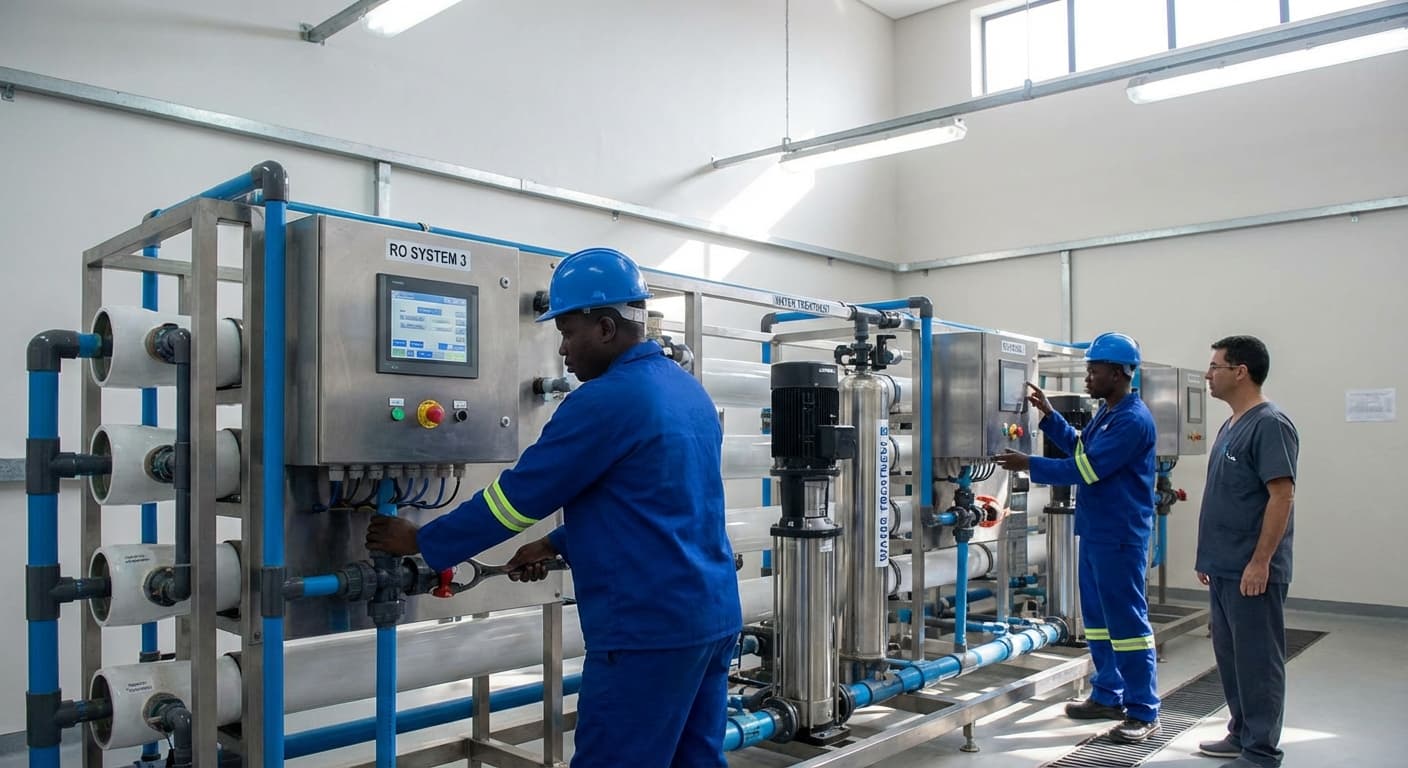
Dialysis RO/Water Treatment Plant Installation Service in Uganda
Engineering Excellence & Technical Support
Dialysis RO/Water Treatment Plant Installation Service High-standard technical execution following OEM protocols and local regulatory frameworks.
Robust Pre-Treatment Systems
We implement multi-stage pre-treatment, including advanced filtration and softening, specifically engineered to handle Uganda's varied raw water quality. This ensures optimal membrane performance and longevity, minimizing downtime and operational costs for your dialysis facility.
Optimized Flow Rates & Pressure Management
Our installations prioritize precise control of flow rates and pressure throughout the RO and water treatment process. This critical parameter management guarantees consistent water quality, essential for patient safety, and maximizes the efficiency of your dialysis machines.
Seamless Integration & Automation
We provide fully integrated and automated RO and water treatment solutions designed for plug-and-play functionality. Our expert technicians ensure all components are perfectly calibrated and connected, enabling immediate operation and simplifying ongoing management for your Ugandan healthcare facility.
What Is Dialysis Ro/water Treatment Plant Installation Service In Uganda?
Dialysis RO/Water Treatment Plant Installation Service in Uganda refers to the comprehensive process of designing, supplying, installing, commissioning, and maintaining Reverse Osmosis (RO) and associated water treatment systems specifically for medical dialysis facilities within Uganda. These plants are critical for producing ultrapure water, a non-negotiable requirement for hemodialysis procedures, to prevent complications and ensure patient safety. The service encompasses all stages from initial site assessment and water quality analysis to the final handover of a fully operational system, including necessary certifications and operator training.
| Who Needs It? | Typical Use Cases | |||
|---|---|---|---|---|
| Renal Dialysis Centers: Both established and newly constructed public and private healthcare facilities offering hemodialysis services. | Hospitals with Nephrology Departments: Medical institutions requiring dedicated ultrapure water for their internal dialysis units. | Non-Governmental Organizations (NGOs) & Charities: Organizations operating healthcare programs focused on kidney disease treatment in underserved areas. | Government Health Ministries: For public healthcare infrastructure development and upgrades. | Medical Equipment Suppliers: Partnering with installation services to offer complete dialysis unit solutions. |
| Hemodialysis Water Production: The primary application, ensuring the delivery of safe and sterile dialysate to patients undergoing hemodialysis. | Peritoneal Dialysis Fluid Preparation (less common for RO): While RO is less critical for PD fluid itself (which is often pre-packaged), a well-treated water source might be used in specific scenarios for facility-level operations. | Water Quality Assurance: Maintaining consistent and verifiable water purity standards to prevent pyrogenic reactions, bacterial contamination, and other patient safety risks. | Compliance with Health Regulations: Meeting the stringent requirements set by the Ugandan Ministry of Health and international healthcare standards for dialysis facilities. | System Longevity & Reliability: Ensuring the installed plant operates efficiently and reliably over its lifespan with proper maintenance, minimizing downtime. |
Key Components of the Service:
- Site Assessment & Water Analysis: Evaluating the existing water source (municipal, well, borewell) for contaminants, flow rates, and pressure. Comprehensive water quality testing is performed to identify dissolved solids, microbial loads, heavy metals, and other potential impurities.
- System Design & Engineering: Developing a tailored RO and water treatment system based on the analysis, ensuring compliance with international dialysis water standards (e.g., AAMI, ISO) and local health regulations. This includes specifying the number and type of RO membranes, pre-filtration stages (sediment, carbon), post-treatment (e.g., UV sterilization, continuous electrodeionization - CEDI), storage tanks, piping, and distribution loops.
- Equipment Procurement & Supply: Sourcing high-quality, reliable components and machinery from reputable manufacturers, ensuring compatibility and adherence to specifications.
- Installation & Assembly: Physically installing all equipment, including pumps, filters, membranes, tanks, control panels, and interconnecting pipework, according to the approved engineering design.
- Electrical & Plumbing Integration: Connecting the treatment plant to the facility's power supply and water distribution network, ensuring safe and efficient operation.
- Commissioning & Validation: Rigorous testing of the installed system to verify performance against design parameters. This includes flushing, sanitization, and obtaining water quality test results that meet stringent dialysis standards. Validation ensures the system consistently produces ultrapure water.
- Operator Training: Providing comprehensive training to facility staff on the operation, routine maintenance, monitoring, and troubleshooting of the RO and water treatment plant.
- Documentation & Certification: Supplying all necessary operational manuals, maintenance logs, warranties, and certifications as required by regulatory bodies and the facility.
Who Needs Dialysis Ro/water Treatment Plant Installation Service In Uganda?
Dialysis RO/Water Treatment Plant Installation services in Uganda are crucial for a variety of entities that rely on purified water for medical procedures, particularly hemodialysis. The demand stems from the critical need to eliminate impurities, bacteria, and dissolved solids from municipal or well water to ensure patient safety and the effective functioning of dialysis equipment. These services are essential for maintaining high healthcare standards and preventing complications associated with untreated or improperly treated water.
| Customer Type | Key Departments/Stakeholders Involved | Primary Needs |
|---|---|---|
| Hospitals (Public and Private) | Nephrology Department, Biomedical Engineering Department, Procurement Department, Facilities Management | Reliable and compliant RO systems for hemodialysis, preventative maintenance, water quality monitoring, training for staff. |
| Specialized Kidney Centers | Medical Director, Clinical Staff, Technical Operations Manager, Procurement | High-capacity, state-of-the-art RO plants, consistent water quality, minimal downtime, long-term service agreements. |
| Clinics with Dialysis Facilities | Clinic Administrator, Lead Nurse, Maintenance Technician | Compact and efficient RO units, cost-effective solutions, ease of operation and maintenance, adherence to local health regulations. |
| Non-Governmental Organizations (NGOs) & International Aid Organizations | Program Managers, Healthcare Coordinators, Logistics Department, Finance Department | Installation in underserved areas, sustainable solutions, training local personnel, cost-efficient and durable systems, compliance with international standards. |
| Government Health Ministries & Facilities | Director of Health Services, Hospital Administrators, Public Procurement and Disposal Unit (PPDU), Technical Officers | Scalable solutions for public hospitals, adherence to national health standards, robust and long-lasting equipment, capacity building for government staff. |
Target Customers & Departments for Dialysis RO/Water Treatment Plant Installation Services in Uganda:
- Hospitals (Public and Private)
- Specialized Kidney Centers
- Clinics with Dialysis Facilities
- Non-Governmental Organizations (NGOs) involved in healthcare
- Government Health Ministries and their facilities
- International Aid Organizations
- Research Institutions conducting medical research
Dialysis Ro/water Treatment Plant Installation Service Process In Uganda
This document outlines the comprehensive workflow for the Dialysis RO/Water Treatment Plant Installation Service Process in Uganda, from initial inquiry to final execution and handover. We aim to provide a clear and systematic approach to ensure a smooth and efficient installation for our clients.
| Stage | Description | Key Activities | Deliverables/Outcomes | Typical Timeline (Uganda Context) |
|---|---|---|---|---|
| The process begins when a client expresses interest in a dialysis RO/water treatment plant installation service. | Receive inquiry (phone, email, website), initial needs assessment, discuss client requirements (capacity, water quality, budget), schedule initial meeting. | Understanding of client needs, preliminary recommendation of system type. | 1-3 Business Days |
| A detailed evaluation of the client's proposed installation site is conducted. | On-site visit, assess space availability, power supply, water source quality and pressure, drainage, existing plumbing, structural integrity. Take measurements and photographs. | Detailed site report, identification of potential challenges, confirmation of system feasibility. | 3-7 Business Days (depending on location and complexity) |
| Based on the inquiry and site assessment, a tailored proposal and quotation are prepared. | Design system specifications, select components, estimate costs (equipment, labor, ancillaries), prepare detailed proposal document including scope of work, timeline, and pricing. | Comprehensive proposal with technical specifications, detailed quotation, projected installation schedule. | 5-10 Business Days |
| Upon client acceptance of the proposal, a formal contract is established. | Review and finalize contract terms, pricing, payment schedules, warranties, service level agreements (SLAs). Obtain client signature. | Signed installation contract, formal agreement to proceed. | 2-5 Business Days |
| All necessary equipment, components, and materials are sourced and transported to the site. | Order equipment and spares from manufacturers/suppliers, arrange for customs clearance (if applicable), coordinate transportation to the installation site in Uganda. | All required equipment and materials delivered to site. | 2-6 Weeks (depending on lead times and shipping) |
| The site is prepared for the installation of the new system. | Clear installation area, prepare necessary civil works (e.g., concrete pads), ensure access to utilities (water, power), set up temporary storage for materials. | Site ready for installation activities. | 1-3 Business Days (concurrent with material arrival) |
| The core installation and initial setup of the RO/water treatment plant. | Assemble and install the RO unit, pre-filters, post-filters, storage tanks, pumps, piping, electrical connections. Connect to water source and distribution. Initial system startup and basic functional checks. | Physically installed and partially operational RO/water treatment system. | 5-15 Business Days (depending on system size and complexity) |
| Rigorous testing to ensure the system meets performance and water quality standards. | Perform water quality testing (TDS, conductivity, pH, etc.), flow rate verification, pressure checks, electrical safety checks, performance diagnostics. Adjust settings for optimal performance. | Validated water quality report, performance test results, system calibrated and optimized. | 2-5 Business Days |
| The client's staff are trained on the operation and basic maintenance of the system. | Conduct comprehensive training sessions on system operation, routine maintenance procedures, troubleshooting common issues, safety protocols. Provide operation and maintenance manuals. Formal handover of the installed system. | Trained operational staff, complete documentation, officially handed-over system. | 1-2 Business Days |
| Ongoing support to ensure the long-term functionality of the system. | Provide warranty support, schedule periodic maintenance visits (as per SLA), offer emergency repair services, supply spare parts. Ongoing consultation and technical assistance. | Continued system reliability, minimized downtime, client satisfaction. | Ongoing |
Key Stages of the Dialysis RO/Water Treatment Plant Installation Service Process
- Initial Inquiry & Consultation
- Site Assessment & Survey
- Proposal & Quotation
- Contract & Agreement
- Procurement & Logistics
- Pre-Installation Preparation
- On-Site Installation & Commissioning
- Testing & Quality Assurance
- Training & Handover
- Post-Installation Support & Maintenance
Dialysis Ro/water Treatment Plant Installation Service Cost In Uganda
Installing a Reverse Osmosis (RO) and Water Treatment plant for dialysis facilities in Uganda involves a complex process with varying costs. The final price is influenced by a multitude of factors, making it essential to get detailed quotes from specialized providers. These costs encompass not just the equipment but also the engineering, installation, commissioning, and ongoing maintenance.
| Service Component | Estimated Cost Range (UGX) | Notes |
|---|---|---|
| Basic Small-Scale RO System (e.g., < 500 L/hr) | 15,000,000 - 30,000,000 | Includes essential RO, pre-filtration, and basic post-treatment. Suitable for smaller clinics or lower patient volumes. |
| Medium-Scale RO System (e.g., 500 - 1500 L/hr) | 30,000,000 - 70,000,000 | More robust pre-treatment, higher-grade membranes, and better automation. For moderate-sized dialysis centers. |
| Large-Scale/High-End RO System (e.g., > 1500 L/hr) | 70,000,000 - 200,000,000+ | Advanced multi-stage treatment, redundancy, sophisticated monitoring, and higher flow rates. For large hospitals or multi-station dialysis units. |
| Pre-Treatment Systems (e.g., Sand Filters, Carbon Filters, Softeners) | 5,000,000 - 25,000,000 | Cost varies significantly based on the extent of raw water contamination and the number of treatment stages required. |
| Post-Treatment Systems (e.g., UV Sterilizers, Deionization) | 3,000,000 - 15,000,000 | Essential for achieving medical-grade purity. UV is standard, deionization adds significant cost. |
| Installation & Commissioning Labor | 5,000,000 - 20,000,000 | Includes skilled technicians, engineers, and site work. Varies with project complexity and location. |
| Ancillary Equipment (Tanks, Piping, Electrical) | 7,000,000 - 30,000,000 | Dependent on storage capacity, material quality, and complexity of electrical and plumbing integration. |
| Engineering & Design Fees | 3,000,000 - 15,000,000 | For custom solutions, site assessments, and system design. |
| Ongoing Maintenance & Service Contracts (Annual) | 2,000,000 - 10,000,000 | Covers regular filter changes, membrane cleaning, inspections, and emergency call-outs. |
Key Pricing Factors for Dialysis RO/Water Treatment Plant Installation in Uganda:
- Plant Capacity and Flow Rate: The volume of purified water required per hour or day directly impacts the size and complexity of the RO membranes, pumps, and storage tanks, thus affecting the overall cost.
- Water Source Quality: The initial quality of the raw water (e.g., borehole, municipal supply) dictates the pre-treatment stages needed. Higher contamination levels (e.g., high TDS, heavy metals, microorganisms) require more advanced filtration and purification methods, increasing the price.
- Technology and System Complexity: Different RO systems offer varying levels of purification and automation. Systems with advanced monitoring, redundant components, and multiple stages of treatment (e.g., ultrafiltration, UV sterilization, deionization) will be more expensive.
- Equipment Brand and Quality: Reputable international brands often come with a higher price tag but generally offer better reliability, performance, and longer lifespans compared to generic or local alternatives. The quality of pumps, membranes, filters, and control systems are crucial.
- Installation and Labor Costs: This includes site preparation, plumbing, electrical connections, civil works (if any), and the skilled labor required for assembly and installation. Geographic location within Uganda can also influence labor rates.
- Engineering and Design: Custom-designed systems tailored to specific site conditions and water challenges will incur higher engineering and design fees than standardized solutions.
- Ancillary Equipment: This may include raw water storage tanks, treated water storage tanks, dosing pumps for chemicals (if required), and water softeners, all contributing to the total cost.
- Commissioning and Training: The process of testing, calibrating, and bringing the plant online, along with training facility staff on operation and maintenance, is a vital part of the service and factored into the price.
- Permits and Approvals: Obtaining necessary permits from local authorities for water abstraction and discharge can add to the upfront costs.
- Warranty and After-Sales Service: The duration and scope of the warranty, as well as the availability and cost of ongoing maintenance and support services, are important considerations.
- Transportation and Logistics: Moving large equipment to the installation site, especially in remote areas of Uganda, can incur significant transportation costs.
- Project Timeline and Urgency: Expedited installation projects may involve additional costs for overtime labor or prioritized delivery of components.
Affordable Dialysis Ro/water Treatment Plant Installation Service Options
Finding affordable and reliable RO/Water Treatment Plant installation services for dialysis centers is crucial. These systems ensure the high-purity water essential for patient safety and treatment efficacy. This guide explores various service options, value bundles, and cost-saving strategies to help dialysis facilities optimize their investments without compromising quality.
| Service Option | Description | Value Proposition | Cost-Saving Strategies |
|---|---|---|---|
| Standard Installation Package | Includes essential RO unit, basic pre-treatment, piping, electrical hookup, and initial testing. Suitable for facilities with good incoming water quality. | Covers core functional requirements for safe dialysis water at a base price. | Bundle with initial maintenance agreement. Seek package deals that include a warranty period. Compare quotes from multiple reputable providers. |
| Comprehensive Value Bundle | Combines advanced RO technology, robust pre-treatment (e.g., water softeners, carbon filters), post-treatment (e.g., UV sterilization), and a multi-year service and maintenance contract. Often includes remote monitoring capabilities. | Offers enhanced water purity, reduced risk of system failure, and predictable long-term operational costs. Peace of mind through proactive maintenance. | Negotiate long-term contracts for discounts. Consider financing options that spread costs over time. Inquire about energy-efficient models to lower utility expenses. |
| Customized Solution with phased approach | Tailored system design based on specific source water analysis and facility needs. May involve phased installation of components to manage budget constraints. | Maximizes efficiency by addressing unique challenges of the facility's water source. Flexibility in deployment to align with budget. | Prioritize essential components first. Explore refurbished or certified pre-owned equipment for non-critical stages. Seek out government grants or healthcare infrastructure funding. |
| Modular/Scalable Systems | Installation of modular components that can be expanded or upgraded as the facility's needs grow. Allows for initial investment to be lower. | Reduces upfront capital expenditure and allows for adaptation to future growth without complete system replacement. | Invest in scalable designs from the outset. Factor in future expansion costs when comparing initial pricing. |
Key Considerations for Affordable Dialysis RO/Water Treatment Plant Installation
- Water Quality Standards: Understand and adhere to AAMI, ISO, and local regulatory standards for dialysis water.
- System Sizing and Capacity: Accurately determine the required water volume based on patient load and treatment frequency.
- Technology Choice: Evaluate different RO technologies (single-pass, double-pass) and pre-treatment options based on source water quality.
- Maintenance and Service Contracts: Factor in ongoing operational costs and the importance of preventative maintenance.
- Installation Expertise: Choose providers with proven experience in healthcare and dialysis facility installations.
- Energy Efficiency: Consider systems designed for lower power consumption to reduce utility bills.
Verified Providers In Uganda
In Uganda's evolving healthcare landscape, identifying trustworthy and competent medical providers is paramount. Franance Health stands out as a leading platform dedicated to showcasing verified healthcare professionals and institutions. Their rigorous credentialing process ensures that every provider listed on their platform has met stringent standards of education, licensure, experience, and patient care. This commitment to verification offers a crucial layer of assurance for individuals seeking quality healthcare. Franance Health’s dedication to transparency and patient safety makes them the preferred choice for navigating Uganda's medical services.
| Category | Franance Health Advantage | Benefit to Patients |
|---|---|---|
| Licensure & Certification | Mandatory verification of all relevant professional licenses and certifications. | Ensures providers meet minimum regulatory and professional standards. |
| Educational Background | Confirmation of accredited medical education and specialized training. | Guarantees a strong foundation of knowledge and expertise. |
| Clinical Experience | Assessment of practical experience and track record in patient care. | Indicates proven ability to diagnose and treat effectively. |
| Professional Reputation | Consideration of ethical conduct and patient feedback where applicable. | Suggests a commitment to excellent patient service and outcomes. |
| Adherence to Standards | Providers are expected to comply with current medical best practices. | Promotes delivery of up-to-date and evidence-based medical care. |
Why Franance Health Providers Are the Best Choice:
- Rigorous Credential Verification: All listed providers undergo a thorough check of their qualifications and licenses.
- Commitment to Patient Safety: Prioritizing a secure and reliable healthcare experience.
- Access to Quality Care: Connecting patients with highly competent and experienced medical professionals.
- Transparency in Healthcare: Providing clear and verifiable information about providers.
- Empowering Patient Choice: Enabling informed decisions through reliable provider data.
Scope Of Work For Dialysis Ro/water Treatment Plant Installation Service
This Scope of Work (SOW) outlines the requirements for the installation services of a Dialysis Reverse Osmosis (RO)/Water Treatment Plant. It details the technical deliverables expected from the service provider and references standard specifications to ensure the successful and compliant implementation of the system. The objective is to deliver a fully functional and operational water treatment plant that meets all regulatory and clinical requirements for dialysis water.
| Item | Standard/Specification Reference | Description |
|---|---|---|
| Water Quality | Association for the Advancement of Medical Instrumentation (AAMI) RD52:2015 (or latest) | Ensures dialysis water meets stringent standards for purity, conductivity, and microbial content. |
| RO Membrane Performance | Manufacturer's Specifications and Relevant ISO Standards (e.g., ISO 9001 for quality management) | Guarantees efficiency, rejection rates, and longevity of RO membranes. |
| Materials of Construction | ASME B31.3 (Process Piping) / NSF/ANSI 61 (Drinking Water System Components) | Specifies appropriate and safe materials for all wetted parts of the system to prevent contamination. |
| Electrical Installation | National Electrical Code (NEC) / IEC Standards | Ensures safe and compliant electrical installation and wiring practices. |
| Instrumentation and Control | ISA Standards (e.g., ISA-TR20.00.01 for Instrumentation Documentation) | Defines requirements for instrument selection, installation, calibration, and control logic. |
| Sanitization Procedures | Manufacturer's Recommendations and Best Practices in Dialysis Water Treatment | Outlines protocols for effective system sanitization to prevent microbial growth. |
| Testing and Validation | Protocols outlined in AAMI RD52:2015 and Client-Specific Validation Plan | Defines the methodology and acceptance criteria for performance testing and validation. |
Key Technical Deliverables
- Detailed Engineering Design and Drawings: Submission of comprehensive engineering drawings, including P&ID (Piping and Instrumentation Diagrams), electrical schematics, layout plans, and civil/structural requirements.
- Equipment Procurement and Supply: Sourcing and delivery of all specified RO membranes, pre-treatment filters, post-treatment components, pumps, storage tanks, piping, valves, and control systems according to approved specifications.
- Site Preparation and Civil Works: Execution of all necessary civil works, including foundation preparation, concrete pads, trenching, and installation of any required structures or enclosures for the water treatment plant.
- Piping and Plumbing Installation: Installation of all internal and external piping systems for raw water intake, pre-treatment, RO unit, post-treatment, permeate storage, distribution, and reject water discharge. This includes material selection, joining, and pressure testing.
- Electrical Wiring and Instrumentation: Installation and connection of all electrical components, including power supply, control panels, sensors, actuators, and interlocks. Calibration and testing of all instrumentation.
- Equipment Assembly and Integration: Rigorous assembly and integration of all individual components and modules of the RO/Water Treatment Plant into a cohesive and functional system.
- Commissioning and Start-up: Comprehensive testing and commissioning of the entire system to verify performance against design specifications. This includes flushing, sanitization, and initial operation under load.
- Performance Testing and Validation: Conducting performance tests to ensure the delivered water quality meets established standards (e.g., AAMI, ISO) and clinical requirements. Validation reports will be provided.
- Training: Providing comprehensive training to the facility's maintenance and operational staff on the safe and efficient operation, routine maintenance, and basic troubleshooting of the water treatment system.
- Documentation and Handover: Submission of all relevant documentation, including as-built drawings, operation and maintenance manuals, warranty certificates, test reports, and compliance certificates. Formal handover of the complete system.
Service Level Agreement For Dialysis Ro/water Treatment Plant Installation Service
This Service Level Agreement (SLA) outlines the response times and uptime guarantees for the installation of Dialysis Reverse Osmosis (RO) and Water Treatment Plants. This SLA applies to all new installations and significant upgrades performed by [Your Company Name] (hereinafter referred to as 'Service Provider') for [Client Name] (hereinafter referred to as 'Client').
| Service Component | Target Response Time | Target Resolution Time (Critical Failure) | Target Resolution Time (Minor Issue) | Uptime Guarantee |
|---|---|---|---|---|
| RO/Water Treatment Plant Installation (During Installation Period) | 1 Hour (Acknowledgement & Initial Assessment) | N/A (Focus is on timely completion) | N/A (Focus is on timely completion) | N/A (Focus is on completing the installation within the agreed timeframe as per SOW) |
| Post-Installation Support (First 90 Days) | 2 Business Hours (Acknowledgement & Initial Assessment) | 8 Business Hours | 24 Business Hours | 99.0% (Excluding scheduled maintenance) |
| Ongoing Support (After 90 Days, as per separate Maintenance Agreement) | 4 Business Hours (Acknowledgement & Initial Assessment) | 16 Business Hours | 48 Business Hours | 99.5% (Excluding scheduled maintenance) |
Key Definitions
- Installation Period: The timeframe defined in the Master Service Agreement (MSA) or Statement of Work (SOW) during which the RO/Water Treatment Plant installation is scheduled to occur.
- Acceptance Testing: The process conducted post-installation to verify that the system meets all specified performance and quality standards as per the project documentation.
- Downtime: Any period during which the RO/Water Treatment Plant is unavailable for use and cannot perform its intended function, excluding scheduled maintenance.
- Response Time: The maximum time allowed for the Service Provider to acknowledge and begin addressing a reported issue after it has been officially reported by the Client.
- Resolution Time: The maximum time allowed for the Service Provider to restore the RO/Water Treatment Plant to its fully operational state, or to provide a mutually agreed-upon workaround.
- Scheduled Maintenance: Pre-planned and communicated periods where the RO/Water Treatment Plant may be temporarily unavailable for routine checks, updates, or repairs.
- Critical Failure: An event that renders the entire RO/Water Treatment Plant inoperable, significantly impacting dialysis operations.
- Minor Issue: A problem that affects the performance or a component of the RO/Water Treatment Plant but does not completely halt its operation.
Frequently Asked Questions

Ready when you are
Let's scope your Dialysis RO/Water Treatment Plant Installation Service in Uganda project in Uganda.

Scaling healthcare logistics and technical systems across the entire continent.