
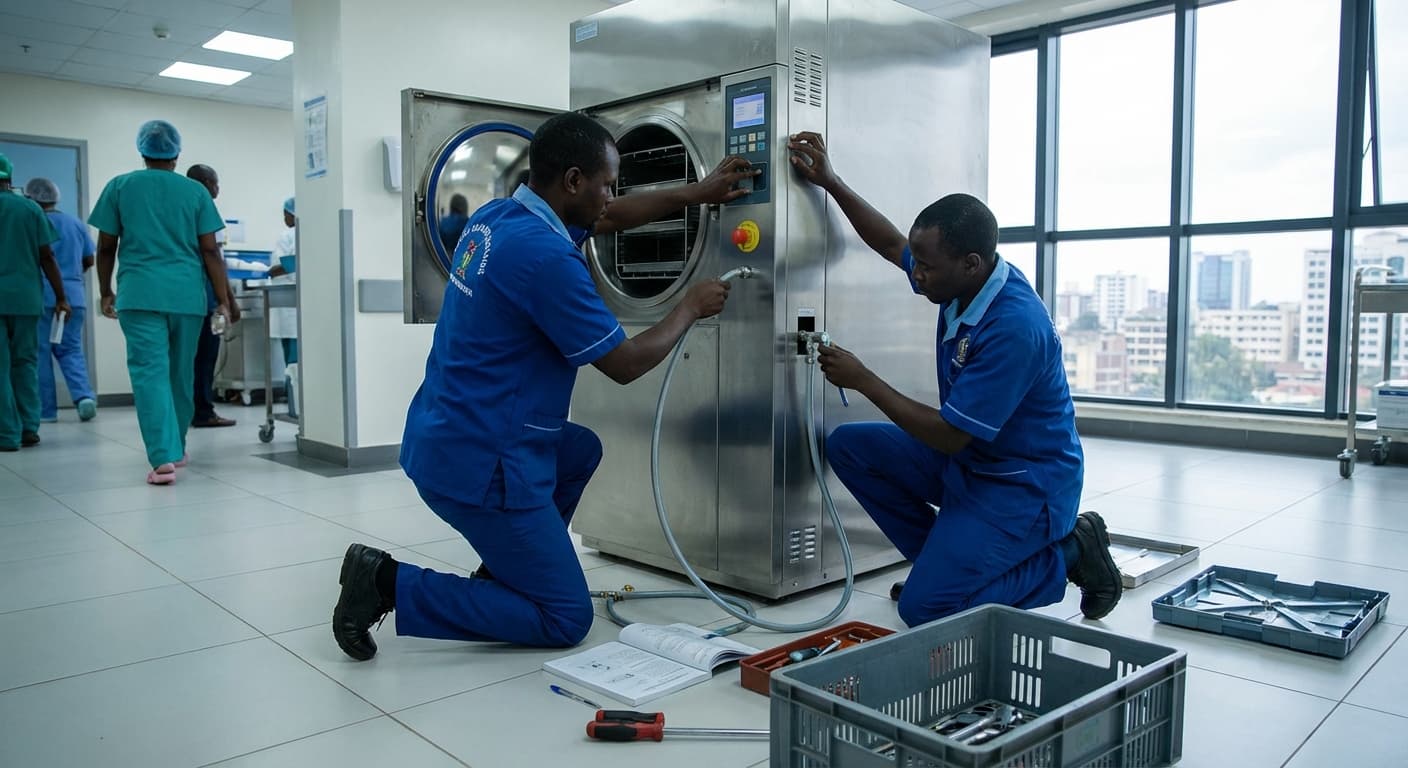
Autoclave & Sterilizer Installation Service in Uganda
Engineering Excellence & Technical Support
Autoclave & Sterilizer Installation Service High-standard technical execution following OEM protocols and local regulatory frameworks.
Certified Uganda Technicians
Our team comprises certified and extensively trained technicians with a deep understanding of Uganda's specific healthcare regulations and infrastructure. We ensure your autoclave and sterilizer installations meet all national standards and are fully compliant for optimal performance and safety.
Precision Installation & Calibration
We employ advanced diagnostic tools and meticulous calibration techniques to guarantee the precise functionality of your autoclave and sterilizer. From initial setup to final validation, we ensure every component operates within optimal parameters for effective sterilization and extended equipment lifespan.
Optimized Workflow Integration
Beyond just installation, we focus on seamlessly integrating your new autoclave or sterilizer into your existing healthcare workflow. Our experts assess your operational needs and provide guidance on best practices to maximize efficiency, reduce downtime, and ensure a consistent supply of sterile instruments.
What Is Autoclave & Sterilizer Installation Service In Uganda?
Autoclave and sterilizer installation service in Uganda refers to the professional provision of setting up, commissioning, and validating medical and laboratory equipment designed for sterilization purposes. These units, primarily autoclaves (steam sterilizers) and various other sterilization devices (e.g., ethylene oxide sterilizers, dry heat sterilizers, plasma sterilizers), are critical for eliminating microorganisms, ensuring the sterility of medical instruments, laboratory consumables, and other materials susceptible to microbial contamination. The service ensures that these complex machines are integrated into existing infrastructure, calibrated to manufacturer specifications, and validated for effective performance according to established standards and regulatory requirements prevalent in Uganda.
| Who Needs Autoclave & Sterilizer Installation Service in Uganda? | Typical Use Cases |
|---|---|
| Hospitals and Healthcare Facilities: Operating rooms, central sterile supply departments (CSSDs), dental clinics, veterinary clinics, and specialized medical units requiring instrument sterilization. | Sterilization of surgical instruments (scalpels, forceps, retractors), dental instruments, anesthesia equipment, endoscopes, and other reusable medical devices. |
| Laboratories (Research, Clinical, Industrial): Microbiology labs, biology labs, pharmaceutical labs, food testing labs, and material science labs. | Sterilization of laboratory glassware, media preparation equipment, filtration units, waste materials, and specialized research apparatus. |
| Pharmaceutical and Biotechnology Companies: Manufacturing facilities requiring sterile environments and validated sterilization processes. | Sterilization of drug manufacturing equipment, packaging materials, and cleanroom consumables. |
| Educational Institutions: University science departments, medical schools, and technical colleges with practical laboratory components. | Sterilization of equipment used in teaching laboratories for biology, chemistry, and medicine. |
| Government and Public Health Agencies: Public health laboratories, disease control centers, and emergency response units. | Sterilization of diagnostic equipment, sample collection materials, and protective gear. |
| Private Clinics and Diagnostic Centers: Smaller healthcare providers that rely on sterile instruments for patient care. | Sterilization of instruments for minor surgical procedures, examinations, and diagnostic tests. |
Key Aspects of Autoclave & Sterilizer Installation Service:
- Site Assessment and Planning: Evaluating the installation site for structural integrity, power supply (voltage, phase, amperage), water source and drainage requirements, ventilation, and exhaust systems. Planning the optimal placement for workflow efficiency and safety.
- Equipment Delivery and Unpacking: Safe transportation and careful unpacking of the sterilization unit, inspecting for any transit damage.
- Mechanical and Electrical Connections: Connecting the sterilizer to appropriate power sources, water inlet and outlet, steam supply (if applicable), and ventilation/exhaust systems as per manufacturer guidelines and local building codes.
- Plumbing and Drainage Integration: Ensuring proper connection to potable water and wastewater drainage systems, often involving specialized piping and filtration for water quality.
- Ventilation and Exhaust System Setup: Installing and connecting ductwork for proper air circulation and safe venting of exhaust gases, particularly crucial for chemical sterilizers.
- Calibration and Performance Testing: Adjusting and verifying all operational parameters (temperature, pressure, time, vacuum levels, etc.) against manufacturer specifications using calibrated test equipment.
- User Training and Handover: Providing comprehensive training to authorized personnel on the operation, routine maintenance, safety procedures, and basic troubleshooting of the installed sterilizer.
- Commissioning and Validation: Conducting rigorous testing to demonstrate that the sterilizer consistently achieves the required sterilization parameters and log cycles effectively. This often includes Installation Qualification (IQ), Operational Qualification (OQ), and Performance Qualification (PQ).
- Documentation and Certification: Providing detailed installation reports, calibration certificates, validation reports, and user manuals. This documentation is vital for regulatory compliance and quality assurance.
- Post-Installation Support and Warranty Activation: Offering initial support and ensuring the warranty provided by the manufacturer is activated.
Who Needs Autoclave & Sterilizer Installation Service In Uganda?
The demand for professional autoclave and sterilizer installation services in Uganda is driven by organizations that prioritize stringent hygiene and infection control. This includes a broad spectrum of entities, from healthcare facilities to research laboratories and specialized industries. Proper installation is crucial for ensuring the effective and safe operation of these critical pieces of equipment, preventing equipment failure, and maintaining compliance with health and safety regulations. Without correct installation, the sterilization process can be compromised, leading to potential health risks and costly downtime.
| Target Customer Type | Key Departments Requiring Service |
|---|---|
| Hospitals (Public & Private) | Central Sterile Supply Department (CSSD), Operating Theatres, Maternity Wards, Dental Departments, Outpatient Clinics, Laboratories |
| Clinics (General & Specialized) | Minor Procedure Rooms, Sterilization Units, Dental Offices |
| Health Centers & District Hospitals | Sterilization Rooms, Treatment Areas |
| Diagnostic Laboratories | Microbiology Labs, Pathology Labs, Blood Banks |
| Research Institutes & Universities | Life Sciences Departments, Medical Faculties, Veterinary Schools, Chemistry Labs |
| Pharmaceutical Companies | Quality Control Labs, Production Areas (for specific equipment) |
| Food & Beverage Manufacturers | Quality Assurance Labs, Packaging Departments (for specific sterilization needs) |
| Dental Practices | Sterilization Room |
| Veterinary Hospitals & Clinics | Surgical Suites, Sterilization Areas |
| Tattoo & Piercing Studios | Sterilization Station |
| Ambulance Services | On-board sterilization equipment maintenance |
| NGOs involved in health programs | Mobile clinics, health posts |
Target Customers and Departments for Autoclave & Sterilizer Installation Service in Uganda
- {"title":"Healthcare Sector","description":"This is the primary and most significant market for autoclave and sterilizer installation services."}
- {"title":"Laboratories and Research Institutions","description":"Facilities that conduct scientific research, diagnostics, and testing require sterile environments and equipment."}
- {"title":"Dental Clinics","description":"Maintaining sterile instruments is paramount for patient safety in dental practices."}
- {"title":"Veterinary Clinics and Animal Hospitals","description":"Similar to human healthcare, veterinary facilities need to sterilize surgical instruments and equipment."}
- {"title":"Manufacturing and Production (Food & Beverage, Pharmaceuticals)","description":"Certain industries require sterile conditions for production processes to prevent contamination."}
- {"title":"Beauty and Tattoo Parlors","description":"High-risk establishments where sterile equipment is essential to prevent the spread of infections."}
- {"title":"Educational Institutions (Medical, Veterinary, Science Faculties)","description":"Universities and colleges with practical training programs in health sciences and laboratories."}
Autoclave & Sterilizer Installation Service Process In Uganda
This document outlines the typical workflow for Autoclave & Sterilizer Installation Services in Uganda, from initial customer inquiry to the successful completion of the installation and handover.
| Stage | Description | Key Activities | Responsible Party | Deliverables/Outcomes |
|---|---|---|---|---|
| The customer expresses interest in autoclave/sterilizer installation services. | Receive and log customer inquiry, understand basic requirements (type of sterilizer, application, location), schedule initial consultation. | Customer, Service Provider | Understanding of customer needs, initial project scope defined. |
| A thorough evaluation of the installation site is conducted. | On-site visit to assess space, power requirements, water supply, ventilation, and any structural modifications needed. Develop a detailed installation plan. | Service Provider (Technical Team) | Detailed site report, confirmed technical specifications, finalized installation plan. |
| Based on the site assessment, a formal quotation and service agreement are prepared. | Prepare a detailed quotation including equipment, labor, materials, and any associated costs. Present quotation to the customer and finalize contract terms. | Service Provider, Customer | Approved quotation, signed service agreement. |
| The necessary autoclave/sterilizer and associated accessories are procured and delivered to the site. | Order equipment from reputable manufacturers/suppliers. Arrange for safe and timely delivery to the installation site. | Service Provider | All required equipment and materials on-site. |
| The autoclave/sterilizer is physically installed and connected to necessary utilities. | Unpack equipment, position according to plan, connect to power, water, and drainage (if applicable). Perform initial setup and configuration. | Service Provider (Installation Technicians) | Physically installed and connected sterilizer. |
| The installed equipment is rigorously tested and calibrated to ensure optimal performance. | Conduct operational tests, leak tests, temperature and pressure validation. Calibrate instruments to meet relevant standards (e.g., ISO, local regulations). | Service Provider (Certified Technicians) | Fully functional and calibrated sterilizer, test reports. |
| End-users are trained on the safe and effective operation of the new equipment. | Provide hands-on training covering operational procedures, basic troubleshooting, safety protocols, and routine maintenance. | Service Provider (Trainer) | Competent and informed users. |
| Formal handover of the installed equipment and associated documentation to the customer. | Present completed installation, provide user manuals, warranty information, calibration certificates, and any other relevant documentation. Obtain customer sign-off. | Service Provider, Customer | Client acceptance of the installation, complete documentation package. |
| Ongoing support and maintenance services are offered to ensure continued optimal operation. | Provide warranty support, offer scheduled maintenance plans, and be available for troubleshooting and repairs. | Service Provider | Customer satisfaction, long-term equipment reliability. |
Autoclave & Sterilizer Installation Service Process in Uganda
- Initial Inquiry & Consultation
- Site Assessment & Planning
- Quotation & Agreement
- Equipment Procurement & Delivery
- Installation & Configuration
- Testing & Calibration
- User Training
- Handover & Documentation
- After-Sales Support
Autoclave & Sterilizer Installation Service Cost In Uganda
Installing an autoclave or sterilizer in Uganda involves several factors that influence the overall cost. These machines are crucial for maintaining hygiene standards in various sectors, including healthcare, laboratories, and beauty salons. The price of installation is not a fixed figure and can vary significantly based on the complexity of the unit, the required site preparation, the location within Uganda, and the service provider chosen.
Key Pricing Factors:
- Type and Size of Autoclave/Sterilizer: Larger, more complex, or high-capacity autoclaves (e.g., steam autoclaves for hospitals) will naturally have higher installation costs than smaller, simpler tabletop units (e.g., UV sterilizers for dental tools). The technology used (e.g., steam, dry heat, chemical vapor) also plays a role.
- Site Preparation: This is often a significant component of the cost. It can include:
* **Electrical Work:** Ensuring adequate and appropriate power supply, including dedicated circuits, surge protectors, and potentially upgrading existing electrical infrastructure.
* **Plumbing:** For steam autoclaves, a reliable water source and a drainage system are essential. This might involve installing new pipes or modifying existing ones.
* **Ventilation:** Some autoclaves require specific ventilation to expel steam or heat safely and effectively.
* **Mounting/Securing:** Ensuring the unit is securely mounted or placed on a stable surface, especially for larger, vibrating machines.
* **Structural Modifications:** In rare cases, minor structural changes to accommodate the unit or its utilities might be needed.
- Location within Uganda: Installation costs can differ between major urban centers like Kampala and more remote rural areas. Travel time, accommodation for technicians, and local labor rates contribute to this variation.
- Service Provider Expertise and Reputation: Reputable and experienced installation companies or certified technicians may charge more due to their proven track record, specialized tools, and insurance. However, this often guarantees a higher quality and safer installation.
- Ancillary Services: Some installation packages might include initial calibration, testing, and user training, which add to the overall price.
- Warranty and Support: The terms of the installation warranty and ongoing support packages offered by the service provider can also impact the initial cost.
Estimated Cost Ranges in Ugandan Shillings (UGX):
It's important to note that these are approximate ranges and can fluctuate. Obtaining multiple quotes from different service providers is highly recommended for accurate budgeting.
- Simple Sterilizers (e.g., UV sterilizers, small dry heat sterilizers for salons/dental clinics): Installation can be relatively straightforward, often involving just plugging in and basic setup. The cost primarily covers the technician's time and travel.
* **Range:** UGX 150,000 - UGX 500,000
- Medium-Sized Autoclaves (e.g., laboratory autoclaves, smaller steam autoclaves for clinics): These require more robust electrical and potentially plumbing considerations.
* **Range:** UGX 500,000 - UGX 2,000,000
- Large/Industrial/Hospital-Grade Autoclaves (e.g., large steam autoclaves with complex plumbing/ventilation requirements): Installation for these units is extensive and can involve significant site preparation.
* **Range:** UGX 2,000,000 - UGX 10,000,000+ (depending on the complexity and scope of work)
Note: These figures generally do not include the cost of the autoclave or sterilizer unit itself, nor the cost of major structural renovations. They are solely for the installation service.
| Sterilizer Type | Estimated Installation Cost (UGX) |
|---|---|
| Simple Sterilizers (UV, small dry heat) | 150,000 - 500,000 |
| Medium-Sized Autoclaves (Lab, small steam) | 500,000 - 2,000,000 |
| Large/Hospital-Grade Autoclaves | 2,000,000 - 10,000,000+ |
Factors Influencing Autoclave & Sterilizer Installation Costs in Uganda
- Type and Size of Autoclave/Sterilizer
- Site Preparation (Electrical, Plumbing, Ventilation)
- Location within Uganda
- Service Provider Expertise and Reputation
- Ancillary Services (Calibration, Testing, Training)
- Warranty and Support Packages
Affordable Autoclave & Sterilizer Installation Service Options
Investing in a reliable autoclave or sterilizer is crucial for hygiene and safety in various professional settings, from dental offices and veterinary clinics to laboratories and tattoo studios. Our affordable installation service ensures your equipment is set up correctly, efficiently, and safely, minimizing downtime and maximizing its lifespan. We offer flexible service options designed to meet your specific needs and budget, focusing on value bundles and cost-saving strategies to make professional sterilization accessible.
| Service Component | Standard Bundle | Premium Bundle | Add-on Cost (Estimate) | Cost-Saving Notes |
|---|---|---|---|---|
| Physical Unit Setup | Included | Included | N/A | Core service, always included. |
| Utility Connections (Power, Water, Drainage) | Up to 1 connection | Up to 2 connections | $50 - $150 per additional connection | Bundles cover typical needs; extra utility points may incur minor charges. |
| Initial Testing & Calibration | Included | Included | N/A | Essential for safe operation. |
| Basic User Orientation | Included | Included | N/A | Ensures proper daily use. |
| Extended User Training (1 hour) | Not Included | Included | $100 | Beneficial for complex units or multiple users. |
| Minor Plumbing/Electrical Adjustments (up to 1 hour) | Not Included | Included | $120 | Covers minor modifications for seamless integration. |
| On-Site Consultation & Assessment | Not Included | Included | $75 | Recommended for complex or new setups. |
| Comprehensive Performance Report | Not Included | Included | $50 | Detailed documentation of installation and initial performance. |
Understanding Our Value Bundles and Cost-Saving Strategies
- {"title":"What are Value Bundles?","description":"Value bundles are pre-packaged service offerings that combine essential installation components at a discounted rate compared to purchasing them individually. These bundles are designed to cover the most common installation requirements, providing a predictable and cost-effective solution."}
- {"title":"Standard Installation Bundle","description":"Our most popular option, this bundle typically includes the physical setup of the autoclave/sterilizer, connection to existing utilities (water, power, drainage if applicable), initial testing and calibration, and a basic user orientation. Ideal for straightforward installations in well-equipped facilities."}
- {"title":"Premium Installation Bundle","description":"This bundle offers enhanced services beyond the standard. It may include advanced utility assessments, minor plumbing or electrical adjustments, extended user training, and a comprehensive performance report. Recommended for complex setups or when additional assurance is desired."}
- {"title":"Customizable Installation Packages","description":"We understand that every facility is unique. Our customizable packages allow you to tailor the installation service to your specific needs, adding or removing components as required. This ensures you only pay for the services you truly need."}
- {"title":"Cost-Saving Strategy 1: Early Bird Booking Discounts","description":"Schedule your installation well in advance and benefit from reduced rates. Early bookings allow us to optimize our schedule, and we pass these savings on to you."}
- {"title":"Cost-Saving Strategy 2: Bundled Equipment & Installation","description":"When purchasing your autoclave or sterilizer through our affiliated partners, we often offer integrated installation packages at a significantly lower cost than purchasing services separately."}
- {"title":"Cost-Saving Strategy 3: Refer-a-Friend Program","description":"Spread the word about our reliable and affordable services. Both you and your referred friend can receive discounts on future installations or services."}
- {"title":"Cost-Saving Strategy 4: Off-Peak Scheduling","description":"Inquire about our availability during off-peak hours or days. Sometimes, scheduling your installation during less busy periods can result in lower service fees."}
- {"title":"Cost-Saving Strategy 5: Preventative Maintenance Add-ons","description":"Consider bundling your installation with a first-year preventative maintenance package. This can often be offered at a discounted rate and helps ensure long-term optimal performance, preventing costly repairs down the line."}
Verified Providers In Uganda
In Uganda's burgeoning healthcare sector, finding truly verified and reputable providers is paramount for individuals seeking quality and trustworthy medical services. Franance Health stands out as a leading platform dedicated to connecting patients with credentialed healthcare professionals and facilities. This commitment to verification ensures that users can make informed decisions, confident in the expertise and legitimacy of the providers they choose. Understanding Franance Health's credentialing process and the benefits it offers reveals why they represent the best choice for healthcare access in Uganda.
| Provider Type | Franance Health Verification Criteria | Benefit for Patients |
|---|---|---|
| Doctors/Specialists | Valid Medical License, Professional Certifications, Educational Degrees, Practice History Check, Specialty Validation | Ensures competence, expertise, and legitimate practice, reducing risk of malpractice or misdiagnosis. |
| Hospitals/Clinics | Accreditation Status, Compliance with National Health Regulations, Facility Infrastructure Assessment, Equipment Standards, Staff Qualifications | Guarantees adherence to safety and quality standards, providing a secure and well-equipped environment for treatment. |
| Diagnostic Centers | Equipment Calibration and Maintenance Records, Staff Expertise in Diagnostics, Accreditation by Health Authorities | Ensures accurate and reliable diagnostic results, crucial for effective treatment planning. |
| Pharmacies | Valid Pharmacy License, Proper Drug Storage and Handling Procedures, Qualified Pharmacists | Confirms availability of genuine medications and professional dispensing services. |
Franance Health's Verification Process and Benefits
- Rigorous Credentialing: Franance Health employs a multi-layered verification process for all listed providers. This includes thorough checks of medical licenses, professional certifications, educational qualifications, and practice history. This ensures that only legitimate and qualified professionals are featured on their platform.
- Specialty and Experience Validation: Beyond basic licensing, Franance Health often validates provider specialties and the depth of their experience in specific medical fields. This is crucial for patients needing specialized care, allowing them to find experts with proven track records.
- Facility Accreditation and Standards: For healthcare facilities, Franance Health verifies accreditations from recognized bodies and assesses adherence to established quality and safety standards. This includes checking for proper infrastructure, equipment, and operational protocols.
- Patient Reviews and Feedback Integration: While not solely a verification metric, Franance Health incorporates verified patient reviews and feedback. This offers a transparent view of patient experiences, further guiding choices and holding providers accountable.
- Reduced Risk for Patients: By entrusting Franance Health with the verification process, patients significantly reduce the risk of encountering unqualified practitioners or substandard facilities. This peace of mind is invaluable when dealing with health concerns.
- Time and Effort Savings: Navigating the healthcare landscape to find a trusted provider can be time-consuming and frustrating. Franance Health streamlines this process, presenting a curated list of verified options, saving users valuable time and effort.
- Promoting Healthcare Excellence: Franance Health's commitment to verification actively encourages higher standards within the Ugandan healthcare industry. By highlighting and rewarding quality providers, they contribute to the overall improvement of healthcare delivery.
- Access to a Wider Network: Franance Health often partners with a broad network of hospitals, clinics, and individual practitioners across Uganda, offering patients a wider range of choices, from general practitioners to highly specialized surgeons.
Scope Of Work For Autoclave & Sterilizer Installation Service
This Scope of Work (SOW) outlines the requirements for the professional installation of new autoclaves and sterilizers at [Client Name] facilities. The service includes the delivery, setup, calibration, testing, and commissioning of specified equipment, ensuring it meets all applicable safety and performance standards. The project aims to provide a fully operational and validated sterilization system ready for use. This SOW details the technical deliverables, standard specifications, and responsibilities of both the vendor and the client.
| Deliverable/Specification | Description | Standard/Requirement |
|---|---|---|
| Site Survey Report | A comprehensive report detailing the proposed installation site, including physical space, utility availability (power, water, drainage, ventilation), accessibility, and any potential site modifications required. | Must include photographic evidence, detailed measurements, and clear recommendations. |
| Equipment Delivery and Handling | Safe and timely delivery of the autoclave(s) and sterilizer(s) to the designated installation location within the facility. Includes unpacking and initial inspection for visible damage. | Adherence to manufacturer's handling guidelines and client site access procedures. Equipment to be protected from environmental damage during transit and handling. |
| Mechanical Installation | Physical placement and securing of the autoclave/sterilizer unit(s) in their final operational position. This includes any necessary structural support or anchoring. | Installation to be performed by certified technicians. Unit(s) to be level and stable according to manufacturer specifications. |
| Electrical Connections | Connection of the equipment to the existing electrical supply. This may involve new circuits, appropriate wiring, and grounding as per electrical codes and manufacturer specifications. | Compliance with local electrical codes (e.g., NEC, IEC) and manufacturer's voltage, amperage, and grounding requirements. GFCI protection required for wet areas where applicable. |
| Plumbing and Drainage | Connection of water supply lines and drainage for steam generators, chamber drainage, and any other water-related components. Requires appropriate pipe materials and fittings. | Use of food-grade or medical-grade (as applicable) piping and fittings. Connections to meet local plumbing codes and ensure leak-free operation. Proper slope for drainage to prevent water backup. |
| Ventilation and Exhaust | Installation of any required ventilation or exhaust systems to safely expel steam, heat, or other byproducts, as per manufacturer specifications and safety regulations. | Appropriate ducting and fan sizing based on equipment specifications and local building codes. Exhaust routed to a safe discharge point away from occupied areas. |
| Initial Power-Up and Functional Test | Turning on the equipment for the first time and performing basic operational checks to ensure all components are receiving power and responding as expected. | Pre-defined checklist of basic functions to be tested. |
| Calibration | Adjustment of critical parameters (e.g., temperature, pressure, time) to ensure the equipment operates within specified tolerances. | Calibration performed using NIST-traceable or equivalent standards. Results documented and provided in the final report. |
| Performance Qualification (PQ) / Validation | Testing the equipment under actual or simulated operating conditions to confirm it consistently produces the desired results (e.g., sterilization of biological indicators). | Execution of at least three consecutive successful sterilization cycles. Use of documented PQ protocols. Biological and chemical indicators to be used as per client's standard operating procedures (SOPs) or industry best practices (e.g., AAMI ST46). |
| Safety Feature Testing | Verification that all safety interlocks, pressure relief valves, and emergency stop mechanisms are functioning correctly. | Testing of all safety features according to manufacturer specifications and relevant safety standards. |
| User Training | Instruction for designated client personnel on the safe and effective operation, basic maintenance, and troubleshooting of the installed equipment. | Training sessions to be interactive and cover daily operation, cycle selection, loading procedures, and basic cleaning. Training materials to be provided. |
| As-Built Drawings | Updated technical drawings reflecting the final installed configuration, including electrical, plumbing, and mechanical connections. | Drawings to be provided in electronic format (e.g., PDF, CAD) and clearly indicate all installed components and connections. |
| Final Installation Report | A comprehensive document summarizing all installation activities, tests performed, calibration results, validation data, training records, and any deviations from the original plan. | Report to include all relevant certificates, test logs, and sign-offs. Final acceptance criteria to be clearly defined. |
| Manufacturer's Warranty Information | Provision of all relevant warranty documentation for the installed equipment and any associated components. | Warranty period and terms to be clearly stated. |
| Standard Safety Compliance | All installation work must comply with relevant national and local safety regulations and standards. | Examples: OSHA, CE Marking, relevant ISO standards for medical device installation and validation. |
Key Phases and Activities
- Site Assessment and Planning
- Equipment Delivery and Unpacking
- Mechanical and Electrical Installation
- Plumbing and Drainage Connections
- Calibration and Validation
- Testing and Commissioning
- User Training
- Documentation and Handover
Service Level Agreement For Autoclave & Sterilizer Installation Service
This Service Level Agreement (SLA) outlines the terms and conditions for the installation services provided by [Your Company Name] for Autoclave and Sterilizer units. It defines response times for critical issues and guarantees a level of availability for the installed systems.
| Service Level | Response Time (Business Hours) | Uptime Guarantee (for installed system) |
|---|---|---|
| Critical Incident (Complete System Failure impacting core function) | 2 Business Hours | 99.5% (monthly average) |
| Major Incident (Partial system malfunction impacting significant features) | 4 Business Hours | N/A (Uptime guarantee applies to critical incidents only) |
| Minor Incident (Non-critical issue, cosmetic, or minor operational adjustment) | 8 Business Hours | N/A |
Scope of Service
- On-site installation of new Autoclave and Sterilizer units purchased from or specified by [Your Company Name].
- Initial testing and calibration of the installed unit to ensure operational readiness.
- Basic user training on the operation of the installed unit.
- Provision of relevant documentation and manuals.
Frequently Asked Questions

Ready when you are
Let's scope your Autoclave & Sterilizer Installation Service in Uganda project in Uganda.

Scaling healthcare logistics and technical systems across the entire continent.