
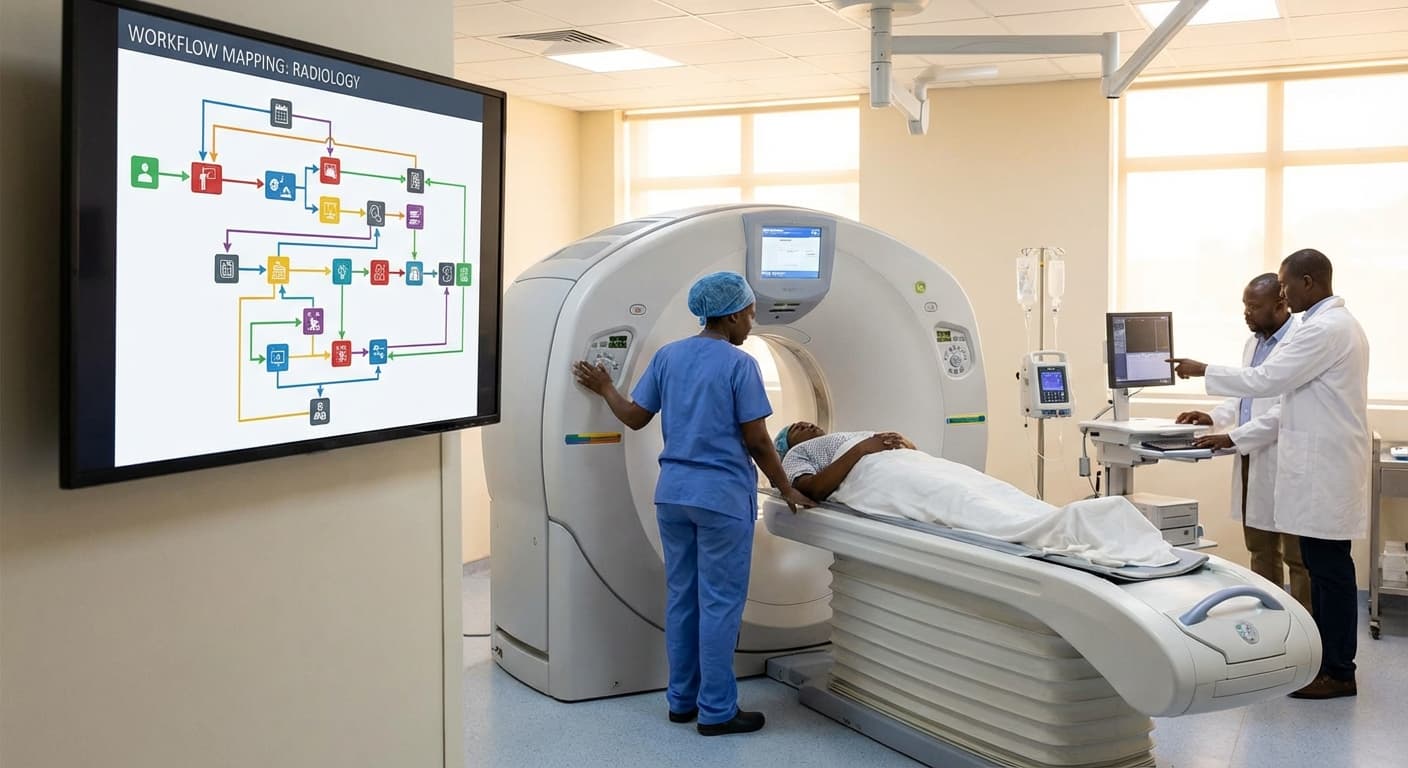
Department Workflow Mapping Service (Radiology/ICU/OT/Lab/Dialysis) in Uganda
Engineering Excellence & Technical Support
Department Workflow Mapping Service (Radiology/ICU/OT/Lab/Dialysis) High-standard technical execution following OEM protocols and local regulatory frameworks.
Streamlined Patient Journeys, Improved Outcomes
Our workflow mapping service digitally blueprints patient pathways across Uganda's Radiology, ICU, OT, Lab, and Dialysis departments. By identifying bottlenecks and redundancies, we enable targeted interventions that reduce wait times, minimize errors, and ultimately enhance patient care and recovery.
Optimized Resource Utilization for High-Demand Services
In Uganda's critical healthcare settings, efficient resource allocation is paramount. Our service meticulously maps the operational flow of key departments like ICU and OT, allowing for data-driven decisions on staffing, equipment, and bed management. This ensures critical resources are available when and where they are most needed, maximizing capacity and service delivery.
Enhanced Data Flow and Collaboration Across Departments
Bridging the communication gap is vital for seamless healthcare delivery. Our workflow mapping service visualizes the interdependencies and data handoffs between departments such as Radiology, Lab, and Dialysis. This facilitates improved information sharing, reduces information silos, and fosters better collaboration for comprehensive patient management and accurate diagnostics.
What Is Department Workflow Mapping Service (Radiology/icu/ot/lab/dialysis) In Uganda?
Department Workflow Mapping Service, particularly within the Ugandan healthcare context for specialized departments like Radiology, Intensive Care Unit (ICU), Operating Theatre (OT), Laboratory, and Dialysis, refers to a systematic analytical process designed to identify, document, analyze, and optimize the sequence of activities, information flow, and resource utilization involved in the delivery of patient care or diagnostic services within these critical units. This service aims to visualize and deconstruct complex departmental processes to enhance efficiency, reduce errors, improve patient throughput, and optimize resource allocation. It involves a deep dive into the current state ('as-is') of operations, identifying bottlenecks, redundant steps, and areas for improvement, leading to the development of an optimized future state ('to-be') workflow. The analysis often incorporates elements of process modeling, value stream mapping, and operational research techniques.
| Stakeholder/Department | Need for Workflow Mapping | Typical Use Cases |
|---|---|---|
| Radiology Department | Optimize patient throughput for imaging procedures, reduce report turnaround time, improve radiologist productivity, ensure efficient equipment utilization, and streamline image archiving and retrieval. | Mapping the patient journey from referral to report generation; analyzing radiologist reading workflows; assessing PACS integration; identifying delays in scheduling or image acquisition; optimizing contrast media management. |
| Intensive Care Unit (ICU) | Enhance patient care coordination, reduce response times for critical events, optimize medication administration, improve communication between multidisciplinary teams, and ensure efficient utilization of high-dependency equipment. | Mapping patient admission, monitoring, and discharge processes; analyzing nurse-physician communication protocols; optimizing ventilator management workflows; assessing alarm fatigue mitigation strategies; streamlining critical care team huddles. |
| Operating Theatre (OT) / Surgical Suite | Improve surgical case turnaround time, minimize operating room downtime, optimize instrument and supply management, enhance surgical team efficiency, and ensure patient safety during surgical procedures. | Mapping the pre-operative, intra-operative, and post-operative patient pathways; analyzing instrument sterilization and turnover processes; optimizing scheduling and room allocation; assessing sterile supply chain management; mapping surgical team communication and coordination. |
| Laboratory Department | Expedite sample processing and analysis, reduce diagnostic turnaround times, minimize sample rejection rates, optimize instrument throughput, and ensure accurate and timely reporting of results. | Mapping the entire laboratory workflow from sample collection and accessioning to analysis and result reporting; analyzing pre-analytical, analytical, and post-analytical phases; assessing LIS integration; optimizing specimen tracking and logistics; managing reagent inventory. |
| Dialysis Unit | Optimize patient scheduling and treatment delivery, reduce patient waiting times, enhance nurse efficiency, ensure proper equipment maintenance and sterilization, and streamline inventory management for consumables. | Mapping patient dialysis session scheduling and management; analyzing pre-dialysis assessment and post-dialysis procedures; optimizing machine allocation and cleaning protocols; assessing staff workload and patient-to-nurse ratios; streamlining consumable supply chain. |
| Hospital Administration / Management | Gain a holistic understanding of departmental operations to identify systemic inefficiencies, inform strategic decision-making, benchmark performance, and justify investments in technology or process improvement initiatives. | Cross-departmental workflow analysis; identifying interdependencies between departments; evaluating the impact of new policies or procedures; resource planning and allocation across multiple critical care areas. |
| Quality Improvement and Patient Safety Teams | Identify and mitigate risks associated with patient care processes, reduce medical errors, enhance compliance with regulatory standards, and promote a culture of continuous improvement. | Root cause analysis of adverse events; developing standardized protocols; ensuring adherence to best practices; identifying opportunities for error prevention. |
Key Components and Objectives of Department Workflow Mapping Service:
- Process Identification and Documentation: Detailing all discrete steps, decision points, and handoffs within a specific department's operational flow.
- Information and Material Flow Analysis: Tracing the movement of patient data, samples, images, medications, and equipment.
- Resource Utilization Assessment: Evaluating the efficiency and effectiveness of personnel, equipment, and physical space.
- Bottleneck Identification: Pinpointing stages in the workflow that impede throughput and cause delays.
- Risk Assessment and Mitigation: Identifying potential points of error, patient safety concerns, and compliance issues.
- Performance Metric Definition: Establishing key performance indicators (KPIs) to measure the effectiveness of the existing and proposed workflows.
- ** 'As-Is' State Analysis:** Comprehensively mapping the current operational procedures.
- ** 'To-Be' State Design:** Developing optimized workflows incorporating best practices and identified improvements.
- Technology Integration Assessment: Evaluating the role and impact of existing or potential technological solutions (e.g., Picture Archiving and Communication Systems - PACS, Laboratory Information Systems - LIS, Electronic Health Records - EHR).
- Training and Implementation Planning: Developing strategies for disseminating and embedding the new workflows.
Who Needs Department Workflow Mapping Service (Radiology/icu/ot/lab/dialysis) In Uganda?
In Uganda's evolving healthcare landscape, optimizing efficiency, reducing errors, and ensuring patient safety are paramount. Department workflow mapping services are crucial for understanding and improving the intricate processes within key hospital departments. This service provides a visual and analytical representation of how tasks are performed, resources are utilized, and information flows, enabling identification of bottlenecks, redundancies, and areas for enhancement. By mapping these workflows, healthcare facilities can implement targeted solutions to boost productivity, streamline patient care, and ultimately improve health outcomes.
| Department | Description of Workflow Challenges | Benefits of Workflow Mapping | Target Users within Department |
|---|---|---|---|
| Radiology | Long turnaround times for imaging reports, patient scheduling backlogs, inefficient image management and retrieval, communication gaps between radiologists and referring physicians. | Faster report generation, reduced patient wait times, improved image accessibility, enhanced interdepartmental communication, optimized equipment utilization. | Radiologists, Radiographers, Technicians, PACS Administrators, Department Managers, Clerical Staff. |
| Intensive Care Unit (ICU) | Complex patient management protocols, critical information sharing, high staff workload and potential for burnout, medication administration errors, timely intervention for deteriorating patients. | Streamlined critical care pathways, improved real-time information exchange, reduced medical errors, optimized nurse-to-patient ratios, enhanced decision-making for critical interventions. | Intensivists, Critical Care Nurses, Respiratory Therapists, Pharmacists, Physicians, Department Heads, Quality Improvement Officers. |
| Operating Theatre (OT) | Surgical scheduling inefficiencies, delays in patient preparation and handover, instrument and supply management, communication breakdowns between surgical teams and support staff, infection control adherence. | Optimized surgical scheduling, reduced patient transit times, improved inventory management for surgical supplies, enhanced team coordination, robust infection prevention protocols. | Surgeons, Anesthesiologists, Surgical Nurses, Theatre Technicians, Sterilization Staff, Department Managers, Biomedical Engineers. |
| Laboratory | Sample collection and processing delays, specimen tracking issues, manual data entry errors, turnaround times for test results, quality control adherence, communication of critical results. | Faster test result turnaround, improved specimen integrity, reduced data entry errors, enhanced quality assurance, efficient communication of critical findings, optimized reagent and supply management. | Pathologists, Laboratory Technicians, Phlebotomists, Lab Assistants, IT Support, Department Supervisors, Quality Control Officers. |
| Dialysis | Patient scheduling for dialysis sessions, machine availability and maintenance, medication and fluid management, patient monitoring during treatment, communication with nephrologists and referring physicians. | Efficient patient scheduling, increased machine uptime, reduced medication errors, improved patient safety during dialysis, better coordination with other medical specialists. | Nephrologists, Dialysis Nurses, Dialysis Technicians, Biomedical Engineers, Patient Coordinators, Department Managers. |
Target Customers and Departments for Workflow Mapping Services in Uganda:
- Hospitals and Healthcare Facilities
- Government Health Ministries and Agencies
- Private Healthcare Providers and Networks
- Non-Governmental Organizations (NGOs) focused on health
- Medical Training Institutions
Department Workflow Mapping Service (Radiology/icu/ot/lab/dialysis) Process In Uganda
This document outlines the typical workflow for a Department Workflow Mapping Service, specifically tailored for the unique operational environments of key hospital departments in Uganda: Radiology, Intensive Care Unit (ICU), Operating Theatre (OT), Laboratory, and Dialysis. The process ensures a comprehensive understanding and documentation of existing workflows to identify inefficiencies, bottlenecks, and opportunities for improvement, ultimately aiming to enhance patient care, resource utilization, and staff productivity.
| Stage | Description | Key Activities | Responsible Parties | Deliverables | Considerations for Ugandan Context |
|---|---|---|---|---|---|
| The service is initiated by a request from a hospital department or administration seeking to understand and improve their operational processes. | Receive and acknowledge inquiry; Schedule initial meeting; Understand broad objectives and pain points; Introduce service methodology. | Client (Department Head/Administrator), Service Provider (Workflow Consultants) | Initial understanding of client needs; Agreement to proceed to next stage. | Language barriers; Accessibility to decision-makers; Understanding of existing (often informal) communication channels. |
| Clearly define the boundaries of the workflow mapping exercise and deeply understand the specific challenges and desired outcomes. | Conduct detailed interviews with key stakeholders; Observe current operations; Identify specific processes to be mapped (e.g., patient referral, sample processing, procedure scheduling); Define desired future state and key performance indicators (KPIs). | Client (Department Staff, Supervisors), Service Provider (Workflow Consultants) | Defined scope of work; List of specific processes to be mapped; Agreed-upon objectives and KPIs. | Limited availability of senior staff for interviews; Need to adapt assessment methods to varying levels of technical literacy; Understanding of existing resource constraints (e.g., equipment, personnel). |
| Gather comprehensive information about the current state of the workflows through various methods. | Conduct direct observation of processes; Interview frontline staff; Review existing documentation (SOPs, forms, registers); Collect relevant data (e.g., patient turnaround times, equipment utilization). | Service Provider (Workflow Consultants), Client (Department Staff for information access) | Raw data on current processes; Observations of inefficiencies and bottlenecks; Initial identification of contributing factors. | Limited or no existing standardized operating procedures; Reliance on verbal communication; Challenges in accessing and interpreting existing paper-based records; Potential for staff apprehension during observation. |
| Visually represent the current state of the identified workflows and document them clearly. | Develop process flowcharts and diagrams (e.g., using BPMN or similar notation); Document each step, decision point, role, and system involved; Identify dependencies and handoffs. | Service Provider (Workflow Consultants) | Detailed, visual 'As-Is' workflow maps; Comprehensive written documentation of each mapped process. | Need for culturally sensitive mapping that respects local customs; Ensuring maps are understandable to diverse educational backgrounds; Incorporating elements of resource management and patient flow unique to the Ugandan context. |
| Present the documented workflows to stakeholders for review and gather their input to ensure accuracy and completeness. | Conduct validation workshops with department staff and management; Present 'As-Is' maps and documentation; Solicit feedback on accuracy, omissions, and potential issues; Refine maps based on feedback. | Service Provider (Workflow Consultants), Client (Department Staff, Management) | Validated and refined 'As-Is' workflow maps; Agreed-upon understanding of current processes. | Ensuring all relevant voices are heard, including junior staff; Facilitating open and honest feedback in a potentially hierarchical environment; Language translation may be required. |
| Analyze the validated workflows to identify areas for improvement and propose actionable recommendations. | Analyze maps for bottlenecks, redundancies, delays, and risks; Identify root causes of inefficiencies; Develop 'To-Be' workflow proposals; Recommend process changes, technology adoption, training needs, and policy adjustments; Prioritize recommendations based on impact and feasibility. | Service Provider (Workflow Consultants) | Comprehensive report detailing findings, analysis, and prioritized recommendations; 'To-Be' workflow proposals. | Recommendations must be practical and affordable given resource limitations; Emphasis on leveraging existing resources effectively; Consideration of local procurement and maintenance capabilities for any proposed technology; Focus on sustainable solutions tailored to the Ugandan healthcare landscape. |
| Assist the department in putting the recommended changes into practice. | Develop implementation plans; Provide training and coaching to staff; Support pilot testing of new workflows; Facilitate change management. | Service Provider (Workflow Consultants), Client (Department Staff, Management) | Implemented process changes; Trained staff; Initial adoption of new workflows. | Building local capacity for ongoing process improvement; Phased implementation approach to manage change effectively; Addressing resistance to change through clear communication and involvement. |
| Assess the effectiveness of implemented changes and make further adjustments as needed. | Track KPIs and compare against baseline; Conduct follow-up observations and interviews; Gather feedback on the impact of changes; Refine workflows based on evaluation results. | Service Provider (Workflow Consultants), Client (Department Staff, Management) | Evaluation reports; Data on improved performance; Further refined workflows. | Establishing simple, consistent data collection methods that can be sustained by the department; Empowering local staff to conduct ongoing monitoring; Fostering a culture of continuous improvement. |
Department Workflow Mapping Service Process
- Inquiry and Initial Consultation
- Scope Definition and Needs Assessment
- Data Collection and Analysis
- Workflow Mapping and Documentation
- Validation and Feedback
- Reporting and Recommendations
- Implementation Support (Optional)
- Monitoring and Evaluation (Optional)
Department Workflow Mapping Service (Radiology/icu/ot/lab/dialysis) Cost In Uganda
The cost of departmental workflow mapping services in Uganda, specifically for areas like Radiology, ICU, OT (Operating Theatre), Lab, and Dialysis, can vary significantly due to several factors. This service is crucial for optimizing efficiency, identifying bottlenecks, and improving patient care within these critical hospital departments. Understanding these pricing dynamics is essential for healthcare institutions seeking to implement or improve their operational workflows.
| Service Component | Estimated Cost Range (UGX) | Notes |
|---|---|---|
| Initial Consultation & Needs Assessment | 500,000 - 1,500,000 | Understanding the specific challenges and objectives. |
| Workflow Documentation & Mapping (per department) | 2,000,000 - 7,000,000 | Covers observation, interviews, and basic diagramming for a standard department. |
| In-depth Process Analysis & Bottleneck Identification | 1,500,000 - 5,000,000 | Deeper dive into specific processes, identifying inefficiencies. |
| Data Collection & Analysis (if advanced) | 1,000,000 - 4,000,000 | Utilizing system data or specialized tools for quantitative analysis. |
| Recommendation Development & Solution Design | 1,000,000 - 3,000,000 | Formulating actionable strategies for improvement. |
| Final Report & Presentation | 700,000 - 2,000,000 | Comprehensive documentation of findings and recommendations. |
| Full-Service Workflow Mapping Project (example: 1-2 departments, 2-4 weeks) | 10,000,000 - 35,000,000+ | Encompasses multiple components for a comprehensive engagement. |
| Specialized Software/Tool Licensing (if applicable) | Variable (one-time or subscription) | Depends on the chosen platform. |
Key Factors Influencing Workflow Mapping Costs in Uganda:
- Scope and Complexity of the Department: Larger departments with more intricate processes and a higher volume of patient traffic will naturally require more extensive mapping and analysis, leading to higher costs.
- Number of Workflows to Map: Mapping multiple distinct workflows within a single department, or across several departments, will increase the overall project duration and resource allocation.
- Level of Detail Required: The depth of analysis, including granular process steps, resource utilization, and data flow, will influence the time and expertise needed.
- Technology and Tools Used: The sophistication of the software or tools employed for mapping, simulation, and analysis can impact costs. This could range from basic diagramming tools to advanced process mining software.
- Consultant Expertise and Experience: Highly experienced consultants with specialized knowledge in healthcare operations and process improvement will command higher fees.
- Duration of Engagement: The length of time the consulting team is on-site or engaged in the project directly correlates with the total cost.
- Data Collection Methods: The methods used to gather data (e.g., direct observation, interviews, system data extraction) can affect the time and resources required.
- Reporting and Deliverables: The complexity and format of the final reports, including detailed recommendations, visualizations, and implementation roadmaps, will influence the final price.
- Location and Accessibility: Travel and accommodation costs for consultants, especially to more remote healthcare facilities in Uganda, will be factored in.
- Urgency of the Project: Expedited timelines often incur premium pricing.
- Customization Needs: Highly tailored solutions that go beyond standard mapping methodologies will be more expensive.
Affordable Department Workflow Mapping Service (Radiology/icu/ot/lab/dialysis) Options
Our affordable department workflow mapping service is designed to optimize operations across critical hospital departments including Radiology, ICU, Operating Theatre (OT), Laboratory, and Dialysis. We provide comprehensive analysis and visualization of your current workflows, identifying inefficiencies, bottlenecks, and areas for improvement. This service helps enhance patient care, reduce operational costs, and improve staff satisfaction.
| Cost-Saving Strategy | Description | Example Application (Department) |
|---|---|---|
| Lean Process Improvement | Eliminating waste (time, resources, redundant steps) in workflows to increase efficiency and reduce operational costs. | Radiology: Reducing patient wait times for imaging reports through streamlined report generation and distribution. |
| Bottleneck Identification & Resolution | Pinpointing and addressing choke points in patient flow or resource utilization to ensure smoother operations and prevent delays. | ICU: Identifying and resolving delays in patient transfer between units or in obtaining critical lab results. |
| Standardized Operating Procedures (SOPs) | Developing and implementing consistent processes reduces variability, errors, and the need for rework, leading to cost savings. | OT: Creating standardized pre-operative checklists and post-operative care protocols. |
| Resource Optimization | Ensuring that equipment, staff, and materials are utilized effectively, minimizing underutilization and preventing shortages. | Lab: Optimizing sample processing workflows to reduce reagent waste and equipment downtime. |
| Improved Communication & Handoffs | Reducing errors and delays caused by poor communication between departments or shifts, which can lead to adverse events and increased costs. | Dialysis: Enhancing communication protocols for patient transfers and medication administration. |
| Predictive Staffing Models | Using workflow data to forecast patient volume and acuity, enabling more accurate staffing levels and reducing over/understaffing costs. | ICU: Adjusting staffing based on predicted patient census and dependency scores. |
Value Bundles for Department Workflow Mapping
- {"title":"Core Workflow Analysis Bundle","features":["Current state workflow diagramming","Identification of 3-5 key bottlenecks","Recommendations for immediate process adjustments","One follow-up consultation"],"description":"Includes detailed mapping of primary patient flow and key operational processes within a single department. Ideal for targeted improvements."}
- {"title":"Integrated Department Optimization Bundle","features":["Includes all Core Bundle features for two departments","Mapping of inter-departmental handoffs and communication points","Analysis of data flow and information sharing","Identification of cross-departmental efficiencies"],"description":"Focuses on the interconnectedness of two departments, analyzing how workflows impact each other. Essential for departments with significant interdependencies (e.g., ICU and OT)."}
- {"title":"Comprehensive Hospital Unit Streamlining Bundle","features":["Includes Integrated Bundle features for multiple departments","End-to-end patient journey mapping across selected departments","System-wide bottleneck identification","Development of standardized operating procedures (SOPs)","Benchmarking against industry best practices"],"description":"A holistic approach to mapping and optimizing workflows across multiple interconnected departments within a unit or service line (e.g., all critical care units)."}
- {"title":"Add-on Service: Technology Integration Analysis","features":["Assessment of existing IT systems and their workflow impact","Recommendations for software/hardware upgrades or implementations","ROI analysis for technology investments"],"description":"Evaluates the current and potential role of technology in your workflows, suggesting cost-effective solutions."}
Verified Providers In Uganda
In Uganda's evolving healthcare landscape, identifying verified providers is paramount for ensuring quality and trust. Franance Health stands out as a leading organization whose credentials and commitment to excellence make them a superior choice for individuals seeking reliable healthcare services. This document outlines why Franance Health's verification and operational standards position them as the best choice for healthcare in Uganda.
| Credential/Standard | Franance Health's Approach | Benefit to Patients |
|---|---|---|
| Regulatory Compliance | Ensures all listed providers hold current and valid licenses from relevant Ugandan health authorities (e.g., Uganda Medical and Dental Practitioners Council, Uganda Nurses and Midwives Council). | Guarantees that patients are receiving care from legally qualified and authorized healthcare professionals. |
| Professional Qualifications & Experience | Verifies the educational background, specialized training, and years of practical experience of healthcare practitioners. | Ensures patients are treated by experts in their respective fields, leading to more accurate diagnoses and effective treatments. |
| Infrastructure and Facility Standards | Assesses the physical environment, equipment, and hygiene standards of healthcare facilities within their network. | Provides a safe, clean, and well-equipped environment for medical procedures and consultations. |
| Ethical Practice and Patient Rights | Adheres to a strict code of conduct, emphasizing patient confidentiality, informed consent, and non-discrimination. | Protects patients' rights and ensures they are treated with dignity and respect, fostering trust in the healthcare system. |
| Continuous Quality Improvement | Implements feedback mechanisms and performance monitoring for providers to maintain high standards of care. | Leads to consistently improving healthcare outcomes and a better overall patient experience over time. |
Why Franance Health is the Top Choice in Uganda:
- Rigorous Verification Process: Franance Health implements a multi-stage verification process for all its network providers, ensuring they meet stringent criteria for licensing, expertise, and ethical practice.
- Commitment to Quality Care: Beyond basic verification, Franance Health actively monitors the quality of services delivered by its partners, promoting continuous improvement and patient satisfaction.
- Accessibility and Affordability: Franance Health strives to make quality healthcare accessible and affordable for a wide range of Ugandans, breaking down barriers to essential medical services.
- Patient-Centric Approach: The organization prioritizes the patient experience, focusing on empathy, clear communication, and personalized care plans.
- Technological Integration: Franance Health leverages technology to streamline appointment booking, access to health records, and efficient communication between patients and providers.
- Comprehensive Network: Their network encompasses a diverse range of specialists and facilities, ensuring that most healthcare needs can be met within their accredited system.
Scope Of Work For Department Workflow Mapping Service (Radiology/icu/ot/lab/dialysis)
This document outlines the Scope of Work (SOW) for a Department Workflow Mapping Service, focusing on the Radiology, Intensive Care Unit (ICU), Operating Theater (OT), Laboratory, and Dialysis departments. The service aims to meticulously document existing workflows, identify inefficiencies, and propose optimized processes. This will enable enhanced operational efficiency, improved patient care, and better resource utilization. The SOW details the objectives, methodology, deliverables, and standard specifications for this engagement.
| Phase | Activity | Description | Deliverables | Standard Specifications |
|---|---|---|---|---|
| Phase 1: Discovery & Planning | Project Kick-off | Initial meeting with stakeholders to define project scope, objectives, timelines, and communication protocols. | Project Charter, Stakeholder Register. | Meeting minutes, Approved Project Charter. |
| Data Gathering (Current State) | Interviews with key personnel, observation of processes, review of existing documentation and system logs. | Interview Notes, Observation Logs, Current State Process Maps (As-Is). | Confidentiality agreements for all gathered data. Process maps adhering to BPMN 2.0 standards or equivalent. | |
| Phase 2: Analysis & Design | Process Analysis | Detailed analysis of current state maps to identify inefficiencies, bottlenecks, and root causes of issues. | Bottleneck Analysis Report, Root Cause Analysis (RCA) documentation. | Data-driven analysis with clear metrics and evidence. |
| Future State Workflow Design | Development of optimized workflows incorporating identified improvements, best practices, and potential technology solutions. | Future State Process Maps (To-Be), Proposed Workflow Scenarios. | Process maps adhering to BPMN 2.0 standards or equivalent, highlighting proposed changes and benefits. | |
| Gap Analysis | Identification of the differences between current and future state workflows and the resources/changes required to bridge these gaps. | Gap Analysis Report. | Clear identification of process, technology, and training gaps. | |
| Phase 3: Reporting & Recommendations | Development of Recommendations | Formulation of specific, actionable recommendations for process improvement, technology adoption, and training. | Recommendations Report, Prioritized Action Plan. | Recommendations should be SMART (Specific, Measurable, Achievable, Relevant, Time-bound) and aligned with organizational goals. |
| Final Report & Presentation | Compilation of all findings, analysis, future state designs, and recommendations into a comprehensive final report and presentation to stakeholders. | Final Project Report, Executive Summary, Presentation Slides. | Report to be well-structured, clear, concise, and visually appealing. Presentation to be engaging and informative. | |
| Phase 4: Knowledge Transfer | Training & Documentation Handover | Training for designated internal staff on maintaining and updating workflow documentation. Handover of all project artifacts. | Training Materials, User Manuals for Process Mapping Tools (if applicable). | Training to be practical and focused on empowering internal teams. |
Objectives
- To comprehensively map current state workflows for Radiology, ICU, OT, Laboratory, and Dialysis departments.
- To identify bottlenecks, redundancies, and areas for improvement within existing processes.
- To develop optimized future state workflows incorporating best practices and technological advancements.
- To provide actionable recommendations for process improvement and technology integration.
- To ensure adherence to relevant regulatory and quality standards.
- To facilitate better inter-departmental communication and collaboration.
- To establish a baseline for performance measurement and continuous improvement.
Service Level Agreement For Department Workflow Mapping Service (Radiology/icu/ot/lab/dialysis)
This Service Level Agreement (SLA) outlines the guaranteed response times and uptime for the Department Workflow Mapping Service, specifically covering Radiology, Intensive Care Unit (ICU), Operating Theatre (OT), Laboratory (Lab), and Dialysis departments. This service aims to provide accurate, up-to-date, and readily accessible workflow maps to optimize departmental operations, training, and troubleshooting.
| Service Component | Response Time Guarantee (for updates/corrections) | Uptime Guarantee |
|---|---|---|
| Initial Workflow Map Creation (per department) | Within 15 business days of request and provision of all necessary information | N/A (one-time service) |
| Minor Updates/Corrections to existing maps (e.g., staff name change, minor equipment adjustment) | Within 2 business days | N/A |
| Major Updates/Revisions to existing maps (e.g., significant process change, new equipment integration) | Within 5 business days of request and provision of all necessary information | N/A |
| Availability of the Workflow Mapping Service Platform/Repository | N/A | 99.5% (measured monthly, excluding scheduled maintenance) |
| Emergency Support (critical workflow map errors impacting patient care/safety) | Within 2 hours (24/7 during operational hours) | N/A |
Service Scope and Objectives
- Service: Provision and maintenance of detailed, accurate, and user-friendly workflow maps for Radiology, ICU, OT, Lab, and Dialysis departments.
- Objectives:
- Enhance operational efficiency by clarifying processes and dependencies.
- Improve training and onboarding of new staff.
- Facilitate rapid troubleshooting and problem-solving during operational disruptions.
- Support continuous improvement initiatives through clear process visualization.
- Ensure compliance with relevant departmental and regulatory standards.
Frequently Asked Questions

Ready when you are
Let's scope your Department Workflow Mapping Service (Radiology/ICU/OT/Lab/Dialysis) in Uganda project in Uganda.

Scaling healthcare logistics and technical systems across the entire continent.