
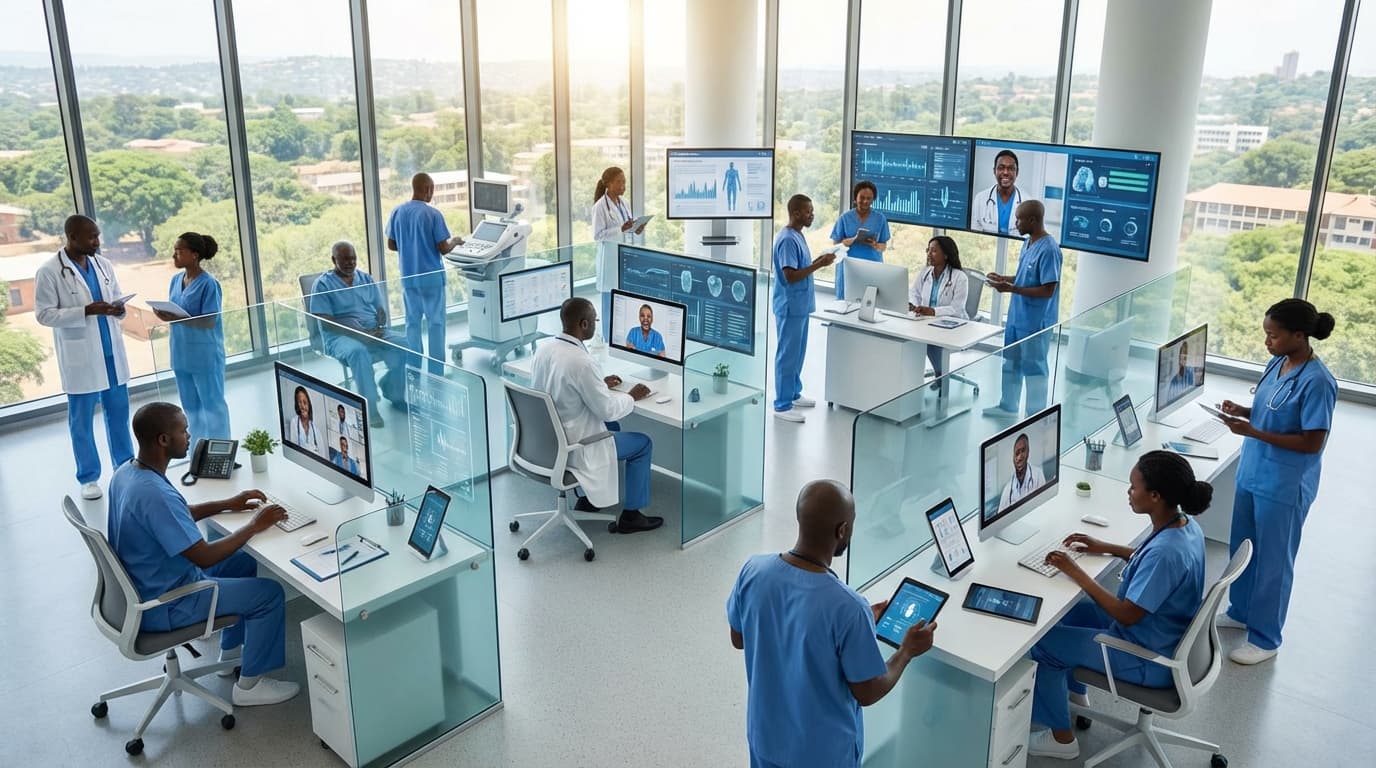
PACS/RIS Migration & Integration in Uganda
Engineering Excellence & Technical Support
Data migration, interoperability and workflow integration for imaging IT. High-standard technical execution following OEM protocols and local regulatory frameworks.
Seamless Cloud-Native PACS/RIS Deployment
Successfully migrated and integrated PACS/RIS systems for multiple Ugandan healthcare facilities onto a robust cloud-native platform. This involved meticulous data migration, ensuring data integrity and security, and enabling scalable, accessible medical imaging and reporting across distributed locations, improving diagnostic turnaround times and patient care.
Interoperability & HL7 FHIR Integration
Achieved seamless interoperability between newly deployed PACS/RIS solutions and existing EMR/HIS systems in Uganda using industry-standard HL7 FHIR. This facilitated real-time data exchange, unified patient records, and enhanced clinical workflows, empowering healthcare professionals with comprehensive patient information at the point of care.
Robust Security & Compliance Framework
Implemented a comprehensive security and compliance framework for PACS/RIS migration and integration across Ugandan healthcare institutions. This ensured adherence to local data privacy regulations and international security best practices, safeguarding sensitive patient data through encryption, access controls, and regular audits, building trust and confidence in the new systems.
What Is Pacs/ris Migration & Integration In Uganda?
PACS/RIS migration and integration in Uganda refers to the process of transitioning from existing, often legacy, Picture Archiving and Communication Systems (PACS) and Radiology Information Systems (RIS) to new, modernized, or consolidated platforms, and subsequently ensuring seamless interoperability between these systems and other healthcare IT infrastructure. This involves the secure and efficient transfer of medical imaging data (DICOM objects) and associated patient and radiological information (HL7 messages, etc.) from the old system(s) to the new. The objective is to achieve a unified, robust, and scalable imaging and radiology workflow management solution, often incorporating advanced features such as AI-driven analytics, cloud storage, and enhanced reporting capabilities. Integration extends to other critical hospital systems, including Electronic Health Records (EHRs)/Electronic Medical Records (EMRs), laboratory information systems (LIS), and billing systems, to facilitate comprehensive patient data management and streamlined clinical operations.
| Who Needs PACS/RIS Migration & Integration? | Typical Use Cases in Uganda | ||||||
|---|---|---|---|---|---|---|---|
| Hospitals and Clinics: Especially those undergoing digital transformation initiatives, expanding services, or facing end-of-life issues with existing systems. | Consolidation of imaging archives from multiple facilities or departments into a single, centralized PACS for improved accessibility and management. | Upgrading from standalone or fragmented PACS/RIS solutions to an integrated, enterprise-wide platform. | Introduction of advanced imaging technologies (e.g., AI for image analysis, advanced visualization tools) that require modern infrastructure. | Mergers and acquisitions of healthcare facilities, necessitating the harmonization of IT systems. | Government health agencies or regional health authorities aiming to standardize imaging data management and improve reporting capabilities across public healthcare facilities. | Research institutions that require access to a large, well-organized imaging database for studies. | Private healthcare providers seeking to enhance efficiency, improve diagnostic turnaround times, and offer advanced radiological services. |
| Radiology Departments: Requiring efficient workflow management, from exam ordering and scheduling to image interpretation and reporting. | Integration with EHR/EMR systems for a holistic view of patient medical history, reducing data silos and improving clinical decision-making. | Interfacing with Laboratory Information Systems (LIS) for correlating imaging findings with laboratory results. | Connecting with billing and administration systems to streamline charge capture and patient accounting processes. | Implementation of teleradiology solutions, enabling remote image interpretation and consultation, particularly relevant in underserved areas. | Deployment of vendor-neutral archives (VNAs) for long-term storage and easier access to images regardless of the original imaging modality or vendor. | Leveraging AI algorithms for automated image segmentation, anomaly detection, or quantitative analysis, requiring robust data pipelines and integration. | Establishing disaster recovery and business continuity plans for medical imaging data. |
Key Components of PACS/RIS Migration & Integration:
- Data Extraction and Transformation: Extracting imaging studies and associated metadata from legacy PACS and patient/exam data from legacy RIS.
- Data Validation and Cleansing: Ensuring data integrity and accuracy during the migration process, correcting any discrepancies.
- Data Loading: Importing the transformed data into the new PACS/RIS environment.
- System Configuration and Customization: Setting up the new PACS/RIS according to specific organizational requirements and workflows.
- Interoperability Implementation: Establishing communication channels and standards (e.g., HL7, DICOM, FHIR) for data exchange between PACS/RIS and other healthcare IT systems.
- Testing and Validation: Rigorous testing of the migrated data and integrated systems to ensure functionality and performance.
- User Training and Support: Providing comprehensive training to clinical and IT staff on the new system.
- Decommissioning of Legacy Systems: Safely archiving or retiring old PACS/RIS environments.
- Security and Compliance: Ensuring adherence to data privacy regulations (e.g., Uganda's data protection laws) and cybersecurity best practices.
Who Needs Pacs/ris Migration & Integration In Uganda?
Healthcare institutions in Uganda are increasingly recognizing the critical need for robust Picture Archiving and Communication Systems (PACS) and Radiology Information Systems (RIS). These integrated solutions are essential for modernizing medical imaging workflows, improving diagnostic accuracy, enhancing patient care, and streamlining administrative processes. While many facilities may still rely on manual or fragmented systems, the benefits of PACS/RIS migration and integration are becoming undeniable for those seeking to elevate their healthcare delivery standards and remain competitive. This technological advancement is not a luxury but a necessity for institutions aiming for efficiency, data security, and superior patient outcomes.
| Customer Type | Key Departments Benefiting | Primary Needs & Benefits |
|---|---|---|
| Large Public Hospitals | Radiology, Cardiology, Oncology, Neurology, Emergency Medicine, IT Department | Improved diagnostic turnaround times, reduced physical film storage, enhanced inter-departmental communication, efficient patient record management, support for research and teaching. |
| Private Hospitals & Diagnostic Centers | Radiology, Orthopedics, Gynecology, General Medicine, Administration, IT | Competitive advantage through advanced imaging services, streamlined workflow for higher patient throughput, secure and accessible patient data, improved billing and reporting, enhanced referrer satisfaction. |
| Specialized Imaging Clinics | Radiology (specific modalities like MRI, CT, Ultrasound), Cardiology, Neurology | Focus on specialized diagnostic capabilities, seamless integration with advanced imaging equipment, efficient management of complex imaging studies, remote access for specialist consultations. |
| University Teaching Hospitals | Radiology, All Clinical Departments, Medical Education Unit, Research Department, IT | Facilitating medical education and training through access to real-time and historical imaging data, supporting clinical research with organized data repositories, standardizing diagnostic protocols, enhancing collaboration between departments. |
| Regional Referral Hospitals | Radiology, Surgery, Internal Medicine, Public Health Units, IT | Improving diagnostic capacity in underserved regions, enabling remote consultations and second opinions, centralizing patient imaging data for better management, supporting public health initiatives through data analytics. |
| Medical Training Institutions with Imaging Facilities | Radiology Department, Medical Students, Faculty, IT | Providing hands-on experience with modern imaging technologies, creating a digital learning environment for radiology trainees, ensuring availability of teaching cases, standardizing training protocols. |
Target Customers and Departments for PACS/RIS Migration & Integration in Uganda:
- Large Public Hospitals
- Private Hospitals & Diagnostic Centers
- Specialized Imaging Clinics
- University Teaching Hospitals
- Regional Referral Hospitals
- Medical Training Institutions with Imaging Facilities
Pacs/ris Migration & Integration Process In Uganda
This document outlines the typical workflow for a PACS/RIS migration and integration project within the Ugandan healthcare landscape, from the initial inquiry to the final execution and post-implementation support.
| Stage | Key Activities | Responsible Parties | Deliverables | Ugandan Context Considerations |
|---|---|---|---|---|
| Healthcare facility expresses interest in PACS/RIS. Initial discussions to understand needs, scope, and potential solutions. Site visits may be conducted. | Healthcare Facility Management, IT Department, PACS/RIS Vendor | Initial proposal/quote, understanding of facility's current IT infrastructure and medical imaging workflow. | Understanding of budget constraints, existing IT skills, and reliance on specific medical equipment. Awareness of local IT support availability and regulations. |
| Detailed analysis of current imaging workflow, existing systems (HIS, LIS), hardware (modalities, workstations), user roles, and future requirements. Define specific functionalities for PACS and RIS. | Healthcare Facility (Radiology Dept, IT, Admin), PACS/RIS Vendor Consultants, Clinical Stakeholders | Detailed Requirements Document (DRD), Functional Specification Document (FSD), Workflow diagrams. | Mapping existing paper-based or fragmented digital workflows. Identifying common imaging modalities and their compatibility. Understanding local medical terminology and reporting standards. |
| Issuance of Request for Proposal (RFP) or Request for Quotation (RFQ). Evaluation of vendor proposals based on functionality, cost, scalability, support, and vendor experience in similar environments. | Healthcare Facility Procurement Department, Technical Evaluation Committee, Finance Department | Vendor scorecards, shortlisted vendors, comparative analysis report. | Prioritizing vendors with proven track record in developing countries or with experience integrating with Ugandan-specific HIS/LIS systems. Considering total cost of ownership (TCO). |
| Negotiation of contract terms, including pricing, payment schedules, service level agreements (SLAs), warranties, and intellectual property. Finalizing purchase orders and agreements. | Healthcare Facility Legal Department, Procurement Department, Finance Department, PACS/RIS Vendor | Signed contract, purchase orders, payment milestones. | Understanding of Ugandan procurement laws and regulations. Negotiation of favorable payment terms to align with facility cash flow. |
| Development of a detailed project plan outlining timelines, milestones, resource allocation, communication strategies, risk management, and change management procedures. Designing the system architecture and network topology. | Project Manager (Facility & Vendor), IT Department, PACS/RIS Vendor Technical Team | Project Charter, Project Plan, System Architecture Diagram, Network Design Document. | Accounting for potential power outages and internet connectivity issues. Designing for offline capabilities or local caching where feasible. Planning for minimal disruption to clinical operations. |
| Procurement and installation of necessary hardware (servers, storage, network equipment, workstations). Ensuring adequate network bandwidth and power supply. Preparing the physical space for the PACS/RIS servers. | IT Department (Facility), Vendor's Technical Team, External IT/Network Vendors | Installed hardware, configured network infrastructure, ready server room. | Sourcing reliable hardware and power backup solutions (generators, UPS). Assessing current network infrastructure and upgrading if necessary to support data transfer volumes. |
| Developing a strategy for migrating existing patient imaging data (DICOM files, reports) from legacy systems or archives. Cleaning and preparing data for migration. Executing the data migration process. | IT Department (Facility), PACS/RIS Vendor Data Migration Specialists, Clinical Staff (for validation) | Data Migration Plan, Migrated Data Set, Data Validation Reports. | Determining the volume and format of legacy data. Developing tools or scripts for conversion if necessary. Prioritizing critical data for migration and planning for phased migration to minimize downtime. |
| Configuring the PACS/RIS software to meet the specific requirements of the facility. Customizing workflows, user roles, reporting templates, and interfaces. | PACS/RIS Vendor Implementation Team, Clinical IT Specialists (Facility) | Configured PACS/RIS system, Customized workflows and templates. | Tailoring reporting templates to local medical language and reporting conventions. Configuring user access based on roles prevalent in Ugandan hospitals (e.g., medical officers, specialists). |
| Integrating the new PACS/RIS with existing Hospital Information System (HIS), Laboratory Information System (LIS), and potentially other departmental systems (e.g., EHR). Ensuring seamless data flow and interoperability. | IT Department (Facility), PACS/RIS Vendor Integration Specialists, HIS/LIS Vendors | Integrated PACS/RIS and HIS/LIS, Data exchange protocols defined and tested. | Working with potentially older or proprietary HIS/LIS systems. Utilizing HL7 standards or other interoperability protocols common in Uganda. Ensuring patient demographic data consistency. |
| Comprehensive training for all end-users (radiologists, technologists, administrators, IT staff) on how to use the PACS and RIS effectively. Developing user manuals and support materials. | PACS/RIS Vendor Trainers, Clinical Champions (Facility), IT Department | Trained users, User manuals, Frequently Asked Questions (FAQ) documents. | Delivering training in appropriate languages (English, potentially local languages for key terms). Adapting training materials to different levels of IT literacy. Emphasizing practical, hands-on sessions. |
| Conducting rigorous testing of all system functionalities, integrations, and data integrity. Performing User Acceptance Testing (UAT) with key stakeholders. Identifying and resolving bugs and issues. | QA Team (Vendor), IT Department (Facility), Clinical Users | Test scripts, Test results, Bug tracking reports, UAT sign-off. | Simulating real-world scenarios, including peak load testing and handling of large datasets. Testing for performance under fluctuating network conditions. |
| Phased or full deployment of the PACS/RIS into the production environment. Transitioning from the old system to the new. Providing on-site support during the initial go-live period. | Project Manager (Facility & Vendor), IT Department, PACS/RIS Vendor Implementation Team | Live PACS/RIS system, Decommissioned legacy systems (if applicable). | Careful planning to minimize disruption to patient care. Having on-site technical support readily available, especially during the critical first few days. |
| Ongoing technical support, system monitoring, performance tuning, and software updates. Regular review of system usage and identification of areas for optimization and future enhancements. Training for new staff. | IT Department (Facility), PACS/RIS Vendor Support Team, Clinical Users | Support tickets resolved, Performance reports, Optimization recommendations, System updates applied. | Establishing a reliable remote support channel. Planning for periodic system health checks and maintenance. Continuously evaluating ROI and user satisfaction. Training new staff as they join the facility. |
PACS/RIS Migration & Integration Workflow in Uganda
- Inquiry & Initial Consultation
- Needs Assessment & Requirements Gathering
- Vendor Selection & Proposal Evaluation
- Contract Negotiation & Procurement
- Project Planning & Design
- Infrastructure Setup & Preparation
- Data Migration Strategy & Execution
- System Configuration & Customization
- Integration with Existing Systems
- User Training & Onboarding
- Testing & Quality Assurance
- Go-Live & Deployment
- Post-Implementation Support & Optimization
Pacs/ris Migration & Integration Cost In Uganda
Migrating and integrating Picture Archiving and Communication Systems (PACS) and Radiology Information Systems (RIS) in Uganda involves a multifaceted cost structure. These costs are influenced by several key factors, ranging from the complexity of the existing infrastructure to the specific vendor and the chosen solution. Understanding these pricing factors is crucial for healthcare institutions in Uganda to accurately budget for such critical IT overhauls. The overall cost will be a combination of software licensing, hardware procurement, implementation services, data migration, training, and ongoing support and maintenance. Estimating precise figures in Ugandan Shillings (UGX) is challenging due to fluctuating exchange rates, vendor-specific pricing strategies, and the bespoke nature of many PACS/RIS deployments. However, a discussion of the influencing factors and estimated ranges provides valuable insight.
| Cost Component | Estimated Range (UGX) | Notes |
|---|---|---|
| Software Licensing (Perpetual) | UGX 50,000,000 - UGX 500,000,000+ | Highly variable based on vendor, modules, and user count. Larger institutions will face higher costs. |
| Software Licensing (SaaS - Annual Subscription) | UGX 10,000,000 - UGX 100,000,000+ per year | Depends on features, number of users, and data storage. Lower upfront cost but higher long-term operational expense. |
| Hardware (Servers, Storage, Networking) | UGX 30,000,000 - UGX 300,000,000+ | Depends on the scale of the institution and the need for upgrades. High-capacity, redundant storage is a significant factor. |
| Implementation & Configuration Services | UGX 40,000,000 - UGX 400,000,000+ | Includes vendor professional services for installation, setup, workflow customization, and basic integration. Complex integrations will increase this. |
| Data Migration | UGX 5,000,000 - UGX 50,000,000+ | Dependent on the volume and complexity of existing data. May require specialized tools or services. |
| Training | UGX 5,000,000 - UGX 30,000,000+ | Covers training for all relevant staff. Can be higher for extensive training programs or larger user bases. |
| Ongoing Support & Maintenance (Annual) | 15-25% of initial software license cost (perpetual) | Covers software updates, technical support, and bug fixes. For SaaS, this is included in the subscription. |
| Integration with HIS/EMR | UGX 10,000,000 - UGX 100,000,000+ | Depends on the complexity of the existing HIS/EMR and the required level of integration. |
| Contingency/Unforeseen Costs | 10-15% of total project cost | Recommended to account for potential scope creep or unexpected technical challenges. |
Key Pricing Factors for PACS/RIS Migration & Integration in Uganda
- System Complexity & Scope: The size of the institution (number of departments, imaging modalities, user base), the volume of existing data, and the desired functionalities (e.g., advanced analytics, AI integration, interoperability with other hospital systems) significantly impact costs.
- Software Licensing Model: This can be a perpetual license (one-time purchase with ongoing maintenance) or a subscription-based model (Software-as-a-Service - SaaS). SaaS often has lower upfront costs but higher long-term expenses.
- Hardware Requirements: This includes servers (for PACS, RIS, database), storage solutions (high-capacity, redundant), networking infrastructure upgrades, and potentially new workstations for radiologists and referring physicians.
- Implementation & Configuration Services: This covers vendor expertise in installation, system setup, workflow customization, integration with existing modalities (X-ray, CT, MRI, Ultrasound, etc.), and integration with other hospital information systems (HIS/EMR).
- Data Migration: Transferring historical patient imaging data and RIS records can be complex, time-consuming, and costly, especially if data is in disparate formats or requires significant cleanup.
- Training & User Adoption: Comprehensive training for radiologists, technologists, IT staff, and administrative personnel is essential. The cost varies with the number of users and the depth of training required.
- Vendor Reputation & Support: Established vendors with proven track records may command higher prices but often offer more robust support and a higher likelihood of successful implementation.
- Customization & Development: Any unique requirements or custom features not readily available in a standard package will incur additional development costs.
- Hardware Infrastructure: The age and capacity of existing servers, network, and storage will dictate the need for upgrades or complete replacements.
- Ongoing Support & Maintenance: Annual maintenance contracts (AMCs) or subscription fees cover software updates, bug fixes, technical support, and system upgrades. These are critical for long-term system viability.
- Interoperability Needs: Integrating with existing hospital information systems (HIS) or electronic medical records (EMR) requires specialized expertise and potentially additional middleware or APIs.
Affordable Pacs/ris Migration & Integration Options
Migrating and integrating a Picture Archiving and Communication System (PACS) and Radiology Information System (RIS) can be a significant undertaking, but it doesn't have to break the bank. Several affordable options and strategic approaches can ensure a smooth and cost-effective transition. This document outlines key value bundles and cost-saving strategies to help healthcare organizations navigate this process.
| Value Bundle/Strategy | Description | Cost-Saving Benefit | Potential Drawbacks |
|---|---|---|---|
| Cloud-Native PACS/RIS | Subscription-based access to PACS/RIS functionalities hosted by a vendor. Eliminates the need for significant on-premise hardware and IT staff for maintenance. | Reduced upfront capital expenditure, predictable monthly costs, scalable resources, no hardware obsolescence worries. | Reliance on internet connectivity, potential data security concerns (ensure robust vendor security measures), ongoing subscription fees. |
| Hybrid PACS/RIS | Combines on-premise components (e.g., for active studies) with cloud-based storage and disaster recovery. Offers a balance of control and scalability. | Lower upfront costs than fully on-premise, leverages existing infrastructure where possible, improved data accessibility and disaster recovery. | Requires management of both on-premise and cloud environments, potential for higher long-term costs than pure cloud. |
| Open-Source PACS (e.g., DCM4CHE, Orthanc) | Free software that can be customized and deployed on your own hardware. Requires strong in-house IT and PACS expertise. | No software licensing fees, full control over the system, highly customizable. | Significant investment in skilled IT personnel for installation, configuration, maintenance, and ongoing support; limited vendor support. |
| Vendor-Provided Migration Services | Many vendors offer bundled migration services as part of their PACS/RIS package. This can include data extraction, conversion, validation, and system setup. | Reduces the need for specialized internal migration teams, ensures smoother data transfer, faster deployment. | Can add to the overall project cost; ensure the scope of services is clearly defined. |
| Data De-duplication and Compression | Implementing techniques to reduce redundant data and compress image files before migration and during ongoing storage. | Significantly reduces storage requirements, leading to lower storage hardware costs and potentially lower cloud storage fees. | Requires robust data management policies and potential reprocessing of some older data. |
| Phased Implementation & Feature Prioritization | Instead of a full system replacement, migrate core functionalities first (e.g., basic RIS, primary imaging modalities) and then add advanced features or other modalities over time. | Spreads capital expenditure over several budget cycles, allows for learning and adaptation, minimizes disruption by tackling smaller projects. | Requires careful planning and a clear roadmap; may lead to temporary workarounds or the need for interim solutions. |
Key Considerations for Affordable PACS/RIS Migration & Integration
- Cloud-Based Solutions: Often a more affordable entry point than on-premise systems, reducing hardware and maintenance costs.
- Modular Systems: Opting for modular PACS/RIS allows for phased implementation, scaling as budget and needs evolve.
- Open-Source Options (with caution): While free, they require significant in-house expertise for implementation and ongoing support.
- Vendor Consolidation: If you have separate vendors for PACS and RIS, exploring integrated solutions from a single provider can streamline processes and reduce costs.
- Data Archiving & De-identification: Strategically archive or de-identify older studies to reduce storage needs during migration.
- Phased Rollout: Migrating departments or functionalities in phases can spread costs and minimize disruption.
- Leveraging Existing Infrastructure: Assess what hardware and network components can be reused or upgraded incrementally.
Verified Providers In Uganda
Finding reliable and certified healthcare providers is crucial for ensuring quality medical care. In Uganda, several organizations and individuals have undergone rigorous verification processes to meet high standards of professionalism and competence. Among these, Franance Health stands out as a prime example of a provider committed to excellence, offering a comprehensive suite of services backed by verified credentials and a patient-centric approach. Their dedication to upholding the highest ethical and clinical standards makes them a trusted choice for individuals seeking dependable healthcare solutions in Uganda.
| Provider Aspect | Franance Health's Commitment | Why it's the Best Choice |
|---|---|---|
| Licensure & Registration | All Franance Health practitioners are fully licensed and registered with the relevant Ugandan professional bodies. | Guarantees that practitioners meet the fundamental legal and educational requirements for safe medical practice. |
| Specialized Expertise | Franance Health employs specialists across various disciplines, many with international training and advanced certifications. | Ensures access to highly skilled professionals for complex medical needs and specialized treatments. |
| Quality Assurance | Rigorous internal quality control measures and a focus on evidence-based medicine are central to Franance Health's operations. | Provides confidence in the accuracy of diagnoses and the effectiveness of treatment plans, leading to better health outcomes. |
| Patient-Centric Care | Franance Health prioritizes patient comfort, clear communication, and personalized treatment plans. | Fosters a trusting relationship between patient and provider, leading to increased patient satisfaction and engagement in their own healthcare. |
| Ethical Practice | Adherence to a strict code of ethics and transparency in all dealings is a cornerstone of Franance Health. | Ensures patients receive care that is always in their best interest, free from conflicts of interest or misconduct. |
Key Credentials and Why They Matter:
- Professional Licensure and Registration: Verified providers in Uganda must hold current and valid licenses from relevant professional bodies (e.g., Uganda Medical and Dental Practitioners Council, Uganda Nurses and Midwives Council). This ensures they have met the minimum educational and competency requirements to practice.
- Specialized Certifications and Fellowships: Advanced training and certifications in specific medical fields indicate a higher level of expertise and commitment to specialized care. For example, a cardiologist with a fellowship from a reputable institution has demonstrated advanced knowledge and skills.
- Continuous Professional Development (CPD): Leading providers actively engage in ongoing training and education to stay abreast of the latest medical advancements and best practices. This commitment to learning is often reflected in their certifications and professional memberships.
- Clean Disciplinary Record: Verified providers undergo background checks to ensure they have no history of malpractice or disciplinary actions, safeguarding patient well-being and trust.
- Patient Testimonials and Reviews: While not a formal credential, positive and consistent feedback from patients can be a strong indicator of a provider's effectiveness, bedside manner, and overall patient satisfaction.
- Accreditation of Facilities: For clinics and hospitals, accreditation by recognized national or international bodies signifies adherence to stringent quality and safety standards in infrastructure, equipment, and operational procedures.
Scope Of Work For Pacs/ris Migration & Integration
This document outlines the Scope of Work (SOW) for the migration and integration of Picture Archiving and Communication System (PACS) and Radiology Information System (RIS). It details the technical deliverables, standard specifications, and key project phases involved in ensuring a successful transition to a new or upgraded PACS/RIS environment. The objective is to seamlessly migrate existing patient imaging data, reports, and associated information, while integrating the new systems with existing hospital IT infrastructure, including the Electronic Health Record (EHR) system, to improve workflow efficiency, data accessibility, and diagnostic capabilities.
| Technical Deliverable | Description | Standard Specifications / Requirements |
|---|---|---|
| New PACS/RIS Software Installation & Configuration | Installation and configuration of the selected PACS/RIS software suite on designated servers. | Vendor-provided installation guides, system requirements, and configuration documentation. Compliance with hospital IT security policies. Support for industry-standard DICOM and HL7 protocols. |
| Data Migration Scripts & Tools | Development and execution of scripts and tools for extracting, transforming, and loading (ETL) patient imaging data and associated metadata from the legacy system. | Robust ETL framework supporting various data formats (e.g., DICOM, XML, CSV). Error handling and logging mechanisms. Data integrity checks and validation routines. Compliance with data privacy regulations (e.g., HIPAA). |
| Data Validation Reports | Comprehensive reports detailing the success rate of data migration, identification of any discrepancies, and resolution steps taken. | Audit trails of migrated data. Comparison reports between source and target data. Sign-off by IT and Radiology departments. |
| Integration Interfaces (HL7/DICOM) | Development and configuration of interfaces for seamless communication between the PACS/RIS, EHR, and imaging modalities. | Adherence to HL7 v2.x or FHIR standards for EHR integration. DICOM conformance statements for modality integration. Secure transmission protocols (e.g., TLS/SSL). |
| EHR Integration Module | Functional integration of the PACS/RIS with the EHR system to enable single sign-on, patient demographic synchronization, order retrieval, and report embedding. | Bi-directional data exchange for patient demographics. Automated retrieval of radiology orders. Embedding of radiology reports within the EHR. Single sign-on (SSO) capabilities. |
| Modality Connectivity Configuration | Configuration of all connected imaging modalities to send studies to the new PACS. | DICOM AE Title configuration for all modalities. Network connectivity testing. Verification of image acquisition and routing. |
| User Access Control & Security Configuration | Definition and implementation of user roles, permissions, and access controls within the PACS/RIS. | Role-based access control (RBAC). Secure authentication mechanisms (e.g., Active Directory integration). Audit logging of user activities. |
| System Performance & Load Testing Reports | Documentation of performance testing results, including system response times, throughput, and stability under simulated load conditions. | Industry-standard performance metrics (e.g., study retrieval times, report generation times). Benchmarking against defined performance objectives. |
| Training Materials & Documentation | Development of comprehensive training manuals, user guides, and administrative documentation. | Clear, concise, and accurate documentation covering system operation, administration, and troubleshooting. Version control for all documentation. |
| Test Cases & UAT Sign-off | Detailed test cases covering all functional and non-functional requirements, along with formal User Acceptance Testing (UAT) sign-off documents. | Traceability matrix linking test cases to requirements. Signed UAT acceptance by authorized stakeholders. |
| Go-Live Checklist & Cutover Plan | A detailed checklist for pre-go-live activities and a comprehensive plan for the transition from the old system to the new. | Clearly defined steps, responsibilities, and timelines for cutover. Contingency plans and rollback procedures. |
| Post-Implementation Support Plan | A defined plan for providing ongoing technical support, issue resolution, and system maintenance after go-live. | Service Level Agreements (SLAs) for support response and resolution times. Defined escalation procedures. |
Project Phases and Activities
- {"items":["Detailed assessment of current PACS/RIS infrastructure, including hardware, software, network, and data storage.","Inventory and analysis of existing imaging modalities and their connectivity.","Review of current workflows for radiology, referring physicians, and other stakeholders.","Identification of data archival and retention policies.","Definition of migration strategy, including data extraction, transformation, and loading (ETL) approach.","Establishment of communication channels and stakeholder engagement plan.","Risk assessment and mitigation strategy development."],"title":"Phase 1: Planning & Discovery"}
- {"items":["Design of the new PACS/RIS architecture, including server specifications, storage solutions, and network requirements.","Configuration of PACS/RIS software, including user roles, permissions, and DICOM routing rules.","Integration design for connectivity with existing imaging modalities (e.g., CT, MRI, X-ray, Ultrasound).","Integration design with the EHR system for seamless data exchange (e.g., patient demographics, orders, reports).","Design of the data migration and validation processes.","Development of testing plans, including unit, integration, and user acceptance testing (UAT).","Definition of security protocols and compliance requirements (e.g., HIPAA, GDPR)."],"title":"Phase 2: System Design & Configuration"}
- {"items":["Extraction of historical imaging data and associated metadata from the legacy PACS.","Transformation of data into the new PACS format.","Loading of migrated data into the new PACS.","Data validation and reconciliation to ensure integrity and completeness of the migrated dataset.","Archiving or decommissioning of legacy PACS storage.","Performance testing of the new PACS with migrated data."],"title":"Phase 3: Data Migration & Validation"}
- {"items":["Implementation of integrations with imaging modalities.","Implementation of integration with the EHR system.","Integration testing to verify data flow and interoperability between systems.","Workflow testing to simulate real-world scenarios and identify any bottlenecks.","User Acceptance Testing (UAT) with key stakeholders to confirm system functionality and usability.","Performance and load testing to ensure system stability under expected usage."],"title":"Phase 4: Integration & Testing"}
- {"items":["Final system configuration and readiness checks.","Cutover planning and execution.","Go-live support and monitoring.","Rollback plan execution if necessary.","Post-go-live issue resolution and optimization."],"title":"Phase 5: Deployment & Go-Live"}
- {"items":["Development of comprehensive user training materials.","Delivery of training sessions for radiologists, technologists, IT staff, and referring physicians.","Creation of system administration and maintenance documentation.","Development of end-user guides and quick reference materials.","Knowledge transfer to the internal IT team for ongoing support."],"title":"Phase 6: Training & Documentation"}
- {"items":["Ongoing technical support and troubleshooting.","System performance monitoring and tuning.","Identification and implementation of system enhancements and optimizations.","Regular system health checks and maintenance.","Review of post-implementation effectiveness and lessons learned."],"title":"Phase 7: Post-Implementation Support & Optimization"}
Service Level Agreement For Pacs/ris Migration & Integration
This Service Level Agreement (SLA) outlines the response times and uptime guarantees for the successful migration and integration of the Picture Archiving and Communication System (PACS) and Radiology Information System (RIS). It defines the expectations for the service provider and the client to ensure a smooth transition and minimal disruption to clinical operations.
| Incident Severity | Response Time Guarantee | Resolution Time Guarantee (Target) | Uptime Guarantee (Monthly) |
|---|---|---|---|
| Critical Incident | 15 Minutes | 4 Hours | 99.9% |
| Major Incident | 1 Hour | 8 Business Hours | 99.8% |
| Minor Incident | 4 Business Hours | 2 Business Days | 99.5% |
| General Inquiries / Non-Critical Tasks | 1 Business Day | 3 Business Days | N/A (Assigned to standard ticket queue) |
Key Definitions
- System Downtime: Any period where the PACS/RIS is unavailable to authorized users for performing critical functions (e.g., image retrieval, report generation, RIS order entry). Scheduled maintenance is excluded.
- Critical Incident: An event that significantly impairs or completely prevents the operation of the PACS/RIS, affecting a large number of users or a critical clinical workflow.
- Major Incident: An event that impacts a significant portion of PACS/RIS functionality or a moderate number of users, causing operational difficulties but not complete system failure.
- Minor Incident: An event that affects a single user, a limited set of features, or causes minor inconvenience without significant impact on core operations.
- Response Time: The maximum time allowed for the service provider to acknowledge a reported incident and begin investigation.
- Resolution Time: The maximum time allowed for the service provider to resolve a reported incident and restore full system functionality.
- Uptime Guarantee: The percentage of time the PACS/RIS is expected to be available and operational.
Frequently Asked Questions

Ready when you are
Let's scope your PACS/RIS Migration & Integration in Uganda project in Uganda.

Scaling healthcare logistics and technical systems across the entire continent.