
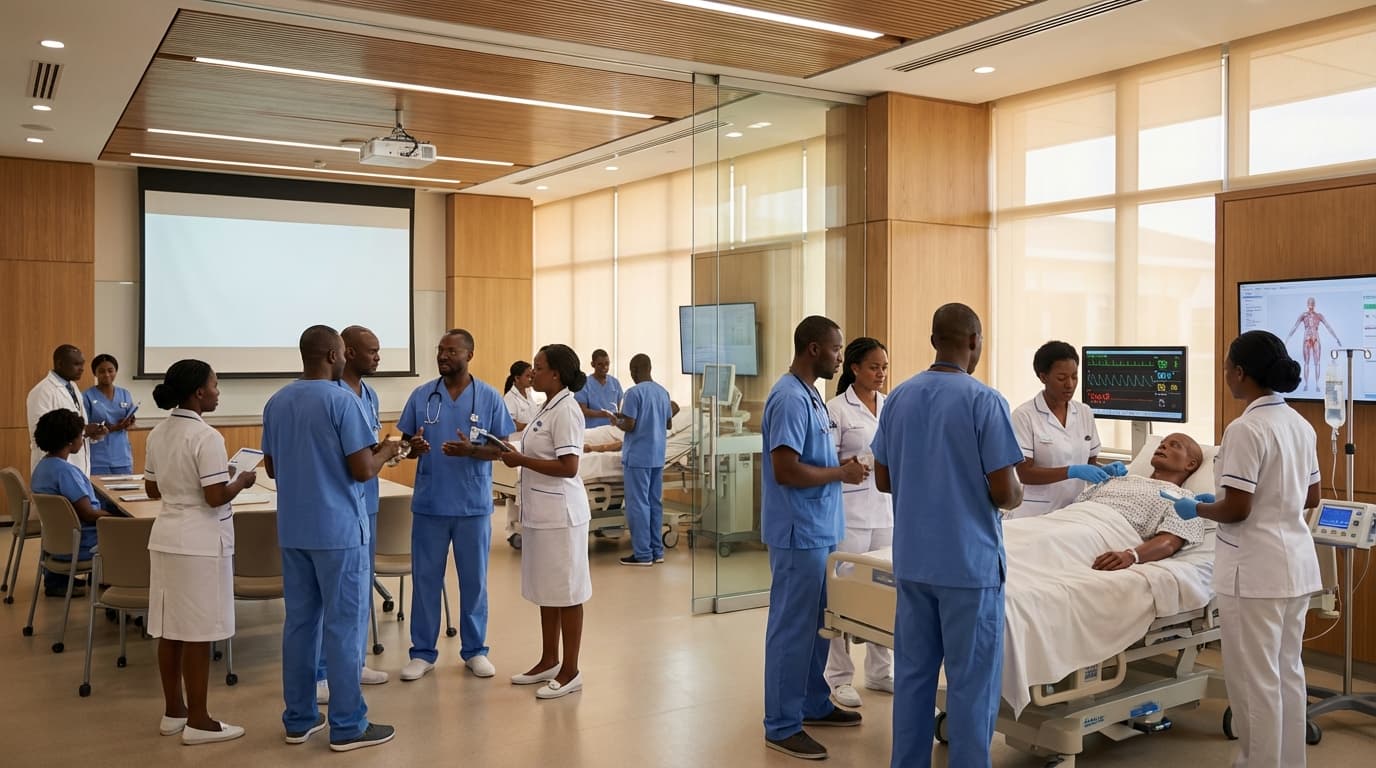
Equipment Training & Education in Tunisia
Engineering Excellence & Technical Support
Comprehensive equipment training and certification programs High-standard technical execution following OEM protocols and local regulatory frameworks.
Advanced Equipment Simulation Lab
Our state-of-the-art simulation lab provides hands-on, risk-free training on a wide range of industrial machinery, including CNC machines, advanced welding equipment, and agricultural technology, using cutting-edge virtual reality and haptic feedback systems. This accelerates skill acquisition and reduces the need for expensive physical equipment downtime during training.
Blended Learning Platform for Technical Skills
We offer a comprehensive blended learning platform that combines engaging online modules with in-person workshops. Trainees can access interactive courses, video tutorials, and knowledge checks at their own pace, followed by practical application sessions led by certified Tunisian instructors specializing in sectors like renewable energy equipment and specialized automotive repair.
Mobile Training Units for Remote Accessibility
To overcome geographical barriers and reach diverse industrial hubs across Tunisia, our fleet of fully equipped mobile training units deliver specialized courses directly to workplaces. These units are designed to provide practical, on-site training for equipment such as heavy construction machinery, mining equipment, and advanced water treatment systems, ensuring widespread access to essential skills development.
What Is Equipment Training & Education In Tunisia?
Equipment training and education in Tunisia refers to structured programs designed to impart knowledge and practical skills necessary for the safe, efficient, and effective operation, maintenance, and repair of specialized machinery and technical apparatus within various industries. This service is crucial for ensuring workforce competency, optimizing asset utilization, and mitigating risks associated with complex equipment.
| Who Needs Equipment Training & Education? | Typical Use Cases | ||||||
|---|---|---|---|---|---|---|---|
| Industrial Operators: Personnel responsible for the day-to-day operation of manufacturing, processing, or production machinery (e.g., CNC machinists, assembly line workers, chemical plant operators). | Maintenance Technicians: Engineers and technicians tasked with the upkeep, repair, and troubleshooting of industrial equipment, automotive systems, or medical devices. | Construction Workers: Individuals operating heavy machinery such as excavators, cranes, bulldozers, and other specialized construction equipment. | Healthcare Professionals: Doctors, nurses, and technicians requiring proficiency in operating sophisticated medical equipment like MRI scanners, ventilators, or surgical robots. | IT Professionals: Staff responsible for managing and maintaining server infrastructure, network devices, and data center equipment. | Logistics and Warehousing Personnel: Employees operating forklifts, automated guided vehicles (AGVs), and other material handling systems. | Energy Sector Workers: Technicians and engineers involved with the operation and maintenance of power generation equipment, renewable energy systems (solar panels, wind turbines), and oil/gas extraction machinery. | Agricultural Professionals: Farmers and agricultural technicians operating modern farming machinery, including tractors, harvesters, and specialized irrigation systems. |
| Manufacturing: Training on CNC machines, robotic arms, assembly lines, packaging equipment, and quality control instruments. | Automotive: Education on diagnostic tools, vehicle lifts, engine repair equipment, and specialized automotive software. | Healthcare: Training on medical imaging devices, surgical instruments, laboratory equipment, and patient monitoring systems. | Construction: Instruction on operating heavy earthmoving equipment, cranes, scaffolding, and power tools. | Oil and Gas: Training on drilling equipment, refinery machinery, safety valves, and exploration tools. | Information Technology: Education on server hardware, networking devices, cybersecurity appliances, and data storage solutions. | Agriculture: Training on advanced tractors, combine harvesters, GPS-guided farming systems, and precision agriculture equipment. | Renewable Energy: Education on solar panel installation and maintenance equipment, wind turbine operation, and battery storage systems. |
Key Components of Equipment Training & Education in Tunisia
- Theoretical Instruction: Covering principles of operation, technical specifications, safety protocols, and regulatory compliance relevant to specific equipment.
- Practical Hands-on Training: Demonstrating and allowing trainees to perform operational procedures, routine maintenance tasks, and basic troubleshooting under supervised conditions.
- Safety and Hazard Awareness: Emphasizing risk assessment, the use of Personal Protective Equipment (PPE), emergency procedures, and lockout/tagout (LOTO) protocols.
- Maintenance and Troubleshooting: Educating on preventive maintenance schedules, diagnostic techniques, and common failure modes with corresponding repair strategies.
- Simulation and Virtual Reality (VR): Increasingly utilized for complex or hazardous equipment, offering safe environments for repetitive practice and scenario-based learning.
- Certification and Assessment: Evaluating trainee competency through theoretical exams, practical assessments, and performance-based evaluations to ensure proficiency.
- Customized Curriculum Development: Tailoring training modules to specific equipment models, industry standards, and organizational needs.
Who Needs Equipment Training & Education In Tunisia?
Equipment training and education are crucial for a wide range of individuals and organizations in Tunisia to ensure operational efficiency, safety, and technological advancement. This training is not limited to specific sectors but is vital across manufacturing, construction, healthcare, agriculture, and the burgeoning tech industry. By investing in skilled personnel, Tunisian businesses can enhance productivity, reduce costly errors, minimize accidents, and adapt to evolving industry standards and new equipment.
| Industry Sector | Key Equipment Types Requiring Training | Primary Benefits of Training |
|---|---|---|
| Manufacturing | CNC machines, robotic arms, industrial automation systems, specialized assembly tools | Increased production output, reduced defects, enhanced worker safety, minimized downtime |
| Construction | Cranes, excavators, bulldozers, power tools, scaffolding systems, laser levels | Improved project timelines, accident prevention, efficient resource utilization, compliance with safety regulations |
| Healthcare | MRI/CT scanners, X-ray machines, laboratory analyzers, surgical robots, ventilators | Accurate diagnoses, patient safety, efficient treatment delivery, regulatory compliance |
| Agriculture | Tractors, harvesters, irrigation systems, processing machinery, drones | Optimized crop yields, reduced labor costs, improved food quality, efficient resource management |
| Energy & Utilities | Turbines, generators, control systems, safety equipment, diagnostic tools | Reliable energy supply, operational efficiency, accident prevention, environmental protection |
| Technology | Server hardware, network equipment, specialized diagnostic tools, cleanroom equipment | System stability, data security, efficient troubleshooting, technological advancement |
Target Customers and Departments for Equipment Training & Education in Tunisia
- {"departments":["Production/Operations","Maintenance & Repair","Quality Control","Assembly Line Workers","Machine Operators","Supervisors & Team Leaders"],"description":"Companies involved in producing goods, ranging from textiles and automotive parts to electronics and food processing.","customer_type":"Manufacturing & Industrial Sector"}
- {"departments":["Site Management","Heavy Machinery Operators","Skilled Trades (Electricians, Plumbers, Welders)","Construction Workers","Safety Officers"],"description":"Firms undertaking building projects, road construction, public works, and civil engineering.","customer_type":"Construction & Infrastructure Development"}
- {"departments":["Medical Technicians (Radiology, Lab, etc.)","Nurses","Doctors & Surgeons (specialized equipment)","Biomedical Engineers","Anesthesiologists"],"description":"Hospitals, clinics, diagnostic centers, and medical device manufacturers.","customer_type":"Healthcare & Medical Services"}
- {"departments":["Farm Workers & Operators","Agronomists","Farm Managers","Mechanics (agricultural machinery)","Irrigation Specialists"],"description":"Farms, cooperatives, food processing plants, and agricultural machinery suppliers.","customer_type":"Agriculture & Agribusiness"}
- {"departments":["Power Plant Operators","Field Technicians","Maintenance Engineers","Safety Personnel","Pipeline Operators"],"description":"Companies involved in power generation, distribution, oil and gas, and water management.","customer_type":"Energy & Utilities"}
- {"departments":["IT Support Staff","Data Center Technicians","Network Engineers","Hardware Engineers","Robotics & Automation Specialists"],"description":"Companies involved in software development, hardware assembly, data centers, and specialized IT infrastructure.","customer_type":"Technology & IT Sector"}
- {"departments":["Fleet Managers","Vehicle Technicians","Warehouse Operatives","Forklift Operators","Port Crane Operators"],"description":"Companies managing fleets of vehicles, shipping, warehousing, and port operations.","customer_type":"Transportation & Logistics"}
- {"departments":["Instructors & Trainers","Curriculum Developers","Lab Technicians"],"description":"Institutes providing technical and vocational education to prepare the future workforce.","customer_type":"Education & Vocational Training Centers"}
- {"departments":["Public Works Departments","Emergency Services Personnel","Environmental Agencies"],"description":"Municipalities, disaster management units, and public service departments.","customer_type":"Government & Public Sector Agencies"}
Equipment Training & Education Process In Tunisia
This document outlines the standard workflow for equipment training and education processes in Tunisia, from the initial inquiry to the final execution of training sessions. This process ensures a structured and efficient approach to equipping personnel with the necessary skills and knowledge for operating and maintaining specific equipment.
| Stage | Description | Key Activities | Responsible Parties | Deliverables/Outcomes |
|---|---|---|---|---|
| The initial contact from a client or internal department seeking training for specific equipment. This stage focuses on understanding the precise training requirements. | Client/Department submits training request; Initial discussion of equipment, target audience, skill gaps, and objectives; Site visit (if necessary); Documentation review. | Client/Requesting Department, Training Provider (Sales/Consulting Team) | Clearly defined training needs, target audience profile, scope of training, and preliminary objectives. |
| Based on the needs assessment, the training provider develops a comprehensive proposal and quotation outlining the proposed training solution. | Development of training curriculum outline; Identification of training methodologies (classroom, on-the-job, simulation); Estimation of resources (instructors, materials, equipment); Costing and profit margin calculation; Submission of detailed proposal and quotation. | Training Provider (Sales/Technical Team) | Formal training proposal document, detailed quotation with pricing, payment terms, and scope of work. |
| Formalizing the training agreement and initiating detailed planning for the execution of the training. | Client reviews and accepts proposal/quotation; Negotiation of terms and conditions; Signing of contract/agreement; Formation of project team (if applicable); Detailed curriculum design and development schedule; Identification of specific training equipment and facilities. | Client, Training Provider (Management, Project Manager, Technical Leads) | Signed contract/agreement; Detailed project plan; Agreed-upon training schedule and modules. |
| Creating and tailoring training materials to meet the specific needs and context of the trainees and the equipment. | Developing training manuals, presentations, handouts, exercises, and assessments; Customizing content to align with client's operational procedures, specific equipment models, and industry standards; Translation of materials (if required). | Training Provider (Instructional Designers, Subject Matter Experts, Technical Writers) | Finalized training materials (manuals, presentations, etc.); Pre- and post-training assessments. |
| Arranging all practical aspects for the successful delivery of the training. | Confirming training dates and times with client; Booking training venue/facilities; Arranging for necessary training equipment and consumables; Scheduling instructors; Arranging travel and accommodation for instructors and/or trainees (if applicable); Communication with trainees regarding schedule and preparation. | Training Provider (Logistics Coordinator, Project Manager), Client (Venue/Equipment Access) | Confirmed training schedule; Secured training venue and equipment; Arranged logistics for personnel. |
| The actual delivery of the training program to the target audience. | Conducting theoretical sessions (lectures, discussions); Performing practical demonstrations and hands-on exercises; Supervised practice on actual equipment; Q&A sessions; Troubleshooting common issues. | Training Provider (Instructors) | Trainees actively participating; Successful completion of practical exercises; Acquisition of new skills and knowledge. |
| Measuring the effectiveness of the training and the participants' learning outcomes. | Administering pre- and post-training assessments (quizzes, practical tests, simulations); Observing trainee performance during practical sessions; Collecting feedback from trainees (satisfaction surveys); Collecting feedback from instructors on trainee progress; Post-training performance review (optional). | Training Provider (Instructors, Project Manager), Client (Management) | Assessment reports; Trainee performance evaluation; Training evaluation summary report; Feedback analysis. |
| Providing ongoing support to reinforce learning and address any lingering questions or challenges. | Issuing certificates of completion; Providing access to additional resources (online portals, FAQs); Offering follow-up technical support; Conducting refresher training (if agreed upon); Gathering testimonials and case studies. | Training Provider (Support Team, Project Manager), Client | Certificates of completion; Post-training support provision; Client satisfaction and potential for future engagements. |
Key Stages in the Equipment Training & Education Process:
- Inquiry & Needs Assessment
- Proposal & Quotation
- Agreement & Planning
- Content Development & Customization
- Logistics & Scheduling
- Training Delivery (Execution)
- Assessment & Evaluation
- Post-Training Support & Follow-up
Equipment Training & Education Cost In Tunisia
The cost of equipment training and education in Tunisia is influenced by several key factors, leading to a broad range of prices for individuals and businesses seeking to upskill their workforce or acquire new technical competencies. These factors include the complexity and specialization of the equipment, the duration and depth of the training program, the reputation and accreditation of the training provider, and the level of hands-on practice included. Furthermore, the location within Tunisia (major cities vs. more remote areas) and whether the training is conducted on-site at a company's facility or at a dedicated training center can also impact the final cost. Customized training packages designed for specific organizational needs often command higher prices due to the tailored content and specialized instruction involved.
| Training Category (Examples) | Typical Duration | Estimated Price Range (TND - Tunisian Dinar) |
|---|---|---|
| Basic Machinery Operation (e.g., Forklifts, Basic Construction Equipment) | 1-3 Days | 200 - 700 TND |
| Intermediate Technical Skills (e.g., CNC Machining, Industrial Automation) | 3-10 Days | 600 - 2,500 TND |
| Advanced Specialized Equipment (e.g., Medical Imaging, Aerospace Components) | 1-4 Weeks | 2,000 - 10,000+ TND |
| Software-Specific Equipment Training (e.g., CAD/CAM, Simulation Software) | 2-5 Days | 400 - 1,800 TND |
| On-site Corporate Training (per day, variable based on group size and customization) | Variable | 800 - 3,000+ TND |
Key Pricing Factors for Equipment Training & Education in Tunisia:
- Equipment Specialization and Complexity
- Training Program Duration and Depth
- Provider Reputation and Accreditation
- Hands-on Practice and Simulation Levels
- Training Location (On-site vs. Training Center)
- Customization and Tailoring of Content
- Inclusion of Certifications
Affordable Equipment Training & Education Options
Investing in proper equipment training and education is crucial for maximizing its lifespan, ensuring safe operation, and improving efficiency. Fortunately, there are numerous affordable options available, from online courses to group workshops. Value bundles and strategic cost-saving measures can make this essential investment even more accessible for individuals and organizations.
| Cost-Saving Strategy | Description | Benefits |
|---|---|---|
| Value Bundles | Combining multiple training modules, courses, or even related equipment into a single package at a reduced price. | Lower overall cost, comprehensive learning, access to multiple skills or topics. |
| Group Discounts | Organizations or individuals registering multiple participants receive a per-person discount. | Significant savings for teams, fosters a shared learning environment. |
| Early Bird Registration | Registering for training courses or workshops well in advance of the deadline to secure a lower price. | Reduced cost, guaranteed spot in popular courses. |
| Subscription Services | Access to a library of online courses and resources for a recurring fee, often offering unlimited training. | Cost-effective for continuous learning, wide range of topics available. |
| Free Online Resources | Leveraging free tutorials, documentation, forums, and open-source training materials. | Zero financial cost, accessible anytime, builds foundational knowledge. |
| Train-the-Trainer Programs | Training a select group of individuals within an organization who then train their colleagues. | Scalable and cost-effective for large teams, builds internal expertise. |
| Government Grants & Subsidies | Exploring available funding opportunities for vocational training or workforce development. | Significant financial assistance, making training accessible for underserved groups. |
| Partnerships with Educational Institutions | Collaborating with schools or colleges to offer tailored training programs at a negotiated rate. | Customized curriculum, potential for accreditation, mutually beneficial. |
Affordable Equipment Training & Education Options
- Online Courses & Webinars
- Manufacturer-Provided Training
- Community College & Vocational Programs
- Industry Association Workshops
- On-the-Job Training & Mentorship
- Open-Source Learning Resources
- Apprenticeship Programs
Verified Providers In Tunisia
In the realm of healthcare, particularly when seeking specialized medical services abroad, the credibility and qualifications of providers are paramount. For those considering medical tourism to Tunisia, understanding the credentials of healthcare facilities and practitioners is crucial. Franance Health has emerged as a leading platform dedicated to connecting patients with verified and high-quality healthcare providers in Tunisia. This document outlines why Franance Health's vetting process and the providers they endorse represent the best choice for discerning patients.
| Franance Health Credential | What it means for you | Example Provider Type |
|---|---|---|
| Accreditation by International Standards (e.g., ISO, JCI) | Demonstrates adherence to globally recognized benchmarks for quality, safety, and patient care. | Reputable Hospitals and Clinics |
| Medical Professional Board Certification | Ensures physicians have met rigorous educational and experiential requirements in their specialty. | Surgeons (e.g., Plastic Surgery, Orthopedics) |
| Extensive Clinical Experience | Indicates a proven track record of successful procedures and patient outcomes. | Specialist Doctors across various fields |
| State-of-the-Art Facilities and Technology | Guarantees access to advanced medical equipment and modern infrastructure for optimal treatment. | Surgical Centers and Diagnostic Labs |
| Patient Testimonials and Satisfaction Scores | Provides real-world feedback on patient experiences and the quality of care received. | All Franance Health Listed Providers |
| Compliance with Tunisian Healthcare Regulations | Confirms that providers operate within the legal and ethical framework of Tunisia's healthcare system. | All Franance Health Listed Providers |
Why Choose Franance Health Verified Providers in Tunisia?
- Unwavering commitment to quality and patient safety.
- Access to a comprehensive network of leading medical specialists and state-of-the-art facilities.
- Transparent and rigorous credential verification process.
- Enhanced patient experience through streamlined communication and support.
- Specialization in a wide range of medical procedures and treatments.
Scope Of Work For Equipment Training & Education
This Scope of Work (SOW) outlines the requirements for providing comprehensive training and educational services for the specified equipment. The objective is to ensure that end-users and technical personnel possess the necessary knowledge and skills to operate, maintain, and troubleshoot the equipment effectively and safely. This SOW details the technical deliverables, standard specifications, and associated activities.
| Deliverable Title | Description | Format | Target Audience | Frequency/Timeline | Standard Specification |
|---|---|---|---|---|---|
| Operator Training Program | Hands-on and theoretical training covering equipment operation, setup, and basic troubleshooting for end-users. | Instructor-led sessions, practical exercises, participant guides, competency assessments. | End-users, operators, line supervisors. | Initial deployment and as needed for new personnel. | Training materials aligned with manufacturer's operator manual, demonstrable proficiency in core operations. |
| Maintenance Training Program | Detailed training on preventive maintenance schedules, component replacement, calibration, and advanced troubleshooting for technical staff. | Instructor-led sessions, practical demonstrations, service manuals, diagnostic tool training, skill-based assessments. | Maintenance technicians, service engineers, skilled operators. | Initial deployment and periodic refreshers (e.g., annually). | Training materials aligned with manufacturer's service manual, ability to perform scheduled maintenance and diagnose common faults. |
| Troubleshooting Guide | A comprehensive, easy-to-understand guide detailing common issues, their causes, and step-by-step resolution procedures. | Digital (PDF) and printed document, flowcharts, diagrams, error code explanations. | Operators and maintenance personnel. | Provided upon equipment delivery and updated as needed. | Content verified by manufacturer's technical experts, clarity and accuracy. |
| Safety & Emergency Procedures Manual | Document outlining all safety precautions, personal protective equipment (PPE) requirements, lockout/tagout procedures, and emergency response actions. | Digital (PDF) and printed document, clear visual aids, incident reporting forms. | All personnel interacting with the equipment. | Provided upon equipment delivery and reviewed annually. | Compliance with relevant safety standards (e.g., OSHA), clear and actionable instructions. |
| Training Effectiveness Report | Report summarizing training attendance, assessment results, identified knowledge gaps, and recommendations for further training or operational improvements. | Written report, summary statistics, qualitative feedback. | Project management, training stakeholders. | Post-training session or phase. | Objective assessment of training outcomes, data-driven recommendations. |
| On-Demand Technical Support | Access to expert technical support for complex issues, remote assistance, and clarification of training materials. | Phone, email, video conferencing, remote access capabilities. | Maintenance personnel, engineering team. | Available during business hours (specify times) and potentially 24/7 for critical issues. | Response time SLAs (e.g., within X hours for non-critical, Y minutes for critical). |
Key Training Objectives
- Familiarization with equipment components, functionalities, and operational procedures.
- Safe and efficient operation of the equipment according to manufacturer guidelines.
- Routine maintenance tasks, including inspection, cleaning, and lubrication.
- Basic troubleshooting of common operational issues and error codes.
- Understanding of safety protocols, emergency procedures, and regulatory compliance.
- Documentation and record-keeping related to equipment usage and maintenance.
Service Level Agreement For Equipment Training & Education
This Service Level Agreement (SLA) outlines the guaranteed response times and uptime for equipment training and education services provided by [Your Company Name] to [Client Company Name]. This agreement is intended to ensure the consistent availability and timely support of our training programs and educational resources.
| Service Component | Uptime Guarantee | Response Time Guarantee (Standard Support) | Response Time Guarantee (Critical Support) | Notes |
|---|---|---|---|---|
| Virtual Training Platform (LMS/Portal) | 99.5% uptime | Within 4 business hours | Within 1 business hour | Excludes scheduled maintenance windows, which will be communicated 48 hours in advance. |
| Live Virtual Training Sessions | 100% availability (scheduled sessions) | N/A (Session delivery is scheduled) | N/A (Session delivery is scheduled) | Technical issues during a session will be addressed immediately by the facilitator. |
| Self-Paced Online Modules | 99.5% uptime | Within 8 business hours | Within 4 business hours | Access to pre-recorded content and knowledge base. |
| Instructor Support (during live sessions) | 100% availability | During scheduled session times | During scheduled session times | Directly addresses participant questions and provides clarification. |
| Technical Support (for platform issues) | N/A | Within 4 business hours (for non-urgent issues) | Within 2 business hours (for urgent, session-impacting issues) | Defined by severity levels (see 'Critical Support' definition). |
| Training Material Access (downloadable/viewable) | 99.5% uptime | Within 12 business hours (for restoration if inaccessible) | Within 6 business hours (for restoration if inaccessible) | Assumes platform is accessible. |
Key Service Components
- Training Delivery: Guaranteed availability of scheduled training sessions (in-person, virtual, or self-paced).
- Technical Support: Timely assistance for any technical issues encountered during virtual training sessions or when accessing online educational platforms.
- Content Accessibility: Ensuring that all provided training materials and educational resources are accessible as per the agreed-upon schedule and format.
- Instructor Availability: For live training sessions, guaranteeing the presence and preparedness of the assigned instructor.
- Platform Uptime: Maintaining the operational availability of any online learning management systems (LMS) or training portals used for content delivery and interaction.
Frequently Asked Questions

Ready when you are
Let's scope your Equipment Training & Education in Tunisia project in Tunisia.

Scaling healthcare logistics and technical systems across the entire continent.