
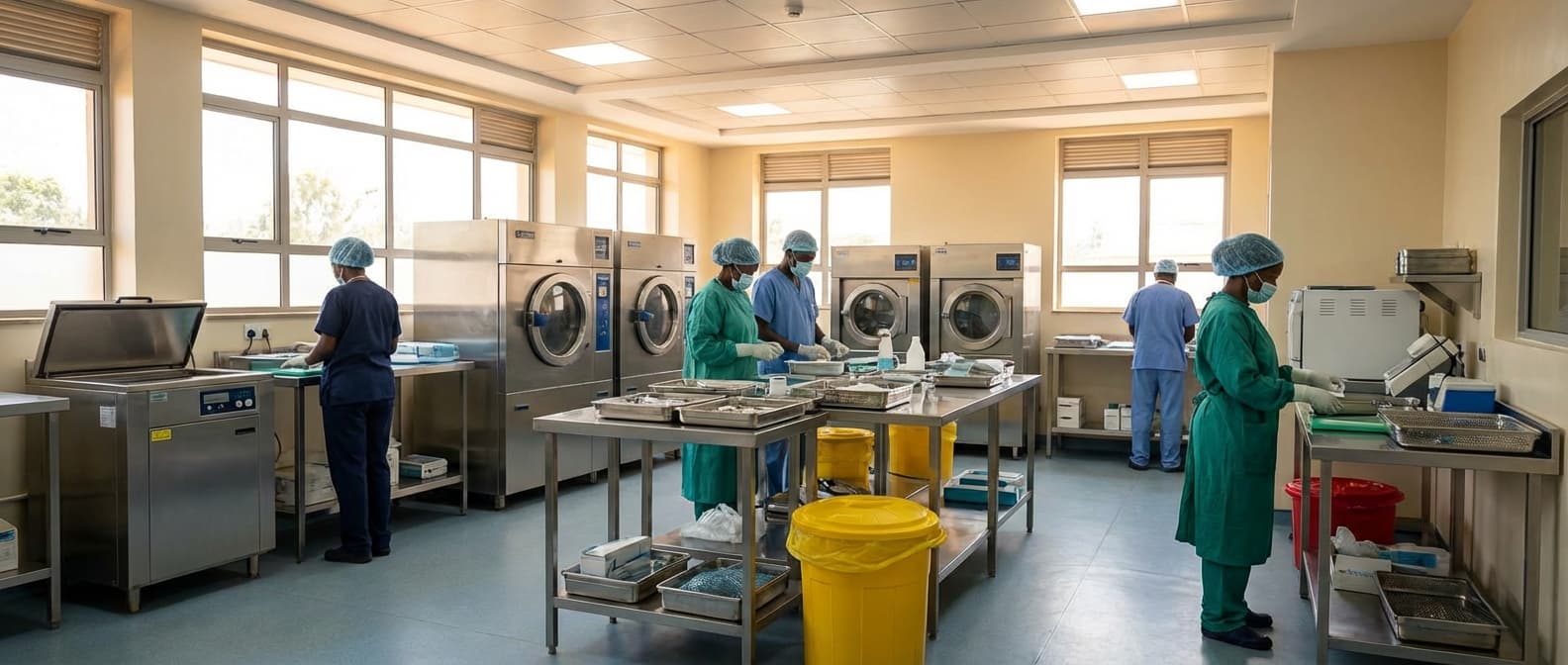
Autoclave Validation Support Service in Tunisia
Engineering Excellence & Technical Support
Autoclave Validation Support Service High-standard technical execution following OEM protocols and local regulatory frameworks.
Comprehensive Validation Protocols
We provide meticulously designed validation protocols for autoclaves of all types, ensuring compliance with Tunisian and international standards (e.g., ISO 17665). Our services cover Installation Qualification (IQ), Operational Qualification (OQ), and Performance Qualification (PQ) with detailed documentation and reporting.
Advanced Biological & Chemical Indicators
Leveraging cutting-edge biological and chemical indicators, we offer robust performance testing to verify sterilization efficacy. Our expert team interprets results accurately, providing clear insights into your autoclave's ability to eliminate microorganisms and ensure patient safety.
Data Analysis & Reporting Excellence
We specialize in the precise analysis of autoclave validation data. Our comprehensive reports are clear, concise, and actionable, facilitating regulatory audits and providing the confidence that your sterilization processes meet the highest quality and safety benchmarks in Tunisia.
What Is Autoclave Validation Support Service In Tunisia?
Autoclave validation support service in Tunisia refers to the comprehensive process of establishing, documenting, and maintaining documented evidence that an autoclave system consistently performs according to predetermined specifications and quality attributes within a defined operating range. This validation is critical for ensuring the sterility of materials and equipment, thereby safeguarding product quality, patient safety, and regulatory compliance within the Tunisian healthcare and pharmaceutical sectors.
| Who Needs Autoclave Validation Support? | Typical Use Cases | ||||
|---|---|---|---|---|---|
| Healthcare Institutions (Hospitals, Clinics, Dental Practices): For sterilizing surgical instruments, medical devices, and laboratory equipment. | Pharmaceutical Manufacturing Facilities: For sterilizing product containers, stoppers, ancillary materials, and processing equipment. | Biotechnology Companies: For sterilizing media, laboratory glassware, and research equipment. | Research and Development Laboratories: For ensuring the sterility of consumables and equipment used in experiments. | Medical Device Manufacturers: For validating sterilization processes for their manufactured devices. | |
| Ensuring the effectiveness of sterilization cycles for reusable medical instruments. | Verifying the efficacy of sterilization processes for pharmaceutical products and packaging. | Meeting regulatory requirements from Tunisian health authorities (e.g., Ministry of Health) and international standards (e.g., ISO, FDA cGMP). | Preventing cross-contamination and hospital-acquired infections. | Maintaining the integrity and sterility of sensitive biological materials in research settings. | Validating sterilization processes for novel medical devices and biotechnological products. |
Key Components of Autoclave Validation Support Service
- Installation Qualification (IQ): Verifies that the autoclave is installed correctly according to manufacturer specifications and relevant standards.
- Operational Qualification (OQ): Tests the autoclave's operational capabilities across its defined range of parameters (e.g., temperature, pressure, time, vacuum).
- Performance Qualification (PQ): Demonstrates that the autoclave consistently achieves the required sterilization cycles under normal operating conditions using validated biological and chemical indicators.
- Revalidation: Periodic re-assessment to ensure continued compliance and effectiveness after significant changes, maintenance, or at predetermined intervals.
- Documentation and Reporting: Comprehensive generation of validation protocols, reports, and standard operating procedures (SOPs) to meet regulatory requirements.
- Training: Provision of training for personnel on the proper operation, maintenance, and validation of the autoclave system.
Who Needs Autoclave Validation Support Service In Tunisia?
In Tunisia, the demand for reliable Autoclave Validation Support Services is critical for a range of industries and healthcare facilities that rely on effective sterilization to ensure patient safety, product integrity, and regulatory compliance. These services are essential for maintaining the operational efficiency and trustworthiness of autoclaves, which are indispensable for sterilizing medical instruments, laboratory equipment, pharmaceutical products, and more. Without proper validation, the efficacy of the sterilization process cannot be guaranteed, leading to potential risks of infection, product recall, and non-compliance with national and international standards.
| Target Customer Type | Key Departments / Functions Involved |
|---|---|
| Hospitals & Clinics | Central Sterile Supply Department (CSSD), Operating Theaters, Infection Control Department, Dental Clinics, Outpatient Services |
| Pharmaceutical Manufacturers | Quality Control (QC), Quality Assurance (QA), Production, Validation Department, Research & Development (R&D) |
| Biotechnology Companies | Quality Control (QC), Quality Assurance (QA), Manufacturing/Production, R&D Laboratories, Sterility Assurance |
| Medical Device Manufacturers | Quality Control (QC), Quality Assurance (QA), Manufacturing, Validation Department, Regulatory Affairs |
| Research & Academic Institutions | Laboratory Management, Research Laboratories (Biology, Chemistry, Medicine), Facilities Management, Safety Officers |
| Food & Beverage Industry (Specific) | Quality Assurance (QA), Production, Packaging Department |
Target Customers and Departments Requiring Autoclave Validation Support Service in Tunisia:
- {"title":"Healthcare Facilities","description":"Hospitals, clinics, dental practices, and specialized medical centers are primary users of autoclaves for sterilizing surgical instruments, dental tools, and other reusable medical devices. Ensuring the sterility of these items is paramount to preventing healthcare-associated infections (HAIs)."}
- {"title":"Pharmaceutical Manufacturers","description":"Companies involved in the production of pharmaceuticals require validated autoclaves for sterilizing equipment, glassware, stoppers, and packaging materials that come into contact with drug products, ensuring product safety and regulatory adherence."}
- {"title":"Biotechnology Companies","description":"Research and development laboratories, as well as production facilities in the biotechnology sector, rely on autoclaves for sterilizing culture media, laboratory equipment, and consumables to maintain sterile environments for sensitive experiments and processes."}
- {"title":"Medical Device Manufacturers","description":"Companies that produce reusable medical devices must validate their sterilization processes, including autoclaving, to ensure that their products are safe for patient use and meet stringent quality standards."}
- {"title":"Research and Academic Institutions","description":"Universities and research institutes with biology, chemistry, and medical departments utilize autoclaves for sterilizing laboratory equipment, glassware, and waste, requiring validation to ensure the integrity of research data and the safety of personnel."}
- {"title":"Food and Beverage Industry (Specific Applications)","description":"While not as widespread as in healthcare, certain segments of the food and beverage industry may use autoclaves for sterilizing packaging materials or specific equipment where high-level sterilization is required."}
Autoclave Validation Support Service Process In Tunisia
This document outlines the typical workflow for Autoclave Validation Support Services in Tunisia, from initial customer inquiry to the final execution and reporting. The process is designed to ensure that autoclaves meet regulatory standards and operate effectively for sterilization purposes.
| Stage | Description | Key Activities | Deliverables/Outcomes | |||||
|---|---|---|---|---|---|---|---|---|
| The process begins when a client in Tunisia expresses interest in autoclave validation services. | Client contacts service provider, discusses needs, identifies autoclave type and purpose, inquires about regulatory requirements (e.g., ISO, GMP), receives preliminary information. | Understanding of client's validation needs, initial scope definition. | |||||
| Based on the consultation, the service provider prepares a formal proposal and service agreement. | Detailed service scope definition, risk assessment (if applicable), quotation preparation (including costs, timelines, equipment, personnel), client review, negotiation, contract signing. | Formal quotation, signed service agreement, payment terms agreed. | |||||
| Once the agreement is in place, detailed planning and scheduling commence to ensure efficient execution. | Site visit coordination (if needed), scheduling of technicians and equipment, preparation of validation protocols, identification of critical parameters, client communication regarding access and availability, risk mitigation planning. | Agreed schedule for on-site activities, approved validation protocol (if applicable). | |||||
| This is the core phase where validation activities are performed at the client's facility. | This stage involves several qualification phases: |
|
|
|
| Data collection using calibrated equipment, documentation of all tests performed, identification of any deviations. | Raw test data, calibration certificates for equipment used, completed test logs, deviation reports (if any). |
| The collected data is meticulously analyzed to draw conclusions about the autoclave's performance. | Review and analysis of all collected test data, comparison against predefined acceptance criteria in the validation protocol, generation of a comprehensive validation report, including findings, conclusions, and recommendations. | Detailed Autoclave Validation Report, summary of findings, recommendations for corrective actions (if needed). | |||||
| Upon successful validation and client acceptance, the service is considered complete, with potential for ongoing support. | Issuance of a validation certificate, discussion of report findings with the client, provision of recommendations for ongoing maintenance and re-validation, scheduling of future re-validation cycles, client satisfaction feedback. | Autoclave Validation Certificate, final report acceptance, plan for future validation/re-validation. |
Autoclave Validation Support Service Process Workflow
- Initial Inquiry & Consultation
- Quotation & Agreement
- Planning & Scheduling
- On-site Execution (Installation & Calibration, Performance Qualification - PQ, Operational Qualification - OQ, Installation Qualification - IQ)
- Data Analysis & Reporting
- Certification & Follow-up
Autoclave Validation Support Service Cost In Tunisia
Autoclave validation is a critical process for ensuring the efficacy and safety of sterilization in healthcare and laboratory settings. In Tunisia, the cost of this service can vary significantly based on several key factors. These factors influence the overall complexity, duration, and resources required for the validation process, ultimately impacting the final price. Understanding these elements is crucial for facilities budgeting for this essential service.
| Validation Type | Estimated Price Range (TND) | Notes |
|---|---|---|
| Installation Qualification (IQ) | 300 - 700 TND | Covers verification of correct installation and component identification. |
| Operational Qualification (OQ) | 500 - 1200 TND | Confirms the autoclave operates within predefined parameters across its range. |
| Performance Qualification (PQ) | 800 - 2500+ TND | Demonstrates consistent effective sterilization under normal operating conditions with actual loads. This is the most variable and potentially expensive part. |
| Full Validation (IQ, OQ, PQ) | 1500 - 4500+ TND | Comprehensive validation package. The upper end depends heavily on autoclave size, cycles, and complexity. |
Key Pricing Factors for Autoclave Validation in Tunisia
- {"title":"Autoclave Size and Capacity","description":"Larger autoclaves with higher capacities generally require more testing cycles and consumables, leading to a higher validation cost."}
- {"title":"Type of Validation (IQ, OQ, PQ)","description":"Installation Qualification (IQ), Operational Qualification (OQ), and Performance Qualification (PQ) have different levels of complexity and time investment. PQ, which involves real-time or simulated load testing, is typically the most extensive and costly."}
- {"title":"Number of Validation Cycles","description":"The required number of successful validation cycles (especially for PQ) directly impacts the labor and material costs."}
- {"title":"Complexity of Sterilization Cycles","description":"Validation of complex cycles (e.g., those involving porous loads, liquids, or specific temperature/pressure profiles) can be more demanding and thus more expensive."}
- {"title":"Geographical Location within Tunisia","description":"While not a primary driver, travel and logistical costs for the validation team might slightly influence pricing for facilities located in more remote areas."}
- {"title":"Service Provider Reputation and Expertise","description":"Established and highly reputable validation service providers with extensive experience and specialized equipment may command higher prices."}
- {"title":"Scope of Work and Additional Services","description":"If the validation includes additional services like instrument calibration, re-validation support, or training, the overall cost will increase."}
- {"title":"Frequency of Validation (Annual, Bi-annual)","description":"While not directly a pricing factor for a single instance, the frequency dictates the recurring costs over time. Discounts may sometimes be offered for long-term service agreements."}
- {"title":"Type of Autoclave Technology","description":"Different autoclave technologies (e.g., steam, chemical) might have varying validation requirements and complexities."}
Affordable Autoclave Validation Support Service Options
Ensuring the proper functioning and compliance of autoclaves is critical for healthcare and laboratory settings. Autoclave validation is a regulatory requirement, but it can also be a significant expense. This document outlines affordable autoclave validation support service options, focusing on value bundles and cost-saving strategies to make this essential service more accessible.
| Service Component | Standard Pricing (Illustrative) | Value Bundle Offering | Cost-Saving Strategy |
|---|---|---|---|
| IQ (Installation Qualification) | $500 - $1,000 | Included in Comprehensive Validation Package | Bundle with OQ/PQ for discounted rate |
| OQ (Operational Qualification) | $600 - $1,200 | Included in Comprehensive Validation Package | Opt for a pre-defined service agreement |
| PQ (Performance Qualification) | $700 - $1,500 | Included in Comprehensive Validation Package | Schedule in advance to leverage off-peak availability |
| Re-validation/Quarterly Checks | $400 - $800 per event | Discounted rate for annual contracts | Combine re-validation with preventative maintenance |
| Calibration of Probes/Sensors | $150 - $300 per unit | Included in higher-tier service agreements | Batch calibration for multiple units |
| Report Generation & Documentation | $100 - $250 | Standard in all validation packages | Digital delivery of reports to reduce printing costs |
Understanding Autoclave Validation Needs
- Types of Validation: Installation Qualification (IQ), Operational Qualification (OQ), Performance Qualification (PQ). Each addresses different stages of the autoclave's lifecycle.
- Regulatory Compliance: Meeting standards set by bodies like the FDA, ISO, and local health authorities.
- Frequency: Validation is typically required upon installation, after major repairs or modifications, and at regular intervals (e.g., annually).
- Types of Autoclaves: Different autoclave technologies (steam, chemical, etc.) may have specific validation requirements.
Verified Providers In Tunisia
In Tunisia's rapidly evolving healthcare landscape, ensuring access to verified and reputable medical providers is paramount for patients seeking quality care. Franance Health stands out as a trusted network, rigorously vetting its affiliated professionals and facilities to guarantee high standards of service, ethical practice, and patient safety. This commitment to verification translates into tangible benefits for those who choose Franance Health's network for their medical needs.
| Provider Type | Franance Health Verification Focus | Benefits for Patients |
|---|---|---|
| Physicians | Medical license, board certification, malpractice history, patient feedback. | Access to highly qualified and experienced doctors, reduced risk of misdiagnosis or malpractice. |
| Hospitals & Clinics | Accreditation, compliance with health regulations, equipment quality, infection control protocols, staff qualifications. | Safe and well-equipped facilities, adherence to international standards of care, professional and attentive staff. |
| Specialized Centers (e.g., Dental, Fertility) | Specific professional licenses, advanced training, technology adoption, patient outcome data. | Access to cutting-edge treatments and specialized knowledge, improved chances of successful outcomes. |
| Diagnostic Labs & Imaging Centers | Laboratory accreditation, equipment calibration, quality control measures, technician certifications. | Accurate and reliable diagnostic results, timely reporting, advanced imaging capabilities. |
Why Franance Health Credentials Make Them the Best Choice:
- Rigorous Verification Process: Franance Health employs a multi-stage vetting system that includes credential review, license verification, and background checks for all its healthcare providers. This ensures that only qualified and ethical practitioners are part of their network.
- Commitment to Quality Standards: Affiliated providers adhere to strict quality benchmarks and patient care protocols established by Franance Health. This uniformity guarantees a consistent and high level of medical service across the network.
- Enhanced Patient Safety: The verification process extends to safety measures and facility standards, minimizing risks and ensuring a secure environment for all patients.
- Access to Specialized Expertise: Franance Health collaborates with a diverse range of specialists, providing patients with access to a broad spectrum of medical expertise within a trusted framework.
- Streamlined Experience: By choosing a Franance Health-verified provider, patients benefit from a more predictable and reassuring healthcare experience, knowing they are in capable hands.
- Trust and Transparency: The accreditation signifies a commitment to transparency and ethical conduct, building trust between patients and their healthcare providers.
Scope Of Work For Autoclave Validation Support Service
This document outlines the Scope of Work (SOW) for Autoclave Validation Support Services. The objective is to provide expert assistance in the validation of steam sterilizers (autoclaves) to ensure they consistently meet predefined performance specifications and regulatory requirements. This includes planning, execution, documentation, and reporting of validation activities. The service will adhere to relevant industry standards and guidelines.
| Item | Standard/Specification | Description | Applicability |
|---|---|---|---|
| Validation Protocols (IQ, OQ, PQ) | ANSI/AAMI ST55, ISO 13485, USP <1072> | Detailed procedures for installation, operational, and performance testing. Includes test methods, acceptance criteria, and environmental conditions. | All autoclave validation phases. |
| Temperature and Pressure Monitoring | FDA 21 CFR Part 820, Good Manufacturing Practices (GMP) | Calibrated sensors and data loggers to record temperature, pressure, and time during cycles. Accuracy requirements for sensors. | OQ, PQ. |
| Biological Indicators (BIs) | ISO 11135, ISO 17665, USP <55> | Use of validated BIs with known resistance (e.g., Geobacillus stearothermophilus) and appropriate incubation procedures. BI challenge locations. | PQ. |
| Chemical Indicator (CI) Strips/Tapes | ISO 11140-1 | Use of Class 4 or Class 5 chemical indicators to verify exposure to critical parameters (time, temperature, saturation). Location and interpretation of results. | OQ, PQ. |
| Sterilization Cycle Parameters | Manufacturer's Specifications, User Requirements Specification (URS) | Defined parameters for sterilization cycles (e.g., temperature, pressure, exposure time, drying time). Consistency and reproducibility. | OQ, PQ. |
| Validation Report | FDA 21 CFR Part 820, ISO 13485 | Comprehensive summary of all validation activities, including protocols, raw data, analysis, deviation reports, and conclusions. Conformance to pre-defined acceptance criteria. | All validation phases. |
| Calibration of Test Equipment | NIST Traceability, ISO/IEC 17025 | All measurement and test equipment used during validation (e.g., thermocouples, pressure gauges, data loggers) must be calibrated by accredited laboratories and have current calibration certificates. | All validation phases. |
| Data Integrity | Good Documentation Practices (GDP), ALCOA+ Principles | Ensuring accuracy, completeness, consistency, and reliability of all data generated during validation. Secure data storage and retrieval. | All validation phases. |
| Re-validation Criteria | FDA 21 CFR Part 820, Risk Assessment | Defined triggers for re-validation (e.g., major repairs, process changes, scheduled intervals). | Post-validation maintenance. |
Technical Deliverables
- Validation Master Plan (VMP) - Autoclave Specific
- Installation Qualification (IQ) Protocol & Report
- Operational Qualification (OQ) Protocol & Report
- Performance Qualification (PQ) Protocol & Report
- Re-validation Protocol & Report (as required)
- Validation Summary Report
- Calibration Certificates for Test Equipment
- Traceability Matrix (linking protocols to requirements)
- Risk Assessment Report (related to autoclave sterilization)
- Training Materials for autoclave operation and maintenance personnel (optional, upon request)
Service Level Agreement For Autoclave Validation Support Service
This Service Level Agreement (SLA) outlines the response times and uptime guarantees for the Autoclave Validation Support Service provided by [Your Company Name]. This SLA is an addendum to the main Service Agreement and details the commitment to ensure timely and reliable support for your autoclave validation needs.
| Service Component | Priority Level | Response Time Target | Resolution Time Target (Target) | Uptime Guarantee | Availability Hours |
|---|---|---|---|---|---|
| Autoclave Validation Software Access | Critical (System Unusable, Major Impact) | 1 Hour | 4 Business Hours | 99.9% | 24/7 |
| Autoclave Validation Software Access | High (Significant Impact, Workaround Available) | 2 Business Hours | 8 Business Hours | 99.9% | 24/7 |
| Autoclave Validation Software Access | Medium (Moderate Impact, Minor Functionality Affected) | 4 Business Hours | 2 Business Days | 99.9% | Business Hours (Mon-Fri, 9 AM - 5 PM [Your Timezone]) |
| Autoclave Validation Software Access | Low (Cosmetic Issue, No Impact on Functionality) | 8 Business Hours | 5 Business Days | 99.9% | Business Hours (Mon-Fri, 9 AM - 5 PM [Your Timezone]) |
| Technical Support (Troubleshooting & Assistance) | Critical | 1 Hour | 4 Business Hours | 24/7 | |
| Technical Support (Troubleshooting & Assistance) | High | 2 Business Hours | 8 Business Hours | 24/7 | |
| Technical Support (Troubleshooting & Assistance) | Medium | 4 Business Hours | 2 Business Days | Business Hours (Mon-Fri, 9 AM - 5 PM [Your Timezone]) | |
| Technical Support (Troubleshooting & Assistance) | Low | 8 Business Hours | 5 Business Days | Business Hours (Mon-Fri, 9 AM - 5 PM [Your Timezone]) | |
| Scheduled Validation Support (e.g., consultation, review) | N/A | As per agreed appointment | As per agreed appointment | As per agreed appointment |
Key Performance Indicators
- Response Time: The maximum time within which [Your Company Name] will acknowledge a support request and begin the investigation process.
- Resolution Time Target: The target time within which a resolved solution or a workaround will be provided for reported issues.
- System Uptime Guarantee: The minimum percentage of time the Autoclave Validation Support Service is expected to be available and functioning correctly.
- Service Availability: The hours during which the Autoclave Validation Support Service is actively monitored and support is available.
Frequently Asked Questions

Ready when you are
Let's scope your Autoclave Validation Support Service in Tunisia project in Tunisia.

Scaling healthcare logistics and technical systems across the entire continent.