
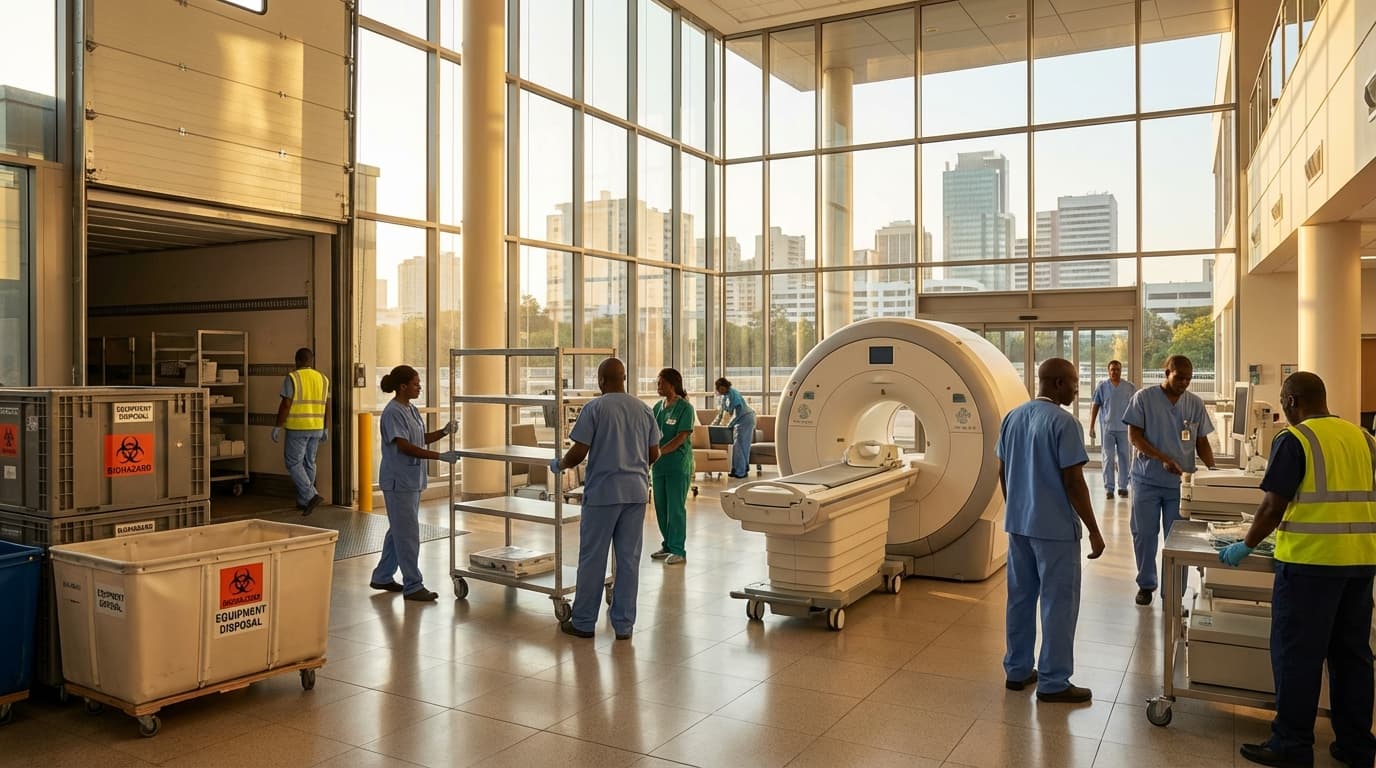
Heavy Medical Equipment De-Installation Service (MRI/CT/Cath Lab) in Tunisia
Engineering Excellence & Technical Support
Heavy Medical Equipment De-Installation Service (MRI/CT/Cath Lab) High-standard technical execution following OEM protocols and local regulatory frameworks.
Specialized Rigging & Logistics Expertise
Our certified technicians possess extensive experience in safely maneuvering and transporting high-value, heavy medical imaging equipment (MRI, CT, Cath Labs) across Tunisia. We utilize custom rigging solutions and adhere to strict safety protocols for secure, damage-free de-installation and relocation.
Precision De-installation & System Preservation
We employ meticulous, manufacturer-approved procedures for the precise de-installation of complex medical systems. Our focus is on preserving the integrity of each component, ensuring minimal downtime and readiness for re-installation or shipment.
Expedited & Compliant Project Management
Our Tunisian-based team offers rapid response and efficient project management, streamlining the de-installation process to meet critical timelines. We ensure full compliance with local regulations and environmental standards for a seamless and responsible service.
What Is Heavy Medical Equipment De-installation Service (Mri/ct/cath Lab) In Tunisia?
Heavy Medical Equipment De-Installation Service (MRI/CT/Cath Lab) in Tunisia refers to the specialized process of safely and systematically dismantling, packaging, and preparing large-scale, high-value medical imaging and interventional systems for relocation, disposal, or storage. These systems, including Magnetic Resonance Imaging (MRI) scanners, Computed Tomography (CT) scanners, and Cardiac Catheterization (Cath Lab) units, are complex and require meticulous attention to detail due to their sensitive components, significant weight, and critical infrastructure dependencies (e.g., power, cooling, shielding). The service encompasses the entire de-installation lifecycle, from initial site assessment and planning to final handover of components, ensuring compliance with all relevant safety, environmental, and regulatory standards applicable in Tunisia.
| Stakeholder/Entity | Reason for Requiring De-Installation Service | Typical Use Cases |
|---|---|---|
| Hospitals and Clinics | Equipment upgrades, replacement, relocation within a facility, or closure of departments/facilities. | Replacing an aging MRI with a newer model; relocating a CT scanner to a new wing; decommissioning a Cath Lab before a facility renovation. |
| Medical Equipment Manufacturers/Vendors | End-of-life equipment removal, refurbishment, or redeployment of demo/loaner units. | Collecting an MRI from a customer after its lease expires; retrieving a Cath Lab for a planned service upgrade; decommissioning a CT scanner for recycling. |
| Third-Party Service Providers/Asset Managers | Managing medical asset lifecycles, facilitating equipment remarketing, or coordinating decommissioning for multiple sites. | Overseeing the de-installation of several CT scanners across a hospital network for resale; managing the decommissioning of a clinic's entire imaging suite. |
| Research Institutions/Universities | Discontinuation of research projects, relocation of specialized equipment for new studies, or facility restructuring. | De-installing an MRI used for neuroimaging research before the lab is repurposed; moving a specialized Cath Lab to a different research center. |
| Government/Public Health Organizations | Consolidation of healthcare services, modernization of public healthcare infrastructure, or response to public health emergencies requiring asset reallocation. | Decommissioning imaging equipment from a closed public hospital; reallocating Cath Lab units to areas with higher demand. |
Key Components of Heavy Medical Equipment De-Installation Service:
- Site Assessment and Planning: Detailed evaluation of the existing installation, including access routes, structural integrity, power requirements, and environmental controls. Development of a comprehensive de-installation strategy and timeline.
- System Shutdown and De-energization: Safe and controlled powering down of all system components, adhering to manufacturer protocols and electrical safety standards.
- Disassembly and Component Separation: Expert dismantling of the equipment into manageable modules or components, utilizing specialized tools and techniques to prevent damage.
- Shielding Removal (if applicable): Safe removal and handling of radiation shielding (e.g., lead lining) for CT and Cath Lab systems.
- Cooling System Management: Proper draining, flushing, and disconnection of sophisticated cooling systems, particularly for MRI and high-power CT scanners.
- Packaging and Protection: Secure packaging of individual components using appropriate materials (e.g., custom crates, anti-static wrap, vibration dampening) to withstand transit.
- Logistics Coordination: Planning and execution of transportation, including coordination with specialized heavy haulage providers.
- Documentation: Comprehensive record-keeping throughout the process, including pre-de-installation surveys, de-installation steps, and component inventories.
- Compliance and Certification: Ensuring all procedures meet Tunisian health, safety, and environmental regulations, and obtaining necessary certifications.
Who Needs Heavy Medical Equipment De-installation Service (Mri/ct/cath Lab) In Tunisia?
The specialized de-installation of heavy medical equipment like MRI, CT scanners, and Cath Labs in Tunisia is a critical service for various healthcare facilities and related entities. This process requires precision, expertise, and adherence to strict safety and regulatory standards. The demand for such services arises when these complex machines reach the end of their operational life, require relocation, or are being replaced with newer models. Ensuring a safe and efficient de-installation prevents damage to the equipment, minimizes downtime for the facility, and complies with environmental and disposal regulations. This specialized service is not a DIY undertaking and necessitates a trained team with the right tools and knowledge to handle the intricate components, shielding, and potential hazardous materials associated with these high-tech medical devices.
| Customer Type | Departments Involved | Reasons for De-Installation |
|---|---|---|
| Hospitals (Public and Private) | Radiology Department (MRI, CT), Cardiology Department (Cath Lab), Biomedical Engineering Department, Facilities Management | Equipment upgrade/replacement, Relocation within facility, End-of-life decommissioning, Renovation projects |
| Specialized Medical Centers | Imaging Department, Cardiology Department, Biomedical Engineering | Facility closure, Expansion requiring different equipment, Sale of the facility |
| University Hospitals and Medical Schools | Radiology, Cardiology, Biomedical Engineering, Research Departments | Research upgrades, Curriculum changes, Relocation for new research initiatives |
| Government Healthcare Agencies | Procurement, Facilities Management, Public Health Departments | Consolidation of services, Budgetary reallocations, Standardization of equipment |
| Medical Equipment Manufacturers and Service Providers | Technical Service Department, Sales and Relocation Teams | Equipment refurbishment and resale, Trade-in programs, Relocation for international sales |
| Third-Party Service Companies | Project Management, Technical De-installation Teams | Contracts with healthcare facilities for equipment lifecycle management, Support for clients undergoing facility changes |
| Decommissioning and Renovation Companies | Project Managers, Demolition and Renovation Teams | Ensuring safe removal of large medical assets before structural changes or demolition |
Target Customers for Heavy Medical Equipment De-Installation Service in Tunisia
- Hospitals (Public and Private)
- Specialized Medical Centers (e.g., Cardiology Clinics, Imaging Centers)
- University Hospitals and Medical Schools
- Government Healthcare Agencies
- Medical Equipment Manufacturers and Service Providers
- Third-Party Service Companies specializing in medical equipment maintenance and relocation
- Decommissioning and Renovation Companies working on healthcare facilities
Heavy Medical Equipment De-installation Service (Mri/ct/cath Lab) Process In Tunisia
This document outlines the comprehensive workflow for heavy medical equipment de-installation services, specifically focusing on MRI, CT scanners, and Cath Labs, within Tunisia. Our process is designed for efficiency, safety, and minimal disruption, ensuring a smooth transition for our clients. From the initial inquiry to the final handover, each step is meticulously managed by our experienced team of engineers and logistics specialists.
| Phase | Description | Key Activities | Responsible Party | Tunisian Regulatory Considerations |
|---|---|---|---|---|
| Inquiry & Initial Assessment | Client contacts our company to request de-installation services for specific medical equipment. | Receive client request, gather preliminary information about the equipment (model, serial number, location, reason for de-installation), understand the urgency and desired timeline. | Client, Service Provider Sales/Inquiry Team | N/A (initial stage) |
| Quotation & Agreement | Based on the initial assessment, a detailed proposal and quotation are provided to the client. | Prepare a comprehensive quotation including scope of work, estimated timeline, costs, safety protocols, and terms & conditions. Upon agreement, finalize and sign the service contract. | Service Provider Sales/Engineering Team, Client | Ensure contract adheres to Tunisian contract law and relevant industry standards. |
| Site Survey & Planning | A thorough on-site assessment is conducted to meticulously plan the de-installation process. | Detailed inspection of the equipment's physical location, access routes, power requirements, necessary dismantling tools, and potential hazards. Develop a detailed de-installation plan, including risk assessment, resource allocation (personnel, equipment), and scheduling. Coordinate with hospital/clinic management for access and downtime. | Service Provider Engineering Team, Logistics Team, Client Facility Management | Comply with any site-specific safety regulations mandated by the healthcare facility or Tunisian authorities. Obtain necessary permits for specialized lifting or transport if required. |
| Equipment De-Installation | The physical dismantling of the heavy medical equipment is executed by trained professionals. | Safely disconnect power and ancillary systems. Systematic dismantling of components according to manufacturer specifications and the pre-approved plan. Careful handling and segregation of all parts and accessories. Ensure all safety procedures and PPE are strictly followed. | Service Provider Certified Engineers & Technicians | Adherence to international safety standards (e.g., ISO, IEC) and any specific Tunisian guidelines for handling medical equipment waste or hazardous materials if applicable. Potentially involve certified technicians for specific equipment types. |
| Logistics & Transportation | Secure and efficient transportation of the de-installed equipment to its destination. | Secure appropriate packaging and crating for sensitive components. Arrange specialized transport vehicles (e.g., air-ride trucks) for heavy and delicate machinery. Coordinate logistics for delivery to storage, a new site, or a designated disposal facility. Provide tracking and real-time updates. | Service Provider Logistics Team, Certified Movers | Comply with Tunisian customs regulations for international transport if applicable. Ensure transport vehicles meet safety and weight regulations within Tunisia. |
| De-Installation Documentation & Handover | Final documentation is provided, and the project is formally handed over to the client. | Prepare a comprehensive de-installation report detailing the process, including photographs, inventory of removed parts, and confirmation of safe removal. Provide waste disposal certificates if applicable. Formal handover of all documentation and confirmation of project completion. | Service Provider Project Manager, Client Representative | Ensure all documentation is compliant with Tunisian record-keeping requirements for medical equipment. If equipment is being moved to a new facility within Tunisia, ensure compliance with relevant health and safety regulations for installation at the new site. |
Heavy Medical Equipment De-Installation Service Workflow (Tunisia)
- Inquiry & Initial Assessment
- Quotation & Agreement
- Site Survey & Planning
- Equipment De-Installation
- Logistics & Transportation
- De-Installation Documentation & Handover
Heavy Medical Equipment De-installation Service (Mri/ct/cath Lab) Cost In Tunisia
De-installing heavy medical equipment like MRI, CT scanners, and Cath Labs in Tunisia involves specialized expertise, logistical challenges, and safety protocols. The cost is influenced by several factors, making a precise, universal quote difficult without detailed project specifics. This service is typically provided by experienced medical equipment technicians and specialized moving companies.
Key Pricing Factors:
- Type and Size of Equipment: Larger and more complex machines (e.g., high-field MRI) will naturally incur higher costs than smaller CT scanners. The number of components and their weight are critical.
- Accessibility and Location: The ease of access to the equipment's current location (e.g., within a hospital floor, basement, or specific room) and the destination for de-installation significantly impact labor and time. Difficult access, narrow corridors, or multiple flights of stairs will increase costs.
- Dismantling Complexity: The degree of disassembly required varies. Some equipment might require extensive breakdown into smaller modules, while others may need minimal disassembly. This directly affects the skilled labor hours needed.
- Technical Expertise Required: MRI, CT, and Cath Lab equipment often require certified technicians with specific knowledge of the manufacturer and model to ensure safe and proper disconnection of power, cooling, and sensitive components. This specialized labor is more expensive.
- Site Preparation and Make-Good: Depending on the lease agreement or hospital policy, there might be requirements to restore the room to its original condition after the equipment is removed (e.g., patching walls, removing specialized flooring or shielding). This adds to the overall cost.
- Logistics and Transportation: While de-installation is the focus, the proximity to transportation routes, the need for specialized lifting equipment (cranes, gantries), and the distance to the next site (if applicable) can influence the service provider's pricing structure.
- Downtime and Scheduling: Hospitals often have strict operational schedules. De-installation might need to be performed during off-peak hours or weekends, potentially incurring overtime charges.
- Insurance and Risk Mitigation: Providers will factor in the cost of insurance to cover potential damage to the equipment or the facility during the de-installation process.
- Permits and Approvals: In some cases, local permits might be required, especially for significant structural modifications or moving large items. The service provider may include this in their quote or it might be the client's responsibility.
- Urgency of Service: Rush jobs often come with a premium.
| Service Component | Estimated Cost Range (TND - Tunisian Dinar) |
|---|---|
| De-installation Labor (Certified Technicians) | 5,000 - 25,000+ |
| Specialized Rigging & Lifting Equipment Rental | 2,000 - 10,000+ |
| Logistical Planning & Coordination | 1,000 - 5,000 |
| Site Assessment & Preparation | 500 - 3,000 |
| Basic Make-Good (Minor repairs) | 500 - 2,000 |
| Extended Make-Good (Structural, flooring) | 2,000 - 15,000+ |
| Consultation and Project Management | 1,000 - 7,000 |
Factors Influencing De-Installation Costs in Tunisia
- Equipment Type and Size
- Site Accessibility and Location
- Dismantling Complexity
- Required Technical Expertise
- Site Preparation and Restoration
- Logistics and Transportation Needs
- Scheduling and Downtime Considerations
- Insurance and Risk Management
- Permits and Regulatory Requirements
- Service Urgency
Affordable Heavy Medical Equipment De-installation Service (Mri/ct/cath Lab) Options
When it comes to de-installing large and complex medical equipment like MRI, CT scanners, and Cath Labs, cost is a significant factor for healthcare facilities. Fortunately, there are affordable service options available that prioritize both efficiency and budget. This guide explores value bundles and cost-saving strategies for heavy medical equipment de-installation.
| Cost-Saving Strategy | Description | Potential Savings Impact |
|---|---|---|
| Bundle Multiple De-installations | If multiple pieces of equipment need de-installation in close proximity or timeframe, consolidating them into a single service agreement can unlock volume discounts. | Significant savings through bulk pricing and reduced mobilization costs. |
| Off-Peak Scheduling | Scheduling de-installation during less busy periods (weekends, holidays, or off-season) can sometimes result in lower rates from specialized service providers. | Moderate savings by leveraging provider availability. |
| In-House Support & Preparation | Performing some pre-de-installation tasks internally, such as initial disconnection of non-critical systems or clearing access routes, can reduce the time the specialized team needs on-site. | Moderate savings by reducing billable hours for the vendor. |
| Negotiate Long-Term Contracts | For facilities with ongoing equipment turnover or expansion plans, negotiating a long-term contract for de-installation services can secure preferential rates and dedicated support. | Substantial long-term savings and guaranteed service availability. |
| Compare Multiple Quotes | Always obtain detailed quotes from at least three reputable de-installation service providers. Compare not only price but also the scope of services included and the provider's experience with your specific equipment types. | Crucial for identifying the most competitive pricing and best value. |
| Utilize Refurbishment/Resale Programs | Some de-installation services partner with equipment refurbishers or resellers. Negotiate to have these services integrated, potentially recouping some of the de-installation costs. | Potential to offset de-installation costs, leading to net savings. |
| Clear Scope of Work Definition | A precisely defined Statement of Work (SOW) prevents scope creep and unexpected charges. Ensure all responsibilities and deliverables are clearly articulated in the contract. | Prevents cost overruns due to misunderstandings or added work. |
Understanding Value Bundles
- {"title":"What are Value Bundles?","description":"Value bundles are service packages that combine multiple de-installation services or related offerings at a discounted price. They are designed to provide comprehensive solutions and eliminate the need for separate vendor negotiations for each component."}
- {"title":"Common Components in De-installation Value Bundles","description":"These bundles often include: preliminary site assessment, specialized rigging and craning, expert dismantling, packaging and crating, transportation coordination, site restoration (patching walls, flooring), and disposal/recycling of non-essential components."}
- {"title":"Benefits of Value Bundles","description":"Key advantages include streamlined project management, predictable costs, reduced administrative overhead, and often a higher level of service integration and accountability from a single provider."}
Verified Providers In Tunisia
In the realm of healthcare tourism and international medical services, establishing trust and credibility is paramount. For individuals seeking medical treatments in Tunisia, understanding which providers are 'verified' and what makes them stand out is crucial. Franance Health has emerged as a leading entity in facilitating access to high-quality medical care, and their rigorous credentialing process for Tunisian providers ensures that patients receive exceptional service, safety, and outcomes. This document outlines why these verified providers, particularly those accredited by Franance Health, represent the best choice for your medical needs in Tunisia.
| Franance Health Credentials | What it Signifies | Benefits for Patients |
|---|---|---|
| Accreditation by Recognized International Bodies (e.g., JCI, ISO) | Demonstrates adherence to globally recognized standards in healthcare quality, patient safety, and infection control. | Ensures a high level of medical care, reduces the risk of complications, and provides peace of mind regarding the quality of treatment. |
| Rigorous Vetting of Medical Professionals (Qualifications & Experience) | Confirms that doctors and surgeons have the necessary educational background, certifications, and extensive practical experience in their respective fields. | Patients are treated by highly skilled and experienced specialists, leading to better diagnostic accuracy and more effective treatment plans. |
| Advanced Technology and State-of-the-Art Facilities | Indicates that the healthcare facilities are equipped with modern medical equipment and technologies necessary for cutting-edge procedures. | Access to the latest diagnostic tools and treatment methods can lead to less invasive procedures, faster recovery times, and improved clinical outcomes. |
| Commitment to Patient Comfort and Post-Operative Care | Highlights a focus on the patient's overall experience, including comfortable accommodation, attentive nursing staff, and comprehensive follow-up care. | Ensures a positive and supportive healing environment, minimizing stress and promoting a smooth recovery process. |
| Transparent Pricing and Clear Communication | Verified providers offer clear and detailed information about treatment costs, procedures, and potential risks, with effective communication channels. | Eliminates hidden fees, empowers patients with knowledge to make informed decisions, and builds a strong patient-provider relationship. |
| Franance Health's Partnership and Quality Control | Franance Health actively monitors and vets its partner facilities and medical professionals to maintain high standards and address any patient concerns. | Provides an extra layer of assurance and a dedicated support system for patients throughout their medical journey in Tunisia. |
Why Verified Providers are Essential
- {"title":"Patient Safety and Quality Assurance","description":"Verification signifies that a healthcare provider has met stringent standards for patient care, facility safety, and medical expertise. This reduces risks and ensures a higher likelihood of successful treatment outcomes."}
- {"title":"Trust and Transparency","description":"Verified providers operate with a higher degree of transparency regarding their qualifications, facilities, and treatment protocols. This builds trust between the patient and the medical institution."}
- {"title":"Access to Specialized Care","description":"Verification processes often identify providers who possess advanced technology, specialized skills, and a track record of success in specific medical fields."}
- {"title":"Ethical Practices and Patient Rights","description":"Credible verification bodies ensure that providers adhere to ethical medical practices and respect patient rights throughout their healthcare journey."}
Scope Of Work For Heavy Medical Equipment De-installation Service (Mri/ct/cath Lab)
This Scope of Work (SOW) outlines the requirements for the de-installation of heavy medical equipment, specifically Magnetic Resonance Imaging (MRI), Computed Tomography (CT), and Cardiac Catheterization (Cath Lab) systems. The service provider will be responsible for safely and efficiently dismantling, preparing for transport, and securing the equipment according to manufacturer specifications and industry best practices. This SOW also details the technical deliverables and standard specifications expected from the service provider.
| Technical Deliverable | Description | Standard Specification / Requirement | Verification Method |
|---|---|---|---|
| De-Installation Plan | A detailed plan outlining the sequence of operations, safety protocols, required tools, and personnel for each equipment type. | Must be submitted to the client at least 10 business days prior to commencement. Must include manufacturer guidelines review and risk assessment. | Client review and approval. |
| Equipment Shutdown & Isolation Log | A log documenting the complete power-down and isolation procedures for each system, including confirmation of safety interlocks. | Must detail the date, time, responsible technician, and confirmation of power isolation. Signed by the lead technician. | On-site verification by client representative. |
| Disconnection Records | Documentation of all connections successfully disconnected, including electrical, data, cooling, and pneumatic lines. | Photographic evidence of disconnection points and detailed notes. Each disconnection point must be clearly identified and documented. | On-site verification and review of photographic evidence. |
| Component Dismantling Report | A report detailing the process of dismantling each major component, including any challenges encountered and solutions implemented. | Must adhere strictly to manufacturer's de-installation manuals. All components to be handled with extreme care to prevent damage. | On-site observation and review of component integrity. |
| Packaging and Crating Specification Compliance | Confirmation that all equipment components are packaged and crated according to manufacturer or approved transport specifications. | Materials used (e.g., anti-static wrap, foam padding, custom crates) must meet industry standards for heavy medical equipment. All crates to be clearly labeled with equipment ID, component name, and handling instructions. | Visual inspection of packaging and labeling by client representative. Shipping manifest verification. |
| Inventory and Labeling | A comprehensive inventory list of all de-installed components, with clear and durable labeling on each packaged item. | Each label must include: serial number, component name, equipment type, and project reference number. Inventory list must match physical items. | On-site inventory reconciliation with the provided list. Verification of label clarity and durability. |
| Site Restoration Plan (if applicable) | A plan for returning the de-installation area to its pre-de-installation state, including removal of debris and minor repairs. | To be agreed upon in advance. Focus on safe and clean removal of all de-installation related materials. | On-site inspection and client acceptance. |
| Final De-Installation Report | A comprehensive report summarizing the entire de-installation process, including any deviations from the plan, issues encountered, and resolutions. | Must include all supporting documentation (logs, photos, inventory lists). Confirmation of successful de-installation and preparation for transport. | Client review and acceptance. |
Key De-Installation Activities
- Site assessment and planning
- Equipment shutdown and power disconnection
- Disconnection of all ancillary systems (e.g., cooling, networking, plumbing)
- Controlled dismantling of components
- Secure packaging and crating of all parts
- Labeling and inventory management
- Removal of specialized cabling and conduits
- Site cleanup and restoration (as per agreement)
- Documentation of de-installation process
Service Level Agreement For Heavy Medical Equipment De-installation Service (Mri/ct/cath Lab)
This Service Level Agreement (SLA) outlines the response times and uptime guarantees for the de-installation of heavy medical equipment, specifically MRI, CT, and Cath Lab systems. This SLA aims to ensure minimal disruption and efficient execution of de-installation services.
| Service Component | Response Time (Notification to Commencement of Work) | Uptime Guarantee (During De-installation Window) | Notes |
|---|---|---|---|
| MRI De-installation | 4 business hours | N/A (De-installation is a single event, uptime is not applicable) | Commencement of work defined as the arrival of the certified de-installation team on-site. |
| CT De-installation | 4 business hours | N/A (De-installation is a single event, uptime is not applicable) | Commencement of work defined as the arrival of the certified de-installation team on-site. |
| Cath Lab De-installation | 4 business hours | N/A (De-installation is a single event, uptime is not applicable) | Commencement of work defined as the arrival of the certified de-installation team on-site. |
| Emergency De-installation (e.g., site remediation, immediate relocation) | 2 business hours | N/A (De-installation is a single event, uptime is not applicable) | Requires explicit 'Emergency' designation by the client at the time of service request. Additional charges may apply. |
| Contingency/Delay Resolution | 2 business hours | N/A | Applies to delays caused by the service provider. Resolution time for client-caused delays will be agreed upon on a case-by-case basis. |
Scope of Service
- De-installation of MRI (Magnetic Resonance Imaging) systems, including magnets, gradient coils, RF coils, and associated components.
- De-installation of CT (Computed Tomography) systems, including gantry, X-ray tube, detector arrays, and control consoles.
- De-installation of Cath Lab (Catheterization Laboratory) systems, including angiography imaging systems (e.g., C-arm), tables, consoles, and associated detectors.
- Safe disconnection and removal of all power, data, and cooling connections.
- Dismantling of equipment into manageable sections for transportation (as per agreed-upon procedure).
- Documentation of the de-installation process.
Frequently Asked Questions

Ready when you are
Let's scope your Heavy Medical Equipment De-Installation Service (MRI/CT/Cath Lab) in Tunisia project in Tunisia.

Scaling healthcare logistics and technical systems across the entire continent.