
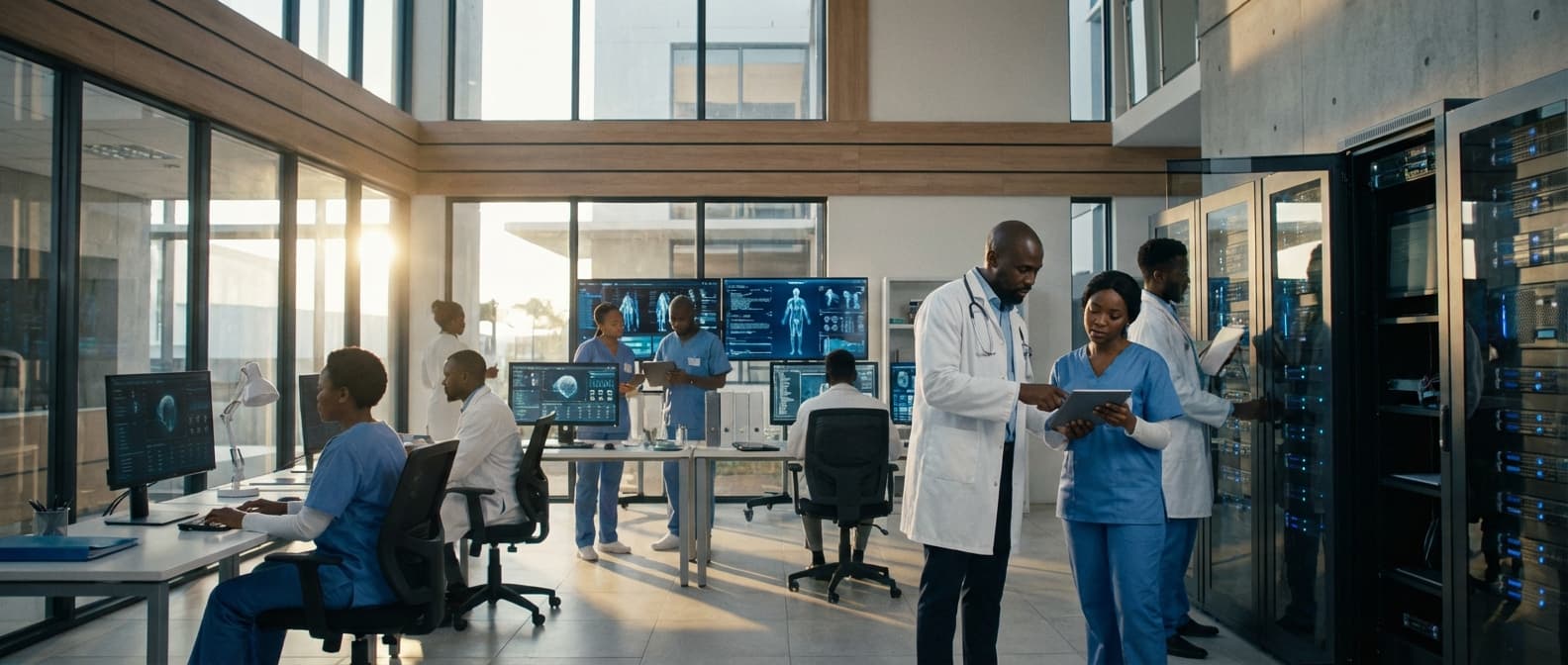
Medical IT Consultation in Tunisia
Engineering Excellence & Technical Support
Strategic technology consulting to optimize healthcare operations, streamline workflows, and integrate cutting-edge medical information systems. High-standard technical execution following OEM protocols and local regulatory frameworks.
Cloud-Native Healthcare Solutions
Leveraging secure and scalable cloud platforms (AWS, Azure, Google Cloud) to modernize EHR/EMR systems, facilitate data interoperability, and enable remote patient monitoring for Tunisian healthcare providers. We ensure compliance with local data privacy regulations.
Robust Cybersecurity for Patient Data
Implementing comprehensive cybersecurity strategies, including end-point protection, network segmentation, vulnerability assessments, and HIPAA-compliant data encryption, to safeguard sensitive patient information against evolving cyber threats in Tunisia's healthcare landscape.
AI-Powered Medical Analytics & Workflow Optimization
Integrating AI and Machine Learning to extract actionable insights from clinical data, improve diagnostic accuracy, streamline administrative workflows, and enhance operational efficiency for Tunisian hospitals and clinics, driving better patient outcomes.
What Is Medical It Consultation In Tunisia?
Medical IT Consultation in Tunisia refers to the provision of specialized information technology expertise and advisory services tailored to the unique needs of healthcare organizations within the Tunisian context. This encompasses strategic planning, system selection and implementation, workflow optimization, data management, security assurance, and regulatory compliance specific to the Tunisian healthcare landscape. The objective is to leverage technology to enhance patient care, improve operational efficiency, reduce costs, and ensure adherence to local health data privacy and security mandates.
| Who Needs Medical IT Consultation? | Typical Use Cases |
|---|---|
| Hospitals (Public & Private): Seeking to modernize their IT infrastructure, implement EHRs, improve patient management, and ensure data security. | Implementing a new hospital information system (HIS), migrating to cloud-based solutions, enhancing cybersecurity posture, integrating telemedicine services. |
| Clinics & Medical Practices: Aiming to digitize patient records, improve appointment scheduling, and enhance communication within the practice. | Adopting an EMR system, setting up secure patient portals, implementing practice management software. |
| Diagnostic Laboratories: Requiring LIS implementation, data standardization, and secure data sharing capabilities. | Deploying a new LIS, integrating with hospital EHRs, ensuring compliance with laboratory accreditation standards. |
| Radiology Centers: Needing PACS/RIS integration, efficient image archiving, and remote access solutions. | Upgrading PACS/RIS, implementing vendor-neutral archives, enabling secure remote image viewing for referring physicians. |
| Pharmaceutical Companies & Medical Device Manufacturers: Requiring IT support for clinical trials, data management, and regulatory compliance. | Developing secure platforms for clinical trial data collection, ensuring IT infrastructure meets Good Clinical Practice (GCP) guidelines. |
| Government Health Agencies & Ministries: Seeking to develop national health information strategies, standardize data, and improve public health surveillance. | Designing national e-health strategies, implementing public health data repositories, facilitating interoperability between regional health centers. |
| Healthcare Startups: Needing to establish robust and scalable IT foundations for innovative healthcare solutions. | Building MVP for a health tech solution, establishing secure data handling protocols, ensuring compliance from inception. |
Key Components of Medical IT Consultation:
- Strategic IT Planning & Roadmapping: Developing long-term technology strategies aligned with organizational goals, including digital transformation initiatives.
- Electronic Health Record (EHR) & Electronic Medical Record (EMR) Systems: Assessment, selection, implementation, customization, and optimization of patient record management systems.
- Health Information Exchange (HIE) & Interoperability: Facilitating seamless data sharing between different healthcare providers, systems, and government health registries.
- Cybersecurity & Data Protection: Implementing robust security measures to safeguard sensitive patient data against breaches and ensuring compliance with Tunisian data protection laws (e.g., Law No. 63 of 2004 concerning Personal Data Protection and its subsequent amendments).
- Telemedicine & Remote Patient Monitoring Solutions: Designing and deploying platforms for remote consultations, diagnostics, and continuous patient monitoring.
- Picture Archiving and Communication Systems (PACS) & Radiology Information Systems (RIS): Integrating imaging data and workflows for efficient radiology departments.
- Laboratory Information Systems (LIS): Streamlining laboratory operations and data management.
- Healthcare Analytics & Business Intelligence: Implementing systems for data analysis to drive clinical decision-making and operational improvements.
- IT Infrastructure Assessment & Modernization: Evaluating existing IT infrastructure and recommending upgrades or replacements for enhanced performance and scalability.
- Compliance & Regulatory Advisory: Ensuring adherence to Tunisian Ministry of Health regulations, international healthcare IT standards (e.g., HL7, DICOM), and data privacy laws.
- Cloud Computing Solutions for Healthcare: Advising on secure and compliant cloud adoption strategies for healthcare data and applications.
- IT Support & Managed Services: Providing ongoing technical support and proactive management of healthcare IT systems.
Who Needs Medical It Consultation In Tunisia?
In Tunisia, the demand for specialized Medical IT consultation is growing across various healthcare sectors. As technology rapidly evolves and patient data security becomes paramount, healthcare providers are increasingly seeking expert guidance to optimize their IT infrastructure, implement new systems, and ensure compliance with national and international regulations. This consultation is crucial for enhancing operational efficiency, improving patient care, and maintaining a competitive edge.
| Customer Type | Key Departments Requiring IT Consultation | Primary Needs and Challenges |
|---|---|---|
| Hospitals (Public & Private) | IT Department, Administration, Clinical Departments (Radiology, Cardiology, Emergency), Pharmacy, Medical Records, Finance | EHR/EMR implementation & optimization, PACS integration, network security, data analytics, telehealth infrastructure, compliance (HIPAA/GDPR equivalents), legacy system migration, cybersecurity, disaster recovery. |
| Clinics & Medical Centers | Management, Front Desk, Doctors' Offices, Billing Department | Practice management software, patient scheduling systems, secure patient data storage, basic network setup, cloud solutions for accessibility, cost-effective IT solutions. |
| Diagnostic Laboratories | Laboratory Information System (LIS) management, IT Department, Quality Assurance | LIS implementation/upgrade, data integrity and accuracy, instrument integration, LIMS (Laboratory Information Management System) adoption, secure reporting, inter-lab connectivity. |
| Pharmaceutical Companies | IT Department, Research & Development (R&D), Clinical Trials Management, Regulatory Affairs | Secure data management for clinical trials, R&D data platforms, compliance with pharmaceutical regulations, data anonymization, secure data sharing, pharmacovigilance systems. |
| Government Health Agencies | IT Department, Public Health Services, Data Management Units | National health information exchange, data standardization, public health surveillance systems, secure data repositories, inter-agency data sharing, cybersecurity for critical infrastructure. |
| Telemedicine Providers | IT Department, Operations, Technical Support | Secure video conferencing platforms, patient portal development, EHR integration for remote access, data privacy, scalable infrastructure, user experience optimization. |
Target Customers and Departments for Medical IT Consultation in Tunisia:
- Hospitals (Public and Private)
- Clinics and Medical Centers
- Diagnostic Laboratories
- Pharmaceutical Companies (for R&D and data management)
- Medical Device Manufacturers (for integration and data handling)
- Government Health Agencies
- Insurance Companies (for claims processing and data integration)
- Telemedicine Providers
- Medical Training and Educational Institutions
Medical It Consultation Process In Tunisia
The Medical IT Consultation Process in Tunisia outlines a structured approach to addressing the information technology needs of healthcare providers. This process typically begins with an initial inquiry from a healthcare institution or individual practitioner seeking IT expertise. Following this, a detailed needs assessment is conducted to understand specific challenges, objectives, and existing infrastructure. Based on this assessment, a tailored consultation proposal is developed, outlining the scope of work, methodologies, deliverables, and associated costs. Upon agreement, the consultation phase commences, involving in-depth analysis, strategy development, and recommendation formulation. The execution phase then translates these recommendations into tangible IT solutions, including implementation, integration, and training. Throughout the entire process, clear communication and stakeholder involvement are paramount to ensure successful project outcomes and seamless adoption of new technologies within the Tunisian healthcare sector.
| Stage | Description | Key Activities | Tunisian Context Considerations |
|---|---|---|---|
| Inquiry and Initial Contact | The client (healthcare facility, clinic, individual) expresses interest in IT consultation services. | Receiving inquiries via phone, email, or website. Scheduling an initial discussion. | Awareness of specific Tunisian healthcare regulations (e.g., regarding patient data privacy) and existing IT landscape in Tunisian hospitals. |
| Needs Assessment and Discovery | Understanding the client's current IT infrastructure, pain points, and future goals. | Interviews with stakeholders, site visits, documentation review, gap analysis. | Identifying common challenges in Tunisian healthcare IT, such as legacy systems, budget constraints, or a need for digital transformation. |
| Proposal Development and Agreement | Presenting a comprehensive plan for the consultation services. | Defining scope, objectives, methodology, deliverables, timeline, and cost. Contract negotiation. | Ensuring proposals are transparent and competitive, reflecting local market pricing and service expectations. |
| Consultation and Strategy Formulation | Developing strategic IT recommendations tailored to the client's needs. | Analyzing data, brainstorming solutions, risk assessment, developing an IT roadmap. | Focusing on solutions that are sustainable and adaptable to the Tunisian healthcare environment, potentially leveraging open-source technologies or cost-effective cloud solutions. |
| Solution Design and Planning | Detailing the technical specifications and implementation plan for chosen IT solutions. | System architecture design, software selection, hardware procurement planning, integration strategies. | Considering local vendor availability for hardware and software, and the feasibility of integration with existing Tunisian health information systems. |
| Implementation and Deployment | Putting the IT solutions into practice. | System installation, configuration, data migration, testing, and go-live. | Phased rollouts might be preferred for larger institutions. Need for on-site support from local IT professionals. |
| Training and Knowledge Transfer | Ensuring the client's staff can effectively use and manage the new IT systems. | Developing training materials, conducting user training sessions, providing documentation. | Training tailored to different user groups (doctors, nurses, administrators) and potentially delivered in Arabic or French, considering the linguistic diversity. |
| Post-Implementation Support and Evaluation | Providing ongoing assistance and assessing the effectiveness of the implemented solutions. | Troubleshooting, system monitoring, performance tuning, user feedback collection, ROI analysis. | Establishing clear service level agreements (SLAs) for support, with consideration for accessibility of support channels within Tunisia. |
Key Stages of the Medical IT Consultation Process in Tunisia
- Inquiry and Initial Contact
- Needs Assessment and Discovery
- Proposal Development and Agreement
- Consultation and Strategy Formulation
- Solution Design and Planning
- Implementation and Deployment
- Training and Knowledge Transfer
- Post-Implementation Support and Evaluation
Medical It Consultation Cost In Tunisia
The cost of medical IT consultation in Tunisia can vary significantly based on several factors. These include the complexity of the project, the experience and specialization of the consultant, the duration of the consultation, and the specific IT services required. Tunisian IT consulting firms often offer a range of services, from initial needs assessment and strategic planning to implementation support, cybersecurity assessments, and cloud migration for healthcare institutions. Pricing is typically provided in Tunisian Dinars (TND).
| Service Type / Consultation Level | Estimated Price Range (TND) |
|---|---|
| Initial Needs Assessment & Basic Consultation (Hourly) | 100 - 250 TND |
| IT Strategy & Planning (Daily Rate) | 500 - 1200 TND |
| EHR/EMR Implementation Consultation (Project-based, varies widely) | 5,000 - 50,000+ TND |
| Cybersecurity Assessment & Compliance (Project-based) | 2,000 - 15,000+ TND |
| Telemedicine Platform Integration (Project-based) | 3,000 - 25,000+ TND |
| Cloud Migration for Healthcare Data (Project-based) | 4,000 - 30,000+ TND |
| Custom Medical Software Development Consultation (Hourly/Project) | 120 - 300 TND (Hourly) |
Key Pricing Factors for Medical IT Consultation in Tunisia:
- Project Scope and Complexity: Larger and more intricate projects requiring extensive planning, development, or integration will naturally incur higher costs.
- Consultant Expertise and Specialization: Highly experienced consultants or those with specialized knowledge in niche areas of medical IT (e.g., EHR implementation, PACS integration, telemedicine platforms) command higher rates.
- Duration of Engagement: The length of time the consultant is engaged directly impacts the overall cost. This can be hourly, daily, or project-based.
- Type of Services Required: Specific services like cybersecurity audits, data privacy compliance (e.g., GDPR for international clients), custom software development, or network infrastructure upgrades will have different pricing structures.
- Technology Stack Involved: The complexity and cost of the technologies to be implemented or integrated can influence the overall consultation fee.
- Client's Size and Budget: Larger healthcare organizations might have different budget allocations and expectations compared to smaller clinics.
- Location and Overhead: While the primary market is Tunisia, some consultations might involve remote work or travel, which could affect costs.
Affordable Medical It Consultation Options
Navigating the complexities of medical IT can be daunting, especially for smaller practices or those with budget constraints. Fortunately, there are affordable consultation options available. Understanding value bundles and implementing cost-saving strategies can make professional IT guidance accessible and beneficial for your healthcare organization. This guide explores these options, helping you make informed decisions to optimize your IT infrastructure while managing costs effectively.
| Cost-Saving Strategy | Description | Benefit for Medical Practices |
|---|---|---|
| Define Clear Project Scope: | Precisely outline the objectives, deliverables, and timeline for any IT project. Avoid scope creep. | Prevents unnecessary expenses and ensures you're only paying for what you truly need. |
| Leverage Existing Technology: | Before investing in new solutions, explore if your current systems can be optimized or reconfigured. | Reduces capital expenditure and the cost of training and integration for new software/hardware. |
| Prioritize Critical Needs: | Focus on IT solutions that address the most pressing challenges (e.g., patient data security, regulatory compliance). | Maximizes ROI by addressing high-impact areas first, preventing costly penalties or breaches. |
| Negotiate Service Level Agreements (SLAs): | Clearly define response times, uptime guarantees, and support levels in your contracts. | Ensures you receive the agreed-upon service, preventing costly downtime or inadequate support. |
| Consider Open-Source or Cloud-Based Solutions: | Explore cost-effective software alternatives that are often free or have lower subscription fees. | Reduces licensing costs and ongoing software maintenance expenses. |
| Bundle Services: | Look for consultants or MSPs that offer packages combining multiple IT services (e.g., cybersecurity, network management, helpdesk). | Often provides a discounted rate compared to purchasing individual services separately. |
| Invest in Internal Training: | Empower your staff with basic IT troubleshooting skills to handle minor issues, reducing the need for external support. | Lowers reliance on external consultants for routine problems, saving on hourly fees. |
Types of Affordable Medical IT Consultation
- Project-Based Consulting: Focuses on specific, well-defined projects like EHR implementation, cybersecurity assessment, or cloud migration. This allows for controlled costs as you pay for the expertise needed for a particular outcome.
- Retainer-Based Consulting: A recurring fee for ongoing access to IT expertise. This is ideal for practices needing consistent support for maintenance, troubleshooting, and strategic planning, often at a discounted hourly rate compared to ad-hoc services.
- Remote/Virtual Consulting: Leverages technology for consultations, reducing travel time and associated expenses. This is a highly cost-effective method for advice, strategy sessions, and troubleshooting.
- Specialized Niche Consultants: Instead of a large firm, consider consultants who specialize in a specific area (e.g., HIPAA compliance, medical billing software integration). Their focused expertise can be more efficient and cost-effective for targeted needs.
- Managed Service Providers (MSPs) with Consultation Services: Many MSPs offer IT consultation as part of their service packages. While you're paying for ongoing management, the strategic advice is often integrated and can represent good value.
Verified Providers In Tunisia
When seeking healthcare services in Tunisia, particularly those related to medical tourism and specialized treatments, identifying verified providers is paramount for ensuring quality, safety, and ethical practices. Franance Health stands out as a leading platform that rigorously vets and authenticates healthcare providers across Tunisia, offering patients unparalleled peace of mind. Their comprehensive credentialing process goes beyond simple registration, delving into the qualifications, experience, and operational standards of each institution and practitioner. This commitment to transparency and verification makes Franance Health a trusted gateway to the best healthcare experiences in Tunisia.
| Provider Type | Franance Health Verification Criteria | Benefits to Patients |
|---|---|---|
| Hospitals & Clinics | Accreditation status (e.g., ISO, JCI if applicable), Quality management systems, Staff qualifications, Patient feedback mechanisms, Infection control protocols | Access to advanced medical technology, experienced multidisciplinary teams, and high standards of patient care and safety. |
| Specialist Doctors | Medical license verification, Board certifications, Years of practice, Surgical/procedural success rates, Continuous professional development records | Confidence in receiving treatment from highly qualified and experienced medical professionals with proven expertise. |
| Medical Tourism Agencies (Facilitators) | Legal registration and licensing, Ethical business practices, Patient testimonials, Partnership agreements with verified providers, Clear communication channels | Seamless coordination of travel, accommodation, and medical appointments, with a reliable partner ensuring a smooth and supportive patient experience. |
| Ancillary Services (e.g., Labs, Imaging) | Laboratory accreditation (e.g., CAP, ISO 15189), Equipment calibration and maintenance, Quality control procedures, Turnaround times for results | Accurate and reliable diagnostic results supporting effective treatment plans. |
Why Franance Health Credentials Matter
- Rigorous Vetting Process: Franance Health employs a multi-faceted approach to credentialing, examining educational backgrounds, professional licenses, accreditations, and peer reviews of all listed providers.
- Commitment to Patient Safety: By verifying protocols, hygiene standards, and adherence to international quality benchmarks, Franance Health prioritizes the well-being and safety of every patient.
- Ensured Expertise and Experience: Credentials verified by Franance Health guarantee that practitioners possess the necessary skills, specialization, and extensive experience in their respective fields.
- Transparency and Trust: The verified status provides a transparent and trustworthy foundation for patients to make informed decisions about their healthcare journey in Tunisia.
- Access to Top-Tier Facilities: Franance Health identifies and showcases healthcare facilities that meet stringent operational and technological requirements, ensuring access to state-of-the-art medical infrastructure.
Scope Of Work For Medical It Consultation
This Scope of Work (SOW) outlines the services to be provided by [Consultant Name/Company] to [Client Name/Organization] for Medical IT Consultation. The objective is to assess, recommend, and assist in the implementation of robust and secure IT infrastructure and solutions tailored to the unique needs of a healthcare environment. This includes ensuring compliance with relevant regulations such as HIPAA and HITECH, optimizing clinical workflows, and enhancing patient data security and accessibility.
| Technical Deliverable | Description | Standard Specifications/Key Considerations | Timeline (Indicative) |
|---|---|---|---|
| Current State IT Assessment Report | A comprehensive report detailing the existing IT infrastructure, hardware, software, network, security posture, and user capabilities. | Includes inventory of all IT assets, network topology diagrams, security vulnerability analysis, assessment of current EHR system performance, and identification of compliance gaps. Report should be actionable with prioritized recommendations. | Weeks 1-2 |
| IT Infrastructure Roadmap | A strategic plan outlining recommended upgrades, replacements, and new technology implementations to meet future organizational goals and regulatory requirements. | Includes phased implementation plan, budget estimates, technology selection criteria, and potential ROI. Must align with clinical objectives and patient care improvements. | Weeks 3-4 |
| Security and Compliance Audit Report | Detailed findings of a security and HIPAA/HITECH compliance audit, including identified risks and remediation strategies. | Covers access controls, data encryption, audit trails, physical security, business associate agreements (BAAs), risk assessments, and breach notification procedures. Recommendations must be practical and cost-effective. | Weeks 5-6 |
| EHR Optimization Plan | Recommendations for optimizing the existing EHR system or guidance on selecting a new EHR solution, focusing on workflow integration and user adoption. | Includes analysis of current EHR utilization, identification of bottlenecks, proposed workflow redesign, training needs assessment, and vendor evaluation criteria. Must support interoperability standards (e.g., HL7, FHIR). | Weeks 7-8 |
| Network Design and Security Recommendations | A proposed network architecture and security protocols to ensure reliable, high-speed, and secure data transmission within the medical facility. | Includes recommendations for wired and wireless network infrastructure, firewalls, intrusion detection/prevention systems, VPNs, and access point management. Must adhere to industry best practices for healthcare networks. | Weeks 9-10 |
| Disaster Recovery and Business Continuity Plan (DR/BCP) | A documented plan to ensure continued operation of critical IT systems and data availability in the event of disruptions. | Includes data backup and recovery procedures, off-site storage strategies, alternative site considerations, communication protocols during an outage, and regular testing schedules. Objectives include RPO (Recovery Point Objective) and RTO (Recovery Time Objective). | Weeks 11-12 |
| Final Consultation Report and Presentation | A comprehensive summary of all findings, recommendations, and implementation plans, presented to key stakeholders. | Includes executive summary, detailed technical recommendations, cost-benefit analysis, proposed timelines, and next steps. Presentation should be clear, concise, and tailored to the audience. | Week 13 |
Key Areas of Consultation
- Current IT Infrastructure Assessment
- Clinical Workflow Optimization
- Electronic Health Record (EHR) System Evaluation and Integration
- Data Security and Privacy Compliance (HIPAA/HITECH)
- Network Infrastructure Design and Security
- Telemedicine and Remote Patient Monitoring Solutions
- Disaster Recovery and Business Continuity Planning
- IT Staff Training and Development
- Vendor Selection and Management
- Cloud Migration Strategy (if applicable)
Service Level Agreement For Medical It Consultation
This Service Level Agreement (SLA) outlines the performance standards and responsibilities for medical IT consultation services provided by [Your Company Name] (hereinafter referred to as "Provider") to [Client Name] (hereinafter referred to as "Client"). This SLA focuses on critical response times for support requests and guarantees a specific level of system uptime for the IT infrastructure managed by the Provider on behalf of the Client.
| Severity Level | Description | Response Time Target | Resolution Time Target (Best Effort) | Uptime Guarantee |
|---|---|---|---|---|
| Critical (e.g., EHR system down, patient safety risk) | System-wide outage or issue directly impacting patient care and safety. | 15 minutes | 2 hours | 99.9% |
| High (e.g., core application partially unavailable, significant workflow disruption) | Major disruption to critical medical applications or workflows, but patient safety not immediately compromised. | 1 hour | 4 business hours | 99.5% |
| Medium (e.g., non-critical application issue, minor performance degradation) | Issue impacting a specific user or a non-critical application, causing minor inconvenience or workflow inefficiency. | 4 business hours | 1 business day | 99.0% |
| Low (e.g., general inquiry, feature request, minor configuration change) | Non-urgent request, question, or request for a minor change that does not affect system operation. | 1 business day | 2 business days | N/A (standard service) |
Key Service Level Objectives
- Response Time: The maximum time elapsed from the Client reporting an issue to the Provider acknowledging the issue and initiating troubleshooting.
- Resolution Time: The target time for resolving reported issues, categorized by severity.
- Uptime Guarantee: The minimum percentage of time the agreed-upon IT infrastructure will be available and operational.
Frequently Asked Questions

Ready when you are
Let's scope your Medical IT Consultation in Tunisia project in Tunisia.

Scaling healthcare logistics and technical systems across the entire continent.