
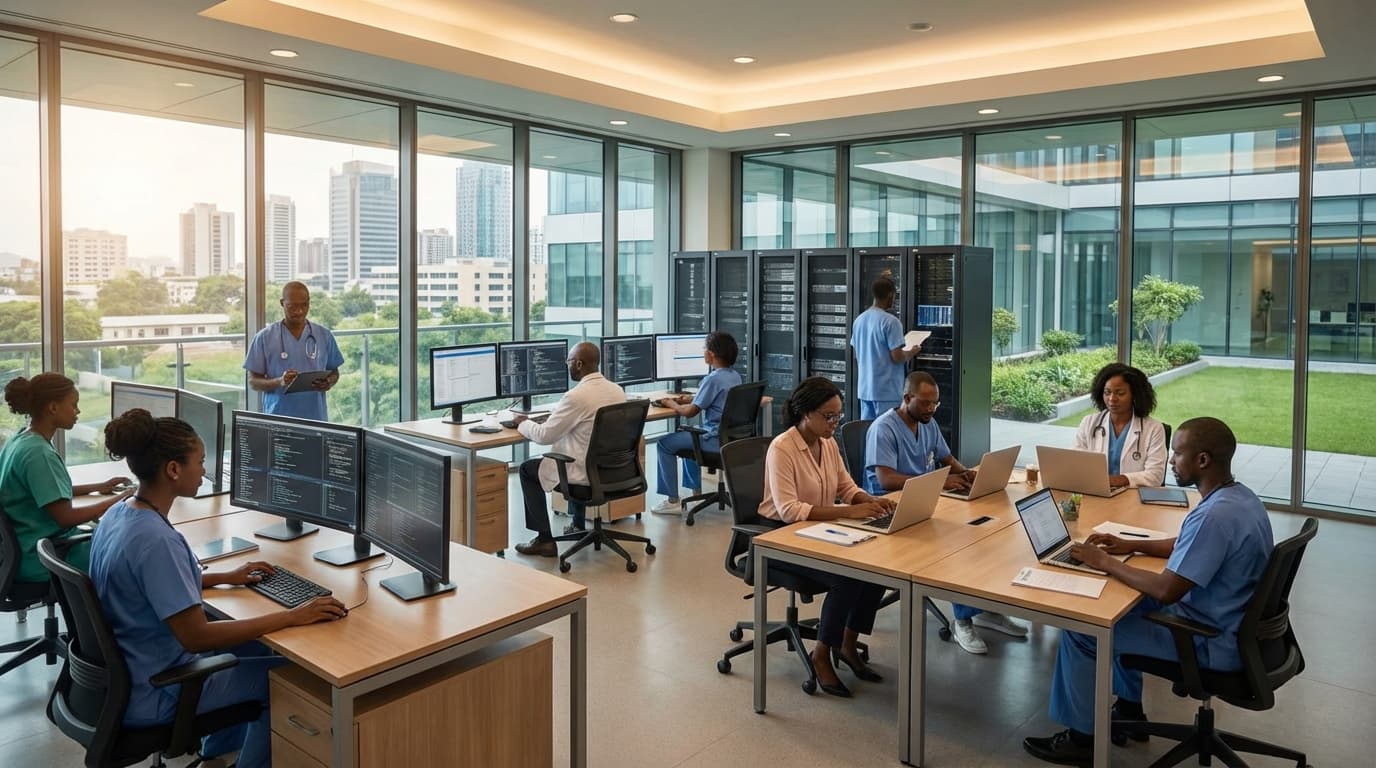
Radiology Reader & Reporting Support in Tunisia
Engineering Excellence & Technical Support
Remote radiology reading and reporting services High-standard technical execution following OEM protocols and local regulatory frameworks.
Enhanced Diagnostic Accuracy
Leveraging advanced AI algorithms, our Radiology Reader & Reporting Support system analyzes medical images with unparalleled precision, flagging subtle anomalies and reducing the likelihood of misdiagnosis. This empowers Tunisian radiologists with enhanced confidence and faster, more accurate diagnoses for patient care.
Streamlined Workflow Integration
Seamlessly integrating with existing PACS and RIS systems in Tunisian healthcare facilities, our solution automates repetitive tasks, standardizes reporting templates, and facilitates efficient collaboration. This dramatically reduces turnaround times and frees up valuable radiologist time for complex cases and patient consultation.
Centralized Knowledge Repository
Our platform acts as a dynamic, continuously learning knowledge base, offering access to a vast library of annotated cases, best practice guidelines, and expert consensus. This provides Tunisian radiologists with on-demand educational resources and support, fostering continuous professional development and adherence to global standards.
What Is Radiology Reader & Reporting Support In Tunisia?
Radiology Reader & Reporting Support in Tunisia refers to a specialized set of services designed to augment the capabilities of radiologists and healthcare institutions within the Tunisian context. This encompasses technologies and workflows that facilitate the efficient and accurate interpretation of medical imaging studies (e.g., X-ray, CT, MRI, Ultrasound) and the subsequent generation of comprehensive diagnostic reports. It addresses the need for enhanced diagnostic throughput, improved report quality, and potentially, access to subspecialty expertise in regions where it might be geographically constrained. These services are typically delivered through a combination of Picture Archiving and Communication Systems (PACS), Radiology Information Systems (RIS), Artificial Intelligence (AI)-powered diagnostic tools, and potentially remote reading or teleradiology platforms.
| Who Needs It | Typical Use Cases |
|---|---|
| Radiology Departments in Tunisian Hospitals (Public & Private) | Expediting interpretation of large imaging volumes, reducing turnaround times for critical diagnoses, supporting general radiologists with complex cases requiring subspecialty expertise, improving consistency and standardization of reports. |
| Independent Radiology Clinics | Enhancing diagnostic accuracy, leveraging advanced visualization techniques, outsourcing subspecialty interpretations when local expertise is unavailable, improving operational efficiency. |
| Medical Imaging Centers | Streamlining workflow, integrating AI for initial screening or specific task automation, facilitating collaborative reporting among multiple readers, managing increasing demand for imaging services. |
| Healthcare Providers in Remote or Underserved Areas | Providing access to expert radiological interpretations and subspecialty opinions that may not be locally available through teleradiology services. |
| Radiologists Seeking Enhanced Workflow and Diagnostic Tools | Utilizing AI for pre-analysis, employing advanced visualization to better understand complex anatomy, improving reporting efficiency through voice recognition and structured templates, seeking secondary opinions on challenging cases. |
Key Components of Radiology Reader & Reporting Support
- AI-powered image analysis tools for anomaly detection, quantification, and segmentation.
- Advanced visualization software for 3D reconstruction, multi-planar reformations (MPR), and image manipulation.
- Voice recognition and dictation software for efficient report generation.
- Structured reporting templates and natural language processing (NLP) tools to ensure consistency and completeness.
- Teleradiology platforms for remote interpretation and second opinions, particularly for subspecialty cases.
- Integration with Electronic Health Records (EHRs) for seamless data flow and contextual information.
- Quality assurance tools for peer review and performance monitoring.
Who Needs Radiology Reader & Reporting Support In Tunisia?
In Tunisia, the demand for Radiology Reader & Reporting Support is growing across various healthcare settings. This specialized service addresses the need for expert interpretation of medical images and efficient generation of comprehensive reports, crucial for accurate diagnosis and patient care. The target customers are diverse, encompassing both public and private healthcare providers who may face challenges such as a shortage of radiologists, high caseloads, or the need for subspecialty expertise.
| Customer Segment | Specific Needs Addressed | Departments Requiring Support |
|---|---|---|
| Public Hospitals | Managing high patient volumes, reducing reporting turnaround times, bridging radiologist shortages, providing access to subspecialty expertise. | Radiology, Emergency, General Medicine, Surgery |
| Private Clinics and Hospitals | Enhancing diagnostic accuracy, improving patient throughput, offering specialized imaging services, ensuring timely reporting for competitive advantage. | Radiology, Cardiology, Neurology, Orthopedics, Oncology |
| Diagnostic Imaging Centers | Optimizing workflow, ensuring consistent reporting quality, meeting demand for specialized interpretations (e.g., mammography, MRI), outsourcing routine reads. | Radiology (all modalities) |
| University Hospitals | Supporting research initiatives, providing consistent reads for teaching cases, managing increased diagnostic workload, offering expert second opinions. | Radiology, Pathology, Research Departments |
| Specialized Medical Centers | Providing subspecialty radiology expertise (e.g., neuroradiology, musculoskeletal radiology) for complex cases, improving diagnostic precision for specific conditions. | Radiology (specialized sub-sections), Oncology, Cardiology, Neurology, Orthopedics |
| Remote/Underserved Facilities | Enabling access to expert radiology interpretation where local specialists are scarce, facilitating remote diagnosis, improving healthcare access in rural areas. | Radiology, General Practice, Emergency Medicine |
Target Customers and Departments in Tunisia
- {"items":["Public Hospitals","Private Clinics and Hospitals","Diagnostic Imaging Centers","University Hospitals and Medical Schools","Specialized Medical Centers (e.g., oncology, cardiology, neurology)","Remote or underserved healthcare facilities"],"title":"Target Customers"}
- {"items":["Radiology Departments (primary beneficiaries)","Emergency Departments (for rapid interpretation)","Oncology Departments (for staging and treatment monitoring)","Cardiology Departments (for cardiac imaging interpretation)","Neurology Departments (for neuroimaging analysis)","Orthopedics Departments (for musculoskeletal imaging)","Gastroenterology Departments (for abdominal imaging)","Pulmonology Departments (for chest imaging)"],"title":"Key Departments Benefiting from Support"}
Radiology Reader & Reporting Support Process In Tunisia
The Radiology Reader & Reporting Support Process in Tunisia outlines the standardized workflow for managing radiology image interpretation and report generation within healthcare facilities. This process ensures efficiency, accuracy, and proper documentation. It typically begins with a request for a radiology examination and concludes with the delivery of a finalized report, often involving multiple stakeholders and systems.
| Stage | Description | Key Actors | Systems Involved | Typical Outcome |
|---|---|---|---|---|
| Inquiry & Scheduling | Patient or referring physician initiates a request for a radiology examination. The request is documented, and an appointment is scheduled. | Referring Physician, Patient, Receptionist/Scheduler | Electronic Health Record (EHR), Picture Archiving and Communication System (PACS) - Scheduling Module, Hospital Information System (HIS) | Scheduled appointment for the radiology examination. |
| Image Acquisition | The specified radiology examination (e.g., X-ray, CT, MRI, Ultrasound) is performed by a radiographer/technologist according to established protocols. | Radiographer/Technologist | Imaging Modalities (X-ray machine, CT scanner, MRI scanner, Ultrasound machine), PACS - Acquisition Module | Raw digital medical images are generated. |
| Image Archiving & Retrieval | Acquired images are automatically sent to and stored in the PACS. Images are organized by patient, study, and date for easy retrieval. | PACS Administrator, Radiographer/Technologist | PACS | Digital images are securely stored and readily accessible. |
| Reader Assignment | Radiology reports are assigned to a qualified radiologist (reader) for interpretation based on specialty, subspecialty, or workload distribution. | Radiology Department Manager, PACS Administrator, Radiologist | PACS - Workflow Management Module, HIS | Assigned radiology examination awaiting interpretation. |
| Image Interpretation & Dictation | The assigned radiologist reviews the images on a workstation, formulates their findings, and dictates their report. | Radiologist | PACS - Workstation, Voice Recognition Software (VRS) or Dictation System | Dictated radiology report (audio file). |
| Report Transcription | The dictated report is transcribed into text by a medical transcriptionist or directly by the VRS. | Medical Transcriptionist, VRS | VRS, Dictation System, HIS/EHR | Written radiology report draft. |
| Report Review & Validation | The radiologist reviews the transcribed report for accuracy, completeness, and consistency with the images. Any necessary corrections are made. | Radiologist | PACS - Reporting Module, HIS/EHR | Validated radiology report draft. |
| Report Finalization & Distribution | The finalized report is signed off by the radiologist and then distributed to the referring physician, patient, and/or integrated into the patient's EHR. | Radiologist, HIS/EHR System | HIS/EHR, PACS - Reporting Module | Finalized and accessible radiology report. |
| Billing & Archiving | Once the report is finalized, billing information is generated, and the entire study (images and report) is permanently archived within the PACS and HIS/EHR. | Billing Department, HIS Administrator | HIS, PACS | Completed billing cycle and permanent record of the radiology examination. |
Key Stages of the Radiology Reader & Reporting Support Process
- Inquiry & Scheduling
- Image Acquisition
- Image Archiving & Retrieval
- Reader Assignment
- Image Interpretation & Dictation
- Report Transcription
- Report Review & Validation
- Report Finalization & Distribution
- Billing & Archiving
Radiology Reader & Reporting Support Cost In Tunisia
The cost of radiology reader and reporting support services in Tunisia can vary significantly based on several factors. These include the complexity of the imaging modality (e.g., X-ray, CT, MRI, Ultrasound), the subspecialty of the radiologist required for interpretation (e.g., neuroradiology, musculoskeletal, abdominal), the urgency of the report, the volume of studies, and the specific service provider or platform utilized. While direct remote interpretation by Tunisian radiologists might be less common than integrated PACS/RIS solutions with built-in reporting, independent teleradiology services are emerging. Pricing is typically structured on a per-study basis, with potential for bulk discounts. Emerging AI-powered reporting tools are also starting to influence cost structures, offering assistance to radiologists and potentially streamlining the reporting process, thus impacting overall expenses.
| Service Type | Estimated Price Range (TND - Tunisian Dinar) | Notes |
|---|---|---|
| Basic X-ray Interpretation (Standard) | 50 - 150 TND | May include basic reporting. Less complex exams. |
| CT/MRI Interpretation (Routine) | 150 - 400 TND | Depends on the number of sequences and complexity of findings. |
| Specialized Subspecialty Interpretation (e.g., Neuroradiology, MSK) | 200 - 600+ TND | Requires highly specialized expertise. |
| Urgent/STAT Reporting | Additional 50 - 150 TND | Often a surcharge for expedited turnaround time. |
| Bulk Study Agreements (Monthly/Annual) | Negotiable, potentially 10-25% discount | For high-volume healthcare providers. |
| AI-Assisted Reporting Tools (Subscription) | Variable (depends on provider and features) | Can be a fixed monthly fee or per-use cost, often supplementing radiologist time. |
| Comprehensive Reporting with Clinical Correlation | 500 - 1000+ TND | Involves in-depth analysis and integration with patient history. |
Key Pricing Factors for Radiology Reader & Reporting Support in Tunisia
- Imaging Modality Complexity (X-ray, CT, MRI, Ultrasound, etc.)
- Radiologist Subspecialty Requirement (Neuroradiology, Musculoskeletal, Abdominal, etc.)
- Report Urgency (Routine, Urgent, STAT)
- Volume of Studies (Per-study vs. Bulk Pricing)
- Service Provider/Platform Type (Independent Teleradiology, Integrated RIS/PACS, AI-assisted)
- Level of Support (Basic interpretation vs. comprehensive reporting with clinical correlation)
- Geographic Location within Tunisia (Potentially minor impact)
Affordable Radiology Reader & Reporting Support Options
For healthcare providers, particularly those with growing radiology needs or budget constraints, accessing efficient and cost-effective radiology reading and reporting support is crucial. This document outlines various affordable options, focusing on value bundles and strategic cost-saving measures to optimize radiology services without compromising quality.
| Value Bundle/Strategy | Description | Cost-Saving Benefit | Key Considerations |
|---|---|---|---|
| 24/7 Teleradiology Coverage | On-demand or scheduled remote radiology reads for all imaging modalities, day and night. | Reduces need for expensive overnight/weekend in-house staff, ensures timely reads. | Service level agreements (SLAs), turnaround times, radiologist credentialing, integration with PACS. |
| Subspecialty Teleradiology Packages | Access to specialized radiologists (e.g., neuroradiology, musculoskeletal, pediatric radiology) on a per-case or dedicated basis. | Avoids the high cost of hiring multiple subspecialists in-house, expands service offering. | Availability of specific subspecialties, quality control, communication protocols. |
| Volume-Based Pricing Teleradiology | Negotiated rates for radiology reads based on projected monthly or annual volumes. | Lower per-read cost for higher volumes, predictable budgeting. | Accurate volume forecasting, contract flexibility, price per modality. |
| AI-Assisted Workflow Solutions | Integration of AI tools for image analysis, anomaly detection, and report generation assistance. | Increases radiologist efficiency, reduces read times, potentially lowers burnout, allowing higher throughput. | AI accuracy rates, integration compatibility, licensing costs, radiologist training, regulatory compliance. |
| Hybrid Teleradiology (In-house + Remote) | Utilizing in-house radiologists for core hours/modalities and teleradiology for overflow, off-hours, or specific subspecialties. | Optimizes labor costs by matching workload to staffing, ensures continuous coverage. | Clear delineation of responsibilities, seamless handover, communication between teams. |
| Managed Radiology Services | Outsourcing the entire radiology department management, including staffing, technology, and operations. | Consolidates costs, leverages expertise of the service provider, simplifies management. | Vendor reputation, contract terms, level of control, service scope. |
| Partnerships with Remote Radiology Groups | Collaborating with established remote radiology groups for both reading and reporting. | Leverages existing infrastructure and radiologist pool, potential for economies of scale. | Provider vetting, contract terms, technology compatibility, geographic coverage. |
Affordable Radiology Reader & Reporting Support Options
- {"title":"Teleradiology Services","description":"Utilizing teleradiology platforms allows access to qualified radiologists remotely. This model is often more cost-effective than maintaining an in-house team, especially for off-hours coverage or specialized subspecialties. Contracts can be structured for per-read, per-hour, or dedicated radiologist models."}
- {"title":"AI-Powered Diagnostic Tools","description":"Artificial intelligence can augment human radiologists by flagging potential abnormalities, prioritizing urgent cases, and automating certain report sections. While an initial investment, AI can increase radiologist efficiency, leading to higher throughput and reduced per-study costs over time."}
- {"title":"Hybrid Teleradiology Models","description":"Combining in-house staffing for routine reads with teleradiology for overflow, after-hours, or subspecialty needs offers a flexible and cost-effective solution. This approach ensures prompt coverage while managing labor costs efficiently."}
- {"title":"Outsourcing Reporting Services","description":"Some providers outsource the transcription and initial formatting of radiology reports to specialized services, freeing up radiologists to focus on interpretation. This can streamline workflow and reduce administrative overhead."}
- {"title":"Partnerships with Academic Centers","description":"Smaller or rural facilities may find cost advantages by partnering with larger academic medical centers for radiology reading and reporting, leveraging their established infrastructure and expert radiologists."}
Verified Providers In Tunisia
In the evolving landscape of healthcare, ensuring access to reliable and credentialed providers is paramount. In Tunisia, the emergence of verified providers, particularly those associated with Franance Health, offers a significant advantage for individuals seeking quality medical services. This document outlines the credentials associated with Franance Health and articulates why they represent the best choice for healthcare needs in Tunisia.
| Credential Category | Verification Method | Significance for Patients |
|---|---|---|
| Medical Licenses & Registrations | Official government and professional body checks | Ensures legal and authorized practice of medicine. |
| Academic Degrees & Diplomas | Verification with awarding institutions | Confirms foundational medical education and specialization. |
| Professional Certifications & Fellowships | Validation with certifying boards and societies | Demonstrates advanced training and specialized expertise in specific fields. |
| Reputation & Peer Review | Internal assessment and feedback mechanisms | Indicates a history of successful patient outcomes and professional respect. |
| Ethical & Professional Conduct | Background checks and reference verification | Guarantees adherence to medical ethics and patient rights. |
| Continuous Medical Education (CME) Records | Review of participation in accredited courses and conferences | Assures providers are up-to-date with the latest medical knowledge and techniques. |
Franance Health Credentials & Benefits
- Strict Vetting Process: Franance Health employs a rigorous vetting process for all affiliated healthcare professionals. This includes verifying medical licenses, academic qualifications, professional certifications, and a clean disciplinary record.
- Specialized Expertise: The network comprises specialists across a wide range of medical disciplines, ensuring patients can find the right expertise for their specific health concerns.
- Commitment to Continuous Professional Development: Franance Health encourages and often requires its providers to engage in ongoing training and education, keeping them abreast of the latest medical advancements and best practices.
- Patient-Centric Approach: Affiliated providers are assessed for their commitment to patient satisfaction, ethical conduct, and clear communication, fostering trust and a positive patient experience.
- International Standards Compliance: Providers are expected to adhere to international healthcare standards and protocols, ensuring a high level of care comparable to global benchmarks.
- Technological Integration: Many Franance Health-affiliated providers leverage modern medical technologies and digital health solutions for enhanced diagnostics, treatment, and patient management.
- Multilingual Support: A significant number of providers within the network offer services in multiple languages, catering to both local and international patients.
Scope Of Work For Radiology Reader & Reporting Support
This Scope of Work (SOW) outlines the requirements for Radiology Reader and Reporting Support services. The objective is to provide qualified and experienced radiologists to interpret medical imaging studies and generate accurate, timely reports. This SOW details the technical deliverables, standard specifications, and service level agreements expected from the service provider.
| Deliverable | Standard Specification | Key Performance Indicators (KPIs) | Frequency/Timeline |
|---|---|---|---|
| Image Interpretation | Interpretation of all assigned radiology modalities (X-ray, CT, MRI, Ultrasound, Nuclear Medicine, Mammography) by board-certified or equivalent radiologists. | Turnaround Time (TAT) for preliminary reports (e.g., < 24 hours for routine studies, < 4 hours for STAT studies). | Continuous, as per study volume. |
| Radiology Reports | Comprehensive, clear, and concise diagnostic reports adhering to established medical terminology and reporting guidelines (e.g., ACR Appropriateness Criteria). Reports to include findings, impression, and relevant clinical correlation recommendations. | Report accuracy (measured by peer review and discrepancy rates). | Continuous, for each interpreted study. |
| Quality Assurance | Implementation of a robust QA program including random case reviews, peer review of critical findings, and continuous professional development for readers. | Rate of identified discrepancies or errors below a defined threshold (e.g., < 2%). | Monthly/Quarterly QA reports. |
| Communication | Prompt notification to referring physicians for critical or unexpected findings via secure communication channels. | Responsiveness to physician queries regarding reports (e.g., < 1-hour response time for urgent queries). | As needed, based on clinical urgency. |
| Technical Infrastructure | Secure, HIPAA-compliant PACS and RIS integration for image access and report submission. Robust cybersecurity measures to protect patient data. | System uptime and reliability (e.g., > 99.9% availability). | Continuous monitoring. |
| Reporting Analytics | Provision of regular reports on key metrics such as study volume by modality, TAT, QA findings, and reader productivity. | Timeliness and completeness of provided reports. | Monthly/Quarterly. |
Key Areas of Radiology Reader & Reporting Support
- Image Interpretation Services
- Radiology Report Generation
- Quality Assurance and Peer Review
- Communication and Consultation
- Technical Infrastructure and Security
- Reporting Metrics and Analytics
Service Level Agreement For Radiology Reader & Reporting Support
This Service Level Agreement (SLA) outlines the performance standards for Radiology Reader & Reporting Support services. It defines guaranteed response times and uptime for critical services to ensure timely and efficient patient care.
| Service Component | SLA Metric | Target | Remedy for Failure | Measurement Frequency |
|---|---|---|---|---|
| Radiology Reader Support (Critical Issues) | Response Time (Acknowledgement) | Within 15 minutes | 10% service credit for the affected period. | Continuous |
| Radiology Reader Support (Non-Critical Issues) | Response Time (Acknowledgement) | Within 1 hour | 5% service credit for the affected period. | Continuous |
| Reporting Support (Urgent Issues - e.g., critical report delay) | Response Time (Acknowledgement) | Within 30 minutes | 15% service credit for the affected period. | Continuous |
| Reporting Support (Standard Issues) | Response Time (Acknowledgement) | Within 4 business hours | 5% service credit for the affected period. | Continuous |
| PACS/RIS System Uptime | Uptime Guarantee | 99.9% (excluding scheduled maintenance) | For every hour of unplanned downtime exceeding 0.1%, a credit of 5% of the monthly service fee shall be applied. Maximum credit capped at 50% of monthly fee. | Monthly |
| Reporting Platform Uptime | Uptime Guarantee | 99.8% (excluding scheduled maintenance) | For every hour of unplanned downtime exceeding 0.2%, a credit of 4% of the monthly service fee shall be applied. Maximum credit capped at 40% of monthly fee. | Monthly |
Key Service Components
- Radiology Reader Support: Assistance with image interpretation, diagnostic queries, and workflow optimization for radiologists.
- Reporting Support: Assistance with dictation, transcription, report generation, and quality assurance of radiology reports.
- System Uptime: Guarantee of continuous availability for the PACS (Picture Archiving and Communication System), RIS (Radiology Information System), and associated reporting platforms.
- Response Times: Timeliness of acknowledgments and resolutions for reported incidents and service requests.
Frequently Asked Questions

Ready when you are
Let's scope your Radiology Reader & Reporting Support in Tunisia project in Tunisia.

Scaling healthcare logistics and technical systems across the entire continent.