
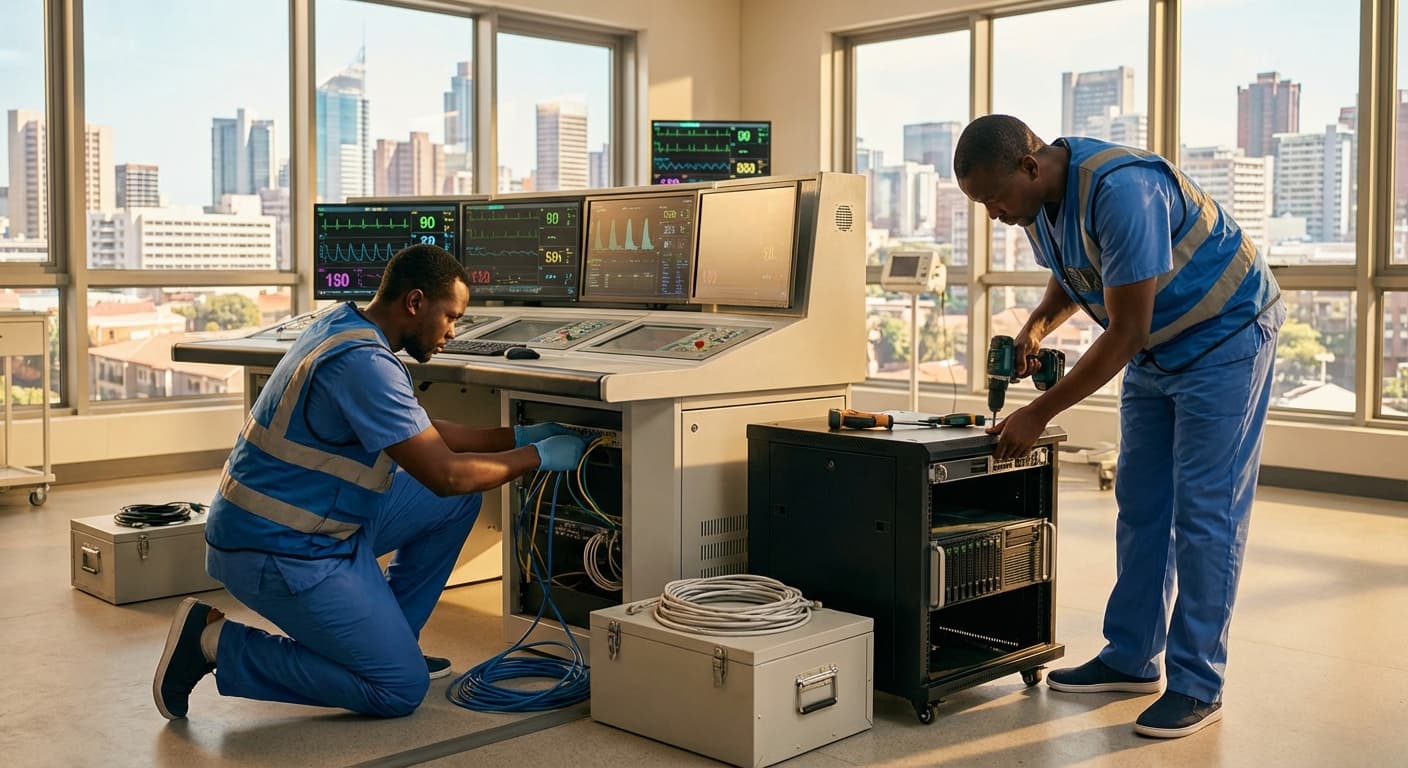
ICU Central Monitoring Station Installation Service in Tunisia
Engineering Excellence & Technical Support
ICU Central Monitoring Station Installation Service High-standard technical execution following OEM protocols and local regulatory frameworks.
Robust Network Infrastructure
Our installations leverage high-performance, redundant network infrastructure designed to ensure uninterrupted data flow from patient monitors to the central station, critical for real-time vital sign tracking and rapid response in Tunisia's intensive care units.
Secure Data Transmission & Compliance
We implement state-of-the-art cybersecurity protocols and encryption for all data transmission, adhering to international and local Tunisian healthcare data privacy regulations, safeguarding patient confidentiality within the ICU environment.
Scalable & Future-Proof Systems
Our installation services are designed for scalability, allowing for seamless integration of future technologies and expansion of monitoring capabilities within the Tunisian healthcare landscape, ensuring long-term operational efficiency and adaptability.
What Is Icu Central Monitoring Station Installation Service In Tunisia?
ICU Central Monitoring Station Installation Service in Tunisia refers to the specialized deployment and configuration of a centralized system designed to remotely monitor vital physiological data from multiple Intensive Care Unit (ICU) beds. This service encompasses the physical installation of network infrastructure, data acquisition hardware, software integration, and comprehensive system testing to ensure seamless data flow and reliable alarm management for critically ill patients within a healthcare facility.
| Who Needs This Service? | Typical Use Cases | |||||
|---|---|---|---|---|---|---|
| Hospitals and Healthcare Facilities in Tunisia: Specifically departments operating Intensive Care Units (ICUs), Coronary Care Units (CCUs), Neonatal ICUs (NICUs), and other critical care settings. | Enhanced Patient Surveillance: Providing a unified view of all critically ill patients' physiological parameters (e.g., ECG, SpO2, NIBP, respiration rate, temperature, invasive pressures) at a central nursing station, allowing for proactive intervention. | Improved Clinical Workflow: Reducing the need for constant bedside rounds for basic vital sign checks, freeing up clinical staff to focus on complex patient care and immediate interventions. | Early Detection of Deterioration: Facilitating the timely identification of subtle changes in patient status through continuous, real-time monitoring and sophisticated alarm systems, potentially preventing adverse events. | Remote Monitoring & Consultation: Enabling remote access to patient data for specialists or consulting physicians, particularly beneficial in facilities with limited on-site expert coverage. | Data Collection & Research: Accumulating historical patient data for clinical audits, quality improvement initiatives, and research purposes. | Compliance with Standards: Meeting the requirements of accreditation bodies and internal hospital policies for advanced patient monitoring in critical care environments. |
Key Components and Scope of the Service
- Hardware Installation: Physical mounting and connection of central monitoring displays, servers, network switches, and patient monitoring device interfaces (e.g., bedside monitor gateways, wireless receivers).
- Network Configuration: Setting up secure and robust local area network (LAN) or wireless local area network (WLAN) infrastructure to facilitate data transmission between bedside monitors and the central station.
- Software Deployment & Integration: Installation and configuration of the central monitoring software platform, including patient demographic integration, customizable alarm parameters, data archiving, and reporting modules. This often involves interoperability with existing Hospital Information Systems (HIS) or Electronic Health Records (EHRs).
- System Calibration & Testing: Rigorous testing of data accuracy, alarm functionality (audible, visual, and remote notification), data integrity, and system responsiveness under simulated clinical conditions.
- User Training & Support: Provision of comprehensive training for clinical staff (nurses, physicians, technicians) on the operation, troubleshooting, and maintenance of the central monitoring system. Post-installation support and maintenance agreements are typically part of the service.
- Compliance & Regulatory Adherence: Ensuring the installation adheres to relevant Tunisian healthcare regulations, data privacy laws (e.g., GDPR if applicable to patient data handling), and international standards for medical device integration.
Who Needs Icu Central Monitoring Station Installation Service In Tunisia?
The installation of an ICU Central Monitoring Station (CMS) service in Tunisia is a critical upgrade for healthcare facilities seeking to enhance patient care, improve clinical efficiency, and optimize resource allocation within their Intensive Care Units. This service ensures that real-time patient vital signs and data are centrally collected, displayed, and analyzed, allowing for faster detection of critical events and more proactive medical interventions. The demand for such advanced technology is driven by the increasing complexity of critical care and the need for sophisticated monitoring solutions to manage critically ill patients effectively.
| Target Customer Segment | Key Departments/Units Involved | Specific Needs/Benefits |
|---|---|---|
| Large Public Hospitals | Intensive Care Unit (ICU), Coronary Care Unit (CCU), Neonatal Intensive Care Unit (NICU), Post-Anesthesia Care Unit (PACU), Emergency Department (ED) | Managing high patient volumes, standardizing monitoring protocols across multiple ICUs, improving data aggregation for research and quality improvement, ensuring continuous oversight of critical patients. |
| Private Hospitals & Clinics | Intensive Care Unit (ICU), Surgical Intensive Care Unit (SICU), Medical Intensive Care Unit (MICU) | Enhancing patient safety, providing advanced monitoring for high-acuity patients, improving staff efficiency, offering premium critical care services, competitive advantage. |
| University Teaching Hospitals | ICU (various specializations), Cardiac Catheterization Lab, Operating Rooms (OR) recovery areas | Facilitating medical education and training, supporting clinical research by providing accessible patient data, integrating with existing EMR/EHR systems, managing complex multi-disciplinary patient cases. |
| Specialized Cardiac Centers | Coronary Care Unit (CCU), Cardiac ICU (CICU) | Real-time monitoring of cardiac parameters (ECG, hemodynamics), early detection of arrhythmias and ischemic events, synchronized management of cardiac interventions and patient status. |
| Pediatric and Neonatal Facilities | Neonatal Intensive Care Unit (NICU), Pediatric Intensive Care Unit (PICU) | Specialized monitoring for infants and children, tracking subtle changes in vital signs, reducing alarms fatigue with advanced filtering, ensuring precise patient data for growth and development tracking. |
Target Customers and Departments for ICU Central Monitoring Station Installation Service in Tunisia
- Hospitals and Medical Centers
- Tertiary Care Facilities
- University Teaching Hospitals
- Private Healthcare Groups
- Government-funded Hospitals
Icu Central Monitoring Station Installation Service Process In Tunisia
This document outlines the comprehensive workflow for the ICU Central Monitoring Station Installation Service Process in Tunisia, covering all stages from initial inquiry to final execution and handover. The process is designed to be systematic, efficient, and to ensure client satisfaction throughout the project lifecycle.
| Stage | Description | Key Activities | Deliverables | Responsible Party |
|---|---|---|---|---|
| Inquiry and Initial Consultation | The process begins when a prospective client expresses interest in the ICU Central Monitoring Station installation service. | Receive inquiry, understand basic requirements, schedule initial meeting/call. | Confirmation of interest, preliminary understanding of client needs. | Sales Team / Account Manager |
| Site Survey and Needs Assessment | A thorough evaluation of the client's existing infrastructure and specific requirements is conducted at the site. | On-site visit, assess space, power, network connectivity, existing equipment compatibility, interview stakeholders. | Detailed site assessment report, finalized functional and technical requirements. | Technical Team / Project Manager |
| Proposal Development and Quotation | Based on the needs assessment, a detailed proposal outlining the solution, scope of work, timeline, and cost is prepared. | Develop system architecture, select components, estimate labor, prepare detailed cost breakdown. | Formal proposal document with technical specifications, project timeline, and quotation. | Technical Team / Project Manager |
| Contract Agreement | Formalization of the agreement between the service provider and the client. | Review and negotiation of contract terms, signing of the service agreement. | Signed contract, confirmed project scope and financial terms. | Client / Service Provider Management |
| Project Planning and Design | Detailed planning and design of the installation, considering all technical and logistical aspects. | Develop detailed installation plan, network design, cabling schematics, risk assessment, resource allocation. | Detailed project plan, system design documents, installation blueprints. | Project Manager / Technical Lead |
| Procurement and Logistics | Acquisition of all necessary hardware, software, and materials, and their timely delivery to the site. | Order equipment and software, manage supply chain, arrange transportation and customs clearance (if applicable). | Procured and delivered equipment and materials to the site. | Procurement Team / Logistics Coordinator |
| On-Site Installation and Configuration | The physical installation and initial setup of the central monitoring station and connected devices. | Install server(s), workstations, network devices, cabling, connect patient monitors and other bedside devices, configure software. | Installed and physically connected hardware and software. | Installation Technicians / Engineers |
| System Testing and Validation | Comprehensive testing to ensure the system functions as per design and meets all specified requirements. | Functional testing, performance testing, integration testing, data accuracy verification, alarm testing. | Test reports, validation certificates, identified and resolved issues. | Quality Assurance Team / Technical Lead |
| Client Training | Educating the hospital staff on the operation and maintenance of the new monitoring system. | Develop training materials, conduct hands-on training sessions for clinical and IT staff. | Trained hospital personnel, training manuals and guides. | Training Specialists / Technical Team |
| Handover and Documentation | Formal transfer of the installed system to the client, along with all relevant documentation. | Final system demonstration, provide all user manuals, technical documentation, warranty information, and support contacts. | Completed installation, comprehensive documentation package, signed handover certificate. | Project Manager / Client Representative |
| Post-Installation Support and Maintenance | Ongoing support and maintenance to ensure the continuous optimal performance of the system. | Provide warranty support, schedule preventive maintenance, offer troubleshooting and repair services. | Ongoing system reliability, resolved support tickets, maintenance records. | Support Team / Maintenance Engineers |
Key Stages of the ICU Central Monitoring Station Installation Service Process
- Inquiry and Initial Consultation
- Site Survey and Needs Assessment
- Proposal Development and Quotation
- Contract Agreement
- Project Planning and Design
- Procurement and Logistics
- On-Site Installation and Configuration
- System Testing and Validation
- Client Training
- Handover and Documentation
- Post-Installation Support and Maintenance
Icu Central Monitoring Station Installation Service Cost In Tunisia
Installing an ICU Central Monitoring Station (CMS) in Tunisia involves a range of costs influenced by several key factors. These costs are critical for healthcare facilities planning to upgrade their intensive care units with advanced patient monitoring capabilities. The CMS integrates data from multiple bedside monitors, providing a centralized view of patient vital signs, alarms, and trends, significantly enhancing patient care and staff efficiency. The pricing in Tunisian Dinars (TND) can fluctuate based on the complexity of the system, the number of beds to be monitored, the chosen brand and model of equipment, installation and integration services, and any necessary infrastructure upgrades.
| Service Component / System Size | Estimated Cost Range (TND) | Notes |
|---|---|---|
| Small ICU (4-8 beds) - Basic CMS | 15,000 - 30,000 TND | Includes central station software, basic integration, and installation for a limited number of beds. |
| Medium ICU (8-16 beds) - Standard CMS | 30,000 - 60,000 TND | Covers more beds, potentially with advanced waveform display and basic data logging. Includes standard installation and training. |
| Large ICU (16+ beds) - Advanced CMS | 60,000 - 150,000+ TND | For larger ICUs, integrating with EHRs, advanced analytics, remote monitoring capabilities. Costs vary significantly with features and brand. |
| Integration with EHR/HIS | 5,000 - 20,000 TND | Can be a significant cost, depending on the complexity of existing systems and the level of integration required. |
| Additional Bed Modules/Licenses | 500 - 2,000 TND per bed | Cost for each additional bedside monitor to be connected to the central station. |
| On-site Training (per session) | 1,000 - 3,000 TND | For comprehensive training of clinical and technical staff. |
| Annual Maintenance & Support Contract | 5% - 15% of total system cost annually | Covers software updates, technical support, and often preventative maintenance. |
Key Pricing Factors for ICU Central Monitoring Station Installation in Tunisia:
- System Complexity and Features: The more advanced the CMS, with features like advanced waveform analysis, data archiving, remote access, and integration with Electronic Health Records (EHRs), the higher the cost.
- Number of Beds Monitored: The price is directly proportional to the number of ICU beds that the central monitoring station needs to support. More beds mean more bedside monitors to integrate and more licenses for the central station software.
- Equipment Brand and Model: Reputable international brands often come with a premium price tag due to their established reputation for quality, reliability, and advanced technology. Local or less established brands might offer more budget-friendly options.
- Installation and Integration Services: This includes the cost of specialized technicians for physical installation, network configuration, software setup, calibration, and integration with existing hospital IT infrastructure. The complexity of integration can significantly impact this cost.
- Training: Comprehensive training for medical staff and IT personnel on operating and maintaining the CMS is usually included or offered as an add-on service, contributing to the overall cost.
- Infrastructure Requirements: If the existing hospital infrastructure (e.g., network cabling, power supply, server capacity) is insufficient to support the new CMS, upgrades will be necessary, adding to the total expenditure.
- Maintenance and Support Contracts: Post-installation, ongoing maintenance, software updates, and technical support are typically offered through service contracts, which are an additional cost but crucial for system longevity and optimal performance.
- Warranty: The duration and scope of the warranty offered by the vendor can also influence the initial purchase price.
Affordable Icu Central Monitoring Station Installation Service Options
Installing an ICU Central Monitoring Station is a critical investment for any healthcare facility, ensuring continuous patient observation and rapid response to critical changes. While the initial outlay can seem significant, there are several affordable options and strategies to make this essential technology accessible. This guide explores value bundles and cost-saving approaches for ICU Central Monitoring Station installation services.
| Strategy/Bundle Type | Description | Potential Cost Savings | Considerations |
|---|---|---|---|
| Basic Monitoring Bundle | Includes essential bedside monitors, a central station for a limited number of beds, and standard installation. | Reduced upfront hardware and installation costs. | May lack advanced features or scalability for future expansion. |
| Comprehensive ICU Bundle | Combines advanced bedside monitors, a robust central station, integration with EMR systems, initial training, and a 1-year support contract. | Bundled pricing offers better value than individual components; integrated systems improve workflow. | Higher initial investment, ensure EMR integration meets specific needs. |
| Cloud-Based Monitoring Solution | Utilizes a subscription-based service where monitoring data is processed and stored on remote servers. Hardware may be leased or purchased separately. | Lower upfront hardware costs, predictable monthly expenses, scalability. | Requires reliable internet connectivity, data security and privacy concerns must be thoroughly addressed. |
| Phased Installation (per unit) | Install monitoring capabilities for a small section of the ICU first, then expand as budget allows. | Spreads capital expenditure over time, allows for testing and refinement. | May require interim solutions for uncovered beds, potential for higher per-unit cost if future expansion isn't factored in. |
| Leasing Agreement | Rent monitoring equipment and central station infrastructure on a monthly or annual basis. | Lowers initial capital outlay, allows for technology refresh. | Total cost over time may be higher than purchasing, lease terms must be carefully reviewed. |
| Vendor-Managed Installation | The vendor handles all aspects of installation, configuration, and testing, often with a simplified pricing structure. | Streamlined process, reduced internal resource strain, often includes performance guarantees. | May be less flexible on customization, ensure clear scope of work. |
| Refurbished Equipment Package | Includes certified refurbished bedside monitors and a central station, with a warranty. | Significant reduction in hardware acquisition costs. | Warranty duration and scope need careful evaluation; availability may be limited. |
Understanding Value Bundles and Cost-Saving Strategies
- Value Bundles: These are pre-packaged offerings that combine hardware, software, installation, training, and sometimes ongoing support at a discounted rate compared to purchasing each component separately. They simplify the procurement process and often provide a predictable budget.
- Phased Implementation: Instead of a full-scale installation at once, consider a phased approach. This allows you to equip a few critical ICU beds first and scale up as budget and needs evolve.
- Leasing vs. Purchasing: Explore leasing options for monitoring equipment. This can reduce upfront capital expenditure and allow for regular technology upgrades.
- Open-Source or Cloud-Based Solutions: Investigate if open-source software or cloud-hosted monitoring platforms can meet your needs, potentially lowering licensing and infrastructure costs.
- Negotiate Service Level Agreements (SLAs): Carefully review and negotiate SLAs to ensure you're only paying for the support and uptime guarantees you truly require.
- Bulk Purchasing Discounts: If you are a larger hospital system or are collaborating with other facilities, consider bulk purchasing to negotiate better prices on equipment and installation.
- Refurbished Equipment: For non-critical components or as a temporary solution, explore the option of certified refurbished monitoring equipment, which can significantly reduce costs.
- Training and In-House Expertise: Invest in comprehensive training for your IT and biomedical engineering staff. Developing in-house expertise can reduce reliance on external support for routine maintenance and troubleshooting.
- Modular System Design: Opt for systems that are modular and scalable. This allows you to start with a basic setup and add more features or beds later without requiring a complete overhaul.
- Strategic Vendor Partnerships: Building long-term relationships with fewer vendors can lead to better pricing, priority support, and bundled service offerings.
Verified Providers In Tunisia
In Tunisia's burgeoning healthcare landscape, identifying trusted and qualified medical professionals is paramount for patients seeking optimal care. Verified Providers in Tunisia are those who have undergone rigorous credentialing processes, ensuring they meet high standards of expertise, ethics, and patient safety. Franance Health stands out as a leading platform that meticulously vets these providers, offering a transparent and reliable pathway to accessing the best healthcare services in the country.
| Provider Type | Franance Health Verification Criteria | Benefits for Patients |
|---|---|---|
| Doctors (Specialists & General Practitioners) | Medical Degree Verification (e.g., University of Tunis, Faculty of Medicine of Sousse) Specialty Board Certification Licensing with the Tunisian Ministry of Health Proof of Current Practice and Experience Background Checks (if applicable) | Access to highly qualified specialists and general practitioners Confidence in their diagnostic and treatment capabilities Reduced risk of medical errors |
| Surgeons | All criteria for Doctors, plus: Accreditation from recognized surgical bodies Demonstrated surgical outcomes (where permissible) Membership in professional surgical associations | Expertise in specific surgical procedures Assurance of up-to-date surgical techniques Trust in a surgeon's track record |
| Dentists | Dental Degree Verification Licensing with the Tunisian Dental Association Specialization certifications (e.g., Orthodontics, Periodontics) Continued education in dental advancements | Comprehensive dental care from qualified professionals Access to specialized dental treatments Peace of mind regarding oral health |
| Nurses (Registered Nurses & Specialized Nurses) | Nursing Diploma/Degree Verification Licensing with the Tunisian Nursing Council Specialized training certifications (e.g., ICU, Oncology) Experience in relevant healthcare settings | Skilled and compassionate nursing care Assistance with recovery and patient well-being Reliable support throughout treatment |
| Therapists (Physiotherapists, Occupational Therapists, etc.) | Therapy Degree/Diploma Verification Licensing with relevant Tunisian professional bodies Specialized certifications in rehabilitation techniques Evidence of effective treatment methodologies | Personalized rehabilitation programs Improved mobility and functional recovery Guidance from experienced therapists |
Why Franance Health Credentials Matter
- Rigorous Verification Process: Franance Health employs a multi-stage verification process that goes beyond basic licensing. This includes scrutinizing educational qualifications, specialized training, clinical experience, and professional affiliations.
- Commitment to Excellence: We partner with providers who demonstrate a consistent commitment to delivering high-quality, patient-centered care. This often involves continuous professional development and adherence to international best practices.
- Ethical Standards: Verified providers on Franance Health are held to strict ethical guidelines, ensuring patient privacy, informed consent, and a respectful approach to medical treatment.
- Transparency and Trust: Our platform provides clear and accessible information about each provider's credentials, allowing patients to make informed decisions with confidence.
- Access to Specialized Expertise: Franance Health connects you with a network of specialists across various medical disciplines, all of whom have met our stringent verification criteria.
- Enhanced Patient Safety: By choosing a Franance Health verified provider, you are assured of receiving care from practitioners who have met established benchmarks for competence and safety, minimizing risks and maximizing positive outcomes.
Scope Of Work For Icu Central Monitoring Station Installation Service
This Scope of Work (SOW) outlines the requirements for the installation services of a new ICU Central Monitoring Station (CMS). The project encompasses the procurement, configuration, installation, integration, testing, and commissioning of all necessary hardware and software components for the CMS, ensuring seamless and reliable patient monitoring within the Intensive Care Unit. The goal is to provide clinicians with a centralized, efficient, and accurate platform for real-time patient data visualization, alarm management, and data archiving.
Project Objectives:
- To successfully install and commission a fully functional ICU Central Monitoring Station.
- To integrate the CMS with existing patient monitoring devices and the hospital's Electronic Health Record (EHR) system.
- To ensure the system meets all relevant safety, regulatory, and performance standards.
- To provide comprehensive training to designated hospital staff on the operation and maintenance of the CMS.
Key Deliverables:
This section details the specific technical deliverables expected from the service provider. These are crucial for the successful implementation and long-term operational success of the ICU CMS.
| Category | Standard Specification | Notes/Applicable Standards |
|---|---|---|
| Hardware Performance | Servers: Minimum Intel Xeon Gold or equivalent, 32GB RAM, 1TB SSD storage. Workstations: Minimum Intel Core i7 or equivalent, 16GB RAM, 512GB SSD storage. Monitors: High-resolution (1920x1080 or higher), medical-grade displays. | Ensure sufficient processing power and storage for real-time data processing and historical data retention. Refer to manufacturer specifications. |
| Network Connectivity | Gigabit Ethernet (10/100/1000 Mbps) for all connections. Redundant network pathways where critical. Support for industry-standard network protocols (TCP/IP, UDP, HTTP/S). | HIPAA compliance, secure network segmentation. IEEE 802.3 standards. |
| Software Compatibility | Operating System: Latest stable version of Windows Server (for servers) and Windows Professional (for workstations). Database: SQL Server or equivalent enterprise-grade database. CMS software compatible with current bedside monitor firmware. | Ensure compatibility with existing hospital IT infrastructure. Microsoft Windows Server specifications. |
| Data Security | Encryption of data at rest and in transit. Role-based access control (RBAC). Audit trails for all system access and modifications. | HIPAA, GDPR (if applicable), NIST Cybersecurity Framework. |
| Alarm Management | Configurable alarm priorities, audible and visual notifications. Centralized alarm logging and reporting. Integration with hospital-wide notification systems (e.g., pagers, mobile devices) if required. | IEC 60601-1-8, ANSI/AAMI ES70. |
| Integration Standards | HL7 v2.x or FHIR for EHR integration. DICOM for image data transfer (if applicable). Manufacturer-specific protocols for direct bedside monitor communication. | HL7 International, DICOM Standards. |
| Power Requirements | All equipment to be connected to hospital-grade, UPS-backed power outlets. Compliance with electrical safety standards. | NFPA 99, IEC 60601 series. |
| Environmental Conditions | Operating temperature: 10°C to 35°C. Operating humidity: 20% to 80% non-condensing. Adequate ventilation for all equipment. | Manufacturer specifications, ASHRAE standards for data centers. |
| User Interface | Intuitive and user-friendly interface with customizable layouts. Support for multiple simultaneous users. | Usability standards, accessibility guidelines. |
Technical Deliverables
- Detailed Project Plan: Including timelines, resource allocation, milestones, and communication protocols.
- Site Survey and Assessment Report: Documenting existing infrastructure, network readiness, power requirements, and environmental conditions relevant to CMS installation.
- Hardware Installation and Configuration: Physical installation of servers, workstations, monitors, network equipment, and all associated cabling according to manufacturer specifications and hospital IT policies.
- Software Installation and Configuration: Installation and configuration of CMS software, operating systems, databases, and any required middleware. This includes user account creation and access control setup.
- System Integration: Seamless integration of the CMS with bedside patient monitors (e.g., vital signs monitors, ventilators, ECG machines) via established protocols (e.g., HL7, DICOM). Integration with the hospital's EHR for data transfer and archiving.
- Network Configuration and Security: Configuration of network interfaces, IP addressing, firewall rules, and adherence to hospital cybersecurity policies to ensure secure data transmission and access.
- Data Migration (if applicable): Secure and accurate migration of historical patient data from any existing monitoring systems to the new CMS.
- Testing and Validation Plan: A comprehensive plan outlining unit testing, integration testing, system testing, and user acceptance testing (UAT) procedures.
- Test Reports: Documenting the results of all testing phases, including any identified issues and their resolutions.
- Commissioning Report: A final report confirming the successful installation, integration, and testing of the CMS, signed off by both the service provider and hospital representatives.
- As-Built Documentation: Detailed schematics, network diagrams, cabling layouts, and configuration settings of the installed CMS.
- Training Materials: User manuals, administrator guides, and any other relevant documentation for system operation and basic troubleshooting.
- Post-Installation Support Plan: Outlining warranty period, response times for technical issues, and escalation procedures.
Service Level Agreement For Icu Central Monitoring Station Installation Service
This Service Level Agreement (SLA) outlines the response times and uptime guarantees for the installation service of the ICU Central Monitoring Station. This SLA is applicable from the date of successful installation and commissioning of the system.
| Incident Severity | Response Time (during Business Hours) | Response Time (outside Business Hours) | Target Resolution Time (during Business Hours) | Target Resolution Time (outside Business Hours) | Uptime Guarantee (Monthly) |
|---|---|---|---|---|---|
| Critical Incident | 1 hour | 2 hours | 4 hours | 8 hours | 99.9% |
| Major Incident | 2 hours | 4 hours | 8 hours | 16 hours | 99.5% |
| Minor Incident | 4 business hours | N/A (addressed during next Business Hours) | 2 business days | N/A (addressed during next Business Hours) | N/A (does not impact Uptime Guarantee) |
Definitions
- Installation Service: Refers to the complete process of setting up and configuring the ICU Central Monitoring Station hardware and software at the Client's premises.
- Central Monitoring Station (CMS): The integrated system designed to receive, process, display, and alarm for patient vital signs and other critical data from bedside monitors within the ICU.
- Critical Incident: Any failure or malfunction of the CMS that significantly impacts its core functionality, preventing the real-time monitoring of patient data or the generation of critical alarms.
- Major Incident: Any failure or malfunction of the CMS that impairs one or more but not all of its core functionalities, affecting the monitoring of a subset of patients or limiting alarm capabilities.
- Minor Incident: Any issue with the CMS that does not directly affect patient monitoring or alarm generation but impacts performance, usability, or requires routine maintenance.
- Downtime: The period during which the CMS is not operational and available for its intended use due to a Critical or Major Incident.
- Response Time: The maximum time allowed for the Service Provider to acknowledge and begin addressing a reported incident.
- Resolution Time: The maximum time allowed for the Service Provider to restore the CMS to full operational status following an incident.
- Uptime Guarantee: The minimum percentage of time the CMS is expected to be available and functional over a defined period.
- Business Hours: Monday to Friday, 9:00 AM to 5:00 PM (Client's local time), excluding public holidays.
- 24x7 Support: Support availability outside of Business Hours, including weekends and public holidays.
Frequently Asked Questions

Ready when you are
Let's scope your ICU Central Monitoring Station Installation Service in Tunisia project in Tunisia.

Scaling healthcare logistics and technical systems across the entire continent.