
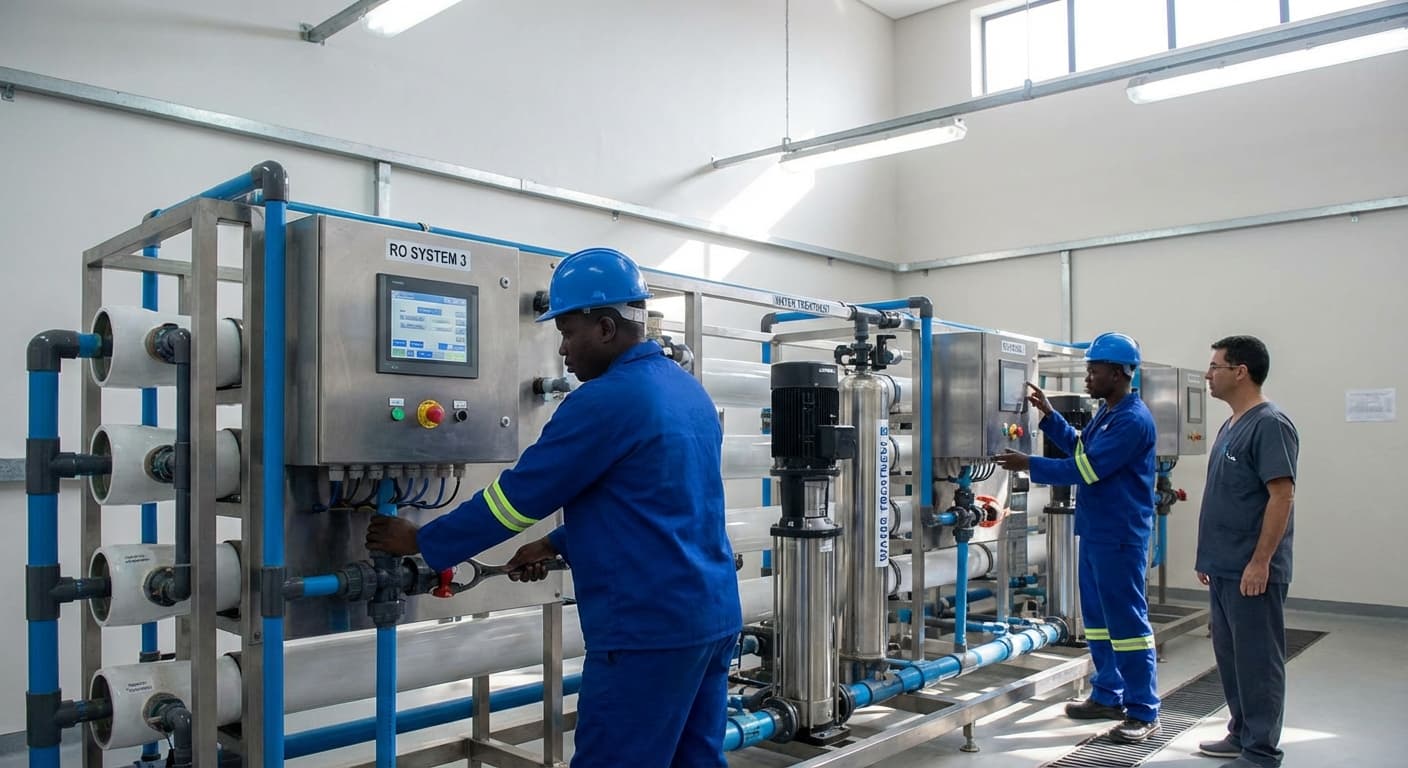
Dialysis RO/Water Treatment Plant Installation Service in Tunisia
Engineering Excellence & Technical Support
Dialysis RO/Water Treatment Plant Installation Service High-standard technical execution following OEM protocols and local regulatory frameworks.
Advanced RO Membrane Technology
Leveraging state-of-the-art Reverse Osmosis (RO) membranes specifically engineered for medical-grade water purity, ensuring optimal performance and extended lifespan for your dialysis facility in Tunisia.
Seamless System Integration & Commissioning
Our expert technicians provide comprehensive on-site installation, system calibration, and meticulous commissioning of your water treatment plant, guaranteeing a fully operational and efficient setup compliant with Tunisian healthcare standards.
Robust Water Quality Monitoring & Compliance
Implementing sophisticated real-time monitoring systems to continuously assess water quality, ensuring unwavering compliance with international and local Tunisian regulations for dialysis water, safeguarding patient safety.
What Is Dialysis Ro/water Treatment Plant Installation Service In Tunisia?
Dialysis RO/Water Treatment Plant Installation Service in Tunisia refers to the specialized engineering and construction process of designing, procuring, installing, and commissioning Reverse Osmosis (RO) and associated water treatment systems specifically for dialysis facilities. These plants are critical for producing ultrapure water, a fundamental requirement for hemodialysis procedures, to ensure patient safety and treatment efficacy. The service encompasses the entire lifecycle from initial site assessment and system conceptualization to final handover and validation, adhering to stringent international and local medical water standards.
| Service Requirement | Who Needs It | Typical Use Cases |
|---|---|---|
| Installation of a new dialysis RO/Water Treatment Plant | New dialysis centers, hospitals establishing new dialysis units, or facilities undergoing significant expansion. | Establishing a new hemodialysis unit, setting up a satellite dialysis clinic, or increasing capacity in an existing facility. |
| Upgrade or replacement of an existing dialysis RO/Water Treatment Plant | Dialysis facilities with outdated, inefficient, or non-compliant water treatment systems, or those experiencing frequent breakdowns. | Replacing end-of-life RO membranes, upgrading to a more advanced treatment technology, addressing persistent water quality issues, or complying with updated regulations. |
| Expansion or modification of an existing dialysis RO/Water Treatment Plant | Facilities looking to increase their dialysis capacity or adapt their water treatment system to accommodate new types of dialysis machines or procedures. | Adding more dialysis stations, integrating a new water purification step, or reconfiguring the distribution loop for improved efficiency. |
| Retrofitting an existing facility for dialysis water treatment | Hospitals or clinics with non-dialysis water systems that need to be converted to support dialysis operations. | Converting a general hospital's water supply infrastructure to meet the stringent requirements for hemodialysis water production. |
Key Components and Stages of Dialysis RO/Water Treatment Plant Installation in Tunisia:
- Site Assessment and Requirements Analysis: Evaluating the existing water source quality (municipal, well, etc.), flow rates, power availability, space constraints, and specific dialysis machine water demands according to standards like AAMI/ASAIO, ISO, and relevant Tunisian Ministry of Health regulations.
- System Design and Engineering: Developing a detailed P&ID (Piping and Instrumentation Diagram), selecting appropriate treatment technologies (pre-filtration, softening, carbon filtration, RO membranes, UV sterilization, post-treatment polishing, loop distribution systems), sizing components, and ensuring redundancy for continuous operation.
- Procurement and Manufacturing: Sourcing high-quality components, membranes, pumps, control systems, and instrumentation from reputable manufacturers. This may involve custom fabrication of skids and control panels.
- Installation and Assembly: Physically installing all equipment, piping, electrical wiring, and control systems within the designated plant area. This includes ensuring proper material selection (e.g., food-grade or medical-grade plastics and stainless steel) to prevent contamination.
- Commissioning and Startup: Bringing the plant online incrementally, performing functional tests of individual units and the integrated system, calibrating sensors, and optimizing operational parameters for efficiency and water quality.
- Water Quality Validation and Testing: Conducting rigorous testing of the treated water at various stages and post-treatment to verify it meets or exceeds specified purity levels for conductivity, TOC (Total Organic Carbon), bacterial endotoxins, and other critical parameters. This often involves third-party accredited laboratory analysis.
- Operator Training and Documentation: Providing comprehensive training to facility biomedical engineers and technicians on system operation, routine maintenance, troubleshooting, and emergency procedures. Delivering as-built drawings, operation manuals, and maintenance logs.
- Compliance and Certification: Ensuring the installation adheres to all relevant Tunisian health, safety, and environmental regulations, as well as international guidelines for dialysis water quality.
Who Needs Dialysis Ro/water Treatment Plant Installation Service In Tunisia?
Access to high-quality, purified water is paramount for various healthcare facilities and industrial operations. In Tunisia, the demand for reliable dialysis RO/water treatment plant installation services stems from a critical need to ensure patient safety, operational efficiency, and regulatory compliance. This service is specifically designed to cater to entities that require stringent water purification standards for their sensitive processes.
| Customer Type | Key Departments Involved | Specific Needs/Reasons for Installation |
|---|---|---|
| Hospitals | Nephrology Department, Infection Control Department, Facilities Management, Procurement Department | To provide safe and sterile water for hemodialysis treatments, preventing infections and ensuring patient well-being. Compliance with national and international medical water standards. |
| Dialysis Centers (Private & Public) | Clinical Operations, Biomedical Engineering, Administration, Procurement | Primary function is dialysis; therefore, reliable and high-purity RO water is essential for daily operations. Ensuring uninterrupted service and patient safety. |
| Pharmaceutical Companies | Quality Control (QC), Production Department, Research & Development (R&D), Engineering Department | Production of sterile pharmaceuticals, drug formulation, cleaning of equipment. Maintaining product integrity and regulatory compliance (e.g., USP, EP standards). |
| Food & Beverage Manufacturers | Quality Assurance (QA), Production, Engineering, Research Department | Water used in beverage production, food processing, cleaning, and sanitation to ensure product safety and quality, and to prevent spoilage. Meeting food safety regulations. |
| Medical Device Manufacturers | Sterilization Department, Production, Quality Assurance, Engineering | Manufacturing of medical devices, sterilization processes, and cleaning of sensitive components. Ensuring that water does not introduce contaminants into devices. |
| Research Laboratories & Universities | Research Departments, Laboratory Management, Facilities Management, Procurement | Conducting scientific research, experiments, and analyses that require ultra-pure water. Preventing interference of impurities with experimental outcomes. |
| Energy Sector (e.g., Power Plants) | Maintenance Department, Engineering, Operations | Boiler feed water, cooling systems, and other industrial processes where water purity is critical to prevent scaling, corrosion, and improve operational efficiency. |
| Ministry of Health & Public Health Authorities | Public Health Services, Planning Department, Infrastructure Development | Ensuring the availability of adequate and safe dialysis services across the country, especially in public healthcare facilities. Setting and enforcing water quality standards. |
Target Customers & Departments for Dialysis RO/Water Treatment Plant Installation Service in Tunisia
- {"title":"Healthcare Facilities","description":"These are the primary beneficiaries, requiring sterile and purified water for life-sustaining treatments and medical procedures. Ensuring the quality of water used in dialysis is directly linked to patient health and preventing complications."}
- {"title":"Industrial & Manufacturing Sectors","description":"Certain industries rely heavily on purified water for their production processes to avoid contamination, ensure product quality, and maintain equipment longevity. This includes sectors where water purity is a critical component of the end product or manufacturing line."}
- {"title":"Research & Development Institutions","description":"Laboratories and R&D centers require ultra-pure water for experiments, analyses, and scientific research, where even trace impurities can compromise results."}
- {"title":"Government & Public Health Organizations","description":"Entities responsible for public health infrastructure and ensuring access to essential medical services may procure or oversee the installation of such plants in public healthcare centers."}
Dialysis Ro/water Treatment Plant Installation Service Process In Tunisia
This document outlines the comprehensive service process for installing Dialysis Reverse Osmosis (RO) and Water Treatment Plants in Tunisia. It details the workflow from the initial client inquiry to the final execution and handover, ensuring a smooth and efficient project lifecycle.
| Stage | Key Activities | Deliverables | Timeline (Typical) | Responsible Party |
|---|---|---|---|---|
| Client expresses interest. Discusses basic needs, facility size, and preliminary requirements. Understands existing water source and quality. | Confirmation of interest, preliminary understanding of project scope. | 1-3 days | Client, Service Provider Sales Team |
| On-site visit by technical experts. Detailed assessment of available space, power, plumbing, water source quality (testing if needed), and specific dialysis unit needs. Finalizing technical specifications. | Detailed site survey report, confirmed technical specifications, list of required consumables. | 3-7 days | Service Provider Technical Team, Client Facility Manager |
| Preparation of a comprehensive proposal including detailed system design, equipment list, installation plan, timeline, cost breakdown, and warranty information. | Formal proposal document, detailed quotation. | 5-10 days | Service Provider Engineering & Sales Team |
| Review and negotiation of the proposal. Signing of the service contract, outlining terms, conditions, payment schedule, and responsibilities. | Signed service contract, Purchase Order (PO). | 3-7 days | Client Procurement & Legal, Service Provider Management |
| Finalizing detailed engineering drawings, P&IDs (Piping and Instrumentation Diagrams), electrical schematics, and structural plans based on approved specifications and site conditions. Obtaining necessary permits (if applicable). | Approved engineering drawings, P&IDs, electrical schematics, permit applications. | 7-21 days | Service Provider Engineering Team |
| Sourcing and purchasing all necessary components, equipment, and materials. Arranging for transportation to the client's site in Tunisia. | Procured equipment and materials, shipping manifests, customs clearance documentation. | 14-60 days (depending on lead times) | Service Provider Procurement & Logistics Team |
| Pre-assembly or skid-mounting of certain components in the service provider's workshop or at a designated location to minimize on-site work and time. | Pre-assembled modules or skids. | 7-14 days | Service Provider Workshop Team |
| Mobilization of the installation team. Installation of the RO membrane units, filters, pumps, piping, electrical connections, and control systems as per engineering drawings. Rigorous safety protocols are observed. | Installed RO/Water Treatment Plant infrastructure. | 7-21 days | Service Provider Installation Team |
| System startup. Flushing and sanitization of the plant. Testing water quality parameters (TDS, conductivity, bacterial count, etc.) to meet dialysis standards. Performance validation and calibration of all components. | Commissioning report, performance test results, calibrated equipment readings. | 3-7 days | Service Provider Commissioning Engineers |
| Comprehensive training for client's technical staff on plant operation, routine maintenance, troubleshooting, and safety procedures. Formal handover of the plant and all documentation. | Trained client personnel, O&M manuals, warranty certificates, as-built drawings. | 2-4 days | Service Provider Training & Project Manager |
| Ongoing technical support, scheduled maintenance visits, spare parts supply, and emergency breakdown assistance as per the service contract. | Ongoing operational support, executed maintenance tasks. | Continuous | Service Provider After-Sales Service Team |
Dialysis RO/Water Treatment Plant Installation Service Process in Tunisia
- Inquiry & Initial Consultation
- Site Assessment & Requirements Gathering
- Proposal Development & Quotation
- Contract Finalization & Agreement
- Design & Engineering
- Procurement & Logistics
- Plant Assembly & Pre-fabrication (if applicable)
- On-site Installation
- Commissioning & Performance Testing
- Training & Handover
- Post-Installation Support & Maintenance
Dialysis Ro/water Treatment Plant Installation Service Cost In Tunisia
Installing a Reverse Osmosis (RO) and water treatment plant for dialysis in Tunisia involves significant investment. The cost is influenced by a multitude of factors, ranging from the size and complexity of the system to the specific requirements of the healthcare facility. This service cost encompasses the design, procurement, installation, commissioning, and often initial training. Understanding these factors is crucial for accurate budgeting and planning.
The core function of these plants is to purify municipal water to a standard suitable for hemodialysis, removing impurities, minerals, and potential contaminants that could harm patients. The price will reflect the technology used, the volume of purified water required, and the level of automation and monitoring built into the system. Tunisian healthcare providers should factor in the long-term operational costs as well, including maintenance, consumables, and energy consumption, which are indirectly tied to the initial installation choice.
| Capacity (Liters/Hour) | Estimated Cost Range (TND - Tunisian Dinar) |
|---|---|
| 50 - 100 | 10,000 - 25,000 |
| 100 - 250 | 20,000 - 50,000 |
| 250 - 500 | 40,000 - 90,000 |
| 500+ | 70,000+ |
Key Pricing Factors for Dialysis RO/Water Treatment Plant Installation in Tunisia
- Plant Capacity and Flow Rate: The primary driver of cost is the volume of purified water the plant needs to produce daily or hourly to meet the demands of the dialysis units. Larger capacities require bigger, more robust equipment, leading to higher prices.
- Technology and Components: The quality and type of RO membranes, pre-filters, post-filters, UV sterilizers, and other purification stages significantly impact cost. Advanced, high-efficiency components generally cost more.
- Water Source Quality: If the incoming municipal water has high levels of hardness, dissolved solids, or other contaminants, more extensive pre-treatment stages will be necessary, increasing the overall complexity and cost of the system.
- Automation and Monitoring Systems: Plants with advanced control panels, remote monitoring capabilities, and automated flushing cycles are more expensive than simpler, manually operated systems.
- Redundancy and Backup Systems: For critical healthcare applications like dialysis, having redundant components or backup systems to ensure continuous water supply in case of failure is essential. This adds to the initial investment.
- Installation Complexity and Site Conditions: The physical location of the installation, accessibility, the need for specialized piping, electrical work, and potential structural modifications can influence labor and material costs.
- Brand and Manufacturer: Reputable international and local manufacturers may have different pricing structures based on their brand reputation, warranty, and after-sales support.
- Ancillary Services: This can include site surveys, detailed design engineering, system integration with existing hospital infrastructure, and comprehensive operator training. Each of these adds to the total cost.
- Regulatory Compliance and Certification: Ensuring the plant meets all Tunisian health and environmental regulations may require specific certifications or testing, which can incur additional fees.
- Warranty and After-Sales Support: The length and scope of the warranty, as well as the availability and cost of ongoing maintenance and support contracts, are important considerations.
Affordable Dialysis Ro/water Treatment Plant Installation Service Options
Installing a Dialysis RO/Water Treatment Plant is a critical investment for any healthcare facility providing renal care. Finding affordable and reliable installation services is paramount. This guide explores various service options, emphasizes the value of service bundles, and outlines effective cost-saving strategies to ensure you receive high-quality treatment while managing your budget.
| Cost-Saving Strategy | Description | Implementation Tip |
|---|---|---|
| Compare Multiple Quotes | Obtain detailed proposals from at least three reputable installation service providers. Ensure quotes are apples-to-apples and clearly define scope of work, equipment, and timelines. | Request a list of references from each provider and follow up with them. |
| Negotiate Contract Terms | Don't be afraid to negotiate pricing, payment schedules, warranty periods, and included services. Flexibility in your requirements can lead to better deals. | Consider offering faster payment terms in exchange for a discount. |
| Leverage Existing Infrastructure | If your facility already has some of the necessary infrastructure (e.g., plumbing, electrical, space), inform potential providers. This could reduce installation time and costs. | Provide detailed blueprints and existing utility specifications during the initial consultation. |
| Phased Installation Options | For larger projects, explore if a phased installation approach is feasible. This might allow for better cash flow management and incremental upgrades. | Discuss with providers the possibility of installing core components first, with expansion options later. |
| Explore Refurbished or Certified Pre-Owned Equipment | While new equipment is ideal, high-quality, certified refurbished or pre-owned RO/water treatment systems can significantly reduce upfront costs. Ensure they come with a warranty. | Work with providers who have strong relationships with reputable equipment suppliers and offer certification services. |
| Bundle with Maintenance Contracts | Often, providers offer discounts when installation and a long-term maintenance contract are bundled together. This ensures ongoing optimal performance and can prevent costly emergency repairs. | Compare the cost of bundled maintenance with independent service contracts for the first few years. |
| Inquire about Government or Industry Grants/Rebates | Research if any local, state, or federal programs, or industry-specific initiatives offer financial assistance or rebates for installing essential medical equipment like RO/water treatment plants. | Consult with your finance department or a specialized grant writer. |
| Standardize Equipment Models | If possible, standardize on a specific model or brand of RO/water treatment equipment. This can lead to bulk purchase discounts and simplified training and maintenance. | Discuss long-term equipment strategies with your medical and engineering teams. |
Understanding Value Bundles
- {"title":"What are Value Bundles?","description":"Value bundles are pre-packaged service offerings designed to provide comprehensive support at a potentially lower overall cost than purchasing individual services. For dialysis RO/water treatment plant installations, these bundles often combine essential components like initial consultation, site assessment, equipment procurement, installation, system commissioning, initial training, and even ongoing maintenance contracts. The aim is to streamline the process and offer predictable costs."}
- {"title":"Benefits of Value Bundles","description":"By opting for a value bundle, you gain several advantages: 1. Cost Predictability: Bundles usually come with a fixed price, reducing the risk of unexpected expenses. 2. Integrated Services: All necessary steps are handled by a single provider, ensuring seamless coordination and accountability. 3. Potential Discounts: Providers often offer discounted rates for bundled services compared to individual service fees. 4. Streamlined Procurement: Simplifies the purchasing process by dealing with one vendor for multiple needs. 5. Faster Deployment: Coordinated services can lead to quicker installation and operational readiness."}
- {"title":"Common Components in Installation Bundles","description":"Typical components included in dialysis RO/water treatment plant installation value bundles are: Consultation & Needs Assessment, Site Survey & Preparation, Equipment Sourcing & Delivery, Professional Installation, System Testing & Commissioning, Initial Operator Training, Warranty & Post-Installation Support."}
Verified Providers In Tunisia
When seeking healthcare services, especially when traveling or living abroad, verifying the credentials of providers is paramount. In Tunisia, a growing number of healthcare facilities and practitioners are committed to international standards of quality and patient safety. Franance Health stands out as a trusted entity that rigorously vets and credentials these providers, ensuring patients receive the highest caliber of care. This commitment to verified excellence makes Franance Health-credentialed providers the best choice for numerous reasons.
| Category | Description of Franance Health's Assurance |
|---|---|
| Medical Expertise | Verification of qualifications, specializations, and years of practice. |
| Clinical Competence | Evaluation of surgical outcomes, patient satisfaction, and adherence to best medical practices. |
| Facility Standards | Assessment of infrastructure, equipment, hygiene, and safety protocols of associated medical centers. |
| Ethical Conduct | Confirmation of adherence to professional ethics and patient rights. |
| Continuous Professional Development | Encouragement and verification of ongoing training and education for providers. |
Why Franance Health Credentials Represent the Best Choice:
- Rigorous Vetting Process: Franance Health employs a stringent and comprehensive vetting process that goes beyond basic licensing. This includes verifying educational backgrounds, professional experience, surgical outcomes, and adherence to ethical practices.
- Commitment to Quality Standards: Providers credentialed by Franance Health have demonstrated their commitment to meeting and exceeding internationally recognized quality benchmarks in healthcare delivery.
- Patient Safety First: The core of Franance Health's mission is to prioritize patient safety. Their credentialing process specifically evaluates protocols, infection control measures, and risk management strategies.
- Experienced and Skilled Professionals: Franance Health identifies and approves healthcare professionals with proven expertise and a track record of successful patient outcomes across various medical specializations.
- Access to Modern Facilities and Technology: Credentialed providers are typically associated with modern medical facilities equipped with advanced diagnostic and treatment technologies, ensuring access to cutting-edge healthcare.
- Transparent and Reliable Information: Franance Health provides a transparent platform where patients can access verified information about providers, fostering trust and informed decision-making.
- International Recognition: The Franance Health credential serves as a mark of quality recognized internationally, offering peace of mind to patients seeking healthcare abroad or from international patients in Tunisia.
- Continuity of Care and Support: By choosing Franance Health-credentialed providers, patients can often expect a higher level of patient-centered care, including better communication and follow-up support.
Scope Of Work For Dialysis Ro/water Treatment Plant Installation Service
This Scope of Work (SOW) outlines the requirements for the installation services of a Dialysis Reverse Osmosis (RO) / Water Treatment Plant. The objective is to ensure a fully functional and compliant water purification system capable of meeting the stringent standards required for hemodialysis treatment. This SOW covers all aspects from site preparation and equipment installation to system commissioning and final handover. The contractor shall provide all necessary labor, supervision, tools, equipment, and materials, unless explicitly stated otherwise, to complete the project according to the specified technical deliverables and standard specifications.
| Phase | Activity | Description | Key Considerations / Requirements | Responsible Party |
|---|---|---|---|---|
| Site Survey and Assessment | Thorough inspection of the installation site to identify all physical constraints, utilities availability, and specific site conditions. | Electrical power availability and capacity, water inlet quality, drainage points, space for equipment and future maintenance, environmental conditions (temperature, humidity). | Contractor (with Client input) |
| Review of Approved Drawings and Specifications | Detailed review of the provided RO/Water Treatment Plant design drawings, P&IDs, electrical schematics, and technical specifications. | Ensure full understanding of all equipment, connections, and compliance requirements. | Contractor |
| Structural Modifications (if required) | Any necessary civil or structural modifications to the installation area to accommodate the RO plant, including flooring, support structures, and mounting points. | Must be performed by qualified personnel and approved by the Client. | Contractor (may involve sub-contractors) |
| Utility Connections Rough-in | Installation of pre-installation utility lines, including incoming water supply, drainage, electrical conduits, and compressed air lines (if applicable). | Adherence to relevant local codes and standards. Proper labeling of all lines. | Contractor |
| RO Plant Skids and Modules | Unpacking, positioning, and securing of all RO plant skids, pre-treatment modules, post-treatment units, and control panels. | Ensure proper alignment, leveling, and access for maintenance. Follow manufacturer's installation guidelines. | Contractor |
| Piping and Tubing Installation | Installation of all process piping, tubing, valves, and fittings for water inlet, distribution, recirculation, and drain lines. Includes pressure and temperature monitoring points. | Use of approved materials (e.g., NSF-certified, medical-grade), proper jointing techniques (welding, threading, compression fittings), and flushing procedures. Minimize dead legs. | Contractor |
| Electrical Installation | Installation of all electrical components, including power supply wiring, control wiring, sensors, actuators, and connection to the main electrical panel. | Compliance with all electrical codes and safety standards. Proper grounding and surge protection. | Contractor (Certified Electrician) |
| Instrumentation and Control Installation | Installation of all sensors (flow meters, pressure transducers, conductivity meters, pH meters, etc.) and connection to the control system (PLC/HMI). | Calibration of sensors as per manufacturer's specifications. Secure and protected installation. | Contractor |
| System Flushing and Cleaning | Thorough flushing of the entire system with deionized or purified water to remove any construction debris, contaminants, and residual chemicals. | Multiple flushing cycles, validated by water quality testing. | Contractor |
| Leak Testing | Pressurization of the system with water and inspection for any leaks at all joints, connections, and fittings. | Hold pressure for a specified duration. Rectify any leaks found. | Contractor |
| Component Verification | Verification of correct installation and functionality of all individual components (pumps, valves, membranes, filters, UV, etc.). | Visual inspection and basic operational checks. | Contractor |
| System Startup and Initial Operation | Gradual startup of the RO plant and operation under controlled conditions. | Monitor system parameters closely. Identify and address any operational anomalies. | Contractor |
| Water Quality Testing | Comprehensive testing of purified water quality at various points in the system, including before and after RO membranes, UV disinfection, and final output. | Testing parameters include conductivity, pH, TOC, total dissolved solids (TDS), microbial counts, endotoxins (if required), and specific ions as per dialysis standards (e.g., AAMI, ISO). | Contractor and/or Client's Laboratory |
| Performance Optimization | Adjustment of system parameters (e.g., pressure, flow rates, recovery rate) to achieve optimal performance and water quality. | Continuous monitoring and fine-tuning. | Contractor |
| Functional Testing of Safety Systems | Testing of all safety interlocks, alarms, and shutdown mechanisms. | Simulate fault conditions to verify system response. | Contractor |
| Operator Training | Comprehensive training for designated Client personnel on the operation, monitoring, routine maintenance, and basic troubleshooting of the RO plant. | Hands-on sessions, demonstration, and Q&A. Provide training manuals. | Contractor |
| Documentation Handover | Provide a complete set of 'As-Built' drawings, operation and maintenance manuals, test reports, certificates of conformity, and warranty documents. | All documents to be in clear, legible format (digital and hard copy). | Contractor |
| Final Acceptance | Formal acceptance of the installed and commissioned RO plant by the Client based on successful completion of all tests and delivery of all documentation. | Sign-off on a formal acceptance certificate. | Client |
Technical Deliverables
- Detailed Project Plan and Schedule:
- As-Built Drawings and Documentation:
- Installation Quality Assurance and Control (QA/QC) Reports:
- System Commissioning Report:
- User Manuals and Training Materials:
- Warranty and Service Agreements:
Service Level Agreement For Dialysis Ro/water Treatment Plant Installation Service
This Service Level Agreement (SLA) outlines the guaranteed response times and uptime for the installation service of Dialysis Reverse Osmosis (RO) and Water Treatment Plants. This agreement ensures timely support and minimal disruption during the critical installation phase. It covers the initial setup, testing, and commissioning of the installed system.
| Service Component | Response Time Guarantee (Business Hours) | Uptime Guarantee | Notes |
|---|---|---|---|
| Initial Site Assessment & Readiness Check | Within 2 business days of service request | N/A (Pre-installation) | To confirm site suitability and required resources. |
| On-site Installation Commencement | Within 5 business days of site readiness confirmation | N/A (Installation Phase) | Subject to equipment delivery and client availability. |
| Critical Issue Resolution (During Installation) | Within 4 business hours | N/A (Installation Phase) | For issues preventing installation progress. Escalation to manufacturer may be required. |
| Standard Issue Resolution (During Installation) | Within 8 business hours | N/A (Installation Phase) | For non-critical issues impacting minor functionalities. |
| System Testing & Validation Completion | Within 2 business days of installation completion | N/A (Installation Phase) | To ensure system meets performance benchmarks. |
| Commissioning & Handover | Within 1 business day of successful testing | N/A (Installation Phase) | Formal handover documentation and training. |
| Post-Installation Support (First 7 Days) | Within 8 business hours (for issues arising post-handover) | 95% Uptime | Focus on initial operational stability. Uptime calculated based on scheduled operational hours. |
Scope of Service
- On-site installation and configuration of the Dialysis RO/Water Treatment Plant as per manufacturer specifications.
- Pre-installation site assessment and readiness check.
- Post-installation system testing and performance validation.
- Commissioning and handover to the client.
- On-site technical support during the installation period.
Frequently Asked Questions

Ready when you are
Let's scope your Dialysis RO/Water Treatment Plant Installation Service in Tunisia project in Tunisia.

Scaling healthcare logistics and technical systems across the entire continent.