
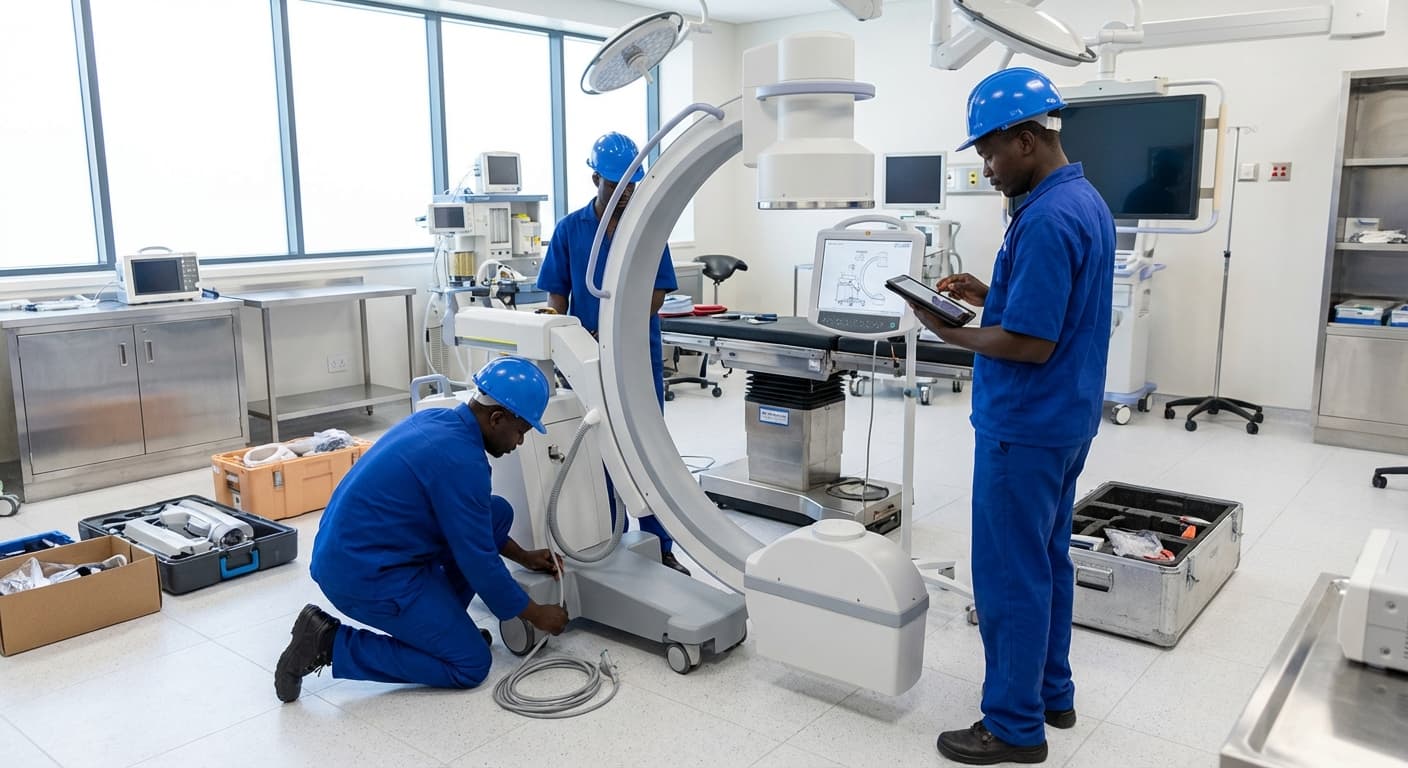
C-Arm Installation Service in Tunisia
Engineering Excellence & Technical Support
C-Arm Installation Service High-standard technical execution following OEM protocols and local regulatory frameworks.
Expert C-Arm System Integration
Our certified technicians ensure seamless integration of your C-arm system with existing medical infrastructure, optimizing workflow and diagnostic accuracy in Tunisian healthcare facilities.
Rapid Deployment & Calibration
Benefit from rapid installation and precision calibration of your C-arm, minimizing downtime and allowing your Tunisian medical team to resume critical patient care operations swiftly.
Compliance & Safety Assurance
We adhere to the strictest international and local safety regulations for C-arm installations in Tunisia, guaranteeing a secure and compliant environment for both patients and healthcare professionals.
What Is C-arm Installation Service In Tunisia?
C-Arm installation service in Tunisia refers to the comprehensive process of setting up and integrating mobile X-ray imaging systems, commonly known as C-arms, within healthcare facilities. This service is crucial for ensuring the proper functioning, safety, and optimal performance of these sophisticated medical devices. It encompasses a series of technical procedures, regulatory compliance checks, and initial user training.
What the Service Involves:
- Site Assessment and Planning: This initial phase involves evaluating the intended installation location to determine power requirements, space availability, radiation shielding needs (if not already present), and network connectivity. Architectural modifications or structural reinforcements may be identified.
- Delivery and Unpacking: Secure transportation and careful unpacking of the C-arm unit and its associated components, ensuring no damage occurs during transit.
- Physical Placement and Mounting: Precise positioning of the C-arm unit within the designated room, often requiring specialized lifting equipment. This includes connecting various components such as the X-ray generator, image intensifier or flat-panel detector, and control console.
- Electrical and Power Connections: Establishing stable and compliant electrical connections, including grounding and surge protection, to meet the power demands of the C-arm and prevent electrical hazards.
- Radiation Safety Measures: Implementing and verifying radiation protection protocols. This may involve installing leaded curtains, monitoring dose indicators, and ensuring the room adheres to national radiation safety standards. Calibration of the X-ray beam and safety interlocks is a critical step.
- Image Acquisition System Setup: Configuring the image processing hardware and software, including calibration of display monitors for accurate image representation and setting up digital archiving and network interfaces (e.g., DICOM for PACS integration).
- Network Integration: Connecting the C-arm to the facility's Picture Archiving and Communication System (PACS), Radiology Information System (RIS), or other relevant hospital networks for seamless data transfer and workflow integration.
- System Testing and Calibration: Performing rigorous diagnostic tests on all C-arm functions, including gantry movements, fluoroscopy, radiography modes, and image quality assessments. Calibration of tube voltage (kVp), current (mA), exposure time, and filtration is performed to ensure accurate and consistent imaging parameters.
- Regulatory Compliance Verification: Ensuring that the installation adheres to all local and national regulations pertaining to medical device installation, radiation safety, and data privacy (e.g., those set by the Tunisian Ministry of Health or equivalent bodies).
- Initial User Training: Providing foundational training to radiographers, physicians, and relevant technical staff on the operation, basic maintenance, and safety features of the newly installed C-arm.
Who Needs It:
- Hospitals: Both public and private hospitals requiring new C-arm units for operating rooms, emergency departments, intensive care units, or specialized imaging suites.
- Surgical Centers: Outpatient surgical facilities that utilize C-arms for intraoperative imaging during orthopedic, cardiovascular, pain management, and other minimally invasive procedures.
- Radiology Clinics: Clinics offering diagnostic and interventional radiology services that incorporate mobile fluoroscopic imaging.
- Research Institutions: Facilities conducting medical research that requires real-time X-ray visualization capabilities.
Typical Use Cases:
- Orthopedic Surgery: Intraoperative imaging for fracture reduction, implant placement (e.g., hip and knee arthroplasty), and spinal surgery (e.g., fusion procedures).
- Cardiovascular Interventions: Fluoroscopic guidance for procedures such as angioplasty, stent placement, pacemaker implantation, and electrophysiology studies.
- Pain Management: Image guidance for epidural injections, nerve blocks, and vertebroplasty.
- Gastroenterology: Endoscopic retrograde cholangiopancreatography (ERCP) and other endoscopic interventions requiring fluoroscopic visualization.
- Urology: Guidance for stent placement, stone removal, and other urological procedures.
- Emergency Medicine: Portable imaging in trauma bays or intensive care units for rapid assessment of fractures, dislocations, and foreign bodies.
- Intensive Care Units (ICU): bedside imaging for line placement (e.g., central venous catheters, endotracheal tubes) and assessment of pulmonary conditions.
- Veterinary Medicine: While not strictly human healthcare, veterinary clinics also utilize C-arms for diagnostic and surgical procedures on animals, and installation services would be relevant.
| Healthcare Setting | Primary Applications | Frequency of C-Arm Use |
|---|---|---|
| Orthopedic Operating Room | Fracture reduction, implant placement, spinal surgery | High (during surgical procedures) |
| Cardiovascular Cath Lab | Angiography, angioplasty, stent placement | Very High (during interventions) |
| Emergency Department/Trauma Bay | Fracture assessment, foreign body localization | Moderate to High (as needed) |
| Intensive Care Unit (ICU) | Line placement, bedside imaging | Moderate (for specific interventions) |
| Pain Management Clinic | Injections, nerve blocks | High (during procedures) |
Key Components of C-Arm Installation Service
- Site assessment and planning
- Physical placement and mounting
- Electrical and power connections
- Radiation safety implementation and verification
- Image acquisition system configuration
- Network integration (PACS/RIS)
- Comprehensive system testing and calibration
- Regulatory compliance checks
- End-user operational training
Who Needs C-arm Installation Service In Tunisia?
C-Arm installation service is a critical necessity for a wide range of medical facilities in Tunisia that utilize advanced imaging technology for diagnostic and surgical procedures. The precise and safe installation of these sophisticated X-ray imaging devices ensures optimal performance, patient safety, and compliance with healthcare regulations. This service is not a one-time event but often involves initial setup, calibration, and potentially ongoing maintenance and upgrades.
| Target Customer/Department | Specific Needs and Reasons for C-Arm Installation |
|---|---|
| Orthopedic Departments | Crucial for intraoperative imaging during fracture repairs, joint replacements, and spinal surgeries. Ensures accurate placement of implants and monitoring of bone alignment. |
| Pain Management Clinics | Essential for guiding minimally invasive procedures like nerve blocks, epidural injections, and facet joint injections, ensuring precise needle placement for effective pain relief. |
| Surgical Departments (General, Vascular, Cardiothoracic, etc.) | Used in various surgical interventions for real-time visualization of instruments, anatomical structures, and critical components during procedures. |
| Emergency Departments | Vital for rapid diagnosis of trauma, fractures, and internal injuries, enabling quick decision-making and treatment initiation. |
| Interventional Radiology Departments | Key for minimally invasive procedures such as angioplasty, stent placement, and biopsies, allowing for precise guidance and monitoring. |
| Urology Departments | Used in procedures like cystography, retrograde pyelography, and lithotripsy to visualize the urinary tract. |
| Cardiology Departments (in some cases) | While primarily using fluoroscopy, C-arms can be employed for specific interventional cardiology procedures requiring localized imaging. |
| Outpatient Surgical Centers | For same-day surgical procedures that require intraoperative imaging, enhancing safety and efficiency. |
| Diagnostic Imaging Centers | To offer specialized imaging services beyond standard X-rays, catering to specific patient needs. |
| Veterinary Hospitals | For advanced diagnostic imaging and surgical support in animal care, particularly for orthopedic and complex surgical cases. |
Who Needs C-Arm Installation Service in Tunisia?
- Hospitals (Public and Private)
- Specialized Surgical Centers
- Orthopedic Clinics
- Pain Management Clinics
- Emergency Departments
- Outpatient Surgical Facilities
- Diagnostic Imaging Centers
- Veterinary Hospitals (for advanced imaging needs)
C-arm Installation Service Process In Tunisia
This document outlines the comprehensive process for C-Arm installation services in Tunisia, from initial customer inquiry to successful execution and handover. Our goal is to ensure a seamless, efficient, and compliant installation, meeting the highest industry standards.
| Phase | Key Steps | Description | Key Deliverables/Outputs |
|---|---|---|---|
| Phase 1: Inquiry & Pre-Qualification | Initial Contact & Needs Assessment | Customer expresses interest. We gather details on the C-Arm model, intended use, and facility type. | Customer's basic requirements, preliminary C-Arm model identification. |
| Technical Consultation | Our experts discuss technical specifications, power requirements, space needs, and potential site challenges. | Understanding of technical prerequisites, identification of any immediate concerns. | |
| Quotation & Proposal Generation | Based on the gathered information, a detailed quotation and service proposal are prepared, outlining scope, timeline, and costs. | Formal quotation, detailed service proposal, initial cost estimate. | |
| Phase 2: Site Assessment & Planning | On-Site Survey | A qualified technician visits the installation site to evaluate power outlets, structural integrity, room dimensions, ventilation, and accessibility. | Detailed site survey report, photographic evidence of the installation area. |
| Risk Assessment & Compliance Check | Identifying potential installation risks and ensuring compliance with Tunisian healthcare regulations, safety standards (e.g., radiation safety), and building codes. | Risk assessment document, identification of regulatory requirements. | |
| Detailed Installation Plan | Developing a comprehensive plan including logistics, scheduling, equipment positioning, cabling routes, and power distribution. | Master installation plan, detailed timelines, resource allocation. | |
| Phase 3: Procurement & Logistics | C-Arm Acquisition (if applicable) | If the client requires the C-Arm unit itself, we manage the procurement process, ensuring it meets specifications. | Procured C-Arm unit, compliance certificates. |
| Ancillary Equipment & Materials | Sourcing and procuring necessary accessories, consumables, shielding materials, and specialized tools. | List of procured ancillary equipment and materials. | |
| Transportation & Delivery | Coordinating secure and timely transportation of the C-Arm and related equipment to the installation site in Tunisia. | Logistics plan, delivery confirmation. | |
| Phase 4: Installation & Integration | Site Preparation | Implementing any necessary modifications identified during the site assessment, such as electrical upgrades or minor structural adjustments. | Prepared installation site, updated electrical infrastructure (if needed). |
| C-Arm Assembly & Placement | Unpacking, assembling, and carefully positioning the C-Arm unit according to the approved installation plan. | Assembled and correctly positioned C-Arm unit. | |
| Electrical & Network Connections | Connecting the C-Arm to the facility's power supply and any required network infrastructure (PACS, HIS). | Secure and compliant electrical and network connections. | |
| Radiation Shielding Installation (if applicable) | Installing appropriate shielding to ensure operator and patient safety, adhering to regulatory guidelines. | Installed and verified radiation shielding. | |
| Phase 5: Testing, Calibration & Training | System Initialization & Power-Up | Bringing the C-Arm system online for the first time and verifying basic functionality. | System powered on, initial functional checks. |
| Performance Testing | Conducting comprehensive tests to ensure all components and functionalities operate within specified parameters. | Performance test reports, diagnostic logs. | |
| Calibration & Quality Assurance | Calibrating the C-Arm for optimal image quality and ensuring it meets all quality assurance standards. | Calibration certificates, QA reports. | |
| Operator Training | Providing thorough training to medical staff on the safe and effective operation of the C-Arm, including basic troubleshooting. | Trained operators, training materials (manuals, guides). | |
| Phase 6: Handover & Documentation | Final Inspection & Acceptance | Customer performs a final inspection and formally accepts the installed C-Arm system. | Signed acceptance form. |
| Documentation & Handover | Providing all relevant documentation, including installation reports, user manuals, warranty information, and calibration certificates. | Complete installation package, user manuals, warranty documents. | |
| Post-Installation Support | Offering initial post-installation support to address any immediate queries or minor adjustments required. | Established support channel, resolved initial issues. |
C-Arm Installation Service Workflow in Tunisia
- Phase 1: Inquiry & Pre-Qualification
- Phase 2: Site Assessment & Planning
- Phase 3: Procurement & Logistics
- Phase 4: Installation & Integration
- Phase 5: Testing, Calibration & Training
- Phase 6: Handover & Documentation
C-arm Installation Service Cost In Tunisia
The cost of installing a C-arm in Tunisia can vary significantly due to several factors, impacting the overall budget for healthcare facilities. These factors range from the type and complexity of the C-arm itself to the specific requirements of the installation site. Understanding these elements is crucial for accurate cost estimation and effective project planning.
Key pricing factors influencing C-arm installation services in Tunisia include:
- Type and Model of C-arm: High-end, advanced C-arms with specialized imaging capabilities (e.g., 3D imaging, vascular applications) will generally command higher installation costs than basic, general-purpose models.
- Site Preparation and Infrastructure: The existing condition of the installation room plays a vital role. This can involve structural modifications, electrical upgrades (sufficient power supply, grounding), radiation shielding (lead lining), and HVAC system adjustments to meet the C-arm's operational requirements. The complexity of these modifications directly affects labor and material costs.
- Installation Complexity: The physical accessibility of the installation site, the need for specialized lifting equipment, and the integration with existing hospital IT networks and PACS (Picture Archiving and Communication Systems) can increase the complexity and therefore the cost.
- Brand and Manufacturer: Different C-arm manufacturers may have varying service pricing structures and required installation protocols, often dictated by their authorized service partners.
- Service Provider: The reputation, experience, and geographical location of the installation service provider (authorized dealer, independent technician) can influence their rates. Larger, established companies might have higher overheads but offer more comprehensive warranties and support.
- Ancillary Services: Additional services such as calibration, initial training for medical staff, and post-installation support packages can add to the overall cost.
- Location within Tunisia: While less of a primary driver, very remote locations might incur slightly higher travel and logistical costs for the installation team.
| Service Component | Estimated Cost Range (TND) | Notes |
|---|---|---|
| Basic C-arm Installation (Simple Site) | 1,500 - 3,000 | Includes physical setup, basic electrical connection, and initial power-on. Assumes minimal site preparation. |
| Standard C-arm Installation (Moderate Site) | 3,000 - 7,000 | Involves moderate site preparation, potential minor electrical upgrades, and initial system checks. May include basic radiation shielding assessment. |
| Complex C-arm Installation (Advanced Site/Features) | 7,000 - 15,000+ | Requires significant site modifications, advanced electrical work, substantial radiation shielding, integration with PACS, and potentially specialized lifting. Costs can escalate for high-end models. |
| Site Preparation (Electrical Upgrades) | 500 - 2,500 | Cost for upgrading power supply, circuit breakers, and grounding, depending on existing infrastructure. |
| Site Preparation (Radiation Shielding) | 1,000 - 5,000+ | Cost varies greatly based on the extent of lead lining, wall modifications, and door shielding required. |
| C-arm Calibration & Testing | 300 - 800 | Ensuring optimal image quality and system performance. |
| Initial Staff Training | 200 - 500 | Basic operational training for the medical team. |
Factors Influencing C-Arm Installation Cost in Tunisia
- Type and Model of C-arm
- Site Preparation and Infrastructure
- Installation Complexity
- Brand and Manufacturer
- Service Provider
- Ancillary Services
- Location within Tunisia
Affordable C-arm Installation Service Options
Acquiring and installing a C-arm is a significant investment for any medical facility. Finding an affordable installation service is crucial to managing costs while ensuring a safe and efficient setup. This section explores various affordable C-arm installation service options, highlighting the value of bundled services and effective cost-saving strategies.
| Value Bundle Component | Potential Savings | Description |
|---|---|---|
| Installation + Extended Warranty | Up to 15% off individual prices | Bundling installation with an extended warranty can secure preferential rates on both, offering peace of mind and long-term cost predictability. |
| Installation + Training | Up to 20% off individual prices | Ensure your staff is proficient from day one. Bundling installation with operator training can be more cost-effective than separate scheduling and fees. |
| Installation + Preventative Maintenance Contract | Up to 10% off individual prices | Proactive maintenance is key to longevity. Integrating it with installation ensures immediate coverage and can unlock bundled discounts. |
| Full Equipment Package (C-arm + Accessories + Installation) | Significant discounts on all components | Purchasing the C-arm, necessary accessories (e.g., printers, protective shielding), and installation as a single package often yields the most substantial overall savings. |
Affordable C-Arm Installation Service Options & Strategies
- {"title":"Manufacturer-Provided Installation","description":"Often the most straightforward option, manufacturers offer installation as part of the equipment purchase. While seemingly standard, inquire about bundled packages that might include extended warranties, training, or initial maintenance at a discounted rate when bundled with installation."}
- {"title":"Third-Party Biomedical Service Companies","description":"Specialized third-party companies offer C-arm installation, often at a competitive price point compared to manufacturers. They may have more flexibility in pricing and can be a good option for facilities looking to source installation separately or for older equipment."}
- {"title":"Refurbished C-Arm Installers","description":"If you're purchasing a refurbished C-arm, the seller or a specialized refurbishment company will likely offer installation services. These can be very cost-effective, as the installation is often integrated into the refurbishment process."}
- {"title":"Value Bundles for C-Arm Installation","description":"Many providers offer 'value bundles' that combine installation with other essential services. These bundles can lead to significant savings compared to purchasing each service individually."}
- {"title":"Cost-Saving Strategies for Installation","description":"Beyond choosing the right provider, several strategies can further reduce your C-arm installation costs."}
Verified Providers In Tunisia
In Tunisia's rapidly evolving healthcare landscape, discerning reliable and high-quality medical services is paramount. Verified providers offer a crucial layer of trust and assurance, ensuring patients receive competent and ethical care. Franance Health stands out as a leading platform for identifying these trusted medical professionals and facilities, providing a comprehensive credentialing process that prioritizes patient safety and medical excellence. Their rigorous vetting system not only validates the qualifications and experience of practitioners but also assesses the operational standards of healthcare institutions. This meticulous approach makes Franance Health credentials a strong indicator of superior healthcare delivery in Tunisia.
| Provider Type | Franance Health Verification Focus | Benefits for Patients |
|---|---|---|
| Individual Medical Practitioners | Medical license, Board Certification, Specialization, Years of practice, Educational institutions, Professional affiliations. | Access to highly qualified and experienced doctors and specialists, assurance of ethical practice, finding the right expertise for specific conditions. |
| Hospitals & Clinics | Accreditation status, Quality management systems, Infection control protocols, Patient safety measures, Availability of specialized equipment, Staff training and qualifications. | Access to safe and well-equipped medical facilities, assurance of adherence to quality standards, a higher likelihood of positive treatment outcomes. |
| Diagnostic Centers (Labs & Imaging) | Accreditation of the laboratory/imaging center, qualifications of technicians and radiologists, use of certified equipment, accuracy and reliability of results. | Confidence in the accuracy of diagnostic tests, reliable information for treatment decisions, access to modern diagnostic technologies. |
Why Franance Health Credentials Matter for Verified Providers in Tunisia:
- Rigorous Qualification Verification: Franance Health meticulously checks the medical licenses, board certifications, and educational backgrounds of all listed providers, ensuring they meet national and international standards.
- Experience and Specialization Confirmation: Beyond basic qualifications, Franance Health verifies the practical experience and specialized expertise of practitioners, helping patients find the most suitable care for their specific needs.
- Ethical Practice Standards: The credentialing process includes assessments of ethical conduct and adherence to professional codes of conduct, promoting a trustworthy patient-provider relationship.
- Facility Accreditation and Compliance: For healthcare institutions, Franance Health evaluates compliance with safety regulations, infection control protocols, and overall quality management systems.
- Patient-Centric Approach: Franance Health prioritizes providers who demonstrate a commitment to patient well-being, communication, and satisfaction.
- Transparency and Accessibility: By providing verified profiles, Franance Health enhances transparency, allowing patients to make informed decisions with greater confidence.
- Continuous Monitoring: Franance Health's commitment extends to ongoing monitoring and re-verification, ensuring that providers maintain their high standards over time.
Scope Of Work For C-arm Installation Service
This Scope of Work (SOW) outlines the requirements for the professional installation services of a C-Arm imaging system. The objective is to ensure a safe, compliant, and fully functional C-Arm unit is installed and ready for clinical use. This includes all necessary site preparation, equipment placement, power integration, network connectivity, system calibration, testing, and user orientation. Adherence to manufacturer guidelines, local regulations, and industry best practices is paramount.
| Category | Specification | Description | Compliance Standard |
|---|---|---|---|
| C-Arm Unit | Model & Serial Number | Specific C-Arm model and its unique serial number as per purchase order. | Manufacturer's Data Sheet |
| Power Requirements | Voltage, Amperage, Plug Type | As specified by the manufacturer. Dedicated, grounded, and properly rated power circuit. | Local Electrical Codes (e.g., NEC, IEC), Manufacturer Specs |
| Environmental Conditions | Temperature, Humidity, Airflow | Within manufacturer-specified operating range to prevent overheating and ensure optimal performance. | Manufacturer's Installation Manual |
| Radiation Shielding | Lead Equivalence | Verification of existing or implementation of necessary shielding for the installation location. | Local Radiation Safety Regulations, NCRP Reports |
| Network Connectivity | Network Port, IP Address, Protocols | RJ45 port connection, DHCP or static IP assignment, DICOM compatibility for image transfer. | DICOM Standards, Hospital IT Policy |
| System Calibration | Image Quality & Dose | Ensuring optimal image acquisition parameters and accurate dose reporting. | Manufacturer's Calibration Procedures, QC Protocols |
| Performance Testing | Imaging Modes, Generator Output | Testing of all available imaging modes (e.g., fluoroscopy, radiography), checking generator output consistency. | Manufacturer's Test Procedures |
| Safety Interlocks | Emergency Stop, Collimator Limits | Verification that all safety features, including emergency stop buttons and collimator limits, are functioning correctly. | Manufacturer's Safety Guidelines |
| Documentation | Installation Report, Test Results | Comprehensive report detailing the installation process, all test results, and signed acceptance forms. | Project Management Standards |
Key Deliverables
- Site assessment report prior to installation.
- Delivery and unboxing of the C-Arm system and accessories.
- Physical placement and mounting of the C-Arm unit, including any necessary structural considerations.
- Electrical power connection and verification, ensuring compliance with safety standards.
- Network connectivity setup (if applicable) for PACS/RIS integration.
- System power-on, initial configuration, and calibration.
- Performance testing to verify imaging quality and functionality.
- Post-installation quality assurance checks and documentation.
- User orientation/basic training session for clinical staff.
- Debris removal and site cleanup post-installation.
Service Level Agreement For C-arm Installation Service
This Service Level Agreement (SLA) outlines the response times and uptime guarantees for the C-Arm Installation Service provided by [Your Company Name] (hereinafter referred to as "Provider") to [Client Company Name] (hereinafter referred to as "Client"). This SLA is an integral part of the Master Service Agreement between the Provider and the Client.
| Service Type / Severity | Response Time Target (Business Hours) | Downtime Guarantee (Monthly) | Uptime Guarantee (Monthly) |
|---|---|---|---|
| Critical Incident | 1 Hour | Max 4 Hours | 99.5% |
| High Severity Issue (System degraded, but partially operational or intermittent failures) | 2 Business Hours | Max 8 Hours | 99.8% |
| Medium Severity Issue (Non-critical functionality impacted, or minor performance degradation) | 4 Business Hours | N/A | 99.9% |
| Low Severity Issue (Minor cosmetic issues, minor operational inconveniences, or general inquiries) | 8 Business Hours | N/A | 99.9% |
| Scheduled Preventive Maintenance (with prior Client agreement) | N/A (Scheduled in advance) | As per agreed schedule | N/A (Maintenance time is excluded from uptime calculation) |
Definitions
- Service Request: Any request from the Client to the Provider for technical support, troubleshooting, or scheduled maintenance related to the C-Arm equipment.
- Downtime: The period during which the C-Arm system is unavailable for use due to a malfunction, failure, or scheduled maintenance initiated by the Provider. Routine preventive maintenance scheduled with prior Client consent is not considered Downtime.
- Response Time: The maximum time allowed for the Provider to acknowledge and begin actively working on a Service Request after it has been officially logged.
- Resolution Time: The maximum time allowed for the Provider to resolve a Service Request and restore the C-Arm system to full operational status. This is dependent on the complexity of the issue.
- Critical Incident: A service disruption that renders the C-Arm system completely inoperable and significantly impacts patient care or critical operational workflows.
Frequently Asked Questions

Ready when you are
Let's scope your C-Arm Installation Service in Tunisia project in Tunisia.

Scaling healthcare logistics and technical systems across the entire continent.