
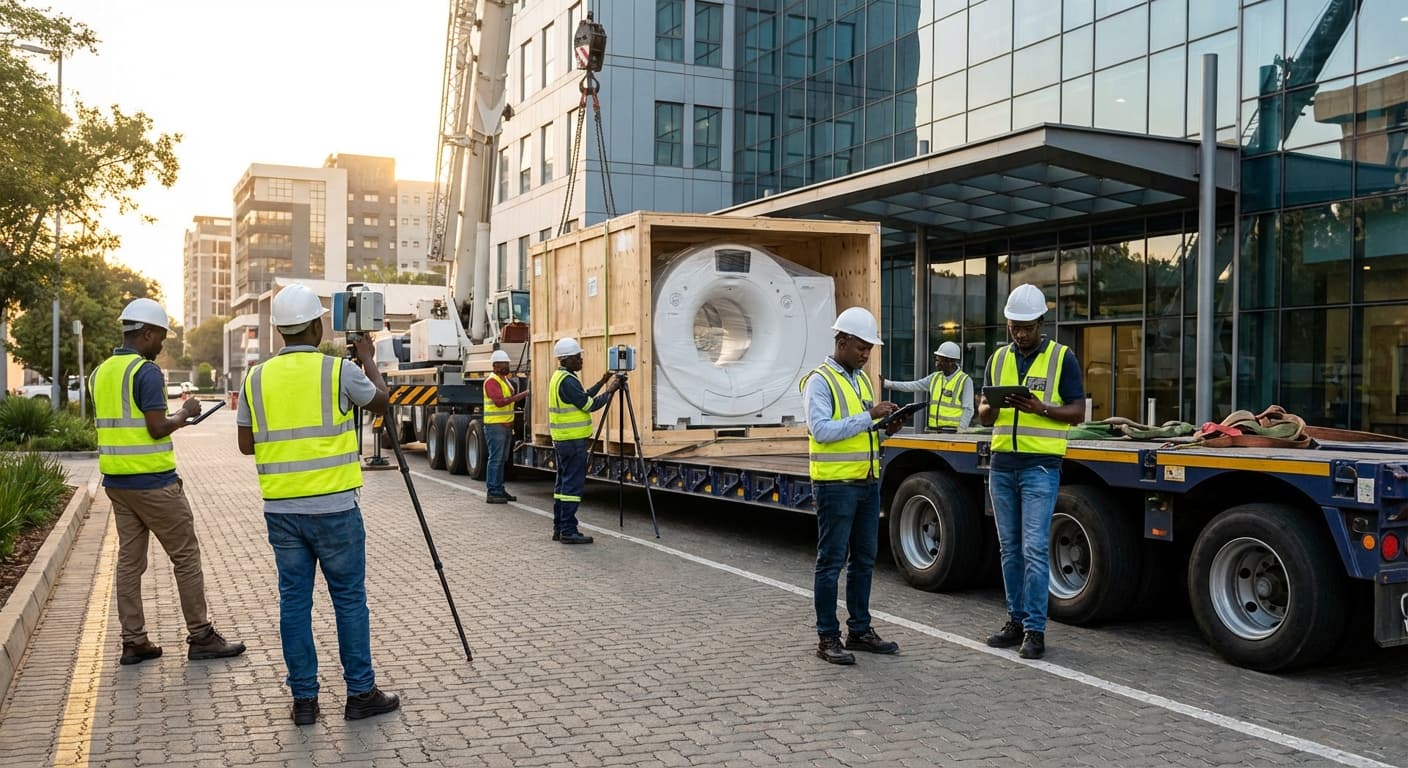
Route Survey & Rigging Plan Service for Heavy Medical Equipment in Tunisia
Engineering Excellence & Technical Support
Route Survey & Rigging Plan Service for Heavy Medical Equipment High-standard technical execution following OEM protocols and local regulatory frameworks.
Precision Route Mapping & Obstacle Analysis
Leveraging advanced surveying techniques and GIS mapping, we conduct detailed route surveys to identify the optimal paths for heavy medical equipment transport across Tunisia. Our analysis meticulously maps potential obstacles such as narrow streets, low bridges, weight-restricted areas, and tight turns, ensuring safe and efficient transit to healthcare facilities.
Specialized Rigging & Load Securing
Our expert rigging teams utilize state-of-the-art equipment and techniques for the secure loading, unloading, and positioning of sensitive heavy medical machinery. We develop tailored rigging plans that account for the unique weight, dimensions, and fragility of each piece of equipment, guaranteeing its integrity throughout the entire process.
Comprehensive Risk Assessment & Mitigation
We provide thorough risk assessments, identifying potential hazards associated with the transport and installation of heavy medical equipment in diverse Tunisian environments. Our service includes proactive mitigation strategies, traffic management coordination, and emergency preparedness plans to minimize disruptions and ensure the safety of personnel and equipment.
What Is Route Survey & Rigging Plan Service For Heavy Medical Equipment In Tunisia?
Route Survey & Rigging Plan Service for Heavy Medical Equipment in Tunisia refers to a specialized engineering and logistics process focused on the safe, efficient, and compliant transportation and installation of oversized, overweight, and delicate medical apparatus within Tunisia. This service is critical for ensuring that high-value medical equipment, often with stringent operational requirements, can be moved from point of import or manufacture to its final installation site without damage, disruption, or safety incidents. The scope encompasses a detailed assessment of the entire movement pathway, from initial site assessment to final placement and connection, incorporating all technical and logistical considerations.
| Need For Service | Typical Use Cases |
|---|---|
| Hospitals and Healthcare Facilities: Procurement of new imaging equipment (MRI, CT scanners, PET scanners), linear accelerators, surgical robots, large-scale laboratory analysis machines, or modular operating theaters. | Medical Equipment Manufacturers and Suppliers: Transporting newly manufactured or refurbished heavy medical devices from their production facilities or ports of entry to customer sites across Tunisia. |
| Research Institutions and Universities: Installation of specialized research equipment requiring significant logistical planning. | Medical Relocations: Moving existing large medical equipment between different departments within a facility, or transferring it to a new or expanded facility. |
| Government and Public Health Projects: Implementation of new medical infrastructure or upgrades requiring the delivery and installation of substantial equipment. | Emergency Response and Disaster Relief: Rapid deployment of essential heavy medical equipment to affected areas, often under challenging logistical conditions. |
Key Components of Route Survey & Rigging Plan Service
- Route Assessment and Planning: Comprehensive analysis of all potential transportation routes, including public roads, private access ways, and internal building pathways. This involves evaluating road conditions, bridge load capacities, overhead clearances (power lines, traffic signals, building overhangs), turning radii, gradient limitations, and potential traffic restrictions. GPS mapping and on-site verification are integral.
- Structural Integrity Assessment: Evaluation of the load-bearing capacity of floors, staircases, elevators, doorways, and crane pick-up points at both the origin and destination sites. This ensures that the weight and dimensions of the equipment can be safely accommodated.
- Rigging and Lifting Plan Development: Detailed engineering design for all lifting and rigging operations. This includes selecting appropriate cranes, hoists, slings, shackles, and other lifting accessories, calculating safe working loads (SWLs), developing lifting procedures, and specifying safety protocols. 3D modeling and simulation may be employed for complex lifts.
- Maneuvering and Installation Strategy: Planning for the precise movement of equipment within confined spaces, considering weight distribution, center of gravity, and the need for specialized dollies, hydraulic jacks, or other positioning equipment. This also includes outlining the final installation and commissioning steps.
- Permitting and Regulatory Compliance: Identification and acquisition of all necessary permits from local authorities, transportation agencies, and potentially building management for route access, road closures, and special transport vehicles. Ensuring adherence to Tunisian transport and safety regulations is paramount.
- Risk Assessment and Mitigation: Proactive identification of potential hazards and the development of mitigation strategies to address risks such as equipment damage, personnel injury, public safety, and environmental impact.
- Logistics Coordination: Seamless integration of transport, lifting, and installation phases with project timelines, including scheduling, coordination with port authorities, customs clearance, and other stakeholders.
- Documentation and Reporting: Provision of comprehensive reports detailing the survey findings, the rigging plan, risk assessments, permit status, and a record of the executed operations.
Who Needs Route Survey & Rigging Plan Service For Heavy Medical Equipment In Tunisia?
Ensuring the safe and efficient transportation and installation of heavy medical equipment in Tunisia is a complex undertaking that requires specialized expertise. Route Survey & Rigging Plan services are crucial for identifying optimal routes, assessing site-specific challenges, and developing detailed rigging plans to prevent damage to the equipment, infrastructure, and personnel. This service is indispensable for a range of stakeholders involved in the procurement, deployment, and ongoing operation of such critical assets.
| Customer Type | Key Departments/Personnel Involved | Specific Needs & Considerations |
|---|---|---|
| Hospitals & Healthcare Facilities | Procurement Department, Facilities Management, Biomedical Engineering Department, IT Department (for integrated systems), Operations Management | Navigating existing hospital layouts, narrow corridors, elevators, stairwells, and operating room spaces. Ensuring minimal disruption to patient care during installation. Planning for power, ventilation, and data connections. Compliance with healthcare safety regulations. |
| Medical Equipment Manufacturers & Suppliers | Logistics Department, Project Management, Technical Support, Sales Department | Protecting high-value equipment during transit and installation. Ensuring timely delivery and successful commissioning. Providing proof of safe handling procedures. Meeting contractual obligations for site readiness. |
| Logistics & Transportation Companies | Operations Management, Project Logistics Teams, Fleet Management, Safety Officers | Identifying safe and accessible routes considering road conditions, bridge capacities, traffic regulations, and potential obstacles. Developing lifting and securing plans for loading and unloading. Managing oversized and overweight permits. Ensuring compliance with transportation laws. |
| Construction & Engineering Firms | Project Managers, Site Engineers, Health & Safety Officers, Structural Engineers | Integrating equipment installation plans with building construction timelines. Ensuring structural integrity for equipment placement and support. Planning for necessary structural modifications or reinforcements. Coordinating with other trades on-site. |
| Government Agencies | Ministry of Health (Procurement & Planning), Public Works Department, Regulatory Compliance Departments | Ensuring public funds are utilized efficiently and safely. Verifying compliance with national standards and regulations for healthcare facilities. Overseeing large-scale public hospital projects. Standardizing procurement and installation processes. |
| Research Institutions & Universities | Laboratory Managers, Procurement Officers, Facilities Management, Principal Investigators | Handling specialized and sensitive research equipment. Ensuring precise placement within laboratory environments. Managing access to secure or controlled areas. Integrating with existing laboratory infrastructure and utilities. |
| International Aid Organizations & NGOs | Project Managers, Logistics Coordinators, Healthcare Program Officers, Finance Departments | Deploying equipment in potentially remote or underserved areas. Navigating challenging local infrastructure. Ensuring equipment is functional and maintained for long-term impact. Compliance with donor requirements and reporting. |
Target Customers for Route Survey & Rigging Plan Services in Tunisia:
- Hospitals and Healthcare Facilities (Public and Private)
- Medical Equipment Manufacturers and Suppliers
- Logistics and Transportation Companies specializing in heavy or oversized cargo
- Construction and Engineering Firms involved in hospital infrastructure development
- Government Agencies responsible for healthcare infrastructure and procurement
- Research Institutions and Universities with specialized medical laboratories
- International Aid Organizations and NGOs operating healthcare projects in Tunisia
Route Survey & Rigging Plan Service For Heavy Medical Equipment Process In Tunisia
This document outlines the comprehensive workflow for our Route Survey & Rigging Plan Service for the transportation of heavy medical equipment in Tunisia. Our service ensures the safe, efficient, and compliant movement of critical medical assets, from initial inquiry to final execution. We meticulously plan every step to mitigate risks and guarantee successful delivery.
| Stage | Description | Key Activities | Deliverables | Timeline (Estimated) |
|---|---|---|---|---|
| Inquiry & Initial Consultation | Receiving client's request and understanding the project scope. | Discussing equipment details (weight, dimensions, fragility), origin, destination, and any specific constraints. | Understanding of project requirements and preliminary feasibility assessment. | 1-2 Business Days |
| Information Gathering & Site Assessment | Collecting all necessary technical data about the medical equipment and the transport environment. | Obtaining equipment specifications, site drawings, access limitations, and identifying potential challenges at origin and destination. | Detailed equipment data sheet, site survey report (initial). | 2-5 Business Days |
| Route Survey & Analysis | Conducting a thorough physical survey of the proposed transportation route. | Identifying road conditions, bridge load capacities, overhead clearances (power lines, signs), turning radii, traffic patterns, and potential obstacles. GPS data collection and mapping. | Detailed route survey report with maps, photos, videos, and identification of critical points. | 5-10 Business Days (depending on route complexity) |
| Rigging Plan Development | Designing the detailed plan for lifting, securing, and transporting the equipment. | Selecting appropriate lifting equipment (cranes, forklifts), rigging gear (slings, shackles), transport vehicles (low-bed trailers, specialized trucks), and securing methods. Calculating load distribution and stability. | Comprehensive rigging and transportation plan, including equipment specifications, lift plans, load calculations, and safety procedures. | 5-7 Business Days |
| Client Review & Approval | Presenting the developed plans to the client for their review and feedback. | Detailed walk-through of the route survey and rigging plan. Addressing any client concerns and making necessary adjustments. | Client-approved route survey and rigging plan. | 2-3 Business Days |
| Permit Acquisition | Obtaining all necessary permits and authorizations for the transportation. | Liaising with local authorities (transportation departments, police, municipalities) to secure permits for oversized/overweight loads, road closures, and escorts. | All required transportation and movement permits. | 5-15 Business Days (highly variable by authority) |
| Pre-Execution Briefing & Equipment Mobilization | Preparing the team and resources for the execution phase. | Conducting pre-job safety briefings, mobilizing all necessary equipment and personnel to the site. Final checks on weather conditions and traffic. | On-site readiness, confirmed equipment and personnel deployment. | 1-2 Business Days |
| Execution of Transportation & Rigging | Carrying out the planned lifting, securing, and transportation operations. | Safe and precise lifting of the medical equipment, secure loading onto the transport vehicle, and methodical movement along the approved route with escorts if required. Adherence to all safety protocols. | Successful loading, transportation, and delivery of the medical equipment to the destination. | 1-3 Business Days (depending on distance and complexity) |
| Post-Execution & Handover | Completing the project and formally handing over the equipment. | Unloading and placement of the equipment at the destination as per client instructions. Final site clean-up. Submission of post-execution reports and documentation. | Signed delivery confirmation, post-execution report, and project closure documentation. | 1-2 Business Days |
Workflow Stages:
- Inquiry & Initial Consultation
- Information Gathering & Site Assessment
- Route Survey & Analysis
- Rigging Plan Development
- Client Review & Approval
- Permit Acquisition
- Pre-Execution Briefing & Equipment Mobilization
- Execution of Transportation & Rigging
- Post-Execution & Handover
Route Survey & Rigging Plan Service For Heavy Medical Equipment Cost In Tunisia
Estimating the cost for a route survey and rigging plan service for heavy medical equipment in Tunisia involves a nuanced approach. The pricing is not a fixed figure but rather a result of several interconnected factors. These factors dictate the complexity, resources required, and time investment from the service provider, ultimately influencing the final quotation. Understanding these elements is crucial for clients to anticipate costs and ensure they are receiving a fair and comprehensive service. The service typically includes a detailed assessment of the proposed route, identification of potential obstacles, structural integrity checks, and the development of a precise rigging and transportation plan to ensure the safe and efficient movement of the heavy medical equipment. The final cost in Tunisian Dinars (TND) will be a reflection of these considerations.
| Service Component | Estimated Cost Range (TND) | Notes |
|---|---|---|
| Initial Route Survey & Site Assessment | 1,000 - 5,000 TND | Varies based on distance, complexity, and number of sites. |
| Development of Rigging & Transportation Plan | 1,500 - 7,000 TND | Depends on equipment size, weight, and complexity of lifting/moving. |
| Specialized Engineering/Structural Analysis (if required) | 500 - 3,000 TND | For assessing building load capacities, bridge limitations, etc. |
| Permit Application & Facilitation Fees | 200 - 1,500 TND | Includes administrative costs and potential official fees. |
| On-site Supervision & Coordination (per day) | 300 - 1,000 TND | For the rigging and transportation execution phase. |
| Rental of Specialized Rigging/Lifting Equipment | Variable (e.g., 500 - 5,000+ TND per day) | Highly dependent on the type and capacity of equipment needed. |
| Comprehensive Project Management & Reporting | 1,000 - 4,000 TND | Covers overall coordination, documentation, and client communication. |
| Total Estimated Project Cost | 5,000 - 25,000+ TND | This is a broad range. A detailed quotation is necessary based on specific project requirements. |
Key Pricing Factors for Route Survey & Rigging Plan Service (Tunisia)
- Equipment Specifications: The size, weight, fragility, and specific handling requirements of the medical equipment are paramount. Larger, heavier, or more delicate items necessitate more robust planning and potentially specialized equipment for rigging and transport.
- Route Complexity & Distance: The total distance to be covered and the nature of the route significantly impact cost. Urban environments with traffic, narrow streets, and potential road closures are more complex than straightforward highway routes. Obstacles like bridges, tunnels, power lines, and uneven terrain require careful assessment and planning.
- Site Accessibility & Conditions: The ease of access to both the origin and destination points for the heavy equipment is a major consideration. Cramped spaces, multi-story buildings, or sites requiring temporary infrastructure modifications will add to the cost.
- Required Rigging & Lifting Equipment: The type and capacity of cranes, forklifts, specialized dollies, and lifting gear needed for the operation directly influence the pricing. The rental or procurement costs of this equipment are factored in.
- Number of Personnel & Expertise: The size of the rigging team, their skill levels, and the need for specialized technicians (e.g., for electrical or mechanical connections of the equipment) will affect labor costs.
- Permits & Authorizations: Obtaining necessary permits from local authorities, traffic management agencies, and potentially utility companies for road closures or temporary diversions will incur administrative fees and time.
- Risk Assessment & Contingency Planning: A thorough risk assessment is integral to the service. The extent of detailed risk analysis and the development of contingency plans for unforeseen events contribute to the overall service scope.
- Time Sensitivity & Urgency: Projects with tight deadlines or requiring off-hours work (nights, weekends, public holidays) often command higher prices due to increased labor costs and operational challenges.
- Insurance Coverage: The level and type of insurance required for the transportation and rigging of valuable medical equipment can add to the overall cost.
- Survey & Reporting Detail: The level of detail required in the route survey report and the rigging plan, including detailed CAD drawings, structural analyses, or photographic documentation, can influence the service cost.
Affordable Route Survey & Rigging Plan Service For Heavy Medical Equipment Options
Navigating the complexities of transporting and installing heavy medical equipment requires meticulous route surveys and rigging plans. Our specialized service offers cost-effective solutions, ensuring safety and compliance without compromising on quality. We understand the unique challenges associated with medical machinery, from precise handling to navigating confined spaces. Our approach focuses on providing detailed route assessments, identifying potential obstacles, and developing robust rigging strategies tailored to each specific piece of equipment and its destination. We prioritize efficiency and risk mitigation, helping you avoid costly delays and damages.
| Service Component | Typical Scope | Cost-Saving Benefit |
|---|---|---|
| Initial Consultation & Needs Assessment | Understanding equipment specifications, destination, and site constraints. | Ensures accurate planning from the outset, minimizing scope creep and rework. |
| On-Site Route Assessment | Physical inspection of all potential transport paths. | Identifies unforeseen challenges early, preventing costly delays and specialized equipment needs. |
| 3D Route Modeling & Obstacle Mapping | Digital representation of routes with critical dimensions and obstacle identification. | Facilitates precise equipment selection and route planning, reducing the need for on-the-spot problem-solving. |
| Rigging Equipment Selection & Load Calculations | Determining the safest and most efficient rigging gear based on weight and site conditions. | Prevents over-specification of equipment (saving rental costs) and under-specification (preventing damage and safety hazards). |
| Safety Protocol Development | Detailed safety procedures for lifting, moving, and installation. | Minimizes the risk of accidents, injuries, and equipment damage, which can incur significant indirect costs. |
| Permit & Traffic Management Planning | Assistance with necessary permits and planning for temporary traffic disruptions. | Avoids fines and project delays caused by non-compliance or unmanaged public impact. |
| Post-Move Inspection & Reporting | Verification of equipment placement and site condition after relocation. | Ensures client satisfaction and provides documentation for any potential future claims. |
Value Bundles and Cost-Saving Strategies:
- {"title":"Comprehensive Route Survey Package","description":"Includes detailed site inspections, 3D mapping of potential routes, identification of access points, and preliminary obstacle assessment (e.g., door widths, ceiling heights, elevator capacities)."}
- {"title":"Detailed Rigging Plan & Equipment Specification","description":"Encompasses lift planning, selection of appropriate rigging equipment (cranes, forklifts, dollies), load calculations, safety protocols, and personnel requirements."}
- {"title":"Combined Route & Rigging Optimization Bundle","description":"Integrates route survey findings directly into rigging plans for seamless execution. This bundle offers the most significant cost savings through enhanced planning and reduced on-site adjustments."}
- {"title":"Modular Service Add-ons","description":"Allows clients to select specific components like traffic management plans, specialized permit acquisition assistance, or post-installation structural integrity checks."}
- {"title":"Early Bird Booking Discounts","description":"Incentivizes clients to book services well in advance, allowing for better resource allocation and potential economies of scale."}
- {"title":"Multi-Equipment Project Discounts","description":"Reduces per-unit costs when multiple heavy medical equipment installations are planned concurrently, leveraging shared route surveying and planning efforts."}
- {"title":"Client-Provided Site Data Integration","description":"We can work with existing building blueprints and site data to reduce the need for extensive on-site measurements, thereby lowering survey costs."}
- {"title":"Standardized Procedure Templates","description":"Development of reusable planning templates for common equipment types, streamlining the planning process and reducing customization time and costs."}
Verified Providers In Tunisia
In Tunisia's burgeoning healthcare landscape, distinguishing between providers can be a challenge. For those seeking reliable and high-quality medical services, particularly those involving international standards and ethical practices, understanding 'verified providers' is crucial. Franance Health plays a pivotal role in this verification process, ensuring that healthcare facilities and professionals meet stringent criteria. Their credentials signify a commitment to patient safety, clinical excellence, and transparent operations, making them the best choice for discerning patients.
| Credential | Description | Benefit to Patients |
|---|---|---|
| Franance Health Accreditation | Indicates a healthcare facility has undergone a comprehensive evaluation of its services, infrastructure, and management systems by Franance Health. | Assures patients of adherence to high standards of quality, safety, and operational efficiency. |
| Certified Medical Professionals | Refers to doctors and specialists who have been assessed and recognized by Franance Health for their qualifications, experience, and ongoing professional development. | Provides confidence in the expertise and competence of the medical team treating them. |
| Compliance with International Protocols | Signifies that the provider adheres to internationally recognized medical protocols, guidelines, and best practices in treatment and patient care. | Ensures patients receive care that is consistent with global standards, offering peace of mind, especially for international travelers. |
| Patient Feedback Integration | Demonstrates that the provider actively collects and acts upon patient feedback as part of their continuous improvement process, overseen by Franance Health. | Highlights a patient-centric approach and a commitment to improving the overall patient experience. |
| Ethical and Transparent Operations | Franance Health verifies that providers operate with integrity, offering clear communication, fair pricing, and upholding patient rights. | Builds trust and ensures patients are treated with respect and honesty throughout their medical journey. |
Why Franance Health Credentials Matter
- Patient Safety Focus: Verified providers adhere to rigorous safety protocols, minimizing risks and ensuring a secure healthcare experience.
- Clinical Excellence: Franance Health vets providers for their medical expertise, advanced treatment methodologies, and commitment to continuous learning.
- Ethical Practices: Credentials guarantee adherence to ethical guidelines, fair pricing, and respectful patient care.
- International Standards Alignment: Verified facilities often meet or exceed international benchmarks for healthcare quality and management.
- Transparency and Trust: Franance Health's verification process fosters trust by providing patients with reliable information about provider qualifications.
- Streamlined Access: For international patients, verified providers offer a smoother and more predictable healthcare journey.
Scope Of Work For Route Survey & Rigging Plan Service For Heavy Medical Equipment
This Scope of Work (SOW) outlines the services required for a comprehensive route survey and detailed rigging plan for the safe and efficient transport of heavy medical equipment. The objective is to identify and mitigate all potential risks associated with the movement of sensitive and high-value assets from origin to installation point, ensuring adherence to all relevant technical and safety standards.
| Section | Description | Technical Deliverables | Standard Specifications / References |
|---|---|---|---|
| Comprehensive on-site survey of all proposed transport routes, including access roads, internal facility pathways, and installation areas. This includes detailed measurements, photographic evidence, and identification of potential obstacles and constraints. | Detailed Route Survey Report including:
| ISO 2769 (Safety in lifting operations) Relevant local transport regulations (e.g., road weight limits, permit requirements). Manufacturer's specifications for the medical equipment regarding transport dimensions and weight. |
| Design of a detailed plan for the safe lifting, moving, and positioning of the heavy medical equipment. This includes selection of appropriate lifting and rigging gear, calculation of load capacities, and definition of operational procedures. | Detailed Rigging Plan including:
| ANSI/ASME B30 series (Safety Standards for Cableways, Cranes, Derricks, Hoists, Hooks, Blocks, Rigging, and Load Chains). Relevant national and international standards for lifting equipment and rigging gear. Manufacturer's installation and handling guidelines for the medical equipment. |
| Evaluation of the origin and destination sites to confirm access for heavy transport vehicles and lifting equipment. Assessment of internal building access, including doorways, corridors, elevator capacities, and stairwells. | Site Assessment Report including:
| Relevant building codes and standards. Manufacturer's requirements for installation environment. |
| Proactive identification of all potential risks associated with the transport and rigging operation, and the development of comprehensive mitigation strategies. | Risk Assessment Matrix detailing identified risks, probability, impact, and mitigation measures. Contingency plans for unforeseen events. | OHSAS 18001 (Occupational Health and Safety Management Systems) or ISO 45001 principles. Industry-specific safety guidelines for heavy equipment handling. |
| Provision of all necessary documentation to clients, regulatory bodies, and operational teams, ensuring clear communication and traceability. | Final SOW compliance report. All interim and final reports as specified in deliverables. As-built documentation if any route modifications were implemented. | Client-specific reporting requirements. ISO 9001 principles for quality management in documentation. |
Key Objectives
- Accurate assessment of all transport routes, including origin, intermediate points, and final destination.
- Development of a detailed and safe rigging plan, including load calculations, equipment selection, and lifting methodologies.
- Identification and mitigation of all potential hazards and constraints along the route.
- Ensuring compliance with all applicable local, national, and international safety regulations and industry best practices.
- Minimizing downtime and potential damage to the medical equipment and surrounding infrastructure.
- Providing clear and actionable documentation for all survey findings and the rigging plan.
Service Level Agreement For Route Survey & Rigging Plan Service For Heavy Medical Equipment
This Service Level Agreement (SLA) outlines the response times and uptime guarantees for the Route Survey & Rigging Plan Service provided by [Your Company Name] for the deployment of heavy medical equipment. This agreement aims to ensure minimal disruption and efficient planning for our clients.
| Service Element | Target Response Time | Uptime Guarantee / Service Level |
|---|---|---|
| Initial Consultation (post-request) | Within 2 business hours | N/A |
| Acknowledgement of Survey Request (including scheduling confirmation) | Within 1 business day | N/A |
| Delivery of Draft Route Survey Report | Within 3-5 business days of site survey completion (dependent on complexity) | N/A |
| Delivery of Final Rigging Plan | Within 2 business days of approval of Draft Route Survey Report | N/A |
| Planning Portal Availability (if applicable) | N/A | 99.5% uptime during standard business hours (Mon-Fri, 9 AM - 5 PM [Time Zone]) |
| Accuracy of Route Survey Data | N/A | 98% accuracy in measurements and path clearance assessments |
| Accuracy of Rigging Plan | N/A | 100% adherence to manufacturer specifications and safety standards |
| Notification of Planned Maintenance | N/A | 24 hours advance notice for scheduled downtime of planning portal |
| Notification of Unplanned Outages | N/A | Within 1 hour of detection for planning portal |
Key Service Level Objectives
- Response Time for Initial Consultation:
- Response Time for Survey Request Submission:
- Response Time for Rigging Plan Delivery:
- Uptime Guarantee for Planning Portal (if applicable):
- Data Accuracy and Completeness:
- Notification of Service Interruption:
Frequently Asked Questions

Ready when you are
Let's scope your Route Survey & Rigging Plan Service for Heavy Medical Equipment in Tunisia project in Tunisia.

Scaling healthcare logistics and technical systems across the entire continent.