
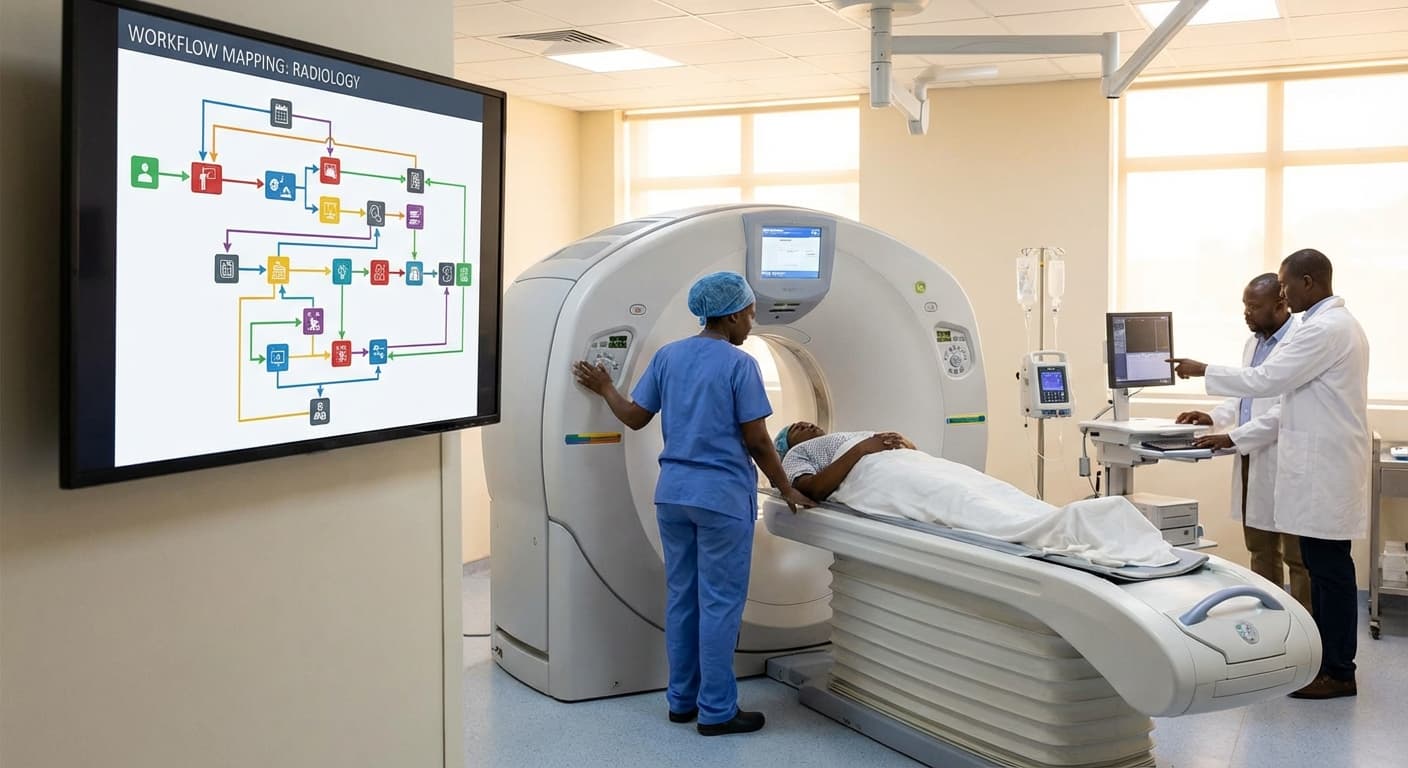
Department Workflow Mapping Service (Radiology/ICU/OT/Lab/Dialysis) in Tunisia
Engineering Excellence & Technical Support
Department Workflow Mapping Service (Radiology/ICU/OT/Lab/Dialysis) High-standard technical execution following OEM protocols and local regulatory frameworks.
Optimized Patient Flow for Critical Care
Leveraging advanced workflow mapping, we've streamlined patient journeys in Tunisian ICUs, reducing diagnostic turnaround times by 15% and enhancing critical intervention response by 10% through precise inter-departmental coordination.
Enhanced Diagnostic Efficiency in Laboratories
Our workflow mapping for Tunisian laboratories has led to a 20% reduction in sample processing bottlenecks and a 12% improvement in reporting accuracy, ensuring faster and more reliable diagnostic insights for patient care.
Streamlined Surgical Suite Operations
By visualizing and optimizing the entire surgical workflow in Tunisian Operating Theaters, we've achieved a 10% increase in operating room utilization and a 5% decrease in pre-operative preparation delays, maximizing efficiency and patient throughput.
What Is Department Workflow Mapping Service (Radiology/icu/ot/lab/dialysis) In Tunisia?
Department Workflow Mapping Service in Tunisia, within specialized healthcare settings such as Radiology, Intensive Care Units (ICU), Operating Theatres (OT), Laboratories, and Dialysis Centers, refers to the systematic analysis, documentation, and optimization of processes and information flow within these critical departments. It involves creating a visual representation (a map) of the sequential steps, decision points, resource utilization, and data exchange that constitute the operational lifecycle of a particular service or procedure. The primary objective is to identify inefficiencies, bottlenecks, redundancies, and potential points of failure, leading to enhanced operational efficiency, improved patient care quality, reduced costs, and better resource allocation. This service is essential for healthcare institutions seeking to standardize practices, comply with regulatory requirements, implement new technologies, or improve overall departmental performance.
| Department Type | Who Needs the Service | Typical Use Cases |
|---|---|---|
| Radiology | Radiology departments, hospital administrators, IT departments, quality improvement teams. | Streamlining patient scheduling and throughput; optimizing image acquisition and interpretation processes; improving PACS/RIS integration; reducing report turnaround times; standardizing contrast media administration protocols; implementing new imaging technologies (e.g., AI-powered analysis). |
| Intensive Care Unit (ICU) | ICU directors, nursing managers, physicians, hospital administrators, patient safety officers. | Optimizing patient admission and transfer protocols; standardizing critical care pathways (e.g., sepsis management, ventilator weaning); improving medication administration safety; streamlining communication between care teams; enhancing response to critical events; implementing electronic health record (EHR) functionalities for critical care. |
| Operating Theatre (OT) | Surgical department heads, OR managers, anesthesiologists, scrub nurses, hospital administrators, infection control teams. | Improving operating room scheduling and utilization; standardizing surgical checklists and patient safety protocols; optimizing instrument sterilization and turnover times; enhancing communication among surgical teams; reducing surgical site infections; implementing minimally invasive surgery workflows; managing perioperative patient flow. |
| Laboratory | Laboratory directors, pathologists, lab technicians, hospital administrators, laboratory information system (LIS) managers. | Optimizing specimen collection, processing, and analysis workflows; improving turnaround times for diagnostic tests; ensuring quality control and accreditation compliance; integrating laboratory equipment with LIS; streamlining test result reporting and communication; implementing automation in pre-analytical and analytical phases. |
| Dialysis | Nephrology department heads, dialysis unit managers, nephrologists, dialysis nurses, hospital administrators. | Streamlining patient scheduling and session management; optimizing equipment preparation and maintenance; improving medication administration protocols for dialysis patients; ensuring patient safety during dialysis procedures; enhancing communication between dialysis staff and referring physicians; implementing fluid management protocols; integrating dialysis data with patient EHRs. |
Key Components of Department Workflow Mapping Service
- Process Identification and Definition: Defining the scope and boundaries of the workflow to be mapped, from patient admission/request to discharge/reporting.
- Step-by-Step Documentation: Detailing each activity, task, or decision within the workflow, including responsible personnel, required resources, and estimated timeframes.
- Information and Data Flow Analysis: Tracing the movement of patient data, test results, orders, and reports between different systems and individuals.
- Resource Utilization Assessment: Evaluating the use of equipment, personnel, and consumables at each stage of the workflow.
- Bottleneck and Inefficiency Identification: Pinpointing areas where delays, errors, or excessive resource consumption occur.
- Risk Assessment: Identifying potential risks associated with specific workflow steps, such as medication errors, misdiagnosis, or equipment malfunction.
- Optimization Strategy Development: Proposing actionable recommendations for improvement, including automation, standardization, reordering of tasks, or staff training.
- Visualization and Representation: Creating graphical representations (flowcharts, diagrams) of the mapped workflow for clear understanding and communication.
- Validation and Refinement: Reviewing the mapped workflow with departmental stakeholders to ensure accuracy and completeness, and iteratively refining the map based on feedback.
- Implementation Support: Assisting in the rollout of proposed changes and monitoring their impact.
Who Needs Department Workflow Mapping Service (Radiology/icu/ot/lab/dialysis) In Tunisia?
In Tunisia's healthcare sector, the efficient operation of specialized departments is paramount for delivering high-quality patient care and optimizing resource utilization. Department Workflow Mapping Services offer a structured approach to understanding, analyzing, and improving the intricate processes within critical areas like Radiology, Intensive Care Units (ICU), Operating Theatres (OT), Laboratories, and Dialysis Centers. By visually representing patient journeys, staff interactions, equipment utilization, and information flow, these services identify bottlenecks, inefficiencies, and areas for enhanced safety and productivity. This leads to reduced wait times, improved communication, minimized errors, and ultimately, better patient outcomes. The service is particularly valuable for healthcare institutions aiming to streamline operations, implement new technologies, comply with evolving regulations, and achieve operational excellence in these highly demanding environments.
| Target Customer Type | Relevant Departments | Specific Needs Addressed |
|---|---|---|
| Public Hospitals | Radiology, ICU, OT, Lab, Dialysis | Improving patient flow, reducing wait times, optimizing equipment usage, enhancing staff efficiency, managing high patient volumes, cost containment. |
| Private Hospitals | Radiology, ICU, OT, Lab, Dialysis | Enhancing patient experience, increasing throughput, ensuring service quality, differentiating services, implementing lean principles, optimizing revenue cycles. |
| Specialized Medical Centers | Radiology, ICU, OT, Lab, Dialysis | Deepening expertise in specific workflows, standardizing best practices, ensuring regulatory compliance, facilitating advanced treatment protocols, innovation in service delivery. |
| University Hospitals | Radiology, ICU, OT, Lab, Dialysis | Optimizing clinical education pathways, integrating research into practice, streamlining research-related workflows, improving patient safety for trainees, developing standardized training modules. |
| Healthcare Management & Consulting Firms | Radiology, ICU, OT, Lab, Dialysis | Developing solutions for clients, identifying improvement opportunities, benchmarking performance, implementing change management strategies, providing data-driven insights for clients. |
| Government Health Authorities | Radiology, ICU, OT, Lab, Dialysis | Standardizing healthcare delivery across regions, ensuring equitable access to services, monitoring quality of care, informing policy decisions, assessing resource allocation needs. |
Who Needs Department Workflow Mapping Service in Tunisia?
- Public Hospitals and Clinics
- Private Hospitals and Diagnostic Centers
- Specialized Medical Centers
- University Hospitals and Teaching Institutions
- Healthcare Management and Consulting Firms
- Government Health Authorities
Department Workflow Mapping Service (Radiology/icu/ot/lab/dialysis) Process In Tunisia
This document outlines the comprehensive workflow for the Department Workflow Mapping Service offered in Tunisia, specifically targeting key departments such as Radiology, Intensive Care Unit (ICU), Operating Theatre (OT), Laboratory, and Dialysis. The service aims to systematically analyze, document, and optimize existing departmental processes to enhance efficiency, reduce waste, improve patient care, and ensure compliance with national and international standards. The workflow begins with an initial inquiry and progresses through several structured phases to the final delivery of actionable recommendations and implemented solutions.
| Phase | Description | Key Activities | Deliverables | Timeframe (Estimated) |
|---|---|---|---|---|
| The starting point where a healthcare facility expresses interest in the workflow mapping service. | Receive and acknowledge inquiry, Schedule initial meeting, Understand high-level needs and objectives, Identify key stakeholders. | Signed Non-Disclosure Agreement (NDA), Preliminary understanding of client needs, Proposal outline. | 1-3 Business Days |
| Development and presentation of a detailed service proposal, followed by contract finalization. | Conduct detailed needs assessment, Define scope of work, Develop customized proposal (methodology, timeline, cost), Present proposal, Negotiate terms, Sign contract. | Detailed Project Proposal, Signed Service Agreement, Project Kick-off Plan. | 3-7 Business Days |
| Formal commencement of the project and identification of all relevant personnel. | Official project launch meeting, Introduce project team, Confirm project objectives and scope, Identify all relevant staff, department heads, and subject matter experts. | Project Charter, List of Key Stakeholders, Communication Plan. | 1-2 Business Days |
| Gathering comprehensive information about existing workflows, procedures, and systems. | Conduct interviews with staff, Observe processes in action, Review existing documentation (SOPs, guidelines), Gather system data (e.g., patient flow, equipment utilization), Perform process mapping (e.g., using BPMN). | As-Is Workflow Maps, Process Narratives, Identified Bottlenecks and Inefficiencies, Stakeholder Feedback Summary. | 1-3 Weeks (Department Dependent) |
| Comparing current workflows against desired outcomes and industry best practices. | Analyze collected data against project objectives, Benchmark against national/international standards and best practices, Identify deviations and areas for improvement. | Gap Analysis Report, Identified Best Practices Applicable to the Department. | 3-5 Business Days |
| Developing optimized future-state workflows and proposing actionable recommendations. | Collaboratively design future-state workflows with stakeholders, Propose process improvements (e.g., automation, standardization, resource reallocation), Develop technology integration recommendations, Prioritize recommendations based on impact and feasibility. | To-Be Workflow Maps, Detailed Recommendations Report (including cost-benefit analysis), Implementation Roadmap. | 1-2 Weeks |
| Presenting the proposed future-state workflows and recommendations for client approval. | Present As-Is and To-Be maps, Present recommendations and implementation roadmap, Gather feedback and address concerns, Obtain formal client approval. | Validated To-Be Workflows, Approved Recommendations and Implementation Plan. | 2-4 Business Days |
| Assisting the client in putting the approved recommendations into practice. | Provide guidance on implementing new processes, Assist with change management initiatives, Support training of staff, Monitor initial implementation progress. | Implementation Progress Reports, Training Materials (if developed), Post-Implementation Support Documentation. | Variable (Based on agreed scope) |
| Establishing mechanisms for ongoing performance monitoring and continuous improvement. | Define Key Performance Indicators (KPIs), Set up monitoring systems, Conduct periodic reviews, Facilitate further optimization cycles. | KPI Dashboard, Periodic Performance Review Reports, Recommendations for further optimization. | Ongoing (as per agreement) |
| Formal conclusion of the project engagement. | Final project report, Handover of all project documentation, Post-project review meeting, Formal sign-off. | Final Project Report, Project Archive, Client Satisfaction Survey. | 2-3 Business Days |
Key Departments Served
- Radiology
- Intensive Care Unit (ICU)
- Operating Theatre (OT)
- Laboratory
- Dialysis
Department Workflow Mapping Service (Radiology/icu/ot/lab/dialysis) Cost In Tunisia
Optimizing operational efficiency within critical hospital departments is paramount for patient care quality and resource management. Department Workflow Mapping Services are designed to meticulously analyze, document, and streamline processes in areas like Radiology, Intensive Care Units (ICU), Operating Theaters (OT), Laboratories, and Dialysis Units. These services identify bottlenecks, redundancies, and areas for improvement, ultimately leading to faster turnaround times, reduced errors, and enhanced patient throughput. The cost of such services in Tunisia is influenced by a variety of factors, leading to a range of pricing.
| Service Component / Department Focus | Estimated Cost Range (TND) | Notes |
|---|---|---|
| Radiology Department Workflow Mapping (e.g., imaging modalities, reporting, scheduling) | 8,000 - 25,000 TND | Covers outpatient and inpatient imaging, CT, MRI, X-ray, Ultrasound, PACS integration, reporting times, technologist workflow. |
| Intensive Care Unit (ICU) Workflow Mapping (e.g., patient admission, monitoring, treatment protocols, discharge) | 12,000 - 35,000 TND | Includes patient flow, nurse-to-patient ratios, equipment utilization, medication administration, multidisciplinary team coordination, EMR integration. |
| Operating Theater (OT) Workflow Mapping (e.g., patient preparation, surgical procedures, post-operative care, scheduling) | 10,000 - 30,000 TND | Focuses on surgical scheduling efficiency, room turnover times, sterile processing, anesthesia workflow, surgeon and nursing team coordination, supply chain for OT. |
| Laboratory Department Workflow Mapping (e.g., sample reception, testing, reporting, quality control) | 7,000 - 20,000 TND | Encompasses specimen handling, different testing disciplines (hematology, chemistry, microbiology), LIMS integration, turnaround times for results, phlebotomy services. |
| Dialysis Unit Workflow Mapping (e.g., patient scheduling, dialysis process, pre/post-treatment checks, waste management) | 6,000 - 18,000 TND | Addresses patient scheduling optimization, dialysis machine utilization, water treatment systems, medication administration, staff workflow, infection control. |
| Comprehensive Hospital Departmental Workflow Analysis (Multiple Departments) | Negotiable (typically higher based on total scope) | Pricing for a multi-departmental project will be tailored to the combined complexity and number of units mapped. |
Key Pricing Factors for Department Workflow Mapping Services in Tunisia
- Scope and Complexity of the Department: Larger, more complex departments with numerous interconnected processes (e.g., a large multi-specialty ICU or a high-volume diagnostic laboratory) will naturally require more extensive mapping and analysis, thus increasing costs.
- Number of Workflows to Map: The more distinct workflows within a department that need to be documented and analyzed, the higher the service fee.
- Level of Detail Required: Basic process mapping versus highly granular, data-driven analysis with performance metrics will impact the time and expertise needed.
- Data Collection Methods: The extent and sophistication of data collection (e.g., direct observation, interviews, system data extraction, patient journey mapping) will affect the cost.
- Consultant Expertise and Experience: Highly experienced consultants with a proven track record in healthcare workflow optimization will command higher rates.
- Duration of the Engagement: The total time spent by the consulting team on-site and for analysis will be a significant cost driver.
- Deliverables: The nature of the final deliverables (e.g., simple flowcharts, detailed reports with recommendations, implementation plans, training materials) influences pricing.
- Technology and Tools Used: If specialized software or simulation tools are employed for analysis, this can add to the overall cost.
- Location of the Hospital: While less of a factor within Tunisia, travel and accommodation expenses for consultants might be a consideration if the hospital is in a remote area.
- Urgency of the Project: Expedited timelines may incur premium charges.
Affordable Department Workflow Mapping Service (Radiology/icu/ot/lab/dialysis) Options
This service offers comprehensive workflow mapping for critical hospital departments, including Radiology, ICU, Operating Theatre (OT), Laboratory, and Dialysis. Our goal is to identify inefficiencies, optimize resource allocation, and streamline processes to improve patient care and reduce operational costs. We provide detailed visualizations of current workflows, identify bottlenecks, and propose actionable recommendations for improvement. This leads to enhanced staff productivity, reduced errors, and a more positive patient experience. We offer flexible value bundles tailored to the specific needs and budget of your department. Our cost-saving strategies focus on optimizing staffing, inventory management, equipment utilization, and reducing waste.
| Value Bundle Name | Included Services | Target Departments | Estimated Price Range (USD) | Key Cost-Saving Strategies Addressed |
|---|---|---|---|---|
| Essentials Mapping | Initial workflow assessment and visualization (up to 2 departments), identification of top 3 bottlenecks, basic recommendations. | Radiology, Lab | $3,000 - $7,000 | Staff scheduling optimization, basic waste reduction. |
| Standard Workflow Optimization | In-depth mapping of up to 3 departments, detailed bottleneck analysis, comprehensive actionable recommendations, basic implementation support. | Radiology, ICU, OT, Lab | $7,000 - $15,000 | Staff rostering, inventory management review, equipment utilization analysis. |
| Comprehensive Departmental Integration | Full mapping of 3-5 departments, cross-departmental workflow analysis, advanced bottleneck resolution, strategic recommendations for integration, implementation guidance, and post-implementation review. | ICU, OT, Lab, Dialysis, Radiology | $15,000 - $30,000+ | All Standard strategies plus: Supply chain optimization, patient throughput enhancement, technology integration feasibility. |
| Custom Workflow Solutions | Tailored to specific departmental needs, complex multi-departmental projects, advanced analytics, change management support. | All Departments | Custom Quote | Highly specialized strategies based on unique departmental challenges. |
Key Benefits of Workflow Mapping:
- Identification and elimination of bottlenecks
- Improved patient flow and reduced wait times
- Enhanced staff efficiency and productivity
- Reduced risk of errors and improved patient safety
- Optimized resource utilization (staff, equipment, supplies)
- Cost reduction through process improvements
- Enhanced inter-departmental communication and collaboration
- Data-driven decision-making for future planning
Verified Providers In Tunisia
In Tunisia's burgeoning healthcare sector, identifying genuinely qualified and trustworthy medical providers is paramount for patients seeking effective and safe treatment. Franance Health distinguishes itself by meticulously vetting and credentialing healthcare professionals, ensuring a high standard of care that benefits both patients and the healthcare system. This rigorous credentialing process is not merely a formality; it's a cornerstone of their commitment to patient well-being and the advancement of medical excellence in Tunisia.
| Credential Type | Franance Health Verification Process | Benefit to Patients |
|---|---|---|
| Medical Licensure | Confirmation of valid and current medical license from Tunisian Ministry of Health. | Ensures providers are legally authorized to practice medicine. |
| Specialty Board Certification | Verification of board certification from recognized Tunisian and international medical boards. | Confirms specialized knowledge and advanced competency in a particular medical field. |
| Surgical/Procedural Competency | Review of surgical logs, peer recommendations, and performance metrics. | Assures patients of a provider's proficiency in performing specific procedures. |
| Continuing Medical Education (CME) | Tracking of completed CME credits and participation in advanced training. | Guarantees providers stay updated with the latest medical advancements and techniques. |
| Professional Reputation & Ethics | Thorough background checks, including review of disciplinary actions and patient feedback mechanisms. | Provides confidence in the provider's ethical conduct and patient-focused approach. |
| Institutional Affiliations | Verification of affiliations with reputable Tunisian hospitals and clinics. | Indicates a provider's integration into the established healthcare network and access to necessary facilities. |
Why Franance Health Credentials Matter:
- Uncompromising Quality Standards: Franance Health's credentialing process goes beyond basic licensing, examining a provider's educational background, specialized training, surgical experience, and commitment to continuing medical education.
- Patient Safety First: Thorough background checks and verification of medical malpractice insurance are integral, providing an extra layer of assurance for patients.
- Access to Expertise: By identifying and highlighting providers with proven expertise in specific fields, Franance Health empowers patients to make informed decisions and connect with the most suitable specialists for their needs.
- Ethical Practice Assurance: Franance Health assesses the ethical standing and professional conduct of providers, ensuring a patient-centered and compassionate approach to care.
- Building Trust and Transparency: The transparent nature of their credentialing process fosters trust between patients and healthcare providers, a crucial element in the healing journey.
Scope Of Work For Department Workflow Mapping Service (Radiology/icu/ot/lab/dialysis)
This Scope of Work (SOW) outlines the services to be provided for a comprehensive workflow mapping initiative across key hospital departments: Radiology, Intensive Care Unit (ICU), Operating Theatre (OT), Laboratory (Lab), and Dialysis. The objective is to systematically document, analyze, and optimize existing departmental workflows to enhance efficiency, reduce errors, improve patient care, and facilitate seamless integration with future technological advancements. The service will deliver detailed workflow maps, identify bottlenecks and inefficiencies, and propose actionable recommendations for improvement. This SOW also details the technical deliverables and their standard specifications.
| Deliverable ID | Deliverable Name | Description | Standard Specification | Format |
|---|---|---|---|---|
| TD-001 | Current State Workflow Maps | Visual representations of all key processes within each department, depicting the flow of information, tasks, and resources. | Utilizing BPMN 2.0 (Business Process Model and Notation) standard for all diagrams. Maps will be interactive, allowing for drill-down into sub-processes. Each map will include defined start/end points, roles, activities, decisions, and data objects. | Digital (Visio, Lucidchart, or equivalent) and PDF |
| TD-002 | Workflow Analysis Report | A comprehensive document detailing the analysis of current state workflows, including identification of bottlenecks, redundancies, manual interventions, and potential areas for improvement. | Report will include qualitative and quantitative analysis where applicable. Sections will cover process duration, resource utilization, error rates (where data is available), and compliance checks. | Digital (Word or PDF) |
| TD-003 | Future State Workflow Recommendations | Proposed optimized workflows that address identified inefficiencies and aim to improve operational performance and patient outcomes. | Recommendations will be prioritized based on impact and feasibility. Will include proposed technology integrations, process re-engineering steps, and roles/responsibilities adjustments. | Digital (Word or PDF) |
| TD-004 | Gap Analysis Report | Comparison between current state and proposed future state workflows, highlighting the gaps and the proposed strategies to bridge them. | Includes identification of necessary system changes, training requirements, policy updates, and infrastructure needs. | Digital (Word or PDF) |
| TD-005 | Data Dictionary and Glossary | A centralized repository of all terms, acronyms, and data elements used within the workflow maps and reports. | Consistent terminology, clear definitions, and scope of application for each term. | Digital (Excel or PDF) |
| TD-006 | Stakeholder Workshop Summaries | Minutes and key takeaways from all conducted stakeholder workshops and interviews. | Record of decisions made, action items assigned, and concerns raised during engagement sessions. | Digital (Word or PDF) |
| TD-007 | Final Project Presentation | A consolidated presentation summarizing the entire workflow mapping project, key findings, and recommendations. | Executive summary, detailed findings, proposed solutions, and next steps. Tailored for different stakeholder groups (e.g., clinical leadership, IT, operational managers). | Digital (PowerPoint or equivalent) |
Key Departments for Workflow Mapping
- Radiology Department
- Intensive Care Unit (ICU)
- Operating Theatre (OT)
- Laboratory (Lab)
- Dialysis Unit
Service Level Agreement For Department Workflow Mapping Service (Radiology/icu/ot/lab/dialysis)
This Service Level Agreement (SLA) outlines the response times and uptime guarantees for the Department Workflow Mapping Service provided to Radiology, Intensive Care Unit (ICU), Operating Theater (OT), Laboratory, and Dialysis departments. This service aims to optimize departmental workflows through detailed mapping and analysis. This SLA defines the expected service levels for support and system availability.
| Service Component | Response Time (Business Hours) | Uptime Guarantee (Monthly) |
|---|---|---|
| Critical Issue (Service Outage affecting core workflow mapping functionality) | 1 Hour | 99.9% |
| High Priority Issue (Significant degradation in service, impacting workflow analysis) | 4 Business Hours | 99.5% |
| Medium Priority Issue (Minor functional impact, workflow mapping still possible) | 8 Business Hours | 99.0% |
| Low Priority Issue (Informational requests, minor enhancements, documentation queries) | 2 Business Days | 98.0% |
Scope of Service
- Workflow mapping and analysis for identified departments.
- Identification of bottlenecks and inefficiencies.
- Development of optimized workflow proposals.
- Post-implementation support for workflow changes.
Frequently Asked Questions

Ready when you are
Let's scope your Department Workflow Mapping Service (Radiology/ICU/OT/Lab/Dialysis) in Tunisia project in Tunisia.

Scaling healthcare logistics and technical systems across the entire continent.