
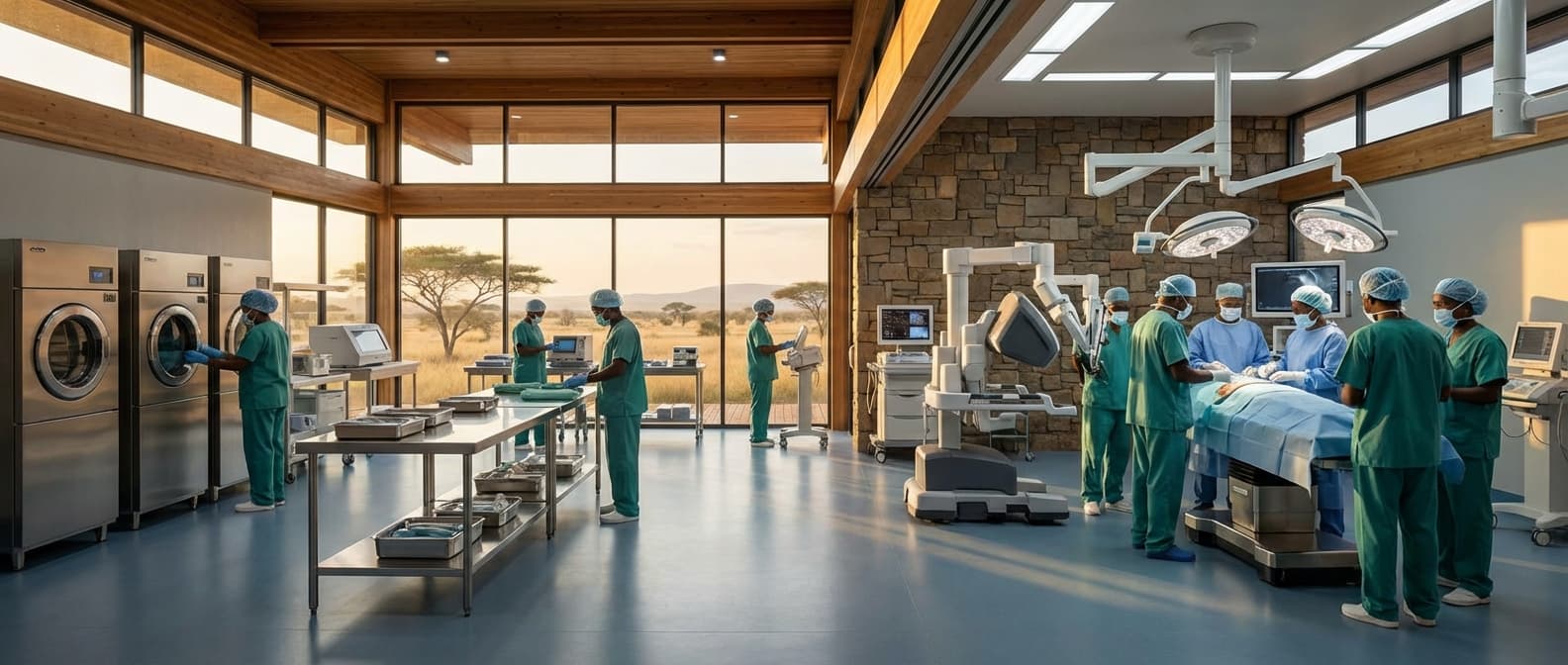
CSSD Design & Validation in Tunisia
Engineering Excellence & Technical Support
CSSD workflow design, validation and process development High-standard technical execution following OEM protocols and local regulatory frameworks.
Sterilization Process Optimization
Leveraging advanced simulation tools and process mapping to identify bottlenecks and optimize cycle times in CSSD workflows, ensuring maximum throughput while maintaining stringent sterilization efficacy for critical medical devices.
Validation Protocol Development & Execution
Designing and executing comprehensive validation protocols for sterilization equipment and processes (e.g., autoclaves, washer-disinfectors) according to international standards (ISO 17665, ISO 13485), providing robust evidence of consistent performance and patient safety.
Performance Monitoring & Data Analytics
Implementing real-time monitoring systems and advanced data analytics to track key performance indicators (KPIs) of CSSD operations, enabling proactive identification of deviations and data-driven decision-making for continuous quality improvement and regulatory compliance.
What Is Cssd Design & Validation In Tunisia?
CSSD (Central Sterile Services Department) design and validation in Tunisia refers to the specialized engineering and quality assurance services required to establish, equip, and verify the operational integrity of sterile processing facilities. This encompasses the architectural planning, equipment selection and integration, workflow optimization, and rigorous validation protocols to ensure the effective and safe sterilization of medical devices, conforming to national and international standards. The process guarantees that the CSSD operates efficiently, minimizes contamination risks, and meets regulatory compliance requirements within the Tunisian healthcare landscape.
| Stakeholder Group | Needs Addressed by CSSD Design & Validation | Typical Use Cases |
|---|---|---|
| Hospitals & Clinics (Public & Private) | Ensuring a safe and efficient supply of sterile medical instruments for patient care, compliance with healthcare accreditation standards, reduction of healthcare-associated infections (HAIs), operational cost optimization, and legal compliance. | New hospital construction or renovation, expansion of surgical services, upgrading existing sterilization facilities, establishing a centralized CSSD for multiple facilities, responding to regulatory audit findings. |
| Medical Device Manufacturers & Distributors | Validation of sterilization processes for reusable medical devices intended for sale, compliance with medical device regulations (e.g., CE marking requirements for European markets), assurance of product sterility for market access. | Developing sterilization validation packages for new reusable medical devices, conducting re-validation studies after process changes, providing compliance documentation to regulatory bodies. |
| Government & Regulatory Bodies (Ministry of Health) | Setting and enforcing standards for sterile processing, ensuring public safety and quality of healthcare, overseeing compliance of healthcare facilities, licensing and accreditation of CSSD operations. | Developing and updating national CSSD guidelines, conducting inspections and audits of healthcare facilities, approving designs for new healthcare infrastructure, investigating incidents related to sterilization failures. |
| Engineering & Consultancy Firms (Specialized) | Providing expertise in facility design, equipment selection, workflow optimization, validation engineering, and regulatory consultation to healthcare providers and manufacturers. | Designing and overseeing the construction of new CSSD facilities, developing validation master plans, conducting risk assessments for sterilization processes, offering expert witness services in legal cases related to sterilization. |
Key Components of CSSD Design & Validation Services:
- Facility Design & Layout: Optimizing space utilization for unidirectional workflow (decontamination, packaging, sterilization, storage) to prevent cross-contamination. Includes ventilation, drainage, and utility (steam, compressed air, vacuum) considerations.
- Equipment Specification & Integration: Selecting appropriate sterilization technologies (e.g., autoclaves, low-temperature sterilizers), washer-disinfectors, drying cabinets, and packaging equipment based on throughput requirements, device types, and budget. Ensuring seamless integration and interoperability.
- Workflow Analysis & Optimization: Developing detailed Standard Operating Procedures (SOPs) for each stage of the sterilization process, from receiving soiled instruments to releasing sterile products. Implementing Lean methodologies to enhance efficiency.
- Regulatory Compliance & Standards Adherence: Ensuring adherence to Tunisian healthcare regulations, Ministry of Health guidelines, and relevant international standards such as ISO 13485, ISO 17665, AAMI ST79, and EN 285.
- Validation Protocols: Executing comprehensive validation studies including Installation Qualification (IQ), Operational Qualification (OQ), and Performance Qualification (PQ) for all equipment and the entire process. This involves testing parameters like temperature, pressure, time, and chemical efficacy.
- Commissioning & Training: Supervising the installation and startup of equipment, conducting performance tests, and providing comprehensive training to CSSD personnel on operation, maintenance, and quality control.
- Ongoing Monitoring & Re-validation: Establishing systems for continuous process monitoring, routine performance testing, and scheduled re-validation to maintain compliance and operational excellence throughout the facility's lifecycle.
Who Needs Cssd Design & Validation In Tunisia?
In Tunisia, the meticulous design and rigorous validation of Central Sterile Services Departments (CSSD) are paramount for ensuring patient safety, infection control, and operational efficiency within healthcare facilities. A well-designed and validated CSSD is not merely a functional space; it's a critical control point in the healthcare delivery system, directly impacting the quality of care and reducing the risk of healthcare-associated infections (HAIs). This process is essential for any institution that handles and reprocesses reusable medical devices, from minor surgical instruments to complex endoscopic equipment.
| Target Customer | Typical Departments Involved in CSSD Design & Validation | Key Reasons for Need |
|---|---|---|
| Public Hospitals | Infection Control Department, Surgical Departments, CSSD Staff, Biomedical Engineering, Procurement, Administration, Quality Assurance | High volume of procedures, strict regulatory compliance, patient safety, cost-effectiveness, reducing HAIs |
| Private Hospitals | Infection Control Nurse, Surgical Teams, CSSD Manager, Quality Management, Facility Management, Administration | Maintaining high standards of care, patient satisfaction, competitive advantage, regulatory adherence, brand reputation |
| Surgical Centers & Day Clinics | Lead Surgeon/Physician, Clinic Manager, Head Nurse, CSSD Technician (if applicable), Facility Manager | Efficient turnaround of instruments for high-volume procedures, minimizing downtime, ensuring instrument readiness, patient safety |
| Specialty Medical Centers | Specialist Physicians, Department Head, Nurse Manager, CSSD Coordinator (if applicable), Biomedical Technician | Handling of specialized instruments, ensuring sterility for complex procedures, compliance with specific instrument reprocessing guidelines |
| Diagnostic Laboratories | Laboratory Director, Head Technologist, Quality Manager, Facilities Management | Sterilization of reusable lab equipment and glassware, preventing cross-contamination, ensuring accuracy of diagnostic tests |
Who Needs CSSD Design & Validation in Tunisia?
- Hospitals (Public and Private)
- Surgical Centers and Day Clinics
- Dental Clinics with Sterilization Needs
- Specialty Medical Centers (e.g., Ophthalmology, Urology)
- Diagnostic Laboratories with Reusable Equipment
- Veterinary Clinics (if applicable to specific regulations)
- Any facility responsible for the sterilization of medical instruments
Cssd Design & Validation Process In Tunisia
The Central Sterile Supply Department (CSSD) design and validation process in Tunisia follows a structured workflow, crucial for ensuring the highest standards of sterilization and patient safety. This process typically begins with an initial inquiry and culminates in the successful validation and operationalization of the CSSD. It involves multiple stakeholders including healthcare facilities, CSSD specialists, engineers, equipment manufacturers, and regulatory bodies. The entire lifecycle is managed to ensure compliance with Tunisian healthcare regulations and international best practices.
| Phase | Description | Key Activities | Responsible Parties | Deliverables/Outcomes |
|---|---|---|---|---|
| Inquiry & Needs Assessment | Initial contact from a healthcare facility requiring a new or upgraded CSSD. Understanding their current needs, patient volume, surgical procedures, and existing infrastructure. | Site visit, interviews with stakeholders, data collection on instrument usage, review of existing workflows. | Healthcare Facility Management, CSSD Manager (if existing), Project Initiator. | Needs assessment report, preliminary scope of work, justification for the project. |
| Conceptual Design & Feasibility Study | Developing initial layout concepts and assessing the feasibility of the project in terms of space, budget, and regulatory compliance. | Space planning, preliminary equipment list, rough cost estimation, identification of potential challenges and risks. | CSSD Consultant/Designer, Healthcare Facility Management, Financial Department. | Conceptual design drawings, feasibility report, initial budget outline. |
| Detailed Design & Engineering | Developing comprehensive architectural, mechanical, electrical, and plumbing (MEP) designs for the CSSD. This includes specific layouts for different zones (decontamination, packing, sterilization, storage). | Production of detailed blueprints, specifications for building materials and finishes, integration of specialized ventilation and water systems, detailed equipment layout. | Architects, MEP Engineers, CSSD Designers/Consultants. | Complete architectural and engineering drawings, detailed equipment specifications, bill of quantities. |
| Equipment Selection & Procurement | Identifying, selecting, and procuring the necessary sterilization equipment, washer-disinfectors, ultrasonic cleaners, packaging materials, and associated infrastructure. | Issuing tenders, evaluating bids, selecting vendors, contract negotiation, purchase orders. | Procurement Department, CSSD Manager, Technical Committee, Equipment Manufacturers/Suppliers. | Selected equipment list, signed purchase agreements, delivery schedules. |
| Installation & Commissioning | The physical installation of all equipment and infrastructure according to the detailed design and manufacturer's specifications. Commissioning involves initial testing to ensure equipment functions correctly. | Site preparation, equipment installation, utility connections, initial power-up and system checks. | Equipment Installers, MEP Contractors, Project Managers, Manufacturers' Technicians. | Installed equipment, basic operational checks passed, initial test reports. |
| Validation (IQ, OQ, PQ) | A critical phase to ensure the CSSD and its equipment operate as intended and consistently produce sterile products. This is a regulatory requirement. | Installation Qualification (IQ): Verifying equipment is installed correctly. Operational Qualification (OQ): Verifying equipment operates within defined parameters. Performance Qualification (PQ): Verifying the entire process consistently produces sterile results under actual operating conditions (using simulated or actual loads). | Validation Engineers, CSSD Staff, Quality Assurance Personnel, Regulatory Representatives (if required). | IQ, OQ, and PQ protocols and reports, Certificates of Validation, compliance documentation. |
| Training & Handover | Comprehensive training of CSSD staff on all aspects of operation, maintenance, and safety protocols. Handover of the facility to the healthcare institution. | Development of training materials, practical training sessions, competency assessments, creation of Standard Operating Procedures (SOPs), final handover documentation. | CSSD Manager, Training Specialists, Manufacturers' Trainers, Healthcare Facility Management. | Trained staff, approved SOPs, handover documentation, operational manuals. |
| Ongoing Monitoring & Maintenance | Continuous monitoring of CSSD processes, regular maintenance of equipment, and periodic revalidation to ensure sustained compliance and optimal performance. | Routine quality control testing, preventative maintenance schedules, internal audits, calibration of instruments, periodic revalidation as per regulations. | CSSD Staff, Biomedical Engineering Department, External Service Providers, Quality Assurance. | Regular quality control records, maintenance logs, updated validation documentation, performance trend analysis. |
CSSD Design & Validation Workflow in Tunisia
- Inquiry & Needs Assessment
- Conceptual Design & Feasibility Study
- Detailed Design & Engineering
- Equipment Selection & Procurement
- Installation & Commissioning
- Validation (IQ, OQ, PQ)
- Training & Handover
- Ongoing Monitoring & Maintenance
Cssd Design & Validation Cost In Tunisia
Designing and validating a Central Sterile Services Department (CSSD) in Tunisia involves a complex set of costs influenced by various factors. These costs are crucial for healthcare facilities to ensure proper sterilization and infection control. The pricing is highly variable, depending on the size of the facility, the scope of services offered, the chosen equipment, the complexity of the design, and the level of validation required.
| Cost Component | Estimated Range (TND) | Notes |
|---|---|---|
| CSSD Design Consultancy Fees | 5,000 - 30,000+ | Varies based on consultant's experience, project scope, and reputation. |
| Equipment Procurement (Mid-range to High-end) | 150,000 - 800,000+ | Includes sterilizers, washers, dryers, ultrasonic cleaners, packaging machines. Highly dependent on brand and automation. |
| Installation and Commissioning of Equipment | 10,000 - 50,000+ | Covers plumbing, electrical, ventilation, and initial setup. |
| Validation Services (IQ, OQ, PQ) | 10,000 - 40,000+ | Includes documentation, testing, and reporting for each validation phase. |
| Project Management and Supervision | 5,000 - 25,000+ | For overseeing the entire project lifecycle. |
| Architectural and Civil Works (if needed) | Highly Variable | Depends on whether new construction or renovation is required. Can add significant cost. |
| Training of CSSD Staff | 2,000 - 10,000+ | For operational and technical staff on new equipment and protocols. |
Key Pricing Factors for CSSD Design & Validation in Tunisia
- Facility Size and Scope: A larger CSSD serving a major hospital will naturally incur higher design and validation costs than a smaller unit for a specialized clinic.
- Equipment Selection: The type, brand, and automation level of sterilizers, washers, dryers, ultrasonic cleaners, and packaging equipment significantly impact costs.
- Design Complexity: Advanced workflows, integration with other hospital departments, and specific architectural requirements increase design expenses.
- Validation Standards: The stringency of validation protocols (e.g., IQ, OQ, PQ) and the need for specialized testing equipment influence validation fees.
- Consultant Fees: Engaging experienced CSSD design consultants and validation specialists is a major cost component. Their expertise and reputation affect their rates.
- Regulatory Compliance: Meeting national and international standards (e.g., ISO, local Tunisian health regulations) can involve additional design considerations and validation procedures.
- Project Management: The cost of managing the design and validation process, including coordination with vendors, contractors, and hospital staff.
- Location and Infrastructure: Accessibility for equipment delivery and installation, as well as existing infrastructure, can indirectly influence costs.
Affordable Cssd Design & Validation Options
Designing and validating a Central Sterile Services Department (CSSD) can be a significant investment. However, understanding value bundles and implementing cost-saving strategies can make this critical process more accessible. Value bundles are pre-packaged solutions that combine various services, often at a reduced overall cost compared to purchasing them individually. Cost-saving strategies focus on optimizing resources, leveraging technology, and making informed procurement decisions without compromising safety and compliance.
| Strategy | Description | Potential Cost Savings | Considerations |
|---|---|---|---|
| Value Bundles (Design & Equipment) | Procure integrated packages for design consultation, space planning, and essential equipment (washer-disinfectors, sterilizers). | Reduced overall project cost due to negotiated package pricing and streamlined procurement. | Ensure the bundle meets specific facility needs and regulatory requirements. Verify supplier reputation and support. |
| Bundled Validation Services | Combine IQ, OQ, and PQ for multiple equipment items into a single service contract. | Lower per-unit validation costs and efficient scheduling of validation engineers. | Confirm the scope of validation covers all critical parameters and regulatory standards. |
| Phased Implementation | Develop and equip the CSSD in stages, starting with core functionalities and expanding over time. | Spreads capital expenditure over a longer period, reducing immediate financial strain. Allows for adjustments based on initial operational experience. | Requires careful planning to ensure interim workflows are safe and efficient. Avoids bottlenecks in critical sterilization processes. |
| Standardization of Equipment | Select equipment from a limited number of manufacturers or product lines. | Bulk purchasing discounts, simplified maintenance and repair, reduced spare parts inventory, and easier staff training. | Ensure standardized equipment meets performance and reliability needs. Evaluate long-term support and parts availability. |
| Energy-Efficient Equipment | Choose washer-disinfectors, sterilizers, and other equipment with high energy efficiency ratings. | Lower utility bills (electricity, water) over the equipment's lifespan, contributing to significant operational savings. | Compare long-term operating costs, not just upfront purchase price. Verify energy consumption claims. |
Key Value Bundles & Cost-Saving Strategies
- Design & Planning Bundles: Often include initial concept design, space planning, equipment layout, and workflow optimization. These bundles can provide a comprehensive starting point, reducing the need for multiple consultants.
- Equipment Procurement Packages: Suppliers may offer bundled deals on essential CSSD equipment (e.g., washer-disinfectors, sterilizers, instrument trays). Negotiating for these packages can lead to significant discounts.
- Validation & Qualification Services: Bundled validation packages can cover Installation Qualification (IQ), Operational Qualification (OQ), and Performance Qualification (PQ) for multiple pieces of equipment, often at a lower per-unit cost.
- Training & Staff Development: Integrate staff training on new equipment and workflows into design or equipment packages to ensure a smooth transition and efficient operation from day one.
- Phased Implementation: Break down the CSSD project into manageable phases. Prioritize essential areas and equipment, allowing for a staged investment and staggered commissioning.
- Standardization & Modular Design: Utilize standardized equipment and modular design principles to reduce custom fabrication costs and simplify future upgrades or replacements.
- Technology Integration: Invest in integrated systems for tracking, documentation, and communication. While an upfront cost, these can streamline workflows, reduce errors, and improve efficiency, leading to long-term savings.
- Outsourcing Non-Core Functions: Consider outsourcing certain non-core functions (e.g., instrument repair, specialized cleaning) to reduce the need for in-house equipment and highly specialized staff.
- Energy-Efficient Equipment: Prioritize energy-efficient equipment to lower operational costs over the lifespan of the CSSD.
- Strategic Partnerships: Develop strong relationships with equipment suppliers and service providers. Long-term partnerships can lead to better pricing, priority service, and customized solutions.
- Data-Driven Decision Making: Utilize data from existing processes and industry benchmarks to inform design choices and identify areas for cost optimization without impacting patient safety.
Verified Providers In Tunisia
In Tunisia's burgeoning healthcare sector, identifying trustworthy and high-quality healthcare providers is paramount for both domestic residents and international patients seeking medical treatment. Franance Health has emerged as a leading force in this landscape, distinguishing itself through a rigorous credentialing process that ensures its network comprises only the most reputable and skilled healthcare professionals and facilities. This commitment to verification not only guarantees a high standard of care but also provides patients with peace of mind, knowing they are in safe and expert hands.
| Provider Type | Verification Criteria | Benefits for Patients |
|---|---|---|
| Hospitals | Accreditation by national/international bodies, advanced medical technology, stringent hygiene standards, experienced medical staff, positive patient reviews | Access to comprehensive medical services, advanced treatment options, a safe and sterile environment, high success rates in procedures |
| Clinics | Specialized medical services, board-certified physicians, modern equipment, efficient patient management systems, positive patient feedback | Targeted treatments, personalized care, shorter waiting times, cost-effectiveness for specific conditions |
| Specialist Doctors | Medical degrees, specialized certifications, proven track record, membership in professional associations, patient testimonials | Expert diagnosis and treatment, access to cutting-edge medical knowledge, tailored treatment plans, reduced risk of complications |
| Diagnostic Centers | State-of-the-art imaging and laboratory equipment, qualified radiologists and technicians, adherence to quality control protocols, prompt reporting | Accurate and timely diagnostic results, early detection of diseases, precise treatment planning, reduced need for invasive procedures |
Why Franance Health Credentials Represent the Best Choice:
- Rigorous Selection Process: Franance Health employs a multi-faceted vetting system, scrutinizing not only medical expertise but also ethical conduct, patient safety protocols, and the overall quality of infrastructure.
- Focus on Specialization: The credentialing process prioritizes providers with demonstrated excellence and advanced training in specific medical fields, ensuring patients are matched with the most qualified specialists for their needs.
- Commitment to Patient Outcomes: Franance Health continuously monitors patient satisfaction and treatment outcomes, ensuring its network consistently delivers excellent results.
- Adherence to International Standards: Verified providers often meet or exceed international healthcare accreditation standards, further solidifying their commitment to quality and safety.
- Transparency and Trust: The credentialing process fosters transparency, allowing patients to make informed decisions based on verified information about their chosen provider's qualifications and experience.
Scope Of Work For Cssd Design & Validation
This Scope of Work (SOW) outlines the requirements for the design and validation of a Central Sterile Supply Department (CSSD). It details the technical deliverables and standard specifications necessary to ensure a functional, efficient, and compliant CSSD facility. The scope covers all phases from conceptualization and detailed design to validation and operational readiness.
| Deliverable Category | Description | Standard Specifications/Applicable Standards |
|---|---|---|
| Design Documents | Architectural drawings (floor plans, elevations, sections), Mechanical, Electrical, and Plumbing (MEP) schematics, workflow diagrams, utility requirements. | ASHRAE Standards, NFPA Standards, local building codes, infection control guidelines (e.g., CDC, WHO), ISO 13485 (for medical devices within CSSD). |
| Equipment Specifications | Detailed technical specifications for all CSSD equipment (sterilizers, washer-disinfectors, instrument washers, ultrasonic cleaners, packaging equipment, storage solutions). | Manufacturer specifications, relevant EN/ISO standards for specific equipment types (e.g., EN 285 for steam sterilizers, ISO 17665 for steam sterilization validation). |
| Validation Protocols | IQ (Installation Qualification), OQ (Operational Qualification), PQ (Performance Qualification) protocols for all equipment and the overall CSSD process. | ISPE GAMP 5, FDA guidelines (for validation principles), specific equipment validation standards. |
| Validation Reports | Detailed reports documenting the execution and results of IQ, OQ, and PQ activities, including deviations and corrective actions. | As per validation protocols and regulatory requirements. |
| Workflow & Process Design | Optimized workflow diagrams, Standard Operating Procedures (SOPs) for all CSSD processes (decontamination, cleaning, inspection, packaging, sterilization, storage, distribution). | AAMI ST79, AORN Guidelines, national and international infection control standards. |
| Material & Finishes | Specifications for materials and finishes in the CSSD, ensuring durability, cleanability, and resistance to cleaning agents and disinfectants. | Healthcare facility design guidelines, antimicrobial material specifications, slip-resistant flooring requirements. |
| Environmental Controls | Specifications for HVAC systems, air filtration (HEPA filters), temperature and humidity control, negative/positive pressure differentials. | ASHRAE 170 (Ventilation of Healthcare Facilities), ISO 14644 (Cleanrooms). |
| Safety & Ergonomics | Considerations for staff safety, ergonomic design of workstations, safe handling of instruments and chemicals. | OSHA standards, ergonomic design principles. |
Key Phases and Activities
- Phase 1: Conceptualization & Feasibility Study
- Phase 2: Schematic Design & Space Planning
- Phase 3: Detailed Design & Engineering
- Phase 4: Equipment Specification & Procurement Support
- Phase 5: Construction & Installation Oversight
- Phase 6: Commissioning & Validation
- Phase 7: Training & Operational Readiness
Service Level Agreement For Cssd Design & Validation
This Service Level Agreement (SLA) outlines the performance standards and guarantees for CSSD (Central Sterile Services Department) Design & Validation services. It defines response times for support requests and uptime guarantees for any associated digital platforms or reporting tools.
| Service Category | Response Time (Business Hours) | Uptime Guarantee (for digital platforms/reporting tools) |
|---|---|---|
| Critical Support (e.g., validation failure, critical design flaw impacting immediate operations) | 2 Business Hours | N/A (Focus on immediate resolution) |
| High Priority Support (e.g., urgent design clarification, protocol amendment request) | 4 Business Hours | N/A (Focus on timely resolution) |
| Standard Support (e.g., general inquiries, design review feedback, protocol questions) | 8 Business Hours | 99.5% |
| Routine Maintenance/Updates (for digital platforms/reporting tools) | Scheduled Notification | N/A (During scheduled downtime) |
Scope of Services Covered
- CSSD Facility Layout and Design Review
- Equipment Selection and Placement Guidance
- Process Flow Optimization
- Validation Protocol Development (IQ/OQ/PQ)
- Validation Execution Support
- Post-Validation Documentation and Reporting
- Troubleshooting and Performance Monitoring of validated systems (if applicable and digitally accessible)
Frequently Asked Questions

Ready when you are
Let's scope your CSSD Design & Validation in Tunisia project in Tunisia.

Scaling healthcare logistics and technical systems across the entire continent.