
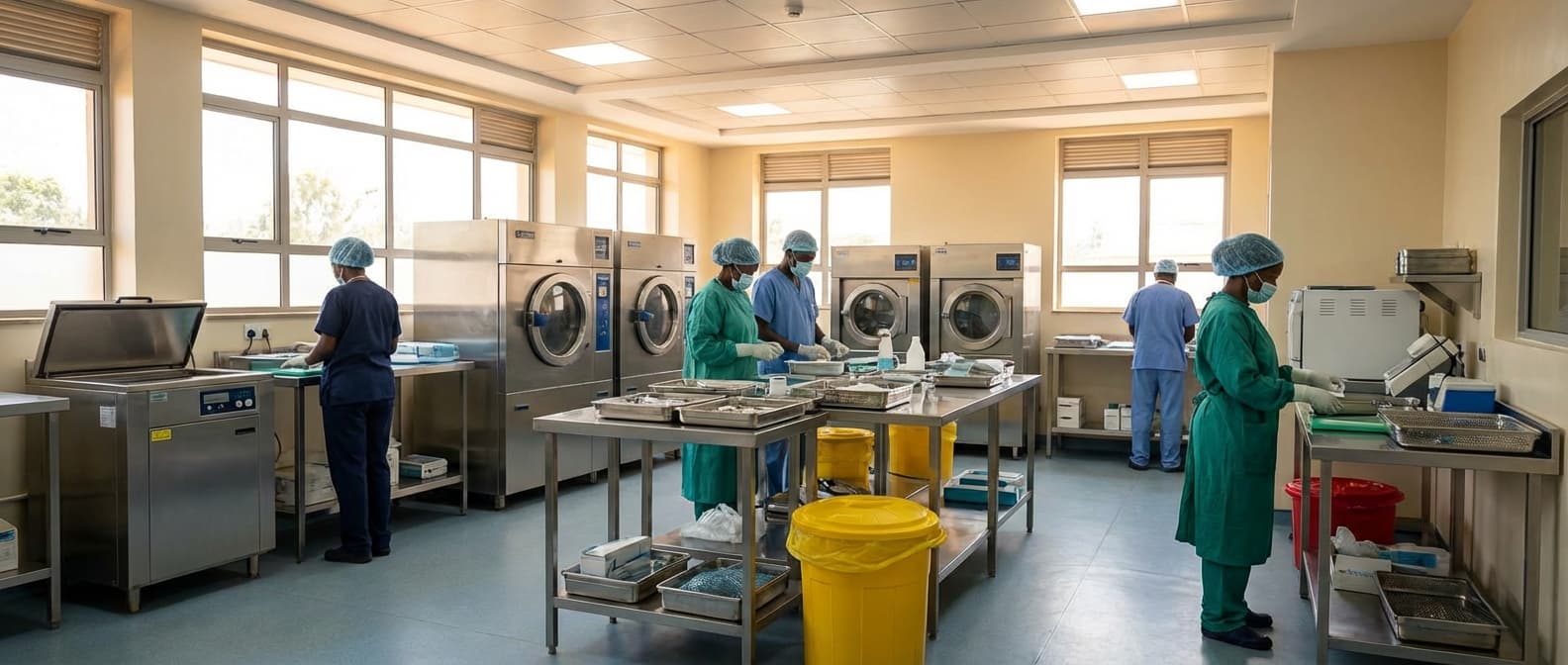
Infection-Control Readiness Support Service for Reusable Equipment in Togo
Engineering Excellence & Technical Support
Infection-Control Readiness Support Service for Reusable Equipment High-standard technical execution following OEM protocols and local regulatory frameworks.
Advanced Sterilization Monitoring
We deploy state-of-the-art chemical and biological indicators for rigorous sterilization validation of reusable medical equipment, ensuring compliance with WHO guidelines and eliminating cross-contamination risks in Togolese healthcare facilities.
On-Site Training & Capacity Building
Our service provides comprehensive, hands-on training for healthcare personnel in Togo on proper disinfection, sterilization techniques, and sterile processing workflows, empowering them to maintain the highest standards of infection control for reusable instruments.
Rapid Response & Equipment Decontamination
We offer a rapid response service for immediate decontamination and sterilization of critical reusable equipment during outbreaks or surges, minimizing downtime and safeguarding patient safety across Togo's healthcare network.
What Is Infection-control Readiness Support Service For Reusable Equipment In Togo?
Infection-Control Readiness Support Service for Reusable Equipment in Togo is a specialized program designed to ensure that healthcare facilities in Togo have the necessary infrastructure, protocols, and trained personnel to safely reprocess and sterilize reusable medical equipment, thereby preventing healthcare-associated infections (HAIs). This service is critical for maintaining patient safety, adhering to national and international infection prevention and control (IPC) standards, and optimizing the lifespan and functionality of valuable medical assets.
| Who Needs It? | Typical Use Cases |
|---|---|
| Public Hospitals and Clinics | Sterilization of surgical instruments (e.g., scalpels, forceps, retractors) after each patient use. |
| Private Healthcare Facilities (Hospitals, Clinics, Dental Practices) | Reprocessing of dental instruments (e.g., probes, explorers, handpieces) to prevent oral pathogen transmission. |
| Maternity and Pediatric Centers | Decontamination and sterilization of equipment used for deliveries, infant care, and pediatric procedures (e.g., respiratory devices, feeding equipment). |
| Non-Governmental Organization (NGO) Healthcare Providers | Ensuring safe reprocessing of reusable medical supplies in resource-limited settings, especially during health campaigns or outreach programs. |
| Diagnostic Laboratories | Sterilization of reusable laboratory equipment and specimen collection tools (e.g., glassware, culture loops, some biopsy instruments). |
| Regional and National Health Authorities | Developing and overseeing standardized IPC protocols for reusable equipment across the healthcare system, ensuring compliance with national guidelines. |
Key Components of the Service:
- Needs Assessment and Gap Analysis: Comprehensive evaluation of existing reprocessing facilities, equipment inventory, workflow processes, and staff competency related to reusable medical equipment.
- Infrastructure Development and Upgrade: Provision of technical guidance, design, and, where applicable, installation of appropriate sterilization and disinfection units, including autoclaves, washer-disinfectors, and appropriate storage solutions.
- Development and Implementation of Standard Operating Procedures (SOPs): Creation and rollout of detailed, context-specific SOPs for the entire lifecycle of reusable equipment, from point-of-use cleaning to sterilization, storage, and distribution.
- Staff Training and Capacity Building: Targeted training programs for sterilization technicians, nurses, and other relevant healthcare personnel on best practices in IPC, safe handling of reusable devices, operation of reprocessing equipment, and quality control measures.
- Equipment Maintenance and Quality Assurance: Support for preventative maintenance, calibration, and validation of sterilization and disinfection equipment, along with robust quality assurance programs to monitor the effectiveness of reprocessing cycles.
- Supply Chain Management for Consumables: Assistance in identifying and sourcing appropriate cleaning agents, disinfectants, sterilization wraps, and other essential consumables.
- Monitoring and Evaluation: Development of systems for tracking reprocessing cycles, monitoring sterilization parameters, documenting training, and assessing the overall effectiveness of the IPC program for reusable equipment.
- Technical Advisory and Ongoing Support: Provision of expert advice, troubleshooting assistance, and continuous improvement strategies to adapt to evolving technologies and challenges.
Who Needs Infection-control Readiness Support Service For Reusable Equipment In Togo?
This document outlines the target customers and departments that would benefit from an infection-control readiness support service specifically for reusable medical equipment in Togo. Effective management of reusable equipment is crucial for preventing healthcare-associated infections (HAIs) and ensuring patient safety within the Togolese healthcare system.
| Department/Unit | Key Responsibilities Related to Reusable Equipment | Infection Control Readiness Needs |
|---|---|---|
| Sterilization and Disinfection Units | Processing of reusable medical devices (cleaning, disinfection, sterilization). | Training on proper protocols, equipment maintenance, validation of sterilization processes, supply chain management for consumables. |
| Operating Theaters/Surgical Suites | Use and immediate handling of surgical instruments and equipment. | Adequate supply of sterile instruments, proper decontamination procedures, staff training on handling contaminated items. |
| Intensive Care Units (ICUs) | Use of respiratory equipment, monitoring devices, and other critical care instruments. | Availability of properly disinfected/sterilized equipment, protocols for high-risk patient care, staff awareness of cross-contamination risks. |
| Maternity Wards and Neonatal Units | Use of instruments for delivery, examination, and neonatal care. | Strict adherence to disinfection protocols for instruments and equipment used on mothers and newborns. |
| Outpatient Departments (OPDs) and Clinics | Use of examination instruments, diagnostic equipment, and minor procedure tools. | Consistent availability of clean and disinfected equipment, proper storage, staff training on basic infection control principles. |
| Laboratory Services | Processing of specimens using reusable glassware, instruments, and media preparation tools. | Effective sterilization of laboratory equipment to prevent cross-contamination and ensure accurate results. |
| Central Sterile Supply Department (CSSD) | The primary hub for cleaning, disinfection, sterilization, and distribution of reusable medical devices. | Comprehensive support in workflow optimization, equipment assessment and repair, quality assurance, staff training, and inventory management. |
| Infection Prevention and Control (IPC) Committees/Officers | Oversight of infection control practices across the facility. | Technical expertise on guidelines, risk assessment of reusable equipment processes, training development and delivery, monitoring and evaluation. |
| Biomedical Engineering Department | Maintenance and repair of sterilization and disinfection equipment. | Support in ensuring equipment functionality, calibration, and adherence to manufacturer guidelines for optimal performance in infection control. |
| Procurement and Logistics Department | Acquisition of consumables and equipment for sterilization and disinfection. | Guidance on sourcing appropriate and quality consumables, ensuring an uninterrupted supply chain for infection control materials. |
Target Customers and Departments
- Healthcare Facilities: All types of healthcare facilities that utilize reusable medical equipment.
- Government Health Agencies: Ministry of Health and its affiliated bodies responsible for public health and healthcare standards.
- Non-Governmental Organizations (NGOs): Organizations involved in healthcare delivery, training, or support in Togo.
- International Aid Organizations: Bodies providing funding and technical assistance for healthcare improvement initiatives.
Infection-control Readiness Support Service For Reusable Equipment Process In Togo
This document outlines the workflow for the Infection-Control Readiness Support Service for Reusable Equipment Process in Togo. It details the steps involved from the initial inquiry from a healthcare facility to the successful execution of the support service, ensuring proper infection control practices for reusable medical equipment.
| Stage | Description | Key Activities | Responsible Parties | Expected Outcome |
|---|---|---|---|---|
| The initial contact from a healthcare facility in Togo requesting support for their reusable equipment infection control processes. | Facility contacts the support service provider; Initial discussion of needs, challenges, and objectives; Site location and type of equipment to be assessed identified. | Healthcare Facility (requester), Support Service Provider (initial contact) | Understanding of the facility's needs and a commitment to explore further engagement. |
| Formalizing the engagement and outlining the scope, objectives, and logistics of the support service. | Development of a formal service agreement/Memorandum of Understanding (MOU); Defining the scope of work (specific equipment types, departments); Scheduling of on-site visits and activities; Resource allocation. | Support Service Provider, Healthcare Facility Management | Clear understanding of deliverables, timelines, and responsibilities. Agreement on resource requirements and access. |
| A thorough evaluation of the facility's current practices, infrastructure, and human resources related to reusable equipment infection control. | Observation of current reprocessing procedures; Review of existing protocols and Standard Operating Procedures (SOPs); Assessment of equipment condition and functionality; Evaluation of staff knowledge and skills; Inventory of supplies and consumables. | Support Service Provider (assessment team), Healthcare Facility Staff | Identification of strengths, weaknesses, and specific gaps in the infection control processes for reusable equipment. |
| Formulating specific, actionable recommendations based on the on-site assessment findings. | Analysis of collected data; Development of customized recommendations for SOPs, infrastructure improvements, equipment upgrades/maintenance, and workflow optimization; Prioritization of recommendations based on risk and feasibility. | Support Service Provider (technical experts) | A comprehensive report with concrete, prioritized recommendations tailored to the facility's context. |
| Empowering healthcare workers with the knowledge and skills to implement and sustain effective infection control practices. | Development and delivery of training modules on sterilization, disinfection, cleaning, handling of reusable equipment, waste management, and IPC principles; Practical demonstrations and hands-on exercises; Post-training assessments. | Support Service Provider (trainers), Healthcare Facility Staff | Improved understanding and practical application of infection control guidelines by facility staff. Enhanced staff competency. |
| Supplying necessary equipment, consumables, or reagents to bridge identified gaps. | Procurement and delivery of recommended equipment (e.g., autoclaves, washer-disinfectors); Provision of essential consumables (e.g., detergents, disinfectants, sterilization wraps); Installation and initial setup of new equipment. | Support Service Provider (procurement/logistics team), Healthcare Facility | Availability of necessary tools and materials to implement recommended practices. |
| Ensuring the sustained implementation of recommendations and providing ongoing support. | Periodic site visits for follow-up assessments; Review of facility-generated data on infection rates and process adherence; Remote technical support and troubleshooting; Addressing emerging challenges. | Support Service Provider, Healthcare Facility Management and Staff | Verification of improved infection control practices. Identification and resolution of any new issues. Long-term sustainability of improvements. |
| Maintaining a clear record of the service provided and its outcomes. | Submission of a final report detailing the assessment findings, recommendations implemented, training conducted, and observed impact; Archiving of all relevant documentation (assessment reports, training materials, service agreements). | Support Service Provider | Documented evidence of service delivery and outcomes. Basis for future engagements and evaluation. |
Workflow for Infection-Control Readiness Support Service
- Inquiry and Needs Assessment
- Service Agreement and Planning
- On-Site Assessment and Gap Analysis
- Development of Tailored Recommendations
- Training and Capacity Building
- Equipment and Supply Provision (if applicable)
- Monitoring and Follow-up
- Reporting and Documentation
Infection-control Readiness Support Service For Reusable Equipment Cost In Togo
This document outlines the pricing factors and estimated cost ranges for an Infection-Control Readiness Support Service for Reusable Equipment in Togo. The service aims to ensure that healthcare facilities have the necessary protocols, training, and supplies to safely reprocess and manage reusable medical equipment, thereby preventing healthcare-associated infections (HAAs). Pricing is influenced by several key variables, and the provided ranges are estimates in local currency (CFA Francs, XOF).
| Service Component | Estimated Cost Range (XOF) | Notes |
|---|---|---|
| Initial Infection Control Readiness Assessment (per facility) | 150,000 - 500,000 | Covers on-site audit, equipment review, protocol evaluation. |
| Staff Training (per session, per group of 10-15) | 75,000 - 200,000 | Includes theoretical and practical sessions on reprocessing reusable equipment. |
| Development/Update of Infection Control Protocols | 100,000 - 300,000 | Tailored to specific facility and equipment types. |
| Supply Chain Assessment and Recommendations (for disposables/consumables) | 50,000 - 150,000 | Focuses on quality, availability, and cost-effectiveness. |
| Ongoing Monitoring and Support (monthly retainer) | 100,000 - 400,000 | Can include remote support, periodic site visits, and data analysis. |
| Basic Sterilization Monitoring Supplies (e.g., chemical indicators - initial stock) | 50,000 - 200,000 | Cost dependent on quantity and type of indicators. |
| Equipment Maintenance Consultation (if needed) | 75,000 - 250,000 | Advisory services for maintaining sterilization equipment. |
Key Pricing Factors
- Scope of Services: This includes the range of reusable equipment covered (e.g., surgical instruments, endoscopes, syringes, thermometers), the level of assessment (e.g., initial audit, ongoing monitoring), and the depth of training provided.
- Facility Size and Complexity: Larger hospitals or facilities with multiple specialized departments will likely incur higher costs due to the increased volume of equipment and complexity of their sterilization processes.
- Current Infrastructure and Equipment: The existing sterilization and disinfection equipment at the facility will impact the service. If upgrades or new equipment are recommended, this will affect the overall cost.
- Training Needs and Duration: The number of staff to be trained and the duration and intensity of the training sessions are significant cost drivers.
- Supply Chain Assessment and Support: If the service includes assessing and supporting the supply chain for cleaning agents, disinfectants, and sterilization consumables, this will add to the cost.
- Frequency of Support: Whether the service is a one-time intervention, an annual assessment, or a recurring monthly/quarterly support package will influence the total price.
- Geographic Location: While Togo has a relatively uniform currency, logistical costs for travel to remote areas might slightly impact pricing.
- Level of Customization: Bespoke service packages tailored to specific facility needs will generally be more expensive than standardized offerings.
Affordable Infection-control Readiness Support Service For Reusable Equipment Options
Our Affordable Infection-Control Readiness Support Service for Reusable Equipment Options is designed to empower healthcare facilities with comprehensive, cost-effective solutions for maintaining the highest standards of infection prevention. We understand the critical need for reliable reprocessing of reusable medical devices while managing budget constraints. This service offers a tiered approach, combining essential infection control expertise, regulatory guidance, and operational optimization to ensure your equipment is safe, compliant, and ready for patient use.
| Cost-Saving Strategy | Description | Impact on Value Bundles |
|---|---|---|
| Preventative Maintenance Scheduling | Proactive scheduling of maintenance for reprocessing equipment to avoid costly breakdowns and extend equipment lifespan. | Included in all bundles, with advanced scheduling tools and analytics in Tier 3. |
| Standardized Reusable Equipment Protocols | Development and implementation of clear, consistent protocols for cleaning, disinfection, and sterilization, reducing errors and waste. | Core offering in Tier 1, refined and customized in Tier 2 and Tier 3. |
| Staff Training & Competency Assessment | Regular, targeted training sessions and competency assessments to ensure staff are up-to-date on best practices, minimizing reprocessing errors. | Essential component of Tier 1, with enhanced training modules and assessment in Tier 2 and Tier 3. |
| Optimized Supply Chain Management | Assistance in sourcing cost-effective, high-quality cleaning agents, disinfectants, and sterilization supplies. | Provided as a consultative service in Tier 2 and Tier 3, with potential bulk purchasing advisory in Tier 3. |
| Regulatory Compliance Monitoring | Ongoing monitoring of evolving regulatory requirements and accreditation standards to ensure continuous adherence, avoiding fines and corrective action costs. | Integrated across all tiers, with advanced reporting and proactive updates in Tier 2 and Tier 3. |
| Data-Driven Process Improvement | Leveraging data analytics to identify inefficiencies in reprocessing workflows and implement targeted improvements, reducing reprocessing time and resource utilization. | Basic reporting in Tier 1, advanced analytics and predictive modeling in Tier 3. |
| Equipment Lifecycle Management | Guidance on selecting durable, easily reprocessable equipment and managing its lifecycle to maximize return on investment. | Consultative advice in Tier 2, strategic planning and ROI analysis in Tier 3. |
Value Bundles for Comprehensive Readiness
- {"title":"Tier 1: Essential Readiness Package","description":"Focuses on foundational infection control practices and compliance checks for reusable equipment. Ideal for facilities seeking to establish or strengthen their basic reprocessing protocols."}
- {"title":"Tier 2: Enhanced Compliance & Optimization Bundle","description":"Includes all Tier 1 benefits plus proactive auditing, staff training reinforcement, and initial process optimization recommendations. Suited for facilities aiming for improved efficiency and reduced risk."}
- {"title":"Tier 3: Advanced Risk Management & Sustainability Suite","description":"Encompasses all Tier 2 benefits with advanced data analytics for reprocessing effectiveness, custom protocol development, and integration of sustainable practices in equipment reprocessing. Designed for facilities committed to leading-edge infection control and long-term cost reduction."}
Verified Providers In Togo
In Togo's rapidly evolving healthcare landscape, identifying reliable and competent healthcare providers is paramount for individuals seeking quality medical attention. Verified providers, particularly those accredited by esteemed organizations like Franance Health, offer a crucial layer of assurance. This accreditation signifies a rigorous vetting process, ensuring that these professionals and facilities adhere to stringent standards of medical practice, patient care, and ethical conduct. Choosing Franance Health-credentialed providers translates to confidence in receiving safe, effective, and compassionate healthcare, making them the unequivocally best choice for your health needs in Togo.
| Credentialing Body | Key Focus Areas | Why it Matters for Patients in Togo |
|---|---|---|
| Franance Health | Clinical Excellence, Patient Safety, Facility Standards, Ethical Governance | Ensures providers meet high standards for accurate diagnosis, effective treatment, and a safe patient environment. Promotes trust and reliability in a developing healthcare sector. |
| National Ministry of Health (Togo) | Licensing, Basic Regulatory Compliance | Confirms legal operation and adherence to fundamental national health regulations. A foundational requirement for practice. |
| International Accreditation Bodies (if applicable) | Global Best Practices, Quality Management Systems | Indicates adherence to world-class standards, attracting investment and expertise. Provides an additional layer of assurance for complex medical needs. |
Key Benefits of Choosing Franance Health Verified Providers:
- Unwavering Commitment to Quality: Franance Health accreditation signifies adherence to international best practices in healthcare delivery.
- Enhanced Patient Safety: Rigorous standards reduce the risk of medical errors and infections.
- Competent and Skilled Professionals: Providers are evaluated on their qualifications, experience, and continuous professional development.
- Ethical Practice and Transparency: Accreditation promotes ethical conduct and transparent communication with patients.
- Access to Modern Medical Infrastructure: Verified facilities often boast state-of-the-art equipment and technologies.
- Improved Patient Outcomes: A combination of skilled professionals and quality care leads to better health results.
- Peace of Mind: Knowing you are in the care of a verified and accredited institution provides significant reassurance.
Scope Of Work For Infection-control Readiness Support Service For Reusable Equipment
This Scope of Work (SOW) outlines the requirements for Infection-Control Readiness Support Services for Reusable Medical Equipment. The service aims to ensure that healthcare facilities have robust processes and procedures in place for the safe and effective cleaning, disinfection, and sterilization of reusable medical equipment, thereby minimizing the risk of healthcare-associated infections (HAIs).
| Deliverable | Description | Standard Specifications / Requirements |
|---|---|---|
| Current State Assessment Report | A comprehensive evaluation of existing reusable equipment infection control processes, including documentation review, staff interviews, and on-site observation. | The report shall detail findings regarding compliance, staff knowledge, equipment availability, workflow efficiency, and identified risks. Include recommendations for improvement, categorized by priority. |
| Standard Operating Procedures (SOPs) Development | Creation of detailed, step-by-step SOPs for the entire lifecycle of reusable equipment, from point-of-use to reprocessing and storage. | SOPs must cover: cleaning, disinfection (high-level and intermediate), sterilization (steam, EtO, etc.), drying, packaging, storage, and handling. Protocols must align with manufacturer instructions for use (IFUs) and regulatory guidelines (e.g., CDC, FDA, AAMI). Documented evidence of review and approval by facility infection control committee. |
| Staff Training Program and Materials | Development and delivery of a tailored training program for all relevant personnel involved in reusable equipment reprocessing. | Training modules shall include theoretical knowledge and practical hands-on demonstration. Materials should include presentations, participant workbooks, competency checklists, and assessment tools. Records of attendance and competency assessment for all trained staff must be maintained. |
| Monitoring and Auditing Framework | Establishment of a system for ongoing monitoring and periodic auditing of reusable equipment reprocessing practices. | Framework should include: regular process audits (e.g., adherence to SOPs, correct use of disinfectants/sterilants), equipment maintenance logs, biological/chemical indicator interpretation, and HAI surveillance related to reusable equipment. Define audit frequency, sample size, and reporting mechanisms. |
| Technology/Equipment Recommendations (Optional) | Assessment of current reprocessing equipment and recommendation of potential upgrades or new technologies to enhance efficiency and safety. | Recommendations should be evidence-based, cost-effective, and support the developed SOPs. Include specifications for recommended equipment, such as washer-disinfectors, sterilizers, and tracking systems. |
| Compliance Report and Gap Analysis | A report summarizing the facility's compliance status with relevant national and international infection control standards and guidelines. | The report shall identify specific areas of non-compliance, with actionable plans for remediation. Include references to applicable standards (e.g., ISO, AAMI ST series, CDC guidelines). |
| Post-Implementation Review and Sustainability Plan | An evaluation of the effectiveness of implemented changes and a plan for long-term sustainability of improved infection control practices. | The plan should address ongoing training needs, quality improvement initiatives, and strategies for adapting to new technologies and evolving guidelines. |
Key Objectives of the Service
- Assess current infection control practices related to reusable equipment.
- Identify gaps and vulnerabilities in existing processes.
- Develop and implement standardized protocols for cleaning, disinfection, and sterilization.
- Provide training to staff on best practices and new protocols.
- Establish monitoring and auditing mechanisms to ensure ongoing compliance.
- Recommend and/or integrate appropriate technologies and equipment.
- Ensure compliance with relevant regulatory standards and guidelines.
Service Level Agreement For Infection-control Readiness Support Service For Reusable Equipment
This Service Level Agreement (SLA) outlines the response times and uptime guarantees for the Infection-Control Readiness Support Service for Reusable Equipment. This service ensures that critical reusable equipment is consistently maintained at a high standard of infection control readiness, minimizing operational disruptions and patient safety risks.
| Service Element | Response Time Guarantee | Uptime Guarantee |
|---|---|---|
| Critical Equipment Out-of-Service Notification | Within 15 minutes of official notification (e.g., via designated ticketing system, phone) | N/A (Focus is on response, not immediate resolution of the underlying issue) |
| Initial Assessment and Triage of Infection Control Issue | Within 1 hour of notification for Critical issues; Within 4 business hours for High priority issues | N/A |
| Deployment of Infection Control Specialist/Technician | For Critical issues: Within 2 hours of confirmed need for on-site presence. For High priority issues: Within 8 business hours. | N/A |
| Availability of Standard Infection Control Protocols and Documentation | 24/7 access via secure portal | 99.5% uptime (excluding scheduled maintenance) |
| Access to Specialized Infection Control Consultants (as needed) | Within 24 business hours for initial consultation scheduling (for pre-approved escalations) | N/A |
| Scheduled Preventative Maintenance and Audits | Scheduled in advance with minimal disruption to clinical operations (typically off-peak hours) | N/A (Proactive measure) |
| Decontamination and Sterilization Process Support | Within 1 hour of confirmed failure or process interruption impacting critical equipment | N/A |
Service Objectives
- To provide timely and effective support for infection control-related issues concerning reusable equipment.
- To ensure the continuous availability of critical reusable equipment for clinical use.
- To minimize downtime of essential equipment due to infection control concerns.
- To uphold the highest standards of patient safety and regulatory compliance.
Frequently Asked Questions

Ready when you are
Let's scope your Infection-Control Readiness Support Service for Reusable Equipment in Togo project in Togo.

Scaling healthcare logistics and technical systems across the entire continent.