
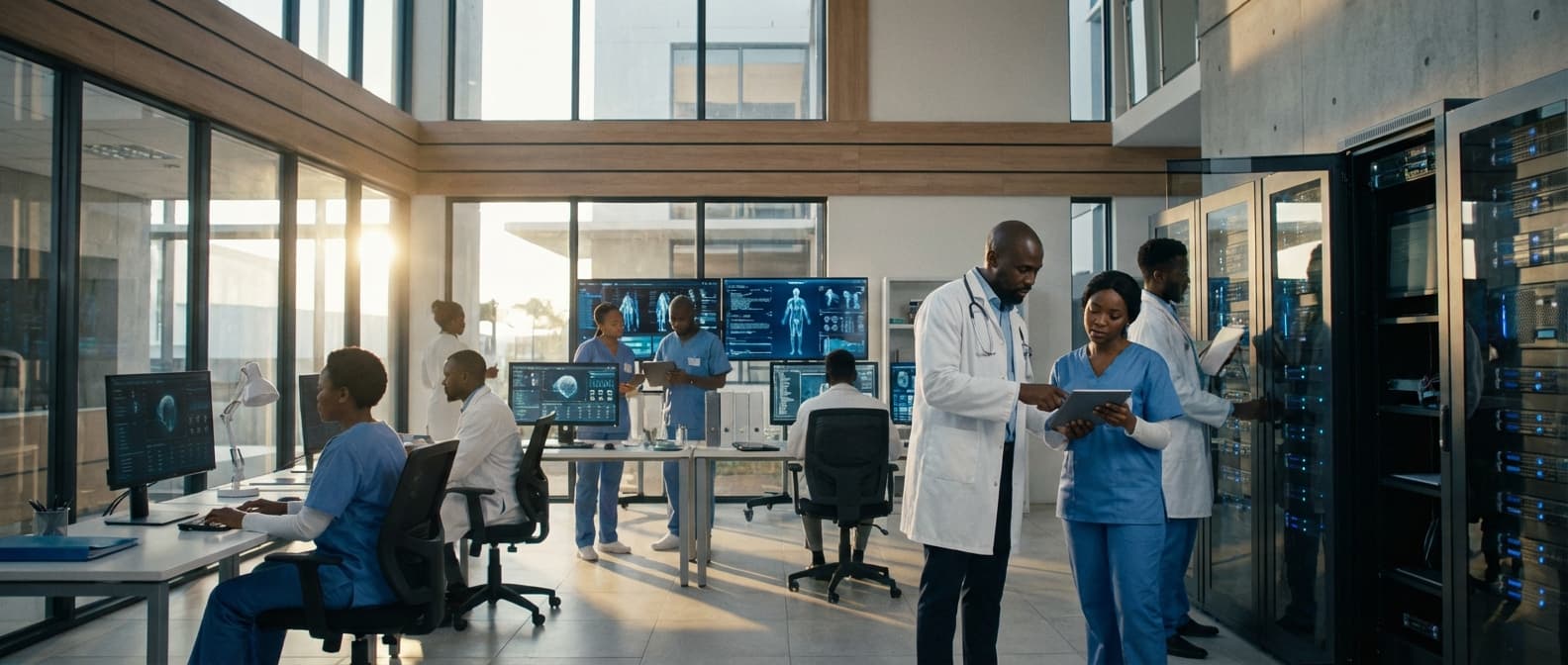
Tele-Radiology in Togo
Engineering Excellence & Technical Support
24/7 access to certified radiologists providing rapid, accurate remote interpretation of diagnostic imaging studies. High-standard technical execution following OEM protocols and local regulatory frameworks.
AI-Powered Diagnostic Assistance
Leveraging advanced Artificial Intelligence algorithms to pre-screen radiological images, identifying potential anomalies and assisting radiologists in faster, more accurate diagnoses, particularly in remote areas where specialist expertise may be limited.
Secure Cloud-Based Image Archiving & Transmission
Implementing a robust and secure cloud infrastructure for storing, managing, and transmitting high-resolution medical images. This ensures data integrity, accessibility for remote specialists, and compliance with data privacy regulations.
High-Bandwidth Connectivity Solutions
Establishing reliable and high-bandwidth internet connectivity, including satellite and cellular options, to facilitate seamless real-time image transfer and teleconsultation, overcoming infrastructure challenges in rural Togo.
What Is Tele-radiology In Togo?
Tele-radiology in Togo refers to the practice of transmitting radiological images (e.g., X-rays, CT scans, MRI scans) from a healthcare facility in Togo to a radiologist located remotely, either within Togo or internationally, for interpretation and reporting. This service leverages telecommunications technology to bridge geographical distances and address disparities in access to specialized radiological expertise. The core of tele-radiology involves the secure digital transfer of medical imaging data, its interpretation by a qualified radiologist, and the subsequent return of a diagnostic report to the referring physician. This modality is particularly crucial in regions with a scarcity of trained radiologists, enabling timely and accurate diagnoses for a broader patient population. The technical infrastructure typically includes PACS (Picture Archiving and Communication Systems) for image storage and retrieval, DICOM (Digital Imaging and Communications in Medicine) standards for image interoperability, and secure network connectivity for data transmission.
| Who Needs Tele-Radiology? | Typical Use Cases |
|---|---|
| Healthcare Facilities in Remote or Underserved Areas: Clinics and hospitals lacking on-site radiologists. | Emergency Department Consultations: Providing rapid interpretation of critical imaging studies (e.g., stroke, trauma, acute abdomen) when local radiologists are unavailable. |
| Primary Healthcare Centers: Enabling access to diagnostic imaging for routine evaluations and screening programs. | Specialized Diagnostic Needs: Facilitating interpretation of complex imaging modalities like MRI and CT scans, which require subspecialty expertise often concentrated in urban centers. |
| Hospitals with Limited Radiologist Staff: Supplementing the workload of existing radiologists and reducing turnaround times. | Follow-up Imaging and Monitoring: Ensuring consistent and expert review of serial imaging for patients with chronic conditions. |
| Public Health Initiatives and Screening Programs: Expanding access to diagnostic services for population-level health assessments. | Medical Education and Training: Providing remote access to diverse case studies for radiologist trainees. |
| Patients in Rural Locations: Improving access to diagnostic imaging without the need for extensive travel. | Post-Surgical Assessment: Evaluating the success of surgical interventions through imaging. |
Key Components and Beneficiaries of Tele-Radiology in Togo
- Digital Image Acquisition: Obtaining radiological images using digital imaging modalities (e.g., digital radiography, CT, MRI).
- Image Transmission: Securely transferring DICOM-compliant images over a network (internet, VPN) to a remote reading center.
- Remote Interpretation: A radiologist, licensed and qualified, analyzes the transmitted images using specialized viewing software.
- Report Generation: The radiologist creates a diagnostic report, which is then securely transmitted back to the referring physician.
- Teleradiology Platforms: Software solutions that facilitate image management, workflow, and communication between the sending and receiving sites.
Who Needs Tele-radiology In Togo?
Tele-radiology, the practice of interpreting medical images remotely, holds significant potential to address existing healthcare disparities and enhance diagnostic capabilities in Togo. The current limitations in accessible, specialized radiological expertise within the country create a critical need for such a service. By leveraging tele-radiology, Togo can bridge geographical gaps, improve turnaround times for diagnoses, and ultimately elevate the quality of patient care across various healthcare settings. This technology is particularly crucial for rural and underserved areas where on-site radiologists are scarce or non-existent.
| Target Customer/Department | Description of Need | Specific Services Required | Potential Benefits of Tele-Radiology |
|---|---|---|---|
| Public Hospitals & Health Centers (Regional/District) | Limited access to specialized radiologists, particularly in remote regions. High patient volume often strains existing resources. Delays in image interpretation lead to delayed treatment. | X-ray, CT scan, Ultrasound interpretation. Urgent case review. Second opinions. Training support for local technicians. | Improved diagnostic accuracy and speed. Reduced patient travel time and costs. Enhanced capacity for handling complex cases. Supports continuous professional development for local staff. |
| Private Clinics & Diagnostic Centers | May have basic imaging equipment but lack in-house radiologists, forcing referrals to distant centers. Desire to offer a wider range of diagnostic services to attract more patients. | CT scan, MRI interpretation (where available). Specialized imaging interpretation (e.g., mammography, musculoskeletal). | Expanded service offerings. Competitive advantage. Faster reporting for clients. Increased revenue potential. |
| Referral Hospitals (e.g., CHU Lomé-Tsévié) | While possessing more advanced equipment, these hospitals may still face shortages of sub-specialist radiologists (e.g., neuroradiology, interventional radiology). Can serve as hubs for receiving remote interpretations from smaller facilities. | Complex case consultations. Sub-specialty interpretations. Quality assurance reviews. Assistance with advanced imaging modalities. | Reduced workload on in-house radiologists. Access to global expertise. Improved management of critically ill patients. Facilitates research and academic collaboration. |
| Missions & NGO Healthcare Facilities | Often operate in areas with minimal healthcare infrastructure. Rely on limited resources and often serve vulnerable populations. High need for cost-effective and accessible diagnostic solutions. | Basic X-ray and ultrasound interpretation. Emergency case assessment. Support for mobile outreach programs. | Democratization of advanced diagnostics in underserved areas. Improved health outcomes for marginalized communities. Cost-effective solution for resource-limited settings. |
| Emergency Medical Services (Ambulance services, Emergency Departments) | Critical need for rapid interpretation of urgent imaging (e.g., head CT for stroke, chest X-ray for trauma) to inform immediate treatment decisions. | 24/7 availability for urgent scan interpretation. Real-time consultations with emergency physicians. | Faster decision-making in life-threatening situations. Improved patient outcomes through timely intervention. Reduced mortality and morbidity. |
Target Customers & Departments for Tele-Radiology in Togo
- Public Hospitals & Health Centers
- Private Clinics & Diagnostic Centers
- Referral Hospitals
- Missions & Non-Governmental Organization (NGO) Healthcare Facilities
- Emergency Medical Services
Tele-radiology Process In Togo
Tele-radiology in Togo aims to extend diagnostic imaging services to remote or underserved areas by leveraging telecommunications technology. This process facilitates remote consultation with radiologists, enabling timely and accurate diagnoses. The workflow typically begins with a patient inquiry or a request from a local healthcare facility, followed by image acquisition, secure transmission, radiologist interpretation, and finally, the delivery of the diagnostic report back to the referring physician.
| Stage | Description | Key Actors | Technology Involved | Potential Challenges |
|---|---|---|---|---|
| Inquiry & Request | Patient presentation and clinician's decision to request imaging. | Patient, General Practitioner, Local Nurse | Basic clinical assessment tools | Lack of awareness of tele-radiology services, limited access to local healthcare facilities. |
| Image Acquisition | Performing the diagnostic imaging procedure. | Radiographer, Technician | X-ray machine, CT scanner, MRI scanner, Ultrasound machine | Equipment malfunction, power outages, lack of trained personnel, image quality issues. |
| Image Digitization & Anonymization | Converting analog images to digital format and removing patient identifiers for privacy. | Technician, PACS Administrator | Film digitizers (if applicable), PACS (Picture Archiving and Communication System) | Data corruption, incomplete anonymization, storage limitations. |
| Secure Transmission | Sending digital images and patient data to the radiologist. | IT Support, PACS Administrator | High-speed internet, VPNs, secure cloud storage, teleradiology software | Poor internet connectivity, bandwidth limitations, cybersecurity threats, data breaches, cost of infrastructure. |
| Radiologist Interpretation | Expert review of images and generation of a diagnostic report. | Radiologist (remote or local) | Workstations with high-resolution monitors, teleradiology software, reporting templates | Radiologist workload, availability of specialized radiologists, language barriers, differing diagnostic standards. |
| Report Delivery & Follow-up | Transmitting the report back and integrating it into patient care. | Radiologist, Referring Physician, IT Support | Secure email, EMR/EHR integration, teleradiology software | Delayed report delivery, misinterpretation of reports, lack of integration with existing healthcare systems, cost of follow-up. |
Tele-Radiology Workflow in Togo
- Patient presents with symptoms requiring radiological imaging.
- Request for imaging study is generated by the local healthcare provider.
- Imaging study (X-ray, CT, MRI, Ultrasound) is performed at the originating site.
- Images are digitized and anonymized.
- Images are securely transmitted to a central tele-radiology hub or directly to a radiologist.
- Radiologist reviews the images and provides a diagnostic report.
- The report is securely transmitted back to the originating healthcare provider.
- Referring physician communicates the diagnosis and treatment plan to the patient.
Tele-radiology Cost In Togo
Tele-radiology, the practice of interpreting medical images remotely, is emerging as a valuable tool in Togo to address the scarcity of radiologists and improve access to diagnostic services. However, understanding the cost associated with these services is crucial for healthcare providers and patients. The pricing of tele-radiology in Togo is influenced by a variety of factors, leading to a range of costs in local currency (CFA Franc).
| Imaging Modality | Estimated Price Range (CFA Franc) | Notes |
|---|---|---|
| X-ray (e.g., Chest X-ray, Limb X-ray) | 15,000 - 40,000 | Generally the most affordable option due to simpler interpretation. |
| Ultrasound | 25,000 - 60,000 | Price can vary based on the complexity of the scan (e.g., abdominal vs. obstetric). |
| CT Scan | 60,000 - 150,000+ | Significantly higher due to complexity and scan time. Prices can escalate for specialized CTs (e.g., CT angiography). |
| MRI | 90,000 - 250,000+ | Typically the most expensive due to the advanced technology and interpretation required. Prices vary by body part and sequence complexity. |
| Urgent/STAT Interpretation (add-on) |
| An additional fee charged for expedited reporting, usually within a few hours. |
| Mammography | 30,000 - 70,000 | Standard pricing for routine screening and diagnostic mammograms. |
Key Pricing Factors for Tele-Radiology in Togo
- Type of Imaging Modality: The complexity and associated time required for interpretation vary significantly. X-rays are generally less expensive than CT scans or MRIs.
- Volume of Cases: Larger healthcare facilities or networks that can commit to a higher volume of interpretations may negotiate lower per-case rates.
- Radiologist Expertise and Specialization: Highly specialized radiologists or those with extensive experience may command higher fees.
- Turnaround Time: Urgent interpretations requiring immediate attention will typically incur a premium compared to routine reports.
- Technology and Platform Costs: The tele-radiology provider's investment in secure platforms, software, and IT infrastructure will be factored into their pricing.
- Geographic Location of the Imaging Facility: While tele-radiology aims to bridge distance, there might be slight variations in pricing depending on the logistical challenges or market conditions of the originating facility's location within Togo.
- Reporting Standards and Complexity: Detailed reports with advanced measurements or comparisons to previous studies will naturally be priced higher than standard interpretations.
- Contractual Agreements: Long-term contracts with bundled services or service level agreements (SLAs) can influence overall cost-effectiveness.
Affordable Tele-radiology Options
Tele-radiology offers significant cost-saving potential for healthcare providers by improving efficiency, reducing overhead, and expanding access to specialized expertise. Understanding value bundles and implementing smart cost-saving strategies are crucial for maximizing these benefits.
| Cost-Saving Strategy | Description | Potential Benefits |
|---|---|---|
| Value Bundles | Pre-defined packages of services offered at a set price or discount. | Predictable costs, comprehensive coverage, potential for significant savings on bundled services. |
| Volume-Based Discounts | Reduced per-study fees for higher volumes of imaging studies. | Direct cost reduction per study, incentive for increased utilization. |
| Long-Term Contracts | Commitment to a tele-radiology provider for an extended period (e.g., 1-5 years). | Secured favorable pricing, provider investment in infrastructure and staffing. |
| Tiered Service Levels | Offering different pricing based on urgency (STAT vs. routine) and specialty. | Pay only for what you need, optimized cost for different types of reads. |
| Integrated IT Solutions | Seamless connection with existing PACS and EHR systems. | Reduced implementation costs, improved workflow efficiency, fewer errors. |
| Outsourcing Non-Core Functions | Delegating tasks like preliminary reads or after-hours coverage. | Focus internal resources on high-value tasks, 24/7 coverage without full-time staffing. |
| Shared Services | Collaborating with other organizations to share tele-radiology services. | Increased negotiation power, spread costs across multiple entities. |
Key Strategies for Affordable Tele-Radiology
- Value Bundles: These are pre-negotiated service packages that offer a comprehensive suite of tele-radiology services at a fixed price or a discounted rate. They often include a combination of preliminary reads, final reads, subspecialty consultations, quality assurance, and IT support.
- Tiered Service Levels: Offer different service packages based on urgency and complexity (e.g., STAT reads vs. routine reads, general radiology vs. subspecialty imaging). This allows providers to pay only for the services they need.
- Volume-Based Discounts: Negotiate lower per-study costs based on the anticipated volume of imaging studies. Higher volumes generally translate to greater discounts.
- Long-Term Contracts: Committing to longer-term contracts can often secure more favorable pricing due to the provider's ability to plan and allocate resources more effectively.
- Shared Services: Explore opportunities with other healthcare facilities to share tele-radiology services, thus leveraging collective buying power and reducing individual costs.
- Integrated IT Solutions: Choose tele-radiology providers that offer seamless integration with your existing Picture Archiving and Communication System (PACS) and Electronic Health Record (EHR). This reduces IT implementation costs and improves workflow efficiency.
- Outsourcing Non-Core Functions: Consider outsourcing functions like preliminary reads or after-hours coverage to tele-radiology providers to free up in-house radiologists for more complex cases or direct patient interaction.
- Data Analytics and Reporting: Utilize the reporting and analytics capabilities of tele-radiology platforms to identify areas for operational improvement and further cost reduction.
- Subspecialty Coverage: Instead of maintaining expensive in-house subspecialists, leverage tele-radiology for on-demand access to expertise in areas like neuro-radiology, musculoskeletal imaging, or cardiac imaging.
- Remote Work Infrastructure: Invest in robust and secure remote access solutions for your in-house radiologists, allowing them to work from home or other remote locations, thereby reducing office space and utility costs.
Verified Providers In Togo
When seeking healthcare services in Togo, identifying verified providers is paramount for ensuring quality, safety, and trustworthiness. Franance Health stands out as a premier choice, distinguished by its rigorous credentialing process and commitment to excellence. This document outlines why partnering with Franance Health-credentialed providers represents the most reliable and beneficial option for individuals and organizations navigating the Togolese healthcare landscape.
| Credential Component | Franance Health Verification | Benefit to Patient |
|---|---|---|
| Academic Qualifications | Verified diplomas, degrees, and certifications from accredited institutions. | Ensures providers have the foundational knowledge and training. |
| Professional Licenses | Confirmation of active and valid licenses with the relevant Togolese medical boards. | Guarantees providers are legally authorized to practice. |
| Continuous Medical Education (CME) | Documentation of participation in ongoing professional development and training. | Confirms providers stay updated with the latest medical advancements and techniques. |
| Professional References and Experience | Collection and verification of references and past work history. | Provides insights into practical application of skills and professional reputation. |
| Background Checks | Screening for any disciplinary actions, malpractice claims, or criminal history. | Safeguards against practitioners with a history of misconduct. |
| Specialization Confirmation | Verification of training and experience in specific medical fields. | Facilitates access to expert care for specialized conditions. |
Why Franance Health Credentials Matter
- Rigorous Vetting Process: Franance Health employs a comprehensive and multi-faceted vetting process for all providers. This includes verification of academic qualifications, professional licenses, continuous medical education (CME) records, and a thorough background check.
- Commitment to Quality Standards: Adherence to international and Togolese healthcare standards is a core tenet of Franance Health's credentialing. Providers must demonstrate a commitment to best practices in patient care, hygiene, and ethical conduct.
- Enhanced Patient Safety: By ensuring that all listed providers meet stringent criteria, Franance Health significantly reduces the risk of encountering unqualified or fraudulent practitioners, thereby prioritizing patient safety above all else.
- Access to Specialized Expertise: The credentialing process identifies providers with specific specializations and expertise, allowing patients to find the most suitable care for their unique medical needs.
- Building Trust and Transparency: Franance Health's transparent credentialing methodology builds trust between patients and healthcare providers, fostering a more informed and confident healthcare seeking experience.
- Continuous Monitoring and Re-evaluation: Beyond initial credentialing, Franance Health often includes mechanisms for ongoing monitoring and periodic re-evaluation of providers to ensure continued adherence to their standards.
Scope Of Work For Tele-radiology
This Scope of Work (SOW) outlines the technical deliverables and standard specifications required for the implementation and operation of a Tele-Radiology service. The objective is to establish a reliable and efficient system for remote radiological image interpretation, reporting, and consultation.
| Category | Technical Deliverable | Standard Specification / Requirement | Description |
|---|---|---|---|
| System Architecture | Tele-Radiology Platform | HIPAA Compliant, Secure, Scalable, Cloud-based or On-Premise | The core software platform that facilitates image transmission, storage, viewing, interpretation, and reporting. |
| Image Acquisition & Transmission | Image Transfer Protocol | DICOM (Digital Imaging and Communications in Medicine) over secure protocols (e.g., VPN, SFTP) | Standard for the transfer of medical images and related information. |
| Image Acquisition & Transmission | Bandwidth Requirements | Minimum upload/download speeds (e.g., 10 Mbps dedicated), latency thresholds | Ensures efficient and timely transfer of large imaging datasets. |
| Image Viewing & Interpretation | Workstation Software | High-resolution, multi-monitor support, advanced visualization tools (e.g., MPR, 3D rendering), user-friendly interface | Software used by radiologists for viewing, manipulating, and interpreting medical images. |
| Image Viewing & Interpretation | Image Quality | Full DICOM compliance, lossless compression (where applicable), consistent display calibration | Ensures diagnostic accuracy and adherence to imaging standards. |
| Reporting | Reporting Software / Module | Structured reporting capabilities, template library, voice recognition integration, e-signature functionality | Tools for generating, editing, and signing radiological reports. |
| Reporting | Report Format | HL7 (Health Level Seven) integration for EHR, PDF export | Standardized format for transmitting patient and clinical data. |
| Data Storage & Archiving | PACS Integration | Bi-directional HL7 interface, DICOM SR (Structured Reporting) support | Integration with the existing PACS for seamless image retrieval and archiving. |
| Data Storage & Archiving | Long-term Archiving Solution | Secure, compliant, scalable storage (e.g., cloud-based archival, dedicated storage servers) | Ensures compliance with retention policies and efficient data management. |
| Security & Privacy | Data Encryption | AES-256 encryption (in transit and at rest) | Protects patient data from unauthorized access. |
| Security & Privacy | Access Control | Role-based access control (RBAC), multi-factor authentication (MFA) | Ensures only authorized personnel can access sensitive data. |
| Security & Privacy | Audit Trails | Comprehensive logging of all user activities, data access, and system changes | Provides accountability and facilitates security investigations. |
| Security & Privacy | Compliance Certifications | HIPAA, GDPR, HITRUST (as applicable) | Demonstrates adherence to relevant data protection regulations. |
| Connectivity & Integration | EHR/EMR Integration | HL7 v2.x or FHIR (Fast Healthcare Interoperability Resources) integration for order entry and report delivery | Seamless integration with the hospital's electronic health record system. |
| Connectivity & Integration | VPN/Secure Tunneling | Industry-standard VPN protocols (e.g., IPsec, OpenVPN) | Establishes secure communication channels between sites. |
| User Management & Training | User Training Program | Comprehensive training for radiologists, technologists, and administrative staff | Ensures users are proficient in operating the tele-radiology system. |
| User Management & Training | Technical Support | 24/7 technical support, defined SLAs (Service Level Agreements) | Provides ongoing assistance and troubleshooting for system issues. |
| Performance & Reliability | Uptime Guarantee | Minimum uptime percentage (e.g., 99.9%) | Ensures consistent availability of the tele-radiology service. |
| Performance & Reliability | Disaster Recovery & Business Continuity | Documented DR/BC plan, regular testing | Ensures service continuity in the event of system failures or disasters. |
Key Objectives of the Tele-Radiology Service
- To provide timely and accurate radiological interpretations to referring physicians, regardless of geographical location.
- To enhance access to specialized radiological expertise.
- To improve turnaround times for critical findings.
- To ensure seamless integration with existing Picture Archiving and Communication Systems (PACS) and Electronic Health Records (EHR).
- To maintain the highest standards of data security and patient privacy.
Service Level Agreement For Tele-radiology
This Service Level Agreement (SLA) outlines the guaranteed response times and uptime for the Tele-Radiology services provided by [Your Company Name] to [Client Name]. This SLA is an integral part of the Master Service Agreement between both parties.
| Study Priority | Guaranteed Response Time | Uptime Guarantee |
|---|---|---|
| Emergency Study | Within [Number] minutes of assignment to a radiologist | 99.9% (excluding scheduled maintenance) |
| Urgent Study | Within [Number] hours of assignment to a radiologist | 99.9% (excluding scheduled maintenance) |
| Routine Study | Within [Number] hours of assignment to a radiologist | 99.9% (excluding scheduled maintenance) |
| Overall System Uptime | N/A | 99.9% (excluding scheduled maintenance) |
Key Service Definitions
- Emergency Study: A radiologic study requiring immediate interpretation due to potentially life-threatening conditions or the need for rapid clinical decision-making (e.g., stroke, trauma, pulmonary embolism).
- Urgent Study: A radiologic study requiring interpretation within a short timeframe, but not immediately life-threatening (e.g., appendicitis, suspected fracture).
- Routine Study: A radiologic study that does not require immediate or urgent interpretation and can be read within standard turnaround times.
- Uptime: The percentage of time the Tele-Radiology service is operational and accessible to the Client, excluding scheduled maintenance periods.
- Response Time: The time elapsed from the moment a study is designated as available for interpretation in the PACS system to the moment a preliminary or final report is made available in the PACS system or electronically.
- Scheduled Maintenance: Pre-announced periods of downtime for system updates, upgrades, or preventative maintenance. Clients will be notified at least [Number] days in advance of scheduled maintenance.
Frequently Asked Questions

Ready when you are
Let's scope your Tele-Radiology in Togo project in Togo.

Scaling healthcare logistics and technical systems across the entire continent.