
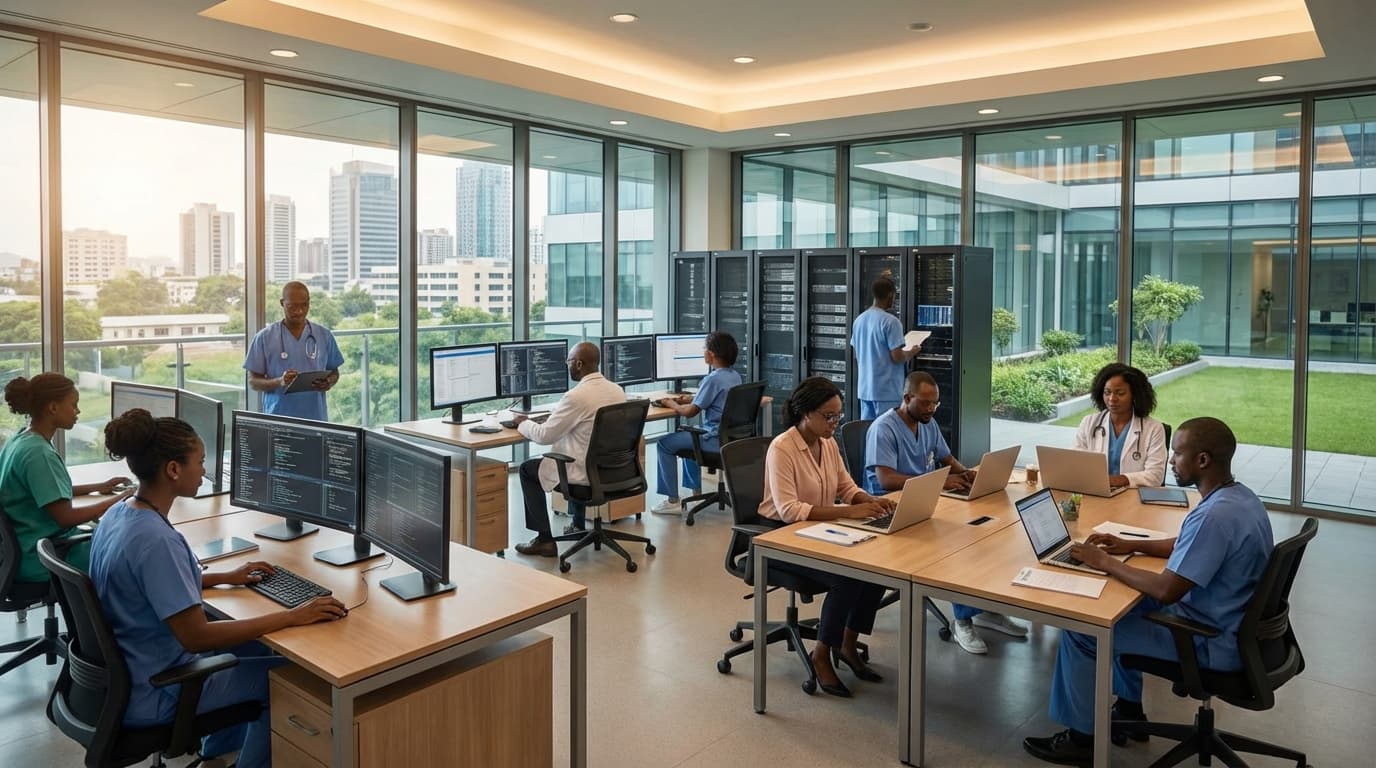
Radiology Reader & Reporting Support in Togo
Engineering Excellence & Technical Support
Remote radiology reading and reporting services High-standard technical execution following OEM protocols and local regulatory frameworks.
Enhanced Diagnostic Accuracy
Empowering Togolese radiologists with advanced AI-powered tools that analyze medical images with superior precision, reducing misinterpretations and improving the detection of subtle pathologies.
Seamless Remote Collaboration
Facilitating real-time collaboration among radiologists across Togo, enabling expert consultations and second opinions regardless of geographical location, thereby democratizing access to specialized radiological expertise.
Streamlined Reporting Workflow
Automating repetitive tasks and intelligently pre-populating reports with key findings and measurements, significantly reducing radiologist workload and turnaround times for diagnostic reports in Togo.
What Is Radiology Reader & Reporting Support In Togo?
Radiology Reader & Reporting Support in Togo refers to the provision of expert interpretation of medical imaging studies (such as X-rays, CT scans, MRI, ultrasound) and the generation of comprehensive diagnostic reports by qualified radiologists, potentially delivered remotely or on-site, to healthcare facilities within Togo. This service aims to augment local radiology capabilities, address radiologist shortages, and enhance diagnostic accuracy and efficiency in areas where specialized expertise may be limited.
| Who Needs It | Typical Use Cases | |||||
|---|---|---|---|---|---|---|
| Hospitals & Clinics in Togo: Particularly those lacking full-time, in-house radiologists or specific subspecialty expertise (e.g., neuroradiology, pediatric radiology, interventional radiology). | Emergency Departments: Rapid interpretation of critical imaging studies (e.g., head CT for stroke, chest X-ray for trauma) to facilitate timely treatment decisions. | Outpatient Imaging Centers: Providing diagnostic reports for routine and specialized imaging procedures. | Rural Healthcare Facilities: Bridging geographical barriers by offering access to expert radiology services. | Public Health Initiatives: Supporting large-scale screening programs or disease surveillance that require extensive imaging analysis. | Referral Networks: Enabling seamless transfer and interpretation of imaging studies between primary care physicians and specialized diagnostic services. | Situations of Radiologist Shortage or Absence: Covering for vacations, sick leave, or ongoing recruitment challenges. |
| Primary Healthcare Providers: Requesting interpretations for patients requiring advanced imaging or where initial assessment suggests complex pathology. | Surgeons & Specialists: Requiring accurate imaging assessments for pre-operative planning, intra-operative guidance, and post-operative monitoring. | Oncologists: Needing precise staging, treatment response assessment, and surveillance imaging for cancer patients. | Pediatricians: Requiring specialized interpretation of imaging in pediatric patients. | Neurologists: Needing expert analysis of brain and spine imaging for neurological conditions. | Public Health Organizations: Collaborating on national health programs requiring significant radiology input. |
Key Components of Radiology Reader & Reporting Support
- Image Interpretation: Analysis of medical images by board-certified radiologists.
- Report Generation: Creation of detailed, structured diagnostic reports following established medical standards.
- Tele-radiology: Remote transmission and interpretation of imaging studies, enabling access to subspecialty expertise.
- Quality Assurance: Implementation of protocols to ensure accuracy and consistency in interpretations and reports.
- Consultation: Providing expert opinions and further guidance to referring physicians.
- Education & Training: Potential for knowledge transfer and skill enhancement for local medical professionals.
Who Needs Radiology Reader & Reporting Support In Togo?
Radiology Reader & Reporting Support is a critical service that can significantly enhance the efficiency, accuracy, and accessibility of diagnostic imaging in Togo. This support is particularly valuable for institutions facing challenges with a shortage of specialized radiologists, heavy workloads, or a desire to improve turnaround times for diagnostic reports. The primary aim is to ensure timely and high-quality interpretations of medical images, leading to better patient outcomes.
| Target Customer/Department | Key Needs Addressed | Specific Services Required | |||
|---|---|---|---|---|---|
| Public Hospitals (e.g., CHU Lomé-Tokoin, regional hospitals) | High patient volume, radiologist shortages, need for specialized interpretations, improving report turnaround times. | Second opinions, sub-specialty readings (neurology, oncology, pediatrics), teleradiology reporting, workflow optimization. | |||
| Private Hospitals and Clinics (e.g., Clinique D'Aide, Hôpital Privé de Lomé) | Demand for timely reporting, competitive service offerings, supplementing existing radiology departments, expanding service range. | Out-of-hours reporting, overflow case management, specific modality interpretations (CT, MRI, Ultrasound), quality assurance. | Diagnostic Centers (e.g., imaging centers) | Consistent and expert reporting for diverse imaging modalities, meeting client (referring physicians) expectations, efficiency. | Routine diagnostic reporting, specialized modality interpretation, quality control of reports, sub-specialty consults. |
| Government Health Ministries (for public health programs) | Large-scale screening programs, data collection and analysis for public health trends, ensuring consistent quality across multiple sites. | Mass screening interpretation (e.g., X-rays for TB), population health imaging analysis, standardized reporting for public health metrics. | |||
| Medical Schools and Teaching Hospitals | Educational support for residents and medical students, access to a diverse range of complex cases for learning, quality assurance in teaching. | Expert case review for trainees, interactive learning sessions, second reads for educational purposes, standardized report templates for learning. | |||
| Emergency & Trauma Departments | Urgent interpretation of imaging for critical patients, 24/7 availability of reporting expertise, reducing delays in diagnosis and treatment. | Emergency teleradiology, rapid turnaround reporting for trauma cases, expert interpretation of acute conditions (stroke, trauma, hemorrhage). | |||
| Rural and Remote Health Posts | Bridging the gap in specialist access, enabling diagnostic capabilities where no radiologists are available, empowering local healthcare providers. | Remote reading of X-rays, ultrasounds, and CT scans, providing essential diagnostic reports for remote populations, remote consultation services. |
Target Customers and Departments in Togo Requiring Radiology Reader & Reporting Support
- Hospitals (Public and Private): These are the primary institutions where radiology services are most in demand. Support can help manage the volume of examinations and ensure that even remote or understaffed facilities can offer advanced diagnostic capabilities.
- Clinics and Diagnostic Centers: Smaller healthcare facilities that may not have in-house radiologists or need to supplement their existing services. This support allows them to offer a wider range of imaging interpretations without significant capital investment in personnel.
- Referral Centers and Tertiary Hospitals: While these institutions often have radiologists, they can benefit from support to handle complex cases, sub-specialty interpretations (e.g., neuro-radiology, musculoskeletal radiology), or to reduce backlogs during peak demand or staff shortages.
- Public Health Programs and Initiatives: Government-led health campaigns or screening programs that require large-scale imaging interpretation (e.g., TB screening via X-ray, mammography screening for breast cancer).
- Medical Training Institutions: Teaching hospitals and universities can leverage this support to enhance the training of their medical students and residents by providing access to expert interpretations and case discussions.
- Emergency Services and Trauma Centers: Critical care settings where rapid and accurate interpretation of imaging is paramount for immediate patient management.
- Remote and Rural Healthcare Facilities: Institutions located far from major urban centers that struggle to attract and retain specialized radiologists. Tele-radiology support can bridge this gap.
Radiology Reader & Reporting Support Process In Togo
The Radiology Reader & Reporting Support Process in Togo outlines the workflow for handling radiology-related inquiries and ensuring accurate and timely reporting. This process is crucial for effective patient diagnosis and treatment within the Togolese healthcare system, often involving collaboration between requesting physicians, radiology technicians, and radiologists.
| Stage | Description | Key Actors | Inputs | Outputs | Key Considerations |
|---|---|---|---|---|---|
| Inquiry Initiation | A physician identifies the need for a radiological examination and initiates an inquiry. | Requesting Physician | Patient medical history, suspected diagnosis, clinical question | Radiology Request Form | Clarity of clinical information, urgency of the request |
| Image Acquisition & Transmission | Radiology technicians perform the requested imaging examinations. Images are then transmitted to the reading physician. | Radiology Technician, Radiology Department | Radiology Request Form, Imaging equipment | Digital images (DICOM format) | Image quality, proper patient positioning, adherence to protocols, secure data transmission |
| Image Review & Interpretation | A radiologist reviews the acquired images to identify abnormalities and formulate an interpretation. | Radiologist | Digital images, patient medical history (if available) | Preliminary findings, identification of abnormalities | Radiologist expertise, availability of prior imaging, potential for multi-disciplinary discussion |
| Report Generation | The radiologist dictates or writes a comprehensive report based on their interpretation. This report includes findings, impression, and recommendations. | Radiologist | Radiology images, preliminary findings | Radiology Report | Clarity, conciseness, accuracy, inclusion of relevant clinical information, adherence to reporting standards |
| Report Distribution & Follow-up | The final radiology report is distributed to the requesting physician. Follow-up may involve clarification or additional imaging. | Radiology Department, Requesting Physician | Radiology Report | Reported diagnosis, treatment plan adjustments, potential for further action | Timely delivery of reports, communication channels for questions, integration into patient EMR |
Workflow Stages
- Inquiry Initiation
- Image Acquisition & Transmission
- Image Review & Interpretation
- Report Generation
- Report Distribution & Follow-up
Radiology Reader & Reporting Support Cost In Togo
Providing accurate radiology readings and reporting in Togo involves a range of costs, influenced by several key factors. These include the complexity of the imaging modality (e.g., X-ray, CT scan, MRI), the specific anatomical region being examined, the urgency of the report, and the qualifications/experience of the radiologist. The availability of subspecialist radiologists also plays a significant role in pricing, as highly specialized readings can command higher fees. Furthermore, operational costs for clinics and hospitals, such as equipment maintenance, staffing, and administrative overhead, are factored into the overall cost of services. The current economic climate and the prevailing market rates within Togo's healthcare sector also influence pricing.
| Service Type | Estimated Price Range (XOF) |
|---|---|
| Basic X-ray Reading & Report | 15,000 - 30,000 |
| CT Scan Reading & Report (e.g., Head, Abdomen) | 40,000 - 80,000 |
| MRI Scan Reading & Report (e.g., Brain, Spine) | 60,000 - 120,000 |
| Ultrasound Reading & Report (e.g., Pelvic, Abdominal) | 25,000 - 50,000 |
| Urgent/STAT Reporting (additional fee) | 10,000 - 30,000 |
| Subspecialist Consultation/Report (e.g., complex MRI) | 80,000 - 150,000+ |
Key Pricing Factors for Radiology Reader & Reporting Support in Togo
- Imaging Modality Complexity (X-ray, CT, MRI, Ultrasound)
- Anatomical Region of Focus
- Report Urgency (Routine vs. STAT)
- Radiologist's Qualifications and Experience
- Subspecialist Expertise (e.g., Neuroradiology, Musculoskeletal)
- Clinic/Hospital Operational Costs (Staffing, Equipment, Overhead)
- Market Demand and Competitive Landscape
- Economic Conditions within Togo
Affordable Radiology Reader & Reporting Support Options
Accessing reliable radiology reading and reporting support doesn't have to break the bank. Several affordable options and strategic approaches can significantly reduce costs while maintaining high-quality diagnostic services. Understanding value bundles and implementing smart cost-saving strategies are key to optimizing your radiology department's budget.
| Strategy | Description | Cost-Saving Mechanism |
|---|---|---|
| Value Bundles | Combining multiple services (e.g., reading, reporting, AI tools, IT support) into a single package with a discounted overall price. | Volume discounts, reduced administrative overhead, predictable budgeting. |
| Tiered Service Agreements | Offering different levels of service based on urgency, complexity, or volume, allowing clients to pay only for what they need. | Pay-as-you-go flexibility, avoiding overspending on premium services for routine cases. |
| Subscription Models | Paying a recurring fee for access to reading services or AI tools, often with unlimited or tiered usage allowances. | Predictable monthly expenses, potential for lower per-case costs with high volume. |
| Referral Partnerships | Establishing referral relationships with other radiology groups or healthcare providers to share excess workload or specific expertise. | Leveraging existing capacity, generating revenue from underutilized resources. |
| Off-Peak Hour Discounts | Utilizing teleradiology services during non-peak hours for potentially lower rates. | Reduced per-hour costs for services rendered outside of prime time. |
| Long-Term Contracts | Committing to longer contract durations with service providers to secure more favorable pricing. | Guaranteed volume for the provider, leading to better negotiation power for discounts. |
| Integration of AI | Implementing AI tools to automate preliminary report generation, flagging critical findings, and improving radiologist efficiency. | Reduced radiologist time per case, increased throughput, potentially fewer errors requiring edits. |
Affordable Radiology Reader & Reporting Support Options
- Teleradiology Services: Leverage remote radiologists for interpretations, often with flexible pricing models.
- Part-time or Contract Radiologists: Engage specialists on a fractional basis, ideal for fluctuating workloads or niche expertise.
- AI-Assisted Reporting Tools: Integrate AI for preliminary report generation and identification of potential findings, streamlining radiologist workflow.
- Outsourced Reporting Platforms: Utilize specialized companies that handle the initial report drafting, freeing up radiologists for final review and signature.
- Training and Upskilling Existing Staff: Invest in training technologists or junior physicians to assist with preliminary reads or basic reporting tasks under radiologist supervision.
- Shared Service Models: Collaborate with other facilities to share radiologist resources, reducing individual overhead.
- Subspecialty Teleradiology: Access expert reads for specific modalities or body parts without the need for in-house specialists.
- Managed Radiology Services: Partner with a provider that offers a comprehensive package including reading, reporting, and potentially IT infrastructure.
Verified Providers In Togo
When seeking healthcare services in Togo, it's crucial to identify verified providers who offer reliable and high-quality care. Franance Health stands out as a premier choice, distinguished by its rigorous credentialing process and commitment to patient well-being. Their verified providers undergo a comprehensive evaluation, ensuring they meet stringent standards of expertise, ethical practice, and patient safety. This meticulous approach guarantees that patients have access to healthcare professionals who are not only skilled but also dedicated to providing compassionate and effective treatment. Choosing Franance Health means opting for assurance, trust, and a superior healthcare experience in Togo.
| Credential Component | Franance Health Standard | Benefit to Patients |
|---|---|---|
| Medical Education & Training | Verification of diplomas, certifications, and completion of accredited programs. | Ensures providers possess foundational knowledge and up-to-date medical education. |
| Licensure & Regulatory Compliance | Confirmation of current and valid medical licenses and adherence to Togolese health regulations. | Guarantees providers are legally authorized to practice and operate within ethical boundaries. |
| Professional Experience | Thorough review of past work history, including clinical practice and any disciplinary actions. | Confirms practical experience and a track record of reliable service. |
| Peer Review & Recommendations | Gathering feedback from colleagues and supervisors on performance and patient outcomes. | Provides an objective assessment of a provider's skills and reputation within the medical community. |
| Specialty Certifications | Validation of advanced certifications in specific medical fields. | Ensures providers have specialized expertise for complex medical needs. |
| Commitment to Continuous Professional Development | Encouraging and verifying ongoing training and participation in medical conferences. | Confirms providers are staying abreast of the latest medical advancements and techniques. |
Why Franance Health Credentials Represent the Best Choice
- Rigorous Verification Process: Franance Health employs a multi-stage credentialing system that scrutinizes each provider's qualifications, experience, and ethical standing.
- Commitment to Excellence: Verified providers demonstrate a consistent dedication to maintaining high standards of medical practice and patient care.
- Patient Safety Focus: The credentialing process prioritizes patient safety by ensuring providers adhere to best practices and regulatory requirements.
- Access to Top Talent: Franance Health identifies and partners with leading healthcare professionals across various specialties in Togo.
- Enhanced Patient Trust: The verified status provides patients with the confidence and assurance that they are receiving care from qualified and reputable practitioners.
Scope Of Work For Radiology Reader & Reporting Support
This Scope of Work (SOW) outlines the requirements for Radiology Reader & Reporting Support services. The vendor will provide qualified radiologists to read and report on medical imaging studies, ensuring timely and accurate diagnostic interpretations. The scope includes a defined set of technical deliverables and adheres to standard specifications for quality and efficiency.
| Technical Deliverable | Standard Specification | Frequency/Timeline | Key Performance Indicators (KPIs) |
|---|---|---|---|
| Radiology Reports | Must be dictation-ready or finalized in standard medical terminology, including findings, impression, and recommendations. Reports must be legible, clear, and unambiguous. | Within 24-48 hours for routine studies; within 1-2 hours for STAT/urgent studies. | Report turnaround time (TAT); Report completeness; Report accuracy. |
| Critical Finding Notifications | Immediate verbal notification followed by a written/electronic notification for findings requiring urgent clinical attention, as defined by client protocol. | Immediate upon identification of a critical finding. | Timeliness of critical finding notification; Documentation of notification. |
| Image Interpretation Quality | Interpretation accuracy should meet or exceed industry benchmarks (e.g., ACR appropriateness criteria, internal quality metrics). Adherence to established diagnostic criteria. | Ongoing, with periodic quality audits. | Radiologist accuracy rate; Peer review scores. |
| Data Security and Privacy | Full compliance with HIPAA and all applicable data privacy regulations. Secure data transmission and storage methods. | Ongoing. | Number of security incidents; Compliance audit results. |
| System Integration & Compatibility | Seamless integration with client's PACS/RIS/EHR for image access, report upload, and order management. Compatibility with common DICOM standards. | Initial setup and ongoing maintenance. | Successful image retrieval rate; Successful report upload rate. |
| Reporting Platform Availability | The remote reading platform must maintain at least 99.5% uptime. | 24/7/365. | Platform uptime percentage. |
Key Responsibilities and Deliverables
- Provide board-certified or board-eligible radiologists with relevant subspecialty expertise.
- Interpret a defined volume of radiology studies (e.g., X-ray, CT, MRI, Ultrasound) per agreed-upon service level agreements (SLAs).
- Generate comprehensive, accurate, and timely radiology reports in a format compatible with the client's Picture Archiving and Communication System (PACS) and Electronic Health Record (EHR).
- Adhere to established reporting templates and style guides provided by the client.
- Participate in peer review and quality assurance processes.
- Communicate critical findings to referring physicians as per client protocols.
- Maintain compliance with all applicable regulatory requirements (e.g., HIPAA, ACR guidelines).
- Provide access to a secure and reliable remote access platform for image interpretation.
- Ensure 24/7 availability for emergency interpretations as per the agreed-upon on-call schedule.
Service Level Agreement For Radiology Reader & Reporting Support
This Service Level Agreement (SLA) outlines the agreed-upon performance standards for Radiology Reader & Reporting Support services. It defines the response times for reported issues and guarantees a minimum uptime for the provided systems and services.
| Severity Level | Definition | Response Time Target | Resolution Time Target |
|---|---|---|---|
| Critical (P1) | Complete system outage affecting all users or critical patient care functions. | 15 minutes | 2 hours |
| High (P2) | Major system malfunction significantly impacting reporting or reading capabilities for a substantial number of users. | 1 hour | 4 hours |
| Medium (P3) | Minor system malfunction or functional issue affecting a subset of users or a non-critical function. | 4 business hours | 8 business hours |
| Low (P4) | General inquiries, feature requests, or non-urgent issues. | 1 business day | As determined by ongoing development and support cycles |
Key Service Level Objectives
- This SLA applies to all users of the Radiology Reader & Reporting Support services.
- All reported issues will be logged and tracked in the designated ticketing system.
- Escalation procedures are in place for critical issues.
- Definitions of severity levels are provided below.
- This SLA is subject to review and revision on an annual basis.
Frequently Asked Questions

Ready when you are
Let's scope your Radiology Reader & Reporting Support in Togo project in Togo.

Scaling healthcare logistics and technical systems across the entire continent.