
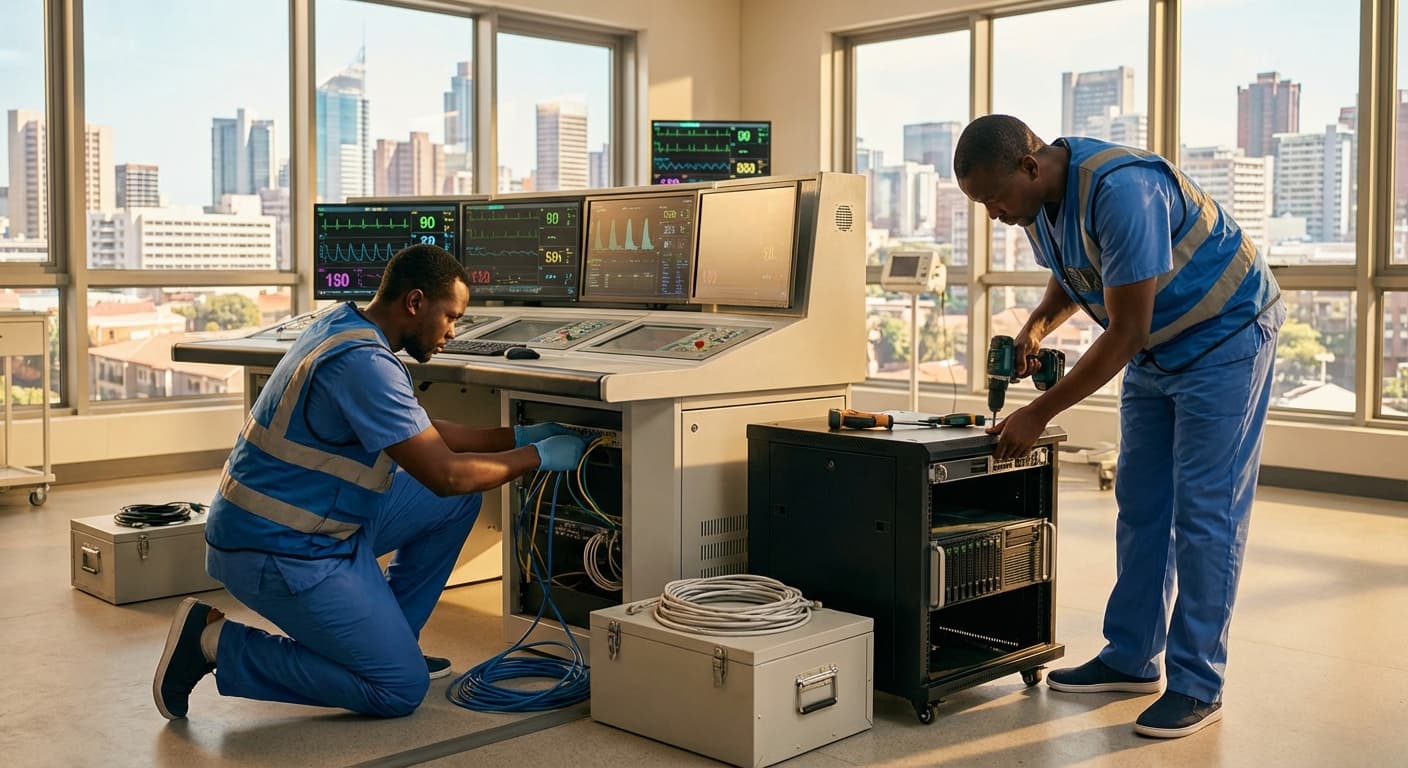
ICU Central Monitoring Station Installation Service in Togo
Engineering Excellence & Technical Support
ICU Central Monitoring Station Installation Service High-standard technical execution following OEM protocols and local regulatory frameworks.
Robust Network Infrastructure
We design and deploy secure, high-bandwidth network infrastructure to ensure seamless, real-time data transmission from bedside monitors to the central station. Our solutions prioritize redundancy and resilience, guaranteeing continuous patient data flow even in challenging environments.
Scalable Data Management Systems
Our installation services include setting up advanced, scalable data management systems capable of securely storing, retrieving, and analyzing vast amounts of patient vital signs and alarm data. This empowers your clinical staff with immediate access to critical information and historical trends for informed decision-making.
Advanced Security Protocols
We implement stringent cybersecurity measures and access control protocols to protect sensitive patient data from unauthorized access and cyber threats, ensuring compliance with international data privacy standards and safeguarding the integrity of your monitoring system.
What Is Icu Central Monitoring Station Installation Service In Togo?
ICU Central Monitoring Station Installation Service in Togo refers to the comprehensive process of setting up, configuring, and deploying a centralized monitoring system for Intensive Care Units (ICUs) within healthcare facilities in Togo. This service ensures that critical patient vital signs, device data, and alarms from multiple ICU beds are aggregated, displayed, and managed from a single, central location. The objective is to enhance patient safety, facilitate real-time clinical decision-making, and optimize the workflow of healthcare professionals by providing immediate access to critical information.
| Who Needs This Service? | Typical Use Cases |
|---|---|
| Hospitals and healthcare facilities in Togo with Intensive Care Units (ICUs). | Enhancing Patient Surveillance: Continuous, real-time monitoring of multiple critically ill patients, enabling early detection of physiological deterioration. |
| New hospital constructions or expansions requiring state-of-the-art ICU infrastructure. | Improving Clinical Response Times: Centralized alarm management alerts clinicians to critical events across the ICU, allowing for rapid intervention and improved patient outcomes. |
| Existing healthcare facilities upgrading their ICU monitoring capabilities. | Optimizing Staff Workflow: Reducing the need for constant physical checks at each bedside, freeing up nursing staff to focus on direct patient care and complex medical interventions. |
| Government health ministries or NGOs involved in developing or improving critical care services. | Data Aggregation and Analysis: Facilitating the collection of vital sign data for trend analysis, research, quality improvement initiatives, and potential research studies. |
| Facilities aiming to meet international standards for critical care monitoring. | Remote Monitoring and Telemedicine Integration: Laying the groundwork for potential future integration with remote monitoring services or telemedicine platforms. |
| Biomedical engineering departments responsible for the upkeep of medical equipment. | Centralized Maintenance and Troubleshooting: Providing a single point of access for monitoring system performance and facilitating efficient troubleshooting of connected devices. |
Key Components and Processes Involved in ICU Central Monitoring Station Installation:
- Site Survey and Assessment: Evaluating existing infrastructure (network, power, physical space), identifying placement for the central station, and assessing integration requirements with existing medical devices and hospital information systems (HIS).
- Hardware Installation: Deploying the central monitoring console(s), servers, network switches, cabling, and any necessary peripherals. This includes physical mounting, power connection, and network connectivity.
- Software Configuration and Integration: Installing and configuring the central monitoring software platform. This involves setting up patient profiles, device drivers for various bedside monitors (e.g., ECG, SpO2, NIBP, EtCO2, invasive pressures), alarm parameters, and data logging functionalities. Integration with HIS/EMR systems is often a critical aspect to ensure seamless data flow.
- Network Infrastructure Setup: Establishing a robust and secure network (wired or wireless) to facilitate data transmission from bedside monitors to the central station. This includes IP addressing, subnetting, firewall configuration, and ensuring adequate bandwidth.
- Calibration and Testing: Verifying the accurate reception and display of patient data from each connected bedside monitor. This involves rigorous testing of all functionalities, including alarm generation, data retrieval, and reporting.
- User Training: Providing comprehensive training to ICU clinicians, nurses, and biomedical engineers on the operation, maintenance, and troubleshooting of the central monitoring system. This includes understanding alarm management, data interpretation, and system navigation.
- Documentation and Handover: Delivering detailed system documentation, including installation guides, user manuals, network diagrams, and maintenance protocols. Formal handover of the fully functional system to the healthcare facility.
Who Needs Icu Central Monitoring Station Installation Service In Togo?
The installation of an ICU Central Monitoring Station is a critical step for any healthcare facility aiming to provide advanced critical care services in Togo. This service caters to a specific set of institutions and departments that require real-time, integrated patient data for optimal Intensive Care Unit (ICU) management and patient outcomes. The target customers are primarily hospitals and advanced medical centers that either operate an existing ICU or are planning to establish or upgrade one to meet international standards of care. The core beneficiaries of this service are the medical professionals and patients within the ICU and related critical care departments.
| Department/Area | Role in ICU Central Monitoring |
|---|---|
| Intensive Care Unit (ICU) | The primary operational unit directly benefiting from the station for continuous patient monitoring. |
| Emergency Department (ED) / Accident & Emergency (A&E) | For stabilization of critically ill patients before transfer to the ICU, allowing early integration of data. |
| Anesthesiology Department | Anesthesiologists often play a crucial role in ICU management and require access to real-time patient data. |
| Cardiology Department (especially for Cardiac ICU) | Monitoring cardiac patients requiring intensive care. |
| Neurology Department (especially for Neuro ICU) | Monitoring neurological patients requiring intensive care. |
| Pulmonology Department (especially for Respiratory ICU) | Monitoring patients with severe respiratory conditions. |
| Infection Control Department | Utilizing aggregated data for early detection and management of hospital-acquired infections. |
| Medical Information Technology (IT) Department | Responsible for the network infrastructure, data security, and ongoing technical support of the monitoring system. |
| Hospital Administration / Management | Overseeing the investment, operational efficiency, and strategic deployment of critical care resources. |
Target Customers for ICU Central Monitoring Station Installation Service in Togo
- Public University Hospitals
- Private Specialty Hospitals
- Large General Hospitals (public and private)
- Regional and National Referral Hospitals
- Military Hospitals
- NGO-funded Medical Centers with Critical Care Capabilities
Icu Central Monitoring Station Installation Service Process In Togo
This document outlines the standard workflow for the ICU Central Monitoring Station Installation Service Process in Togo, from initial client inquiry to successful execution and handover. The process is designed to ensure efficient project management, clear communication, and a high-quality installation that meets all regulatory and client-specific requirements.
| Phase | Key Activities | Deliverables | Responsible Parties |
|---|---|---|---|
| Initial contact, information gathering, preliminary site assessment | Understanding of client needs, preliminary scope definition | Client, Service Provider Sales/Consultant |
| Detailed site survey, system design, proposal generation, contract negotiation | Approved system design, detailed technical proposal, signed contract | Service Provider Engineering/Technical Team, Client Procurement/Management |
| Equipment sourcing, logistics, import, site preparation | All necessary equipment on-site, prepared installation environment | Service Provider Procurement/Logistics, Client Facility Management |
| Hardware installation, network setup, software deployment, system testing | Fully installed and configured central monitoring system | Service Provider Installation Team, IT Department |
| Staff training, UAT, documentation, final sign-off | Trained staff, approved system, handover documentation | Service Provider Training Team, Client Clinical/IT Staff |
| Warranty, maintenance, performance monitoring | Ongoing system functionality, technical support | Service Provider Support Team |
ICU Central Monitoring Station Installation Service Process in Togo
- {"steps":[{"stepNumber":1,"description":"Initial Client Inquiry: The process begins with a client (hospital, clinic, or healthcare facility in Togo) contacting the service provider with a request for an ICU Central Monitoring Station installation. This can be via phone, email, or an online inquiry form."},{"stepNumber":2,"description":"Information Gathering: The service provider gathers preliminary information about the project, including the number of ICU beds, existing infrastructure, specific monitoring requirements, preferred brands/technologies (if any), and the desired timeline."},{"stepNumber":3,"description":"Preliminary Site Assessment (Remote/Initial Visit): A preliminary assessment may be conducted remotely or through an initial site visit to understand the physical space, power availability, network infrastructure, and any potential site-specific challenges."}],"title":"Phase 1: Inquiry and Pre-Assessment"}
- {"steps":[{"stepNumber":4,"description":"Detailed Site Survey: A comprehensive site survey is conducted by qualified engineers to assess power, HVAC, networking, space requirements, existing equipment, and safety regulations. This is crucial for accurate planning."},{"stepNumber":5,"description":"System Design and Configuration: Based on the site survey and client requirements, a detailed system design is developed. This includes selecting the central monitoring unit, bedside monitors, networking components, software, and accessories. Compliance with Togolese healthcare regulations is ensured."},{"stepNumber":6,"description":"Technical Proposal and Quotation: A detailed technical proposal is prepared, outlining the proposed system, installation plan, timeline, required resources, and a comprehensive quotation. This is presented to the client for review and approval."},{"stepNumber":7,"description":"Contract Negotiation and Signing: Once the client approves the proposal, a formal contract is negotiated and signed, outlining the scope of work, payment terms, responsibilities, and warranties."}],"title":"Phase 2: Proposal and Planning"}
- {"steps":[{"stepNumber":8,"description":"Equipment Procurement: All necessary equipment, including central monitors, bedside monitors, cables, network devices, and software licenses, are procured from reputable suppliers, adhering to quality standards and lead times."},{"stepNumber":9,"description":"Logistics and Importation: Arranging for the transportation of equipment to Togo, including managing customs clearance and any import duties, ensuring compliance with Togolese import regulations."},{"stepNumber":10,"description":"Pre-Installation Site Preparation: The client, in coordination with the service provider, prepares the installation site. This may include ensuring adequate power outlets, network drops, and a clean, safe working environment."}],"title":"Phase 3: Procurement and Preparation"}
- {"steps":[{"stepNumber":11,"description":"Equipment Installation: Certified technicians install the central monitoring station hardware in the designated control room and connect bedside monitors to the network and the central station."},{"stepNumber":12,"description":"Network Configuration: The network infrastructure is configured to support the real-time data transmission from bedside monitors to the central station, ensuring data security and reliability."},{"stepNumber":13,"description":"Software Installation and Configuration: The central monitoring software is installed, configured, and customized according to the hospital's specific needs and workflows. This includes setting up patient profiles and alarm parameters."},{"stepNumber":14,"description":"System Integration and Testing: All components are integrated, and rigorous testing is performed to ensure that data is accurately transmitted, alarms function correctly, and the system is stable under various load conditions."}],"title":"Phase 4: Installation and Configuration"}
- {"steps":[{"stepNumber":15,"description":"Staff Training: Comprehensive training is provided to ICU staff (nurses, doctors, technicians) on the operation, maintenance, and troubleshooting of the central monitoring system. Training materials in French or relevant local languages are provided."},{"stepNumber":16,"description":"User Acceptance Testing (UAT): The client's designated personnel conduct User Acceptance Testing to confirm that the system meets all specified requirements and functions as expected."},{"stepNumber":17,"description":"Final Walkthrough and Documentation: A final walkthrough of the installed system is conducted with the client. All relevant documentation, including user manuals, technical specifications, and warranty information, is handed over."},{"stepNumber":18,"description":"Project Sign-off and Handover: Upon successful completion of UAT and client satisfaction, a formal project sign-off is obtained, marking the official handover of the installed ICU Central Monitoring Station."}],"title":"Phase 5: Training and Handover"}
- {"steps":[{"stepNumber":19,"description":"Warranty and Maintenance: The service provider offers ongoing warranty and maintenance support, including scheduled check-ups, software updates, and emergency technical assistance, as per the contract."},{"stepNumber":20,"description":"Performance Monitoring: Remote monitoring of the system's performance may be offered to proactively identify and address any potential issues."}],"title":"Phase 6: Post-Installation Support"}
Icu Central Monitoring Station Installation Service Cost In Togo
Installing an ICU Central Monitoring Station (CMS) in Togo involves a range of costs influenced by several critical factors. These stations are vital for real-time patient monitoring in intensive care units, requiring specialized equipment, skilled labor, and adherence to medical infrastructure standards. The pricing can fluctuate significantly based on the complexity of the system, the brand of equipment chosen, the size of the ICU, and the specific installation site's existing infrastructure. Understanding these elements is key to accurately budgeting for such a crucial healthcare investment.
| Cost Component | Estimated Range (XOF - Togolese Franc) |
|---|---|
| Basic Bedside Monitor (per bed) | 1,500,000 - 4,000,000 |
| Central Monitoring Station Unit (display, server) | 5,000,000 - 15,000,000 |
| Networking & Cabling (per ICU bay) | 500,000 - 2,000,000 |
| Software & Licensing (initial) | 2,000,000 - 8,000,000 |
| Installation Labor & Engineering | 3,000,000 - 10,000,000 |
| Staff Training | 1,000,000 - 3,000,000 |
| Import Duties & Taxes (estimated percentage) | 10% - 30% of CIF value |
| Annual Software Maintenance & Support | 1,000,000 - 5,000,000 |
Key Pricing Factors for ICU Central Monitoring Station Installation in Togo:
- Equipment Brand and Quality: High-end, internationally recognized brands (e.g., Philips, GE Healthcare, Draeger) will generally command higher prices than less established or locally sourced alternatives. The quality and features of the monitors, central display units, and networking components are paramount.
- Number of Patient Monitoring Beds: The total number of ICU beds that need to be integrated into the central monitoring system directly impacts the number of bedside monitors required, thus increasing overall equipment and installation costs.
- System Complexity and Features: Advanced features such as integrated data management software, direct integration with Electronic Health Records (EHR), advanced alarm management, and telemetry capabilities will add to the cost.
- Installation Site Requirements: The existing electrical infrastructure, network cabling, and physical space within the ICU can influence installation costs. Retrofitting older facilities might require more extensive and costly modifications than installing in new constructions.
- Software Licensing and Support: Ongoing software licenses for the central monitoring system, as well as annual maintenance and technical support contracts, are significant recurring costs.
- Training: Comprehensive training for medical staff (doctors, nurses) and IT personnel on operating and maintaining the CMS is essential and contributes to the overall project cost.
- Import Duties and Taxes: As medical equipment is often imported into Togo, import duties, customs fees, and local taxes will be added to the base cost of the equipment and services.
- Installation Service Provider: The reputation, experience, and geographical location of the installation service provider (local Togolese companies vs. international firms) will affect labor rates and overall service charges.
- Warranty and Service Agreements: Extended warranties and comprehensive service agreements, which include preventative maintenance and rapid repair response, will increase the upfront cost but offer long-term value.
- Project Management and Consultancy: For larger or more complex installations, engaging project managers or specialized healthcare IT consultants can add to the overall expense.
Affordable Icu Central Monitoring Station Installation Service Options
Installing an Intensive Care Unit (ICU) central monitoring station is a critical investment for any healthcare facility, ensuring continuous patient observation and immediate response to vital sign changes. This service involves the setup, integration, and configuration of a comprehensive system that allows clinical staff to monitor multiple patients from a central location. The goal is to provide reliable, real-time data to improve patient outcomes and enhance clinical workflow efficiency. Understanding the various installation service options, value bundles, and cost-saving strategies is crucial for making an informed decision that balances essential functionality with budget constraints.
| Service Option/Bundle | Key Features | Typical Cost Range (Illustrative) | Value Proposition |
|---|---|---|---|
| Basic Installation Package | Core hardware setup, software installation, basic network configuration, and initial system testing. | $15,000 - $40,000 | Cost-effective solution for facilities with existing network infrastructure and minimal customization needs. |
| Standard Value Bundle | Includes Basic Package plus EHR integration, advanced system configuration, and on-site staff training. | $30,000 - $75,000 | Offers a more integrated and user-friendly system with improved workflow by connecting to existing patient records. |
| Premium All-Inclusive Bundle | Comprehensive service covering hardware, software, network infrastructure design and setup, extensive customization, advanced data analytics integration, and extended on-site support and training. | $60,000 - $150,000+ | Provides a complete, optimized, and future-proof solution, maximizing patient safety and operational efficiency with dedicated support. |
| Phased Installation Service | Breaking down the installation into manageable stages, allowing for incremental deployment and payment. Ideal for expanding facilities or those with budget constraints. | Varies based on scope of each phase. | Allows for budget flexibility and gradual adoption, minimizing disruption. |
| Remote Installation Support | Leveraging remote access for configuration, troubleshooting, and initial setup, with on-site presence for critical phases. | Lower than full on-site, typically $5,000 - $15,000+ for remote components. | Reduces on-site labor costs, especially for facilities with good IT infrastructure. |
Key Components of ICU Central Monitoring Station Installation
- Hardware Procurement & Installation: This includes bedside patient monitors, central workstations, networking equipment, and servers.
- Software Integration & Configuration: Setting up the monitoring software, customizing display parameters, and integrating with existing Electronic Health Records (EHR) systems.
- Network Infrastructure Setup: Ensuring secure and reliable network connectivity for data transmission between bedside monitors and the central station.
- System Testing & Calibration: Thoroughly testing all components and calibrating sensors to ensure accurate data readings.
- Clinical Staff Training: Providing comprehensive training to nurses, physicians, and technicians on operating and utilizing the central monitoring system effectively.
- Ongoing Maintenance & Support: Post-installation services including software updates, hardware repairs, and technical assistance.
- Project Management: Overseeing the entire installation process from planning to deployment, ensuring timely completion and adherence to budget.
Verified Providers In Togo
In Togo's evolving healthcare landscape, ensuring access to reliable and credentialed medical professionals is paramount. Franance Health stands out as a leading platform dedicated to connecting individuals with verified healthcare providers. This commitment to rigorous credentialing is not just a procedural step; it's a cornerstone of patient safety and quality care. By prioritizing providers who have undergone thorough vetting, Franance Health empowers users to make informed decisions, fostering trust and confidence in the healthcare services they receive. Their meticulous credentialing process ensures that all listed practitioners meet established standards of education, licensure, and professional conduct, offering a crucial layer of security in a field where expertise and integrity are non-negotiable. This dedication to verified quality makes Franance Health the best choice for anyone seeking dependable healthcare in Togo.
| Provider Type | Franance Health Verification Status | Why it Matters for Patients |
|---|---|---|
| General Practitioners | Verified | Ensures they possess the foundational knowledge and skills to diagnose and treat a wide range of common ailments. |
| Specialists (e.g., Cardiologists, Dermatologists) | Verified | Confirms specialized training and expertise, guaranteeing high-quality care for specific medical conditions. |
| Surgeons | Verified | Indicates rigorous training, adherence to safety protocols, and proven surgical competence. |
| Dentists | Verified | Guarantees they meet standards for oral health examinations, treatments, and preventative care. |
| Pharmacists | Verified | Ensures accurate dispensing of medications, patient counseling, and adherence to drug safety regulations. |
Key Aspects of Franance Health's Credentialing Process:
- Verification of Medical Licenses and Certifications
- Background Checks on Professional History
- Validation of Educational Qualifications
- Confirmation of Membership in Professional Bodies
- Ongoing Monitoring of Provider Performance
Scope Of Work For Icu Central Monitoring Station Installation Service
This Scope of Work (SOW) outlines the requirements for the installation of an Intensive Care Unit (ICU) Central Monitoring Station (CMS) service. It details the technical deliverables and standard specifications necessary to ensure a successful and fully functional CMS deployment. The project aims to integrate patient monitoring devices within the ICU into a centralized system for enhanced patient care and real-time data accessibility by clinical staff.
| Technical Deliverable | Description | Standard Specification / Requirement |
|---|---|---|
| CMS Server(s) | The core processing unit for the central monitoring system. | High availability, redundant power supplies, sufficient processing power (e.g., multi-core Xeon processors), ample RAM (e.g., 64GB+), and fast storage (e.g., SSDs). Must meet or exceed manufacturer's recommended specifications for the chosen CMS software. |
| CMS Workstation(s) | User interface terminals for clinical staff to view patient data. | High-resolution monitors (e.g., 24-inch minimum), powerful CPUs, adequate RAM, and ergonomic keyboard/mouse. Must be capable of displaying multiple data streams simultaneously without performance degradation. |
| Network Cabling and Infrastructure | Installation of structured cabling to connect all monitoring devices and CMS components. | Category 6a or higher Ethernet cabling for all connections. All cabling to be tested and certified for performance. Dedicated network switches with sufficient port density and QoS capabilities. DHCP and DNS services to be configured and managed. |
| Patient Monitoring Device Integration | Connecting existing and new patient monitors to the CMS. | Compatibility with standard medical device communication protocols (e.g., HL7, DICOM, proprietary vendor protocols). Integration will involve physical connections (wired/wireless) and logical configuration within the CMS software. |
| CMS Software Installation and Configuration | Deployment and setup of the central monitoring software. | Installation of the licensed CMS software on designated servers and workstations. Configuration of patient demographics, alarm parameters, data storage, user roles, and security settings. Compliance with relevant healthcare IT standards (e.g., HIPAA). |
| System Security Measures | Implementation of security protocols to protect patient data. | Role-based access control, strong password policies, data encryption (at rest and in transit), audit trails, and regular security patching. Firewall configuration and intrusion detection systems as required. |
| Data Storage and Backup Solution | Ensuring reliable storage and backup of patient monitoring data. | Sufficient storage capacity for historical data (e.g., 5+ years). Implementation of a robust backup strategy (e.g., daily incremental, weekly full backups) with offsite storage or cloud backup solution. Regular testing of backup restoration procedures. |
| Alarm Management System | Configuration of alarm thresholds and notification systems. | Customizable alarm limits for all monitored parameters. Audible and visual alarms on workstations and potentially mobile devices. Defined escalation procedures for critical alarms. |
| Integration with EMR/EHR (Optional) | Connecting the CMS to the Electronic Medical Records/Electronic Health Records system. | Successful transmission of relevant patient monitoring data to the EMR/EHR. Compliance with interoperability standards (e.g., HL7 v2.x, FHIR). Data mapping and validation to ensure accuracy. |
| System Documentation | Comprehensive documentation of the installed system. | As-built diagrams, network topology, configuration guides, user manuals, troubleshooting guides, and maintenance procedures. All documentation to be delivered in both hard copy and electronic formats. |
| User Training Materials | Development of training resources for clinical staff. | Comprehensive training manuals, presentation slides, and hands-on exercises covering system operation, data interpretation, alarm management, and basic troubleshooting. Training sessions tailored to different user roles. |
Key Project Phases and Activities
- Site Survey and Assessment
- System Design and Planning
- Hardware Procurement and Staging
- Network Infrastructure Preparation
- CMS Server and Workstation Installation
- Patient Monitoring Device Integration
- Software Configuration and Customization
- System Testing and Validation
- User Training
- Go-Live and Post-Installation Support
Service Level Agreement For Icu Central Monitoring Station Installation Service
This Service Level Agreement (SLA) outlines the response times and uptime guarantees for the installation services provided by [Your Company Name] for ICU Central Monitoring Stations. This SLA is an appendix to the Master Service Agreement (MSA) between [Your Company Name] and [Client Name].
| Service Component | Response Time Guarantee | Resolution Time Target | Uptime Guarantee |
|---|---|---|---|
| Initial System Testing & Calibration | Within 4 business hours of identified issue during installation | Within 12 business hours of identified issue during installation | N/A (Focus on successful installation) |
| Critical System Functionality (e.g., data acquisition, alarm generation) | Within 2 business hours of identified issue during installation | Within 8 business hours of identified issue during installation | N/A (Focus on successful installation) |
| Post-Installation System Uptime (first 30 days) | Not Applicable (Focus on proactive monitoring) | Not Applicable (Focus on proactive monitoring) | 99.5% during operational hours (defined as 24/7 for ICU) |
| Non-Critical Functionality (e.g., reporting, historical data access) | Within 8 business hours of identified issue during installation | Within 24 business hours of identified issue during installation | Not Applicable (Focus on successful installation) |
Key Service Objectives
- To ensure prompt and efficient resolution of issues during the installation process.
- To maintain a high level of system availability for the newly installed ICU Central Monitoring Station.
- To provide clear communication and timely updates throughout the service period.
Frequently Asked Questions

Ready when you are
Let's scope your ICU Central Monitoring Station Installation Service in Togo project in Togo.

Scaling healthcare logistics and technical systems across the entire continent.