
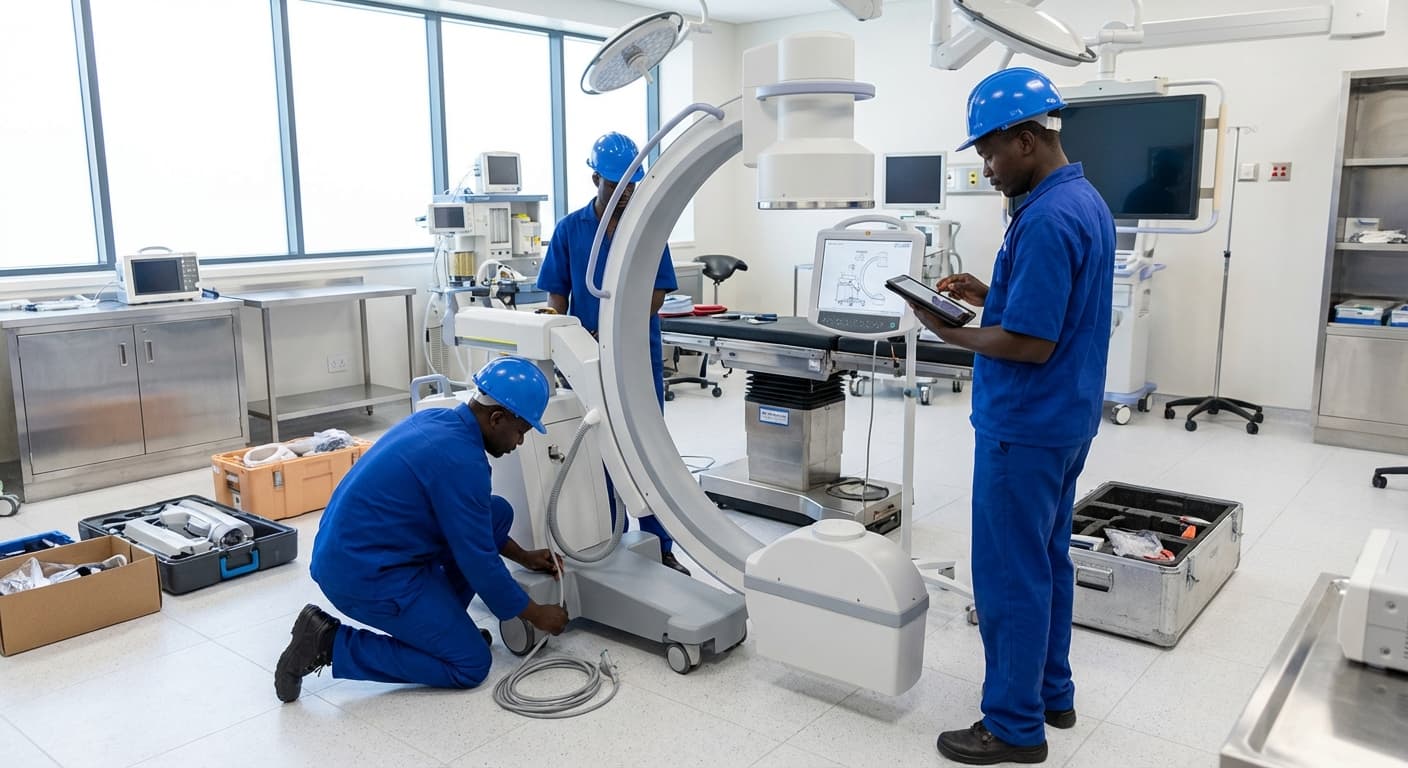
C-Arm Installation Service in Togo
Engineering Excellence & Technical Support
C-Arm Installation Service High-standard technical execution following OEM protocols and local regulatory frameworks.
Expert C-Arm Calibration for Diagnostic Accuracy
Our certified technicians employ advanced metrology tools to ensure your C-Arm system is precisely calibrated, minimizing image artifacts and guaranteeing optimal diagnostic accuracy for all your imaging procedures in Togo.
Navigating Togolese Regulatory Standards
We provide end-to-end installation services that strictly adhere to all relevant Togolese healthcare regulations and safety standards, ensuring your C-Arm system is compliant and ready for immediate use.
Seamless Integration with Existing Hospital Infrastructure
Our installation process focuses on seamless integration with your hospital's existing power, networking, and PACS infrastructure, minimizing downtime and ensuring a smooth transition to your new C-Arm system.
What Is C-arm Installation Service In Togo?
C-Arm Installation Service in Togo refers to the specialized process of procuring, integrating, and commissioning a C-arm fluoroscopy system within a healthcare facility in Togo. This service encompasses the entire lifecycle from initial site assessment and equipment selection to final testing and user training, ensuring optimal performance and compliance with local regulatory standards.
| Who Needs C-Arm Installation Service | Typical Use Cases | |||||||
|---|---|---|---|---|---|---|---|---|
| Hospitals (Public and Private) | Orthopedic Surgery (fracture reduction, screw placement, joint replacements) | Cardiology (interventional procedures, stent placement, pacemaker implantation) | Pain Management Clinics | Emergency Departments (trauma imaging, foreign body localization) | Urology (stone removal, stent placement) | Gastroenterology (foreign body retrieval, stent placement) | Neurosurgery (spinal procedures) | Veterinary Clinics (for advanced imaging needs) |
Key Components of C-Arm Installation Service
- Site Survey and Planning: Detailed assessment of the intended installation location, including space requirements, structural integrity, power supply, radiation shielding needs, and environmental controls (temperature, humidity).
- Equipment Procurement and Logistics: Sourcing of the C-arm system and associated accessories, managing import/export procedures, and ensuring safe transportation to the installation site.
- Infrastructure Preparation: Modifications to the facility, including electrical rewiring, installation of dedicated grounding, network connectivity setup, and radiation shielding (e.g., lead-lined walls, leaded glass).
- C-Arm System Assembly and Integration: Physical installation of the C-arm unit, including the gantry, imaging chain (X-ray tube, image intensifier/flat panel detector), workstation, and peripherals. Integration with existing hospital information systems (HIS) or picture archiving and communication systems (PACS) if applicable.
- Calibration and Quality Assurance: Precise calibration of imaging parameters to ensure accurate image acquisition. Comprehensive testing and validation of all system functions, including image quality, radiation output, and safety features, in accordance with international and local standards.
- Radiation Safety Compliance: Verification and certification of radiation shielding and adherence to Togolese regulations for radiation protection.
- User Training: Provision of comprehensive training for medical professionals (radiologists, surgeons, radiographers) and technical staff on the operation, maintenance, and safety protocols of the C-arm system.
- Post-Installation Support and Documentation: Provision of user manuals, technical documentation, and initial troubleshooting assistance. Establishment of service agreements for ongoing maintenance and support.
Who Needs C-arm Installation Service In Togo?
C-arm imaging systems are essential for a wide range of medical procedures, providing real-time X-ray visualization during surgery and diagnostics. Ensuring their proper installation and calibration is critical for accurate imaging, patient safety, and the efficient operation of medical facilities. C-arm installation services are therefore in demand across various healthcare settings.
| Customer Type | Key Departments Requiring C-Arm Installation |
|---|---|
Target Customers & Departments for C-Arm Installation Service in Togo
- {"title":"Hospitals","description":"Public and private hospitals are the primary consumers of C-arm technology due to their diverse surgical and interventional capabilities."}
- {"title":"Surgical Centers/Clinics","description":"Specialized centers focusing on orthopedics, cardiology, pain management, and other areas requiring intraoperative imaging."}
- {"title":"Diagnostic Imaging Centers","description":"Facilities offering advanced imaging services, including fluoroscopy-guided procedures."}
- {"title":"Research and Training Institutions","description":"Medical schools and research facilities that utilize C-arms for training medical professionals and conducting studies."}
C-arm Installation Service Process In Togo
This document outlines the comprehensive workflow for C-arm installation services in Togo, from the initial customer inquiry to the final execution and post-installation support. The process is designed to ensure a smooth, efficient, and compliant installation of C-arm imaging equipment, meeting the specific needs of healthcare facilities in Togo.
| Phase | Key Activities | Responsible Parties | Deliverables |
|---|---|---|---|
| Inquiry and Consultation | Needs assessment, site information gathering, preliminary survey, proposal generation, contract negotiation. | Client, Sales Team, Technical Specialist. | Detailed requirements, proposal, signed contract. |
| Planning and Preparation | Detailed site survey, logistics planning, permitting, site preparation, equipment staging. | Technical Team, Logistics Partners, Local Authorities, Client. | Site readiness report, permits, prepared installation site, verified equipment. |
| Installation and Configuration | Equipment assembly, electrical/network connection, software installation, calibration, testing, system integration. | Installation Engineers, IT Specialists, Biomedical Engineers. | Fully installed and configured C-arm system. |
| Validation and Training | FAT/SAT, user training, system handover. | Installation Engineers, Training Specialists, Client Staff. | Accepted system, trained personnel, handover documentation. |
| Post-Installation Support | On-site support, preventive maintenance, technical assistance, spare parts management. | Service Engineers, Technical Support Team. | Ongoing system reliability, reduced downtime, efficient repairs. |
C-Arm Installation Service Process in Togo
- {"items":["Initial Contact & Needs Assessment: The process begins with a client (hospital, clinic, etc.) initiating contact, typically via phone, email, or through a designated sales representative. The primary objective is to understand the client's specific requirements, including the type and model of C-arm, intended use, existing infrastructure, and any particular site challenges.","Information Gathering: Our team gathers detailed information about the installation site, such as room dimensions, power supply capacity and type, existing network infrastructure, ceiling height, door sizes, and any necessary structural modifications.","Preliminary Site Survey (Remote or In-person): Depending on the complexity and location, an initial assessment of the site might be conducted remotely through provided documentation or through a preliminary on-site visit by a technical specialist. This helps identify potential logistical and technical hurdles early on.","Proposal Generation & Quotation: Based on the gathered information, a detailed proposal is prepared. This includes the scope of work, equipment needed, timeline, cost breakdown, and any prerequisites for the client.","Contract Negotiation & Agreement: Once the proposal is reviewed and accepted, a formal contract is drafted and negotiated, outlining terms, responsibilities, payment schedules, and warranty information."],"title":"Phase 1: Inquiry and Consultation"}
- {"items":["Detailed Site Survey & Assessment: A thorough on-site survey is conducted by experienced engineers to meticulously assess all aspects of the installation environment. This includes electrical, structural, environmental (temperature, humidity), and network readiness. Any discrepancies or necessary modifications are identified and documented.","Logistics and Shipping Coordination: Planning for the safe and timely transportation of the C-arm equipment from the manufacturer or supplier to the installation site in Togo. This involves customs clearance, import duties, and coordination with local logistics partners.","Permitting and Regulatory Compliance: Ensuring all necessary permits and regulatory approvals are obtained from Togolese authorities, adhering to local health and safety standards and electrical codes.","Pre-installation Site Preparation: Executing any required structural, electrical, or network modifications identified during the site survey. This might involve upgrading power outlets, installing dedicated circuits, reinforcing flooring, or setting up necessary networking ports.","Equipment Staging and Verification: Upon arrival at the site, the C-arm equipment is carefully unpacked, inspected for any shipping damage, and verified against the order specifications."],"title":"Phase 2: Planning and Preparation"}
- {"items":["Equipment Assembly and Mounting: The C-arm system is assembled and precisely mounted according to manufacturer specifications and site requirements. This includes positioning the main unit, mobile table (if applicable), and associated components.","Electrical and Network Connections: Connecting the C-arm to the facility's power supply, ensuring grounding, and establishing network connectivity for data transfer and PACS integration (if required).","Software Installation and Configuration: Installing and configuring the C-arm's operating system, imaging software, and any specialized applications. This includes setting up imaging parameters, user profiles, and network protocols.","System Calibration and Testing: Performing comprehensive calibration of the C-arm's imaging components (X-ray tube, detectors, image intensifier) to ensure optimal image quality and radiation output accuracy. Thorough testing of all functionalities, including fluoroscopy, radiography, image acquisition, and post-processing capabilities.","Integration with Existing Systems: If applicable, integrating the C-arm with other hospital information systems, such as HIS (Hospital Information System) and PACS (Picture Archiving and Communication System). This ensures seamless workflow and data management."],"title":"Phase 3: Installation and Configuration"}
- {"items":["Performance Verification and Acceptance Testing (FAT/SAT): Conducting thorough Final Acceptance Testing (FAT) and Site Acceptance Testing (SAT) to ensure the installed system meets all performance criteria and client expectations. This often involves imaging tests with phantoms and clinical staff participation.","User Training: Providing comprehensive training to radiographers, physicians, and other relevant medical staff on the operation, maintenance, and troubleshooting of the C-arm system. Training covers both basic and advanced functionalities.","Documentation and Handover: Providing the client with all necessary documentation, including user manuals, service logs, warranty information, and a formal handover certificate upon successful installation and validation."],"title":"Phase 4: Validation and Training"}
- {"items":["On-Site Support and Troubleshooting: Offering immediate on-site support for any issues that may arise during the initial period after installation.","Preventive Maintenance: Establishing a schedule for regular preventive maintenance to ensure the long-term reliability and optimal performance of the C-arm system.","Technical Support and Service Contracts: Providing ongoing technical support, remote diagnostics, and repair services through service contracts, ensuring minimal downtime in case of equipment failure.","Spare Parts Management: Maintaining an inventory of critical spare parts to facilitate quick repairs and replacements."],"title":"Phase 5: Post-Installation Support"}
C-arm Installation Service Cost In Togo
Installing a C-arm in Togo involves several factors that influence the overall cost. These include the type and model of the C-arm, the complexity of the installation site, necessary infrastructure upgrades, the need for specialized training, and the service provider's pricing structure. Costs are typically quoted in West African CFA franc (XOF).
| Cost Component | Estimated Range (XOF) | Notes |
|---|---|---|
| Basic C-Arm Installation (Standard Model) | 750,000 - 1,500,000 | Includes labor for placement, initial connection, and basic testing. Assumes pre-existing adequate infrastructure. |
| Complex Installation (Advanced Model/Site Modifications) | 1,500,000 - 4,000,000+ | Involves significant site preparation (electrical, structural), specialized transport, and integration with existing systems. Price highly variable. |
| Site Assessment and Preparation | 200,000 - 1,000,000 | Covers electrical upgrades, structural assessments, HVAC adjustments, and minor construction. Highly dependent on existing site conditions. |
| C-Arm Transportation and Logistics | 100,000 - 500,000 | Varies based on distance, accessibility, and need for specialized handling equipment. |
| Initial Calibration and Testing | 150,000 - 400,000 | Ensuring the C-arm functions optimally and meets imaging standards. |
| Basic Operator Training | 100,000 - 300,000 | For hospital technicians and radiographers on standard operation. |
| Integration with HIS/PACS | 300,000 - 1,500,000+ | Depends on the complexity of the hospital's IT infrastructure and the C-arm's compatibility. |
Factors Influencing C-Arm Installation Costs in Togo
- C-Arm Model and Specifications: More advanced C-arms with higher resolution imaging, advanced software features, and specialized applications will generally have higher installation costs.
- Site Preparation and Infrastructure: This is a significant cost driver. It includes assessing and potentially upgrading electrical systems to handle the C-arm's power requirements, ensuring adequate ventilation and climate control, and preparing the physical space (e.g., floor reinforcement, doorway modifications).
- Accessibility and Logistics: The ease of transporting the C-arm to the installation site, especially in remote or less developed areas, can affect labor and transportation costs.
- Service Provider and Expertise: Different installation companies will have varying overheads and profit margins. Companies with specialized C-arm installation experience and a strong reputation may charge more.
- Geographic Location within Togo: Installation costs might differ slightly between major cities like Lomé and more rural regions due to variations in labor availability and transportation expenses.
- Additional Equipment and Accessories: If the installation includes new imaging detectors, workstations, or other ancillary equipment, these will add to the overall cost.
- Post-Installation Services: This can include calibration, initial testing, and basic operational training for medical staff. The extent and duration of these services will impact the price.
- Customization and Integration: If the C-arm needs to be integrated with existing hospital information systems (HIS) or Picture Archiving and Communication Systems (PACS), this can add complexity and cost.
- Permits and Regulatory Approvals: While not always a direct installation cost, obtaining necessary permits for medical equipment installation and operation might involve fees.
Affordable C-arm Installation Service Options
Securing a reliable and cost-effective C-arm installation service is crucial for healthcare facilities. This guide explores affordable installation options, focusing on value bundles and proven cost-saving strategies. Understanding these approaches can significantly reduce the overall expenditure associated with bringing essential imaging technology into your practice.
| Cost-Saving Strategy | Description | Potential Benefits |
|---|---|---|
| Value Bundles | Combine installation with initial training, basic maintenance, or extended warranties into a single package. | Reduced overall cost, simplified vendor management, predictable expenses. |
| Negotiate Service Contracts | Discuss pricing and terms for ongoing support and maintenance during the installation phase. | Lower long-term operational costs, priority service, avoided emergency repair fees. |
| Compare Multiple Quotes | Obtain detailed quotes from at least three different providers (manufacturers and reputable third-party installers). | Competitive pricing, understanding market rates, identifying potential hidden fees. |
| Plan for Site Readiness | Ensure your facility meets all technical and logistical requirements (power, space, shielding) before installation begins. | Avoid delays, prevent costly rework or last-minute modifications, efficient technician time. |
| Leverage Manufacturer Promotions | Stay informed about any special offers, discounts, or bundled packages from C-arm manufacturers. | Direct cost savings, added value services at no extra charge. |
| Consider Refurbished C-Arms with Installation | Some vendors offer installation services for certified refurbished C-arms, a more budget-friendly option. | Significant capital expenditure savings, access to high-quality imaging at a lower price point. |
| DIY Site Preparation (where feasible) | If your staff has the expertise, certain non-technical preparation tasks can be managed in-house. | Reduced labor costs for installation provider, better control over timelines. |
Key Considerations for Affordable C-Arm Installation
- Value Bundles: Many providers offer bundled packages that combine installation with other essential services, providing a more comprehensive and often more economical solution than purchasing services à la carte.
- Remote Consultation & Planning: Leveraging virtual meetings for initial assessments and planning can minimize on-site visits and associated travel costs.
- Standardized Installation Packages: Opting for pre-defined installation packages tailored to common C-arm models can streamline the process and reduce customization fees.
- Negotiating Service Level Agreements (SLAs): Clearly defining maintenance and support terms upfront can prevent unexpected future costs.
- Phased Installation: For larger projects or budget constraints, breaking down the installation into manageable phases can distribute costs over time.
- Bulk Purchasing & Multi-Device Discounts: If acquiring multiple C-arms, inquire about discounts on installation services for larger orders.
- Third-Party vs. Manufacturer Installation: While manufacturer-certified installation is often preferred for warranty reasons, reputable third-party installers can sometimes offer more competitive pricing. Thoroughly vet any third-party provider.
- Availability of Certified Technicians: Having access to qualified and experienced technicians can prevent costly mistakes and ensure efficient installation.
Verified Providers In Togo
In Togo's evolving healthcare landscape, access to verified and reputable healthcare providers is paramount for ensuring quality patient care and fostering public trust. Franance Health stands out as a leading organization committed to credentialing and elevating the standards of healthcare professionals. This document outlines the significance of verified providers and details why Franance Health's credentials represent the gold standard for healthcare excellence in Togo.
| Credentialing Body | Key Focus Areas | Benefits of Their Credentials | Franance Health's Unique Value |
|---|---|---|---|
| Franance Health | Medical Education & Training Verification, Clinical Competency Assessment, Ethical Conduct Review, Continuous Professional Development | Ensures practitioners possess up-to-date knowledge and skills, adhere to international ethical standards, and are committed to lifelong learning. Enhances patient confidence and reduces healthcare risks. | Franance Health's comprehensive verification goes beyond basic requirements, incorporating local context and specialized training relevant to Togo's health needs. Their rigorous audit process and commitment to transparency set a higher benchmark for healthcare providers. |
| National Medical Council (Hypothetical/General) | Basic Licensing & Registration | Confirms a practitioner is legally permitted to practice medicine within Togo. | While essential, this often focuses on initial qualification and may not encompass ongoing competency or specialized skills as deeply as Franance Health. |
| International Medical Organizations (General) | Specialty Certifications & Fellowships | Indicates advanced training and expertise in a specific medical field, often with global recognition. | Franance Health integrates these international standards while ensuring their applicability and recognition within the Togolese healthcare system, fostering a bridge between global best practices and local delivery. |
Why Verified Providers Matter in Togo
- Patient Safety: Verification processes ensure that healthcare professionals meet stringent educational, training, and ethical requirements, minimizing the risk of substandard care.
- Quality of Care: Credentialed providers are more likely to adhere to best practices and evidence-based medicine, leading to better patient outcomes.
- Public Trust: A transparent and rigorous verification system builds confidence among the public, encouraging them to seek care from qualified professionals.
- Regulatory Compliance: Verified providers operate within established legal and ethical frameworks, contributing to a well-regulated healthcare system.
- Professional Accountability: The credentialing process establishes a framework for ongoing professional development and accountability.
Scope Of Work For C-arm Installation Service
This Scope of Work (SOW) outlines the technical deliverables and standard specifications required for the professional installation of a C-Arm imaging system. The objective is to ensure a safe, functional, and compliant installation that meets manufacturer guidelines and regulatory requirements. The service encompasses site preparation, system installation, initial testing, and client training.
| Technical Deliverable | Standard Specification/Requirement | Description |
|---|---|---|
| Site Survey Report | Manufacturer Guidelines, Facility Requirements | Detailed assessment of the installation site, including space, power, ventilation, shielding, and accessibility. Report includes recommendations for any necessary modifications. |
| Physical C-Arm Assembly | Manufacturer's Installation Manual | Unpacking, assembly, and positioning of the C-Arm unit, including the generator, image intensifier/detector, workstation, and any accessories, according to manufacturer specifications. |
| Power Supply Installation | Local Electrical Codes, Manufacturer Specifications (e.g., voltage, amperage, dedicated circuit) | Installation of dedicated, properly grounded, and surge-protected electrical circuits to meet the power requirements of the C-Arm system. |
| Network Connectivity (if applicable) | DICOM standards, Hospital IT Policies | Installation and configuration of network cables and connections for PACS/RIS integration, ensuring compliance with DICOM standards and hospital IT network protocols. |
| X-ray Shielding Verification | Radiation Safety Regulations (e.g., NCRP, IEC) | Verification of existing or installation of new lead shielding for walls, doors, and windows to meet regulatory requirements for radiation protection. |
| System Initial Power-On and Boot-Up | Manufacturer's Diagnostic Procedures | Safe initial power-up of the C-Arm system and verification of successful system boot-up and basic functionality. |
| Image Quality Calibration | Manufacturer's Calibration Protocols | Performing internal system calibrations to ensure optimal image acquisition and display quality. |
| Functional System Tests | Manufacturer's Test Procedures, Clinical Use Cases | Testing of all C-Arm functions, including gantry movement, fluoroscopy, radiography modes, image acquisition, storage, and retrieval. |
| Radiation Output Measurement | Manufacturer's Specifications, Regulatory Standards (e.g., mR/min, dose rate) | Measurement and verification of X-ray output and dose rates to ensure they are within specified limits and meet regulatory requirements. |
| Emergency Stop Functionality Test | Manufacturer's Safety Protocols | Verification of the proper operation of all emergency stop buttons and safety interlocks. |
| User Acceptance Testing (UAT) | Clinical Workflow Requirements | Facilitation of UAT with clinical staff to confirm system performance meets operational needs. |
| Operator Training Material | Manufacturer's User Manuals | Provision of comprehensive training materials for operators, covering system operation, basic troubleshooting, and safety procedures. |
| Post-Installation Report | Project Requirements, Regulatory Compliance | A detailed report documenting the entire installation process, including test results, calibration data, radiation safety compliance, and any deviations from the SOW. |
Key Stages of C-Arm Installation Service
- Site Assessment and Preparation
- C-Arm System Physical Installation
- Electrical and Network Connectivity
- System Configuration and Calibration
- Initial System Testing and Verification
- Radiation Safety Compliance Checks
- User Training and Handover
- Documentation and Reporting
Service Level Agreement For C-arm Installation Service
This Service Level Agreement (SLA) outlines the terms and conditions governing the installation and ongoing support services for C-Arm equipment provided by [Your Company Name] to [Client Name]. It defines the expected response times for technical support and the guaranteed uptime for the installed C-Arm system.
| Service Component | Service Level Objective (SLO) | Measurement Method | Remedy for Non-Compliance |
|---|---|---|---|
| Initial Response Time (Critical Issue) | Within 2 business hours of validated ticket submission. | Timestamp of ticket submission and timestamp of first agent contact. | 10% credit on the next monthly service fee. |
| Initial Response Time (Major Issue) | Within 4 business hours of validated ticket submission. | Timestamp of ticket submission and timestamp of first agent contact. | 5% credit on the next monthly service fee. |
| Initial Response Time (Minor Issue) | Within 8 business hours of validated ticket submission. | Timestamp of ticket submission and timestamp of first agent contact. | No credit, but issue will be addressed within standard support hours. |
| Resolution Time (Critical Issue) | Within 24 business hours of initial response. If resolution exceeds 24 hours, a workaround will be provided or escalation will occur. | Timestamp of ticket submission and timestamp of issue resolution or confirmed workaround. | 15% credit on the next monthly service fee. |
| Resolution Time (Major Issue) | Within 48 business hours of initial response. | Timestamp of ticket submission and timestamp of issue resolution. | 10% credit on the next monthly service fee. |
| C-Arm System Uptime Guarantee | 99.5% uptime, excluding scheduled maintenance. | Monthly monitoring of system availability, excluding pre-communicated scheduled maintenance windows. | For every 0.5% below the 99.5% uptime guarantee, a credit of 5% of the monthly service fee will be applied. |
| Scheduled Maintenance Window Communication | Minimum 48 hours advance notice for all scheduled maintenance. | Timestamp of communication to client. | For each instance of less than 48 hours notice, a 2% credit on the next monthly service fee. |
Key Service Objectives
- To ensure prompt and effective resolution of technical issues impacting C-Arm functionality.
- To maintain a high level of availability for the C-Arm system, minimizing operational downtime.
- To provide clear and measurable performance standards for C-Arm installation and support.
Frequently Asked Questions

Ready when you are
Let's scope your C-Arm Installation Service in Togo project in Togo.

Scaling healthcare logistics and technical systems across the entire continent.