
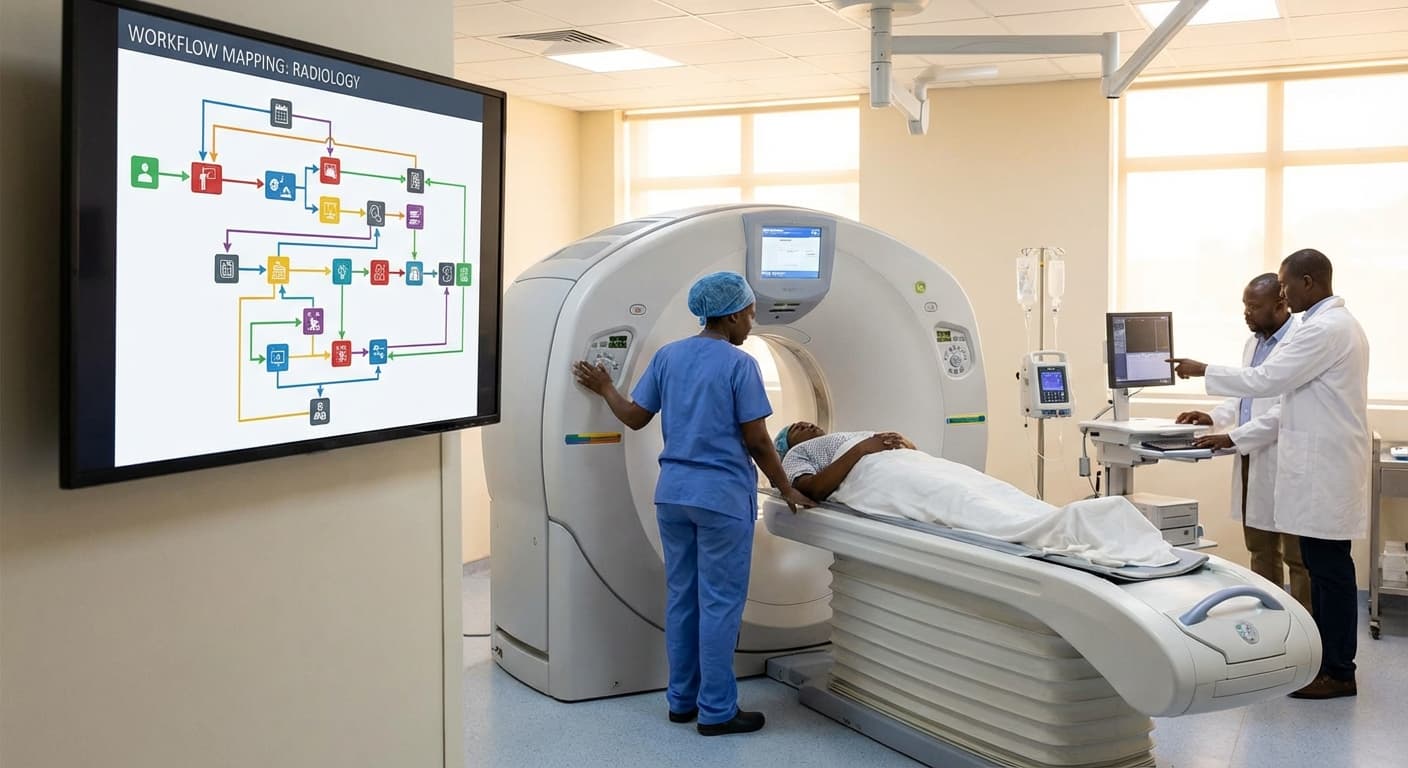
Department Workflow Mapping Service (Radiology/ICU/OT/Lab/Dialysis) in Togo
Engineering Excellence & Technical Support
Department Workflow Mapping Service (Radiology/ICU/OT/Lab/Dialysis) High-standard technical execution following OEM protocols and local regulatory frameworks.
Visualizing Patient Journeys
Our service provides comprehensive visual maps of patient workflows across critical departments like Radiology, ICU, OT, Lab, and Dialysis in Togolese healthcare facilities. This allows for clear identification of bottlenecks, redundancies, and areas for improvement, leading to optimized patient care and resource allocation.
Boosting Operational Efficiency
By meticulously mapping departmental workflows, we pinpoint inefficiencies in patient movement, data transfer, and resource utilization. This enables targeted interventions to streamline processes, reduce wait times, and enhance the overall operational efficiency within Togolese hospitals, directly impacting patient throughput and staff productivity.
Enhancing Interdepartmental Synergy
Our workflow mapping service illuminates the critical handoffs and communication pathways between departments such as Radiology, ICU, OT, Lab, and Dialysis. This visual clarity fosters better interdepartmental collaboration, reduces errors due to miscommunication, and ensures a seamless, coordinated patient experience throughout their treatment journey in Togo.
What Is Department Workflow Mapping Service (Radiology/icu/ot/lab/dialysis) In Togo?
Department Workflow Mapping Service (Radiology/ICU/OT/Lab/Dialysis) in Togo refers to a specialized consultancy and implementation offering designed to systematically analyze, document, visualize, and optimize the operational processes within critical hospital departments. This service aims to enhance efficiency, reduce errors, improve patient throughput, and ensure compliance with regulatory standards by creating detailed blueprints of existing workflows and proposing data-driven improvements. It addresses the complex interdependencies and sequential tasks inherent in departments such as Radiology, Intensive Care Units (ICU), Operating Theaters (OT), Laboratories, and Dialysis Centers.
| Department | Who Needs the Service | Typical Use Cases |
|---|---|---|
| Radiology | Radiology departments seeking to improve patient scheduling, image acquisition efficiency, reporting turnaround times, and PACS (Picture Archiving and Communication System) utilization. | Optimizing patient flow from referral to reporting; reducing appointment wait times; streamlining image archiving and retrieval; improving radiologist productivity; integrating AI-powered diagnostic tools. |
| Intensive Care Unit (ICU) | ICU management aiming to enhance patient care coordination, reduce critical event response times, optimize resource allocation (staff, equipment), and improve patient safety protocols. | Mapping patient admission, transfer, and discharge processes; standardizing critical care protocols; improving interdisciplinary communication; optimizing ventilator management and patient monitoring workflows; implementing early warning scoring systems. |
| Operating Theater (OT) | Surgical departments focused on maximizing operating room utilization, minimizing procedure delays, ensuring sterile supply chain efficiency, and improving surgical team coordination. | Streamlining patient preparation and anesthesia induction; optimizing surgical scheduling and room turnover; managing instrument and implant inventory; improving post-operative handover; enhancing surgical safety checklists implementation. |
| Laboratory | Clinical laboratories striving to accelerate sample processing, reduce testing errors, improve result reporting accuracy and speed, and optimize reagent and equipment management. | Mapping specimen collection, transport, accessioning, testing, and reporting workflows; implementing Laboratory Information System (LIS) functionalities; automating pre-analytical and post-analytical processes; ensuring quality control compliance. |
| Dialysis | Nephrology departments managing dialysis centers to optimize patient scheduling, treatment delivery, machine utilization, and infection control measures. | Streamlining patient appointment management for hemodialysis and peritoneal dialysis; optimizing dialysis machine allocation and cleaning cycles; improving medication administration and monitoring; enhancing patient education and support workflows. |
Key Components of Department Workflow Mapping Service
- Process Discovery & Analysis: Comprehensive observation and interviews to understand current operational steps, roles, responsibilities, decision points, and data flows.
- Workflow Visualization: Creation of detailed process maps (e.g., using BPMN, flowcharts) illustrating the end-to-end journey of patients, samples, or procedures.
- Bottleneck Identification: Pinpointing areas of inefficiency, delays, redundancies, or excessive resource utilization within the mapped workflows.
- Performance Metric Definition: Establishing Key Performance Indicators (KPIs) to measure the effectiveness and efficiency of mapped processes (e.g., turnaround time, error rates, patient satisfaction).
- Optimization Strategy Development: Proposing actionable recommendations for process redesign, automation, technology integration, staff training, and resource allocation.
- Implementation Support: Assisting in the phased rollout of redesigned workflows, including change management and user adoption strategies.
- Continuous Monitoring & Improvement Framework: Establishing mechanisms for ongoing performance tracking and iterative optimization.
Who Needs Department Workflow Mapping Service (Radiology/icu/ot/lab/dialysis) In Togo?
The Department Workflow Mapping Service is essential for healthcare facilities in Togo aiming to optimize efficiency, reduce errors, and enhance patient care across critical departments. By visually representing existing processes, identifying bottlenecks, and proposing streamlined alternatives, this service empowers organizations to make informed decisions about resource allocation, technology adoption, and staff training. The demand for this service stems from a growing recognition of the need for standardized, effective, and patient-centric operations within Togolese healthcare.
| Department | Why Workflow Mapping is Crucial | Specific Applications |
|---|---|---|
| Radiology | Ensures efficient patient throughput, timely image acquisition and interpretation, and optimal use of expensive imaging equipment. | Patient registration and scheduling, imaging protocol adherence, image archiving and retrieval, radiologist reporting turnaround time. |
| Intensive Care Unit (ICU) | Critical for timely intervention, precise monitoring of critically ill patients, effective communication among multidisciplinary teams, and minimizing adverse events. | Patient admission and transfer protocols, medication administration processes, ventilator management, communication pathways for critical alerts, multidisciplinary rounds. |
| Operating Theatre (OT) | Essential for surgical safety, efficient scheduling, optimal resource utilization (staff, equipment, supplies), and minimizing surgical site infections. | Surgical scheduling and preparation, instrument sterilization and management, anesthesia protocols, post-operative care handoff, instrument count verification. |
| Laboratory | Guarantees accurate and timely diagnostic results, efficient sample handling and processing, quality control, and compliance with international standards. | Sample collection and labeling, specimen transport and storage, test ordering and processing, result reporting and verification, quality assurance procedures. |
| Dialysis Center | Ensures patient safety, consistent treatment delivery, efficient scheduling, and effective management of dialysis-related supplies and equipment. | Patient scheduling and preparation for dialysis, treatment monitoring and adjustments, medication administration during dialysis, infection control protocols, equipment maintenance and calibration. |
Target Customers & Departments in Togo
- {"title":"Hospitals (Public & Private)","description":"Hospitals of all sizes, from large university teaching hospitals to smaller community clinics, can benefit significantly. This includes both government-funded public hospitals and privately-owned medical centers seeking to improve their service delivery and competitive edge."}
- {"title":"Specialized Medical Centers","description":"Facilities focusing on specific areas like advanced diagnostics, surgical procedures, or chronic care management."}
- {"title":"Non-Governmental Organizations (NGOs) & International Health Organizations","description":"Organizations involved in improving healthcare infrastructure and services in Togo often require process optimization to maximize the impact of their initiatives."}
- {"title":"Ministry of Health & Regional Health Authorities","description":"Government bodies responsible for overseeing and regulating healthcare services across the country can leverage workflow mapping for policy development, quality assurance, and resource planning."}
Department Workflow Mapping Service (Radiology/icu/ot/lab/dialysis) Process In Togo
This document outlines the Department Workflow Mapping Service (Radiology/ICU/OT/Lab/Dialysis) process in Togo. It details the steps involved from the initial inquiry to the successful execution of a workflow mapping project within these critical hospital departments. The service aims to analyze, document, and optimize existing operational processes to enhance efficiency, reduce errors, and improve patient care.
| Step | Description | Key Activities | Deliverables/Outcomes | Responsible Parties |
|---|---|---|---|---|
| 1.1 Inquiry Received | The service receives an initial request from a healthcare facility in Togo for workflow mapping in specific departments. | Acknowledgement of inquiry, preliminary understanding of needs. | Confirmation of receipt of inquiry. | Service Provider (SP) |
| 1.2 Initial Consultation | A preliminary meeting to understand the client's objectives, scope, and existing challenges. | Discussion of goals, department(s) of interest, pain points, and desired outcomes. | High-level understanding of project scope and client expectations. | SP, Client Representative |
| 2.1 Scoping Workshop | A more in-depth session to define the precise boundaries and objectives of the workflow mapping project. | Detailed identification of processes to be mapped, stakeholders involved, and desired level of detail. | Agreed-upon project scope, specific departmental focus (Radiology, ICU, OT, Lab, Dialysis). | SP, Client Stakeholders |
| 2.2 Proposal Development | Based on the scope, a formal proposal is created outlining methodology, timeline, resources, and cost. | Drafting of proposal, cost estimation, resource allocation. | Formal Project Proposal. | SP |
| 2.3 Proposal Review & Agreement | The client reviews the proposal, and upon agreement, a contract is signed. | Clarification of proposal details, negotiation, contract finalization. | Signed Contract/Agreement. | Client, SP |
| 3.1 Data Collection Planning | Development of a strategy for gathering information about current workflows. | Identification of data sources (interviews, observation, document review), creation of data collection tools (questionnaires, observation checklists). | Data Collection Plan. | SP |
| 3.2 Data Collection Execution | Systematic gathering of information on existing processes within the specified departments. | Conducting interviews with staff, observing processes in action, reviewing SOPs, patient charts, and system logs. | Raw data on current workflows, identified variations and inefficiencies. | SP, Department Staff |
| 3.3 Data Analysis | Reviewing and synthesizing collected data to identify patterns, bottlenecks, and areas for improvement. | Categorization of data, identification of process steps, time taken, resource utilization, and common issues. | Analysis Report, identification of initial pain points. | SP |
| 4.1 Workflow Mapping | Visually representing the current state of the workflows using standardized notation (e.g., BPMN). | Creation of process flowcharts, swimlane diagrams, and other visual representations of each step. | Current State Workflow Maps. | SP |
| 4.2 Documentation of Current State | Detailed written descriptions accompanying the visual maps, capturing nuances and specificities of each process. | Narrative descriptions of each workflow, including roles, responsibilities, and inputs/outputs. | Comprehensive Documentation of Current Workflows. | SP |
| 5.1 Bottleneck Identification | Pinpointing specific steps or areas in the workflow that cause delays, errors, or inefficiencies. | Analysis of cycle times, error rates, resource constraints, and communication breakdowns. | List of identified bottlenecks and their root causes. | SP |
| 5.2 Improvement Opportunity Identification | Brainstorming potential areas where processes can be streamlined, automated, or otherwise enhanced. | Considering best practices, technological advancements, and client-specific operational constraints. | List of potential improvement areas. | SP |
| 6.1 Recommendation Development | Formulating concrete, actionable recommendations to address identified bottlenecks and leverage improvement opportunities. | Developing proposed solutions, including procedural changes, technology adoption, training needs, and policy adjustments. | Draft Recommendations Report. | SP |
| 6.2 Optimized Workflow Design | Designing future-state workflow maps incorporating the proposed recommendations. | Creating 'To-Be' process flowcharts reflecting the optimized processes. | Future State Workflow Maps. | SP |
| 7.1 Draft Report & Map Presentation | Presenting the findings, analysis, recommendations, and proposed optimized workflows to the client. | Interactive session to discuss the current state, bottlenecks, proposed solutions, and future workflows. | Draft Project Report, presentation of workflow maps. | SP, Client Stakeholders |
| 7.2 Validation & Feedback | Gathering feedback from the client and stakeholders on the proposed changes. | Discussion, clarification, and incorporation of client feedback. | Validated Recommendations and Optimized Workflows. | Client Stakeholders, SP |
| 7.3 Final Report & Deliverables | Finalizing all project documentation and deliverables. | Producing the final comprehensive report including current state, future state, recommendations, and validated workflow maps. | Final Project Report and all associated deliverables. | SP |
| 8.1 Implementation Planning (Optional) | Assisting the client in developing a plan to implement the recommended changes. | Defining implementation phases, resource needs, timelines, and key performance indicators (KPIs). | Implementation Plan. | SP, Client Implementation Team |
| 8.2 Implementation Support (Optional) | Providing guidance and support during the actual implementation of the new workflows. | Training, coaching, issue resolution, and progress monitoring. | Successful adoption of new workflows. | SP, Client Implementation Team |
| 9.1 Post-Implementation Review (Optional) | Assessing the effectiveness of the implemented changes after a period. | Measuring KPIs, gathering feedback on the impact of the changes. | Post-Implementation Review Report. | SP, Client |
| 9.2 Monitoring & Optimization (Optional) | Establishing mechanisms for ongoing monitoring and further optimization of workflows. | Setting up dashboards, regular review cycles, and continuous improvement processes. | Sustained operational efficiency. | Client, SP (ongoing advisory) |
Department Workflow Mapping Service Process in Togo
- Phase 1: Inquiry & Initial Consultation
- Phase 2: Scoping & Proposal Development
- Phase 3: Data Collection & Analysis
- Phase 4: Workflow Mapping & Documentation
- Phase 5: Identification of Bottlenecks & Improvement Opportunities
- Phase 6: Development of Recommendations & Optimized Workflows
- Phase 7: Presentation & Validation
- Phase 8: Implementation Support (Optional)
- Phase 9: Post-Implementation Review & Monitoring (Optional)
Department Workflow Mapping Service (Radiology/icu/ot/lab/dialysis) Cost In Togo
The cost of Department Workflow Mapping Services for key hospital departments like Radiology, Intensive Care Units (ICU), Operating Theatres (OT), Laboratories, and Dialysis in Togo can vary significantly. This is due to a multitude of factors influencing the complexity, duration, and expertise required for each assessment. Generally, these services aim to analyze, document, and optimize patient flow, resource utilization, communication protocols, and overall efficiency within these critical healthcare settings.
Several pricing factors come into play. The size and complexity of the department are primary drivers. A larger ICU with more beds and specialized equipment will naturally require more extensive mapping than a smaller, less complex laboratory. The number of processes and sub-processes to be mapped also impacts cost; a theatre department with intricate surgical workflows will demand more detailed analysis. The level of detail and granularity required in the mapping is another crucial factor. Is a high-level overview sufficient, or is a granular, step-by-step breakdown of every interaction and decision point needed? The experience and reputation of the consulting firm or individual providing the service will also influence pricing, with established firms often commanding higher fees. The duration of the engagement, which is tied to the scope and complexity, directly affects the overall cost. Finally, the specific deliverables expected (e.g., detailed process maps, bottleneck analysis reports, proposed optimization strategies, training materials) will be factored into the pricing. Travel and accommodation for consultants within Togo, if applicable, would also be an additional cost.
| Department Type | Indicative Cost Range (XOF - West African CFA Franc) | Notes on Cost Variation |
|---|---|---|
| Radiology Department | 250,000 - 750,000 XOF | Varies with imaging modalities, patient volume, and complexity of diagnostic pathways. |
| Intensive Care Unit (ICU) | 400,000 - 1,200,000 XOF | Depends on bed capacity, patient acuity, staffing levels, and critical care protocols. |
| Operating Theatre (OT) | 500,000 - 1,500,000 XOF | Influenced by the number of operating rooms, types of surgeries performed, pre- and post-operative workflows, and scheduling complexity. |
| Laboratory | 200,000 - 600,000 XOF | Factors include the range of tests performed, sample throughput, automation levels, and quality control processes. |
| Dialysis Unit | 300,000 - 800,000 XOF | Determined by the number of dialysis machines, patient load, treatment protocols, and associated support services. |
Key Pricing Factors for Department Workflow Mapping in Togo
- Department Size and Complexity (e.g., number of beds, equipment, specialized units)
- Number and intricacy of processes and sub-processes
- Required level of detail and granularity in mapping
- Experience and reputation of the service provider
- Duration of the engagement
- Specific deliverables required (reports, recommendations, training)
- Travel and accommodation expenses (if applicable)
Affordable Department Workflow Mapping Service (Radiology/icu/ot/lab/dialysis) Options
Our Affordable Department Workflow Mapping Service offers a comprehensive solution for optimizing operational efficiency across critical hospital departments including Radiology, Intensive Care Unit (ICU), Operating Theatre (OT), Laboratory, and Dialysis. We focus on identifying bottlenecks, streamlining processes, and reducing waste to improve patient care and resource utilization. Our services are tailored to meet the unique needs of each department, ensuring tangible improvements and a strong return on investment.
| Service Component | Value Proposition | Cost-Saving Strategy | Typical Department Focus |
|---|---|---|---|
| Initial Workflow Audit & Analysis | Uncovers hidden inefficiencies and areas of waste, providing a clear baseline. | Reduces the need for expensive, reactive problem-solving by identifying issues proactively. | All Departments |
| Process Re-engineering & Optimization | Designs leaner, more effective workflows to improve speed and accuracy. | Minimizes staff time spent on non-value-added tasks, reducing labor costs. | All Departments |
| Bottleneck Identification & Resolution | Pinpoints and addresses critical delays in patient care or sample processing. | Improves patient throughput, potentially increasing revenue and reducing patient length of stay. | Radiology (Report turnaround), ICU (Bed availability), OT (Procedure completion), Lab (Sample processing), Dialysis (Patient slots) |
| Technology Recommendation & Implementation Support | Guides selection of affordable, impactful technologies that enhance efficiency. | Avoids overspending on unnecessary technology; leverages existing systems where possible. Improves data accuracy, reducing rework. | Radiology (PACS/RIS), ICU (EMR, monitoring systems), Lab (LIS, automation) |
| Staff Training on Optimized Workflows | Ensures smooth adoption of new processes and empowers staff to contribute to efficiency. | Reduces errors and rework, improves staff morale and retention. Faster onboarding of new staff. | All Departments |
| Performance Metrics & Continuous Improvement Framework | Establishes measurable goals and a system for ongoing departmental improvement. | Drives sustained cost reductions and quality improvements over time. Enables data-driven decision making. | All Departments |
Value Bundles & Cost-Saving Strategies
- Core Workflow Mapping: Detailed analysis of current processes, identification of inefficiencies, and development of optimized workflows. This forms the foundation for all other services.
- Technology Integration Assessment: Evaluating existing technology and recommending cost-effective solutions for improved data flow and automation (e.g., PACS integration for Radiology, EMR integration for ICU).
- Staff Training & Empowerment: Developing and delivering training programs for staff on new workflows and best practices, fostering a culture of continuous improvement and reducing errors.
- Performance Monitoring & Reporting: Establishing key performance indicators (KPIs) and setting up systems for ongoing monitoring and reporting of departmental efficiency and patient throughput.
- Department-Specific Modules: Specialized mapping and optimization for the unique challenges of Radiology (imaging turnaround times), ICU (patient flow, resource allocation), OT (scheduling, sterile processing), Lab (sample handling, testing turnaround), and Dialysis (patient scheduling, equipment utilization).
Verified Providers In Togo
In Togo's evolving healthcare landscape, identifying reliable and high-quality medical services is paramount for both citizens and expatriates. The term 'Verified Providers' signifies a commitment to excellence, patient safety, and adherence to international standards. Franance Health has emerged as a leading authority in verifying and endorsing healthcare facilities and practitioners across Togo, establishing a benchmark for quality care. Their rigorous credentialing process ensures that accredited providers meet stringent criteria, offering peace of mind and superior health outcomes. This verification is not merely a label; it represents a dedication to continuous improvement, ethical practices, and patient-centric approaches. Choosing a Franance Health verified provider means opting for transparency, expertise, and a healthcare experience that prioritizes your well-being above all else.
| Credential Aspect | Franance Health Verification Indicator | Benefit for Patients |
|---|---|---|
| Medical Professional Qualifications | Verification of degrees, licenses, and specialized training | Ensures practitioners possess the necessary expertise for accurate diagnosis and effective treatment. |
| Facility Infrastructure & Equipment | Assessment of medical equipment, technology, and facility hygiene | Guarantees access to modern diagnostic tools and a safe, sterile environment. |
| Clinical Protocols & Practices | Review of treatment methodologies and adherence to best practices | Promotes standardized, evidence-based care for optimal health outcomes. |
| Patient Experience & Satisfaction | Evaluation of patient feedback mechanisms and complaint resolution | Prioritizes patient comfort, clear communication, and responsive service. |
| Ethical Conduct & Professionalism | Adherence to a strict code of ethics and professional conduct | Ensures a trustworthy and respectful healthcare interaction. |
| Emergency Preparedness | Verification of emergency response plans and capabilities | Provides assurance of readiness for critical medical situations. |
Why Franance Health Credentials Represent the Best Choice:
- Rigorous Vetting Process: Franance Health employs a comprehensive evaluation of medical professionals and facilities, covering qualifications, experience, infrastructure, and adherence to safety protocols.
- Commitment to International Standards: Verified providers align with globally recognized healthcare benchmarks, ensuring a high level of care and treatment.
- Patient Safety and Quality Assurance: The verification process emphasizes patient safety, infection control, and the consistent delivery of high-quality medical services.
- Transparency and Accountability: Franance Health ensures that patients have access to clear information about the credentials and expertise of their verified providers.
- Enhanced Patient Trust: The Franance Health seal of approval builds confidence and trust, allowing individuals to make informed decisions about their healthcare.
- Access to Specialized Expertise: Verification often highlights providers with specialized skills and advanced medical technologies, ensuring access to comprehensive care.
- Continuous Monitoring and Improvement: Franance Health maintains ongoing oversight of its verified providers, encouraging a culture of continuous learning and service enhancement.
Scope Of Work For Department Workflow Mapping Service (Radiology/icu/ot/lab/dialysis)
This document outlines the Scope of Work (SOW) for a comprehensive workflow mapping service for critical hospital departments: Radiology, Intensive Care Unit (ICU), Operating Theatre (OT), Laboratory (Lab), and Dialysis. The objective is to meticulously document, analyze, and optimize existing operational processes within these departments to enhance efficiency, reduce errors, improve patient care, and facilitate digital transformation initiatives. The service includes detailed technical deliverables and adherence to standard specifications.
| Phase | Activities | Technical Deliverables | Standard Specifications |
|---|---|---|---|
| Define project scope, objectives, and key stakeholders.<br>Conduct initial stakeholder interviews.<br>Gather existing documentation (SOPs, policies, system descriptions). | Project Charter<br>Stakeholder Register<br>Initial Project Plan | HIPAA/PHI Compliance<br>Confidentiality Agreements<br>Industry best practices for project initiation. |
| Conduct in-depth observation and interviews within each department.<br>Document all processes, including inputs, activities, outputs, decision points, and roles.<br>Identify key systems and technologies used (PACS, LIS, EMR, etc.).<br>Map patient flow, staff movement, and material flow. | Detailed As-Is Workflow Diagrams (e.g., BPMN 2.0 compliant)<br>Process Narratives<br>Data Flow Diagrams (DFD)<br>Stakeholder Interviews Transcripts | BPMN 2.0 standard for process modeling<br>Data modeling standards (e.g., UML)<br>Adherence to clinical informatics standards (e.g., HL7 for data exchange concepts).<br>Usability and accessibility standards for documentation. |
| Analyze mapped workflows for inefficiencies, bottlenecks, redundancies, and potential risks.<br>Identify areas for improvement in terms of time, cost, quality, and patient safety.<br>Benchmark against industry best practices and relevant standards. | Gap Analysis Report<br>Bottleneck Identification Report<br>Risk Assessment Matrix<br>Benchmarking Report | Lean Six Sigma principles for analysis<br>ISO 31000 for risk management<br>Relevant clinical quality indicators (e.g., patient wait times, turnaround times). |
| Develop To-Be workflows incorporating identified improvements and technological advancements.<br>Propose solutions for process optimization, automation, and digital integration.<br>Define requirements for any proposed system enhancements or new implementations.<br>Prioritize recommendations based on impact and feasibility. | Proposed To-Be Workflow Diagrams<br>Recommendations Report (including cost-benefit analysis)<br>High-Level System Requirements (if applicable)<br>Prioritized Action Plan | Digital transformation frameworks<br>Change management principles<br>ROI analysis methodologies.<br>Alignment with organizational strategic goals. |
| Present As-Is and To-Be workflows and recommendations to stakeholders for feedback.<br>Incorporate feedback and refine documentation and proposals.<br>Conduct validation sessions to ensure accuracy and consensus. | Validated Workflow Diagrams<br>Final Recommendations Report<br>Meeting Minutes<br>Updated Project Plan | Stakeholder engagement best practices<br>Agile/Iterative development principles for refinement. |
| Compile all documentation into a comprehensive final report.<br>Provide training or knowledge transfer on the mapped workflows and methodologies.<br>Archive project documentation in a secure and accessible format. | Comprehensive Workflow Mapping Report (including all diagrams, analyses, and recommendations)<br>Training Materials<br>Project Archive | Document management standards<br>Secure data storage and retrieval protocols.<br>Sustainability of documented processes. |
Key Departments for Workflow Mapping
- Radiology Department
- Intensive Care Unit (ICU)
- Operating Theatre (OT)
- Laboratory (Lab)
- Dialysis Unit
Service Level Agreement For Department Workflow Mapping Service (Radiology/icu/ot/lab/dialysis)
This Service Level Agreement (SLA) outlines the response times and uptime guarantees for the Department Workflow Mapping Service, specifically tailored for the Radiology, Intensive Care Unit (ICU), Operating Theatre (OT), Laboratory, and Dialysis departments. This service aims to improve operational efficiency, identify bottlenecks, and optimize patient flow within these critical healthcare areas.
| Service Component | Description | Response Time Target | Uptime Guarantee |
|---|---|---|---|
| Initial Consultation & Scoping | Understanding department needs, defining project scope, and identifying key stakeholders for workflow mapping. | Within 2 business days of request submission. | N/A (Project-based service) |
| Workflow Data Collection & Analysis | Gathering data through interviews, observations, and system analysis to understand current processes. | Average of 5 business days per identified workflow segment (actual time dependent on department complexity and availability). | N/A (Project-based service) |
| Development of Current State Maps | Creation of visual representations of existing departmental workflows. | Within 7 business days of completing data collection for a specific workflow. | N/A (Project-based service) |
| Identification of Bottlenecks & Improvement Opportunities | Analysis of current state maps to pinpoint inefficiencies and suggest areas for enhancement. | Provided concurrently with Current State Map delivery. | N/A (Project-based service) |
| Development of Future State Maps & Recommendations | Designing optimized workflows and providing detailed recommendations for implementation. | Within 10 business days of approval of Current State Maps and identified opportunities. | N/A (Project-based service) |
| Workflow Mapping Service Platform Availability | The platform used for documenting and visualizing workflows will be available for access and updates. | N/A | 99.5% during standard business hours (Monday-Friday, 8:00 AM - 5:00 PM local time). |
| Support & Clarifications | Responding to questions and providing clarifications regarding the mapped workflows and recommendations. | Within 4 business hours during standard business hours. | N/A (Project-based service) |
| Post-Implementation Review (Optional) | Assisting in reviewing the effectiveness of implemented workflow changes. | Within 5 business days of request for review, scheduled collaboratively. | N/A (Project-based service) |
Service Scope and Objectives
- Mapping of current state workflows for Radiology, ICU, OT, Laboratory, and Dialysis departments.
- Identification of inefficiencies, redundancies, and potential areas for improvement.
- Development of optimized future state workflows.
- Documentation and presentation of proposed workflow changes.
- Support for the implementation of agreed-upon workflow improvements.
- Enhancement of communication and collaboration between departments.
- Reduction in patient wait times and turnaround times.
- Improvement in resource utilization and staff productivity.
Frequently Asked Questions

Ready when you are
Let's scope your Department Workflow Mapping Service (Radiology/ICU/OT/Lab/Dialysis) in Togo project in Togo.

Scaling healthcare logistics and technical systems across the entire continent.