
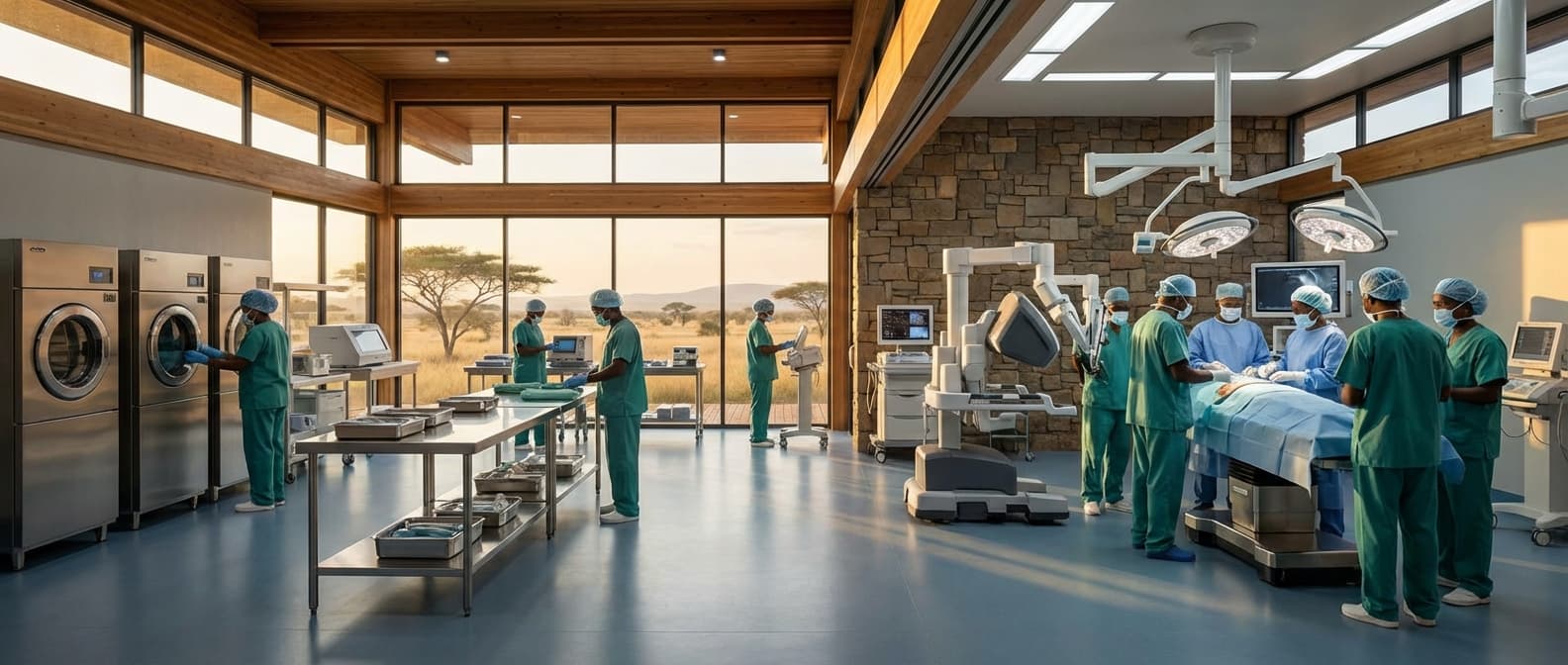
Operating Theatre Turnkey Build in Togo
Engineering Excellence & Technical Support
Complete OR design, equipment integration and commissioning High-standard technical execution following OEM protocols and local regulatory frameworks.
Optimized Workflow Integration
Engineered a seamless operational workflow by integrating state-of-the-art medical equipment, advanced HVAC systems for sterile environments, and intelligent lighting solutions, ensuring efficient patient throughput and reduced risk of cross-contamination in the new operating theatre.
Uninterrupted Power & Medical Gas Supply
Designed and implemented a robust, redundant power supply system featuring industrial-grade generators and UPS units, coupled with a reliable medical gas pipeline network. This ensures continuous operation of critical life-support equipment during any power outage or supply disruption.
Modular & Scalable Infrastructure
Leveraged a modular construction approach for the operating theatre build, allowing for rapid deployment and future scalability. This design facilitates easy upgrades, expansion, and adaptation to evolving surgical technologies and increasing healthcare demands in Togo.
What Is Operating Theatre Turnkey Build In Togo?
An Operating Theatre Turnkey Build in Togo refers to a comprehensive, end-to-end service for the design, construction, outfitting, and commissioning of a fully functional operating theatre suite. This service encompasses all phases of project development, from initial site assessment and conceptualization to final handover of a ready-to-operate medical facility. The 'turnkey' nature signifies that the client receives a complete and operational unit with minimal further input required from their side, allowing for rapid deployment of surgical services.
| Who Needs It | Typical Use Cases |
|---|---|
| Hospitals and Clinics (Public & Private): Seeking to expand or upgrade surgical capacity, establish new specialized surgical departments, or replace outdated facilities. | Establishment of New Healthcare Facilities: Greenfield projects requiring a complete operating theatre suite from inception. |
| Government Health Ministries/Agencies: Implementing public health initiatives, building or upgrading infrastructure in underserved regions, or responding to specific healthcare needs. | Modernization and Renovation Projects: Replacing existing, non-compliant, or inefficient operating theatres with state-of-the-art facilities. |
| Non-Governmental Organizations (NGOs) & Charities: Developing medical infrastructure for humanitarian aid, disaster relief, or specialized medical missions. | Deployment of Specialized Surgical Services: Establishing dedicated units for complex procedures like cardiac surgery, neurosurgery, or orthopedic surgery, which require specific equipment and environmental controls. |
| Remote or Underserved Areas: Where local expertise or resources for specialized construction and equipment installation may be limited. | Rapid Deployment Scenarios: In response to public health crises or to quickly bring essential surgical services online. |
Key Components of an Operating Theatre Turnkey Build
- Design & Planning: Architectural design, space planning, workflow optimization, compliance with local and international healthcare standards (e.g., hygiene, safety, infection control).
- Civil Works & Construction: Site preparation, construction of the operating theatre structure, including specialized wall and flooring systems (e.g., seamless, antimicrobial), ceiling installations, and HVAC system integration.
- Specialized Systems Integration: Installation and commissioning of critical infrastructure such as medical gas pipelines (oxygen, vacuum, air), electrical systems with redundant power supplies and UPS, nurse call systems, and data networking.
- Equipment Outfitting: Procurement, installation, and calibration of surgical equipment (e.g., operating tables, surgical lights, anesthesia machines, electrosurgical units), sterilization equipment (autoclaves), imaging devices (X-ray, C-arm), and monitoring systems.
- Sterile Environment Control: Implementation of advanced air filtration and laminar flow systems (HEPA filters) to maintain ultra-clean air within the operating room, critical for reducing surgical site infections.
- Ancillary Spaces: Construction and outfitting of supporting areas like sterile processing departments (SPD), recovery rooms, scrub sinks, changing rooms, and staff lounges.
- Commissioning & Validation: Rigorous testing of all installed systems and equipment to ensure optimal performance, safety, and compliance with regulatory requirements. This includes environmental monitoring and performance validation.
- Training & Handover: Provision of training for clinical and technical staff on the operation and maintenance of the new facility and its equipment, followed by formal handover.
Who Needs Operating Theatre Turnkey Build In Togo?
Operating Theatre Turnkey Builds in Togo are essential for healthcare facilities aiming to establish or significantly upgrade their surgical capabilities. These comprehensive solutions offer end-to-end services, from design and construction to equipment installation and commissioning, ensuring a fully functional and compliant operating theatre. This significantly reduces the burden on local entities by providing a streamlined and expert-led process.
| Target Customer Group | Typical Departments Benefiting | Key Needs Addressed |
|---|---|---|
| Public Hospitals | General Surgery, Orthopedics, Obstetrics & Gynecology, Urology, Ophthalmology, Emergency Surgery, Intensive Care Unit (ICU) recovery areas | Increased surgical capacity, modern infection control, improved patient outcomes, compliance with international standards, enhanced training environments. |
| Private Hospitals and Clinics | All surgical specialties (e.g., Cardiovascular, Neurosurgery, Plastic Surgery, Bariatric Surgery), Anesthesiology, Post-Anesthesia Care Unit (PACU) | Competitive service offering, high-tech surgical capabilities, patient comfort and safety, brand enhancement, attracting specialist surgeons. |
| NGOs and International Aid Organizations | Maternal & Child Health Surgery, Trauma Surgery, Infectious Disease Surgical Units, Diagnostic Imaging departments (adjacent) | Sustainable healthcare infrastructure, specialized medical interventions, rapid deployment of facilities, cost-effective solutions, training local medical staff. |
| Military and Security Forces Medical Units | Trauma Surgery, General Surgery, Battlefield Medicine Support Units | Robust and reliable surgical facilities, rapid response capabilities, self-sufficiency, specialized equipment for military medicine. |
| New Healthcare Investment Projects | Comprehensive surgical suites across multiple specialties, sterile processing departments, pre-operative and post-operative care areas, laboratory and imaging support | Turnkey solution for immediate operational readiness, integrated design for efficiency, adherence to building codes and healthcare regulations, complete project management. |
Target Customers for Operating Theatre Turnkey Builds in Togo
- Public Hospitals: Government-owned hospitals seeking to expand or modernize their surgical capacity to serve the broader population. This includes regional hospitals, university teaching hospitals, and specialized medical centers.
- Private Hospitals and Clinics: For-profit healthcare providers looking to offer advanced surgical services to a growing private patient base or to attract medical tourism. This can range from single-specialty surgical centers to multi-disciplinary private hospitals.
- Non-Governmental Organizations (NGOs) and International Aid Organizations: Entities involved in improving healthcare infrastructure in Togo, particularly those focusing on maternal and child health, emergency care, or specialized surgical interventions.
- Military and Security Forces Medical Units: Establishing or upgrading surgical facilities for personnel care and broader medical support.
- New Healthcare Investment Projects: Developers and investors planning to establish entirely new hospitals or medical complexes in Togo.
Operating Theatre Turnkey Build Process In Togo
The process of undertaking a turnkey operating theatre build in Togo involves a comprehensive workflow designed to manage all aspects of the project from initial client inquiry to final handover. This systematic approach ensures efficiency, quality, and compliance with local regulations and international standards. The workflow is typically divided into several distinct phases, each with specific objectives and deliverables. These phases are crucial for a successful and timely completion of the operating theatre, a critical healthcare infrastructure. The turnkey nature of the project means the contractor is responsible for the entire process, from design and procurement to construction and commissioning.
| Phase | Key Activities | Deliverables | Togo Specific Considerations |
|---|---|---|---|
| Phase 1: Inquiry & Initial Consultation | Client expresses interest. Initial discussions on project scope, budget, timeline, and specific requirements (e.g., number of theaters, specializations, desired technology). Site visit may be conducted. | Initial project brief, understanding of client needs, preliminary scope definition. | Understanding local healthcare needs and existing infrastructure. Identifying key stakeholders in the Ministry of Health or relevant regulatory bodies. |
| Phase 2: Feasibility Study & Site Assessment | Detailed site analysis (geotechnical, environmental, access). Assessment of existing utilities (power, water, waste disposal). Regulatory review and permitting assessment. Detailed budget and timeline refinement. | Feasibility report, site assessment report, preliminary design concepts, refined budget and timeline. | Navigating land ownership and acquisition processes. Assessing local availability of construction materials and skilled labor. Understanding power grid stability and water supply reliability. |
| Phase 3: Design & Engineering | Architectural and structural design. MEP (Mechanical, Electrical, Plumbing) design including HVAC, medical gases, specialized lighting. Equipment selection and integration. Compliance with international standards (e.g., ISO, JCI) and local building codes. Detailed drawings and specifications. | Approved architectural and engineering drawings, detailed specifications, equipment list, bill of quantities. | Ensuring designs cater to local climate conditions (heat, humidity). Sourcing of locally compliant and maintainable medical equipment. Incorporating designs that facilitate future expansion if needed. |
| Phase 4: Procurement & Logistics | Sourcing and purchasing of all construction materials, specialized equipment, and medical devices. Establishing supply chain management. Managing customs clearance and import duties for specialized equipment. Transportation and logistics to the site. | Procurement contracts, supply chain plan, customs clearance documentation, delivered materials and equipment. | Navigating import regulations and potential delays. Identifying reliable local suppliers and logistics partners. Managing currency fluctuations if applicable. |
| Phase 5: Construction & Installation | Site preparation and excavation. Structural construction. Installation of MEP systems, medical gases, and specialized infrastructure. Finishing works (flooring, wall finishes, ceilings). Installation of operating theatre equipment and integrated systems. | Completed building structure, installed MEP systems, finished interior, installed equipment. | Managing local construction workforce and ensuring adherence to safety standards. Overcoming potential logistical challenges for heavy equipment delivery. Ensuring proper waste management during construction. |
| Phase 6: Testing, Commissioning & Training | Testing of all installed systems (electrical, plumbing, HVAC, medical gases, IT). Calibration and testing of medical equipment. Performance verification against design specifications. Training of hospital staff on equipment operation and theatre protocols. Final inspections by regulatory bodies. | Test reports, commissioning certificates, training manuals, trained staff. | Ensuring training materials are available in French or other relevant local languages. Verifying that all equipment is certified for use in Togo. Obtaining necessary operational permits from the Ministry of Health. |
| Phase 7: Handover & Project Closure | Final walk-through with the client. Documentation handover (as-built drawings, operation & maintenance manuals, warranties). Final project sign-off. Establishment of after-sales service and maintenance agreements. | Project completion certificate, final documentation package, operational facility. | Establishing clear warranty and maintenance support structures for the long term. Ensuring transfer of knowledge for local maintenance capabilities. Finalizing any outstanding administrative procedures with local authorities. |
Turnkey Operating Theatre Build Process in Togo: Workflow Stages
- Phase 1: Inquiry & Initial Consultation
- Phase 2: Feasibility Study & Site Assessment
- Phase 3: Design & Engineering
- Phase 4: Procurement & Logistics
- Phase 5: Construction & Installation
- Phase 6: Testing, Commissioning & Training
- Phase 7: Handover & Project Closure
Operating Theatre Turnkey Build Cost In Togo
The cost of constructing a turnkey operating theatre in Togo can vary significantly due to several factors. A turnkey project implies that the contractor handles all aspects of the build, from design and construction to the installation of all necessary medical equipment and finishes. This comprehensive approach offers convenience but often comes with a premium. Key pricing factors include the size and complexity of the operating theatre, the level of technology and sophistication of the medical equipment chosen, the quality of construction materials and finishes, site accessibility and preparation requirements, and the specific contractor's overheads and profit margins. Fluctuations in the local currency (West African CFA franc - XOF) against major international currencies can also impact the cost of imported equipment and specialized materials. It is crucial for prospective clients to obtain detailed quotations from multiple reputable contractors and to clearly define the project scope to ensure accurate budgeting.
| Category | Estimated Cost Range (XOF) | Notes |
|---|---|---|
| Basic Operating Theatre (small, minimal equipment) | 40,000,000 - 80,000,000 | Includes essential equipment and standard finishes. Suitable for less complex procedures. |
| Standard Operating Theatre (medium size, moderate equipment) | 80,000,000 - 150,000,000 | Accommodates a wider range of procedures with more advanced equipment. Focus on infection control. |
| Advanced Operating Theatre (larger, high-end equipment, specialized features) | 150,000,000 - 300,000,000+ | Designed for complex surgeries, incorporating state-of-the-art technology, advanced imaging, and potentially robotic systems. May include multiple theatres. |
| Specialized Equipment (per unit, e.g., anesthesia machine, surgical light) | 2,000,000 - 20,000,000+ | Costs vary significantly based on brand, model, and features. This is a separate consideration from the build itself, but crucial for turnkey projects. |
| Ancillary Rooms (e.g., scrub rooms, sterile processing, recovery bays - per unit/area) | 5,000,000 - 25,000,000 | Costs depend on size, equipment, and complexity of integration. |
Key Pricing Factors for Operating Theatre Turnkey Builds in Togo:
- Size and Square Footage of the Operating Theatre
- Complexity of the Design and Layout (e.g., number of ancillary rooms, workflow integration)
- Level of Medical Equipment Sophistication (e.g., advanced surgical lights, anesthesia machines, imaging systems, robotic surgery integration)
- Quality of Construction Materials (e.g., specialized flooring, wall finishes, ceiling systems designed for sterile environments)
- Ventilation and HVAC Systems (including HEPA filtration and pressure differentials for infection control)
- Lighting Systems (including surgical lighting, ambient lighting, and emergency lighting)
- Plumbing and Electrical Infrastructure (including specialized outlets and gas lines)
- Architectural and Engineering Design Fees
- Site Preparation and Civil Works (including foundation, excavation, and utility connections)
- Finishes and Fittings (e.g., cabinetry, sinks, doors, windows)
- Integration of IT and Communication Systems
- Contractor's Overhead, Profit Margin, and Project Management Fees
- Import Duties and Taxes on Imported Equipment and Materials
- Permits and Regulatory Approvals
Affordable Operating Theatre Turnkey Build Options
Navigating the prospect of building an operating theatre can seem daunting, particularly regarding the substantial investment required. However, a growing number of specialized providers are offering 'turnkey' solutions designed to simplify the process and control costs. Turnkey operating theatre builds encompass all aspects of design, construction, equipping, and commissioning, delivering a fully functional surgical suite ready for immediate use. The key to affordability lies in understanding value bundles and implementing strategic cost-saving measures. These solutions often package essential services and equipment, offering predictable pricing and reducing the risk of unforeseen expenses.
| Cost-Saving Strategy | Description | Potential Benefit |
|---|---|---|
| Standardized Design & Layout | Utilizing pre-designed, modular, or standardized theatre layouts reduces design time and custom fabrication costs. These layouts are optimized for workflow and regulatory compliance. | Reduced architectural and engineering fees, faster construction timelines. |
| Bulk Equipment Procurement | Providers leverage their relationships with manufacturers to negotiate better pricing on essential surgical equipment, sterilizers, and furniture due to bulk purchasing power. | Lower equipment acquisition costs compared to individual sourcing. |
| Modular Construction Elements | Employing pre-fabricated wall panels, ceiling systems, and utility modules can significantly speed up on-site construction and reduce labor costs. | Shorter build times, less on-site disruption, predictable costs. |
| Energy-Efficient Systems | Integrating energy-efficient lighting, HVAC systems, and medical gas systems can lead to long-term operational cost savings. | Reduced utility bills, lower environmental impact. |
| Phased Equipping & Technology Upgrades | Starting with essential equipment and planning for future technology upgrades allows for upfront cost management. Providers can often facilitate these later additions. | Manages initial capital outlay, allows for adoption of newer, potentially more efficient technologies over time. |
| Off-the-Shelf vs. Custom Fabrication | Prioritizing readily available, standard-specification equipment and components over highly customized solutions generally leads to lower costs and faster delivery. | Reduced lead times, lower manufacturing and installation costs. |
| Comprehensive Project Management | A good turnkey provider handles all aspects, from planning and permitting to construction and commissioning, preventing costly delays and errors caused by miscommunication or lack of expertise. | Minimizes project overruns, ensures compliance, and reduces client administrative burden. |
Value Bundles Explained
- Standard Package: Typically includes essential infrastructure (walls, flooring, HVAC), basic lighting, a sterilizer, a basic surgical table, anesthesia machine, and essential surgical instruments. This is the most cost-effective option, suitable for lower-complexity procedures or new facilities establishing a foundation.
- Intermediate Package: Builds upon the standard by adding advanced imaging capabilities (e.g., C-arm), enhanced surgical lighting, a more sophisticated anesthesia workstation, and a wider range of specialized instruments. This offers a balance between cost and capability.
- Advanced Package: Features state-of-the-art technology such as integrated operating room systems, advanced robotic surgery platforms, high-definition surgical displays, comprehensive monitoring equipment, and specialized ventilation systems for infection control. This is the most comprehensive but also the most expensive option, ideal for high-volume or highly specialized surgical centers.
- Customizable Packages: Many providers allow for a degree of customization within their bundles, enabling clients to select specific equipment or features to tailor the package to their unique needs and budget. This allows for targeted investment and avoids paying for unnecessary components.
- Phased Implementation Bundles: For organizations with budget constraints, some providers offer phased bundles. This allows for the initial construction and equipping of a core operating theatre, with options to upgrade or add further equipment and capabilities in subsequent phases as funding becomes available.
Verified Providers In Togo
Ensuring access to quality healthcare is paramount, and in Togo, identifying verified healthcare providers is crucial for patient safety and trust. Franance Health stands out as a leader in this domain, meticulously vetting and credentialing healthcare professionals and facilities. Their rigorous verification process goes beyond surface-level checks, delving into qualifications, experience, ethical standing, and adherence to international healthcare standards. This commitment to thoroughness means that when you choose a provider accredited by Franance Health, you are selecting a partner dedicated to delivering safe, effective, and compassionate care. Their credentials represent a benchmark of excellence, providing peace of mind to individuals seeking reliable healthcare services in Togo. The 'best choice' stems from this unparalleled dedication to quality assurance, making Franance Health a trusted name for verified healthcare.
| Provider Type | Franance Health Verification Focus | Patient Benefit |
|---|---|---|
| Hospitals & Clinics | Licensing, accreditation, quality of care protocols, infection control measures, staff qualifications. | Access to safe surgical procedures, reliable diagnostics, and patient-centered care. |
| Specialist Physicians | Medical board certifications, specialist training, years of practice, peer reviews, disciplinary records. | Consultation with highly skilled and experienced medical experts. |
| General Practitioners | Medical license, continuing medical education, patient feedback, practice management. | Reliable primary healthcare services and ongoing health management. |
| Diagnostic Laboratories | Accreditation, quality control measures, equipment calibration, staff expertise, turnaround times. | Accurate and timely laboratory test results for effective diagnosis. |
| Pharmacies | Licensing, drug sourcing protocols, dispensing accuracy, pharmacist qualifications. | Safe and legitimate access to essential medications. |
Why Franance Health Credentials Represent the Best Choice:
- Rigorous qualification and experience verification for all providers.
- Adherence to stringent ethical standards and best practices in healthcare.
- Ensuring compliance with national and international healthcare regulations.
- Promoting patient safety through meticulous facility and equipment assessments.
- Building trust and confidence in Togo's healthcare landscape.
- Providing access to a network of reliable and high-quality healthcare professionals.
- Continuous monitoring and re-evaluation of accredited providers.
Scope Of Work For Operating Theatre Turnkey Build
This Scope of Work (SOW) outlines the requirements for the turnkey construction and equipping of a new Operating Theatre (OT) suite. It covers all phases from design and planning through to commissioning and handover. This document also details the technical deliverables expected from the contractor and the standard specifications to be adhered to throughout the project.
| Technical Deliverable | Description | Standard/Specification Reference |
|---|---|---|
| Architectural Drawings | Detailed floor plans, elevations, sections, and structural drawings for the OT suite. | Local building codes, NFPA 99, HTM 00-01 |
| MEP Drawings | Detailed drawings for Mechanical, Electrical, Plumbing, and Medical Gas systems. | ASHRAE Standards, IEC 60364, BS 7671, HTM 02-01 |
| HVAC System Design | Design for positive pressure, HEPA filtration, temperature, and humidity control. | ASHRAE 170, HTM 03-01 |
| Electrical System Design | Includes power distribution, emergency power, lighting, and UPS systems. | IEC 60364, BS 7671, NFPA 99 |
| Medical Gas System Design | Design for piped medical gases (Oxygen, Medical Air, Vacuum, Nitrous Oxide) and alarm systems. | HTM 02-01, ISO 7396 |
| Laminar Flow Systems | Design and specification for unidirectional airflow ceilings. | ISO 14644-1 |
| Operating Theatre Lights | Specifications for surgical lighting systems, including intensity, color temperature, and maneuverability. | IEC 60601-2-41 |
| Anesthesia Machines | Specifications for integrated anesthesia delivery systems. | IEC 60601-1 |
| Surgical Tables | Specifications for advanced surgical table systems with various positioning capabilities. | IEC 60601-1 |
| Imaging Equipment Integration | Provisions for integration of C-arms, X-ray, and other imaging modalities. | DICOM standards |
| Sterilization Equipment | Specifications for autoclaves and other sterilization units. | ISO 13485, EN 285 |
| Air Quality Monitoring | System for continuous monitoring of air quality parameters within the OT. | ISO 14644-2 |
| Fire Suppression System | Design and installation of appropriate fire suppression systems. | NFPA 101, local fire codes |
| Infection Control Measures | Detailed plan for materials and finishes promoting infection control. | HTM 01-01 |
| Commissioning Report | Comprehensive report detailing all tests performed and their results. | Project-specific verification plan |
| As-Built Drawings | Updated drawings reflecting the final constructed state of the OT suite. | As per project requirements |
| Operations & Maintenance Manuals | Detailed manuals for all installed equipment and systems. | Manufacturer specifications |
| Training Certificates | Proof of training provided to hospital staff on equipment and system operation. | As per project requirements |
Key Project Phases
- Design & Planning
- Construction & Fit-out
- Equipment Procurement & Installation
- Testing & Commissioning
- Training & Handover
Service Level Agreement For Operating Theatre Turnkey Build
This Service Level Agreement (SLA) outlines the response times and uptime guarantees for the operation of the turnkey build for the Operating Theatre. This agreement is between [Client Name] (hereinafter referred to as 'Client') and [Service Provider Name] (hereinafter referred to as 'Provider').
| Service Component | Response Time (Business Hours) | Response Time (Outside Business Hours) | Uptime Guarantee |
|---|---|---|---|
| Critical Systems (HVAC, Power, Medical Gases, etc.) | 1 Hour | 2 Hours | 99.5% per month |
| Major Surgical Equipment (Anesthesia Machines, Imaging) | 2 Hours | 4 Hours | 98.0% per month |
| Ancillary Systems (Communication, basic lighting control) | 4 Hours | 8 Hours | 99.0% per month |
Definitions
- Operating Theatre (OT): The complete, functional operating theatre suite, including all installed equipment and systems, provided under the turnkey build contract.
- Downtime: Any period where the OT is unavailable for its intended clinical use due to failure of critical systems, equipment, or infrastructure directly attributable to the Provider's responsibility under this SLA. Routine maintenance and planned shutdowns are excluded.
- Critical System: Any system essential for the safe and effective operation of the OT, including but not limited to: HVAC (air handling units, filtration), medical gas supply, power supply (including UPS and generator), surgical lighting, anesthesia machines, and imaging equipment (if part of the turnkey build).
- Response Time: The maximum allowed time for the Provider to acknowledge a reported issue and initiate troubleshooting. This does not guarantee immediate resolution.
- Resolution Time: The maximum allowed time for the Provider to resolve a reported issue and restore the OT to its intended operational state. This may vary based on the complexity of the issue and availability of parts/personnel.
- Uptime Guarantee: The minimum percentage of time the OT is expected to be available for use over a defined period.
- Business Hours: [Specify Business Hours, e.g., Monday to Friday, 8:00 AM to 6:00 PM local time, excluding public holidays].
Frequently Asked Questions

Ready when you are
Let's scope your Operating Theatre Turnkey Build in Togo project in Togo.

Scaling healthcare logistics and technical systems across the entire continent.