
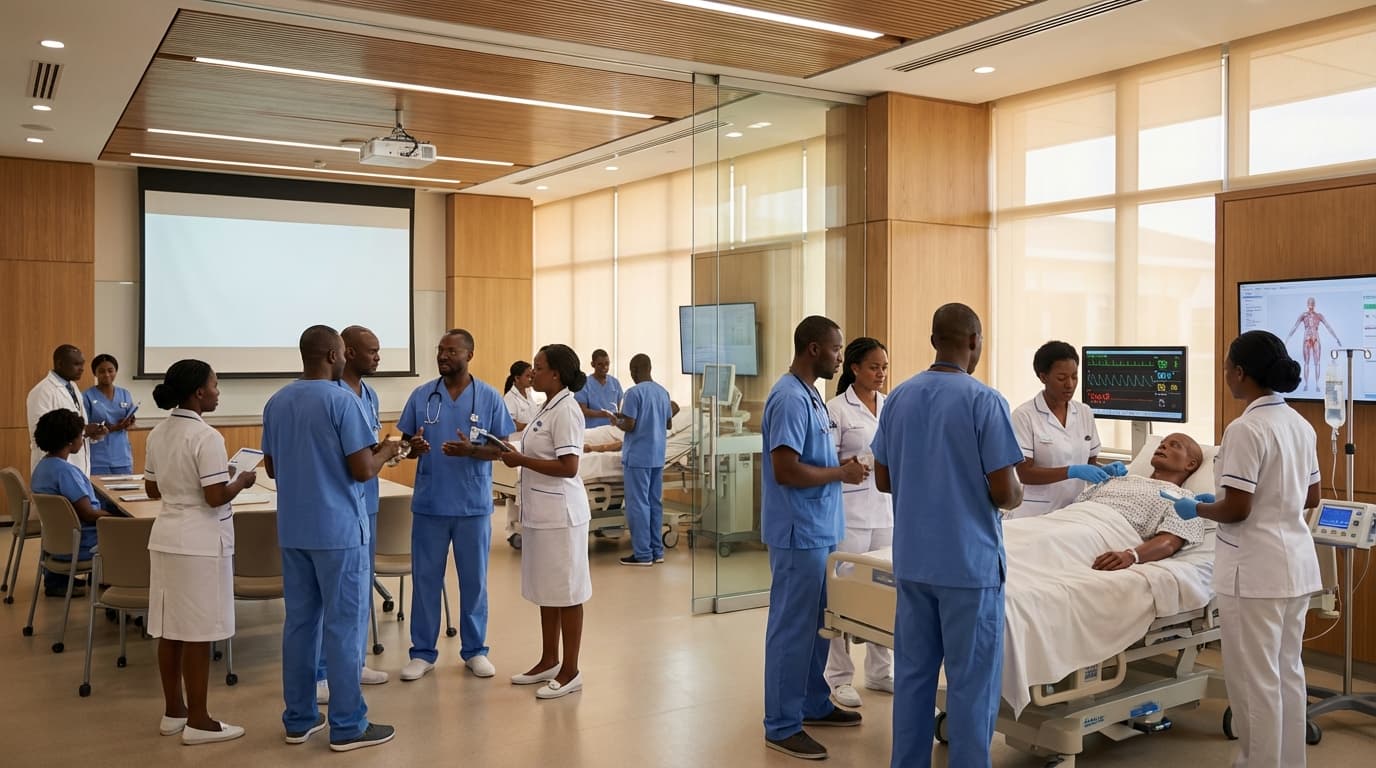
Equipment Training & Education in Tanzania
Engineering Excellence & Technical Support
Comprehensive equipment training and certification programs High-standard technical execution following OEM protocols and local regulatory frameworks.
Mobile Training Units Deployment
Establish a fleet of fully-equipped mobile training units that can travel to remote mining, agricultural, and industrial sites across Tanzania. These units will provide hands-on, practical training on operating and maintaining essential machinery, including excavators, tractors, and generators, directly where it's needed most.
Digital Skills & Simulation Platform
Develop and implement a comprehensive digital learning platform featuring interactive modules, virtual reality (VR) simulators for complex equipment, and online knowledge bases. This will offer scalable, accessible, and safe training environments for Tanzanian technicians and operators to hone their skills before working with real-world machinery.
Local Capacity Building & Certification Program
Partner with local vocational institutes and industry associations to develop and deliver standardized equipment training curricula. This initiative will focus on training local instructors, establishing accredited certification programs, and ensuring a sustainable pipeline of skilled equipment operators and maintenance personnel for Tanzania's growing economy.
What Is Equipment Training & Education In Tanzania?
Equipment training and education in Tanzania refers to the structured process of imparting knowledge and practical skills necessary for the safe, efficient, and effective operation, maintenance, and repair of specific machinery, tools, and systems. This service is critical for a diverse range of industries and professions operating within the Tanzanian context, aiming to enhance workforce competency, improve operational reliability, and ensure adherence to safety standards. The scope encompasses theoretical instruction, hands-on practical demonstrations, simulated exercises, and ongoing professional development.
| Target Audience | Necessity and Rationale | Typical Use Cases |
|---|---|---|
| Agricultural Sector Personnel (Farm managers, operators of tractors, harvesters, irrigation systems) | Enhance crop yields, reduce post-harvest losses, improve machinery longevity, ensure food security, and comply with agricultural mechanization policies. | Operation and maintenance of agricultural machinery, precision farming technologies, pesticide application equipment. |
| Construction Industry Professionals (Equipment operators, site supervisors, maintenance technicians for excavators, bulldozers, cranes, concrete mixers) | Ensure project timelines, improve site safety, minimize equipment downtime, reduce operational costs, and adhere to construction safety regulations. | Heavy machinery operation (excavators, loaders), crane operation, concrete batching plant management, maintenance of scaffolding and formwork systems. |
| Manufacturing and Industrial Workers (Machine operators, maintenance engineers, quality control personnel for assembly lines, CNC machines, processing equipment) | Increase production efficiency, maintain product quality, minimize defects, enhance workplace safety, and optimize resource utilization. | Operation of specialized industrial machinery, robotics, quality inspection equipment, preventative maintenance of production lines. |
| Mining Sector Employees (Operators of drilling rigs, haul trucks, crushers, conveyor systems, processing plant operators) | Improve extraction efficiency, ensure safe working practices in hazardous environments, minimize equipment failures, and comply with mining safety and environmental regulations. | Operation of mining-specific heavy-duty vehicles, drilling equipment, ore processing machinery, safety procedures for underground and surface mining. |
| Healthcare Professionals (Technicians operating medical imaging equipment, laboratory equipment, surgical instruments) | Ensure accurate diagnoses, patient safety, proper functioning of critical medical devices, and adherence to healthcare standards. | Operation of X-ray machines, MRI scanners, CT scanners, laboratory centrifuges, autoclaves, and other specialized medical equipment. |
| IT and Telecommunications Technicians (Network engineers, server administrators, field technicians for telecommunication infrastructure) | Maintain network uptime, ensure data integrity, implement and manage IT infrastructure, and troubleshoot complex technical issues. | Server management and maintenance, network hardware installation and configuration, fiber optic splicing and testing, mobile network infrastructure deployment. |
| Energy Sector Personnel (Power plant operators, renewable energy technicians for solar/wind turbines, fuel handling equipment operators) | Ensure reliable power generation, optimize energy efficiency, maintain safety in high-voltage environments, and support the transition to sustainable energy sources. | Operation and maintenance of generators, turbines, solar panel installation and maintenance, electrical substations, fuel management systems. |
Key Components of Equipment Training & Education in Tanzania
- Curriculum Development: Tailoring training programs to specific equipment models, industry standards (local and international), and Tanzanian regulatory requirements.
- Instructional Delivery: Employing qualified trainers with subject matter expertise and pedagogical skills. Methods include classroom lectures, workshops, on-the-job training (OJT), and e-learning modules.
- Practical Skill Acquisition: Providing hands-on experience with the equipment, focusing on operational procedures, diagnostic techniques, troubleshooting, and routine maintenance tasks.
- Safety Protocols: Emphasizing safety regulations, risk assessment, the use of Personal Protective Equipment (PPE), emergency procedures, and hazard identification relevant to the Tanzanian work environment.
- Maintenance and Troubleshooting: Training on preventative maintenance schedules, fault diagnosis, basic repair procedures, and the correct use of diagnostic tools and equipment.
- Documentation and Record-Keeping: Instruction on proper equipment logs, maintenance records, and reporting procedures as mandated by Tanzanian authorities.
- Certification and Assessment: Evaluating learner competency through theoretical tests, practical assessments, and practical examinations, leading to accredited certifications where applicable.
Who Needs Equipment Training & Education In Tanzania?
Equipment training and education in Tanzania are crucial for a wide range of individuals and organizations to ensure safe, efficient, and productive use of various machinery and tools across different sectors. This training empowers operators, technicians, supervisors, and even managers with the knowledge and skills to maximize equipment lifespan, minimize downtime, prevent accidents, and comply with industry standards. Without proper training, the potential for costly breakdowns, injuries, and operational inefficiencies is significantly high, impacting both individual livelihoods and national economic development.
| Industry Sector | Key Equipment Types | Relevant Departments/Roles |
|---|---|---|
| Agriculture | Tractors, harvesters, irrigation systems, processing machinery, sprayers | Farm managers, tractor operators, agricultural technicians, mechanics, cooperative leaders |
| Mining | Excavators, haul trucks, drills, crushing and grinding equipment, conveyor systems | Mine operators, maintenance technicians, geologists, safety officers, shift supervisors |
| Construction | Cranes, bulldozers, excavators, concrete mixers, welding equipment, scaffolding | Site managers, equipment operators, construction supervisors, safety inspectors, foremen |
| Manufacturing | Assembly line machinery, CNC machines, welding machines, packaging equipment, forklifts | Production line operators, machine setters, maintenance engineers, quality control staff, warehouse managers |
| Energy (Oil & Gas) | Drilling rigs, pumps, generators, safety equipment, specialized tools | Drillers, refinery operators, maintenance crew, safety engineers, field technicians |
| Energy (Power Generation) | Turbines, generators, transformers, control systems, safety equipment | Power plant operators, electrical technicians, mechanical engineers, safety supervisors |
| Transportation & Logistics | Trucks, forklifts, cranes (port/warehouse), cargo handling equipment, maritime vessels | Drivers, warehouse operators, logistics managers, port authorities, mechanics |
| Healthcare | Medical imaging equipment (X-ray, MRI, CT), laboratory analyzers, surgical tools, sterilization equipment | Radiographers, lab technicians, biomedical engineers, nurses, hospital administrators |
| Tourism & Hospitality | Kitchen equipment (ovens, fryers), laundry machines, cleaning equipment, generators | Chefs, kitchen staff, laundry attendants, hotel maintenance, operations managers |
Target Customers & Departments for Equipment Training & Education in Tanzania
- Industries: Agriculture, Mining, Construction, Manufacturing, Energy (Oil & Gas, Power Generation), Transportation & Logistics, Healthcare, Tourism & Hospitality.
- Key Personnel: Machine Operators, Technicians & Mechanics, Supervisors & Team Leaders, Safety Officers, Engineers, Maintenance Personnel, Procurement & Logistics Staff, Management & Decision-Makers.
- Government & Public Sector: Ministries (e.g., Agriculture, Works, Health, Energy), Parastatals, Local Government Authorities, Disaster Management Agencies.
- Private Sector: Small, Medium, and Large Enterprises across all listed industries.
- Non-Governmental Organizations (NGOs) & Community Groups: Those involved in development projects, agriculture cooperatives, and vocational training initiatives.
Equipment Training & Education Process In Tanzania
The Equipment Training & Education Process in Tanzania is a multi-stage workflow designed to ensure that users are proficient in operating and maintaining specific equipment. This process typically begins with an inquiry from a potential client, progresses through needs assessment, curriculum development, scheduling, execution of training, and concludes with evaluation and certification. The objective is to enhance safety, efficiency, and longevity of the equipment through skilled personnel.
| Stage | Description | Key Activities | Responsible Parties | Output/Deliverable |
|---|---|---|---|---|
| Inquiry & Initial Contact | The process begins when an individual or organization expresses interest in equipment training. | Receiving inquiries (phone, email, website), preliminary information gathering. | Potential Client, Training Provider Sales/Inquiry Desk | Initial understanding of client's interest. |
| Needs Assessment & Scope Definition | Determining the specific training requirements, target audience, and learning objectives. | Detailed discussion with the client, assessing existing knowledge, identifying skill gaps, defining specific equipment models and functionalities to be covered. | Training Provider (Sales/Technical Team), Client (Key Personnel/Managers) | Training needs analysis report, defined scope of work, learning objectives. |
| Curriculum Development & Customization | Designing or adapting training materials to meet the identified needs. | Developing training modules, presentations, practical exercises, assessments, incorporating safety protocols specific to the Tanzanian context. | Training Provider (Curriculum Developers, Subject Matter Experts) | Training curriculum, training manuals, handouts, assessment tools. |
| Proposal & Quotation | Presenting a detailed offer to the client outlining the training program, costs, and schedule. | Preparing a formal proposal, including scope, objectives, duration, methodology, trainer profiles, and cost breakdown. | Training Provider (Sales/Management) | Training proposal and quotation. |
| Contract Agreement & Payment | Formalizing the training agreement and securing payment. | Client reviews and accepts the proposal, signing a contract, processing initial payment or deposit as per terms. | Client, Training Provider (Legal/Finance) | Signed training contract, confirmed payment. |
| Trainer Assignment & Resource Allocation | Assigning qualified trainers and preparing necessary training resources. | Identifying and assigning trainers with relevant expertise, booking training venues, procuring or confirming availability of equipment for training, preparing training materials. | Training Provider (Operations/Training Management) | Assigned trainers, confirmed venue and equipment, ready training materials. |
| Scheduling & Logistics | Finalizing the training dates, times, and location. | Coordinating with the client for mutually agreeable dates, arranging travel and accommodation for trainers if necessary, communicating schedule to participants. | Training Provider (Operations/Logistics), Client | Confirmed training schedule, logistical arrangements. |
| Training Delivery & Execution | Conducting the training sessions as per the agreed curriculum. | Theoretical instruction, practical demonstrations, hands-on exercises, troubleshooting scenarios, safety briefings. | Assigned Trainer(s) | Delivered training sessions. |
| Assessment & Evaluation | Measuring the effectiveness of the training and participants' comprehension. | Administering written tests, practical skill assessments, observation of performance, collecting feedback from participants on the training. | Trainer(s), Training Provider (Quality Assurance) | Assessment results, participant feedback forms. |
| Certification & Documentation | Issuing certificates to successful participants and providing final documentation. | Reviewing assessment results, issuing training certificates to qualified participants, providing a training completion report to the client. | Training Provider (Administration/Management) | Training certificates, training completion report. |
| Post-Training Support & Feedback | Providing ongoing support and gathering feedback for continuous improvement. | Answering follow-up queries from clients/participants, conducting post-training follow-up surveys, analyzing feedback for future program enhancements. | Training Provider (Support Team/Management), Client | Resolved queries, enhanced training programs. |
Workflow Stages of Equipment Training & Education in Tanzania
- Inquiry & Initial Contact
- Needs Assessment & Scope Definition
- Curriculum Development & Customization
- Proposal & Quotation
- Contract Agreement & Payment
- Trainer Assignment & Resource Allocation
- Scheduling & Logistics
- Training Delivery & Execution
- Assessment & Evaluation
- Certification & Documentation
- Post-Training Support & Feedback
Equipment Training & Education Cost In Tanzania
The cost of equipment training and education in Tanzania is a dynamic field influenced by a multitude of factors, leading to a broad spectrum of pricing. These factors dictate the overall investment required for individuals and organizations seeking to acquire or enhance skills related to specific machinery and technological equipment. Understanding these variables is crucial for accurate budgeting and informed decision-making.
Several key pricing factors significantly impact the cost of equipment training in Tanzania. The type and complexity of the equipment being trained on is a primary driver. Training on basic hand tools will naturally be less expensive than specialized industrial machinery, advanced medical equipment, or complex software-driven systems. The duration and depth of the training program also play a vital role. Short introductory courses will be considerably cheaper than comprehensive, multi-day or multi-week programs that cover advanced troubleshooting and maintenance. The provider's reputation and accreditation are also influential. Established training institutions with certified instructors and a proven track record often command higher fees due to the perceived quality and value of their offerings. The location of the training can also affect costs, with urban centers potentially having higher overheads for training facilities, impacting pricing. Furthermore, the inclusion of practical hands-on sessions versus purely theoretical instruction influences cost, as hands-on training often requires dedicated equipment, consumables, and specialized instructors. Finally, the level of certification or qualification offered at the end of the training program can be a significant factor, with internationally recognized certifications typically carrying a higher price tag. Customized training packages for specific organizations, tailored to their unique equipment and operational needs, will also have their own pricing structures based on the bespoke nature of the service.
| Training Category/Equipment Type | Estimated Price Range (TZS) | Notes/Typical Inclusions |
|---|---|---|
| Basic Hand Tools & General Workshop Skills | 50,000 - 250,000 | Short courses (1-3 days), basic safety, usage. May include some material costs. |
| Agricultural Machinery (Tractors, Harvesters) | 150,000 - 600,000 | Typically 3-5 days, operation, basic maintenance, safety. May include simulator time. |
| Construction Equipment (Excavators, Loaders) | 200,000 - 800,000 | 3-7 days, operation, site safety, pre-operation checks. May include practical operation on actual sites. |
| Industrial Machinery (Welding, Manufacturing) | 300,000 - 1,500,000+ | Varies widely by specialization. Can range from a few days to several weeks. Includes practical application, safety standards. Certification often available. |
| IT Hardware & Networking Equipment | 250,000 - 1,000,000+ | Can be vendor-specific. Focus on installation, configuration, troubleshooting. Often modular courses. |
| Medical Equipment (Basic Diagnostics) | 400,000 - 2,000,000+ | Requires specialized knowledge and often certification. Focus on operation, calibration, basic maintenance. Highly dependent on equipment complexity. |
| Specialized/Advanced Industrial Equipment (e.g., CNC Machines, Robotics) | 800,000 - 5,000,000+ | Longer duration, highly technical. Often delivered by manufacturers or authorized partners. Includes advanced troubleshooting and programming. Industry-specific. |
| Customized Corporate Training Packages | Variable (per quote) | Tailored to specific company needs, equipment, and personnel. Priced based on scope, duration, and trainer expertise. |
Key Pricing Factors for Equipment Training & Education in Tanzania
- Type and Complexity of Equipment
- Duration and Depth of Training Program
- Provider's Reputation and Accreditation
- Location of Training
- Inclusion of Practical Hands-on Sessions
- Level of Certification or Qualification Offered
- Customization of Training Packages
Affordable Equipment Training & Education Options
Acquiring and mastering the use of specialized equipment is crucial for many industries, from manufacturing and healthcare to construction and research. Fortunately, numerous affordable training and education options exist to equip individuals and teams with the necessary skills without breaking the bank. Leveraging value bundles and implementing smart cost-saving strategies are key to maximizing your investment in equipment training.
| Training Type | Typical Cost Range (USD) | Value Proposition | Ideal For |
|---|---|---|---|
| Online Courses/Webinars | $50 - $500+ | Flexibility, accessibility, affordability | Individual learners, ongoing skill development |
| Vendor-Provided Training | Often included or discounted | Equipment-specific expertise, direct manufacturer knowledge | New equipment acquisition, specialized operations |
| Community College/Vocational Programs | $200 - $2,000+ | Structured curriculum, foundational skills, recognized credentials | Career changers, entry-level positions |
| In-House Training | Primarily time/resource investment | Tailored to specific needs, builds internal capacity | Organizations with existing expertise, large teams |
| Apprenticeships/Internships | Stipend/wages + program fees | Hands-on experience, long-term skill building | Entry-level talent acquisition, workforce development |
| Train-the-Trainer | $300 - $1,500+ (per trainer) | Scalable knowledge dissemination, long-term cost savings | Organizations seeking to build internal training capacity |
Cost-Saving Strategies for Equipment Training & Education
- {"title":"Online & E-Learning Platforms","description":"Utilize the vast array of online courses, webinars, and video tutorials. These often provide self-paced learning, reducing the need for travel and time away from work. Many platforms offer specialized courses at significantly lower prices than traditional in-person training."}
- {"title":"Vendor-Provided Training","description":"Many equipment manufacturers offer complimentary or discounted training as part of the purchase agreement. Always inquire about available training packages when acquiring new equipment."}
- {"title":"Government & Non-Profit Initiatives","description":"Explore programs funded by government agencies or non-profit organizations that aim to upskill the workforce. These can provide subsidized or free training opportunities in specific sectors."}
- {"title":"In-House Training Programs","description":"If you have experienced personnel, consider developing internal training modules. This leverages existing expertise and eliminates external training costs, although it requires an investment in developing the curriculum and trainer time."}
- {"title":"Apprenticeships & Internships","description":"Apprenticeship programs combine on-the-job training with theoretical education, often at a reduced cost. Internships can also provide valuable hands-on experience with equipment under mentorship."}
- {"title":"Community Colleges & Vocational Schools","description":"These institutions often offer affordable certificate programs and courses focused on specific equipment and technologies, providing a solid foundation for practical skills."}
- {"title":"Group Discounts & Bulk Purchases","description":"When training multiple employees, inquire about group discounts for courses or training packages. Negotiating bulk purchases can also lead to significant savings."}
- {"title":"Train-the-Trainer Programs","description":"Invest in training a few key individuals who can then become internal trainers. This creates a sustainable and cost-effective method for ongoing skill development within your organization."}
- {"title":"Open-Source & Free Resources","description":"For foundational knowledge and introductory concepts, explore free online resources, manuals, and community forums. While not a substitute for hands-on training, they can supplement learning and reduce the need for paid introductory courses."}
Verified Providers In Tanzania
In the burgeoning healthcare landscape of Tanzania, identifying reliable and high-quality healthcare providers is paramount for individuals and organizations seeking accessible and effective medical services. Among the many entities operating, Franance Health stands out as a beacon of trust and excellence. This document aims to verify Franance Health's credentials and elucidate why they represent the best choice for healthcare solutions in Tanzania.
| Aspect | Franance Health's Commitment | Benefit to Patients |
|---|---|---|
| Quality Assurance | Adherence to national and international accreditation standards. | Ensures safe, effective, and consistently high-quality medical care. |
| Professional Expertise | Employment of highly qualified and continuously trained medical staff. | Access to competent and up-to-date medical knowledge and treatment. |
| Service Breadth | Offering a comprehensive range of medical services. | Convenient access to diverse healthcare needs, reducing the need to seek multiple providers. |
| Patient Experience | Prioritizing personalized care and open communication. | A supportive and comfortable healthcare journey with a focus on individual needs. |
| Innovation | Investment in advanced medical technology and equipment. | Accurate diagnostics, leading to more effective and timely treatments. |
Franance Health's Verified Credentials and Key Strengths
- Accreditation and Affiliation: Franance Health has secured accreditations from reputable national and international health organizations, demonstrating adherence to stringent quality and safety standards. Their affiliations with recognized medical bodies ensure that their practices align with global best practices.
- Experienced and Qualified Professionals: The organization boasts a team of highly skilled and experienced healthcare professionals, including doctors, nurses, specialists, and support staff. Continuous professional development and rigorous selection processes guarantee competence and dedication.
- Comprehensive Service Offerings: Franance Health provides a wide spectrum of medical services, encompassing primary care, specialized treatments, diagnostic services, and preventative health programs. This holistic approach caters to diverse patient needs under one roof.
- Patient-Centric Approach: A core tenet of Franance Health's philosophy is a commitment to patient well-being and satisfaction. They prioritize personalized care, clear communication, and a supportive environment for all individuals seeking their services.
- Technological Integration: Embracing modern advancements, Franance Health invests in state-of-the-art medical equipment and technology. This ensures accurate diagnostics, efficient treatment, and improved patient outcomes.
- Community Engagement and Outreach: Beyond clinical services, Franance Health actively engages with communities through health education initiatives and outreach programs, promoting public health awareness and access to care.
- Ethical Practices and Transparency: Upholding the highest ethical standards, Franance Health operates with transparency in all its dealings, from pricing to treatment protocols, fostering trust and accountability.
Scope Of Work For Equipment Training & Education
This Scope of Work (SOW) outlines the requirements for comprehensive training and educational services for the newly acquired [Equipment Name/System]. The objective is to ensure that designated personnel possess the necessary knowledge and skills to operate, maintain, and troubleshoot the equipment effectively and safely, adhering to manufacturer specifications and best practices. The training will cover theoretical concepts, practical hands-on sessions, and assessment of learning outcomes.
| Category | Standard Specification/Requirement | Description/Details |
|---|---|---|
| Training Audience | Defined Roles | Operators, Maintenance Technicians, Supervisors, Safety Officers (specify roles) |
| Training Duration | Total Hours/Days | XX hours/days per module/overall program (detailed breakdown to be provided in curriculum) |
| Training Location | On-site/Off-site | On-site at [Client Facility Address] or Off-site at [Vendor Facility Address/Training Center] |
| Training Methodologies | Mixed-Modal | Lectures, demonstrations, practical exercises, case studies, simulations, group discussions |
| Prerequisites | Basic Knowledge | Basic understanding of [relevant industry/technology], foundational safety knowledge |
| Equipment Access | Dedicated/Shared | Access to [Equipment Name/System] for hands-on practice during training hours |
| Training Materials Language | English | All training materials will be provided in English. [Specify other languages if required] |
| Trainer Qualifications | Certification & Experience | Minimum X years of experience with [Equipment Name/System], relevant certifications (e.g., manufacturer-specific) |
| Assessment Criteria | Pass/Fail | Minimum score of X% on written and practical assessments required for successful completion |
| Post-Training Support | Duration | XX days/weeks of remote support via email/phone for clarification and troubleshooting |
Technical Deliverables
- Training curriculum and materials (manuals, presentations, exercises)
- Certified trainer(s) with proven expertise on the [Equipment Name/System]
- Hands-on training sessions utilizing actual or simulated [Equipment Name/System]
- Assessment tools (quizzes, practical evaluations, knowledge tests)
- Post-training support documentation and contact information
- Certificate of Completion for each participant
- Training progress and attendance reports
- Equipment operation and maintenance logs (if applicable as part of training)
- Troubleshooting guides and procedures (integrated into training)
- Safety protocols and hazard identification training
Service Level Agreement For Equipment Training & Education
This Service Level Agreement (SLA) outlines the terms and conditions for the provision of Equipment Training & Education services, focusing on guaranteed response times for support requests and uptime for training platforms.
| Service Component | Response Time Guarantee | Uptime Guarantee | Definition of Incident |
|---|---|---|---|
| Technical Support (Tier 1 - Basic Inquiries) | Within 4 business hours | N/A (Support is reactive) | Inquiries regarding platform navigation, account access, or basic feature usage. |
| Technical Support (Tier 2 - Complex Issues) | Within 8 business hours | N/A (Support is reactive) | Issues impacting the ability to access or utilize training content, troubleshooting of platform errors. |
| Online Training Platform Availability | N/A (Platform is always accessible) | 99.5% uptime (excluding scheduled maintenance) | The online portal and its core training delivery functionalities are accessible and operational. |
| Scheduled Instructor-Led Sessions | N/A (Sessions are pre-scheduled) | 100% (Provided the instructor and participants are available) | The scheduled training session commences as per the agreed-upon time and duration. |
| Knowledge Base / FAQ Access | N/A (Content is always accessible) | 99.5% uptime | The knowledge base and FAQ sections are accessible and searchable. |
Scope of Services
- On-demand technical support for training platform inquiries.
- Availability of online training modules and resources.
- Scheduled instructor-led training sessions (virtual and/or in-person).
- Access to knowledge base and FAQs related to equipment operation and training.
Frequently Asked Questions

Ready when you are
Let's scope your Equipment Training & Education in Tanzania project in Tanzania.

Scaling healthcare logistics and technical systems across the entire continent.