
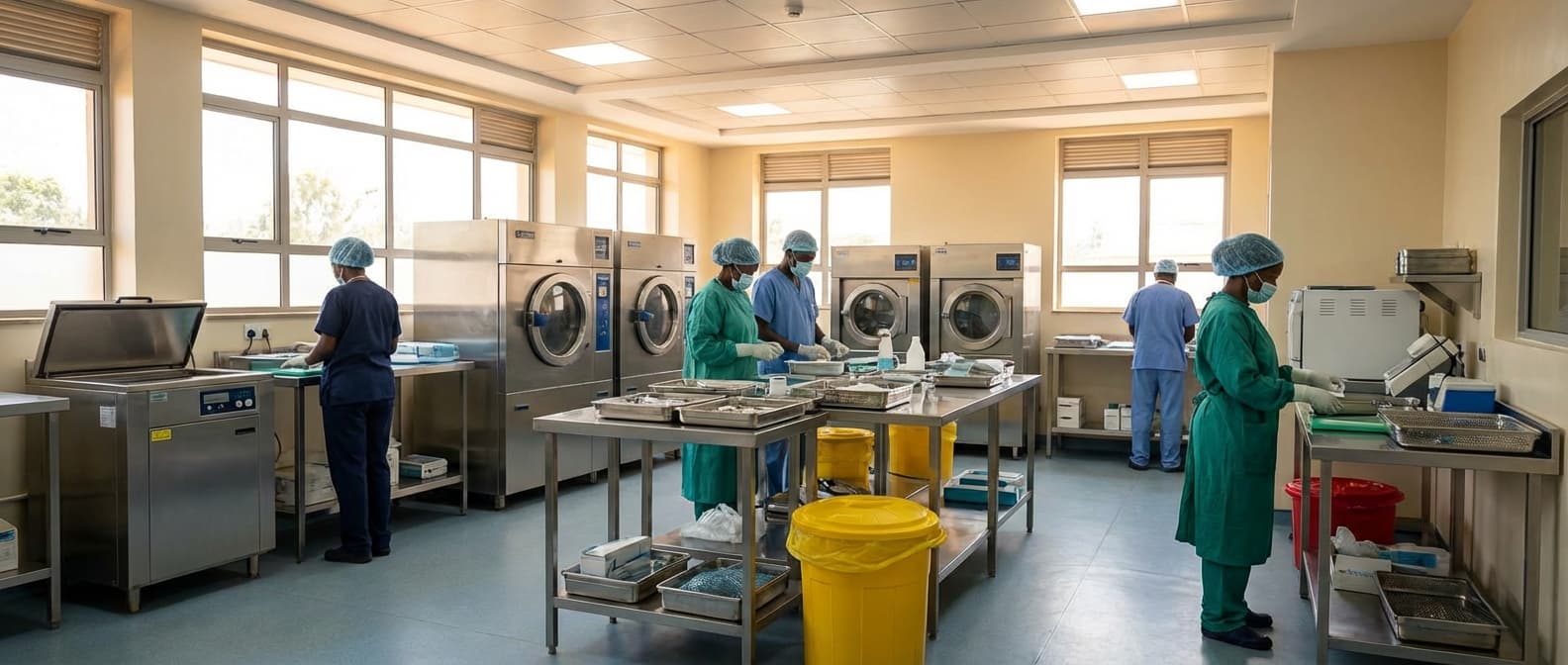
Endoscope Reprocessing Equipment Support Service in Tanzania
Engineering Excellence & Technical Support
Endoscope Reprocessing Equipment Support Service High-standard technical execution following OEM protocols and local regulatory frameworks.
Rapid On-Site Technical Support
Minimize downtime with our expert technicians providing prompt on-site diagnostics and repair for all major brands of endoscope reprocessing equipment across Tanzania. Our rapid response team ensures your sterile processing department remains operational and compliant.
Preventative Maintenance & Calibration Programs
Proactively extend the lifespan and maintain the optimal performance of your endoscope reprocessing equipment through our tailored preventative maintenance schedules and precise calibration services. Enhance reliability and reduce costly emergency repairs.
Compliance & Validation Assistance
Navigate complex regulatory requirements with confidence. We provide expert support for equipment validation, performance testing, and documentation to ensure your endoscope reprocessing practices meet all national and international standards for patient safety and infection control.
What Is Endoscope Reprocessing Equipment Support Service In Tanzania?
Endoscope Reprocessing Equipment Support Service in Tanzania refers to a comprehensive range of technical assistance and maintenance provisions dedicated to the optimal functioning and longevity of automated and semi-automated equipment used in the cleaning, disinfection, and sterilization of flexible and rigid endoscopes. This service is critical for healthcare facilities to ensure patient safety by preventing the transmission of infections through inadequately reprocessed endoscopic instruments. The service encompasses routine preventative maintenance, on-demand repair, calibration, validation, and the supply of spare parts and consumables specific to various makes and models of endoscope reprocessors, washer-disinfectors, and associated ancillary equipment.
| Who Needs Endoscope Reprocessing Equipment Support Service? | Typical Use Cases |
|---|---|
| Hospitals and Clinics: Both public and private healthcare institutions performing endoscopic procedures (e.g., gastroenterology, pulmonology, urology, gynecology, surgery). | Routine maintenance of Automated Endoscope Reprocessors (AERs): Ensuring daily disinfection cycles are effective and safe for patient use. |
| Specialized Surgical Centers: Facilities focusing on minimally invasive procedures that heavily rely on flexible and rigid endoscopes. | Repair of malfunctioning washer-disinfectors: Addressing issues such as incomplete cleaning, inadequate disinfection, or equipment downtime. |
| Government Health Facilities: Ministry of Health-run hospitals and regional referral centers where budget constraints might necessitate external support for specialized equipment. | Validation of reprocessing cycles: Verifying that newly installed or repaired equipment meets safety and efficacy standards before clinical use. |
| Non-Governmental Organizations (NGOs) providing healthcare services: Organizations operating clinics or hospitals in underserved areas. | Calibration of critical parameters: Ensuring accurate temperature, pressure, and chemical concentration for effective disinfection. |
| Biomedical Engineering Departments: In-house technical teams responsible for maintaining hospital equipment. | Troubleshooting and resolution of alarm conditions: Addressing error codes and operational failures in reprocessing machines. |
| Sterile Processing Departments (SPDs): The primary end-users responsible for instrument reprocessing. | Replacement of worn-out components: Sourcing and installing filters, pumps, seals, or heating elements to maintain performance. |
| Medical Device Suppliers and Distributors: Companies that sell endoscope reprocessing equipment may offer or contract support services. | Ensuring compliance with national and international healthcare standards: Maintaining equipment to meet infection control guidelines. |
| Regulatory Bodies: While not direct users, they rely on the existence of such services to ensure public health standards are met. | Preventing cross-contamination and Healthcare-Associated Infections (HAIs): The overarching goal of reliable reprocessing equipment. |
Key Components of Endoscope Reprocessing Equipment Support Service:
- Preventative Maintenance (PM): Scheduled inspections, cleaning, lubrication, and testing of equipment to identify and address potential issues before they lead to failure. This often includes filter replacements, seal checks, and functional diagnostics.
- Corrective Maintenance/Repair: Emergency or scheduled interventions to diagnose and resolve equipment malfunctions, breakdowns, or performance degradation. This involves troubleshooting, component replacement, and post-repair testing.
- Calibration and Validation: Ensuring that equipment operates within specified parameters and consistently achieves the required levels of cleaning and disinfection efficacy. This includes cyclical testing and documentation to meet regulatory and accreditation standards.
- Software Updates and Upgrades: Maintaining the operational integrity and functionality of equipment through the application of manufacturer-provided software patches and updates.
- Technical Training: Providing instruction to in-house biomedical engineering or sterile processing personnel on the proper operation, basic troubleshooting, and routine maintenance of the equipment.
- Spare Parts and Consumable Supply: Ensuring the availability of genuine or compatible spare parts, detergents, disinfectants, and other consumables essential for the effective operation of the reprocessing equipment.
- Documentation and Reporting: Maintaining detailed records of all maintenance activities, repairs, calibrations, and validations for compliance and audit purposes.
- Remote Diagnostics and Support: In some cases, utilizing tele-assistance or remote monitoring tools to diagnose issues and provide initial support.
Who Needs Endoscope Reprocessing Equipment Support Service In Tanzania?
Endoscope reprocessing equipment support services are crucial for healthcare facilities in Tanzania to ensure patient safety, regulatory compliance, and operational efficiency. These services are essential for maintaining the functionality and longevity of critical equipment used in the decontamination of reusable medical endoscopes.
| Customer Segment | Key Departments Involved | Specific Needs for Support Service |
|---|---|---|
| Public Hospitals | Endoscopy Unit, Central Sterile Supply Department (CSSD), Biomedical Engineering Department, Infection Prevention and Control (IPC) | Routine maintenance, emergency repairs, validation and calibration of Automated Endoscope Reprocessors (AERs) and associated equipment, spare parts supply, technician training. |
| Private Hospitals | Endoscopy Suite, CSSD, Biomedical Services, IPC Department | Preventive maintenance contracts, rapid response for breakdowns, software updates, performance monitoring, staff training on new equipment or protocols. |
| Specialty Clinics (e.g., Gastroenterology, Pulmonology) | Endoscopy Procedure Room, Sterilization Area, Clinical Staff | On-site technical support, regular servicing of AERs and washer-disinfectors, troubleshooting, ensuring compliance with manufacturer guidelines and local health regulations. |
| Surgical Centers | Operating Rooms, CSSD, Infection Control Team | Reliable equipment uptime for endoscopic procedures, timely repair services, equipment performance testing, preventive maintenance to avoid procedural delays. |
| Diagnostic Imaging Centers | Endoscopy Service Area, Technical Support Team | Maintenance of disinfection equipment, calibration of reprocessing cycles, staff training on safe handling and operation, sourcing of consumables. |
| Government Health Institutions | Central Medical Stores, Regional Hospitals, District Hospitals with Endoscopy Services | Cost-effective maintenance solutions, bulk servicing agreements, capacity building for in-house technicians, provision of spare parts and consumables. |
| INGOs with Healthcare Programs | Supported Healthcare Facilities (hospitals, clinics), Program Management Team | Ensuring sustainability of equipment function, technical oversight, training for local staff, procurement of support services that align with project goals and budgets. |
Target Customers and Departments Requiring Endoscope Reprocessing Equipment Support Service in Tanzania
- Hospitals (Public and Private)
- Specialty Clinics (e.g., Gastroenterology, Pulmonology, Urology)
- Surgical Centers
- Diagnostic Imaging Centers with Endoscopy Units
- Government Health Institutions
- International Non-Governmental Organizations (INGOs) with healthcare programs
Endoscope Reprocessing Equipment Support Service Process In Tanzania
This document outlines the standard workflow for Endoscope Reprocessing Equipment Support Services within Tanzania. The process is designed to ensure timely, efficient, and effective resolution of issues related to endoscope reprocessing equipment, from initial customer inquiry to the successful completion of the service.
| Step | Description | Responsible Party | Key Activities | Documentation/Outcome |
|---|---|---|---|---|
| Customer identifies a need for support for their endoscope reprocessing equipment (e.g., malfunction, maintenance, installation, query). | Customer (Healthcare Facility) | Contacting the support provider (phone, email, portal). Clearly stating the equipment, nature of the problem, and urgency. | Service Request logged in the system. Unique Ticket/Reference Number generated. |
| Support provider receives the inquiry and performs an initial assessment to understand the scope and urgency of the issue. | Support Provider (Service Department/Help Desk) | Categorizing the request (e.g., technical support, preventive maintenance, spare parts). Prioritizing based on urgency and impact. | Service Request categorized and prioritized. Initial troubleshooting steps may be provided to the customer. |
| Based on the assessment, a service plan is developed, and a service engineer is assigned and scheduled. | Support Provider (Service Coordinator/Manager) | Determining if remote support is possible. If not, identifying required parts and tools. Scheduling site visit, considering customer availability and engineer's schedule. | Service Order generated. Appointment scheduled with the customer. Parts and tools requested/allocated. |
| Attempting to resolve the issue remotely through troubleshooting guidance or remote diagnostics. | Support Provider (Service Engineer/Remote Support Team) | Guiding the customer through troubleshooting steps. Accessing equipment logs remotely. Providing necessary information for on-site resolution. | Resolution documented (if successful). If not, proceeding to on-site visit. |
| A qualified service engineer visits the customer's facility to diagnose and repair the equipment. | Support Provider (Service Engineer) | Performing on-site diagnostics. Repairing or replacing faulty components. Performing calibration and functional tests. Providing basic user training if needed. | Service Report detailing findings, actions taken, parts used, and test results. Customer sign-off on work performed. |
| Ensuring availability and timely delivery of necessary spare parts for repairs. | Support Provider (Logistics/Inventory Department & Service Engineer) | Identifying required parts. Ordering parts from inventory or suppliers. Tracking part delivery. Installing parts on-site. | Parts utilized recorded. Inventory updated. |
| Conducting scheduled maintenance to prevent future issues and ensure optimal equipment performance. | Support Provider (Service Engineer) | Following manufacturer's recommended maintenance schedule. Cleaning, lubricating, testing, and replacing wear-and-tear parts. Providing maintenance report. | Preventive Maintenance Report. Updated equipment service history. |
| Concluding the service engagement and ensuring the customer is satisfied with the resolution. | Support Provider (Service Engineer) & Customer | Demonstrating that the equipment is functioning correctly. Handing over service reports and any relevant documentation. Addressing any final customer questions. | Customer acceptance and sign-off on the service completion. Finalized Service Report. |
| Generating and processing invoices for services rendered. | Support Provider (Finance Department) | Creating invoice based on service order, labor hours, and parts used. Sending invoice to customer. Following up on payment. | Invoice issued. Payment received. |
| Ensuring customer satisfaction and gathering feedback for service improvement. | Support Provider (Customer Service/Account Manager) | Contacting customer post-service to confirm satisfaction. Collecting feedback on service quality. Identifying opportunities for service enhancement. | Customer feedback recorded. Service improvement initiatives identified. |
Endoscope Reprocessing Equipment Support Service Process in Tanzania
- This process encompasses all stages of a support service request, from initial contact to service completion and follow-up.
- Clear communication and documentation are crucial at every step to ensure transparency and accountability.
- Customer satisfaction is a primary objective, and feedback mechanisms are integrated throughout the process.
Endoscope Reprocessing Equipment Support Service Cost In Tanzania
Endoscope reprocessing equipment is crucial for maintaining patient safety and preventing healthcare-associated infections in Tanzania. The cost of supporting services for this equipment, including maintenance, repair, calibration, and validation, can vary significantly. Several factors influence these costs, and understanding them is essential for healthcare facilities when budgeting and procurement. The local currency in Tanzania is the Tanzanian Shilling (TZS).
| Service Type | Typical Description | Estimated Price Range (TZS/Year or Per Service) |
|---|---|---|
| Preventative Maintenance (Annual Contract) | Scheduled checks, cleaning, lubrication, minor adjustments, and filter replacements to ensure optimal performance and longevity. | 1,500,000 - 5,000,000 TZS per unit per year (depending on equipment type and SLA) |
| Reactive Maintenance (Pay-per-Incident) | On-demand repairs due to breakdowns or malfunctions. Includes labor and parts costs. | 200,000 - 800,000 TZS per call-out (plus cost of parts, which can range from 100,000 to 2,000,000+ TZS depending on the part) |
| Calibration and Performance Verification | Ensuring the equipment meets manufacturer specifications for disinfection and cleaning cycles. | 300,000 - 1,000,000 TZS per service, often bundled with preventative maintenance |
| Validation Services (IQ/OQ/PQ) | Installation Qualification, Operational Qualification, and Performance Qualification. Often required for regulatory compliance or at initial installation/major repair. Can be a significant one-time or periodic cost. | 1,000,000 - 4,000,000 TZS per equipment validation cycle (can vary greatly) |
| Remote Support/Troubleshooting | Initial diagnostics and troubleshooting via phone or online, potentially reducing the need for a site visit. | May be included in SLAs or charged at a lower hourly rate (e.g., 50,000 - 150,000 TZS per hour) |
| Parts and Consumables (Individual Purchase) | Cost of specific replacement parts (e.g., pumps, valves, seals, filters) not covered by a contract. | Highly variable: 50,000 TZS for small filters to 2,000,000+ TZS for major components |
| Extended Warranty/Service Contracts | Longer-term agreements that may offer cost savings over time and predictable budgeting. | Negotiated based on equipment value and service duration, often a percentage of the original equipment cost annually. |
Key Pricing Factors for Endoscope Reprocessing Equipment Support Services in Tanzania
- Type and Complexity of Equipment: Different types of endoscope reprocessors (e.g., automated reprocessors, washer-disinfectors) and their associated accessories (e.g., leak testing devices, drying cabinets) have varying maintenance requirements. More complex or automated systems generally incur higher support costs.
- Service Level Agreements (SLAs): The scope and responsiveness of the support service significantly impact pricing. SLAs can range from basic reactive maintenance (pay-per-incident) to comprehensive preventative maintenance contracts with guaranteed response times and uptime.
- Manufacturer vs. Third-Party Service: Support services directly from the original equipment manufacturer (OEM) are often more expensive but may offer specialized expertise and access to genuine parts. Third-party service providers can sometimes offer more competitive pricing but may have varying levels of expertise and part availability.
- Age and Condition of Equipment: Older or poorly maintained equipment may require more frequent repairs and specialized attention, leading to higher service costs. Proactive preventative maintenance can often mitigate this.
- Location and Accessibility: The geographical location of the healthcare facility within Tanzania can affect service costs due to travel time, accommodation, and logistical challenges for service technicians.
- Frequency of Service: Routine preventative maintenance visits, calibration, and validation are typically priced on a per-visit or annual contract basis. Emergency repair call-outs usually have higher hourly rates and potential call-out fees.
- Parts and Consumables: The cost of replacement parts and specialized consumables (e.g., filters, seals) required for maintenance and repair is a direct contributor to overall service expenses.
- Technician Expertise and Certification: Highly skilled and certified technicians, particularly those trained by OEMs, may command higher service fees.
- Warranty Status: Equipment still under warranty may have different support costs compared to out-of-warranty units, with OEMs often including some level of support within the initial purchase price.
- Volume and Contract Duration: For larger healthcare networks or longer-term service contracts, there might be opportunities for volume discounts or more favorable pricing structures.
Affordable Endoscope Reprocessing Equipment Support Service Options
Maintaining the cleanliness and functionality of endoscopes is paramount for patient safety and effective medical procedures. High-quality reprocessing equipment is essential, but the associated costs can be substantial. This service aims to provide affordable support for endoscope reprocessing equipment, focusing on value bundles and cost-saving strategies to make essential maintenance and repair accessible to a wider range of healthcare facilities.
| Cost-Saving Strategy | Description | Benefit |
|---|---|---|
| Bundled Services | Combining multiple services (e.g., PM, repair, remote support) into a single package at a reduced overall cost compared to purchasing services individually. | Lower overall expenditure, simplified budgeting, and predictable service delivery. |
| Proactive Preventive Maintenance | Regularly scheduled maintenance checks and servicing to identify and address minor issues before they become major, costly repairs. | Reduces the likelihood of expensive emergency repairs and unplanned downtime, extending equipment life. |
| Remote Diagnostics & Support | Utilizing technology to diagnose and troubleshoot issues remotely, often resolving problems without the need for an on-site visit. | Faster issue resolution, reduced travel costs for technicians, and minimized disruption to operations. |
| Discounted Parts & Labor | Negotiated reduced rates on replacement parts and technician labor for contract holders. | Direct reduction in the cost of repairs and maintenance activities. |
| Extended Equipment Lifespan | Focus on maintaining equipment optimally through regular care and timely repairs, delaying the need for expensive new equipment purchases. | Significant capital expenditure savings by maximizing the useful life of existing assets. |
| Flexible Contract Options | Offering tiered service levels and customizable contract durations to match the specific needs and budget constraints of different healthcare facilities. | Ensures that facilities only pay for the services they truly need, improving cost-efficiency. |
| Training & Education | Providing training for in-house staff on basic equipment operation, cleaning protocols, and minor troubleshooting. | Empowers staff to handle routine tasks, reducing the need for external technician intervention for simple issues. |
Value Bundles for Endoscope Reprocessing Equipment Support
- {"title":"Preventive Maintenance Plus Package","description":"This bundle includes scheduled preventive maintenance visits, essential parts replacement based on manufacturer recommendations, and remote diagnostics. It's designed to minimize unexpected breakdowns and extend equipment lifespan."}
- {"title":"Repair & Response Bundle","description":"Offers priority response times for equipment malfunctions, a set number of on-site repair visits per year, and discounted rates on parts for all repairs. Ideal for facilities anticipating higher repair needs."}
- {"title":"Total Care Subscription","description":"A comprehensive solution covering preventive maintenance, unlimited remote support, a fixed number of on-site visits, priority repair scheduling, and a percentage discount on all parts and labor. Provides the highest level of predictability and peace of mind."}
- {"title":"Equipment Lifecycle Management Add-on","description":"Integrates with any of the above bundles. This add-on includes regular equipment health assessments, recommendations for upgrades or replacements, and assistance with end-of-life disposal or refurbishment, ensuring optimal investment over time."}
Verified Providers In Tanzania
Navigating healthcare in Tanzania can be a complex undertaking. Ensuring you are engaging with qualified and ethical providers is paramount. Franance Health stands out as a leader in connecting patients with verified healthcare professionals across Tanzania, offering a crucial layer of trust and reliability. Their rigorous credentialing process and commitment to patient well-being make them the discerning choice for anyone seeking quality medical care. This document outlines what makes Franance Health's verified providers the best option, detailing their credentials, the benefits of their verification, and why they are a superior choice.
| Provider Category | Franance Health Verification Criteria | Benefit to Patient |
|---|---|---|
| Doctors (General Practitioners & Specialists) | Valid Medical Degree from an accredited institution, Current Practicing License from the Tanzania Medical Association (TMA), Specialty Board Certification (where applicable), Clean disciplinary record. | Access to qualified physicians with verified expertise, ensuring accurate diagnosis and effective treatment plans. |
| Nurses | Registered Nurse (RN) or Nursing Officer (NO) qualification from a recognized nursing school, Current Practicing License from the Tanzania Nurses Association (TNA), Relevant certifications for specialized nursing (e.g., midwifery, critical care). | Confidently receive competent and compassionate nursing care from licensed professionals trained in various medical disciplines. |
| Pharmacists | Bachelor of Pharmacy degree, Current Practicing License from the Pharmacy Council of Tanzania, Good Standing Certificate from the Tanzania Pharmaceutical Association. | Reliable dispensing of medications with accurate information on usage, dosage, and potential side effects from licensed pharmacists. |
| Dentists | Doctor of Dental Surgery (DDS) or Bachelor of Dental Surgery (BDS) degree, Current Practicing License from the Tanzania Dental Association, Membership in relevant professional bodies. | Receive safe and effective dental treatments from qualified dental practitioners who adhere to ethical standards. |
| Medical Laboratories | Accreditation by the relevant Tanzanian health authorities, Qualified laboratory technicians and technologists, Adherence to international quality standards (e.g., ISO 15189). | Trustworthy and accurate diagnostic testing, crucial for effective medical management and treatment. |
| Hospitals & Clinics | Valid operating license from the Ministry of Health, Tanzania, Compliance with facility standards and safety regulations, Employing a majority of verified healthcare professionals. | Access to well-equipped healthcare facilities staffed by a team of credentialed medical professionals, ensuring comprehensive care. |
What Makes Franance Health Verified Providers the Best Choice?
- Rigorous Credentialing Process: Franance Health employs a multi-stage verification system to ensure all listed providers meet stringent standards of education, licensing, and professional experience.
- Commitment to Ethical Practice: Beyond technical qualifications, Franance Health assesses providers for their adherence to ethical medical practices and patient-centered care.
- Up-to-date Licensing and Certifications: We continuously monitor the validity of licenses and certifications of our network providers to ensure they are compliant with Tanzanian health regulations.
- Patient Feedback and Reviews: Incorporating real-world patient experiences, Franance Health considers feedback and reviews to maintain a high standard of service.
- Specialization and Expertise: Our verification process helps to identify and highlight providers with specialized skills and areas of expertise, allowing patients to find the right care for their specific needs.
- Transparency and Accessibility: Franance Health promotes transparency by providing clear information about provider qualifications, making it easier for patients to make informed decisions.
- Reduced Risk of Malpractice and Fraud: By partnering with verified providers, patients significantly reduce their exposure to unqualified practitioners and potential medical malpractice or fraudulent activities.
- Enhanced Patient Safety and Trust: The assurance of a provider's verified credentials fosters a sense of security and trust, leading to a more positive and effective healthcare experience.
Scope Of Work For Endoscope Reprocessing Equipment Support Service
This Scope of Work (SOW) outlines the requirements for Endoscope Reprocessing Equipment Support Service. The service aims to ensure the optimal performance, reliability, and safety of endoscope reprocessing equipment through scheduled maintenance, corrective maintenance, calibration, and validation services. This SOW details the technical deliverables and the standard specifications for the services to be provided.
| Service Area | Description | Standard Specification / Requirement | Frequency / Trigger | Deliverable |
|---|---|---|---|---|
| Preventative Maintenance (PM) | Scheduled inspection, cleaning, lubrication, adjustment, and testing of endoscope reprocessing equipment to ensure optimal performance and prevent failures. | Adherence to manufacturer's PM schedule and recommendations. Use of approved lubricants and cleaning agents. Comprehensive functional testing of all components. | As per manufacturer's recommendations (e.g., quarterly, semi-annually, annually). | PM Report, Equipment Performance Log, Calibration Certificate (if applicable). |
| Corrective Maintenance (CM) | On-demand repair of malfunctioning or failed endoscope reprocessing equipment. | Diagnosis of the root cause of failure. Use of genuine or approved replacement parts. Thorough testing post-repair to confirm full functionality and safety. Minimization of equipment downtime. | As and when required (upon notification of equipment failure). | CM Service Report (including root cause analysis), Equipment Performance Log, Spare Parts Usage Report. |
| Calibration | Adjustment of equipment to meet specified performance standards and ensure accuracy of measurements. | Use of calibrated test equipment traceable to national/international standards. Documentation of pre- and post-calibration readings. Adherence to manufacturer's calibration procedures and tolerances. | As per manufacturer's recommendations, regulatory requirements, or upon failed performance checks. | Calibration Certificate, Equipment Performance Log. |
| Validation (IQ/OQ/PQ) | Verification that the equipment has been installed correctly (IQ), operates according to specifications (OQ), and performs reliably under normal operating conditions (PQ). | Development and execution of documented protocols for IQ, OQ, and PQ. Use of approved test equipment and reagents. Generation of comprehensive validation reports. | New equipment installation, major repairs, or upgrades affecting performance, and at defined intervals (e.g., annually or biennially). | IQ Report, OQ Report, PQ Report, Equipment Performance Log. |
| Technical Support & Training | Provision of expert advice, troubleshooting assistance, and basic operational/maintenance training to facility staff. | Availability of technical support via phone or email during business hours. On-site training sessions conducted by qualified technicians. Training materials developed for user-friendliness and clarity. | On-demand for support; scheduled for training (e.g., annually or upon request). | Technical Support Logs, Training Materials, Training Attendance Records. |
| Emergency Service | Rapid response to critical equipment failures that impact patient care. | Guaranteed response time (e.g., within 4 hours for critical failures). On-site diagnosis and repair initiation. Provision of temporary solutions if immediate repair is not possible. | Immediate upon notification of critical failure. | Emergency Service Response Record, CM Service Report (if applicable). |
Key Technical Deliverables
- Scheduled Preventative Maintenance (PM) Reports for each piece of equipment.
- Corrective Maintenance (CM) Service Reports, including root cause analysis and resolution.
- Calibration Certificates for all calibrated equipment, traceable to national/international standards.
- Validation Reports (Installation Qualification - IQ, Operational Qualification - OQ, Performance Qualification - PQ) for new installations and significant repairs/upgrades.
- Equipment Performance Logs, documenting all service activities and findings.
- Technical Training Materials for facility biomedical staff on basic troubleshooting and operation.
- Detailed Inventory of serviced equipment with serial numbers, model numbers, and service history.
- Emergency Service Response Records, detailing response times and actions taken.
- Consumable and Spare Parts Usage Report.
- Compliance Documentation, demonstrating adherence to relevant regulatory standards (e.g., AAMI, ISO, manufacturer recommendations).
Service Level Agreement For Endoscope Reprocessing Equipment Support Service
This Service Level Agreement (SLA) outlines the support services provided for Endoscope Reprocessing Equipment, focusing on response times for incidents and uptime guarantees for critical equipment functions. The objective is to minimize downtime and ensure the efficient and safe reprocessing of endoscopes.
| Service Component | Priority Level | Response Time Guarantee (Remote) | Response Time Guarantee (On-site) | Uptime Guarantee |
|---|---|---|---|---|
| Critical Incident (Equipment Unusable for Reprocessing) | High | Within 2 Hours | Within 8 Business Hours | 98% (Excluding scheduled maintenance) |
| Major Incident (Reduced Functionality or Performance) | Medium | Within 4 Business Hours | Within 24 Business Hours | 99% (Excluding scheduled maintenance) |
| Minor Incident (Non-critical issue, cosmetic or minor functional) | Low | Within 1 Business Day | Within 72 Business Hours | N/A |
| Preventative Maintenance | Scheduled | N/A | As per agreed schedule | N/A |
Scope of Services
- 24/7 remote technical support for troubleshooting and initial diagnosis.
- On-site technical support for hardware failures and complex issues.
- Preventative maintenance services as per manufacturer recommendations.
- Provision of replacement parts and consumables.
- Software updates and patches as required.
- Training for staff on proper equipment operation and basic troubleshooting.
Frequently Asked Questions

Ready when you are
Let's scope your Endoscope Reprocessing Equipment Support Service in Tanzania project in Tanzania.

Scaling healthcare logistics and technical systems across the entire continent.