
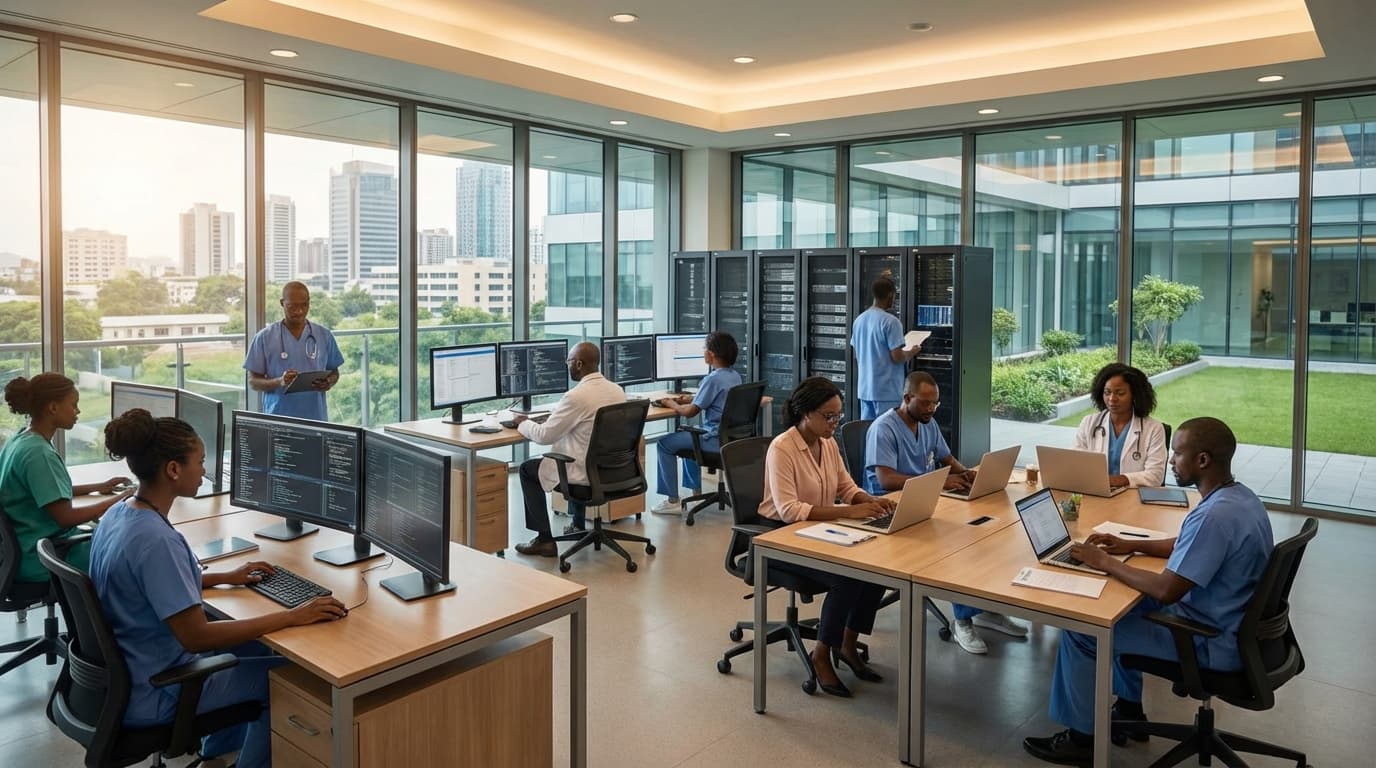
Radiology Reader & Reporting Support in Tanzania
Engineering Excellence & Technical Support
Remote radiology reading and reporting services High-standard technical execution following OEM protocols and local regulatory frameworks.
Advanced DICOM Viewer Integration
Seamless integration with leading DICOM viewers, offering radiologists in Tanzania enhanced image manipulation tools, multi-planar reconstruction (MPR), and 3D visualization capabilities to improve diagnostic accuracy and efficiency.
Automated Workflow Optimization
Streamline radiology reporting workflows through intelligent task routing, automated preliminary findings generation, and real-time status tracking, reducing turnaround times and enabling faster patient care in Tanzanian healthcare facilities.
Tele-radiology & Remote Support
Facilitates secure, high-quality tele-radiology consultations and remote reporting assistance, empowering Tanzanian healthcare providers to access specialized radiological expertise regardless of geographical location, bridging the gap in underserved areas.
What Is Radiology Reader & Reporting Support In Tanzania?
Radiology Reader & Reporting Support in Tanzania refers to the provision of specialized services aimed at augmenting the capabilities of local healthcare facilities in interpreting medical imaging studies and generating comprehensive diagnostic reports. This support is crucial in environments where access to board-certified radiologists or subspecialist expertise may be limited or geographically dispersed. The service typically leverages advanced tele-radiology platforms and a network of remote, qualified radiologists and reporting physicians to deliver timely and accurate diagnostic interpretations. It encompasses a spectrum of activities, from primary interpretation of general radiological examinations to subspecialty reads (e.g., neuro-radiology, musculoskeletal radiology, pediatric radiology) and quality assurance of existing reports.
| Who Needs This Service? | Typical Use Cases | ||||||||
|---|---|---|---|---|---|---|---|---|---|
| Hospitals and Clinics in Remote or Underserved Areas: Facilities lacking in-house diagnostic radiologists or subspecialist expertise. | Emergency Departments: Requiring rapid interpretation of critical imaging studies for trauma, stroke, or acute abdominal conditions, irrespective of local radiologist availability. | Specialized Medical Centers: Seeking second opinions or subspecialty interpretations for complex cases (e.g., oncology, neurology, cardiology imaging). | Public Health Initiatives: Supporting screening programs or mass imaging campaigns where localized radiologist capacity is insufficient. | Healthcare Networks: Standardizing reporting quality and ensuring consistent access to diagnostic services across multiple facilities. | Training Institutions: Augmenting resident and fellow training with exposure to a high volume and variety of cases interpreted by experienced subspecialists. | Facilities Experiencing Radiologist Shortages or Vacation Coverage: Providing continuous diagnostic support during periods of reduced local staffing. | |||
| Primary Interpretation of General Radiography (X-ray): Particularly in facilities where only general practitioners or limited radiology personnel are present. | CT and MRI Interpretation: For diagnosing acute conditions like intracranial hemorrhage, stroke, pulmonary embolism, or evaluating complex masses. | Ultrasound Interpretation: Supporting obstetric, abdominal, or superficial structure evaluations. | Mammography Interpretation: For breast cancer screening and diagnosis. | Pediatric Radiology Consultations: Requiring expertise in interpreting imaging findings in neonates and children. | Musculoskeletal (MSK) Imaging Interpretation: For diagnosing sports injuries, arthritis, or bone pathologies. | Neuro-Radiology Consultations: For interpreting brain and spine imaging related to neurological disorders. | Oncology Imaging: For staging, treatment response assessment, and follow-up of cancer patients. | Pre-operative and Post-operative Imaging Review: Ensuring appropriate surgical planning and assessing outcomes. | Quality Control of Locally Generated Reports: Providing an independent review to enhance diagnostic accuracy and mitigate potential errors. |
Key Components of Radiology Reader & Reporting Support
- Image Acquisition & Transmission: Facilitating the secure digital transfer of medical images (X-ray, CT, MRI, Ultrasound, etc.) from originating healthcare facilities to remote reading centers.
- Remote Interpretation: Certified radiologists and subspecialists remotely analyze transmitted images.
- Report Generation: Creation of detailed, structured diagnostic reports based on the image interpretation, adhering to international reporting standards.
- Subspecialty Consultation: Providing access to expert interpretations in highly specialized areas of radiology.
- Quality Assurance & Peer Review: Implementing processes for validating the accuracy and completeness of diagnostic reports, either pre- or post-publication.
- Turnaround Time (TAT) Management: Ensuring efficient and timely delivery of reports to support clinical decision-making.
- Workflow Integration: Seamless integration with existing Picture Archiving and Communication Systems (PACS) and Electronic Health Records (EHR) at local facilities.
- Training & Capacity Building: Offering educational resources and mentorship to local medical professionals involved in the radiology workflow.
Who Needs Radiology Reader & Reporting Support In Tanzania?
Radiology reader and reporting support services are crucial for improving diagnostic accuracy, efficiency, and access to specialized radiology expertise in Tanzania. These services can bridge the gap created by a shortage of trained radiologists and advanced imaging technologies in many areas. The primary beneficiaries are healthcare facilities facing these challenges, enabling them to provide better patient care and manage their diagnostic workflows more effectively.
| Customer Type | Key Departments Needing Support | Specific Needs/Challenges | Benefits of Support |
|---|---|---|---|
| Government Hospitals | Radiology Department, Emergency Department, Outpatient Clinics, Surgical Wards | Limited number of radiologists, high patient volume, outdated equipment, need for subspecialty interpretation (e.g., neuroradiology, musculoskeletal) | Improved diagnostic turnaround time, enhanced accuracy, access to expert opinions, reduced radiologist burnout, training opportunities for local staff |
| Private Hospitals | Radiology Department, various clinical specialties (e.g., Orthopedics, Neurology, Oncology) | Demand for rapid and accurate reports, maintaining competitive service standards, covering for vacationing radiologists, complex case interpretation | Consistent report quality, faster reporting, ability to offer a wider range of imaging services, improved patient satisfaction, efficient resource utilization |
| Diagnostic Imaging Centers | Radiology Department, referring physicians' offices | High throughput of imaging studies, need for specialized reporting (e.g., interventional radiology, mammography), ensuring report consistency across different readers | Streamlined workflow, standardized reporting, access to subspecialty expertise, improved quality control, increased capacity |
| Mission-run & Rural Health Facilities | Radiology Department (if available), General Practice, Surgery | Severe shortage of radiologists, limited access to advanced imaging, reliance on basic imaging, need for remote interpretation due to geographical isolation | Expanded access to diagnostic services, critical findings identified in remote areas, support for general practitioners, improved referral decisions |
| Specialty Clinics (e.g., Oncology, Cardiology) | Radiology Department, referring oncologists, cardiologists, surgeons | Need for highly specialized interpretations of complex scans (e.g., PET-CT, advanced cardiac MRI), timely reporting for treatment planning | Precise diagnostic information for tailored treatment, enhanced interdisciplinary collaboration, improved patient outcomes |
| Medical Schools & Teaching Hospitals | Radiology Department, training residents and medical students | Need for experienced readers to supervise trainees, provide didactic lectures, and handle complex cases that serve as learning opportunities | High-quality training for future radiologists, exposure to diverse and challenging cases, mentorship for junior radiologists |
Target Customers and Departments in Tanzania for Radiology Reader & Reporting Support
- Hospitals (Government, Private, Mission-run)
- Diagnostic Imaging Centers
- Specialty Clinics (e.g., Oncology, Cardiology)
- Rural and Underserved Health Facilities
- Medical Schools and Teaching Hospitals
Radiology Reader & Reporting Support Process In Tanzania
The Radiology Reader & Reporting Support Process in Tanzania is a crucial system designed to facilitate the timely and accurate interpretation of radiological images and the generation of diagnostic reports. This process is vital for patient care, especially in regions where access to specialized radiologists may be limited. The workflow typically begins with a request for a radiology examination and concludes with the delivery of a finalized report to the referring physician, ensuring that patient diagnoses and treatment plans are informed by expert analysis.
| Stage | Description | Key Actors | Output | Considerations/Challenges |
|---|---|---|---|---|
| Patient Registration and Examination Request | The process starts when a patient requires a radiological examination. The referring physician initiates a request, detailing the clinical information, suspected diagnosis, and the specific imaging modality needed. | Referring Physician, Patient, Healthcare Facility Staff | Completed Examination Request Form | Availability of imaging equipment, accurate clinical information for optimal examination, patient consent. |
| Image Acquisition | The radiological examination is performed using the appropriate equipment (X-ray, CT, MRI, Ultrasound). Images are captured according to established protocols. | Radiology Technologist/Radiographer, Patient | Raw Radiological Images (DICOM format) | Equipment functionality and maintenance, technologist expertise, patient cooperation, radiation safety. |
| Image Upload and Teleradiology Platform Integration | Acquired images are securely uploaded to a central Picture Archiving and Communication System (PACS) or directly to a teleradiology platform. This ensures images are accessible remotely. | Radiology Technologist, IT Support, Teleradiology Platform Administrator | Digital Images on PACS/Teleradiology Platform | Internet connectivity, data security, platform reliability, file size management. |
| Case Assignment to Radiologist | Cases are assigned to available radiologists based on expertise, workload, and subspecialty. This can be automated by the teleradiology platform or managed manually. | Teleradiology Platform Administrator, Radiologist Coordinator | Assigned Case/Study | Radiologist availability, fair workload distribution, subspecialty matching. |
| Image Interpretation and Dictation | The assigned radiologist reviews the images, correlates them with the clinical information, and dictates their findings and diagnostic impression. | Radiologist | Dictated Report (Audio File) | Radiologist's expertise, quality of images, clarity of clinical information, uninterrupted workflow. |
| Report Transcription | The dictated audio files are transcribed into a written report by a medical transcriptionist or through speech recognition software. | Medical Transcriptionist, Speech Recognition Software | Draft Written Report | Transcription accuracy and speed, clarity of dictation, availability of transcriptionists. |
| Report Review and Validation | The drafted report is reviewed by the radiologist for accuracy, completeness, and adherence to standard reporting formats. Amendments are made as necessary. | Radiologist | Finalized Radiological Report | Radiologist's attention to detail, time constraints, potential for errors in transcription or interpretation. |
| Report Dispatch and Archiving | The finalized report is securely dispatched to the referring physician, often electronically via the teleradiology platform or hospital information system (HIS). Reports are then archived for future reference. | Teleradiology Platform, HIS Administrator, Referring Physician | Dispatched and Archived Report | Secure communication channels, integration with HIS/EMR, long-term data storage and retrieval, data privacy regulations. |
Key Stages of the Radiology Reader & Reporting Support Process:
- Patient Registration and Examination Request
- Image Acquisition
- Image Upload and Teleradiology Platform Integration
- Case Assignment to Radiologist
- Image Interpretation and Dictation
- Report Transcription
- Report Review and Validation
- Report Dispatch and Archiving
Radiology Reader & Reporting Support Cost In Tanzania
The cost of radiology reader and reporting support services in Tanzania can vary significantly based on several factors. These include the complexity and modality of the radiology examination (e.g., X-ray, CT, MRI, Ultrasound), the experience and specialization of the radiologist providing the interpretation, the volume of reports required, and the turnaround time demanded. Furthermore, the geographic location of the facility, whether it's in a major urban center like Dar es Salaam or a more remote area, can influence costs due to differences in overhead, accessibility, and the availability of specialized personnel. The use of advanced reporting software, integration with hospital information systems (HIS) or picture archiving and communication systems (PACS), and the level of ongoing consultation or training provided also contribute to the overall pricing. Generally, services are billed on a per-study or per-report basis.
| Service Type | Estimated Price Range (TZS) | Notes |
|---|---|---|
| Basic X-ray Interpretation | 5,000 - 15,000 | Standard interpretation of simple X-ray studies. |
| CT Scan Interpretation | 15,000 - 40,000 | Interpretation of routine CT scans (e.g., head, chest, abdomen). |
| MRI Scan Interpretation | 20,000 - 50,000 | Interpretation of routine MRI scans (e.g., brain, spine, joints). |
| Ultrasound Interpretation | 10,000 - 30,000 | Interpretation of common ultrasound examinations. |
| Complex/Specialized Interpretations (e.g., interventional radiology, advanced neuroimaging) | 40,000 - 100,000+ | For highly specialized or complex cases requiring significant radiologist expertise. |
| Per-Report Fee (Outsourced Service) | Varies widely based on volume and contract | Typically for remote reporting services where a provider handles a bulk of reports. |
Key Pricing Factors for Radiology Reader & Reporting Support in Tanzania
- Modality of Examination (X-ray, CT, MRI, Ultrasound, etc.)
- Complexity of the Case
- Radiologist's Experience and Specialization
- Volume of Reports
- Required Turnaround Time (Standard vs. Expedited)
- Geographic Location of the Facility
- Integration with HIS/PACS
- Ancillary Services (Consultation, Training)
Affordable Radiology Reader & Reporting Support Options
Radiology practices and healthcare providers are increasingly seeking cost-effective solutions for radiology reading and reporting. Leveraging value bundles and implementing smart cost-saving strategies can significantly reduce expenses while maintaining or improving service quality. This involves exploring flexible service models, optimizing workflow, and embracing technology.
| Strategy/Bundle | Description | Cost-Saving Mechanism | Potential Benefits |
|---|---|---|---|
| Subspecialty Reading Bundles | Pre-negotiated packages for specific subspecialties. | Volume discounts, predictable budgeting. | Access to expert reads without per-case variability, reduced overhead. |
| TAT Tiered Services | Differentiated pricing based on urgency of report. | Cost optimization by aligning payment with need. | Reduced cost for routine reads, efficient resource allocation. |
| Shared Service Models | Jointly utilizing radiologist or platform resources. | Distribution of fixed costs, increased utilization. | Lower individual operational costs, enhanced capacity. |
| Technology Integration (AI/Workflow) | Implementing AI for preliminary reads, optimizing PACS/RIS. | Automation of manual tasks, increased radiologist throughput. | Reduced labor costs, faster reporting times, improved accuracy. |
| Remote/Tele-Radiology | Outsourced reading services, often for off-hours or overflow. | Lower overhead compared to in-house staff, pay-as-you-go options. | 24/7 coverage, access to a wider pool of specialists, cost flexibility. |
| Flexible Staffing | Mix of full-time, part-time, and locum tenens radiologists. | Adaptability to workload fluctuations, reduced fixed labor costs. | Improved cost control, optimized staffing ratios. |
| Long-Term Contracts/Volume Commitments | Agreements for extended periods or guaranteed read volumes. | Negotiated discounts, economies of scale. | Lower per-unit cost, stable service provider relationship. |
Key Value Bundles & Cost-Saving Strategies
- Subspecialty Reading Bundles: Instead of engaging individual subspecialists for every case, consider bundled packages for common subspecialty reads (e.g., a monthly block of neuroimaging reads). This can lead to volume discounts and predictable costs.
- Turnaround Time (TAT) Tiered Services: Negotiate different pricing tiers based on required turnaround times. Critical, STAT reads may command a premium, while routine reads can be offered at a lower, more cost-effective rate.
- Shared Service Models: Partner with other practices or facilities to share a pool of radiologists or reading platforms. This distributes fixed costs and allows for better utilization of resources, especially for lower-volume needs.
- Technology Integration & Workflow Optimization: Investing in integrated PACS/RIS systems and AI-powered preliminary reading tools can automate routine tasks, reduce manual effort, and improve radiologist efficiency, thereby lowering per-study costs.
- Remote & Tele-Radiology Solutions: Utilizing remote reading services, especially for off-hours or during periods of high demand, can be more cost-effective than maintaining a large in-house team. Negotiate per-study, per-hour, or subscription-based models.
- Flexible Staffing Models: Employ a mix of full-time, part-time, and per-diem radiologists. This allows for scalability and cost control, adapting to fluctuating workloads without overcommitting resources.
- Data Analytics for Efficiency: Regularly analyze reading and reporting metrics to identify bottlenecks, optimize radiologist assignments, and pinpoint areas for efficiency improvements, leading to cost reductions.
- Long-Term Contracts & Volume Commitments: For consistent, high-volume needs, longer-term contracts with service providers often come with significant discounts. Similarly, committing to a certain volume of reads can unlock preferential pricing.
Verified Providers In Tanzania
In Tanzania's healthcare landscape, identifying reliable and qualified medical providers is paramount for individuals seeking quality care. Franance Health stands out as a beacon of trust and excellence, distinguished by its rigorous credentialing process and unwavering commitment to patient well-being. This commitment translates into a network of verified providers who consistently deliver exceptional medical services, making Franance Health the optimal choice for your healthcare needs.
| Provider Type | Key Credentials Verified | Benefits of Choosing Franance Health Verified Providers |
|---|---|---|
| General Practitioners | Valid Medical License, Clean Practice Record, Tertiary Education in Medicine | Accessible primary care, early detection of common ailments, referrals to specialists when needed. |
| Specialist Physicians (e.g., Cardiologists, Dermatologists) | Board Certification in Specialty, Advanced Training, Proven Experience in Area | Expert diagnosis and treatment for complex conditions, access to specialized knowledge. |
| Surgeons | Surgical Board Certification, Fellowship Training, Extensive Surgical Experience, Hospital Privileges | Safe and effective surgical procedures, adherence to strict surgical protocols. |
| Dentists | Dental License, Specialization Certifications (e.g., Orthodontics), Continuing Education | Comprehensive oral health care, preventative and restorative treatments. |
| Pharmacists | Pharmacy License, Sound Knowledge of Medications and Interactions | Accurate dispensing of prescriptions, patient counseling on medication use. |
Why Franance Health Providers are the Best Choice:
- Rigorous Credentialing: Franance Health implements a multi-faceted vetting process for all its partner providers. This includes verifying medical licenses, accreditations, educational qualifications, and a clean professional record. This ensures that only the most competent and ethical practitioners are part of the network.
- Specialized Expertise: The network boasts a diverse range of medical professionals, from general practitioners to highly specialized surgeons and consultants. This allows members to access the precise expertise required for their specific health conditions, ensuring accurate diagnoses and effective treatments.
- Patient-Centric Approach: Franance Health emphasizes a patient-first philosophy. Verified providers are expected to demonstrate empathy, clear communication, and a commitment to shared decision-making, fostering strong doctor-patient relationships and enhancing patient satisfaction.
- Quality Assurance: Regular reviews and feedback mechanisms are in place to continuously monitor the quality of care provided. This proactive approach addresses any potential concerns and ensures that the high standards of the Franance Health network are maintained.
- Accessibility and Convenience: Franance Health's network is strategically designed to offer accessibility across various regions in Tanzania, minimizing travel time and ensuring that quality healthcare is within reach.
- Focus on Continuous Improvement: The organization actively encourages and supports ongoing professional development for its providers, ensuring they remain at the forefront of medical advancements and best practices.
Scope Of Work For Radiology Reader & Reporting Support
This Scope of Work (SOW) outlines the requirements for Radiology Reader & Reporting Support services. The objective is to provide qualified and experienced radiologists to supplement existing reading and reporting capacity, ensuring timely and accurate interpretation of medical imaging studies. This document details the technical deliverables and standard specifications expected from the service provider.
| Category | Technical Deliverables | Standard Specifications & Requirements | Key Performance Indicators (KPIs) | ||||
|---|---|---|---|---|---|---|---|
| Radiology Reading & Reporting | Interpretation of various imaging modalities (X-ray, CT, MRI, Ultrasound, Nuclear Medicine, Mammography, Interventional Radiology). | Readings must be performed by board-certified or equivalent radiologists. | Accuracy of interpretation (as measured by peer review and discrepancy rates). | Timeliness of report generation (e.g., STAT reads < 1 hour, routine reads < 24 hours). | Report format compliant with client standards (e.g., structured reporting, free-text). | Adherence to client-specific protocols and workflows. | |
| Reporting System Integration | Secure and stable connection to client's PACS/RIS for image access and report dictation/generation. | Read-only access to patient history and prior imaging studies. | Capability to utilize client's dictation and speech recognition software. | Integration with client's Electronic Health Record (EHR) for report delivery. | Data security and HIPAA/GDPR compliance. | Uptime and availability of the integration link. | Successful transmission of finalized reports. |
| Quality Assurance | Adherence to all relevant professional and regulatory guidelines (e.g., ACR, FDA, local medical board regulations). | Participation in client's peer review process. | Provision of credentials and licenses for all reading radiologists. | Regular quality audits and performance reviews. | Reporting of any significant findings or critical results to the referring physician as per client protocol. | Minimization of report errors and discrepancies. | |
| Communication & Support | Dedicated point of contact for all service-related issues. | Defined escalation procedures for urgent matters. | Regular performance reporting to the client. | Availability of radiologists during specified coverage hours. | Responsiveness to client inquiries and feedback. | On-boarding and training on client-specific systems and workflows. | Resolution time for reported issues. |
| Data & Reporting | Provision of anonymized data for workload analysis and trend identification. | Detailed billing and service utilization reports. | Customizable reporting on reading turnaround times, accuracy metrics, and radiologist productivity. | Compliance with data retention policies. | Accuracy and completeness of all provided reports. |
Key Objectives
- Provide on-demand reading and reporting of radiology studies.
- Ensure adherence to established clinical protocols and quality standards.
- Deliver accurate and comprehensive radiology reports in a timely manner.
- Maintain seamless integration with the client's Picture Archiving and Communication System (PACS) and Radiology Information System (RIS).
- Offer flexible support to accommodate fluctuating workloads and physician availability.
Service Level Agreement For Radiology Reader & Reporting Support
This Service Level Agreement (SLA) outlines the performance standards and guarantees for Radiology Reader & Reporting Support services. It defines the expected response times for reported issues and the minimum guaranteed uptime for the provided services.
| Incident Priority | Response Time Target | Resolution Time Target | Guaranteed Uptime |
|---|---|---|---|
| Critical Incident | 15 minutes | 2 hours | 99.9% |
| High Priority Incident | 30 minutes | 4 business hours | 99.9% |
| Normal Priority Incident | 2 business hours | 8 business hours | 99.9% |
Key Definitions
- Radiology Reader & Reporting Support: Refers to the services provided to assist radiologists in interpreting medical images and generating accurate reports, including but not limited to PACS access, RIS interaction, voice recognition system support, and report editing assistance.
- Critical Incident: An issue that renders the primary radiology reading or reporting functions completely unavailable, preventing radiologists from performing their core duties. This includes complete PACS downtime, inability to access patient data, or failure of the primary reporting system.
- High Priority Incident: An issue that significantly degrades the performance of radiology reading or reporting, but does not completely halt operations. Examples include slow system response times affecting multiple users, intermittent access issues to specific patient data, or partial functionality loss in the reporting system.
- Normal Priority Incident: An issue that has a minor impact on reading or reporting capabilities and does not prevent radiologists from performing their core duties. Examples include minor UI glitches, documentation errors, or requests for minor system configuration changes.
- Uptime: The percentage of time the Radiology Reader & Reporting Support services are available and functional for use by authorized personnel.
- Response Time: The maximum time allowed from the reporting of an incident until the support team acknowledges the incident and begins active work towards resolution.
- Resolution Time: The maximum time allowed from the reporting of an incident until the issue is resolved or a mutually agreed-upon workaround is implemented.
Frequently Asked Questions

Ready when you are
Let's scope your Radiology Reader & Reporting Support in Tanzania project in Tanzania.

Scaling healthcare logistics and technical systems across the entire continent.