
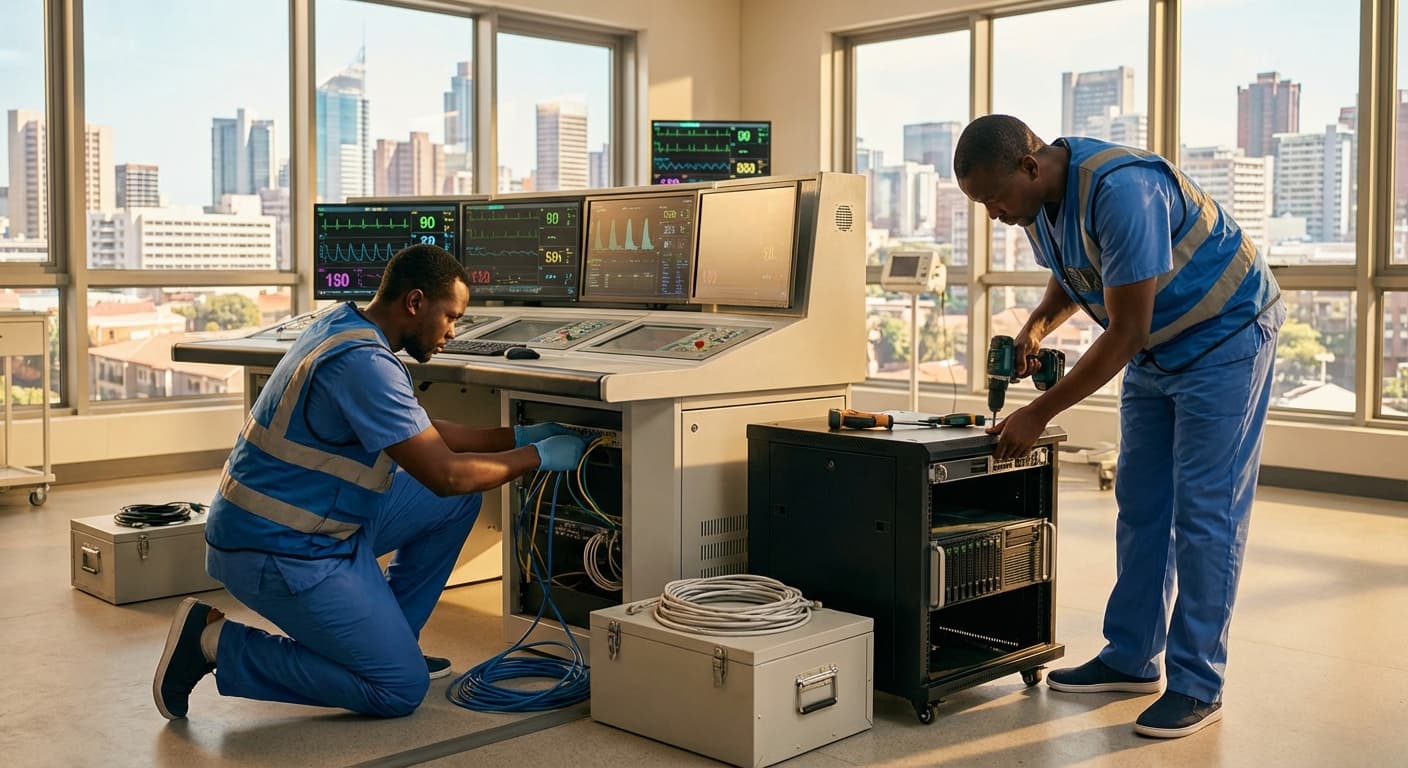
ICU Central Monitoring Station Installation Service in Tanzania
Engineering Excellence & Technical Support
ICU Central Monitoring Station Installation Service High-standard technical execution following OEM protocols and local regulatory frameworks.
Advanced Remote Patient Monitoring
Leveraging cutting-edge technology to provide real-time, continuous vital sign monitoring for critically ill patients across Tanzania. Our expert installations ensure seamless data transmission and early detection of critical events, empowering medical staff with actionable insights.
Robust & Secure Network Infrastructure
We design and implement highly reliable and secure network architectures specifically for ICU environments. Our installations guarantee uninterrupted data flow and protect sensitive patient information, adhering to international cybersecurity standards.
Seamless Integration & Scalability
Our service focuses on integrating the central monitoring station with existing hospital IT systems and a wide range of medical devices. We ensure a future-proof solution that is easily scalable to accommodate growing healthcare needs in Tanzania.
What Is Icu Central Monitoring Station Installation Service In Tanzania?
The ICU Central Monitoring Station Installation Service in Tanzania refers to the comprehensive process of designing, procuring, installing, configuring, and commissioning a centralized hub for real-time patient physiological data acquisition and display within Intensive Care Units (ICUs). This service ensures that critical patient parameters from multiple bedside monitoring devices are aggregated, analyzed, and presented to a dedicated team of healthcare professionals at a central workstation, facilitating immediate assessment, timely intervention, and improved patient outcomes.
| Service Beneficiary | Primary Need Addressed | Typical Use Cases |
|---|---|---|
| Hospitals and Healthcare Facilities with ICUs in Tanzania | To enhance patient surveillance, early detection of critical events, and efficient resource allocation within the ICU environment. | Real-time monitoring of multiple critically ill patients simultaneously. Centralized alarm management and immediate response to deteriorating patient conditions. Facilitating collaborative decision-making among the ICU clinical team. Data logging and trend analysis for patient management and research. Improving staff efficiency by reducing the need for constant bedside checks. |
| Ministry of Health and Regional Health Authorities | To improve the quality of critical care services, standardize monitoring practices, and strengthen healthcare infrastructure across the nation. | Ensuring consistent standards of critical care across different healthcare facilities. Facilitating remote oversight and support for ICUs in underserved areas. Gathering data for public health initiatives and epidemiological studies. |
| Medical Equipment Vendors and Installers | To offer specialized installation and integration services for advanced medical monitoring technologies. | Providing end-to-end solutions for hospital procurement of ICU monitoring systems. Ensuring seamless integration of diverse medical devices into a unified monitoring platform. |
Key Components and Activities of the Service:
- Site Assessment and Design: Evaluating existing ICU infrastructure, network capabilities, power supply, and space requirements to develop a tailored monitoring station layout and system architecture.
- Hardware Procurement and Installation: Sourcing and physically installing central monitoring servers, workstations, large-format displays, network switches, cabling, and associated power and data infrastructure.
- Device Integration and Configuration: Connecting and configuring individual patient bedside monitors (e.g., ECG, SpO2, NIBP, invasive/non-invasive blood pressure, respiration, temperature) to the central station via secure network protocols (e.g., HL7, DICOM).
- Software Deployment and Customization: Installing and configuring the central monitoring software, including alarm management systems, data logging, trend analysis modules, and user access control.
- Network Infrastructure Setup: Establishing a robust and reliable network (wired or wireless) capable of transmitting high volumes of real-time physiological data from bedside devices to the central station.
- Power and Backup Systems: Implementing appropriate power solutions, including Uninterruptible Power Supplies (UPS) and potentially backup generators, to ensure continuous operation during power outages.
- Testing and Commissioning: Thoroughly testing all system components, data flow, alarm functionality, and user interfaces to verify performance and compliance with clinical requirements.
- Training and Handover: Providing comprehensive training to clinical staff and IT personnel on the operation, maintenance, and troubleshooting of the central monitoring system.
- Documentation and Support: Delivering detailed system documentation, including network diagrams, configuration guides, and warranty information, along with ongoing technical support and maintenance agreements.
Who Needs Icu Central Monitoring Station Installation Service In Tanzania?
This document outlines the critical need for ICU Central Monitoring Station Installation Services in Tanzania. Such specialized installations are essential for equipping healthcare facilities with advanced patient monitoring capabilities, ensuring timely interventions, and improving patient outcomes in critical care settings.
| Target Customer Type | Key Departments Requiring Service | Specific Needs & Rationale |
|---|---|---|
| Government Hospitals | Intensive Care Unit (ICU), High Dependency Unit (HDU), Coronary Care Unit (CCU), Emergency Department (ED) | To enhance capacity, upgrade aging infrastructure, comply with modern healthcare standards, and provide critical care to a larger population. |
| University Teaching Hospitals | ICU, HDU, CCU, Postgraduate Training Units | To support advanced medical training, research, and the provision of highly specialized critical care services. Modern monitoring is crucial for evidence-based practice. |
| Private Hospitals and Clinics | ICU, HDU, Surgical Wards, Cardiology Departments | To offer premium critical care services, attract specialized medical professionals, and cater to a clientele requiring advanced and reliable monitoring solutions. |
| Specialized Medical Centers | Dedicated ICUs within Cardiology, Neurology, Oncology, or Trauma Units | To provide continuous, high-fidelity monitoring of patients with specific complex conditions, allowing for precise diagnosis and immediate response. |
| International NGOs | ICU, Emergency Response Units | To establish or upgrade critical care facilities in underserved areas, ensuring that essential life-saving monitoring is available for patients in challenging environments. |
| Large Industrial Companies | On-site Medical Centers, Occupational Health Units | To provide immediate and advanced medical support for industrial accidents or critical health events occurring in remote or demanding work environments. |
Target Customers for ICU Central Monitoring Station Installation Services in Tanzania:
- Government Hospitals (National, Regional, and District)
- University Teaching Hospitals
- Private Hospitals and Clinics (especially those with a focus on critical care or trauma)
- Specialized Medical Centers (e.g., cardiac centers, neurological centers)
- International NGOs operating healthcare facilities
- Mining and large industrial companies with on-site medical facilities
Icu Central Monitoring Station Installation Service Process In Tanzania
This document outlines the comprehensive workflow for the ICU Central Monitoring Station Installation Service Process in Tanzania, from initial inquiry to final execution and handover. Our aim is to provide a clear, efficient, and transparent process for healthcare facilities seeking to implement or upgrade their ICU central monitoring systems.
| Phase | Key Activities | Deliverables | Timeline (Indicative) |
|---|---|---|---|
| Phase 1: Initial Inquiry & Consultation | Client contacts service provider with inquiry. Initial discussion to understand client's needs, existing infrastructure, and expectations. Information gathering on current ICU setup and patient monitoring requirements. | Understanding of client's needs. Initial assessment of project scope. Agreement on next steps. | 1-3 Business Days |
| Phase 2: Site Assessment & System Design | On-site visit to the ICU. Detailed assessment of physical space, power outlets, network infrastructure, and existing equipment. Identification of optimal locations for monitors, central station, and cabling. Collaboration with clinical staff and IT department for system design. | Detailed site survey report. Customized system design proposal. Bill of Materials (BOM) and technical specifications. | 3-7 Business Days |
| Phase 3: Quotation & Proposal | Preparation of a comprehensive quotation based on the system design and BOM. Inclusion of hardware, software, installation, training, and warranty costs. Presentation of the formal proposal to the client. | Formal quotation. Detailed technical proposal. Payment terms and schedule. | 2-5 Business Days |
| Phase 4: Order Confirmation & Planning | Client review and acceptance of the quotation and proposal. Formal purchase order issuance. Joint planning meeting for installation schedule, resource allocation, and site access. | Signed contract/PO. Detailed project plan with timelines. Designated project manager. | 1-5 Business Days |
| Phase 5: Pre-installation & Logistics | Procurement and delivery of all required equipment and materials to the site. Pre-configuration of central monitoring software and hardware where feasible. Coordination with hospital facilities and IT for necessary pre-installation work (e.g., network port activation, power supply checks). | All equipment and materials on-site. Completed pre-installation checks. | Varies based on equipment availability and site readiness (typically 1-4 Weeks) |
| Phase 6: Installation & Configuration | Physical installation of central monitoring units, bedside monitors, and associated cabling. Network configuration and integration. Software installation and initial system configuration. | Installed hardware and software. Basic system connectivity established. | Varies based on ICU size and complexity (typically 1-2 Weeks) |
| Phase 7: Testing & Validation | Comprehensive testing of all system functionalities (e.g., data transmission, alarms, patient data display). Validation against predefined performance criteria. Integration testing with existing hospital information systems (if applicable). | Test reports. Validated system performance. Sign-off on system functionality. | 3-5 Business Days |
| Phase 8: Training & Handover | Training sessions for ICU clinical staff and IT personnel on system operation, maintenance, and troubleshooting. Formal handover of the installed system with all necessary documentation. | Trained staff. User manuals and technical documentation. Certificate of Handover. | 2-4 Business Days |
| Phase 9: Post-installation Support & Maintenance | Provision of warranty services. On-call technical support. Scheduled preventive maintenance visits (as per contract). Software updates and upgrades. | Ongoing system reliability. Minimized downtime. Customer satisfaction. | Ongoing (as per warranty and maintenance agreement) |
ICU Central Monitoring Station Installation Service Process in Tanzania
- Phase 1: Initial Inquiry & Consultation
- Phase 2: Site Assessment & System Design
- Phase 3: Quotation & Proposal
- Phase 4: Order Confirmation & Planning
- Phase 5: Pre-installation & Logistics
- Phase 6: Installation & Configuration
- Phase 7: Testing & Validation
- Phase 8: Training & Handover
- Phase 9: Post-installation Support & Maintenance
Icu Central Monitoring Station Installation Service Cost In Tanzania
Installing an ICU Central Monitoring Station (CMS) in Tanzania involves a complex process with costs influenced by several key factors. These stations are critical for real-time patient vital sign monitoring in Intensive Care Units, and their implementation requires specialized equipment, skilled labor, and often significant infrastructure considerations. Understanding these elements is crucial for budgeting and project planning.
Key Pricing Factors:
- Number of Beds/Monitored Patients: The most significant driver of cost is the scale of the ICU. A larger ICU with more beds requiring continuous monitoring will necessitate more patient monitors, central display units, and network infrastructure, directly increasing the overall price.
- Type and Brand of Equipment: High-end, feature-rich patient monitors and central station software from reputable international brands (e.g., Philips, GE Healthcare, Mindray) will command higher prices than more basic models or those from less established manufacturers. Factors like advanced waveform display, integrated diagnostics, and data management capabilities influence cost.
- Network Infrastructure: A robust and reliable network is essential for seamless data transmission from patient monitors to the central station. This includes cabling (Ethernet, fiber optic), network switches, routers, and potentially wireless infrastructure. The complexity and existing state of the hospital's network will impact installation costs.
- Software and Licensing: The central monitoring software itself, along with any necessary licenses for advanced features, user access, and data archiving, contributes to the total cost. Ongoing software support and maintenance agreements also need to be factored in.
- Installation and Integration Services: This includes the professional services of trained technicians and biomedical engineers for physical installation, system configuration, calibration, and integration with existing hospital IT systems (e.g., Electronic Health Records - EHRs). Training for clinical staff on using the system is also a crucial part of this service.
- Project Management: For larger or more complex installations, dedicated project management services ensure the project stays on schedule and within budget.
- Site Preparation and Infrastructure Upgrades: Depending on the hospital's current infrastructure, upgrades to power supply, backup power (UPS, generators), and even environmental controls (e.g., air conditioning for server rooms) might be required, adding to the cost.
- Warranty and Maintenance: While not strictly an installation cost, the price of extended warranties and post-installation maintenance contracts is a critical consideration for ongoing operational expenses.
- Logistics and Import Duties: For imported equipment, transportation costs, customs duties, and taxes within Tanzania will add to the final price.
Estimated Cost Ranges in Tanzanian Shillings (TZS):
Due to the variability in the factors above, providing precise figures is challenging. However, based on typical ICU sizes and equipment choices, we can offer estimated ranges.
- Small ICU (e.g., 4-8 beds): TZS 80,000,000 - TZS 150,000,000
- Medium ICU (e.g., 9-16 beds): TZS 150,000,000 - TZS 300,000,000
- Large ICU (e.g., 17+ beds): TZS 300,000,000 - TZS 600,000,000+
These ranges typically include patient monitors, the central station console, essential networking, and standard installation and basic training services. High-end configurations with advanced features, extensive customization, or significant infrastructure upgrades could push these costs considerably higher.
| ICU Size (Approx. Beds) | Estimated Cost Range (TZS) | Notes |
|---|---|---|
| Small (4-8 beds) | 80,000,000 - 150,000,000 | Includes basic monitors, central station, core networking, and standard installation. |
| Medium (9-16 beds) | 150,000,000 - 300,000,000 | Higher bed count implies more equipment and network points. |
| Large (17+ beds) | 300,000,000 - 600,000,000+ | Significant investment in hardware, software, infrastructure, and integration. |
Factors Influencing ICU Central Monitoring Station Installation Costs in Tanzania
- Number of ICU beds to be monitored
- Specific brands and models of patient monitors and central station hardware/software
- Complexity and existing state of the hospital's IT and network infrastructure
- Requirement for new cabling, network switches, or wireless solutions
- Features and licensing of the central monitoring software
- Scope of installation, configuration, and integration services
- Need for staff training on the new system
- Potential infrastructure upgrades (power, backup power, environmental controls)
- Costs associated with logistics, import duties, and taxes for imported equipment
- Inclusion of warranty periods and post-installation maintenance packages
Affordable Icu Central Monitoring Station Installation Service Options
Installing an Intensive Care Unit (ICU) central monitoring station is a critical investment for any healthcare facility, ensuring continuous patient oversight and timely intervention. While the technology itself can be substantial, there are various affordable installation service options and cost-saving strategies that can make this essential system accessible. This guide explores value bundles, potential cost-saving measures, and provides a framework for understanding pricing.
| Value Bundle Component | Description | Cost-Saving Impact |
|---|---|---|
| Basic Monitoring Package | Includes essential hardware (servers, workstations, network infrastructure), software licenses for core monitoring, and standard installation. Typically supports a predefined number of patient beds. | Lower upfront cost, suitable for smaller ICUs or facilities with basic monitoring needs. Allows for future upgrades if requirements change. |
| Integrated Solution Bundle | Combines central monitoring hardware and software with EMR/EHR integration services. May also include basic cybersecurity measures and initial staff training. | Reduces the complexity and cost of managing multiple vendors. Streamlines workflows and improves data accuracy by avoiding manual data entry, leading to efficiency gains. |
| Advanced Features Bundle | Includes all components of the integrated bundle plus advanced analytics, predictive alerting, mobile access capabilities, and extended warranty/support. | While a higher initial investment, it can lead to significant long-term savings through early detection of patient deterioration, reduced adverse events, and optimized staffing. |
| Phased Implementation Plan | Instead of installing a complete system at once, this approach breaks down the installation into manageable stages, prioritizing critical areas or bed count. | Spreads the capital expenditure over time, making it more budget-friendly. Allows for real-world testing and adjustments between phases, minimizing risk and potential rework. |
Key Considerations for Affordable ICU Central Monitoring Station Installation
- Understand Your Needs: Accurately assess the number of beds requiring monitoring, the types of vital signs to be tracked, and integration requirements with existing EMR/EHR systems. Over-specifying can lead to unnecessary costs.
- Service Provider Expertise: Choose providers with a proven track record in healthcare IT and medical device integration. Their efficiency and understanding of compliance (HIPAA, etc.) can prevent costly mistakes.
- Scalability: Opt for solutions that can scale with your facility's growth. Modular systems allow for phased implementation and future expansion without requiring a complete overhaul.
- Training and Support: Factor in the cost of comprehensive training for your clinical staff and IT support. Proper usage minimizes errors and maximizes the system's effectiveness, ultimately saving time and resources.
- Maintenance and Service Agreements: Explore different levels of post-installation support. While an upfront cost, a good service agreement can prevent costly downtime and emergency repairs.
Verified Providers In Tanzania
In Tanzania, identifying reliable and credentialed healthcare providers is paramount for ensuring quality care. Franance Health stands out as a leader in this regard, offering a network of verified professionals who meet rigorous standards. Their commitment to excellence translates into a patient-centered approach, where trust and efficacy are the cornerstones of their service. Choosing Franance Health means opting for a provider that prioritizes your well-being through a carefully curated selection of skilled and ethical practitioners.
| Provider Type | Key Credentials Verified | Franance Health Advantage |
|---|---|---|
| Doctors (General Practitioners & Specialists) | Medical Degree (MD/MBChB), Specialist Certifications (e.g., FRCS, MRCP), Valid Medical Practicing License | Access to a broad range of specialists, ensuring you find the right expertise for your needs. Ongoing professional development encouraged. |
| Nurses | Nursing Diploma/Degree, Registered Nurse (RN) License, Relevant Certifications (e.g., Midwifery, Critical Care) | Qualified and experienced nurses providing essential care and support. Emphasis on patient advocacy and education. |
| Pharmacists | Pharmacy Degree, Registered Pharmacist License, Continuing Professional Development (CPD) Compliance | Reliable access to prescription fulfillment and expert pharmaceutical advice, ensuring safe and effective medication use. |
| Allied Health Professionals (e.g., Physiotherapists, Lab Technicians) | Relevant Degree/Diploma, Professional Registration/License, Specific Skill Certifications | Comprehensive rehabilitation and diagnostic services from certified professionals. Accurate and timely diagnostic support. |
Why Franance Health is the Best Choice:
- Rigorous Vetting Process: Franance Health employs a comprehensive screening and verification process for all its affiliated healthcare providers.
- Credential Verification: We meticulously check and confirm the qualifications, licenses, and certifications of every professional.
- Experience and Expertise: Our network comprises healthcare providers with proven track records and specialized knowledge in various medical fields.
- Patient-Centric Approach: Franance Health partners with providers who are dedicated to delivering compassionate, respectful, and personalized care.
- Commitment to Quality: We continuously monitor and evaluate provider performance to ensure adherence to the highest standards of medical practice.
- Accessibility and Convenience: Our platform simplifies the process of finding and accessing trusted healthcare professionals across Tanzania.
Scope Of Work For Icu Central Monitoring Station Installation Service
This Scope of Work (SOW) outlines the requirements for the installation services of a new ICU Central Monitoring Station (CMS) system. The project encompasses the entire lifecycle of the CMS installation, from site preparation and equipment installation to system configuration, testing, and final handover. The goal is to ensure a fully functional and integrated CMS that meets the critical monitoring needs of the Intensive Care Unit (ICU).
| Technical Deliverable | Description | Standard Specifications/Requirements | Acceptance Criteria |
|---|---|---|---|
| Detailed Installation Plan | A comprehensive plan detailing all installation activities, timelines, resource allocation, and risk mitigation strategies. | Includes site survey report, equipment list, cable routing diagrams, power requirements, network topology, and phased rollout schedule. | Approved by the Project Manager and relevant hospital stakeholders. |
| Site Preparation Report | Documentation of site readiness, including any required modifications to the physical environment. | Includes assessment of electrical capacity, network connectivity, HVAC requirements, and any structural modifications needed. | Confirmation of site readiness for equipment installation. |
| Installed CMS Hardware | Physical installation of all CMS server(s), workstations, displays, network switches, and associated peripheral devices. | Adherence to manufacturer's installation guidelines, hospital safety standards, and ergonomic best practices. Proper grounding and ventilation. | All hardware physically secured, powered on, and accessible for configuration. |
| Network Cabling and Connectivity | Installation of all necessary network cables, patch panels, and connectors to ensure reliable data transmission between patient monitors and the CMS. | Use of hospital-approved cabling standards (e.g., Cat 6A or higher), proper cable labeling, and adherence to network security policies. Minimum bandwidth requirements met. | All network ports tested for connectivity and data throughput. Signal integrity verified. |
| Power Distribution and UPS Integration | Installation of dedicated power outlets for CMS equipment and integration with the hospital's Uninterruptible Power Supply (UPS) system. | Compliance with electrical safety codes. UPS capacity sufficient for CMS components. Redundant power sources as specified. | All equipment powered successfully from both main and UPS sources. Load testing of UPS completed. |
| CMS Software Installation and Configuration | Installation of the CMS operating system, application software, and drivers. | Configuration of user accounts, roles, permissions, alarm thresholds, display layouts, and data archiving parameters as per hospital requirements. | Software installed and configured correctly. Basic functionality tested (e.g., login, data display). |
| Integration with Existing Medical Devices | Seamless integration of the CMS with existing patient monitoring devices and any other relevant hospital information systems (e.g., EMR). | Utilizing manufacturer-specified protocols and interfaces. Data synchronization and compatibility verified. | Successful data flow from patient monitors to CMS and vice-versa. Data accuracy confirmed. |
| System Testing and Validation Report | Comprehensive documentation of all tests performed on the CMS, including functional, performance, and stress tests. | Includes test cases, test results, and any identified issues or deviations from expected performance. Verification of alarm functionality and reporting. | All test cases passed. System meets performance benchmarks. No critical or major issues outstanding. |
| User Training Materials and Sessions | Development and delivery of training programs for ICU staff on the operation and maintenance of the CMS. | Includes user manuals, quick reference guides, and hands-on training sessions tailored to different user roles. | Staff demonstrate proficiency in operating the CMS for daily tasks and basic troubleshooting. |
| As-Built Documentation | Finalized documentation reflecting the actual installation, including updated diagrams, configuration settings, and system architecture. | Includes detailed network diagrams, cable termination schedules, IP address assignments, and software version details. | Accurate representation of the installed system, signed off by both parties. |
| Handover Certificate | Formal document certifying the completion and acceptance of the CMS installation service. | Confirms all contractual obligations have been met and the system is operational. | Signed by authorized representatives of the hospital and the installation service provider. |
Project Phases and Key Activities
- Phase 1: Project Planning & Design Review
- Phase 2: Site Preparation & Infrastructure
- Phase 3: Equipment Installation & Cabling
- Phase 4: System Configuration & Integration
- Phase 5: Testing & Validation
- Phase 6: Training & Handover
- Phase 7: Post-Installation Support (Optional)
Service Level Agreement For Icu Central Monitoring Station Installation Service
This Service Level Agreement (SLA) outlines the performance standards and commitments for the installation services of the ICU Central Monitoring Station (CMS) provided by [Your Company Name]. This SLA covers response times for support requests and uptime guarantees for the newly installed CMS.
| Service Level | Response Time Target (during Service Hours) | Resolution Time Target (during Service Hours) | Uptime Guarantee |
|---|---|---|---|
| Emergency Support | 15 minutes | 4 hours | 99.9% Monthly Uptime |
| Urgent Support | 1 hour | 8 business hours | 99.9% Monthly Uptime |
| Routine Support | 4 business hours | 2 business days | N/A (not directly tied to uptime guarantee, but impacts overall system health) |
Key Definitions
- Service Hours: Business hours from Monday to Friday, 9:00 AM to 5:00 PM [Your Time Zone], excluding public holidays.
- Emergency: A critical system failure that renders the CMS completely inoperable and significantly impacts patient care monitoring.
- Urgent: A non-emergency issue that degrades CMS functionality but does not render it completely inoperable, or a recurring issue that, if left unaddressed, could lead to an Emergency.
- Routine: A non-urgent request, such as a minor configuration change, a question about system features, or a request for documentation.
- Response Time: The maximum time allowed from the initiation of a support request to the first substantive acknowledgement and assessment by [Your Company Name]'s support team.
- Resolution Time: The maximum time allowed to restore the CMS to its agreed-upon operational state. Resolution may involve workarounds or temporary fixes in certain cases, especially for complex issues.
- Downtime: Any period during which the CMS is unavailable or inoperable, preventing the monitoring of ICU patients.
Frequently Asked Questions

Ready when you are
Let's scope your ICU Central Monitoring Station Installation Service in Tanzania project in Tanzania.

Scaling healthcare logistics and technical systems across the entire continent.