
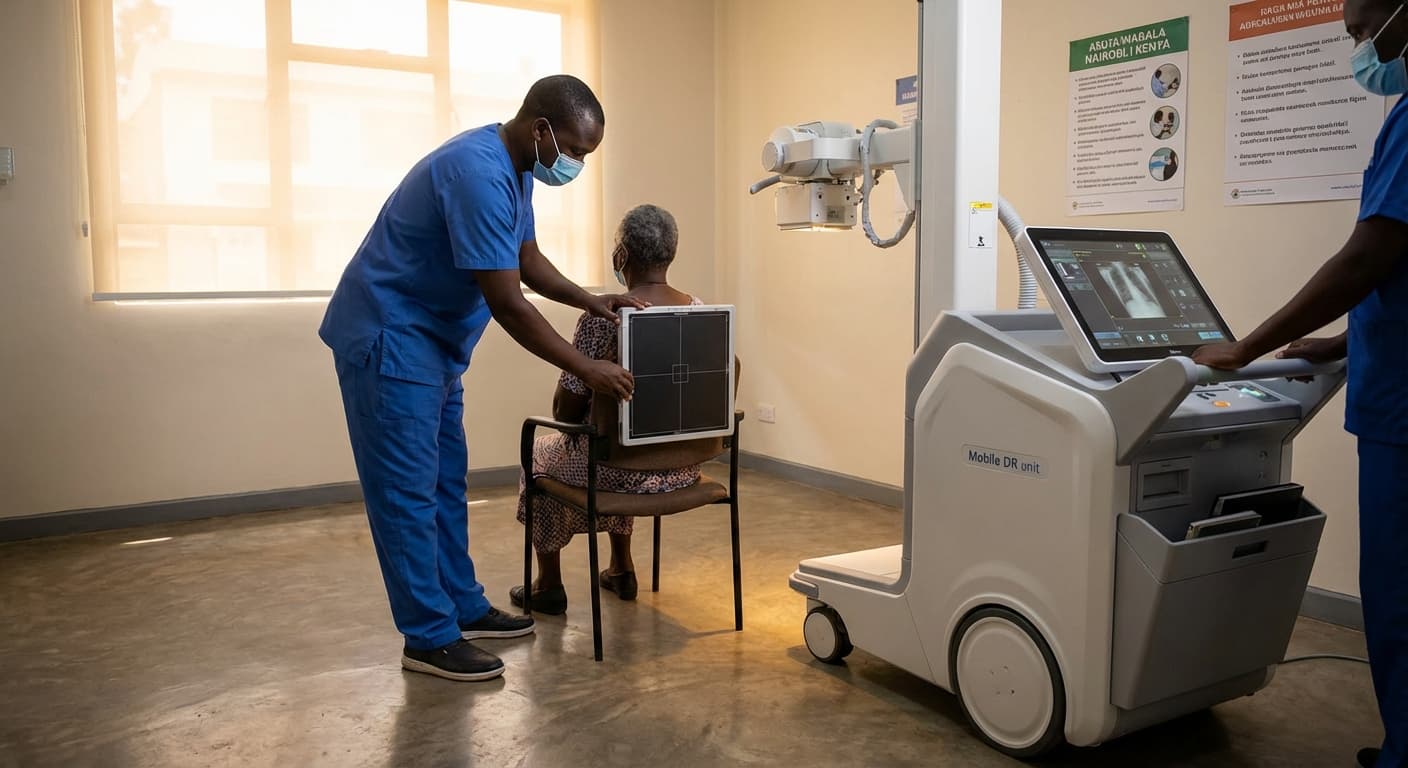
Digital X-Ray Installation Service (Mobile DR) in Tanzania
Engineering Excellence & Technical Support
Digital X-Ray Installation Service (Mobile DR) High-standard technical execution following OEM protocols and local regulatory frameworks.
Rapid Deployment & Field Readiness
Our expert technicians ensure swift mobile DR unit installation and calibration across Tanzania, minimizing downtime and maximizing your diagnostic capability in remote or challenging locations.
Robust System Integration & Compliance
We specialize in seamless integration of mobile DR systems with existing hospital infrastructure, adhering to all local Tanzanian regulatory standards for safe and efficient operation.
Comprehensive On-Site Training & Support
Beyond installation, we provide thorough, hands-on training for your medical staff on the mobile DR system's operation, maintenance, and troubleshooting, ensuring long-term operational excellence.
What Is Digital X-ray Installation Service (Mobile Dr) In Tanzania?
Digital X-ray Installation Service (Mobile DR) in Tanzania refers to the comprehensive process of deploying and configuring digital radiography (DR) systems within mobile units designed for flexible medical imaging operations. This service encompasses the physical installation of the DR detector, X-ray generator, control console, image acquisition software, and associated networking components within a vehicle. It ensures the system is operational, calibrated, and integrated to facilitate immediate radiographic examinations in various settings, particularly where fixed infrastructure is unavailable or impractical. The service also includes essential training for radiographers and technicians on system operation, maintenance, and image management, as well as initial quality assurance testing.
| Recipient Category | Specific Needs Addressed | Typical Use Cases |
|---|---|---|
| Rural Healthcare Facilities | Access to advanced diagnostic imaging where fixed X-ray units are absent or outdated. | On-site chest X-rays for tuberculosis screening; basic fracture diagnosis in remote clinics; initial trauma assessments. |
| Mobile Health Clinics and Outreach Programs | Extending diagnostic capabilities to underserved populations and community health initiatives. | Screening programs for lung diseases, orthopedic evaluations in community settings, diagnostic imaging during public health campaigns. |
| Emergency Response and Disaster Management Teams | Rapid deployment of imaging services in disaster-affected areas or during mass casualty incidents. | Trauma imaging at accident sites; on-site assessment of injuries in emergency shelters; supporting field hospitals. |
| Private Healthcare Providers (Mobile Services) | Offering specialized mobile diagnostic services to patients at home or in business locations. | Post-operative follow-up imaging; imaging for patients with mobility issues; providing diagnostic services to industrial sites. |
| Government Health Ministries and Agencies | Facilitating national health programs and improving the reach of diagnostic services. | Implementing nationwide screening initiatives (e.g., for infectious diseases); supporting public health surveillance; equipping mobile medical units for national campaigns. |
Key Components of Mobile DR Installation Service:
- Site Assessment and Vehicle Integration: Evaluating the mobile unit's suitability for equipment housing, power supply, and environmental conditions (temperature, humidity).
- Equipment Mounting and Interconnection: Securely installing and connecting the X-ray generator, DR detector (fixed or portable), collimator, and control workstation.
- Power Management and Conditioning: Integrating stable power sources, including vehicle-based generators and inverters, with surge protection and backup systems.
- Data Network Configuration: Establishing wired or wireless local area network (LAN) connectivity for image transfer and potential PACS (Picture Archiving and Communication System) integration.
- Software Installation and Configuration: Deploying and configuring the image acquisition software (IAS), including image processing parameters, DICOM (Digital Imaging and Communications in Medicine) compliance, and user profiles.
- Calibration and Quality Assurance (QA): Performing initial system calibration, exposure parameter optimization, and conducting QA tests to ensure image quality and diagnostic accuracy.
- Radiation Safety Compliance: Verifying adherence to local radiation safety regulations and implementing appropriate shielding and interlock mechanisms.
- User Training and Documentation: Providing comprehensive training on system operation, troubleshooting, routine maintenance, and issuing detailed technical manuals.
Who Needs Digital X-ray Installation Service (Mobile Dr) In Tanzania?
Mobile Digital Radiography (DR) installation services are crucial for enhancing diagnostic imaging capabilities across various healthcare settings in Tanzania. These services are specifically tailored for facilities seeking to upgrade their X-ray technology for improved efficiency, image quality, and patient care. The adoption of mobile DR systems allows for greater flexibility in positioning and imaging, especially for immobile patients, in emergency situations, and in remote areas where fixed X-ray units might be impractical. This makes the installation service essential for any facility aiming to modernize its radiology department.
| Department | Specific Needs Addressed by Mobile DR Installation | Benefits |
|---|---|---|
| Radiology Department | Upgrading from film-based or computed radiography (CR) to direct digital radiography (DR) for immediate image acquisition and processing. | Faster turnaround times for diagnoses, reduced radiation exposure (in some cases), improved image quality, and easier image archiving and retrieval. |
| Emergency Department | Rapid bedside imaging for trauma patients, critically ill individuals, or those unable to be transported to a fixed X-ray room. | Quicker assessment of injuries, timely treatment decisions, and improved patient outcomes in high-pressure environments. |
| Intensive Care Unit (ICU) | Imaging of intubated or ventilated patients, post-operative patients, or those with limited mobility for diagnosis of conditions like pneumonia, pneumothorax, or line placement confirmation. | Reduced patient disturbance, continuous monitoring of critical conditions, and accurate assessment without compromising patient stability. |
| Orthopedic Department | Imaging of fractures, joint assessments, and post-operative follow-ups, especially in operating rooms or patient wards. | Precise visualization of bone structures, improved surgical planning, and efficient post-treatment evaluation. |
| Pediatric Department | Comfortable and efficient imaging of children, often requiring specialized positioning and reduced scan times. | Minimized patient discomfort and anxiety, faster imaging procedures, and high-quality diagnostic images of developing anatomy. |
| Surgical Department (Operating Rooms) | Intra-operative imaging for guidance during orthopedic procedures, placement of devices, or confirmation of surgical interventions. | Enhanced surgical precision, reduced need for re-operation, and improved patient safety during complex procedures. |
| Outreach & Mobile Clinics | Deployment of imaging services to remote areas, underserved communities, or during public health campaigns where fixed infrastructure is unavailable. | Expanded access to diagnostic imaging, early detection of diseases, and improved healthcare delivery to populations with limited access. |
Target Customers and Departments for Mobile DR Installation Service in Tanzania
- Hospitals (Public & Private): Offering advanced diagnostic imaging for a wide range of medical conditions.
- District Hospitals & Regional Referral Hospitals: Upgrading from older X-ray technology to digital for improved diagnostic accuracy and workflow.
- Specialty Clinics & Diagnostic Centers: Expanding their imaging services with flexible and high-quality digital radiography.
- Rural Health Centers & Dispensaries: Providing essential imaging services in areas with limited infrastructure, leveraging the mobility of DR systems.
- Military & Police Medical Units: Ensuring immediate diagnostic capabilities for personnel in diverse operational environments.
- Research Institutions: Facilitating advanced imaging studies and data collection.
- Non-Governmental Organizations (NGOs) & Humanitarian Organizations: Deploying mobile imaging solutions for medical outreach programs and disaster relief efforts.
Digital X-ray Installation Service (Mobile Dr) Process In Tanzania
This document outlines the typical workflow for installing a Digital X-Ray (Mobile DR) system in Tanzania, from the initial customer inquiry to the successful execution of the installation. The process emphasizes clear communication, site readiness, and technical expertise to ensure a smooth and efficient deployment.
| Phase | Key Activities | Responsible Party | Deliverables/Outcomes |
|---|---|---|---|
| 1. Inquiry and Initial Assessment | 1.1. Customer expresses interest in Mobile DR system. 1.2. Initial discussion to understand specific needs, intended use cases, and budget. 1.3. Provision of preliminary product information and pricing. 1.4. Agreement on a preliminary scope of work. | Customer, Sales Team | Initial understanding of requirements, preliminary quote, agreement to proceed. |
| 2. Site Survey and Planning | 2.1. Technical team conducts a site visit to assess: - Room dimensions and layout. - Power supply availability and stability (voltage, grounding). - Network infrastructure (Wi-Fi, Ethernet). - Space for equipment placement (DR detector, workstation, potentially UPS). - Radiation safety considerations (if applicable, though less critical for portable DR). 2.2. Detailed technical specifications are confirmed. 2.3. A comprehensive installation plan, including timelines and resource allocation, is developed. 2.4. Customer reviews and approves the installation plan. | Technical Team, Customer | Detailed site assessment report, confirmed technical specifications, approved installation plan. |
| 3. Pre-Installation Preparations | 3.1. Procurement and delivery of the Mobile DR system and all necessary accessories. 3.2. Customer prepares the site according to the installation plan (e.g., ensuring power outlets are ready, Wi-Fi is functional). 3.3. Pre-installation checks of the Mobile DR system components at the supplier's facility. | Supplier, Customer | Delivered equipment, prepared site, confirmed system readiness. |
| 4. Installation and Configuration | 4.1. On-site arrival of the technical installation team. 4.2. Physical installation of the Mobile DR system components. 4.3. Connection to power and network infrastructure. 4.4. Installation and configuration of the DR detector, acquisition workstation, and PACS/RIS integration software (if applicable). 4.5. Initial software setup and basic configuration. | Technical Installation Team | Physically installed and powered Mobile DR system, configured software. |
| 5. Testing and Validation | 5.1. Performance testing of the DR detector (image quality, acquisition speed). 5.2. Network connectivity and data transfer testing. 5.3. Image acquisition and processing workflow validation. 5.4. Integration testing with existing hospital systems (PACS/RIS) if applicable. 5.5. Basic user functional testing with sample images. | Technical Team, Customer (Radiographer/Technician) | Validated system performance, successful data transfer, confirmation of core functionalities. |
| 6. Training and Handover | 6.1. Comprehensive training for radiographers and technicians on: - System operation and workflow. - Image acquisition techniques. - Basic troubleshooting. - Radiation safety protocols. 6.2. Demonstration of advanced features. 6.3. Formal handover of the system to the customer, including documentation and warranty information. 6.4. Customer signs off on the installation and training completion. | Technical Training Team, Customer | Trained personnel, completed handover documentation, customer sign-off. |
| 7. Post-Installation Support | 7.1. Remote and/or on-site technical support for initial operational issues. 7.2. Warranty period support and maintenance. 7.3. Follow-up communication to ensure customer satisfaction and address any emerging needs. | Support Team, Customer | Resolved initial issues, ongoing system availability, customer satisfaction. |
Digital X-Ray (Mobile DR) Installation Service Workflow in Tanzania
- Phase 1: Inquiry and Initial Assessment
- Phase 2: Site Survey and Planning
- Phase 3: Pre-Installation Preparations
- Phase 4: Installation and Configuration
- Phase 5: Testing and Validation
- Phase 6: Training and Handover
- Phase 7: Post-Installation Support
Digital X-ray Installation Service (Mobile Dr) Cost In Tanzania
Installing a Digital X-Ray system, specifically a Mobile DR (Digital Radiography) unit, in Tanzania involves several cost components. The overall price can vary significantly based on the chosen equipment, vendor, installation complexity, and additional services required. This document aims to provide an estimated cost range and outline the key factors influencing the pricing in Tanzanian Shillings (TZS).
| Component/Service | Estimated Price Range (TZS) | Notes |
|---|---|---|
| Mobile DR Unit (Basic to Mid-Range) | 150,000,000 - 300,000,000 | Excludes import duties and taxes. Varies greatly by brand and specifications. |
| Mobile DR Unit (High-End/Advanced) | 300,000,000 - 600,000,000+ | Includes advanced features, superior image quality, and potentially larger detector sizes. |
| Installation & Commissioning | 5,000,000 - 20,000,000 | Depends on site complexity and vendor. |
| User Training | 3,000,000 - 15,000,000 | For radiographers, technicians, and IT staff. Duration and comprehensiveness are key. |
| Software/PACS Integration (Initial) | 5,000,000 - 25,000,000 | If integration with existing systems or new PACS is required. |
| Warranty (1-2 Years Included) | Included in unit price generally. | |
| Extended Warranty/Service Plan (Annual) | 10,000,000 - 30,000,000+ | Covers maintenance and potential repairs after the initial warranty. |
| Shipping & Import Duties/Taxes (Estimated) | 20% - 40% of CIF value | Can significantly increase the total cost if not factored in by vendor. |
| Site Preparation (if needed) | Variable | Minor electrical work or space modifications. |
Key Pricing Factors for Mobile DR Installation in Tanzania
- 1. Mobile DR Unit Cost: This is the most substantial component. Prices vary based on the manufacturer, brand reputation, imaging capabilities (e.g., resolution, detector size, wireless vs. wired), and specific features (e.g., built-in patient positioning aids, integrated PACS viewer). High-end models with advanced features will command a premium.
- 2. Vendor and Distributor Margins: The price is influenced by the markups added by the local distributor or the direct sales representative of the manufacturer. Different vendors may have varying pricing structures and negotiation flexibility.
- 3. Installation and Commissioning Fees: This covers the physical setup of the unit, including any necessary electrical work, calibration, and initial testing to ensure optimal performance. The complexity of the installation site can also impact these fees.
- 4. Training: Comprehensive training for radiographers, technicians, and IT staff is crucial for the effective operation and maintenance of the Mobile DR system. The duration and scope of training influence the cost.
- 5. Software and PACS Integration: While some units may come with basic software, integrating with existing Picture Archiving and Communication Systems (PACS) or implementing a new PACS can incur additional costs for software licenses, configuration, and integration services.
- 6. Warranty and Maintenance Agreements: The length and scope of the warranty period and any post-warranty maintenance service contracts will add to the initial investment. Extended warranties and comprehensive service plans offer peace of mind but at a higher cost.
- 7. Shipping and Import Duties/Taxes: If the Mobile DR unit is imported, shipping costs, customs duties, and Value Added Tax (VAT) will be added to the landed cost.
- 8. Site Preparation: Depending on the existing infrastructure of the clinic or hospital, there might be a need for minor renovations or upgrades to accommodate the Mobile DR unit, such as ensuring adequate power supply and space.
- 9. Optional Accessories and Upgrades: Any additional accessories, such as specialized detectors, mobile workstations, or advanced image processing software, will increase the overall cost.
Affordable Digital X-ray Installation Service (Mobile Dr) Options
Exploring affordable digital X-ray installation services, particularly for Mobile DR (Digital Radiography) systems, involves understanding various pricing models and implementing smart cost-saving strategies. This guide aims to demystify the process, focusing on value bundles and practical tips to keep your investment manageable without compromising quality.
| Cost-Saving Strategy | Description | Potential Savings |
|---|---|---|
| Bundle Deals & Package Pricing | Many vendors offer pre-configured bundles that include the DR detector, X-ray generator, workstation, and basic installation at a reduced combined price compared to purchasing individually. | 10-20% (on bundled hardware and software) |
| Refurbished or Certified Pre-Owned Equipment | Purchasing high-quality, refurbished DR systems from reputable dealers can significantly lower upfront costs. Ensure they come with a warranty. | 30-50% (on hardware) |
| Negotiate Installation & Training Packages | Don't accept the initial quote for installation and training at face value. Negotiate for bundled training hours or consider phased installation if budget is tight. | 5-15% (on services) |
| Phased Implementation | If a full DR setup is beyond immediate budget, consider installing the detector and workstation first and upgrading the X-ray generator later, or vice-versa. This spreads the cost over time. | Deferred payments, but potentially higher long-term cost if upgrades are expensive. |
| Leasing Options | Leasing equipment can offer lower upfront costs and predictable monthly payments, allowing you to access modern technology without a large capital outlay. | Spread cost, but overall cost may be higher than purchasing outright. |
| Explore Government Grants & Rebates | Investigate if there are any local, state, or federal grants, or manufacturer rebates available for upgrading to digital radiography, especially for rural or underserved areas. | Can be substantial, depending on program availability. |
| Consider Vendor-Provided Financing | Some manufacturers and distributors offer in-house financing, which might be more flexible than traditional bank loans and could include installation costs. | May offer competitive rates or tailored payment plans. |
| Prioritize Essential Features | Focus on the core functionalities you need. Avoid paying for advanced software features or detectors that won't be utilized in your daily workflow. | 5-10% (on unnecessary features) |
Key Components of an Affordable Digital X-Ray Installation Service
- System Acquisition (DR Detector, X-ray Generator, Workstation)
- Installation & Integration
- Calibration & Testing
- Basic Training
- Warranty & Support
Verified Providers In Tanzania
In Tanzania's evolving healthcare landscape, identifying reliable and accredited medical service providers is paramount for individuals and organizations seeking quality care. Franance Health stands out as a beacon of trust and excellence, meticulously vetting and credentialing providers to ensure they meet the highest standards of medical practice, patient safety, and ethical conduct. This commitment to rigorous verification makes Franance Health credentials a powerful indicator of superior healthcare.
| Credentialing Aspect | Franance Health's Approach | Benefit to Patients |
|---|---|---|
| Clinical Competence | Verification of educational background, specialized training, and documented experience. | Ensures access to highly skilled and knowledgeable medical professionals. |
| Operational Excellence | Assessment of facility management, equipment maintenance, and adherence to hygiene standards. | Guarantees a safe, clean, and well-equipped environment for treatment. |
| Patient Experience | Evaluation of patient feedback mechanisms, complaint resolution processes, and communication protocols. | Promotes a patient-centered approach with clear communication and effective care delivery. |
| Regulatory Compliance | Confirmation of adherence to all relevant Tanzanian health regulations and licensing requirements. | Provides peace of mind that providers operate legally and ethically. |
| Technological Integration | Assessment of the adoption of modern medical technologies and information systems where applicable. | Access to up-to-date diagnostic and treatment capabilities. |
Why Franance Health Credentials Represent the Best Choice:
- Uncompromising Quality Standards: Franance Health employs a multi-faceted vetting process that goes beyond basic licensing. It assesses clinical expertise, adherence to evidence-based practices, facility infrastructure, and patient outcome metrics.
- Patient Safety First: A core tenet of Franance Health's credentialing is the emphasis on patient safety protocols, infection control measures, and a commitment to minimizing medical errors.
- Ethical Practice Assurance: Providers accredited by Franance Health are held to strict ethical codes, ensuring transparency, informed consent, and respectful patient interactions.
- Continuous Improvement Focus: Franance Health doesn't just accredit and forget. Their process involves ongoing monitoring and evaluation to ensure providers maintain and enhance their standards over time.
- Streamlined Access to Trusted Care: By presenting a curated list of verified providers, Franance Health simplifies the often-complex task of finding dependable healthcare in Tanzania, saving patients time and reducing anxiety.
- Enhanced Reputation and Trust: Earning Franance Health credentials signifies a provider's dedication to excellence, thereby enhancing their reputation among patients and the wider healthcare community.
Scope Of Work For Digital X-ray Installation Service (Mobile Dr)
This Scope of Work (SOW) outlines the requirements for the installation of a Mobile Digital Radiography (DR) system at [Client Facility Name/Location]. The service includes the delivery, setup, integration, testing, and training for the Mobile DR unit. The objective is to ensure the Mobile DR system is fully operational and meets all technical specifications and client requirements for efficient diagnostic imaging.
| Phase | Activity | Deliverables | Standard Specifications / Requirements |
|---|---|---|---|
| Site Survey & Assessment | Site readiness report, network connectivity assessment, power assessment, space verification. | Adequate space for unit maneuverability, stable power supply (UPS recommended), network port availability, secure Wi-Fi connectivity (if applicable). |
| System Delivery & Unpacking | Confirmation of all components received as per packing list, visual inspection for transit damage. | All hardware components, accessories, and documentation present and intact. | |
| Hardware Setup & Assembly | Physical installation of DR detector, X-ray generator, control console, and mobile cart. | Proper alignment, secure mounting, and cable management as per manufacturer guidelines. |
| Software Installation & Configuration | Installation of DR acquisition software, image processing modules, and viewer. | Compatibility with existing operating systems, driver installation, license activation. | |
| PACS/RIS Integration | Configuration of DICOM send/receive, HL7 interface (if applicable), patient data acquisition. | Successful transmission and reception of images and patient data to/from PACS/RIS, adherence to DICOM standards. | |
| Network Configuration | Connection to hospital network, IP address assignment, firewall configuration. | Secure network connection, stable communication with PACS/RIS, minimal latency. | |
| System Calibration & QA | Performance checks of X-ray generator, detector sensitivity, image quality parameters. | Acceptable Signal-to-Noise Ratio (SNR), Contrast-to-Noise Ratio (CNR), spatial resolution within manufacturer specifications. |
| Image Quality Assessment | Acquisition of test images (e.g., phantom scans) and comparison to benchmarks. | Sharpness, contrast, artifact-free images, accurate exposure indices. | |
| Workflow Testing | Simulated patient studies, examination protocol execution, image review process. | Smooth workflow from patient registration to image archiving, efficient acquisition and processing times. | |
| User Acceptance Testing (UAT) | Client validation of all functionalities and performance against agreed-upon criteria. | Sign-off on UAT by authorized client representative. | |
| Operator Training | Hands-on training for radiographers on system operation, acquisition techniques, troubleshooting. | Competency demonstration in system operation and image acquisition. |
| Radiologist/Physician Training | Training on image review, post-processing tools, PACS integration. | Understanding of image interpretation features and workflow. | |
| IT Support Training | Training on basic system maintenance, network troubleshooting, software updates. | Ability to perform routine IT checks and basic troubleshooting. | |
| Documentation & Handover | Delivery of user manuals, technical manuals, training materials, installation report. | Complete and accurate documentation provided, formal handover of the system. |
Key Objectives
- Seamless integration of the Mobile DR system with the existing Picture Archiving and Communication System (PACS) and Radiology Information System (RIS).
- Verification and validation of the system's performance against defined technical specifications.
- Comprehensive user training for radiologists, radiographers, and IT support staff.
- Ensuring compliance with all relevant regulatory and safety standards.
Service Level Agreement For Digital X-ray Installation Service (Mobile Dr)
This Service Level Agreement (SLA) outlines the guaranteed response times and uptime for the Digital X-Ray Installation Service (Mobile DR) provided by [Your Company Name] to [Client Name]. This SLA is an addendum to the Master Service Agreement (MSA) dated [Date of MSA].
| Service Component | Uptime Guarantee | Response Time Guarantee (During Business Hours) | Resolution Time Target (During Business Hours) |
|---|---|---|---|
| Mobile DR System Availability (Post-Installation) | 99.5% (excluding scheduled maintenance) | N/A (This SLA focuses on installation service response) | N/A (This SLA focuses on installation service response) |
| Installation Service Support - Initial Contact (for installation-related queries) | N/A | Within 2 Business Hours | N/A (Focus is on initial engagement) |
| Installation Service Support - On-site Technician Dispatch (for critical installation issues requiring physical presence) | N/A | Within 4 Business Hours (from confirmation of critical issue) | Target: Within 8 Business Hours (for initial assessment and potential resolution) |
| Remote Troubleshooting & Guidance (for installation-related issues) | N/A | Within 1 Business Hour (for acknowledgment and initial assessment) | Target: Within 4 Business Hours (for guidance and potential resolution) |
Key Definitions
- Installation Service: Refers to the professional services provided for the setup, configuration, and initial testing of the Mobile DR system.
- Downtime: Means the period during which the Mobile DR system is unavailable to the client for its intended use, excluding scheduled maintenance.
- Scheduled Maintenance: Planned maintenance activities that are communicated to the client in advance.
- Business Hours: [Specify your business hours and days, e.g., Monday to Friday, 8:00 AM to 5:00 PM local time, excluding public holidays].
- Emergency: A critical failure of the Mobile DR system that renders it completely inoperable and impacts patient care.
- Critical Issue: A significant malfunction that degrades system performance or functionality but does not render the system completely inoperable.
Frequently Asked Questions

Ready when you are
Let's scope your Digital X-Ray Installation Service (Mobile DR) in Tanzania project in Tanzania.

Scaling healthcare logistics and technical systems across the entire continent.