
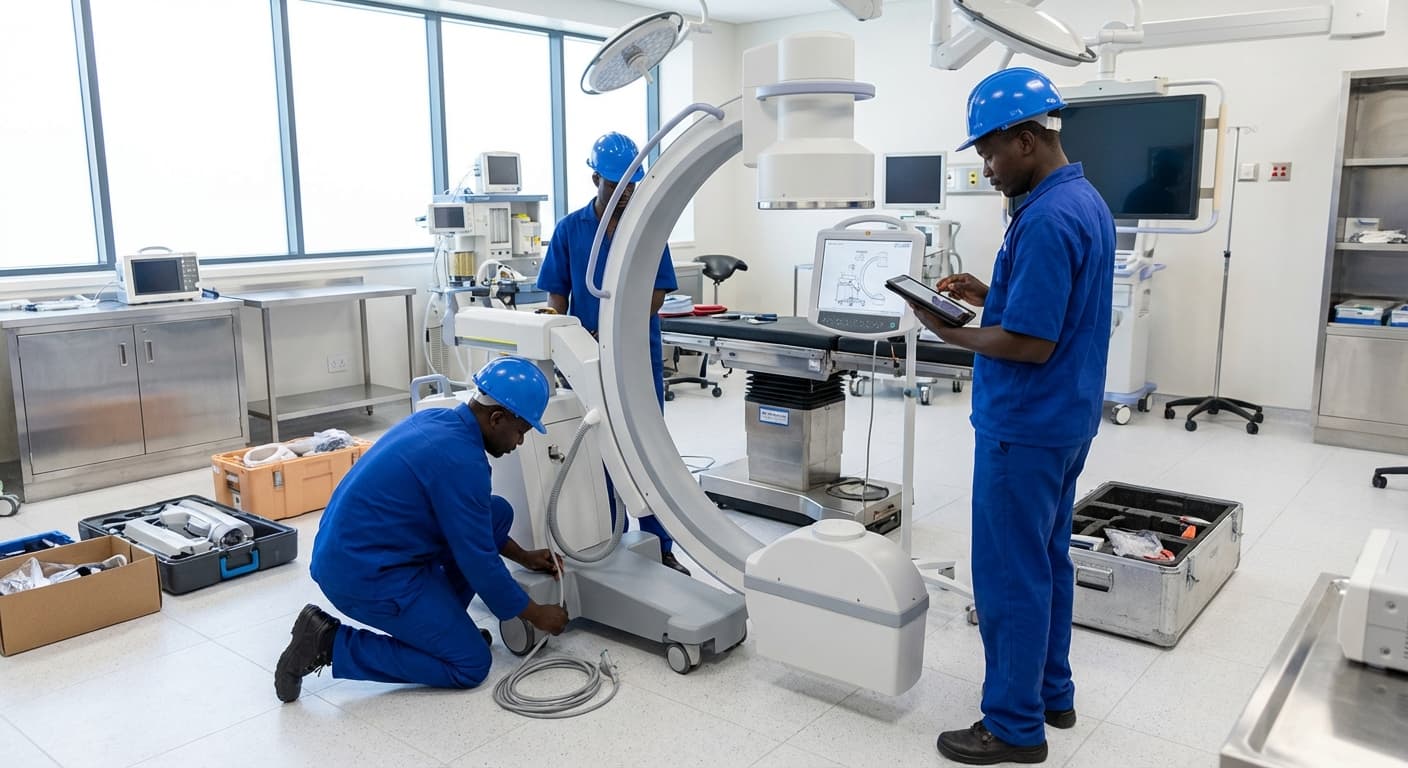
C-Arm Installation Service in Tanzania
Engineering Excellence & Technical Support
C-Arm Installation Service High-standard technical execution following OEM protocols and local regulatory frameworks.
Precision Installation for Optimal Imaging
Our C-Arm installation service in Tanzania focuses on meticulous alignment and calibration, ensuring your medical imaging equipment delivers unparalleled diagnostic accuracy and patient safety from day one.
Adherence to International Standards & Local Regulations
We guarantee C-Arm installations that meet rigorous international safety and performance standards, while also ensuring full compliance with all relevant Tanzanian healthcare regulations and guidelines.
Rapid Deployment & Expert Post-Installation Support
Leveraging our local expertise, we offer swift C-Arm installation across Tanzania, minimizing downtime and providing comprehensive post-installation training and support for seamless integration into your clinical workflow.
What Is C-arm Installation Service In Tanzania?
C-Arm installation service in Tanzania refers to the professional process of setting up, calibrating, and integrating a C-arm imaging system within a healthcare facility. This involves ensuring the C-arm is correctly positioned, connected to power and imaging networks, and functioning optimally according to the manufacturer's specifications and relevant regulatory standards. The service aims to provide a safe, efficient, and reliable imaging solution for diagnostic and interventional procedures. It encompasses site preparation, physical installation, electrical and network integration, software configuration, initial testing, user training, and documentation.
| Who Needs C-Arm Installation Service? | Typical Use Cases in Tanzania | |||||
|---|---|---|---|---|---|---|
| Hospitals and Medical Centers: Both public and private healthcare facilities requiring advanced imaging capabilities for surgical and diagnostic procedures. | Orthopedic Surgery: Intraoperative imaging for fracture reduction, joint replacements, and spinal procedures. | Cardiology Departments: Real-time imaging during catheterizations, angioplasties, and pacemaker insertions. | Pain Management Clinics: Guiding injections for epidural steroid injections, nerve blocks, and facet joint injections. | Emergency Departments: Rapid imaging for trauma assessment and fracture diagnosis. | Surgical Theaters: Providing real-time visualization during various surgical interventions. | Outpatient Clinics: For specialized diagnostic imaging in fields like urology and gastroenterology. |
Key Components of C-Arm Installation Service
- Site Assessment and Preparation: Evaluating the installation space for power requirements, radiation shielding, structural integrity, and accessibility.
- Physical Placement and Mounting: Positioning the C-arm unit in its designated location, ensuring proper alignment and stability.
- Electrical Connection and Power Supply: Connecting the C-arm to the facility's electrical grid, including grounding and surge protection.
- Network Integration (if applicable): Connecting the C-arm to Picture Archiving and Communication Systems (PACS) or other hospital information systems (HIS) for image management and transfer.
- Software Configuration and Calibration: Installing and configuring the C-arm's operating software, performing image quality adjustments, and calibrating detectors and X-ray generators.
- Safety Checks and Radiation Protection Verification: Conducting rigorous safety checks, including radiation leakage tests and ensuring compliance with local radiation safety regulations.
- System Testing and Performance Validation: Performing comprehensive diagnostic tests to verify all functions, image acquisition parameters, and performance metrics.
- User Training and Familiarization: Providing training to medical staff on the operation, maintenance, and safety protocols of the C-arm system.
- Documentation and Handover: Providing comprehensive documentation, including installation reports, test results, user manuals, and warranty information.
Who Needs C-arm Installation Service In Tanzania?
C-arm installation services are a critical component for healthcare facilities in Tanzania looking to upgrade or establish advanced imaging capabilities. These specialized X-ray systems are indispensable for real-time visualization during a wide range of medical procedures. Ensuring proper, safe, and efficient installation is paramount to maximizing the benefits of this technology, guaranteeing accuracy, patient safety, and operational efficiency.
| Department | Procedure Examples Requiring C-Arm | Key Benefits of Proper Installation |
|---|---|---|
| Orthopedics | Fracture reduction and fixation, joint replacement surgery, spinal surgery, arthroscopy | Accurate placement of implants, real-time monitoring of bone alignment, reduced fluoroscopy time for patients and staff. |
| Cardiology / Interventional Cardiology | Angiography, angioplasty, stent placement, pacemaker implantation, electrophysiology studies | Precise navigation of catheters and guidewires, real-time visualization of blood flow, improved procedural outcomes. |
| Pain Management | Epidural steroid injections, nerve blocks, facet joint injections | Accurate needle placement into specific anatomical targets, minimizing risks of complications. |
| Urology | Ureteral stent placement, stone removal, diagnostic imaging for urinary tract abnormalities | Improved visualization of urinary tract structures, precise guidance for instrumentation. |
| Gastroenterology / Endoscopy | ERCP (Endoscopic Retrograde Cholangiopancreatography), interventional endoscopic procedures | Real-time imaging for guiding endoscopic instruments and visualizing bile ducts and pancreatic ducts. |
| General Surgery | Placement of central venous catheters, drainage procedures, foreign body removal | Enhanced visualization during minimally invasive procedures, improved accuracy in catheter and drain placement. |
| Emergency Medicine | Trauma assessment, fracture identification, procedural guidance in critical situations | Rapid and accurate diagnosis in emergency settings, enabling prompt treatment decisions. |
| Anesthesiology | Regional anesthesia blocks, placement of epidural catheters | Precise needle guidance to target nerves, enhancing safety and efficacy of anesthesia. |
Target Customers and Departments for C-Arm Installation Services in Tanzania:
- Hospitals (Public and Private): Ranging from large tertiary care centers to smaller district hospitals, all facilities performing or planning to perform surgical and interventional procedures.
- Specialized Clinics and Medical Centers: Institutions focusing on specific surgical specialties or diagnostic imaging.
- University Teaching Hospitals: Integral for training medical professionals and conducting research, requiring state-of-the-art equipment.
- Government Health Initiatives and Programs: Organizations involved in expanding access to advanced medical diagnostics and treatments across the country.
- International Aid Organizations and NGOs: Those supporting the development of healthcare infrastructure in Tanzania.
- Veterinary Hospitals (for advanced imaging): While primarily for human medicine, some specialized veterinary practices may utilize C-arms for complex diagnostic imaging.
- Research and Development Institutions: Facilities involved in medical research requiring imaging capabilities.
C-arm Installation Service Process In Tanzania
This document outlines the standard process for C-Arm installation services in Tanzania, from the initial customer inquiry to the final execution and handover. Our aim is to provide a clear, efficient, and transparent workflow to ensure successful and timely installation of your C-Arm equipment.
| Phase | Key Activities | Customer Involvement | Service Provider Role | Estimated Timeline (Tanzania Specific Considerations) |
|---|---|---|---|---|
| Customer expresses interest, provides C-Arm model details, and specifies installation location and any unique requirements. Initial discussion to understand technical needs and budget. | Provide C-Arm details, location, and specific needs. | Respond to inquiry, gather initial information, schedule preliminary consultation. | 1-3 Business Days (response time) |
| On-site visit to assess the installation area. This includes checking power supply, ventilation, space, weight bearing capacity, radiation shielding requirements, and network connectivity. Detailed site plan created. | Facilitate access to the installation site, provide site blueprints if available, answer questions about the facility. | Conduct thorough site assessment, identify potential challenges, develop an installation plan. | 2-5 Business Days (depending on site complexity and travel) |
| Based on the site survey, a detailed quotation is prepared outlining all costs (equipment, labor, materials, travel). A formal contract is drafted and agreed upon by both parties. | Review quotation, negotiate terms, sign the installation contract. | Prepare accurate quotation, draft contract, obtain customer signature. | 2-4 Business Days (after site survey) |
| Procurement of any necessary materials, coordination of delivery of the C-Arm (if not already on-site), and scheduling of the installation team. Consideration for Tanzanian import regulations if applicable. | Confirm availability for installation dates. Ensure site is ready. | Arrange for equipment/material delivery, book engineers, confirm installation dates. | Varies (can be concurrent with contract signing, contingent on delivery timelines and engineer availability) |
| Ensuring the installation area is prepared according to the site plan (e.g., any minor structural modifications, ensuring power is accessible, securing necessary permits if any). | Ensure the designated installation area is cleared and ready as per the site plan. | Communicate specific preparation requirements to the customer. | Concurrent with logistics/scheduling, customer responsibility |
| The installation team arrives at the site. Unpacking, physical setup, electrical connections, network integration, and initial system configuration of the C-Arm. | Provide access to the installation site, be present for key stages of installation, address any immediate concerns. | Perform physical installation, connect power and network, configure software settings. | 2-5 Business Days (depending on C-Arm complexity and site readiness) |
| Thorough testing of all C-Arm functions, imaging quality checks, and calibration according to manufacturer specifications and local medical imaging standards. Radiation safety checks are paramount. | Observe testing procedures, confirm functionality as per expectations. | Conduct comprehensive tests, perform calibration, ensure all safety features are operational. | 1-2 Business Days (concurrent with or immediately after installation) |
| Hands-on training for medical staff on the operation, basic maintenance, and safety protocols of the C-Arm. Training materials are provided. | Ensure relevant staff attend training, actively participate, and ask questions. | Deliver comprehensive training sessions, provide user manuals and support documentation. | 1-2 Business Days (typically follows successful testing) |
| Final system check, documentation handover (installation reports, calibration certificates, warranty information), and confirmation of customer satisfaction. Discuss ongoing maintenance and support options. | Review and sign off on installation completion, confirm understanding of warranty and support. | Provide all necessary documentation, confirm customer acceptance, offer ongoing support contract. | 1 Business Day (finalization) |
C-Arm Installation Service Process Workflow
- Initial Inquiry & Needs Assessment
- Site Survey & Planning
- Quotation & Contract Agreement
- Logistics & Scheduling
- Pre-Installation Preparation
- On-Site Installation & Configuration
- Testing & Calibration
- User Training
- Post-Installation Support & Handover
C-arm Installation Service Cost In Tanzania
The cost of C-arm installation services in Tanzania can vary significantly due to several factors, impacting the overall investment for medical facilities. These factors include the complexity of the installation, the specific model and features of the C-arm unit, the geographic location within Tanzania, the need for specialized infrastructure, and the chosen service provider. Understanding these elements is crucial for accurate budgeting and planning.
The installation process typically involves site preparation, the physical mounting of the C-arm, integration with existing imaging systems and networks, calibration, and comprehensive testing. The duration of the installation also plays a role in the final cost, with more intricate setups requiring more man-hours. Furthermore, any necessary modifications to the operating room or X-ray suite, such as reinforced flooring, radiation shielding, or specific electrical and ventilation upgrades, will add to the expense. The level of training provided to the medical staff on operating and maintaining the C-arm is another component that influences the total service cost. Reputable service providers often offer tiered training packages to cater to different institutional needs.
| Factor | Description | Estimated Cost Range (TZS - Tanzanian Shilling) |
|---|---|---|
| Basic C-Arm Installation | Standard setup for a new or well-prepared space, includes physical mounting, basic calibration, and initial testing. | 3,000,000 - 7,000,000 TZS |
| Complex C-Arm Installation | Requires significant site preparation, potential structural modifications, advanced integration with multiple systems (PACS, EMR), and extended calibration. | 7,000,000 - 15,000,000+ TZS |
| Site Preparation & Infrastructure Upgrades | Includes minor electrical work, reinforced flooring, or basic ventilation. More extensive upgrades (lead shielding, etc.) would be additional. | 1,000,000 - 5,000,000 TZS (variable) |
| Radiation Shielding Consultation & Installation | Expert assessment and implementation of necessary lead lining or other shielding measures. | 2,000,000 - 10,000,000+ TZS (highly variable based on room size and requirements) |
| Integration with PACS/EMR | Connecting the C-arm to digital imaging archives and electronic medical records systems. | 500,000 - 2,000,000 TZS per integration |
| Comprehensive Training Package | On-site training for multiple staff members covering operation, basic maintenance, and troubleshooting. | 1,000,000 - 3,000,000 TZS |
| Emergency or Rush Installation | Expedited service requiring overtime or immediate deployment of technicians. | Additional 20% - 50% surcharge on standard rates |
Key Pricing Factors for C-Arm Installation in Tanzania
- C-Arm Model and Specifications
- Installation Complexity
- Geographic Location within Tanzania
- Site Preparation and Infrastructure Requirements
- Need for Radiation Shielding
- Integration with Existing Medical Equipment/PACS
- Calibration and Testing Procedures
- Technical Support and Training Packages
- Service Provider Reputation and Experience
- Warranty and Maintenance Agreements
Affordable C-arm Installation Service Options
Installing a C-arm is a significant investment, and finding affordable installation services is crucial for healthcare facilities. This guide explores various options, value bundles, and cost-saving strategies to help you manage your C-arm installation budget effectively.
| Strategy | Description | Potential Cost Savings | Considerations |
|---|---|---|---|
| Value Bundles | Combining C-arm purchase/lease with installation, training, and maintenance. | Streamlined pricing, potential discounts for package deals. | Ensure all components are adequately priced and meet your needs. |
| Third-Party Installers | Hiring independent biomedical service companies for installation. | Often more competitive pricing than manufacturers. | Thorough vetting of experience, certifications, and reputation is critical. |
| Proactive Site Preparation | Ensuring the installation site meets all technical requirements before arrival. | Avoids costly on-site modifications, delays, and additional labor charges. | Requires detailed planning and coordination with facilities management. |
| Negotiation | Actively discussing and negotiating installation fees with providers. | Can lead to direct reductions in the overall installation cost. | Be prepared to compare quotes and understand market rates. |
| Bundling with Other Purchases | Integrating C-arm installation with the purchase of other medical equipment. | Potential for volume discounts or preferential pricing. | Requires coordination across different vendors or departments. |
Understanding Value Bundles and Cost-Saving Strategies for C-Arm Installation
- Value Bundles: These often combine C-arm purchase or lease with installation, training, and sometimes maintenance into a single package. They can offer a more predictable overall cost and streamline the procurement process.
- Manufacturer-Provided Services: Direct installation by the C-arm manufacturer or their authorized partners often ensures expertise and adherence to strict protocols. While sometimes perceived as more expensive, it can prevent costly errors and ensure optimal system performance.
- Third-Party Installation Companies: Independent biomedical service companies can offer competitive pricing for C-arm installation. It's essential to vet these companies thoroughly for experience, certifications, and customer reviews.
- Site Preparation Coordination: Proactive planning and coordination of the installation site, including power, imaging rooms, and network infrastructure, can prevent delays and unexpected on-site charges.
- Negotiating Installation Fees: Don't hesitate to negotiate installation costs, especially when bundling with C-arm purchases or when comparing quotes from multiple providers.
- Phased Installation: For larger or more complex installations, consider a phased approach if feasible. This might spread costs over time and allow for earlier, albeit partial, system utilization.
- Remote Support and Troubleshooting: Inquire about the availability and cost of remote support, which can sometimes resolve minor issues without the need for an on-site visit, saving on labor costs.
- Bundling with Other Equipment: If you are purchasing multiple pieces of medical equipment, explore if installation services can be bundled for a volume discount.
- Used or Refurbished C-arms: While not directly an installation cost-saving, purchasing a refurbished C-arm can free up budget for a higher-quality installation or other essential services.
Verified Providers In Tanzania
In Tanzania, ensuring access to quality healthcare is paramount. When seeking medical services, identifying 'Verified Providers' is crucial for patient safety and effective treatment. Franance Health stands out as a leading platform for connecting individuals with these trusted healthcare professionals. This document outlines the stringent credentialing process employed by Franance Health and explains why their verified providers represent the best choice for your healthcare needs.
| Provider Type | Key Verification Points | Benefits of Choosing Verified |
|---|---|---|
| Doctors (General Practitioners & Specialists) | Medical Council License, Degree Verification, Specialization Certification, Experience | Accurate diagnosis, effective treatment plans, access to specialized care. |
| Nurses & Midwives | Nursing Council License, Certification, Experience in specific areas (e.g., maternal care, pediatrics) | Compassionate and skilled care, support during critical health periods, safe delivery services. |
| Pharmacists & Pharmacy Technicians | Pharmacy Council License, Degree/Diploma Verification, Retail Pharmacy License | Legitimate and safe medication dispensing, professional advice on drug usage, drug interaction awareness. |
| Diagnostic Laboratories | Ministry of Health Accreditation, Quality Control Measures, Certified Technicians | Accurate and reliable test results, timely diagnosis, informed treatment decisions. |
| Hospitals & Clinics | Ministry of Health Licenses, Compliance with Health Facility Standards, Qualified Staff | Comprehensive medical services, safe and sterile environments, multidisciplinary care. |
Franance Health Credentialing Process: Ensuring Excellence
- Professional License Verification: All listed healthcare providers undergo rigorous verification of their current and valid professional licenses issued by the relevant Tanzanian regulatory bodies (e.g., Tanzania Medical Council, Tanzania Nurses and Midwives Council).
- Educational Qualification Validation: Franance Health meticulously checks and validates the educational degrees and certifications of its providers, ensuring they have received accredited training from recognized institutions.
- Experience and Specialization Confirmation: Beyond basic qualifications, we confirm the practical experience and areas of specialization of each provider, matching them with the services they offer.
- Reputation and Performance Review: We conduct thorough background checks and solicit feedback to ensure a consistent track record of patient satisfaction and ethical practice.
- Continuing Professional Development (CPD) Monitoring: To ensure providers remain up-to-date with the latest medical advancements and best practices, Franance Health monitors their adherence to mandatory CPD requirements.
- Background Checks and Criminal Record Screening: As an added layer of security, comprehensive background checks are performed to ensure the integrity and safety of our verified providers.
Scope Of Work For C-arm Installation Service
This Scope of Work (SOW) outlines the services required for the professional installation of a C-Arm imaging system. It details the technical deliverables, standard specifications, and responsibilities of all parties involved to ensure a safe, efficient, and compliant installation. This SOW applies to new C-Arm system installations, including all necessary hardware, software, and initial configuration.
| Category | Technical Deliverables | Standard Specifications / Requirements |
|---|---|---|
| Site Preparation | Confirmation of adequate space, power, and network connectivity. | Site survey report detailing space, ceiling height, floor load capacity, environmental conditions (temperature, humidity), and radiation shielding requirements. Power requirements (voltage, amperage, dedicated circuits, UPS if specified). Network connectivity (LAN ports, IP address allocation, firewall rules if applicable). |
| System Unpacking and Inspection | Careful unpacking and inspection of all C-Arm components. | Visual inspection for any shipping damage. Verification of all listed parts against the packing list. Documentation of any discrepancies or damages with photographic evidence. |
| Physical Installation | Positioning and assembly of the C-Arm system. | Accurate placement of the C-Arm, X-ray source, detector, workstation, and any associated accessories according to manufacturer guidelines and site layout. Secure mounting and alignment of all components. Cable management for a clean and safe installation. |
| Electrical Connections | Connection of the C-Arm system to the power supply. | Adherence to local electrical codes and manufacturer specifications. Use of appropriate connectors and grounding. Verification of power stability. |
| Network Integration | Connection and configuration of the C-Arm to the hospital network. | Successful network connectivity to PACS, RIS, or other hospital information systems as specified. Verification of data transmission protocols (e.g., DICOM). Firewall configuration if required. |
| Software Installation & Configuration | Installation and initial configuration of system software. | Loading of the latest stable software version. Configuration of user profiles, imaging protocols, and any specific departmental settings. Integration with existing IT infrastructure. |
| System Testing & Calibration | Performance and safety testing of the C-Arm system. | Full system diagnostics and functional tests. Image quality assessment and calibration. Radiation output verification and safety checks (e.g., collimator alignment, dose rate linearity). Compliance with IEC 60601 and other relevant standards. |
| Radiation Safety Compliance | Verification of radiation safety measures and interlocks. | Confirmation of lead shielding effectiveness (if applicable). Verification of interlocks and safety features. Issuance of radiation safety compliance certificate. |
| User Orientation & Handover | Basic training and handover to designated personnel. | Demonstration of key system functions, basic operation, and safety procedures. Provision of user manuals and documentation. Formal sign-off of system acceptance by the client. |
| Documentation | Provision of all installation and testing documentation. | Installation report detailing all steps performed. Calibration certificates. Test results and compliance verification reports. Site survey report. As-built diagrams (if applicable). |
Key Objectives
- Successful and safe installation of the C-Arm system in the designated location.
- Verification of all system components and their proper functioning.
- Completion of all required testing and calibration according to manufacturer specifications.
- Ensuring compliance with all relevant medical device regulations and safety standards.
- Provision of basic user orientation and system handover.
- Minimizing disruption to hospital operations during the installation process.
Service Level Agreement For C-arm Installation Service
This Service Level Agreement (SLA) outlines the agreed-upon response times and uptime guarantees for the C-Arm installation service provided by [Your Company Name] (hereinafter referred to as "Provider") to [Client Company Name] (hereinafter referred to as "Client"). This SLA is an integral part of the overall service contract.
| Service Level | Description | Target Metric | Service Credit (if not met) |
|---|---|---|---|
| Critical Incident Response Time | For issues that prevent the C-Arm installation from being used at all or significantly impact its core functionality (e.g., failure to power on, inability to acquire images). | Within 2 business hours of initial notification. | 5% of monthly service fee |
| High Priority Incident Response Time | For issues that degrade the performance or functionality of the C-Arm installation but do not completely prevent its use (e.g., slow image acquisition, minor display anomalies). | Within 4 business hours of initial notification. | 3% of monthly service fee |
| Medium Priority Incident Response Time | For issues that are inconveniences or affect non-critical features (e.g., cosmetic issues, minor user interface glitches). | Within 8 business hours of initial notification. | 1% of monthly service fee |
| Uptime Guarantee | The C-Arm installation service shall be available to the Client for a minimum of 99.5% of the scheduled operational time per month. | 99.5% Monthly Uptime | 5% of monthly service fee for every 0.5% deviation below the guaranteed uptime. |
Key Service Level Objectives
- Response Time: The maximum time allowed for the Provider to acknowledge and begin addressing a reported incident.
- Resolution Time: The maximum time allowed for the Provider to resolve a reported incident, bringing the C-Arm installation service back to its agreed-upon operational status.
- Uptime Guarantee: The minimum percentage of time the C-Arm installation service is expected to be operational and available for use.
- Service Availability: Refers to the C-Arm installation service being functional and accessible to the Client as per the terms of the contract.
Frequently Asked Questions

Ready when you are
Let's scope your C-Arm Installation Service in Tanzania project in Tanzania.

Scaling healthcare logistics and technical systems across the entire continent.