
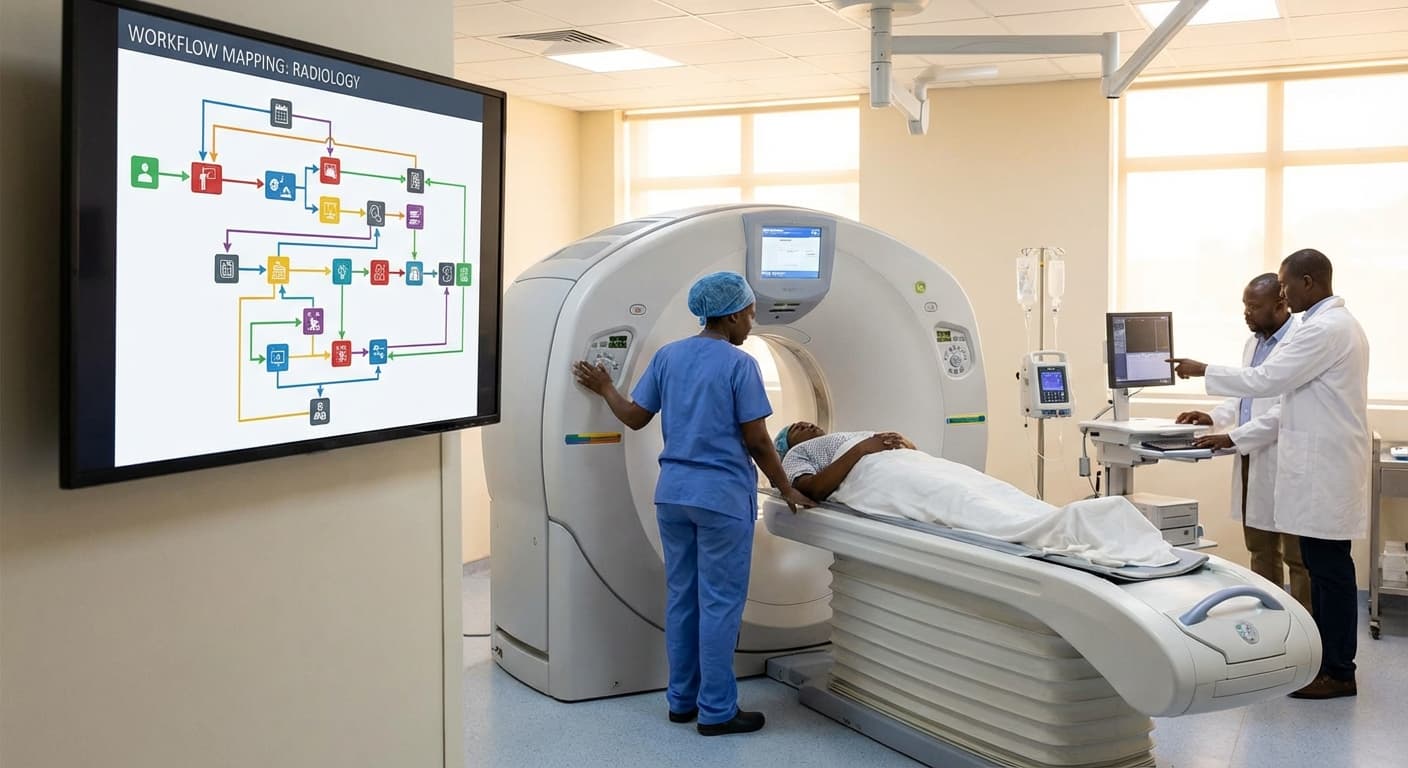
Department Workflow Mapping Service (Radiology/ICU/OT/Lab/Dialysis) in Tanzania
Engineering Excellence & Technical Support
Department Workflow Mapping Service (Radiology/ICU/OT/Lab/Dialysis) High-standard technical execution following OEM protocols and local regulatory frameworks.
Streamlined Radiology Patient Flow Optimization
Accelerated diagnostic turnaround times by mapping and optimizing the entire radiology patient journey, from referral and scheduling to imaging, reporting, and follow-up, ensuring quicker diagnoses and treatment initiation for Tanzanian patients.
Enhanced ICU Patient Handoff Protocol Enhancement
Improved critical care continuity by visually mapping and standardizing ICU patient handoff procedures, reducing information gaps and potential errors during shift changes, leading to safer and more effective patient management in Tanzanian ICUs.
Optimized Operating Theatre Resource Allocation
Reduced surgical wait times and maximized theatre utilization by mapping the end-to-end OT workflow, identifying bottlenecks in scheduling, equipment, and staffing, and implementing data-driven solutions for efficient surgical case management in Tanzanian hospitals.
What Is Department Workflow Mapping Service (Radiology/icu/ot/lab/dialysis) In Tanzania?
Department Workflow Mapping Service (Radiology/ICU/OT/Lab/Dialysis) in Tanzania refers to a systematic process of documenting, analyzing, and optimizing the sequence of tasks, information flow, and resource allocation within specific high-acuity hospital departments. This service aims to identify inefficiencies, bottlenecks, and areas for improvement to enhance patient care delivery, operational efficiency, and resource utilization. It involves a detailed examination of the 'as-is' state of a department's operations and the development of a 'to-be' state that is more streamlined and effective. The service is crucial for ensuring standardized processes, reducing errors, and improving patient outcomes in critical healthcare settings.
| Service Type | Who Needs It? | Typical Use Cases |
|---|---|---|
| Radiology Department Workflow Mapping | Radiology departments in hospitals, diagnostic imaging centers, medical facilities with imaging services. | Reducing patient wait times for scans and reports, optimizing radiologist and technologist schedules, improving PACS (Picture Archiving and Communication System) integration, streamlining contrast media management, enhancing reporting turnaround times, ensuring compliance with safety protocols. |
| ICU Department Workflow Mapping | Intensive Care Units (ICUs) in hospitals, critical care units. | Optimizing patient admission and transfer processes, improving nurse-to-patient ratios and task delegation, streamlining medication administration and monitoring, enhancing communication between multidisciplinary teams, reducing ventilator-associated complications, managing critical equipment availability and maintenance. |
| OT (Operating Theatre) Department Workflow Mapping | Operating theatres (OTs) and surgical suites in hospitals. | Improving operating room utilization, optimizing surgical scheduling and turnover times, streamlining sterilization and instrument management, enhancing pre-operative patient preparation and post-operative recovery processes, ensuring efficient surgical team coordination, minimizing surgical site infections. |
| Laboratory Department Workflow Mapping | Clinical laboratories, pathology departments, diagnostic testing facilities. | Reducing sample processing times, optimizing laboratory equipment usage and maintenance, streamlining test ordering and result reporting, improving quality control and assurance processes, managing inventory of reagents and consumables, ensuring compliance with accreditation standards. |
| Dialysis Department Workflow Mapping | Renal dialysis units, nephrology departments in hospitals. | Optimizing patient scheduling for dialysis sessions, streamlining patient preparation and monitoring during dialysis, managing dialysis machine availability and maintenance, improving water treatment system efficiency, enhancing communication between nephrologists and dialysis staff, ensuring infection control protocols are followed. |
Key Components of Department Workflow Mapping Service:
- Process Identification & Documentation: Detailed mapping of all steps involved in patient care pathways, from admission/referral to discharge/completion of service.
- Information & Data Flow Analysis: Tracing the movement of patient data, test results, imaging reports, and other critical information across different systems and personnel.
- Resource Allocation Assessment: Evaluating the utilization of human resources (doctors, nurses, technicians), equipment, and consumables.
- Bottleneck Identification: Pinpointing stages in the workflow where delays, inefficiencies, or quality issues frequently occur.
- Stakeholder Consultation: Engaging with all relevant personnel (clinicians, administrators, IT, support staff) to gather comprehensive insights.
- Benchmarking & Best Practice Integration: Comparing existing workflows against established national and international best practices.
- Optimization Strategy Development: Proposing specific interventions, process redesigns, technology adoption, or policy changes.
- Implementation Planning: Creating a roadmap for adopting the optimized workflows.
- Performance Monitoring & Evaluation: Establishing metrics to track the impact of implemented changes.
Who Needs Department Workflow Mapping Service (Radiology/icu/ot/lab/dialysis) In Tanzania?
In Tanzania's evolving healthcare landscape, optimizing efficiency and patient flow within critical departments is paramount. A Department Workflow Mapping Service offers a critical solution for identifying bottlenecks, streamlining processes, and improving overall service delivery in high-demand areas like Radiology, Intensive Care Units (ICUs), Operating Theaters (OTs), Laboratories, and Dialysis centers. This service is designed to provide a comprehensive, visual understanding of how work is currently performed, enabling targeted improvements for better patient outcomes, reduced wait times, and more effective resource utilization.
| Target Customer Type | Specific Departments & Their Needs |
|---|---|
| Public Hospitals (Government-owned) | Radiology: Long queues for imaging, slow report turnaround. ICU: Inefficient patient admission/discharge, staff overburden. OT: Scheduling conflicts, underutilized theaters, equipment downtime. Lab: Delayed test results, specimen mishandling. Dialysis: Patient scheduling issues, equipment maintenance delays. |
| Private Hospitals & Clinics | Radiology: Optimizing patient flow for private pay/insured patients, competitive turnaround times. ICU: Enhancing patient experience, managing high occupancy rates. OT: Maximizing surgical slot utilization, efficient staff rostering. Lab: Ensuring rapid diagnostic accuracy for critical cases, premium service delivery. Dialysis: Streamlining appointment systems, ensuring patient comfort and compliance. |
| Tertiary & Referral Hospitals | Radiology: Managing complex imaging requests, integrating advanced modalities. ICU: Coordinated care for critically ill patients, interdepartmental communication. OT: Complex surgical scheduling, managing multiple specialized theaters. Lab: Handling high volumes of specialized and routine tests, quality control. Dialysis: Managing chronic and acute dialysis needs, patient education and support. |
| Mission Hospitals & NGOs | Radiology: Maximizing limited resources, ensuring accessibility. ICU: Providing critical care in resource-constrained environments. OT: Optimizing surgical capacity for essential procedures. Lab: Reliable testing for disease surveillance and diagnosis. Dialysis: Addressing the growing burden of kidney disease in underserved communities. |
| Healthcare Training Institutions | Radiology: Mapping workflows for educational purposes, simulating real-world scenarios. ICU: Training protocols, interdisciplinary team dynamics. OT: Surgical team coordination, sterile technique adherence. Lab: Specimen handling and analysis pathways. Dialysis: Patient management and technical procedures training. |
Who Needs Department Workflow Mapping Service (Radiology/ICU/OT/Lab/Dialysis) in Tanzania?
- Hospitals seeking to enhance patient throughput and reduce waiting times.
- Healthcare facilities aiming to improve resource allocation and utilization (staff, equipment, space).
- Institutions focused on enhancing patient safety and reducing medical errors.
- Organizations looking to standardize processes and ensure consistent service quality.
- Government health ministries and regulatory bodies interested in overseeing and improving healthcare infrastructure.
- Private healthcare providers aiming for competitive advantage through operational excellence.
- Training and academic medical centers seeking to optimize their clinical learning environments.
- Any department experiencing recurring operational challenges, staff frustration, or patient complaints.
- Facilities preparing for accreditation or external audits.
- Hospitals implementing new technologies or seeking to integrate existing ones more effectively.
Department Workflow Mapping Service (Radiology/icu/ot/lab/dialysis) Process In Tanzania
This document outlines the standard workflow for the Department Workflow Mapping Service, specifically tailored for key departments within Tanzanian healthcare facilities: Radiology, Intensive Care Unit (ICU), Operating Theatre (OT), Laboratory, and Dialysis. The service aims to analyze, document, and optimize existing processes within these critical departments to enhance efficiency, reduce errors, and improve patient care. The workflow encompasses the entire engagement, from the initial inquiry by a healthcare facility to the final execution and delivery of the mapped workflows.
| Phase | Step | Description | Key Activities | Deliverables | Responsible Party |
|---|---|---|---|---|---|
| Initiation |
| The healthcare facility expresses interest in workflow mapping services. | Contacting the service provider, expressing need, initial discussion of objectives. | Expression of Interest, Preliminary Meeting Minutes. | Healthcare Facility, Service Provider |
| Initiation |
| Understanding the specific challenges and desired outcomes for the department(s). | On-site visits (if feasible), interviews with key personnel, review of existing documentation, defining the scope of the mapping project (specific processes, departments). | Needs Assessment Report, Defined Project Scope Document. | Service Provider, Healthcare Facility Stakeholders |
| Initiation |
| A formal proposal outlining the methodology, timeline, resources, and costs is presented and agreed upon. | Developing a detailed proposal, cost estimation, contract negotiation, signing of agreement. | Formal Proposal, Signed Service Agreement. | Service Provider, Healthcare Facility Management |
| Execution |
| Gathering comprehensive information about the existing workflows. | Observation of daily operations, interviews with all levels of staff (doctors, nurses, technicians, administrators), shadowing, reviewing patient charts, equipment logs, and standard operating procedures (SOPs). | Detailed process maps (current state), interview notes, raw data. | Service Provider, Healthcare Facility Staff |
| Execution |
| Analyzing the collected data to identify inefficiencies, redundancies, and areas for improvement. | Identifying bottlenecks, analyzing time taken for each step, identifying potential error points, root cause analysis of identified issues. | Analysis Report highlighting inefficiencies and bottlenecks. | Service Provider |
| Execution |
| Collaborative session to design optimized future state workflows. | Facilitating workshops with stakeholders to brainstorm solutions, redesign processes, incorporate best practices, and define new SOPs. | Draft Future State Workflow Maps, Proposed SOPs. | Service Provider, Healthcare Facility Stakeholders |
| Execution |
| Formalizing the proposed future state workflows and validating them with stakeholders. | Creating clear and concise workflow diagrams, documenting new SOPs, presenting and reviewing the proposed workflows with department heads and staff, incorporating feedback. | Finalized Future State Workflow Maps, Draft Standard Operating Procedures (SOPs). | Service Provider, Healthcare Facility Stakeholders |
| Execution |
| Developing a plan for the successful implementation of the new workflows. | Outlining implementation steps, assigning responsibilities, defining training needs, setting timelines for rollout. | Implementation Plan. | Service Provider, Healthcare Facility Management |
| Closure |
| Providing training to staff on the new workflows and offering support during the initial rollout phase. | Conducting training sessions, providing on-site support during implementation, addressing initial challenges. | Trained Staff, Initial Implementation Report. | Service Provider, Healthcare Facility Staff |
| Closure |
| Assessing the effectiveness of the implemented workflows and formally handing over the documentation. | Conducting a post-implementation review, gathering feedback on the effectiveness of the new workflows, finalizing all documentation, and handing over to the facility for ongoing management. | Post-Implementation Review Report, Final Workflow Documentation Package. | Service Provider, Healthcare Facility Management |
Key Departments Covered:
- Radiology
- Intensive Care Unit (ICU)
- Operating Theatre (OT)
- Laboratory
- Dialysis
Department Workflow Mapping Service (Radiology/icu/ot/lab/dialysis) Cost In Tanzania
The cost of Department Workflow Mapping Services in Tanzania, specifically for departments like Radiology, ICU, OT (Operating Theatre), Lab, and Dialysis, can vary significantly. This service is crucial for optimizing efficiency, identifying bottlenecks, and improving patient care within these critical hospital units. The pricing is not standardized and depends on several key factors, making it essential for healthcare institutions to obtain tailored quotes. Factors influencing the cost include the complexity and size of the department, the scope of the mapping engagement, the experience and reputation of the consulting firm, and the duration of the project. Local Tanzanian currency (Tanzanian Shilling - TZS) is used for these services, with international consultants potentially also pricing in USD or other major currencies and converting.
| Department Type | Estimated Cost Range (TZS) | Notes |
|---|---|---|
| Radiology | 8,000,000 - 25,000,000+ | Covers imaging modalities, scheduling, reporting, patient preparation, and IT integration (PACS). |
| ICU (Intensive Care Unit) | 10,000,000 - 35,000,000+ | Includes patient monitoring, life support, medication administration, staff communication, and care pathways. |
| OT (Operating Theatre) | 12,000,000 - 40,000,000+ | Focuses on pre-operative, intra-operative, and post-operative workflows, sterile processing, scheduling, and resource management. |
| Lab (Laboratory Services) | 7,000,000 - 20,000,000+ | Encompasses sample reception, testing processes, quality control, reporting, and laboratory information systems (LIS). |
| Dialysis | 6,000,000 - 18,000,000+ | Covers patient preparation, dialysis procedures, equipment management, fluid management, and staff coordination. |
Factors Influencing Department Workflow Mapping Service Costs in Tanzania
- Department Size and Complexity: Larger departments with more intricate processes and a higher volume of patient throughput will generally incur higher costs due to the increased time and resources required for comprehensive mapping.
- Scope of Work: The depth of the analysis is a primary cost driver. This can range from a high-level overview to a detailed, granular mapping of every step, including technology integration, staff interactions, and patient flow.
- Number of Sub-Departments/Units: Mapping multiple, interconnected units within a larger department (e.g., different sections of a laboratory or various specialized areas within the ICU) will increase the overall cost.
- Consulting Firm's Expertise and Reputation: Established firms with a proven track record in healthcare workflow optimization and specific departmental expertise will typically command higher fees than newer or less specialized consultancies.
- Data Collection and Analysis Methods: The intensity of data gathering (e.g., direct observation, interviews, time studies, system data extraction) and the complexity of the analytical tools and techniques employed will impact pricing.
- Technology Integration Assessment: If the service includes evaluating and recommending improvements for existing IT systems (PACS, LIS, HIS, EMR) or integrating new technologies, this adds to the scope and cost.
- Reporting and Deliverables: The level of detail, customisation, and format of the final reports and recommendations will influence the pricing.
- Project Duration: Longer engagement periods, especially for extensive mapping projects, will naturally lead to higher overall costs.
- Location within Tanzania: While not a primary driver for the service itself, logistical costs (travel, accommodation) for consultants may vary slightly depending on the remoteness of the healthcare facility within Tanzania.
- Customization and Specific Requirements: Unique needs or specialized requests from the healthcare provider will require tailored approaches, impacting the final cost.
Affordable Department Workflow Mapping Service (Radiology/icu/ot/lab/dialysis) Options
Our Affordable Department Workflow Mapping Service provides a critical analysis and optimization of operational processes within key hospital departments, including Radiology, Intensive Care Unit (ICU), Operating Theatre (OT), Laboratory, and Dialysis. By meticulously documenting and visualizing existing workflows, we identify bottlenecks, redundancies, and areas for improvement. This leads to enhanced efficiency, reduced errors, improved patient care, and significant cost savings. We offer flexible value bundles tailored to departmental needs and employ strategic cost-saving measures throughout the mapping and implementation process.
| Value Bundle | Description | Included Services | Target Departments | Estimated Price Range (USD) |
|---|---|---|---|---|
| Essential Workflow Snapshot | A foundational mapping of a single, critical workflow. | Workflow documentation, basic bottleneck identification, initial recommendations. | Radiology, ICU, OT, Lab, Dialysis (single department focus) | $1,500 - $3,000 |
| Comprehensive Departmental Audit | In-depth mapping of all core workflows within one department. | Detailed workflow diagrams, bottleneck analysis, process optimization suggestions, preliminary ROI estimate. | Radiology, ICU, OT, Lab, Dialysis (single department) | $3,000 - $7,000 |
| Inter-Departmental Synergy Mapping | Analysis of workflows and handoffs between two or more interconnected departments. | Cross-departmental workflow mapping, identification of interface issues, collaborative solution development. | e.g., ICU & OT, Radiology & ICU, Lab & OT | $5,000 - $10,000 |
| Full Hospital Departmental Overhaul | End-to-end mapping and optimization across multiple designated departments. | Comprehensive mapping for 3-5 departments, advanced process re-engineering, strategic implementation roadmap, ongoing support options. | Multiple departments (customizable) | Custom Quote (starting at $10,000+) |
Key Benefits of Workflow Mapping:
- Improved patient flow and reduced wait times.
- Enhanced resource utilization (staff, equipment, supplies).
- Reduced operational costs through waste elimination.
- Increased staff satisfaction and reduced burnout.
- Minimized errors and improved patient safety.
- Streamlined communication and collaboration between departments.
- Foundation for digital transformation and technology adoption.
- Compliance with regulatory requirements and accreditation standards.
Verified Providers In Tanzania
In Tanzania's evolving healthcare landscape, identifying reliable and high-quality healthcare providers is paramount for individuals and organizations seeking dependable medical services. Franance Health stands out as a leading entity, distinguished by its rigorous credentialing process and unwavering commitment to excellence. This document outlines the verified providers associated with Franance Health and elucidates why their credentials signify the best choice for healthcare in Tanzania.
| Provider Type | Key Credentialing Criteria | Why They Represent the Best Choice | Franance Health Verification |
|---|---|---|---|
| Hospitals and Clinics | Accreditation by recognized bodies (local & international), advanced equipment, experienced medical staff, patient safety protocols, hygiene standards. | Offer comprehensive care, state-of-the-art facilities, and a multidisciplinary approach to treatment, ensuring optimal patient outcomes. | Confirmed through on-site inspections, review of accreditation certificates, and verification of operational licenses. |
| Specialist Physicians | Valid medical license, board certification in their specialty, extensive clinical experience, peer reviews, continuous professional development. | Possess deep knowledge and practical skills in specific medical areas, leading to accurate diagnoses and effective, personalized treatment plans. | Validated through medical council registration, verification of specialty certifications, and reference checks. |
| Diagnostic Laboratories | Accreditation (e.g., ISO standards), qualified laboratory personnel, up-to-date equipment, quality control procedures, timely reporting. | Provide accurate and reliable diagnostic results, crucial for informed medical decision-making and appropriate treatment initiation. | Verified by reviewing accreditation documents, laboratory staff qualifications, and operational protocols. |
| Pharmacies | Valid operating license, qualified pharmacists, adherence to drug storage and dispensing regulations, quality of pharmaceutical products. | Ensure access to authentic and safely stored medications, dispensed by knowledgeable professionals for safe and effective therapy. | Confirmed through inspection of licenses, pharmacist registrations, and drug inventory audits. |
Franance Health Credentialing Pillars
- Rigorous Verification: Franance Health employs a multi-stage verification process for all its affiliated providers. This includes extensive background checks, review of academic qualifications and medical licenses, and confirmation of professional experience.
- Quality Assurance: Beyond initial vetting, Franance Health implements ongoing quality assurance measures. This involves regular audits, patient feedback mechanisms, and performance monitoring to ensure consistent adherence to high standards of care.
- Specialized Expertise: The credentialing process specifically identifies and validates providers with specialized expertise in various medical fields. This ensures patients are connected with practitioners best equipped to address their unique health needs.
- Ethical Practice: Franance Health prioritizes providers who demonstrate a strong commitment to ethical medical practices and patient confidentiality. This is a non-negotiable aspect of their credentialing criteria.
- Technological Integration: Affiliated providers are assessed for their adoption of modern medical technologies and best practices, enhancing diagnostic accuracy and treatment efficacy.
Scope Of Work For Department Workflow Mapping Service (Radiology/icu/ot/lab/dialysis)
This Scope of Work (SOW) outlines the services to be provided for comprehensive workflow mapping across key hospital departments including Radiology, Intensive Care Unit (ICU), Operating Theatre (OT), Laboratory (Lab), and Dialysis. The objective is to meticulously document, analyze, and optimize existing processes to enhance efficiency, reduce errors, improve patient flow, and facilitate seamless integration of new technologies or protocols.
| Department | Key Workflow Areas to Map | Primary Data Collection Methods | Expected Output Formats | Standard Specification Requirements | |
|---|---|---|---|---|---|
| Radiology | Patient registration & scheduling, Image acquisition, Image processing & interpretation, Report generation, Image archiving & retrieval, Interdepartmental communication, Equipment maintenance scheduling. | Direct observation, Staff interviews, Review of existing documentation (SOPs, guidelines), System log analysis. | Process flowcharts (e.g., BPMN 2.0), Swimlane diagrams, Data flow diagrams, Narrative descriptions, Visio/Lucidchart files. | Uniform notation and symbols, Clear and concise labeling, Defined process boundaries, Identification of roles and responsibilities, Traceability of data and information flow, Compliance with HIPAA/GDPR (if applicable) for data handling. | Integration points with EMR/PACS, Data security protocols, Turnaround time benchmarks. |
| ICU | Patient admission & handover, Continuous patient monitoring, Vital sign data collection & management, Medication administration, Ventilation & respiratory support management, Renal replacement therapy management, Communication & handover between shifts, Code blue response, Discharge & transfer procedures. | Direct observation (including real-time), Staff interviews, Chart audits, Review of patient records and electronic health records (EHR), Equipment usage logs. | Process flowcharts, Swimlane diagrams, Decision trees, Data flow diagrams, Risk assessment matrices, Standard Operating Procedure (SOP) gap analysis, Visio/Lucidchart files. | Standardized notation, Clear actor identification (nurses, physicians, technicians), Defined critical decision points, Identification of critical care pathways, Accuracy and completeness of information transfer, Adherence to patient safety protocols. | Interoperability with bedside monitors and ventilators, Alarm management workflows, EHR integration for real-time data, Sepsis protocol integration. |
| OT | Pre-operative patient assessment & preparation, Surgical scheduling & resource allocation, Patient transfer to OT, Anesthesia induction & monitoring, Surgical procedure steps, Post-operative recovery & handover, Instrument sterilization & management, Infection control protocols, Waste management. | Direct observation (including intra-operative), Staff interviews (surgeons, anesthetists, nurses, technicians), Review of surgical checklists and protocols, Theatre log analysis, Sterilization records review. | Process flowcharts, Swimlane diagrams, Use case diagrams, Sequence diagrams, Task analysis, Risk assessment matrices, Visio/Lucidchart files. | Clear definition of surgical stages, Identification of critical steps and potential deviations, Role-based activity mapping, Strict adherence to sterility and infection control, Traceability of instruments and supplies. | Integration with scheduling systems, Patient tracking systems, Anesthesia record keeping, Sterilization monitoring systems. |
| Lab | Specimen collection & accessioning, Specimen transport, Sample processing (centrifugation, aliquoting), Test ordering & analysis, Quality control (QC) procedures, Result validation & reporting, Equipment calibration & maintenance, Inventory management (reagents, consumables), Communication of critical results. | Direct observation, Staff interviews, Specimen tracking log analysis, Laboratory Information System (LIS) data extraction, Review of QC data and CAP procedures. | Process flowcharts, Swimlane diagrams, Data flow diagrams, Gantt charts (for turnaround times), Risk assessment matrices, Visio/Lucidchart files. | Standardized notation, Accurate representation of sample lifecycle, Clear QC points, Defined critical value reporting protocols, Traceability of samples and results, Compliance with CLIA/ISO 15189 standards. | LIS integration with HIS/EMR, Automation integration, Barcoding systems, Specimen tracking systems. |
| Dialysis | Patient scheduling & preparation, Pre-dialysis assessment, Dialysis machine setup & priming, Dialysis treatment procedure, Patient monitoring during treatment, Post-dialysis assessment & care, Vascular access management, Fluid & electrolyte balance monitoring, Machine cleaning & disinfection, Inventory of supplies. | Direct observation, Staff interviews, Patient record review, Dialysis machine logs, Medication administration records. | Process flowcharts, Swimlane diagrams, Decision trees, Data flow diagrams, Visio/Lucidchart files. | Clear depiction of patient journey, Identification of critical safety checks, Role-based tasks, Accurate medication and fluid management tracking, Adherence to infection control protocols. | Integration with EHR for patient data, Dialysis machine monitoring software, Inventory management systems for consumables. |
Project Objectives
- To create detailed visual maps of current state workflows in Radiology, ICU, OT, Lab, and Dialysis.
- To identify bottlenecks, inefficiencies, and areas of potential risk within each workflow.
- To propose optimized future state workflows based on best practices and identified improvement areas.
- To provide actionable recommendations for process improvement, technology adoption, and staff training.
- To ensure all deliverables are standardized and adhere to industry best practices and relevant regulatory requirements.
Service Level Agreement For Department Workflow Mapping Service (Radiology/icu/ot/lab/dialysis)
This Service Level Agreement (SLA) outlines the performance standards for the Department Workflow Mapping Service, covering Radiology, Intensive Care Unit (ICU), Operating Theatre (OT), Laboratory, and Dialysis departments. It defines response times for reported issues and guarantees system uptime to ensure the continued availability and efficiency of these critical services. The SLA applies to the digital workflow mapping platform and associated support services.
| Service Component | Severity Level | Response Time Target | Resolution Target | Uptime Guarantee |
|---|---|---|---|---|
| Workflow Mapping Platform Availability | Critical (System Outage affecting all departments) | 15 Minutes | 4 Hours | 99.9% |
| Workflow Mapping Platform Availability | High (Affecting one department or critical function) | 30 Minutes | 8 Hours | 99.9% |
| Workflow Mapping Platform Availability | Medium (Minor functionality issue, workaround available) | 2 Business Hours | 24 Business Hours | N/A (Platform is operational) |
| Workflow Mapping Platform Availability | Low (Non-critical issue, cosmetic or minor usability) | 4 Business Hours | 5 Business Days | N/A (Platform is operational) |
| Support Request (General Inquiry/Guidance) | All Severities | 4 Business Hours | N/A (Informational) | N/A |
| Scheduled Maintenance (Notification required) | N/A | 7 Days Advance Notice | N/A | N/A (Planned downtime) |
Applicable Departments
- Radiology
- Intensive Care Unit (ICU)
- Operating Theatre (OT)
- Laboratory
- Dialysis
Frequently Asked Questions

Ready when you are
Let's scope your Department Workflow Mapping Service (Radiology/ICU/OT/Lab/Dialysis) in Tanzania project in Tanzania.

Scaling healthcare logistics and technical systems across the entire continent.