
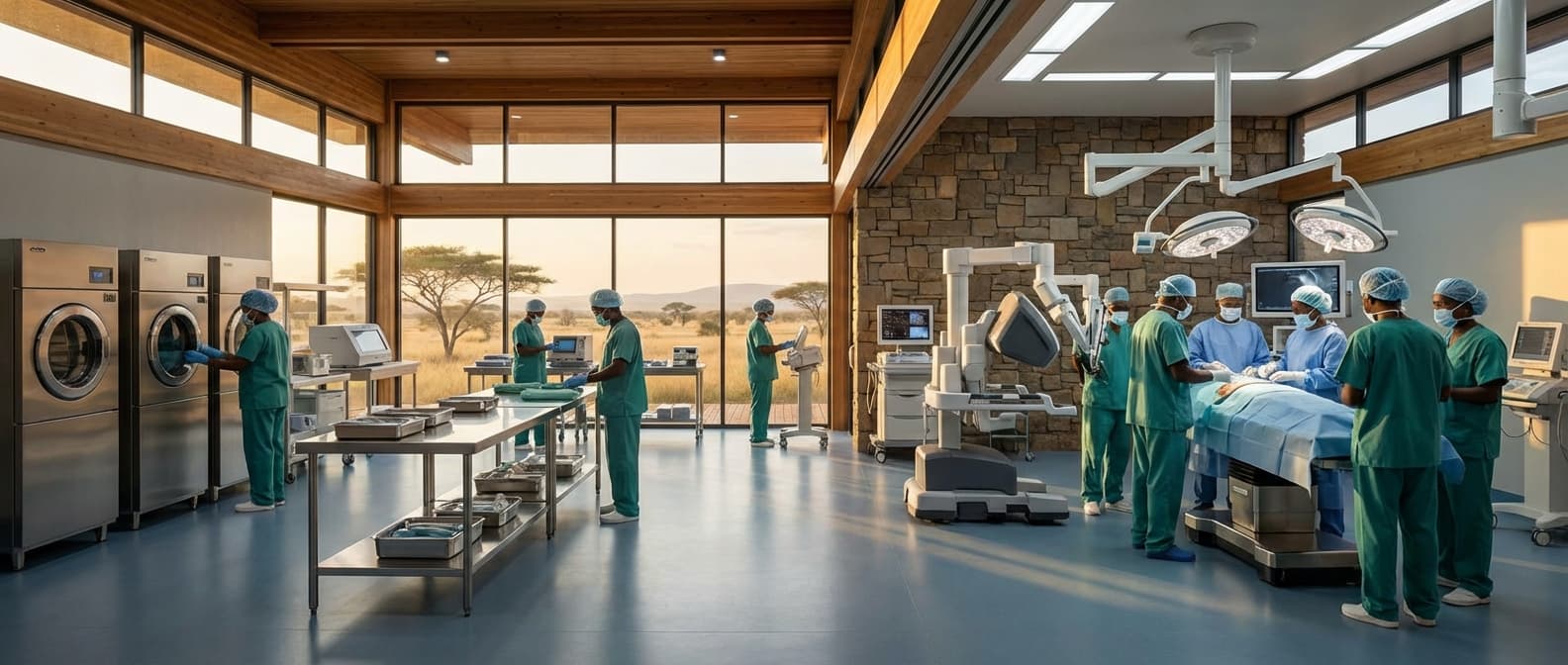
CSSD Design & Validation in Tanzania
Engineering Excellence & Technical Support
CSSD workflow design, validation and process development High-standard technical execution following OEM protocols and local regulatory frameworks.
Advanced Sterilization Modularity
Designing and validating CSSD facilities with modular, scalable sterilization technologies (e.g., pre-vacuum autoclaves, low-temperature plasma) to meet fluctuating healthcare demands and optimize workflow efficiency in Tanzanian hospitals.
Rigorous Performance Qualification (PQ)
Implementing comprehensive Performance Qualification protocols for all sterilization equipment, ensuring consistent and validated decontamination cycles aligned with international standards (e.g., ISO 13485) to guarantee patient safety in Tanzanian healthcare settings.
Integrated Workflow Optimization
Developing and validating CSSD designs that prioritize ergonomic workflows, minimizing cross-contamination risks and maximizing throughput. This includes validated instrument tracking systems and optimized sterile storage solutions for Tanzanian medical facilities.
What Is Cssd Design & Validation In Tanzania?
CSSD Design & Validation in Tanzania refers to the comprehensive process of planning, configuring, and verifying the infrastructure, equipment, and workflows for a Central Sterile Supply Department (CSSD). This service is critical for healthcare facilities to ensure the safe and effective sterilization and reprocessing of medical devices, thereby preventing healthcare-associated infections (HAIs). The design phase focuses on optimizing spatial layout, workflow efficiency, equipment selection, and adherence to international standards and local regulations. Validation encompasses the systematic testing and documentation required to prove that the designed CSSD operates as intended and consistently produces sterile products. This includes qualification of equipment (IQ, OQ, PQ) and validation of processes (sterilization cycles, cleaning protocols, disinfection procedures).
| Typical Use Cases | Description of Use Case | Key Considerations/Objectives |
|---|---|---|
| New Facility Construction | Designing a CSSD from the ground up within a new hospital or clinic building. | Optimizing workflow from dirty to clean to sterile areas, ensuring adequate space for equipment, staff movement, and storage. Compliance with building codes and infection control principles. |
| Facility Renovation/Expansion | Reconfiguring or upgrading an existing CSSD to meet increased demand, incorporate new technologies, or address functional deficiencies. | Minimizing disruption to ongoing operations, assessing existing infrastructure limitations, and integrating new systems seamlessly. Enhancing efficiency and capacity. |
| Equipment Procurement & Installation | Selecting and integrating new sterilization and cleaning equipment (e.g., autoclaves, washer-disinfectors, ultrasonic cleaners). | Ensuring equipment compatibility with facility infrastructure (power, water, ventilation), proper installation, and initial performance qualification (IQ/OQ). Matching equipment capabilities to reprocessing needs. |
| Process Optimization & Workflow Analysis | Analyzing and refining the end-to-end process of medical device reprocessing, from receiving soiled instruments to releasing sterile supplies. | Identifying bottlenecks, reducing turnaround times, improving staff ergonomics, and minimizing the risk of contamination. Implementing lean principles where applicable. |
| Regulatory Compliance & Accreditation | Ensuring the CSSD meets national health regulations, international standards (e.g., ISO 13485, AAMI), and accreditation body requirements. | Developing and implementing robust documentation systems, validation protocols, and quality management systems (QMS). Preparing for audits and inspections. |
| Infection Prevention & Control Enhancement | Implementing design features and validation procedures that directly contribute to reducing HAIs. | Focusing on containment strategies, air pressure differentials, material flow, and validated sterilization efficacy. Continuous monitoring and improvement of infection control metrics. |
| Training & Competency Assurance | Designing training programs and validation processes that ensure CSSD staff are competent in operating equipment and following procedures. | Developing Standard Operating Procedures (SOPs), conducting practical training, and validating staff competency through assessments and performance monitoring. |
Who Needs CSSD Design & Validation Services in Tanzania?
- Hospitals (public, private, teaching)
- Surgical Centers
- Specialized Clinics (e.g., dental, ophthalmology, endoscopy)
- Outpatient Surgery Facilities
- Diagnostic Laboratories with sterile instrument requirements
- Healthcare facilities undergoing new construction or renovation
- Facilities seeking accreditation or aiming to improve patient safety standards
- Organizations involved in medical device reprocessing and distribution
Who Needs Cssd Design & Validation In Tanzania?
The Central Sterile Services Department (CSSD) is the heart of infection prevention and control within any healthcare facility. For Tanzania, a nation actively working to strengthen its healthcare infrastructure and ensure patient safety, effective CSSD design and rigorous validation are not just beneficial – they are essential. A well-designed and validated CSSD ensures that surgical instruments are properly cleaned, disinfected, and sterilized, drastically reducing the risk of healthcare-associated infections (HAIs). This directly impacts patient outcomes, reduces hospital stays, and lowers overall healthcare costs. Furthermore, adherence to international standards through proper design and validation is crucial for building trust and facilitating partnerships within the global healthcare community.
| Target Customer/Department | Description of Need & Impact | Key Considerations for CSSD Design/Validation |
|---|---|---|
| Public Hospitals (e.g., Regional, Referral) | Serve a large patient population with diverse surgical needs. High volume of instruments requires efficient workflow and robust sterilization processes to prevent widespread infections. Budgetary constraints necessitate cost-effective yet compliant solutions. | Space optimization for high throughput, material flow (dirty to clean), choice of appropriate sterilization technologies (e.g., steam, low-temperature), staff training, and ongoing quality assurance. |
| Private Hospitals & Specialized Clinics | Often cater to specific surgical specialties (e.g., orthopedics, cardiology) with specialized instruments. Emphasis on patient satisfaction and brand reputation necessitates impeccable infection control standards. May have higher investment capacity for advanced technologies. | Integration of specialized instrument processing, advanced monitoring systems, ergonomic design for staff comfort and efficiency, compliance with international accreditation standards. |
| Government Health Ministry & Regional Health Offices | Responsible for setting and enforcing healthcare standards across the nation. Need to ensure compliance with national guidelines and international best practices to improve overall public health outcomes and reduce the burden of HAIs. | Development and implementation of national CSSD guidelines, capacity building for healthcare facilities, regulatory oversight, and support for evidence-based design and validation practices. |
| Infection Prevention & Control (IPC) Departments | Directly responsible for monitoring and mitigating HAIs. Require a well-designed and validated CSSD as a cornerstone of their IPC strategy. Their input is critical in establishing protocols and ensuring adherence. | Defining sterilization and disinfection protocols, validation of processes (e.g., Bowie-Dick tests, biological indicators), regular audits, and continuous improvement initiatives. |
| Procurement & Facilities Management Departments | Involved in the selection, purchase, and maintenance of CSSD equipment and infrastructure. Need to understand the technical specifications and long-term operational costs associated with CSSD design and validation. | Understanding equipment lifecycle, energy efficiency, maintenance requirements, and the importance of validation in ensuring equipment longevity and performance. |
| Healthcare Professionals (Surgeons, Nurses, Technicians) | Directly interact with sterilized instruments. Require a functional, safe, and efficient CSSD to perform their duties effectively and safely. Their feedback is crucial for optimizing design and processes. | Ergonomic design of workspaces, clear signage, efficient instrument turnaround times, adequate lighting, and appropriate personal protective equipment (PPE) within the CSSD. |
Who Needs CSSD Design & Validation in Tanzania?
- Hospitals (Public and Private)
- Surgical Centers and Clinics
- Maternity Homes and Birthing Centers
- Dental Clinics with Surgical Procedures
- Veterinary Hospitals (for surgical facilities)
- Research Institutions with Biomedical Labs
Cssd Design & Validation Process In Tanzania
The design and validation process for Central Sterile Services Department (CSSD) facilities in Tanzania is a multi-stage workflow, crucial for ensuring the provision of safe and effective sterile medical devices. This process, from initial inquiry to final execution, involves a collaborative effort between healthcare facilities, CSSD specialists, architectural/engineering firms, and regulatory bodies. The objective is to create a CSSD that meets international standards and local health regulations, ultimately safeguarding patient health.
| Stage | Key Activities | Responsible Parties | Deliverables | Typical Timeline (Illustrative) |
|---|---|---|---|---|
| Initial consultation to understand the facility's requirements, existing infrastructure, patient load, types of procedures, and budget. Site survey to assess space availability and constraints. | Healthcare Facility Management, CSSD Stakeholders, Potential CSSD Consultants/Designers | Needs Assessment Report, Preliminary Space Requirements | 1-2 Weeks |
| Developing preliminary layouts and flow diagrams for the CSSD, adhering to principles of unidirectional flow (dirty to clean). Identifying key functional areas: Decontamination, Preparation & Packing, Sterilization, Storage, and sterile distribution. Allocating space for equipment and personnel. | CSSD Consultants/Designers, Architects, Healthcare Facility Management | Conceptual Layout Drawings, Preliminary Flow Diagrams, Block Plan | 2-4 Weeks |
| Developing detailed architectural drawings, mechanical, electrical, plumbing (MEP) plans, and HVAC (Heating, Ventilation, and Air Conditioning) systems. Specifying materials, finishes, and equipment requirements based on international standards (e.g., ISO 13485, HTM 01-01) and local building codes. | Architects, MEP Engineers, HVAC Engineers, CSSD Consultants, Equipment Suppliers | Detailed Architectural Drawings, MEP Drawings, HVAC Design, Equipment Specifications | 8-16 Weeks |
| Submitting design plans to relevant local authorities (e.g., Ministry of Health, local council) for review and approval. Obtaining necessary building permits and environmental clearances. | Healthcare Facility Management, Architects, Regulatory Bodies | Approved Building Permits, Stamped Drawings | 4-12 Weeks (can vary significantly) |
| Tendering and procurement of building materials and construction services. Actual construction of the CSSD space according to approved detailed designs. Ensuring adherence to quality standards during construction. | Procurement Department, Construction Contractors, Project Managers, Healthcare Facility Management | Constructed CSSD Facility Shell | 12-24 Weeks (depending on project scale) |
| Procurement and installation of all CSSD equipment (e.g., washers, disinfectors, autoclaves, packaging machines, sterile storage cabinets). Functional testing of each piece of equipment to ensure it operates according to manufacturer specifications. | Equipment Suppliers, Biomedical Engineers, CSSD Consultants, Healthcare Facility Management | Installed and Functionally Tested Equipment | 4-8 Weeks |
| Comprehensive validation of the entire CSSD process and equipment. This includes:
| Validation Specialists, Microbiologists, CSSD Consultants, Equipment Manufacturers, Healthcare Facility Management | IQ/OQ/PQ Reports, Validation Certificates | 4-6 Weeks |
| Training of CSSD staff on proper procedures, equipment operation, safety protocols, infection control practices, and quality assurance. Developing Standard Operating Procedures (SOPs). | CSSD Manager, Senior CSSD Technicians, Trainers (Internal/External), Healthcare Facility Management | Trained Staff, Approved SOPs, Operational Readiness | 2-4 Weeks |
| Continuous monitoring of sterilization cycles, equipment performance, and adherence to protocols. Regular preventative maintenance and calibration of equipment. Periodic revalidation to ensure ongoing compliance and efficacy. | CSSD Staff, Biomedical Engineers, Quality Assurance Department, External Service Providers | Daily Monitoring Logs, Maintenance Records, Revalidation Reports | Continuous |
CSSD Design & Validation Workflow in Tanzania
- Inquiry & Needs Assessment
- Conceptual Design & Space Planning
- Detailed Design & Engineering
- Regulatory Approvals & Permits
- Procurement & Construction
- Equipment Installation & Commissioning
- Validation & Performance Testing
- Staff Training & Operationalization
- Ongoing Monitoring & Maintenance
Cssd Design & Validation Cost In Tanzania
Designing and validating a Central Sterile Supply Department (CSSD) in Tanzania involves a multifaceted cost structure influenced by several key factors. These factors directly impact the overall pricing, which can vary significantly based on the scope of the project, the scale of the facility, and the specific requirements for sterilization equipment and validation protocols. Understanding these elements is crucial for accurate budgeting and successful implementation of a compliant and efficient CSSD.
| Cost Component | Estimated Range (TZS - Tanzanian Shilling) | Notes |
|---|---|---|
| Consultancy & Design Fees | 5,000,000 - 30,000,000+ | Varies based on firm, project size, and scope of services. |
| Sterilization Equipment (e.g., Autoclaves, Washer-Disinfectors) | 20,000,000 - 200,000,000+ | Significant variation depending on size, type (steam, plasma), brand, and whether new or refurbished. |
| Ancillary CSSD Equipment (e.g., Packaging Machines, Sealers) | 5,000,000 - 25,000,000+ | Depends on the number and sophistication of machines needed. |
| Validation Services (IQ, OQ, PQ) | 8,000,000 - 40,000,000+ | Includes documentation, testing, and potentially third-party validation. Cost increases with the number of equipment types and validation cycles. |
| Infrastructure Modifications | 10,000,000 - 50,000,000+ | Highly dependent on the existing facility's condition and specific requirements for utilities and ventilation. |
| Water Treatment Systems | 3,000,000 - 15,000,000+ | Essential for many sterilization processes; cost depends on capacity and technology. |
| Installation and Commissioning | 2,000,000 - 10,000,000 | Typically a percentage of equipment cost, or a fixed fee. |
| Contingency (10-15%) | Variable | Crucial for unforeseen expenses. |
Key Pricing Factors for CSSD Design & Validation in Tanzania
- Scope of CSSD Services: The range of sterilization processes offered (e.g., steam, low-temperature plasma, ethylene oxide) and the types of instruments to be processed will dictate the complexity and cost of equipment and validation.
- Facility Size and Capacity: The number of beds in the healthcare facility, the volume of surgical procedures, and the anticipated workload directly influence the required size of the CSSD and the capacity of sterilization equipment, thus affecting costs.
- Equipment Selection and Quality: The choice between new, refurbished, or imported equipment, along with the specific brands and their technological features, significantly impacts capital expenditure. Higher quality and advanced equipment generally command higher prices.
- Validation Protocol Complexity: The stringency of the validation process, the number of validation cycles required, and the need for specialized external validation services contribute to the overall cost.
- Consultancy and Design Fees: Engaging experienced CSSD designers and consultants is essential. Their fees are often based on project complexity, time spent, and the level of detail in the design and documentation.
- Infrastructure Requirements: Modifications or upgrades to existing infrastructure, including plumbing, electrical systems, ventilation, and water treatment, to meet CSSD standards, add to the project cost.
- Training and Staffing: The cost of training CSSD personnel on equipment operation, decontamination processes, and quality control measures needs to be factored in. While not a direct design/validation cost, it's a related operational expense that influences overall budget planning.
- Regulatory Compliance and Certification: Navigating local health regulations and obtaining necessary certifications might involve fees and require adherence to specific standards that could influence design and equipment choices.
- Geographic Location within Tanzania: While less of a primary driver, transportation costs for equipment and personnel, as well as potential local labor availability and rates, might have minor regional variations.
- Turnkey Solutions vs. Phased Implementation: Opting for a complete turnkey solution might involve higher upfront costs but can simplify project management. A phased approach might spread costs but require more internal coordination.
Affordable Cssd Design & Validation Options
Designing and validating a Central Sterile Supply Department (CSSD) is a critical investment for any healthcare facility, ensuring patient safety and operational efficiency. However, the costs associated with achieving compliance with stringent standards can be substantial. This document outlines affordable CSSD design and validation options, focusing on value bundles and cost-saving strategies to make this essential process more accessible.
| Cost-Saving Strategy | Description | Potential Savings |
|---|---|---|
| Phased Design and Implementation | Break down the CSSD project into manageable phases. Prioritize critical areas and equipment, allowing for gradual investment and implementation as budget allows. This is particularly useful for smaller facilities or those undergoing renovations. | Reduces upfront capital expenditure. Allows for operational revenue to offset future costs. Minimizes disruption to existing services. |
| Modular Design Solutions | Opt for modular or prefabricated CSSD units where feasible. These can be faster to install, require less on-site construction, and can be reconfigured or expanded more easily in the future. | Lower construction costs and shorter build times. Potentially lower long-term adaptation costs. |
| Leveraging Existing Infrastructure | Carefully assess if existing building infrastructure (e.g., ventilation, plumbing, electrical) can be adapted or upgraded rather than completely replaced. This requires thorough initial assessment. | Significant reduction in civil works and infrastructure costs. |
| Bulk Purchasing & Negotiated Discounts | When procuring equipment and supplies, explore opportunities for bulk purchasing or negotiate discounts with preferred vendors, especially when purchasing multiple items or committing to long-term service agreements. Value bundles often incorporate this. | Direct savings on equipment and consumables. More favorable service contract rates. |
| Standardized Equipment Selection | Where possible, standardize on a limited range of equipment manufacturers or models. This can lead to economies of scale in purchasing, simplified maintenance, and easier staff training. | Reduced training complexity and cost. Streamlined spare parts inventory and maintenance. |
| Efficient Workflow & Layout Optimization | A well-designed workflow minimizes unnecessary movement of staff and materials, reducing wasted time and improving throughput. This is a fundamental aspect of good design and can be achieved through expert consultation. | Increased staff productivity. Reduced operational expenditure due to optimized resource utilization. |
| In-House vs. Outsourced Validation | While full validation often requires external expertise, consider if certain components of validation or routine re-validation can be performed or supported by trained in-house staff with appropriate equipment and protocols. | Potential reduction in ongoing validation costs if internal capabilities are developed. However, ensure no compromise on accuracy and regulatory compliance. |
| Long-Term Equipment Service Contracts | While an upfront cost, well-negotiated service contracts can prevent costly emergency repairs, ensure uptime, and often include preventative maintenance, which is cheaper than reactive repairs. | Predictable maintenance costs. Reduced downtime, leading to fewer operational disruptions. |
| Focus on Energy Efficiency | Select energy-efficient equipment and incorporate smart design elements (e.g., LED lighting, efficient HVAC) to reduce long-term operational costs and utility bills. | Lower ongoing utility expenses. Potential for reduced environmental impact. |
Understanding Value Bundles
- {"title":"What are CSSD Value Bundles?","description":"Value bundles are pre-packaged service offerings that combine multiple CSSD design and validation components into a single, often discounted, price. They are designed to streamline the procurement process, provide predictable costs, and ensure a comprehensive approach to facility setup and compliance."}
- {"title":"Typical Components of a Value Bundle","description":"These bundles commonly include a combination of the following, tailored to the facility's size and needs:"}
- {"title":"Design Services","description":"Includes initial concept development, workflow analysis, space planning, equipment layout, and compliance review against relevant standards (e.g., ISO, AAMI, local health regulations)."}
- {"title":"Equipment Specification & Procurement Support","description":"Assistance in selecting appropriate sterilization equipment, washer-disinfectors, sterile storage solutions, and other necessary apparatus, often with bundled purchasing agreements."}
- {"title":"Validation Services","description":"Crucial for demonstrating that equipment and processes consistently meet performance specifications. This includes Installation Qualification (IQ), Operational Qualification (OQ), and Performance Qualification (PQ) for all sterilization and disinfection equipment."}
- {"title":"Documentation & Training","description":"Development of Standard Operating Procedures (SOPs), training materials for staff on new equipment and processes, and assistance with regulatory documentation submission."}
- {"title":"Benefits of Value Bundles","description":"Bundles offer a predictable budget, reduced administrative overhead, faster project timelines, and a single point of contact for multiple services, leading to greater efficiency and potential cost savings."}
Verified Providers In Tanzania
Finding reliable healthcare providers is crucial for ensuring quality medical care, especially when navigating a new system. In Tanzania, the landscape of healthcare providers is diverse, but identifying those that are truly 'verified' and uphold the highest standards can be a challenge. Franance Health has emerged as a leading entity in credentialing and verifying healthcare providers, offering a transparent and trustworthy pathway for individuals seeking medical services. Their rigorous vetting process goes beyond simple registration, focusing on the actual capabilities, ethical conduct, and operational integrity of each provider. This commitment to verification not only benefits patients by reducing risk and uncertainty but also elevates the overall quality of healthcare services available in Tanzania. Choosing a Franance Health-verified provider means opting for assurance, expertise, and a patient-centered approach.
| Provider Type | Franance Health Verification Focus | Patient Benefit |
|---|---|---|
| Hospitals & Clinics | Accreditation, infrastructure, staff qualifications, patient safety protocols, infection control measures. | Access to well-equipped facilities with competent medical teams, ensuring safe and effective treatment outcomes. |
| Specialist Doctors | Medical degrees, post-graduate qualifications, board certifications, professional licenses, peer reviews, and practice history. | Consultation with highly skilled and experienced specialists who possess the latest knowledge and techniques in their field. |
| Diagnostic Laboratories | Licensing, equipment calibration, quality control procedures, staff expertise in laboratory sciences, turnaround times. | Reliable and accurate diagnostic test results, crucial for accurate diagnosis and treatment planning. |
| Pharmacies | Pharmacy licenses, drug procurement policies, storage conditions, dispensing protocols, pharmacist qualifications. | Access to genuine medications, dispensed by qualified professionals, ensuring patient safety and efficacy of treatments. |
Why Franance Health Credentials Matter:
- Rigorous Vetting: Franance Health employs a multi-faceted verification process that scrutinizes qualifications, experience, certifications, and adherence to ethical medical practices.
- Quality Assurance: Their credentials act as a seal of approval, indicating that the provider meets established benchmarks for quality care and patient safety.
- Reduced Risk: Patients can feel more confident seeking treatment from verified providers, minimizing the risk of encountering unqualified or unethical practitioners.
- Transparency: The verification process brings a much-needed layer of transparency to the healthcare sector, empowering patients with reliable information.
- Enhanced Trust: Partnering with healthcare facilities and professionals who undergo this verification process builds greater trust and credibility within the Tanzanian healthcare ecosystem.
- Access to Excellence: Franance Health aims to connect patients with providers who consistently demonstrate a commitment to excellence in their practice.
Scope Of Work For Cssd Design & Validation
This Scope of Work (SOW) outlines the design and validation process for a Central Sterile Supply Department (CSSD). It details the technical deliverables and standard specifications required to ensure a safe, efficient, and compliant sterile processing environment. The project will cover the conceptual design, detailed engineering, equipment selection, installation oversight, and validation of the CSSD to meet international standards and best practices.
| Phase | Key Activities | Technical Deliverables | Standard Specifications |
|---|---|---|---|
| Phase 1: Conceptual Design & Planning | Needs assessment, space allocation study, workflow analysis, initial equipment list, budget estimation. | Conceptual layout drawings, preliminary equipment schedule, workflow diagrams, preliminary budget report. | Adherence to relevant health authority guidelines for sterile processing facilities, ergonomic design principles, initial compliance review against ISO 13485 (quality management for medical devices). |
| Phase 2: Detailed Design & Engineering | Detailed architectural and MEP (Mechanical, Electrical, Plumbing) design, equipment specifications development, material selection, detailed cost estimation. | Detailed architectural drawings, MEP schematics, comprehensive equipment specifications, Bill of Materials (BOM), final budget. | Compliance with national building codes, HVAC design for negative/positive pressure zones (e.g., cleanroom standards), electrical safety standards, plumbing requirements for sterile water and waste disposal, specific manufacturer guidelines for selected equipment. |
| Phase 3: Equipment Procurement & Installation Oversight | Tender process for equipment, vendor selection, contract negotiation, site preparation supervision, installation supervision, initial testing. | Approved vendor list, equipment purchase orders, installation plans, progress reports, punch lists. | Compliance with manufacturer's installation manuals, industry best practices for medical equipment installation, calibration requirements, traceability documentation. |
| Phase 4: Process Validation | Development of Standard Operating Procedures (SOPs), validation master plan (VMP), qualification of personnel, cleaning validation, sterilization validation (e.g., steam, low-temperature), biological indicator testing, chemical indicator testing. | Validated SOPs, Validation Master Plan (VMP), Installation Qualification (IQ) protocols and reports, Operational Qualification (OQ) protocols and reports, Performance Qualification (PQ) protocols and reports, calibration certificates. | ISO 17665 (sterilization by moist heat), ISO 11135 (sterilization by ethylene oxide), ISO 11137 (sterilization by radiation), AAMI TIR 30 (sterilization documentation), relevant biological and chemical indicator manufacturer instructions, GAMP 5 guidelines for validation of automated systems. |
| Phase 5: Documentation & Handover | Final documentation compilation, training of CSSD staff, final acceptance, handover of all project documents. | As-built drawings, O&M manuals, training materials and records, final project report, certificates of validation. | Completeness and accuracy of all validation documentation, traceability of all instruments and equipment, records of staff competency and training. |
Key Objectives of CSSD Design & Validation
- To ensure the CSSD adheres to all relevant national and international standards and guidelines (e.g., ISO, AAMI, local health regulations).
- To design a workflow that minimizes the risk of cross-contamination and optimizes efficiency in instrument decontamination, sterilization, and distribution.
- To select and integrate appropriate equipment that meets the specific needs of the facility and its patient care activities.
- To validate all processes and equipment to confirm they consistently perform as intended and meet required sterilization parameters.
- To ensure a safe and ergonomic working environment for CSSD personnel.
- To establish robust quality control and assurance systems for all CSSD operations.
Service Level Agreement For Cssd Design & Validation
This Service Level Agreement (SLA) outlines the terms and conditions for the design and validation of Central Sterile Supply Department (CSSD) facilities, focusing on response times for support requests and guaranteed uptime for critical CSSD systems. This SLA is intended to ensure the efficient and reliable operation of CSSD services, thereby supporting patient safety and healthcare delivery.
| Service Type | Response Time for Support Requests (Business Hours) | Escalation Priority | Uptime Guarantee for Critical CSSD Systems |
|---|---|---|---|
| CSSD Design Consulting | 4 Business Hours | High (Critical Design Flaws/Delays) | N/A (Design services are project-based, not system uptime related) |
| CSSD Validation (IQ/OQ/PQ) - Planning & Execution | 8 Business Hours | High (Validation Delays Impacting Go-Live) | N/A (Validation services are project-based, not system uptime related) |
| Support for Design-Related Queries (Post-Implementation) | 4 Business Hours | Medium (Clarification/Minor Adjustments) | N/A |
| Support for Validation-Related Issues (During Active Validation Project) | 4 Business Hours | High (Issues Preventing Validation Progress) | N/A |
| Remote Support for Critical CSSD System Malfunctions (during validation period) | 2 Business Hours | Critical (System Failure impacting validation) | 99.5% during active validation project scope (for systems under validation) |
| On-site Support for Critical CSSD System Malfunctions (during validation period) | 8 Business Hours (from arrival) | Critical (System Failure impacting validation) | 99.5% during active validation project scope (for systems under validation) |
Key Definitions
- CSSD: Central Sterile Supply Department, the department responsible for the decontamination, sterilization, and sterile distribution of medical devices and equipment.
- Design Services: Includes consulting, planning, layout design, equipment specification, workflow optimization, and regulatory compliance review for CSSD facilities.
- Validation Services: Includes installation qualification (IQ), operational qualification (OQ), and performance qualification (PQ) of CSSD equipment and processes to ensure they meet intended use and regulatory requirements.
- Critical CSSD Systems: Essential infrastructure and equipment that directly impact the ability to process and sterilize instruments. Examples include sterilization equipment (autoclaves, low-temperature sterilizers), washer-disinfectors, sterile storage areas, and associated environmental controls (HVAC, humidity).
- Support Request: A communication from the Client to the Service Provider requesting assistance with a design or validation-related issue, or a system malfunction.
- Uptime Guarantee: The percentage of time that critical CSSD systems are operational and performing within specified parameters.
- Downtime: The period during which a critical CSSD system is not operational or performing within specified parameters.
- Response Time: The maximum time elapsed between the Service Provider receiving a Support Request and initiating contact with the Client to begin addressing the issue.
Frequently Asked Questions

Ready when you are
Let's scope your CSSD Design & Validation in Tanzania project in Tanzania.

Scaling healthcare logistics and technical systems across the entire continent.