
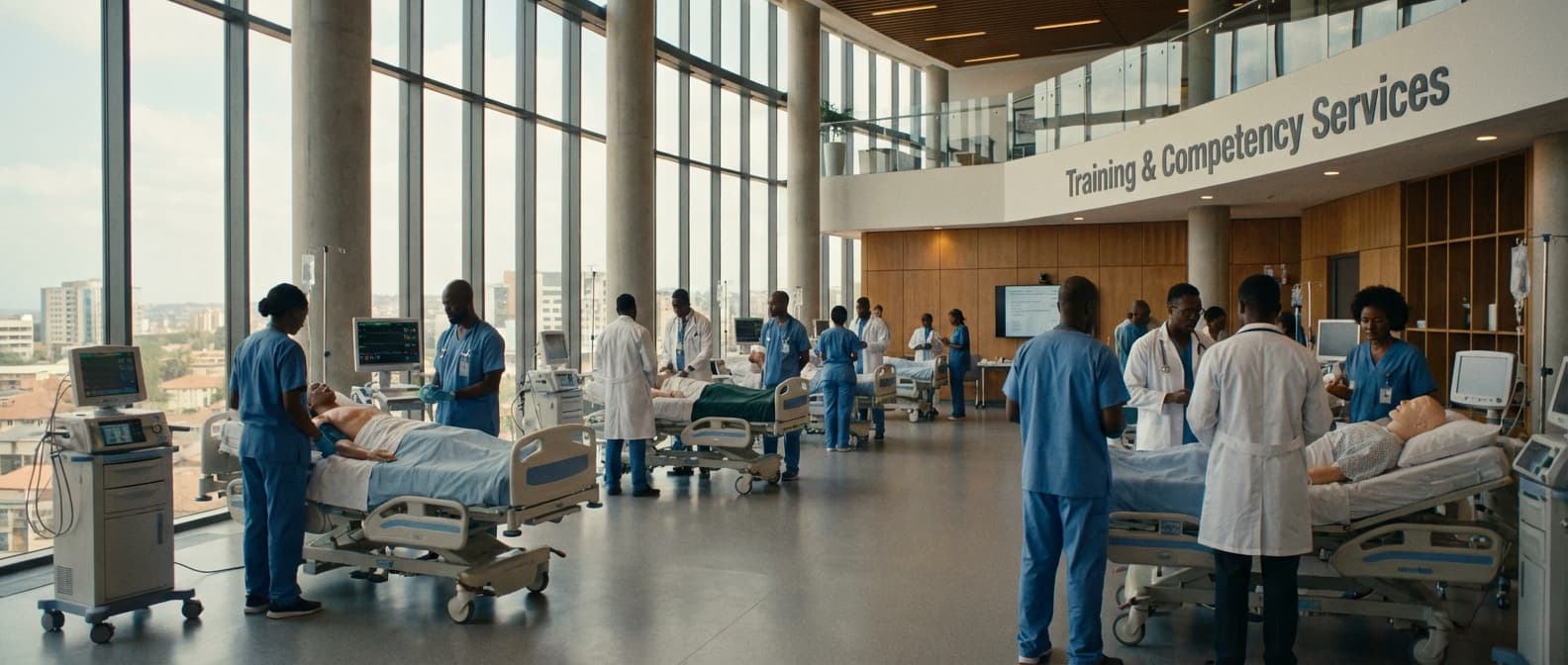
Biomedical Engineering First-Line Support Training Service in Sudan
Engineering Excellence & Technical Support
Biomedical Engineering First-Line Support Training Service High-standard technical execution following OEM protocols and local regulatory frameworks.
Proficient Biomedical Device Troubleshooting
Equips trainees with advanced diagnostic techniques and hands-on experience in repairing common medical equipment, ensuring rapid resolution of technical issues in Sudanese healthcare facilities.
Medical Software & Network Integration
Provides comprehensive training on installing, configuring, and troubleshooting critical medical software and ensuring seamless integration with existing hospital IT infrastructure across Sudan.
Biomedical Safety & Regulatory Compliance
Focuses on instilling best practices in biomedical equipment safety, maintenance protocols, and adherence to Sudanese health regulations to ensure patient and staff well-being.
What Is Biomedical Engineering First-line Support Training Service In Sudan?
Biomedical Engineering First-Line Support Training Service in Sudan refers to a specialized program designed to equip individuals with the foundational knowledge and practical skills necessary to provide initial troubleshooting, maintenance, and basic repair of biomedical equipment. This service is crucial for ensuring the operational readiness and safety of medical devices within healthcare facilities across Sudan, especially in resource-constrained environments. The training focuses on common equipment types, preventive maintenance procedures, identification of critical faults, and escalation protocols for complex issues. Its primary objective is to empower local personnel to address immediate equipment failures, thereby minimizing downtime, optimizing resource utilization, and ultimately contributing to improved patient care.
| Who Needs the Training? | Typical Use Cases | ||||||||
|---|---|---|---|---|---|---|---|---|---|
| Biomedical engineering technicians (junior level or newly recruited) | Performing routine checks and calibration on patient monitoring systems. | Troubleshooting and resolving minor issues with infusion pumps. | Conducting preventive maintenance on autoclaves. | Responding to immediate equipment malfunction alerts. | Ensuring basic functionality of medical devices before patient use. | Basic sterilization equipment operational checks. | Inventory management and initial assessment of equipment status. | Replacing user-serviceable parts (e.g., batteries, fuses) on medical devices. | Reporting equipment failures to senior technicians or manufacturers. |
| Healthcare facility maintenance staff with technical aptitude | Assisting in the setup and initial operational checks of new medical equipment. | Identifying and tagging equipment requiring advanced repair. | Performing basic cleaning and disinfection of medical devices. | Ensuring proper power supply and connectivity for medical equipment. | Documenting equipment usage and basic maintenance logs. | Basic troubleshooting of imaging peripherals. | Emergency response for minor equipment malfunctions. | On-site verification of equipment performance post-repair. | Providing feedback on equipment reliability and usability. |
| Clinical staff involved in equipment oversight (e.g., nurses, ward managers) | Understanding basic operational indicators and error messages of essential equipment. | Reporting equipment issues promptly and accurately. | Ensuring correct usage of medical devices to prevent damage. | Performing simple user-level checks as per manufacturer guidelines. | Recognizing signs of equipment malfunction. | Basic understanding of equipment maintenance needs. | Coordinating with support personnel for equipment repair. | Safe disconnection and preparation of equipment for servicing. | Familiarity with basic equipment safety features. |
Key Components of Biomedical Engineering First-Line Support Training:
- Fundamental principles of biomedical equipment operation and safety.
- Identification and classification of common biomedical equipment (e.g., vital signs monitors, infusion pumps, basic diagnostic tools).
- Basic troubleshooting methodologies and diagnostic techniques.
- Preventive maintenance procedures and schedules.
- Safe handling and storage of biomedical equipment.
- Documentation and reporting of maintenance activities.
- Understanding of essential biomedical instrumentation and their functionalities.
- Basic electrical safety principles and testing.
- Proper use of common tools and test equipment.
- Escalation procedures for complex repairs and advanced technical support.
Who Needs Biomedical Engineering First-line Support Training Service In Sudan?
Biomedical Engineering First-Line Support Training Service in Sudan is crucial for ensuring the optimal functioning and safety of medical equipment across various healthcare facilities. This training is designed to equip personnel with the essential skills to perform initial troubleshooting, routine maintenance, and minor repairs, thereby reducing downtime, improving patient care, and extending the lifespan of valuable medical assets. The primary objective is to empower local technical staff to address immediate equipment issues, freeing up senior biomedical engineers for more complex tasks and specialized interventions.
| Target Customer/Department | Specific Roles Requiring Training | Key Training Needs Addressed |
|---|---|---|
| Hospitals (Public and Private) | Junior Biomedical Technicians/Engineers, Maintenance Staff, Clinical Engineers | Basic troubleshooting of common equipment (e.g., patient monitors, infusion pumps, ECG machines), preventative maintenance, basic electrical safety checks, documentation and reporting of issues. |
| Clinics and Health Centers | On-site Technicians, General Maintenance Personnel | Understanding and troubleshooting of essential medical devices, basic sterilization equipment maintenance, safe operation of diagnostic tools. |
| Diagnostic Laboratories | Laboratory Technicians with equipment responsibilities, Junior Technical Staff | Maintenance and troubleshooting of laboratory equipment (e.g., centrifuges, microscopes, basic analyzers), calibration checks, adherence to quality control protocols. |
| Research Institutions | Research Assistants, Technical Support Staff | Operation and basic maintenance of specialized research equipment, understanding of instrument functionality for experimental procedures. |
| Medical Equipment Suppliers and Distributors | Field Service Technicians, Installation and Commissioning Engineers | First-line troubleshooting for newly installed or under-warranty equipment, understanding common user errors, basic repair techniques for prevalent issues, efficient customer support. |
Target Customers and Departments in Sudan
- Hospitals (Public and Private)
- Clinics and Health Centers
- Diagnostic Laboratories
- Research Institutions
- Medical Equipment Suppliers and Distributors
Biomedical Engineering First-line Support Training Service Process In Sudan
This document outlines the standard workflow for the Biomedical Engineering First-Line Support Training Service in Sudan. It details the process from the initial inquiry made by a client organization to the final execution of the training program and subsequent follow-up.
| Step | Description | Key Activities | Responsible Party | Output/Deliverable |
|---|---|---|---|---|
| The client organization expresses interest in the first-line support training service. | Receive inquiry via email, phone, or website form; Initial clarification of service offerings. | Client Organization, Service Provider (SP) | Acknowledged inquiry, initial service information |
| Understanding the specific training needs of the client. | Conduct needs assessment (surveys, interviews); Define target audience, skill gaps, and desired outcomes; Develop a tailored training proposal. | SP | Detailed Training Proposal (including objectives, curriculum outline, duration, cost) |
| Formalizing the service agreement between the client and the service provider. | Review and negotiation of proposal; Signing of a service agreement or contract. | Client Organization, SP | Signed Service Agreement/Contract |
| Developing or refining the training curriculum to meet specific needs. | Finalize module content; Develop training materials (presentations, manuals, exercises); Incorporate client-specific equipment or protocols. | SP | Finalized Training Curriculum and Materials |
| Arranging all practical aspects for the training. | Determine training dates and times; Secure training venue (on-site or off-site); Arrange for necessary equipment and resources; Communicate schedule to participants. | Client Organization, SP | Confirmed Training Schedule and Logistics Plan |
| Selecting and preparing qualified trainers. | Identify and assign appropriate trainers; Provide trainers with curriculum and participant details; Conduct pre-training briefings. | SP | Assigned and Prepared Trainers |
| Conducting the training sessions. | Deliver theoretical and practical training modules; Facilitate discussions and practical exercises; Address participant queries. | SP (Trainers) | Completed Training Sessions |
| Assessing the effectiveness of the training. | Administer pre- and post-training assessments; Collect participant feedback through evaluation forms; Gather trainer feedback. | SP | Training Evaluation Report, Participant Feedback Summary |
| Documenting successful completion and providing official records. | Issue certificates of completion to participants who meet passing criteria; Prepare a comprehensive training report for the client. | SP | Certificates of Completion, Final Training Report |
| Providing ongoing assistance and ensuring sustained knowledge transfer. | Offer post-training support (Q&A sessions, troubleshooting assistance); Schedule follow-up calls or site visits (if agreed upon); Collect feedback on the application of learned skills. | SP | Post-Training Support Services, Follow-up Report |
Biomedical Engineering First-Line Support Training Service Workflow
- Inquiry and Initial Contact
- Needs Assessment and Proposal Development
- Agreement and Contract Finalization
- Training Program Design and Customization
- Logistics and Scheduling
- Trainer Assignment and Preparation
- Training Delivery
- Post-Training Evaluation and Feedback
- Certification and Reporting
- Follow-up and Support
Biomedical Engineering First-line Support Training Service Cost In Sudan
Providing first-line support training for Biomedical Engineering professionals in Sudan is a crucial service for ensuring the proper functioning and maintenance of medical equipment. The cost of such training is influenced by several factors, leading to a range of pricing. Key elements impacting the expense include the duration and depth of the training program, the qualifications and experience of the instructors, the learning environment (on-site at a facility, dedicated training center, or virtual), and the number of participants. Additionally, the specific modules covered, such as troubleshooting basic electronic failures, preventive maintenance procedures, or safe operation of common medical devices, will affect the overall cost. The inclusion of practical, hands-on sessions with actual equipment or simulators, as well as the provision of training materials and certifications, also contributes to the final price. The economic conditions and currency exchange rates within Sudan play a significant role in determining the local currency pricing.
| Training Scope/Duration | Estimated Price Range (SDG - Sudanese Pound) | Notes |
|---|---|---|
| Basic Fundamentals (1-2 days) | 15,000 - 30,000 SDG | Covers introductory concepts, safety, basic troubleshooting. |
| Standard Core Skills (3-5 days) | 30,000 - 60,000 SDG | Includes core maintenance, preventive checks, common device types. |
| Specialized Modules (e.g., specific imaging or life support equipment) (2-3 days per module) | 25,000 - 50,000 SDG per module | Focuses on detailed knowledge for specific equipment categories. |
| Comprehensive Program (1-2 weeks, multiple modules) | 70,000 - 150,000+ SDG | Offers in-depth training across various aspects of biomedical support. |
| On-site Training (for groups) | Varies based on duration and participant count, often a package deal. | Can be more cost-effective for larger groups at their location. |
| Virtual/Online Training | Potentially slightly lower than in-person, but depends on interactivity and instructor engagement. | Offers flexibility but may lack hands-on component. |
Key Pricing Factors for Biomedical Engineering First-Line Support Training in Sudan
- Training Duration and Intensity
- Instructor Expertise and Qualifications
- Training Delivery Method (On-site, Virtual, Training Center)
- Number of Participants
- Specific Training Modules and Content
- Inclusion of Practical/Hands-on Sessions
- Provision of Training Materials and Resources
- Certification and Assessment Processes
- Logistics and Venue Costs (if applicable)
- Market Demand and Competition
Affordable Biomedical Engineering First-line Support Training Service Options
Securing effective and affordable first-line biomedical engineering support is crucial for healthcare institutions to ensure equipment uptime, patient safety, and operational efficiency. This service focuses on initial troubleshooting, basic maintenance, and triage of biomedical device issues. Investing in well-trained first-line support staff can significantly reduce the need for costly on-site specialist interventions and minimize device downtime. This document outlines value bundles and cost-saving strategies for comprehensive first-line biomedical engineering support training.
| Cost-Saving Strategy | Description | Potential Impact |
|---|---|---|
| Leverage Online & Remote Learning: | Utilize e-learning platforms, webinars, and virtual instructor-led training to reduce travel, accommodation, and facility costs associated with traditional in-person training. | Significant reduction in training delivery expenses, increased scalability, and flexibility for trainees. |
| **Develop Internal Training Resources: | Create custom training materials, standard operating procedures (SOPs), and simulation exercises tailored to the institution's specific equipment and workflows. | Reduces reliance on external vendors, ensures relevance, and fosters institutional knowledge retention. |
| **Group Purchasing & Volume Discounts: | Collaborate with other healthcare organizations to negotiate bulk discounts on training programs or platforms. | Lower per-user training costs through shared resources and increased purchasing power. |
| **Phased Training Implementation: | Break down training into manageable modules, allowing staff to be trained progressively as their roles evolve or as new equipment is introduced. | Spreads training costs over time and allows for immediate application of learned skills, demonstrating ROI sooner. |
| **Focus on High-Impact Devices First: | Prioritize training for the most frequently used or critical devices that contribute to the highest incident rates or downtime. | Maximizes the return on investment by addressing the most pressing needs first, leading to faster problem resolution and reduced costs. |
| **Partnerships with Manufacturers & Vendors: | Explore training opportunities offered by medical device manufacturers, which are often included or discounted when purchasing equipment. Collaborate with third-party service providers for specialized training modules. | Access to manufacturer-specific expertise at potentially lower costs, ensuring accuracy and up-to-date information. |
| **Performance-Based Training & Assessment: | Implement training programs with clear learning objectives and measurable outcomes. Regularly assess staff competency to ensure effective knowledge transfer. | Ensures that training investments are yielding tangible results in terms of improved troubleshooting and reduced device downtime, preventing wasted training expenditure. |
Value Bundles for First-Line Biomedical Engineering Support Training
- Core Competency Bundle: Focuses on foundational knowledge of common medical devices (e.g., patient monitors, infusion pumps, ventilators), basic electrical safety, troubleshooting methodologies, and documentation best practices. Ideal for new hires or staff transitioning into a support role.
- Specialty Device Bundle: Offers in-depth training on specific high-volume or critical medical device categories relevant to the institution's needs (e.g., imaging equipment, surgical tools, laboratory analyzers). This allows for targeted skill development and faster resolution of common issues within those specialties.
- Preventive Maintenance & Calibration Fundamentals Bundle: Equips first-line staff with the skills to perform basic preventive maintenance tasks, identify early signs of wear and tear, and understand the principles of calibration verification. This proactive approach reduces the likelihood of unexpected failures.
- Regulatory & Compliance Essentials Bundle: Covers essential knowledge of relevant regulations (e.g., FDA, HIPAA, Joint Commission) and how they apply to biomedical device management, including proper documentation and reporting procedures. This ensures adherence to critical standards.
- Blended Learning Bundle: Combines online self-paced modules with interactive virtual or in-person workshops, offering flexibility and engaging learning experiences. This caters to diverse learning styles and schedules.
- Train-the-Trainer Program: Empowers experienced internal staff to become trainers, creating a sustainable and cost-effective internal training program for ongoing onboarding and skill development.
Verified Providers In Sudan
In Sudan's evolving healthcare landscape, access to verified and trustworthy healthcare providers is paramount. Franance Health stands out as a beacon of quality, offering a robust network of credentialed professionals committed to delivering exceptional patient care. Their rigorous verification process ensures that every provider associated with Franance Health meets the highest standards of expertise, ethical conduct, and patient safety. This dedication to excellence makes Franance Health the optimal choice for individuals seeking reliable and effective medical services in Sudan.
| Credential Verification Aspect | Franance Health's Approach | Patient Benefit |
|---|---|---|
| Medical License Validation | Thorough checks against official Sudanese medical regulatory bodies. | Ensures providers are legally authorized to practice. |
| Educational Background Accreditation | Verification of degrees and certifications from recognized institutions. | Confirms providers possess the necessary academic qualifications. |
| Professional Experience Review | Detailed assessment of past clinical experience and specializations. | Guarantees practical expertise in chosen medical fields. |
| Ethical Conduct and Disciplinary Records | Checks for any past malpractice claims or disciplinary actions. | Protects patients from unethical or incompetent practitioners. |
| Ongoing Professional Development | Encouragement and tracking of continuous learning and skill enhancement. | Ensures providers stay updated with the latest medical advancements. |
Why Franance Health is the Superior Choice:
- Rigorous Credentialing: Franance Health employs a multi-faceted verification process that scrutinizes medical licenses, educational backgrounds, professional experience, and ethical standing of all its affiliated providers.
- Commitment to Excellence: Beyond basic qualifications, Franance Health prioritizes providers who demonstrate a consistent track record of positive patient outcomes and adherence to best medical practices.
- Patient-Centric Approach: The network is curated to include professionals who are dedicated to compassionate care, clear communication, and patient empowerment.
- Comprehensive Network: Franance Health offers access to a wide spectrum of medical specialties, ensuring that patients can find the right expert for their specific health needs.
- Trust and Reliability: By choosing Franance Health, patients gain the assurance that they are connecting with legitimate, qualified, and trustworthy healthcare professionals.
Scope Of Work For Biomedical Engineering First-line Support Training Service
This Scope of Work (SOW) outlines the requirements for a Biomedical Engineering First-Line Support Training Service. The objective is to equip a designated team with the fundamental knowledge and practical skills necessary to perform initial troubleshooting, basic maintenance, and effective escalation of issues related to biomedical equipment. This training will enhance the operational efficiency and safety of medical devices within the organization.
| Module Title | Learning Objectives | Key Topics Covered | Duration (Estimated) | Assessment Method |
|---|---|---|---|---|
| Introduction to Biomedical Engineering Support | Understand the role and responsibilities of first-line biomedical support. Identify common issues and escalation pathways. | Role definition, safety principles, organizational structure, basic troubleshooting philosophy, documentation. | 4 hours | Quiz, Scenario Discussion |
| Basic Electrical Safety and Principles | Recognize and mitigate electrical hazards. Understand fundamental electrical concepts relevant to medical devices. | Ohm's Law, grounding, insulation, isolation, common electrical faults, safety standards (e.g., IEC 60601). | 6 hours | Quiz, Practical Demonstration (simulated) |
| Common Biomedical Equipment Types and Functionality | Identify and describe the basic functions of prevalent medical devices. Understand their intended use. | Patient monitors, infusion pumps, ECG machines, defibrillators, ventilators (basic principles). | 8 hours | Quiz, Equipment Identification Exercise |
| Initial Troubleshooting Techniques | Apply systematic approaches to diagnose and resolve common equipment malfunctions. Understand error codes and indicators. | Problem identification, symptom analysis, logical deduction, use of diagnostic tools (basic), common failure modes. | 10 hours | Case Studies, Practical Troubleshooting (simulated) |
| Basic Preventive Maintenance (PM) Procedures | Perform routine checks and simple maintenance tasks to ensure equipment reliability and safety. | Visual inspections, cleaning procedures, battery testing, functional checks, PM documentation. | 6 hours | Practical Demonstration, Checklist Completion |
| Documentation and Record Keeping | Accurately document all support activities, including troubleshooting steps, repairs, and maintenance. | Service reports, incident logs, equipment history, data entry procedures. | 3 hours | Mock Service Report Creation |
| Escalation Procedures and Communication | Effectively escalate complex issues to higher levels of support. Communicate clearly with stakeholders. | Identifying escalation triggers, reporting procedures, inter-departmental communication, vendor contact. | 3 hours | Role-playing Exercises |
Technical Deliverables
- Training curriculum document outlining modules, learning objectives, and assessment methods.
- Training materials (presentations, handouts, case studies, practical exercises).
- Competency assessment tools (quizzes, practical skill demonstrations, scenario-based evaluations).
- Training completion certificates for all participants who meet the defined competency standards.
- Post-training support plan, including access to subject matter experts and refresher resources for a specified period.
- Training feedback forms and summary report.
- Trainer qualifications and experience documentation.
Service Level Agreement For Biomedical Engineering First-line Support Training Service
This Service Level Agreement (SLA) outlines the performance standards for the Biomedical Engineering First-Line Support Training Service. It defines the response times for support requests and the uptime guarantees for the training platform. This agreement is intended to ensure timely and effective training for personnel responsible for first-line support of biomedical equipment, minimizing disruptions to healthcare operations.
| Service Component | Priority Level | Response Time Guarantee | Uptime Guarantee | Notes |
|---|---|---|---|---|
| Biomedical Engineering First-Line Support Training Platform | Critical (System Outage) | 15 minutes | 99.9% | Applies during the Availability Window. |
| Biomedical Engineering First-Line Support Training Platform | High (Major Functionality Impaired) | 1 hour | 99.9% | Applies during the Availability Window. |
| Biomedical Engineering First-Line Support Training Platform | Medium (Minor Functionality Impaired or Training Content Query) | 4 business hours | 99.5% | Includes requests for clarification on training materials or platform features. |
| Biomedical Engineering First-Line Support Training Platform | Low (General Inquiry or Feedback) | 8 business hours | 99.5% | Includes suggestions for improvement or non-urgent queries. |
Key Performance Indicators (KPIs)
- Response Time: The maximum time allowed for acknowledging and initiating work on a support request.
- Resolution Time: The maximum time allowed for resolving a support request.
- Uptime: The percentage of time the training platform is available and operational.
- Availability Window: The scheduled hours during which the training platform is expected to be available.
Frequently Asked Questions

Ready when you are
Let's scope your Biomedical Engineering First-Line Support Training Service in Sudan project in Sudan.

Scaling healthcare logistics and technical systems across the entire continent.