
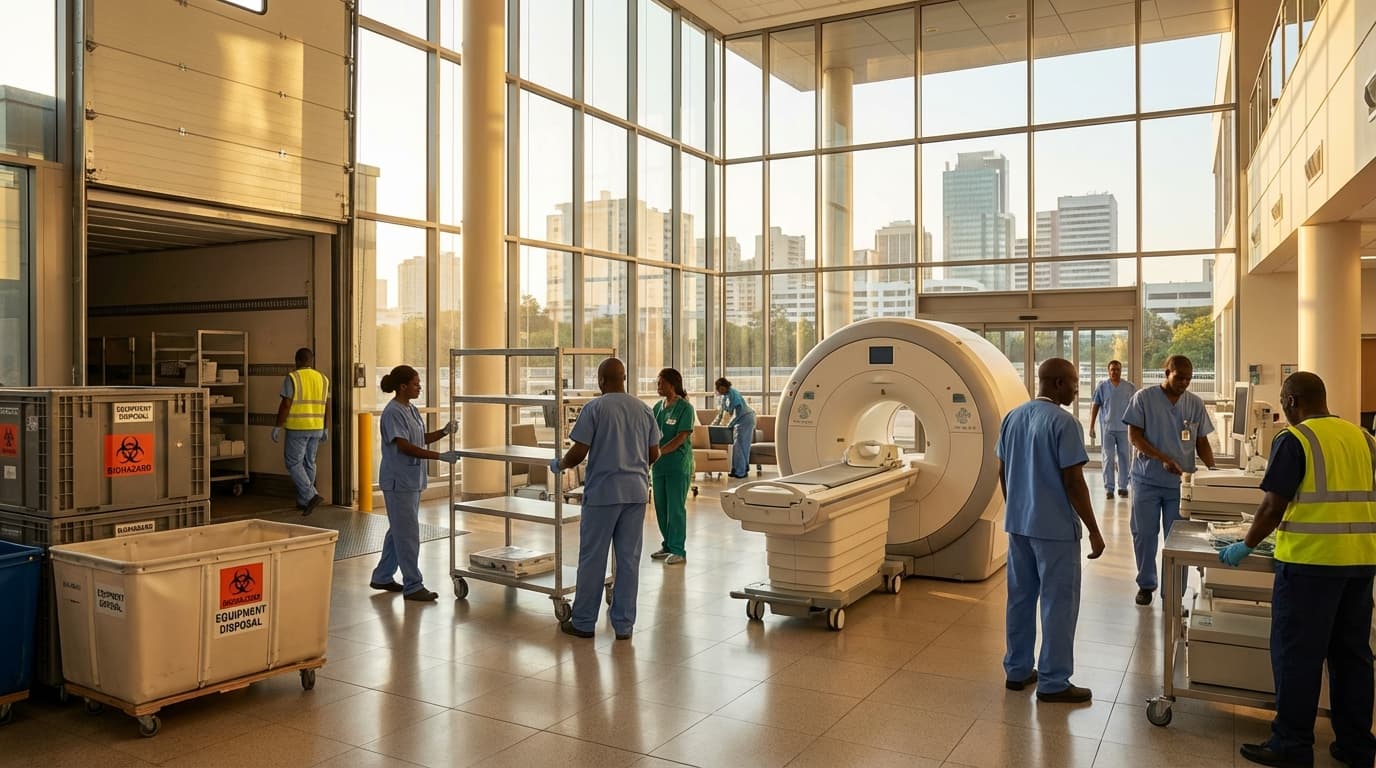
Heavy Medical Equipment De-Installation Service (MRI/CT/Cath Lab) in Sudan
Engineering Excellence & Technical Support
Heavy Medical Equipment De-Installation Service (MRI/CT/Cath Lab) High-standard technical execution following OEM protocols and local regulatory frameworks.
Certified Decommissioning & Compliance
Our highly trained technicians adhere to international safety standards and Sudan's specific regulatory frameworks for the complete and safe decommissioning of complex medical imaging equipment. We ensure all processes minimize environmental impact and meet legal requirements for transport and disposal.
Specialized Logistics & Transportation
We offer bespoke logistical solutions for the secure transport of sensitive and heavy medical equipment across Sudan. Our expertise includes specialized packing, rigging, and a fleet equipped to handle the unique challenges of the Sudanese terrain, guaranteeing equipment arrives intact and on schedule.
Advanced Robotic Dismantling Techniques
Leveraging state-of-the-art robotic arms and precision tools, we perform meticulous de-installation of MRI, CT, and Cath Lab systems. This advanced methodology minimizes physical stress on components, ensures accuracy, and significantly reduces the time required for complex disassemblies in challenging environments.
What Is Heavy Medical Equipment De-installation Service (Mri/ct/cath Lab) In Sudan?
Heavy medical equipment de-installation service in Sudan, specifically for modalities such as Magnetic Resonance Imaging (MRI), Computed Tomography (CT) scanners, and Cardiac Catheterization (Cath) Laboratories, refers to the systematic, safe, and compliant process of dismantling, disconnecting, and preparing these complex and high-value systems for relocation, disposal, or upgrades. This specialized service is critical in healthcare infrastructure management, ensuring that sensitive and often bulky equipment is handled with expertise to prevent damage, maintain operational integrity, and adhere to safety regulations.
| Who Needs This Service? | Typical Use Cases | |||||
|---|---|---|---|---|---|---|
| Hospitals and Diagnostic Imaging Centers: Healthcare facilities undergoing equipment upgrades, renovations, or relocation of entire departments or facilities. | Relocation of Existing Equipment: Moving an MRI, CT, or Cath Lab from one wing of a hospital to another, or to a new facility within Sudan. | Equipment Upgrades: Replacing older generation systems with newer, more advanced technology, requiring the removal of the incumbent equipment. | Disposal of Obsolete Equipment: When equipment reaches the end of its lifecycle and needs to be retired and removed from service. | Temporary De-installation for Construction/Renovation: Removing equipment temporarily to facilitate major building works or infrastructure changes. | International/Inter-regional Transfer: Facilitating the movement of equipment within or out of Sudan for sale, refurbishment, or deployment to another site. | Asset Management and Inventory Control: Facilities seeking to efficiently manage their capital assets, including the removal and tracking of high-value medical equipment. |
Key Components of Heavy Medical Equipment De-Installation:
- Site Assessment and Planning: Thorough evaluation of the existing installation site to determine access routes, structural considerations, power requirements, and the overall scope of the de-installation. This includes developing a detailed project plan and risk assessment.
- System Shutdown and Isolation: Controlled powering down of all equipment components, including associated subsystems (e.g., cryogenics for MRI, high-voltage systems for CT), and isolation from primary power and network connections.
- Disconnection and Dismantling: Meticulous disconnection of all internal and external cabling (power, data, signal, cooling), plumbing, and structural supports. This often involves staged disassembly of major components (e.g., gantry, magnet, patient table, generator, console).
- Component Handling and Packaging: Careful lifting, maneuvering, and securing of individual equipment components using specialized lifting equipment (cranes, forklifts, hydraulic jacks) and appropriate packaging materials (crates, protective wraps) to prevent damage during transit.
- Decommissioning and Waste Management: Proper disposal or recycling of obsolete parts and materials in accordance with environmental and regulatory guidelines.
- Documentation: Comprehensive record-keeping throughout the process, including photographs, logs of removed parts, and final condition reports.
- Logistical Coordination: Management of transportation, warehousing, and any necessary permits for moving large and heavy equipment.
Who Needs Heavy Medical Equipment De-installation Service (Mri/ct/cath Lab) In Sudan?
The de-installation of heavy medical equipment like MRI, CT scanners, and Cath Labs is a highly specialized and critical process. In Sudan, this service is essential for a variety of entities that operate or are looking to upgrade their medical imaging and interventional radiology capabilities. This involves meticulous planning, safe dismantling, careful packaging, and secure transportation of sophisticated and often sensitive machinery. The need arises from several scenarios, including equipment relocation, upgrades to newer technology, decommissioning of old units, or when facilities are undergoing renovation or closure.
| Customer Type | Relevant Departments | Specific Needs for De-Installation |
|---|---|---|
| Major Hospitals (Public & Private) | Radiology Department, Cardiology Department, Neurology Department, Onco-Radiology | Relocation of MRI/CT scanners to new wings, decommissioning of outdated CT/MRI units for replacement, dismantling of Cath Lab equipment during renovations or upgrades. |
| Specialized Medical Centers | Interventional Cardiology, Diagnostic Imaging | De-installation of Cath Lab equipment for upgrades or relocation, removal of older generation MRI/CT scanners. |
| Diagnostic Imaging Centers | Radiology, Medical Imaging | Dismantling of MRI/CT scanners when upgrading to newer models or relocating the entire facility. |
| Research Institutions | Medical Research Departments, Imaging Sciences Labs | Safe de-installation of specialized imaging equipment for maintenance, upgrades, or relocation to new research facilities. |
| Government Health Ministries | Planning & Infrastructure Departments, Public Health Projects | Overseeing the decommissioning and relocation of medical equipment from public hospitals undergoing significant upgrades or closures. |
| International Health Organizations & NGOs | Program Management, Logistics, Health Infrastructure Teams | Facilitating the removal or relocation of donated or established heavy medical equipment as part of project cycles or facility development/closure in Sudan. |
Target Customers & Departments in Sudan
- Major Hospitals (Public & Private)
- Specialized Medical Centers (e.g., Cardiac Centers, Oncology Centers)
- Diagnostic Imaging Centers
- Research Institutions with Medical Imaging Facilities
- Government Health Ministries (for public health infrastructure projects)
- International Health Organizations and NGOs operating in Sudan
Heavy Medical Equipment De-installation Service (Mri/ct/cath Lab) Process In Sudan
This document outlines the comprehensive workflow for the heavy medical equipment de-installation service, specifically for MRI, CT, and Cath Lab systems, within Sudan. The process is designed to be systematic, ensuring safety, efficiency, and compliance with all relevant regulations.
| Phase | Key Activities | Description | Personnel Involved | Timeline (Estimate) |
|---|---|---|---|---|
| Receive Inquiry, Needs Assessment, Preliminary Discussion | Client contacts service provider with de-installation requirements. Initial discussion to understand the equipment type, location, and urgency. | Client Representative, Service Provider Sales/Consultant | 1-2 Business Days |
| On-Site Visit, Technical Evaluation, Risk Assessment, Logistics Planning | A technical team visits the site to assess the equipment's physical condition, surrounding infrastructure (power, cooling, access routes), identify potential challenges, and develop a detailed de-installation plan. | Senior Technical Engineer, Project Manager, Client Facility Manager | 2-5 Business Days |
| Cost Estimation, Proposal Submission, Contract Negotiation, Signing | Based on the site assessment, a detailed quotation is prepared. Once approved, a formal contract outlining scope, timeline, costs, and responsibilities is signed. | Service Provider Project Manager, Client Procurement Department | 3-7 Business Days |
| Obtain Permits, Schedule Logistics, Secure Resources, Client Briefing | Necessary permits from local authorities are obtained. Transportation, specialized tools, lifting equipment, and necessary safety gear are arranged. Client is briefed on the de-installation schedule and any required site preparations. | Project Manager, Logistics Coordinator, Site Supervisor, Client Facility Manager | 5-10 Business Days (can vary based on permit acquisition) |
| Power Down, Disconnection, Component Dismantling, Packaging, Loading | Highly trained technicians execute the de-installation according to the pre-approved plan. This includes safe power down, disconnection of all utilities, systematic dismantling of components, careful packaging, and loading onto transport vehicles. | Senior Technicians, Specialized Engineers, Riggers, Safety Officers | 3-15 Business Days (depending on equipment complexity and size) |
| Site Cleanup, Waste Disposal, Equipment Transfer, Final Inspection | The de-installation area is cleaned and restored to its original condition where possible. Any generated waste is disposed of responsibly. Equipment is transferred to the designated transport. A final inspection of the de-installation site is conducted. | Site Supervisor, Cleaning Crew, Logistics Team | 1-2 Business Days |
| Generate Report, Provide Documentation, Client Sign-off | A comprehensive de-installation report is compiled, detailing the process, any encountered issues, and the condition of the equipment. All relevant documentation, including safety records and asset transfer forms, is provided to the client for final sign-off. | Project Manager, Administrative Staff, Client Representative | 2-3 Business Days |
De-Installation Service Workflow
- Inquiry and Initial Consultation
- Site Assessment and Planning
- Quotation and Contract Agreement
- Pre-De-Installation Preparations
- Equipment De-Installation Execution
- Post-De-Installation Activities
- Documentation and Handover
Heavy Medical Equipment De-installation Service (Mri/ct/cath Lab) Cost In Sudan
De-installing heavy medical equipment like MRI, CT scanners, and Cath Labs in Sudan is a complex and specialized process that requires expert technicians, specialized tools, and logistical planning. The cost is influenced by several factors, making it difficult to provide a single fixed price. These costs are typically quoted in Sudanese Pounds (SDG).
| Equipment Type | Estimated De-installation Cost Range (SDG) | Notes |
|---|---|---|
| CT Scanner | 150,000 - 400,000 SDG | Varies based on model, size, and site accessibility. Simpler designs may fall at the lower end. |
| MRI Scanner (excluding magnet removal) | 300,000 - 800,000+ SDG | MRI magnets are extremely heavy and complex. De-installation costs are significantly higher due to specialized handling and safety requirements. Magnet removal/preparation for transport is a major cost driver. |
| Cath Lab (Angiography System) | 200,000 - 500,000 SDG | Involves multiple components including X-ray generators, tables, and control consoles. Complexity depends on the system's integration. |
Key Pricing Factors for Heavy Medical Equipment De-Installation in Sudan:
- Equipment Type and Size: The complexity of de-installation varies significantly. MRI machines, with their large superconducting magnets, are generally more complex and costly to de-install than CT scanners or Cath Labs. The sheer size and weight of the components are primary drivers of cost.
- Accessibility and Site Conditions: The ease of access to the equipment within the facility plays a crucial role. Tight spaces, multiple floors, or difficult entry/exit points will increase labor time and require more specialized lifting equipment, thus raising the cost. The condition of the building and surrounding infrastructure (e.g., need for temporary structural support) can also impact pricing.
- De-installation Complexity and Time: The amount of disassembly required, the number of specialized components, and the overall time the de-installation process is expected to take directly influence labor costs. This includes time for meticulous disconnection, component segregation, and careful packing.
- Specialized Tools and Equipment: De-installing this type of equipment often necessitates the use of specialized tools, cranes, hydraulic lifts, and custom-built cradles. The rental or purchase of such equipment adds to the overall expense.
- Logistics and Transportation: While the service focuses on de-installation, the client's ultimate goal is often relocation or storage. The cost may include the initial packing and preparation for transport, but full transportation and re-installation would be separate services. However, the complexity of moving large components within the facility to an exit point needs to be factored in.
- Technician Expertise and Experience: Highly skilled and experienced technicians are essential for safely and effectively de-installing sensitive and expensive medical equipment. Their hourly rates or project fees will reflect their specialized knowledge.
- Dismantling vs. Partial De-installation: A full dismantle down to the smallest components will be more expensive than a partial de-installation where larger, manageable sections are moved. The client's specific needs will determine the scope.
- Project Management and Coordination: Ensuring a smooth de-installation process requires effective project management, including scheduling, coordination with facility staff, and adherence to safety protocols. This overhead is factored into the pricing.
- Emergency or Rush Services: If the de-installation is required on short notice or outside of standard working hours, there will likely be a premium added to the cost.
- Geographic Location within Sudan: While major cities like Khartoum will have a more established service provider base, de-installations in more remote areas might incur additional travel and logistical costs for the technicians and equipment.
Affordable Heavy Medical Equipment De-installation Service (Mri/ct/cath Lab) Options
De-installing heavy medical equipment like MRI, CT scanners, and Cath Labs can be a complex and costly undertaking. Choosing the right service provider and understanding how to optimize costs is crucial for healthcare facilities. This guide explores affordable de-installation options, focusing on value bundles and cost-saving strategies specifically for these high-value assets.
| Cost-Saving Strategy | Description | Potential Impact |
|---|---|---|
| Bundle Services | Negotiate a comprehensive package that includes de-installation, packaging, and potentially logistics from a single provider. | Can lead to significant discounts compared to sourcing services separately. Simplifies project management. |
| Off-Peak Scheduling | Schedule de-installation during less busy periods for the provider (e.g., weekdays, avoiding holidays). | May allow for more competitive pricing and greater flexibility in scheduling. |
| Early Planning & Lead Time | Engage de-installation services well in advance of the actual removal date. This allows providers to better plan resources and potentially offer better rates. | Reduces last-minute rushes and associated surcharges. Allows for more thorough site assessment. |
| Phased De-installation | If feasible, break down the de-installation into smaller, manageable phases. This can be particularly useful for large facilities or when budget constraints exist. | Spreads the cost over time and allows for potential price adjustments based on market conditions. |
| Provider Specialization | Choose providers with proven expertise in the specific type of equipment (MRI, CT, Cath Lab). They often have specialized tools and procedures that are more efficient. | Faster de-installation times and reduced risk of damage can translate to lower overall costs. |
| Compare Multiple Quotes | Obtain detailed quotes from at least 3-5 reputable de-installation service providers. Ensure quotes are for comparable scope of work. | Facilitates price negotiation and ensures you are getting competitive market rates. |
| Disposal/Recycling Options | Clarify what disposal or recycling services are included. Sometimes, a provider might offer a credit or reduced fee if you handle certain aspects yourself or use their preferred recycling partners. | Can reduce the overall cost of the de-installation if equipment has residual value or can be efficiently recycled. |
| Facility Preparedness | Ensure your facility is prepared for the de-installation (e.g., clear access routes, power disconnected). A prepared site reduces on-site time for the technicians. | Minimizes labor hours and potential overtime charges. |
| Long-Term Relationships | For organizations with ongoing needs, building a relationship with a preferred provider can lead to preferential pricing and service agreements. | Consistent and potentially lower costs over time. |
| Negotiate Contract Terms | Carefully review and negotiate contract terms, including payment schedules, insurance coverage, and liability clauses. | Prevents hidden costs and protects your organization. |
Understanding Value Bundles in Medical Equipment De-installation
- {"title":"What is a Value Bundle?","description":"A value bundle in medical equipment de-installation refers to a package of services offered by a provider at a potentially reduced overall cost compared to procuring each service individually. These bundles are designed to streamline the process, reduce coordination efforts, and provide a more predictable budget."}
- {"title":"Common Components of De-installation Value Bundles:","sublist":["Pre-de-installation site assessment and planning","Professional de-installation and disconnection by certified technicians","Safe disassembly and component segregation","Specialized crating and packaging","Logistics and transportation coordination (sometimes optional or tiered)","Disposal or recycling of components (if applicable)","Documentation and certification of the de-installation process"],"description":"These bundles often include a combination of the following:"}
- {"title":"Benefits of Value Bundles:","sublist":["Cost Predictability: Bundled pricing often provides a clearer upfront cost, reducing the risk of unexpected expenses.","Efficiency: Streamlined processes and single-point of contact minimize administrative overhead and potential delays.","Expertise: Bundles typically include services from experienced professionals specializing in sensitive medical equipment.","Risk Mitigation: Reputable providers offer insurance and adherence to safety protocols, reducing liability."],"description":"Opting for a value bundle can offer several advantages:"}
Verified Providers In Sudan
In Sudan's evolving healthcare landscape, identifying trusted and verified healthcare providers is paramount for ensuring quality patient care. Franance Health stands out as a beacon of reliability, offering a comprehensive network of credentialed professionals and facilities. Their rigorous vetting process guarantees that every provider associated with Franance Health meets the highest standards of medical expertise, ethical practice, and patient safety. Choosing Franance Health means prioritizing access to care from practitioners who are not only skilled but also deeply committed to the well-being of the Sudanese population.
| Credentialing Aspect | Franance Health's Assurance | Benefit to Patients |
|---|---|---|
| Medical Licensure and Certification | Verification of all relevant national and international medical licenses and certifications. | Ensures practitioners are legally qualified and possess recognized expertise. |
| Educational Background and Training | Thorough review of medical school diplomas, residency certificates, and specialized training. | Confirms a strong foundation in medical knowledge and practical skills. |
| Professional Experience | Assessment of prior work history, including previous employment and surgical/procedural logs where applicable. | Indicates practical application of knowledge and proven competence. |
| Peer Review and References | Collection and evaluation of references from peers and supervisors, as well as participation in peer review processes. | Provides objective insights into a provider's performance and reputation. |
| Background Checks | Screening for any disciplinary actions, malpractice claims, or criminal records. | Safeguards patients by identifying potential risks and ensuring a trustworthy healthcare environment. |
| Commitment to Continuing Medical Education (CME) | Confirmation of ongoing participation in accredited CME programs. | Ensures providers remain up-to-date with the latest medical advancements and best practices. |
Why Franance Health Providers are the Best Choice:
- Unwavering Commitment to Quality: Franance Health's providers undergo a meticulous credentialing process, ensuring they possess the necessary qualifications, experience, and licenses.
- Patient-Centric Approach: Our network prioritizes patient comfort, effective communication, and personalized treatment plans.
- Ethical Practice Standards: All Franance Health providers adhere to strict ethical guidelines, promoting transparency and trust.
- Comprehensive Healthcare Network: Access a wide range of specialists and facilities to meet diverse medical needs.
- Continuous Professional Development: Providers are encouraged and supported in their ongoing learning and skill enhancement.
Scope Of Work For Heavy Medical Equipment De-installation Service (Mri/ct/cath Lab)
This Scope of Work (SOW) outlines the requirements for the de-installation of heavy medical imaging equipment, specifically Magnetic Resonance Imaging (MRI) scanners, Computed Tomography (CT) scanners, and Cardiac Catheterization (Cath Lab) systems. The service includes all necessary labor, materials, and management to safely and efficiently disconnect, dismantle, and prepare the equipment for relocation or disposal. This document specifies the technical deliverables and standard specifications to be adhered to by the service provider.
| Service Component | Description | Standard Specifications / Deliverables | Applicable Equipment |
|---|---|---|---|
| Pre-De-installation Survey | On-site assessment of the equipment, surrounding infrastructure, and access routes to plan the de-installation process. | Detailed site survey report including: power requirements, cooling systems, ventilation, structural integrity, access points, potential hazards, and required lifting equipment. Risk assessment and mitigation plan. | MRI, CT, Cath Lab |
| De-energization and Safety Procedures | Safely disconnecting power and other essential services to the equipment. | Strict adherence to manufacturer's de-energization procedures. Verification of zero energy state. Lockout/Tagout (LOTO) procedures implemented and documented. | MRI, CT, Cath Lab |
| System Disconnection and Component Removal | Careful disconnection of all internal and external components, cables, and conduits. | Systematic labeling and documentation of all disconnected components. Removal of coolant lines (MRI), pneumatic lines (CT), and water/power connections (Cath Lab). Specialized tools and techniques for handling sensitive components. | MRI, CT, Cath Lab |
| Dismantling of Major Components | Disassembly of large and heavy equipment parts as per manufacturer specifications. | Controlled dismantling of magnet (MRI), gantry (CT), patient table, X-ray tube (CT/Cath Lab), and other large modules. Use of appropriate lifting and support equipment. Minimization of stress on components. | MRI, CT, Cath Lab |
| Cooling System Decommissioning (MRI) | Safe draining and handling of cryogen (e.g., Helium) and/or coolant systems. | Adherence to cryogen handling safety protocols. Certified personnel for cryogen management. Proper containment and disposal/recovery of cryogens. Documentation of coolant levels and handling. | MRI |
| Cable Management and Packaging | Organized bundling, labeling, and protective packaging of all removed cables and wiring. | Each cable bundle clearly labeled with its origin and destination. Protection from damage during handling and transport (e.g., bubble wrap, conduit). | MRI, CT, Cath Lab |
| Component Protection and Packaging | Safeguarding all dismantled components from physical damage during handling and storage. | Use of custom-made crates, protective padding, and shrink-wrapping as required for sensitive parts (e.g., X-ray tube, detector arrays, magnet components). | MRI, CT, Cath Lab |
| De-installation Documentation | Comprehensive record-keeping of the entire de-installation process. | Photographic and video documentation of key stages. Detailed logs of actions taken, parts removed, and any encountered issues. Certificate of de-installation. | MRI, CT, Cath Lab |
| Site Remediation (Minor) | Restoration of the immediate de-installation area to a safe and clean condition. | Removal of debris, residual fluids (if any), and temporary support structures. Surface cleaning of the immediate work area. | MRI, CT, Cath Lab |
| Coordination and Communication | Regular updates and coordination with the client's facility management and IT departments. | Designated project manager for the service. Regular progress reports and scheduled communication meetings. Clear communication channels established. | MRI, CT, Cath Lab |
| Transportation Preparation | Ensuring all components are ready for safe loading and transport. | Components staged in designated areas, secured, and ready for transport by the designated logistics provider. Weight and dimension documentation for transport planning. | MRI, CT, Cath Lab |
Key Objectives
- Safe and secure de-installation of specified medical equipment.
- Minimization of downtime and disruption to clinical operations.
- Adherence to all relevant safety regulations and manufacturer guidelines.
- Proper documentation of the de-installation process.
- Preparation of equipment for transport, including component segregation and protection.
- Compliance with environmental regulations for waste disposal (if applicable).
Service Level Agreement For Heavy Medical Equipment De-installation Service (Mri/ct/cath Lab)
This Service Level Agreement (SLA) outlines the terms and conditions for the de-installation of heavy medical equipment, specifically MRI, CT, and Cath Lab systems. It defines the agreed-upon response times and uptime guarantees to ensure minimal disruption to healthcare operations during the de-installation process. This agreement is between [Your Company Name] (hereinafter referred to as 'Service Provider') and [Client Healthcare Facility Name] (hereinafter referred to as 'Client').
| Service Type | Response Time Target | Escalation Path (if Target not Met) | Uptime Guarantee (for unaffected services) | Remedy for Uptime Breach |
|---|---|---|---|---|
| Scheduled De-installation (Non-Emergency) | Within 4 business hours of scheduled start time | Immediate notification to Senior Management (Service Provider) and Client Project Manager. | 99.5% availability of other critical medical equipment during the Service Window. | 10% discount on the next scheduled de-installation service for every 1 hour of Unplanned Downtime exceeding 2 hours. |
| Emergency De-installation (Critical Equipment Failure/Urgent Relocation) | Within 2 business hours of confirmed request | Immediate notification to Senior Management (Service Provider) and Client Operations Director. | 99.0% availability of other critical medical equipment during the Service Window. | Waiver of service fees for the affected de-installation event if Unplanned Downtime exceeds 4 hours. Potential additional compensation to be mutually agreed upon for significant operational impact. |
| De-installation Completion Time | As per agreed project timeline and scope. Deviation requires documented approval from both parties. | Weekly progress review meetings. Any potential delays are to be communicated 48 hours in advance. | N/A (Focus is on schedule adherence) | N/A |
Key Definitions
- De-installation: The complete process of safely and meticulously disconnecting, dismantling, and preparing for relocation or disposal of specified heavy medical equipment.
- Scheduled De-installation: De-installation services scheduled in advance with the Client.
- Emergency De-installation: De-installation required due to unforeseen circumstances, equipment failure leading to immediate cessation of operations, or urgent facility relocation.
- Response Time: The maximum allowed time from the moment the Service Provider receives a valid service request (via agreed communication channels) to the time a qualified technician is actively engaged with the Client's site or commences work.
- Uptime Guarantee: For the purpose of this de-installation SLA, 'uptime' refers to the continuous operational readiness of the remaining critical medical equipment within the Client's facility that is not undergoing de-installation. This SLA does not guarantee uptime of the equipment being de-installed itself, as de-installation inherently means it will cease to function.
- Downtime: The period during which the Client's critical medical services (excluding the equipment being de-installed) are unavailable due to issues directly attributable to the de-installation process by the Service Provider.
- Service Window: The pre-defined period during which the de-installation work is authorized to occur.
Frequently Asked Questions

Ready when you are
Let's scope your Heavy Medical Equipment De-Installation Service (MRI/CT/Cath Lab) in Sudan project in Sudan.

Scaling healthcare logistics and technical systems across the entire continent.