
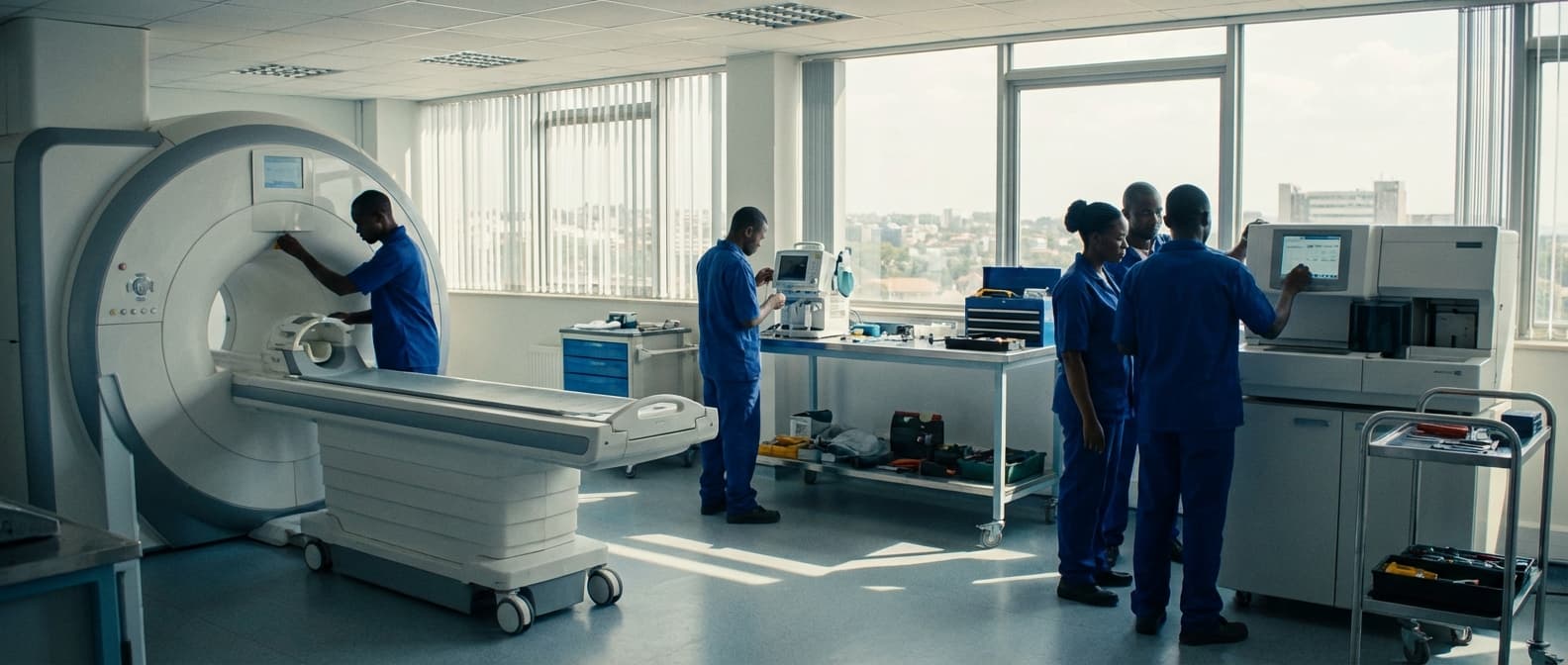
Comprehensive Maintenance Contract (CMC) Management Service (Parts & Labor) in Sudan
Engineering Excellence & Technical Support
Comprehensive Maintenance Contract (CMC) Management Service (Parts & Labor) High-standard technical execution following OEM protocols and local regulatory frameworks.
All-Inclusive Parts & Labor Coverage
Our CMC offers complete peace of mind by covering all necessary spare parts and expert labor for your equipment maintenance needs in Sudan. Minimize unexpected downtime and budget overruns with our transparent, single-contract solution.
Proactive Maintenance & Extended Equipment Lifespan
Benefit from scheduled inspections, preventative servicing, and rapid-response repairs, all managed under our comprehensive contract. This proactive approach ensures optimal performance and significantly extends the operational lifespan of your assets in challenging Sudanese conditions.
Streamlined Inventory & Cost Control
We provide expert management of spare parts inventory, ensuring availability while optimizing stock levels. This, combined with fixed labor rates, offers superior cost predictability and control, making your maintenance budget more efficient and reliable.
What Is Comprehensive Maintenance Contract (Cmc) Management Service (Parts & Labor) In Sudan?
Comprehensive Maintenance Contract (CMC) Management Service (Parts & Labor) in Sudan refers to a service offering that encompasses the proactive and reactive management of all aspects of maintaining a piece of equipment or a system under a contractual agreement. This service is procured by asset owners to outsource the complex responsibilities of ensuring the optimal operational status, longevity, and performance of their critical assets. The 'Parts & Labor' component signifies that the contract explicitly covers the cost of all necessary replacement parts and the labor required for their installation, repair, and routine servicing.
| Who Needs CMC Management Service (Parts & Labor) in Sudan? | Typical Use Cases |
|---|---|
| Organizations in Sudan that operate critical, high-value, or complex equipment where unplanned downtime can result in significant financial losses, operational disruptions, or safety hazards. | Industrial Manufacturing: Production lines, heavy machinery (e.g., in cement, food processing, textiles). Energy Sector: Power generation equipment (turbines, generators), oil and gas processing facilities. Healthcare: Medical imaging equipment (MRI, CT scanners), laboratory instruments, HVAC systems in hospitals. Telecommunications: Network infrastructure, base stations, data centers. Transportation & Logistics: Fleet vehicles, specialized handling equipment (e.g., in ports). Construction: Heavy construction machinery, specialized site equipment. Information Technology: Servers, network switches, uninterruptible power supplies (UPS) in large data centers. Commercial Buildings: HVAC systems, elevators, security systems in large office complexes and shopping malls. Public Sector Infrastructure: Water treatment plants, municipal vehicles, critical governmental IT systems. |
Key Inclusions of CMC Management Service (Parts & Labor):
- Preventive Maintenance (PM): Scheduled inspections, cleaning, lubrication, calibration, and replacement of worn-out components to mitigate the likelihood of failure.
- Corrective Maintenance (CM): Emergency repairs and troubleshooting to restore equipment to operational status following a breakdown or malfunction.
- Parts Procurement & Inventory Management: Sourcing, stocking, and managing the inventory of genuine or approved spare parts to ensure timely availability and minimize downtime.
- Labor Management: Deployment of skilled technicians, engineers, and support staff with the necessary expertise to perform maintenance tasks.
- Service Level Agreements (SLAs): Defined performance metrics and response times for maintenance activities, including repair turnaround times and uptime guarantees.
- Reporting & Analytics: Provision of detailed reports on maintenance activities, equipment performance, costs, and recommendations for optimization.
- Technical Support & Consultation: Access to expert advice on equipment operation, troubleshooting, and potential upgrades.
- Asset lifecycle management considerations: Potentially including recommendations for end-of-life replacement and technology upgrades.
- On-site and/or Off-site Service: Depending on the equipment and contract, maintenance can be performed at the client's location or at the service provider's facility.
- Compliance & Safety: Ensuring all maintenance activities adhere to relevant industry standards, safety regulations, and manufacturer specifications.
Who Needs Comprehensive Maintenance Contract (Cmc) Management Service (Parts & Labor) In Sudan?
In Sudan, where infrastructure development and operational efficiency are crucial for economic progress, a Comprehensive Maintenance Contract (CMC) Management Service (Parts & Labor) plays a vital role in ensuring the longevity, reliability, and optimal performance of critical assets. This service is essential for organizations that rely heavily on specialized equipment and machinery, and where downtime can lead to significant financial losses, operational disruptions, and safety risks. The service encompasses proactive maintenance, emergency repairs, and the sourcing and management of spare parts, covering both labor and material costs under a single, streamlined contract. This approach allows organizations to focus on their core business activities while outsourcing the complex and often costly task of equipment maintenance.
| Target Customer Type | Key Departments/Units Benefiting | Types of Equipment Covered |
|---|---|---|
| Government Ministries and Agencies | Public Works, Transportation, Health, Education, Agriculture, Defense, IT Departments | Road construction equipment, water treatment plants, power generation units, communication networks, medical equipment, agricultural machinery, vehicles. |
| Public Sector Undertakings (PSUs) | Operations, Engineering, Maintenance, Procurement, Asset Management | Manufacturing machinery, processing equipment, power plants, mining equipment, heavy vehicles, specialized testing apparatus. |
| Large-Scale Industrial Enterprises | Production, Operations, Engineering, Maintenance, Plant Management, Quality Control | Assembly lines, CNC machines, industrial furnaces, packaging machinery, material handling systems, robotics, specialized tooling. |
| Infrastructure Development Companies | Project Management, Site Operations, Engineering, Equipment Management | Construction machinery (excavators, bulldozers, cranes), tunneling equipment, concrete batching plants, asphalt pavers, surveying equipment. |
| Energy and Utilities Providers | Operations, Generation, Transmission, Distribution, Maintenance, Power Systems Engineering | Turbines, generators, transformers, switchgear, pumps, piping systems, substations, smart grid equipment. |
| Telecommunication Companies | Network Operations, Field Services, Infrastructure Management, IT Operations | Base stations, transmission equipment, fiber optic infrastructure, data centers, network monitoring tools, power backup systems. |
| Healthcare Institutions | Biomedical Engineering, Hospital Administration, IT Department, Facilities Management | Diagnostic imaging equipment (MRI, CT scanners), surgical equipment, laboratory analyzers, patient monitoring systems, life support systems, HVAC systems. |
| Educational Institutions | Facilities Management, IT Department, Science and Engineering Departments, Research Labs | Laboratory equipment (microscopes, centrifuges), specialized workshop machinery, IT infrastructure, audiovisual equipment, HVAC systems. |
| Agricultural Cooperatives and Large Farms | Farm Operations, Machinery Maintenance, Irrigation Management | Tractors, harvesters, irrigation systems, processing machinery (e.g., for grains, oils), storage facilities. |
| Manufacturing and Processing Plants | Production, Operations, Engineering, Maintenance, Quality Assurance | Food processing equipment, textile machinery, chemical processing units, plastic injection molding machines, metal fabrication equipment. |
Target Customers for CMC Management Service (Parts & Labor) in Sudan:
- Government Ministries and Agencies
- Public Sector Undertakings
- Large-Scale Industrial Enterprises
- Infrastructure Development Companies
- Energy and Utilities Providers
- Telecommunication Companies
- Healthcare Institutions
- Educational Institutions
- Agricultural Cooperatives and Large Farms
- Manufacturing and Processing Plants
Comprehensive Maintenance Contract (Cmc) Management Service (Parts & Labor) Process In Sudan
This document outlines the Comprehensive Maintenance Contract (CMC) Management Service (Parts & Labor) process for clients in Sudan. This service ensures that equipment remains in optimal working condition through proactive maintenance, timely repairs, and the provision of necessary parts and skilled labor, all managed under a contractual agreement. The workflow is designed for efficiency, transparency, and client satisfaction, covering the entire lifecycle from initial inquiry to the successful execution of maintenance activities.
| Stage | Description | Key Activities | Responsible Party |
|---|---|---|---|
| Inquiry & Initial Consultation | Client expresses interest and initial needs are understood. | Needs assessment, service introduction. | Client, Service Provider Sales/Technical Team |
| Site Assessment & Quotation Generation | Detailed evaluation of equipment and environment for accurate pricing. | Site visit, inventory, condition report, proposal development. | Service Provider Technical Team, Sales Team |
| Contract Negotiation & Agreement | Formalizing the service terms and conditions. | Proposal presentation, negotiation, contract signing. | Client, Service Provider Management |
| Contract Activation & Service Planning | Initiating the contract and preparing for service delivery. | Schedule creation, resource allocation, communication setup. | Service Provider Operations Team |
| Preventive Maintenance Execution | Proactive maintenance to prevent breakdowns. | Scheduled checks, cleaning, lubrication, reporting. | Service Provider Technicians |
| Corrective Maintenance & Breakdown Response | Addressing equipment failures and malfunctions. | Issue reporting, dispatch, diagnosis, repair planning. | Client, Service Provider Technical Support/Technicians |
| Parts Procurement & Management | Ensuring availability of necessary spare parts. | Sourcing, inventory management, quality control. | Service Provider Logistics/Procurement Team |
| Labor Provision & Skill Management | Supplying qualified and trained technicians. | Technician deployment, training, skill assessment. | Service Provider HR/Operations Team |
| Repair & Restoration | Fixing the equipment and ensuring its proper function. | On-site or workshop repair, testing, reinstallation. | Service Provider Technicians |
| Post-Maintenance Follow-up & Reporting | Reviewing completed work and communicating with the client. | Service report generation, client sign-off, performance review. | Service Provider Technical Team, Account Manager |
| Contract Review & Renewal | Evaluating the contract's effectiveness and planning for continuation. | Performance analysis, renewal proposal, negotiation. | Service Provider Management, Account Manager, Client |
| Billing & Payment | Financial transactions related to the CMC. | Invoice generation, payment processing, account reconciliation. | Client, Service Provider Finance Team |
Key Stages of CMC Management Service Workflow in Sudan
- 1. Inquiry & Initial Consultation:
- Client expresses interest in CMC services.
- Preliminary discussion to understand equipment type, quantity, location, and specific maintenance needs.
- Introduction to the CMC service offerings and benefits.
- 2. Site Assessment & Quotation Generation:
- Technical team conducts a site visit to assess the equipment's condition, environment, and existing maintenance records (if any).
- Detailed inventory and condition report of the equipment to be covered.
- Based on the assessment, a customized CMC proposal is developed, including scope of work, covered services (preventive maintenance, corrective maintenance, parts, labor, response times), service level agreements (SLAs), and pricing.
- 3. Contract Negotiation & Agreement:
- Presentation of the quotation and proposal to the client.
- Negotiation of terms, conditions, pricing, and payment schedules.
- Finalization of the CMC contract, clearly defining responsibilities of both parties.
- Contract signing and formal agreement.
- 4. Contract Activation & Service Planning:
- Upon contract signing, the CMC is activated.
- Development of a detailed preventive maintenance schedule based on manufacturer recommendations and equipment usage.
- Allocation of dedicated maintenance personnel and resources.
- Establishment of communication channels and emergency contact procedures.
- 5. Preventive Maintenance Execution:
- Scheduled visits by qualified technicians to perform routine checks, cleaning, lubrication, and minor adjustments.
- Use of standardized checklists to ensure all aspects are covered.
- Performance of necessary upgrades or replacements as identified during preventive maintenance.
- Generation of detailed service reports for each preventive maintenance visit, including findings and recommendations.
- 6. Corrective Maintenance & Breakdown Response:
- Client reports an equipment malfunction or breakdown.
- Service request is logged and prioritized based on the SLA.
- Dispatch of a qualified technician to the client's site within the agreed response time.
- Diagnosis of the issue and identification of required parts and labor.
- If on-site repair is not possible, arrangement for equipment transportation to a service center (if applicable).
- 7. Parts Procurement & Management:
- Identification of required spare parts for both preventive and corrective maintenance.
- Sourcing of genuine and high-quality parts from approved suppliers (local or international).
- Management of spare parts inventory to ensure availability and minimize downtime.
- Secure storage and handling of spare parts.
- 8. Labor Provision & Skill Management:
- Deployment of certified and experienced technicians with expertise in the specific equipment covered.
- Ongoing training and development for technicians to stay updated with the latest technologies and maintenance techniques.
- Ensuring adequate staffing levels to meet service demands.
- 9. Repair & Restoration:
- Execution of repairs using the procured parts and skilled labor.
- Thorough testing of the equipment after repair to ensure full functionality and performance.
- If the equipment is moved to a service center, it is returned to the client's site and reinstalled.
- 10. Post-Maintenance Follow-up & Reporting:
- Generation of comprehensive service reports for corrective maintenance, detailing the problem, solution, parts used, and labor involved.
- Client confirmation of successful repair and satisfaction.
- Regular performance reviews and reporting to the client on overall contract status, equipment uptime, and maintenance activities.
- Proactive identification of trends or recurring issues and development of strategies to mitigate them.
- 11. Contract Review & Renewal:
- Periodic review of the CMC contract to assess its effectiveness and alignment with client needs.
- Discussion about any changes in equipment, operational requirements, or desired service enhancements.
- Preparation and presentation of renewal proposals.
- Negotiation and execution of contract renewal.
- 12. Billing & Payment:
- Issuance of invoices based on the agreed payment schedule (e.g., monthly, quarterly).
- Timely processing of payments by the client.
- Reconciliation of accounts.
Comprehensive Maintenance Contract (Cmc) Management Service (Parts & Labor) Cost In Sudan
Managing Comprehensive Maintenance Contracts (CMCs) for parts and labor in Sudan involves a nuanced approach to pricing. The cost is not a fixed figure but rather a dynamic calculation influenced by a variety of factors. These factors can be broadly categorized into the nature of the equipment, the scope of services, service provider considerations, and the prevailing economic conditions in Sudan. Understanding these elements is crucial for accurately estimating CMC costs and ensuring value for money. Service providers typically offer a range of options, from basic preventative maintenance to full-risk solutions that cover all eventualities, with pricing reflecting the level of commitment and coverage.
Key Pricing Factors for CMC (Parts & Labor) in Sudan:
- Equipment Type & Complexity: The more sophisticated, specialized, or critical the equipment, the higher the CMC cost. This includes factors like brand reputation, availability of spare parts, and the required skill level of technicians.
- Age & Condition of Equipment: Older or poorly maintained equipment will likely incur higher maintenance costs due to increased wear and tear and a higher probability of breakdowns. Manufacturers' warranties also play a role; post-warranty CMCs are generally more expensive.
- Scope of Coverage (Parts & Labor): This is a primary driver of cost. Full coverage, encompassing all parts (genuine, OEM, or compatible) and unlimited labor for repairs and replacements, will be significantly more expensive than a contract focused solely on scheduled preventative maintenance.
- Downtime Sensitivity & Response Time Guarantees: For critical operations, guaranteed rapid response times and minimal downtime are essential and command a premium. Contracts with strict Service Level Agreements (SLAs) for uptime will reflect this.
- Preventative Maintenance Schedules & Frequency: The number of planned maintenance visits per year and the extent of the tasks performed during each visit directly impact the labor and material costs within the CMC.
- Spare Parts Inventory & Availability: The cost of genuine or OEM spare parts can be substantial, especially for specialized equipment. Contracts that include the proactive stocking of critical spare parts will be priced accordingly. Local availability and import duties for parts can also be a factor.
- Geographic Location of Equipment: For equipment located in remote or difficult-to-access areas, the travel and logistics costs for technicians and spare parts will increase the overall CMC price.
- Service Provider Expertise & Reputation: Established and reputable service providers with highly skilled technicians and a proven track record may charge higher prices, reflecting their quality of service and reliability.
- Contract Duration: Longer-term CMCs can sometimes offer slightly better per-annum rates due to the commitment and predictability they provide to the service provider.
- Economic Factors in Sudan: This is a significant and often volatile element. Inflation rates, currency exchange fluctuations (especially against major currencies where parts are imported), import duties, taxes, and the general cost of living and labor in Sudan directly influence the pricing of CMCs. The ability to secure foreign currency for imported parts can also impact pricing.
- Risk Transfer: Some CMCs are structured to transfer a higher degree of risk to the service provider (e.g., covering unforeseen major component failures), which will naturally increase the cost compared to a basic maintenance agreement.
Estimated Cost Ranges in Sudanese Pound (SDG):
It's crucial to preface these ranges by stating that they are estimates and can vary significantly based on the aforementioned factors. The Sudanese Pound has experienced considerable volatility, making precise, static pricing challenging. The figures below are illustrative and would need to be confirmed with local service providers at the time of quotation.
For the purpose of this estimation, we will consider a hypothetical mid-range piece of industrial or medical equipment with a moderate complexity and a standard scope of preventative and corrective maintenance.
Annual CMC Cost (Parts & Labor) - Illustrative Ranges:
- Basic Preventative Maintenance Only (excluding major parts): 80,000 - 200,000 SDG per year.
- Standard CMC (Scheduled PM, minor repairs, essential spare parts): 200,000 - 600,000 SDG per year.
- Comprehensive CMC (Unlimited corrective maintenance, critical spare parts, rapid response SLAs): 600,000 - 2,000,000+ SDG per year.
Factors driving costs within these ranges:
- Lower end of ranges: Simpler equipment, less frequent PM, fewer critical spare parts included, longer response times, less reputable providers.
- Higher end of ranges: Complex and critical equipment (e.g., advanced medical imaging, heavy industrial machinery), high frequency of PM, full coverage of genuine/OEM parts, strict uptime guarantees and rapid response, highly experienced providers, high import costs for parts.
Important Considerations for Sudan:
- Currency Volatility: Always seek quotes in a stable currency if possible, or ensure the SDG quotation has clear mechanisms for adjusting for significant currency fluctuations. This might involve periodic reviews or referencing specific exchange rates.
- Importation: The process and cost of importing spare parts can be a significant variable. Clarify who bears the responsibility and cost of import duties, taxes, and logistical challenges.
- Negotiation: Prices are often negotiable. It is advisable to obtain multiple quotes from different reputable service providers.
- Scope Definition: A precisely defined scope of work is paramount to avoid disputes and ensure the CMC meets the actual needs of the asset.
In conclusion, CMC management services for parts and labor in Sudan are a significant investment. A thorough understanding of the influencing factors, combined with diligent research and negotiation with local service providers, is essential to secure a contract that offers both comprehensive coverage and cost-effectiveness.
| Service Level | Estimated Annual Cost (SDG) | Key Inclusions/Considerations |
|---|---|---|
| Basic Preventative Maintenance Only | 80,000 - 200,000 | Scheduled PM visits, labor for inspection and minor adjustments. Major parts/repairs excluded. Longer response times. |
| Standard CMC | 200,000 - 600,000 | Scheduled PM, labor for repairs, limited coverage of essential spare parts. Moderate response times. |
| Comprehensive CMC | 600,000 - 2,000,000+ | Full PM & corrective maintenance, comprehensive spare parts (genuine/OEM), rapid response SLAs, uptime guarantees. Subject to equipment value and risk profile. |
Key Factors Influencing CMC Cost in Sudan
- Equipment Type & Complexity
- Age & Condition of Equipment
- Scope of Coverage (Parts & Labor)
- Downtime Sensitivity & Response Time Guarantees
- Preventative Maintenance Schedules & Frequency
- Spare Parts Inventory & Availability
- Geographic Location of Equipment
- Service Provider Expertise & Reputation
- Contract Duration
- Economic Factors in Sudan (Inflation, Exchange Rates, Duties, Taxes)
- Risk Transfer
Affordable Comprehensive Maintenance Contract (Cmc) Management Service (Parts & Labor) Options
Our Affordable Comprehensive Maintenance Contract (CMC) Management Service offers a robust solution for businesses seeking to streamline their equipment upkeep while optimizing costs. We provide a range of options for parts and labor coverage, focusing on proactive maintenance, timely repairs, and efficient resource allocation. Our service aims to minimize downtime, extend equipment lifespan, and ultimately reduce your total cost of ownership.
| Bundle Name | Key Inclusions (Parts & Labor) | Target Audience | Estimated Cost Savings (vs. Ad-hoc) |
|---|---|---|---|
| Bronze Basic Care | Annual Preventative Maintenance, Standard Parts Replacement (wear & tear), 24/7 Emergency Support (Labor) | SMEs with critical but not highly complex equipment | 15-25% |
| Silver Standard Care | Bi-annual Preventative Maintenance, Standard & Essential Parts Replacement, Priority On-site Response (Labor) | Growing businesses with diverse equipment needs | 20-30% |
| Gold Premium Care | Quarterly Preventative Maintenance, All Parts Replacement (including critical components), Express On-site Response, Remote Diagnostics | Large enterprises with mission-critical infrastructure | 25-40% |
| Platinum Advanced Care | Customized Preventative Maintenance Schedule, All Parts & Labor, Proactive Monitoring & Predictive Analytics Integration, Dedicated Account Manager | Industries with highly specialized or high-value equipment | 30-50%+ |
Value Bundles & Cost-Saving Strategies
- Tiered Service Levels: We offer different CMC tiers, allowing you to select the level of coverage that best suits your operational needs and budget. Higher tiers may include faster response times, premium parts, and extended warranties, while lower tiers focus on essential preventative maintenance and standard repairs.
- Preventative Maintenance Focus: Our CMCS prioritizes scheduled, proactive maintenance to identify and address potential issues before they escalate into costly breakdowns. This reduces the need for emergency repairs and the associated labor charges.
- Strategic Parts Sourcing: We leverage our extensive network of suppliers to source high-quality replacement parts at competitive prices. This includes bulk purchasing power and partnerships with certified manufacturers.
- Labor Optimization: Our skilled technicians are trained to perform efficient and effective repairs. We optimize scheduling and resource allocation to minimize labor hours and travel time.
- Predictive Maintenance Integration (Optional Add-on): For an enhanced cost-saving approach, consider integrating our predictive maintenance modules. These leverage data analytics and IoT sensors to anticipate equipment failures, allowing for planned interventions and avoiding catastrophic breakdowns.
- Extended Warranty Programs: Negotiating extended warranties on new equipment can be a significant cost-saver, and we can assist in structuring these agreements as part of your CMC.
- On-site vs. Off-site Repair Options: We offer flexible repair solutions, determining the most cost-effective approach for each situation. Some repairs may be efficiently handled on-site, while others might benefit from specialized workshop environments.
- Customizable Service Agreements: We understand that every business is unique. Our CMCS can be tailored to your specific equipment, usage patterns, and risk tolerance, ensuring you only pay for the coverage you truly need.
- Performance Reporting & Analysis: Regular reports detailing maintenance activities, parts used, and labor hours provide transparency and allow for continuous improvement in your maintenance strategy, identifying areas for further cost optimization.
- Training & Knowledge Transfer: We can offer training to your in-house staff on basic maintenance and troubleshooting, empowering them to handle minor issues and reducing reliance on external technicians for simpler tasks.
Verified Providers In Sudan
In Sudan's evolving healthcare landscape, identifying reliable and credentialed medical service providers is paramount for individuals seeking quality care. Franance Health stands out as a beacon of trust, offering a meticulously vetted network of healthcare professionals and facilities. Their commitment to rigorous credentialing ensures that every provider associated with Franance Health meets the highest standards of expertise, ethical practice, and patient safety. This dedication translates into a superior healthcare experience for users, offering peace of mind and confidence in the medical services received. By prioritizing verified providers, Franance Health addresses a critical need for dependable healthcare solutions in Sudan, making them the premier choice for discerning patients.
| Credentialing Aspect | Franance Health's Approach | Benefit to Patients |
|---|---|---|
| Licensure Verification | Mandatory and ongoing verification of all professional medical licenses. | Ensures providers are legally authorized and qualified to practice. |
| Educational and Professional Qualifications | Thorough review of academic degrees, specialized training, and board certifications. | Guarantees providers possess the necessary expertise for their chosen field. |
| Clinical Experience and Performance | Assessment of past performance, peer reviews, and patient feedback where available. | Provides insights into a provider's practical skills and patient satisfaction. |
| Ethical Standards and Compliance | Adherence to strict ethical guidelines and medical board regulations. | Upholds the integrity of medical practice and protects patient rights. |
| Facility Standards (where applicable) | Evaluation of clinic and hospital infrastructure, equipment, and hygiene protocols. | Ensures a safe and conducive environment for treatment. |
Why Franance Health is the Best Choice for Verified Providers in Sudan:
- Rigorous Credentialing Process: Franance Health employs a stringent vetting system to ensure all listed providers possess valid licenses, relevant qualifications, and a proven track record of excellent patient care.
- Commitment to Quality and Safety: Every partner undergoes thorough background checks and an assessment of their facilities and operational standards to guarantee patient safety and adherence to best practices.
- Diverse Range of Specialties: Franance Health offers access to a wide spectrum of medical specialists and services, catering to a broad array of healthcare needs.
- Enhanced Patient Trust and Confidence: By providing a curated list of verified professionals, Franance Health empowers patients to make informed decisions with assurance.
- Streamlined Access to Care: Navigating the Sudanese healthcare system is simplified through Franance Health's user-friendly platform, connecting patients directly with trusted providers.
Scope Of Work For Comprehensive Maintenance Contract (Cmc) Management Service (Parts & Labor)
This Scope of Work (SOW) outlines the services to be provided by the Service Provider for the Comprehensive Maintenance Contract (CMC) Management Service, encompassing both Parts and Labor. The objective is to ensure the optimal performance, reliability, and longevity of the contracted equipment through proactive and reactive maintenance, ensuring minimal downtime and adherence to technical standards.
| Technical Deliverable | Standard Specification | Description |
|---|---|---|
| Preventive Maintenance (PM) Schedule | ISO 9001:2015 Compliant | Development and adherence to a detailed PM schedule based on manufacturer recommendations, equipment usage, and environmental factors. Includes pre-defined checklists and service intervals. |
| PM Execution Reports | ANSI/ASME Y14.5-2018 (Geometric Dimensioning and Tolerancing) applicable to measurements | Detailed reports for each PM visit, documenting activities performed, readings taken, parts replaced, anomalies identified, and recommendations. Reports shall include date, time, technician, equipment ID, and signature. |
| Corrective Maintenance (CM) Response Time | Agreed Service Level Agreement (SLA) - e.g., < 4 hours for critical equipment | Timely dispatch of qualified technicians to address equipment breakdowns and malfunctions as per the defined SLA. Prioritization based on criticality. |
| CM Resolution Time | Agreed SLA - e.g., < 24 hours for standard repairs | Efficient diagnosis and repair of equipment to restore full functionality within the defined resolution time, minimizing downtime. |
| Spare Parts Inventory Management | ISO 14001:2015 (Environmental Management) principles for storage | Maintenance of an optimal inventory of critical spare parts. Includes tracking of stock levels, consumption, lead times, and expiration dates. Implementation of a First-In, First-Out (FIFO) system. |
| Spare Parts Quality Assurance | Manufacturer's Original Equipment Manufacturer (OEM) specifications | Procurement and use of only genuine or approved equivalent spare parts that meet or exceed OEM specifications. Certification of authenticity may be required. |
| Technician Skill Matrix and Certifications | Industry-specific certifications (e.g., CompTIA A+, specific vendor certifications) | Ensuring all deployed technicians possess the necessary skills, training, and certifications relevant to the equipment under contract. Maintaining an updated record of technician qualifications. |
| Labor Time Tracking and Reporting | Accurate timekeeping as per agreed rates | Detailed tracking of labor hours spent on PM and CM activities, categorized by task and technician. This data will be used for cost analysis and performance evaluation. |
| Technical Documentation Updates | IEEE 802.1 (Networking Standards) for relevant equipment | Maintenance and regular updating of all technical documentation, including equipment manuals, schematics, calibration records, and service history. Ensuring accessibility of documentation. |
| Equipment Performance Baseline | Manufacturer's published performance metrics | Establishing and regularly monitoring equipment performance against defined baseline metrics to identify deviations and potential issues. |
| Root Cause Analysis (RCA) Reports | Six Sigma DMAIC (Define, Measure, Analyze, Improve, Control) methodology | For recurring or significant failures, conducting a thorough RCA to identify the underlying causes and implement corrective actions to prevent recurrence. |
| Safety Compliance | OSHA (Occupational Safety and Health Administration) standards | Strict adherence to all relevant safety regulations and best practices during all maintenance activities. Providing necessary safety equipment and training to technicians. |
| Audit Trail for All Activities | HIPAA (Health Insurance Portability and Accountability Act) compliance for sensitive data, if applicable | Maintaining a comprehensive and secure audit trail for all maintenance actions, part replacements, and data entries for accountability and traceability. |
| Calibration and Validation Reports | NIST (National Institute of Standards and Technology) traceability for measurements | Ensuring that measuring and testing equipment used during maintenance is regularly calibrated and validated, with traceable records to national standards. |
Key Service Areas
- Preventive Maintenance (PM) Planning and Execution
- Corrective Maintenance (CM) / Breakdown Support
- Spare Parts Management (Procurement, Inventory, and Tracking)
- Labor Management (Technician Deployment, Skill Assessment, and Performance Monitoring)
- Technical Documentation and Record Keeping
- Reporting and Performance Analysis
- Quality Assurance and Compliance
Service Level Agreement For Comprehensive Maintenance Contract (Cmc) Management Service (Parts & Labor)
This Service Level Agreement (SLA) outlines the response times and uptime guarantees for the Comprehensive Maintenance Contract (CMC) Management Service, covering both parts and labor. It aims to ensure timely resolution of issues and minimize operational disruptions for the client.
| Issue Severity | Definition | Response Time (Remote Support) | Response Time (On-site Technician) | Resolution Time Target | Uptime Guarantee (for critical systems) |
|---|---|---|---|---|---|
| Critical (Severity 1) | Complete system outage, impacting all users and core business functions. | Within 30 minutes | Within 2 hours | Within 4 business hours | 99.9% |
| High (Severity 2) | Significant system degradation, affecting a large number of users or key business functions. | Within 1 hour | Within 4 business hours | Within 8 business hours | 99.5% |
| Medium (Severity 3) | Partial system functionality loss or performance issues affecting a subset of users or non-critical functions. | Within 4 business hours | Within 8 business hours | Within 24 business hours | 99.0% |
| Low (Severity 4) | Minor issues, cosmetic problems, or feature requests that do not impact core functionality. | Within 8 business hours | As per scheduled maintenance or next available appointment | Within 48 business hours | N/A (does not impact operational uptime) |
Scope of CMC Management Service
- Proactive monitoring and scheduled maintenance of all covered equipment.
- On-demand technical support for hardware and software issues.
- Procurement and management of replacement parts.
- Coordination and scheduling of certified technician labor for repairs and maintenance.
- Regular reporting on equipment performance, maintenance activities, and incident resolution.
- Management of warranty claims and manufacturer support.
Frequently Asked Questions

Ready when you are
Let's scope your Comprehensive Maintenance Contract (CMC) Management Service (Parts & Labor) in Sudan project in Sudan.

Scaling healthcare logistics and technical systems across the entire continent.