
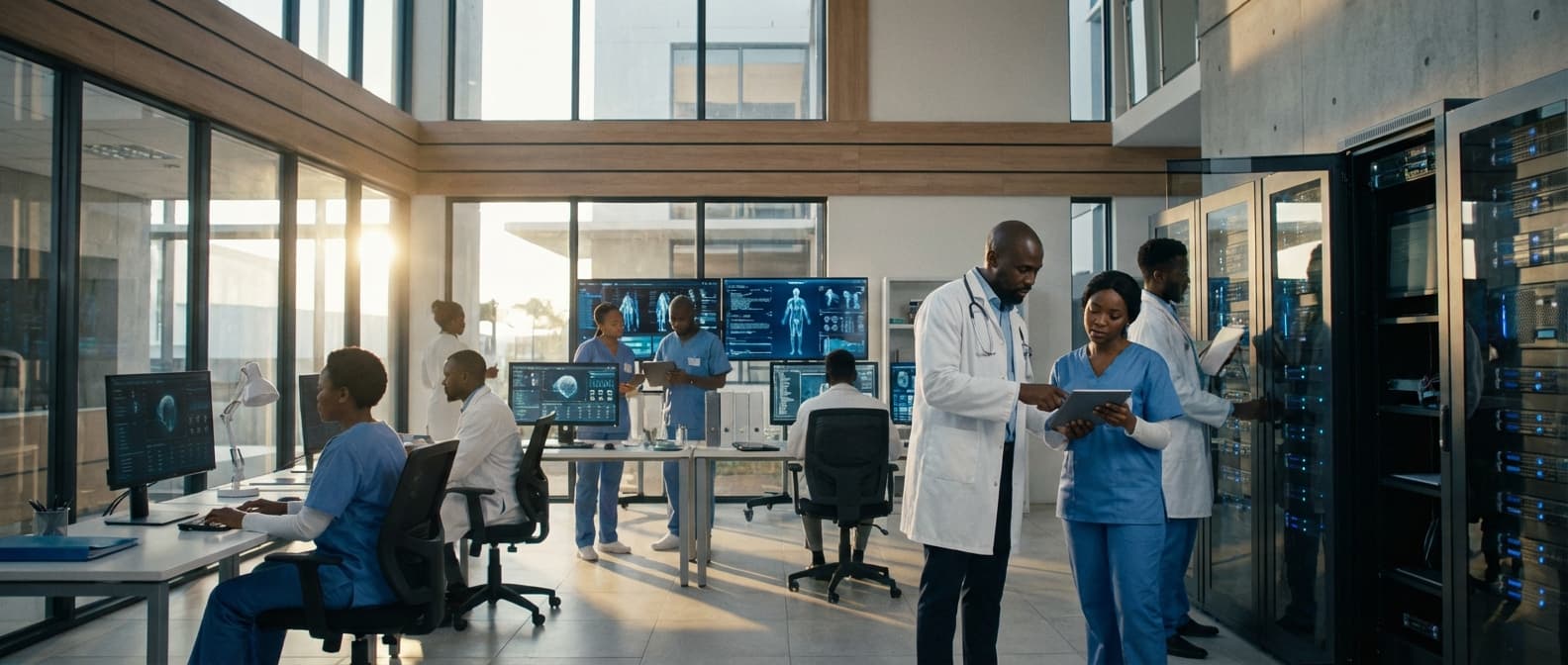
Medical IT Consultation in Sudan
Engineering Excellence & Technical Support
Strategic technology consulting to optimize healthcare operations, streamline workflows, and integrate cutting-edge medical information systems. High-standard technical execution following OEM protocols and local regulatory frameworks.
Telemedicine Infrastructure Deployment
Expertly design and implement secure, scalable telemedicine platforms for remote consultations, patient monitoring, and healthcare education across Sudan's diverse geographical landscape. Focus on robust connectivity solutions for underserved areas.
E-Health Record System Integration
Facilitate the seamless integration and adoption of Electronic Health Record (EHR) systems, improving data accuracy, patient privacy, and inter-facility communication within Sudanese healthcare institutions. Prioritize data security and compliance with local regulations.
Cybersecurity & Data Protection Strategy
Develop and deploy comprehensive cybersecurity strategies to safeguard sensitive patient data and critical healthcare infrastructure against evolving threats. Implement robust access controls, encryption, and disaster recovery plans tailored for the Sudanese context.
What Is Medical It Consultation In Sudan?
Medical IT Consultation in Sudan refers to the provision of expert advisory services focused on the strategic planning, implementation, optimization, and maintenance of information technology (IT) systems within healthcare organizations located in Sudan. This service aims to leverage technology to enhance clinical care delivery, improve operational efficiency, ensure data security and compliance, and support evidence-based decision-making in the Sudanese healthcare landscape. It encompasses a broad range of technical and strategic guidance tailored to the unique challenges and opportunities present within the nation's medical sector, including resource constraints, evolving regulatory frameworks, and the need for robust digital health infrastructure.
| Who Needs Medical IT Consultation? | Typical Use Cases |
|---|---|
| Hospitals & Clinics (Public and Private): Seeking to modernize patient care, improve administrative efficiency, and comply with digital health mandates. | Implementing an EHR system to centralize patient records and reduce administrative overhead. Upgrading network infrastructure to support telemedicine services. Developing a cybersecurity strategy to protect patient data against breaches. |
| Ministry of Health & Public Health Agencies: Aiming to establish national health information systems, improve public health surveillance, and implement digital health policies. | Designing and deploying a national health information exchange platform. Implementing a disease surveillance system for real-time monitoring. Developing guidelines for the adoption of digital health technologies across the country. |
| Medical Training Institutions & Universities: Requiring advanced IT infrastructure for research, education, and simulation. | Setting up virtual learning environments for medical students. Implementing specialized software for medical imaging analysis and research. Ensuring secure data repositories for research data. |
| Non-Governmental Organizations (NGOs) & Humanitarian Organizations: Operating in remote or underserved areas and needing cost-effective IT solutions to deliver healthcare services. | Deploying mobile clinics with integrated data collection systems. Establishing satellite communication links for remote consultations. Implementing low-bandwidth solutions for data transfer in challenging environments. |
| Startups & New Healthcare Ventures: Requiring foundational IT planning and strategic advice for technology adoption. | Selecting and implementing a basic practice management system. Establishing cloud-based data storage and backup solutions. Developing a digital marketing and patient engagement strategy. |
| Existing Healthcare IT Providers & Integrators: Seeking specialized expertise to augment their service offerings or address complex technical challenges. | Collaborating on large-scale EHR implementations. Seeking guidance on specific interoperability standards. Enhancing cybersecurity services offered to clients. |
Key Components of Medical IT Consultation in Sudan:
- Needs Assessment & Gap Analysis: Evaluating existing IT infrastructure, software, hardware, and workflows to identify deficiencies and areas for improvement in relation to organizational goals and international best practices.
- Strategic IT Planning: Developing long-term IT roadmaps aligned with organizational objectives, including digital transformation strategies, technology adoption timelines, and budget allocation.
- Electronic Health Records (EHR) / Electronic Medical Records (EMR) System Implementation & Optimization: Guiding the selection, deployment, customization, and ongoing improvement of EHR/EMR systems to facilitate patient data management, clinical decision support, and interoperability.
- Health Information Exchange (HIE) & Interoperability Solutions: Designing and implementing strategies for secure and seamless exchange of health information between different healthcare providers, facilities, and relevant stakeholders within Sudan.
- Cybersecurity & Data Privacy: Developing and implementing robust security protocols, data encryption strategies, access controls, and compliance measures to protect sensitive patient information in accordance with Sudanese data protection laws and international standards (e.g., HIPAA, GDPR principles where applicable).
- Telemedicine & Remote Patient Monitoring: Advising on the selection and implementation of telemedicine platforms, remote diagnostic tools, and patient monitoring systems to extend healthcare reach and accessibility, particularly in underserved areas.
- IT Infrastructure Design & Management: Recommending and overseeing the procurement, installation, and maintenance of reliable and scalable IT infrastructure, including networks, servers, storage, and end-user devices.
- Cloud Computing & Data Storage Solutions: Evaluating and advising on the adoption of cloud-based solutions for data storage, application hosting, and disaster recovery, considering local internet infrastructure and regulatory implications.
- IT Staff Training & Capacity Building: Developing training programs and workshops to enhance the technical skills and IT literacy of healthcare professionals and IT personnel within Sudanese institutions.
- Regulatory Compliance & Governance: Ensuring that IT systems and practices adhere to relevant Sudanese healthcare regulations, data privacy laws, and ethical guidelines.
- Vendor Selection & Management: Assisting in the evaluation and selection of IT vendors and service providers, and managing vendor relationships throughout the project lifecycle.
- IT Project Management: Providing expertise in managing complex IT projects from inception to completion, ensuring adherence to scope, budget, and timelines.
Who Needs Medical It Consultation In Sudan?
Medical IT consultation is crucial for a wide range of healthcare organizations in Sudan, from large public hospitals to smaller private clinics and specialized medical facilities. These entities often face unique challenges related to outdated infrastructure, limited technical expertise, data security concerns, and the need to adopt modern digital health solutions to improve patient care, operational efficiency, and administrative processes. A dedicated IT consultation can bridge these gaps, offering tailored strategies and implementation support.
| Target Customer | Key Departments Benefiting from IT Consultation | Specific Needs & Challenges |
|---|---|---|
| Public Hospitals | Information Technology (IT) Department, Administration, Clinical Departments (e.g., Radiology, Laboratory, Pharmacy), Patient Records Management | Legacy system integration, cybersecurity, Electronic Health Record (EHR) implementation, network infrastructure upgrades, data backup and recovery, telemedicine capabilities, staff training. |
| Private Hospitals and Medical Centers | IT Department, Management, Finance, Patient Services, Medical Staff | Scalable IT solutions, patient portal development, customer relationship management (CRM) for patient engagement, cloud migration, compliance with data privacy regulations, optimizing HIS (Hospital Information System). |
| Specialized Clinics | IT Support (if any), Clinic Management, Medical Specialists, Administrative Staff | Implementing specialized software (e.g., PACS for radiology, LIS for labs), secure data sharing, remote diagnostics support, efficient appointment scheduling, inventory management for consumables. |
| NGOs with Healthcare Initiatives | Program Management, M&E (Monitoring and Evaluation) Teams, Field Operations, IT Coordinators | Developing data collection tools for public health programs, setting up remote data access for field staff, ensuring data integrity and security in resource-limited settings, implementing mobile health (mHealth) solutions. |
| Medical Training and Research Institutions | IT Department, Research Divisions, Academic Departments, Libraries | Setting up research databases, facilitating data analysis tools, secure storage of research data, enabling collaboration platforms, managing learning management systems (LMS). |
| Government Ministry of Health Departments | Health Information Systems Unit, Public Health Surveillance, Policy and Planning, IT Directorate | Developing national health data standards, implementing national EHR systems, public health data analytics, cybersecurity for sensitive health data, digital transformation of healthcare services, e-health strategy development. |
Target Customers for Medical IT Consultation in Sudan
- Public Hospitals (Federal and State-level)
- Private Hospitals and Medical Centers
- Specialized Clinics (e.g., diagnostic centers, cardiac centers, oncology units)
- Non-Governmental Organizations (NGOs) with Healthcare Initiatives
- Medical Training and Research Institutions
- Pharmaceutical Companies with Distribution and Supply Chain Needs
- Government Ministry of Health Departments
- Emerging Health Tech Startups
Medical It Consultation Process In Sudan
The Medical IT Consultation process in Sudan typically follows a structured workflow designed to address the specific IT needs of healthcare facilities. This process begins with an initial inquiry and culminates in the successful execution and implementation of IT solutions. The workflow emphasizes understanding the unique challenges faced by Sudanese healthcare providers, including infrastructure limitations, budget constraints, and the need for culturally relevant and sustainable solutions. A thorough assessment phase is crucial to tailor services effectively. Throughout the process, clear communication, collaboration with stakeholders, and a focus on long-term support are paramount for successful outcomes.
| Stage | Description | Key Activities | Deliverables | Key Stakeholders |
|---|---|---|---|---|
| The process begins when a healthcare facility or organization in Sudan reaches out to an IT consultancy firm for IT-related services. | Initial phone call/email, brief overview of services, scheduling introductory meeting. | Contact information, confirmed meeting schedule. | Healthcare Facility Representative, IT Consultancy Firm Representative |
| A detailed understanding of the client's current IT infrastructure, challenges, goals, and specific needs is established. | On-site visits, interviews with staff (doctors, nurses, administrators), system audits, workflow analysis, identification of pain points and opportunities. | Needs assessment report, detailed requirements document, gap analysis. | Healthcare Facility Management, Department Heads, IT Staff (if any), IT Consultancy Team |
| Based on the gathered requirements, the consultancy firm designs a tailored IT solution and develops a comprehensive proposal. | Conceptualization of solutions (e.g., EHR implementation, network upgrade, cybersecurity), vendor selection, cost estimation, development of implementation roadmap, risk assessment. | Technical solution design, project plan, budget proposal, timeline, terms of service. | IT Consultancy Team, Technical Specialists, Project Managers |
| The client reviews the proposal and negotiates terms before officially engaging the consultancy. | Proposal presentation, Q&A sessions, negotiation of scope, cost, and timelines, contract drafting and signing. | Signed contract, formal project initiation. | Healthcare Facility Management, Legal Department (if applicable), IT Consultancy Management |
| The designed IT solution is installed, configured, and integrated into the healthcare facility's operations. | Hardware procurement and installation, software installation and configuration, network setup, data migration, system integration. | Installed hardware and software, configured systems, integrated solutions. | IT Consultancy Implementation Team, Technical Specialists, Vendor Representatives (if applicable) |
| End-users and IT staff are trained on how to effectively use and manage the new IT systems. | Development of training materials, delivery of training sessions (on-site/remote), hands-on practice, user guides. | Trained staff, user manuals, training evaluation reports. | IT Consultancy Trainers, Healthcare Facility End-Users, IT Staff |
| The system is thoroughly tested to ensure functionality and reliability before and after going live, with ongoing monitoring. | User Acceptance Testing (UAT), system performance testing, bug fixing, phased or full go-live, real-time system monitoring, initial troubleshooting. | Testing reports, successful go-live, performance metrics. | IT Consultancy Testing Team, Healthcare Facility User Representatives, IT Consultancy Support Team |
| Ongoing support and maintenance are provided to ensure the smooth operation of the IT systems. | Help desk support, remote assistance, on-site visits for critical issues, regular system updates and patching, performance optimization. | Resolved support tickets, updated systems, ongoing operational efficiency. | IT Consultancy Support Team, Healthcare Facility IT Staff |
| Periodic reviews are conducted to assess the effectiveness of the implemented solutions and plan for future IT needs. | Performance review meetings, feedback collection, identification of new needs or improvements, strategic IT planning. | Review reports, updated IT strategy, recommendations for future projects. | Healthcare Facility Management, IT Consultancy Management |
Medical IT Consultation Workflow in Sudan
- Inquiry & Initial Contact
- Needs Assessment & Requirements Gathering
- Solution Design & Proposal Development
- Client Approval & Contract Finalization
- Implementation & Deployment
- Training & Capacity Building
- Testing, Go-Live & Monitoring
- Post-Implementation Support & Maintenance
- Review & Future Planning
Medical It Consultation Cost In Sudan
Medical IT consultation costs in Sudan can vary significantly based on several factors, including the complexity of the IT issues, the experience and specialization of the consultant, the size and type of healthcare facility, and the urgency of the required services. These consultations can range from basic advice on hardware and software to complex strategic planning for electronic health records (EHR) implementation, cybersecurity, or network infrastructure upgrades. The local currency is the Sudanese Pound (SDG).
| Service Type/Complexity | Estimated Cost Range (SDG) | Notes |
|---|---|---|
| Basic IT Advice (e.g., software selection, troubleshooting) | 2,000 - 7,000 SDG | Short duration, general IT knowledge. |
| Intermediate Consultation (e.g., network assessment, hardware upgrade planning) | 7,000 - 20,000 SDG | Requires some specialization, analysis of existing systems. |
| Advanced Consultation (e.g., EHR/HIS strategy, cybersecurity audit, cloud migration) | 20,000 - 70,000+ SDG | Highly specialized, complex projects, strategic planning, requires deep healthcare IT expertise. |
| Project Management for IT Implementation | 10-15% of project cost or equivalent daily/monthly rate | Typically tied to larger IT projects. |
| Hourly Rate (General IT Consultant) | 500 - 2,000 SDG per hour | Varies based on experience and demand. |
Key Pricing Factors for Medical IT Consultation in Sudan
- Scope of Services: Simple advice versus in-depth system analysis, design, and implementation support.
- Consultant's Expertise & Experience: Highly specialized consultants or those with extensive experience in healthcare IT command higher fees.
- Type of Healthcare Facility: Hospitals, clinics, specialized centers, or individual practitioners will have different IT needs and budgets.
- Duration of Consultation: Hourly rates versus project-based fees.
- Urgency of the Request: Rush services or emergency consultations may incur premium charges.
- Location within Sudan: While less pronounced than in other countries, accessibility and travel costs for consultants to remote areas might be a factor.
- Technology Stack: The complexity and proprietary nature of existing or proposed IT systems can influence consultation time and expertise required.
- Deliverables: Whether the consultation includes written reports, recommendations, training materials, or implementation blueprints.
Affordable Medical It Consultation Options
Navigating the complexities of medical IT can be daunting, especially for practices looking to optimize operations and patient care without breaking the bank. Fortunately, several affordable medical IT consultation options exist, focusing on delivering high value through smart bundling of services and employing effective cost-saving strategies. These approaches ensure that healthcare organizations can access expert guidance and implement necessary technology solutions in a budget-conscious manner.
| Strategy | Description | Benefit to Healthcare Organizations |
|---|---|---|
| Project-Based Consultation | Engaging consultants for specific, well-defined projects with clear deliverables and timelines. This avoids ongoing retainer fees and allows for focused problem-solving. | Predictable costs, immediate impact, and avoids long-term commitments. |
| Remote Consultation and Support | Leveraging technology to provide consultations, troubleshooting, and training remotely. This significantly reduces travel expenses and allows for more frequent check-ins. | Reduced overhead for consultants translates to lower fees; increased flexibility and speed of issue resolution. |
| Phased Implementation | Breaking down large IT projects into smaller, manageable phases. This allows organizations to spread costs over time and see tangible benefits at each stage, while also adjusting strategies based on early successes. | Improved cash flow management, reduced initial investment, and opportunities for iterative improvements. |
| Focus on Open-Source and Cost-Effective Solutions | Consultants can guide organizations towards leveraging open-source software or more budget-friendly commercial alternatives where appropriate, without compromising on essential functionality or security. | Significant reduction in software licensing costs, allowing more budget for consultation and implementation. |
| Staff Training and Empowerment | Investing in comprehensive training for internal IT staff or end-users. This reduces reliance on external support for routine tasks and builds internal capacity. | Long-term cost reduction by minimizing the need for external support, improved internal efficiency and user adoption. |
| Strategic Technology Roadmapping | Developing a long-term IT strategy that aligns with organizational goals. This prevents reactive, piecemeal technology purchases and ensures investments are purposeful and cost-effective. | Optimized IT spending, avoidance of redundant systems, and alignment of technology with business objectives. |
| Negotiated Service Level Agreements (SLAs) | Carefully defining the scope and service levels for any ongoing support or managed services. This ensures you are paying for exactly what you need and can negotiate favorable terms. | Ensures value for money in ongoing support, prevents overspending on unused services, and guarantees required uptime and response times. |
Affordable Medical IT Consultation Options Explained
- {"title":"Value Bundles: Maximizing ROI","description":"Value bundles are pre-packaged sets of IT consultation services designed to address common needs within healthcare organizations. They offer a more predictable and often lower overall cost compared to purchasing individual services à la carte. These bundles are typically structured to provide comprehensive solutions for specific objectives, such as EHR implementation, cybersecurity upgrades, HIPAA compliance audits, or cloud migration. By combining related services, consultants can streamline processes, leverage specialized expertise more efficiently, and pass on cost savings to the client."}
- {"title":"Key Components of Value Bundles:","description":"Common components include initial assessment and strategy development, system design and implementation, staff training, ongoing support, and compliance monitoring. The exact composition varies based on the bundle's focus, but the underlying principle is to deliver a complete solution for a defined outcome."}
- {"title":"Cost-Saving Strategies for Medical IT Consultation","description":"Beyond pre-defined bundles, consultants employ several strategies to make their services more affordable and deliver greater value for money."}
Verified Providers In Sudan
In the challenging landscape of healthcare in Sudan, identifying and relying on verified providers is paramount. Franance Health stands out as a beacon of trust and quality. Their rigorous credentialing process ensures that every healthcare professional and facility affiliated with them meets the highest standards of expertise, ethics, and patient care. This commitment to verification not only safeguards patients but also elevates the overall quality of healthcare services available in Sudan. Choosing Franance Health means choosing peace of mind, knowing you are receiving care from the most competent and trustworthy medical professionals.
| Credential Aspect | Franance Health Verification | Benefit to Patients |
|---|---|---|
| Medical License & Certifications | Thorough verification of all active and valid medical licenses and specialized certifications. | Ensures providers are legally qualified and possess the necessary expertise for their practice. |
| Professional Experience & Training | Detailed review of educational background, residency, fellowships, and years of practice. | Guarantees that patients are treated by experienced and well-trained medical professionals. |
| Clinical Competence & Performance | May include peer reviews, performance metrics, and ongoing professional development tracking (where applicable). | Indicates a commitment to maintaining high standards of medical practice and continuous learning. |
| Ethical Standing & Background | Checks for any disciplinary actions, malpractice claims, or ethical violations. | Provides assurance of patient safety, integrity, and trustworthy medical care. |
| Facility Accreditation (if applicable) | Verification of hospital or clinic accreditations from recognized bodies. | Confirms that facilities meet stringent standards for safety, quality, and patient services. |
Why Franance Health Credentials Matter:
- Uncompromising Quality Standards: Franance Health meticulously vets all providers, ensuring they possess the necessary qualifications, experience, and up-to-date certifications.
- Ethical Practice Assurance: Their credentialing process includes background checks and verification of ethical conduct, ensuring patient safety and trust.
- Access to Expertise: By affiliating with top medical professionals and facilities, Franance Health provides access to specialized knowledge and advanced medical treatments.
- Patient-Centric Approach: The focus is always on delivering compassionate and effective care, with providers committed to patient well-being and satisfaction.
- Reliability and Trustworthiness: Franance Health's verified network offers a reliable source of healthcare in Sudan, eliminating the uncertainty of finding qualified practitioners.
Scope Of Work For Medical It Consultation
This Scope of Work (SOW) outlines the services to be provided by [Consultant Name] (hereinafter referred to as "the Consultant") to [Client Name] (hereinafter referred to as "the Client") for Medical IT Consultation. The primary objective is to assess, recommend, and implement strategic IT solutions that enhance the Client's operational efficiency, data security, patient care, and regulatory compliance within the healthcare environment. This SOW details the technical deliverables and outlines standard specifications for each.
| Technical Deliverable | Description | Standard Specifications/Metrics | Phase |
|---|---|---|---|
| Current IT Infrastructure Audit Report | Comprehensive review of existing hardware, software, network, and security infrastructure. | Includes: Inventory of all IT assets, network topology diagrams, software licensing review, identification of single points of failure, security vulnerability assessment report. | Phase 1 |
| Gap Analysis Report | Identifies discrepancies between current IT capabilities and desired future state, aligning with business objectives and industry best practices. | Includes: Comparison of current vs. recommended technologies, assessment of compliance with HIPAA, HITECH, and other relevant regulations, identification of areas for improvement in performance, security, and usability. | Phase 1 |
| IT Strategy Roadmap | A phased plan detailing recommended IT investments, upgrades, and implementations to achieve the Client's strategic goals. | Includes: Prioritized list of initiatives, estimated timelines, budget recommendations, technology selection criteria, risk assessment and mitigation strategies. | Phase 2 |
| Vendor and Technology Evaluation Report | Assessment of potential vendors and specific technologies (e.g., EHR systems, PACS, telehealth platforms) based on functionality, cost, security, and support. | Includes: Vendor comparison matrix, feature/benefit analysis, total cost of ownership (TCO) calculation, reference checks, security certifications review. | Phase 2 |
| System Design and Architecture Document | Detailed blueprints for proposed IT systems, including network design, server configurations, database architecture, and integration points. | Includes: Network diagrams (logical and physical), server specifications, database schemas, API documentation, data flow diagrams, security architecture. | Phase 3 |
| Implementation Plan | Step-by-step guide for the deployment and integration of new IT systems and upgrades. | Includes: Project schedule, resource allocation, testing protocols, rollback procedures, communication plan, go-live checklist. | Phase 3 |
| Data Migration Plan | Strategy for transferring existing patient and operational data to new systems, ensuring data integrity and minimal downtime. | Includes: Data mapping, data cleansing procedures, validation scripts, downtime minimization strategies, audit trails. | Phase 3 |
| Security Policy and Procedure Updates | Revised or new policies and procedures to ensure compliance with data protection regulations and best practices. | Includes: Access control policies, data encryption standards, incident response plan, business continuity plan, user training materials. | Phase 3 |
| User Training Materials and Sessions | Comprehensive documentation and hands-on training for end-users on new systems and processes. | Includes: User manuals, quick reference guides, video tutorials, scheduled training sessions, proficiency assessments. | Phase 4 |
| Post-Implementation Support Plan | Outline of ongoing support services, including help desk, troubleshooting, and system maintenance. | Includes: Service level agreements (SLAs), escalation procedures, remote and on-site support availability, knowledge base articles. | Phase 4 |
| Performance Monitoring and Optimization Report | Analysis of system performance post-implementation, with recommendations for ongoing optimization. | Includes: Key performance indicator (KPI) tracking (e.g., system uptime, response times, error rates), performance tuning recommendations, capacity planning insights. | Phase 5 |
| Final Project Report and Recommendations | Summary of project outcomes, lessons learned, and recommendations for future IT development. | Includes: Achievement of project objectives, ROI analysis, ongoing maintenance recommendations, strategic IT vision for the future. | Phase 5 |
Project Phases and Activities
- Phase 1: Discovery and Assessment
- Phase 2: Strategy and Recommendations
- Phase 3: Implementation and Deployment
- Phase 4: Training and Support
- Phase 5: Evaluation and Optimization
Service Level Agreement For Medical It Consultation
This Service Level Agreement (SLA) outlines the guaranteed response times and uptime for Medical IT Consultation services provided by [Your Company Name] to [Client Name]. This SLA is an addendum to the Master Service Agreement (MSA) between the parties, dated [Date of MSA].
| Incident Priority | Definition | Response Time (Business Hours) | Resolution Target (Business Hours) | Uptime Guarantee |
|---|---|---|---|---|
| Emergency | Critical system failure impacting patient care or core operations. | 15 Minutes | 2 Hours | 99.9% Monthly |
| High Priority | Significant departmental or user impact, disrupting non-critical operations. | 1 Hour | 4 Business Hours | 99.9% Monthly |
| Medium Priority | Single user or small group impact, causing inconvenience. | 2 Business Hours | 8 Business Hours | 99.5% Monthly |
| Low Priority | General inquiry or minor non-disruptive issue. | 4 Business Hours | 2 Business Days | N/A (Focus on timely resolution) |
Key Definitions
- Business Hours: Monday through Friday, 9:00 AM to 5:00 PM [Time Zone], excluding public holidays recognized by [Client Name]'s region.
- Emergency: A critical system failure that prevents patient care, data access, or core business operations. Examples include total network outage, inability to access Electronic Health Records (EHR), or loss of critical medical equipment connectivity.
- High Priority Incident: An issue that significantly impacts a department or a substantial number of users, causing a disruption to non-critical operations but not patient care. Examples include slow system performance affecting multiple users, intermittent connectivity issues, or partial EHR functionality loss.
- Medium Priority Incident: An issue affecting a single user or a small group of users, causing inconvenience but not significantly impacting workflow or patient care. Examples include printer malfunctions, software application errors for one user, or minor email issues.
- Low Priority Incident: A general inquiry, feature request, or minor non-disruptive issue. Examples include password resets (non-emergency), minor software configuration questions, or requests for informational documentation.
- Downtime: Any period during which the Services are unavailable to [Client Name] due to maintenance, failure, or other causes within the control of [Your Company Name]. Scheduled maintenance is excluded.
- Uptime: The percentage of time the Services are available and operational during a given month, calculated as (Total Minutes in Month - Downtime Minutes) / Total Minutes in Month * 100.
- Response Time: The maximum time within which [Your Company Name] will acknowledge receipt of a support request and initiate troubleshooting.
Frequently Asked Questions

Ready when you are
Let's scope your Medical IT Consultation in Sudan project in Sudan.

Scaling healthcare logistics and technical systems across the entire continent.