
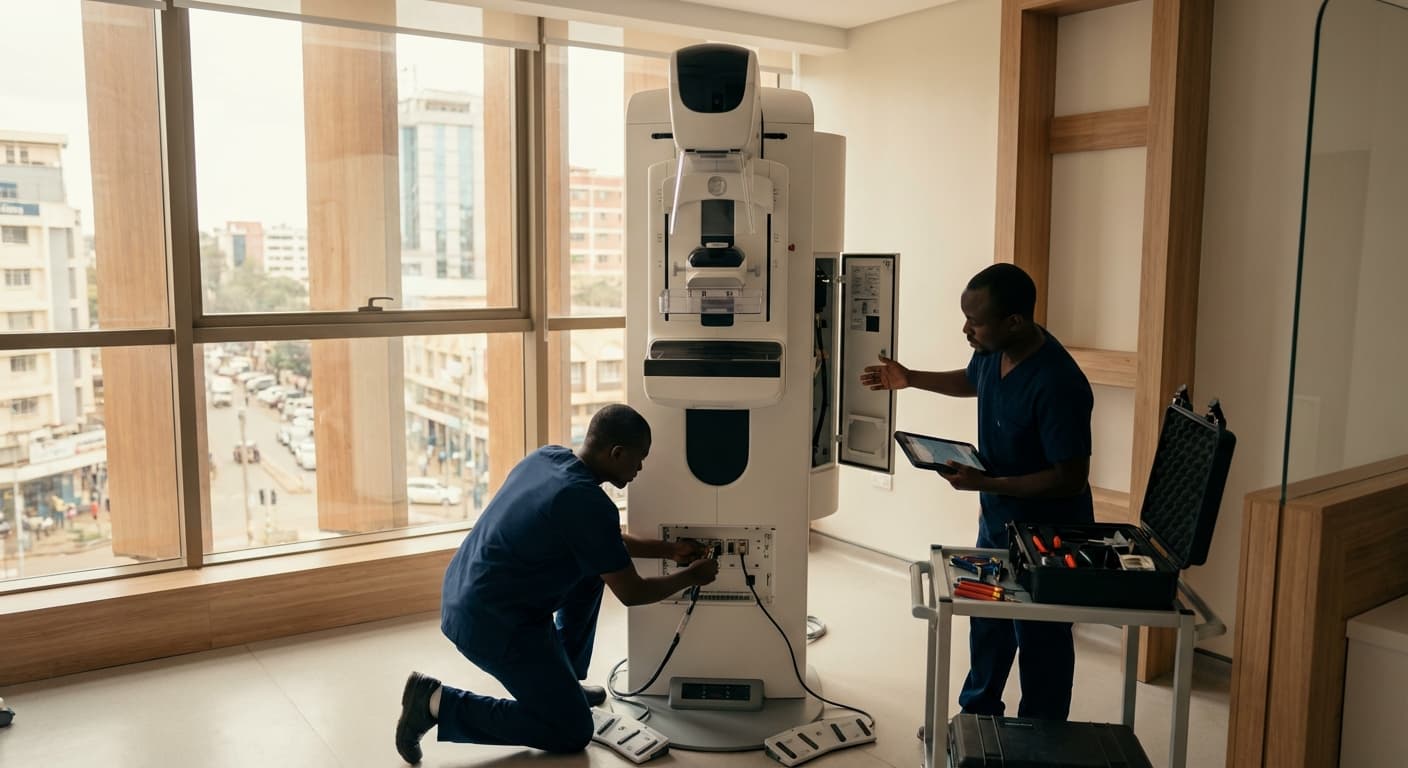
Mammography Installation Service in Sudan
Engineering Excellence & Technical Support
Mammography Installation Service High-standard technical execution following OEM protocols and local regulatory frameworks.
Expert Calibration & Quality Assurance
Our certified technicians in Sudan meticulously calibrate all mammography equipment to rigorous international standards, ensuring precise image acquisition and adherence to stringent quality assurance protocols for optimal diagnostic accuracy.
Rapid Deployment & Site Readiness
We provide swift and efficient installation services across Sudan, including remote and challenging terrains. Our team ensures thorough site preparation and immediate equipment integration, minimizing downtime and accelerating access to critical screening services.
Comprehensive Staff Training & Support
Beyond installation, we offer comprehensive, hands-on training for your Sudanese medical staff on the operation and maintenance of new mammography systems. Our commitment extends to ongoing technical support and troubleshooting to ensure sustained operational excellence.
What Is Mammography Installation Service In Sudan?
Mammography Installation Service in Sudan refers to the specialized process of deploying, configuring, and commissioning mammography equipment within healthcare facilities across Sudan. This service ensures that medical imaging systems designed for breast cancer screening and diagnosis are properly set up, calibrated, and integrated into existing hospital or clinic infrastructure to meet clinical, technical, and regulatory standards. The objective is to enable accurate and reliable mammographic imaging, crucial for early detection and management of breast pathologies.
| Need | Description | Typical Use Cases |
|---|---|---|
| New Healthcare Facilities | Establishment of new hospitals, clinics, or diagnostic centers requiring a fully operational mammography suite. | Setting up a new breast imaging department; equipping a new wing for women's health services. |
| Equipment Upgrade/Replacement | Replacing outdated or obsolete mammography machines with newer, more advanced digital or tomosynthesis systems. | Transitioning from film-screen to digital mammography; adopting 3D mammography (tomosynthesis) for improved lesion detection. |
| Expansion of Services | Healthcare providers seeking to expand their diagnostic imaging capabilities to include specialized breast screening and diagnosis. | A general hospital adding a dedicated breast imaging unit; a primary care clinic introducing basic screening services. |
| Relocation or Renovation | Moving existing mammography equipment to a new location within a facility or after significant renovation that impacts the installation environment. | Transferring a mammography unit to a newly constructed radiology department; re-installing equipment after a major building overhaul. |
| Regulatory Compliance | Ensuring that installed mammography equipment meets evolving national and international safety and performance standards. | Periodic re-installation or recalibration to comply with updated medical device regulations. |
Key Components of Mammography Installation Service:
- Site Assessment and Planning: Evaluation of the designated installation space to ensure compliance with radiation shielding requirements, environmental conditions (temperature, humidity, power stability), and structural integrity. Includes planning for cable routing, power supply, and ventilation.
- Equipment Delivery and Unpacking: Secure transportation of the mammography unit and associated accessories to the site, followed by careful unpacking and inventory verification.
- Physical Installation: Precise placement and mounting of the mammography system, including the X-ray tube, detector, compression paddle, and console. This involves mechanical assembly and alignment.
- Electrical and Network Connectivity: Connection to the facility's power grid, ensuring surge protection and adequate grounding. Integration with Picture Archiving and Communication Systems (PACS) and Electronic Health Records (EHR) for digital image management and workflow.
- Software Configuration and Integration: Installation and configuration of the mammography system's operating software, including image acquisition protocols, patient management modules, and quality control (QC) parameters. Integration with PACS/EHR requires specific network protocols and data formats.
- Calibration and Quality Assurance (QA): Rigorous calibration of all system components to ensure image quality and diagnostic accuracy. This includes X-ray output consistency, spatial resolution, contrast detectability, and dose monitoring. QA procedures align with international and local regulatory guidelines.
- Testing and Validation: Comprehensive testing of all system functions, including image acquisition, processing, display, and archiving. This involves phantom studies and clinical image validation by qualified radiographers and radiologists.
- Training: Instruction for radiographers, technologists, and IT personnel on the operation, basic maintenance, and troubleshooting of the mammography system. Training also covers adherence to safety protocols and QC procedures.
- Documentation and Handover: Provision of detailed installation reports, user manuals, service logs, and training materials. Formal handover of the operational system to the healthcare facility.
Who Needs Mammography Installation Service In Sudan?
Mammography installation is a critical service for ensuring the availability of advanced breast cancer screening and diagnostic tools. This service is essential for healthcare facilities in Sudan aiming to improve women's health outcomes by providing accurate and timely detection of breast abnormalities. The demand for such specialized installation stems from the increasing recognition of breast cancer's prevalence and the need for sophisticated medical equipment to combat it effectively.
| Customer Type | Key Departments Involved | Reason for Installation |
|---|---|---|
| Hospitals (Public & Private) | Radiology Department, Oncology Department, Women's Health Clinic, Surgical Department | Diagnosis of breast cancer, screening programs, post-treatment monitoring, pre-surgical assessment. |
| Diagnostic Imaging Centers | Radiology Department, Operations Management | Providing specialized mammography services to a wider patient base, improving diagnostic accuracy. |
| Cancer Treatment & Research Centers | Radiology Department, Oncology Research Unit, Clinical Trials Department, Pathology Department | Early detection for research cohorts, accurate staging, monitoring treatment efficacy, biopsy guidance. |
| Government Health Ministries | Public Health Department, National Cancer Control Program, Procurement Division | Implementing national screening programs, ensuring access to essential diagnostics in public facilities, disease surveillance. |
| NGOs & Humanitarian Aid Organizations | Healthcare Program Management, Project Implementation Team, Local Healthcare Partners | Improving access to breast cancer screening in remote or resource-limited areas, maternal and child health initiatives. |
Target Customers & Departments for Mammography Installation Service in Sudan
- {"title":"Hospitals (Public & Private)","description":"These are the primary sites requiring mammography installation. Both large national hospitals and smaller private clinics will benefit from this service. This includes hospitals focusing on general healthcare, specialized women's health centers, and oncology units."}
- {"title":"Diagnostic Imaging Centers","description":"Dedicated imaging centers that offer a range of diagnostic services, including mammography, are key customers. Their business model relies on providing advanced imaging technologies to referring physicians."}
- {"title":"Cancer Treatment & Research Centers","description":"Institutions focused on the research and treatment of cancer will require state-of-the-art mammography equipment for diagnosis, staging, and follow-up care. This also includes facilities involved in clinical trials and studies."}
- {"title":"Government Health Ministries & Public Health Initiatives","description":"Government bodies responsible for public health programs, especially those focused on women's health and disease screening, may procure and install mammography units in public health facilities across Sudan."}
- {"title":"Non-Governmental Organizations (NGOs) & Humanitarian Aid Organizations","description":"Organizations working to improve healthcare access and women's health in underserved regions of Sudan may fund and oversee the installation of mammography services as part of their healthcare delivery initiatives."}
Mammography Installation Service Process In Sudan
This document outlines the typical workflow for mammography installation services in Sudan, covering the entire process from initial inquiry to successful execution. The process is designed to ensure that new mammography equipment is installed correctly, safely, and in compliance with relevant Sudanese regulations and standards, ultimately enabling effective diagnostic imaging services.
| Phase | Key Activities | Responsible Parties | Deliverables | Notes/Considerations (Sudan Context) | |||||||||||||||||||||||||||||||||||||||||||||||||||||||
|---|---|---|---|---|---|---|---|---|---|---|---|---|---|---|---|---|---|---|---|---|---|---|---|---|---|---|---|---|---|---|---|---|---|---|---|---|---|---|---|---|---|---|---|---|---|---|---|---|---|---|---|---|---|---|---|---|---|---|---|
| Customer (hospital/clinic) expresses interest. Discusses needs, desired equipment specifications, and budget. Initial technical feasibility assessment. | Customer, Service Provider/Vendor | Understanding of customer requirements, preliminary technical advice. | Establish clear communication channels. Understand local healthcare infrastructure and existing equipment. |
| Detailed site survey: room dimensions, power availability, radiation shielding requirements, ventilation, network connectivity. Develop installation plan, including timelines, resource allocation, and potential challenges. | Service Provider/Vendor, Customer (facility manager, radiologist) | Site assessment report, installation plan, risk assessment. | Consult with local engineers for structural and electrical requirements. Understand local building codes and safety regulations regarding radiation. |
| Based on site assessment and equipment, provide a detailed quotation including equipment cost, installation labor, materials, training, and warranty. Negotiate contract terms, payment schedule, and service level agreements. | Service Provider/Vendor, Customer | Formal quotation, signed contract/agreement. | Ensure clarity on import duties, taxes, and customs clearance procedures in Sudan. Payment terms may require flexibility. |
| Order equipment from manufacturer. Manage shipping, customs clearance, and transportation to the site in Sudan. Secure necessary permits and approvals. | Service Provider/Vendor, Logistics Partner, Customs Authorities | Proof of shipment, customs clearance documents, delivery confirmation. | Coordinate closely with customs agents. Be prepared for potential delays in customs and transportation. Ensure proper insurance for transit. |
| Perform any necessary civil works, electrical upgrades, radiation shielding installation/verification, HVAC adjustments, and network cabling as per the installation plan. | Customer (facility), Contractors, Service Provider/Vendor (supervision) | Completed site modifications, updated blueprints (if applicable). | Engage reliable local contractors. Ensure compliance with local safety standards for construction and electrical work. Radiation shielding must meet international and Sudanese guidelines. |
| Transport equipment from arrival point to the installation room. Carefully unpack and inspect for any damage. | Service Provider/Vendor, Logistics Team | Unpacked equipment, initial inspection report. | Handle with extreme care. Document any visible damage immediately. |
| Assemble and connect all components of the mammography system according to manufacturer's specifications and installation plan. | Service Provider/Vendor (certified technicians) | Assembled mammography unit. | Technicians must be manufacturer-certified. Follow all safety protocols during assembly. |
| Configure software, network settings, and integrate with Picture Archiving and Communication System (PACS) and/or Electronic Medical Record (EMR) systems if applicable. | Service Provider/Vendor (field engineers, IT specialists) | Configured system, basic functionality test results. | Ensure compatibility with existing IT infrastructure. Local IT support may be required. |
| Conduct comprehensive tests to verify system performance, image quality, and radiation output against manufacturer's specifications and regulatory requirements. Perform necessary calibrations. | Service Provider/Vendor (application specialists, engineers) | Performance verification report, calibration certificates, QA test results. | Adherence to international quality assurance (QA) standards is crucial. Radiological physicist involvement may be necessary. |
| Provide hands-on training to radiologists, radiographers, and relevant technical staff on system operation, image acquisition, basic troubleshooting, and quality control procedures. | Service Provider/Vendor (application specialists) | Trained personnel, training attendance sheets, training materials. | Training should be tailored to the specific needs and experience level of the Sudanese staff. Language considerations may be important. |
| Provide all necessary documentation, including user manuals, service manuals, warranty information, installation reports, QA reports, and training records. Formal handover to the customer. | Service Provider/Vendor | Complete documentation package, signed handover certificate. | Ensure all documentation is accessible and understandable. Confirm customer acknowledgment of the delivered system. |
| Provide ongoing technical support, routine maintenance, and repairs as per the service agreement. Respond to any issues or malfunctions. | Service Provider/Vendor | Ongoing technical support, completed maintenance records. | Establish a clear support contact and response time. Availability of spare parts and trained local technicians is vital for long-term service. |
Mammography Installation Service Process in Sudan
- Inquiry and Initial Consultation
- Site Assessment and Planning
- Quotation and Contract Negotiation
- Equipment Procurement and Logistics
- Site Preparation and Infrastructure Work
- Equipment Delivery and Unpacking
- Installation and Assembly
- System Configuration and Testing
- Performance Verification and Calibration
- Operator Training
- Documentation and Handover
- Post-Installation Support and Maintenance
Mammography Installation Service Cost In Sudan
Installing mammography equipment in Sudan involves a range of costs influenced by several key factors. These include the type and complexity of the mammography unit (e.g., digital mammography, 3D mammography/tomosynthesis, analog), the brand and manufacturer, the specific features and technological advancements of the chosen model, and the required accessories and peripherals. The installation process itself incurs costs related to site preparation (which can vary significantly based on the existing infrastructure of the healthcare facility), transportation of the equipment to the installation site, specialized labor for assembly and calibration, and testing to ensure optimal performance. Furthermore, training for radiographers and technicians on operating the new system is an essential component of the service and contributes to the overall cost. The geographic location within Sudan can also impact expenses due to differing transportation and logistical challenges. Maintenance and support contracts, often included or offered alongside installation, add to the initial investment but are crucial for long-term operational efficiency and equipment longevity.
| Cost Component | Estimated Range (SDG - Sudanese Pound) |
|---|---|
| Basic Digital Mammography Unit Installation (excluding equipment purchase) | 5,000,000 - 15,000,000+ |
| Advanced Digital Mammography/Tomosynthesis Unit Installation (excluding equipment purchase) | 10,000,000 - 30,000,000+ |
| Site Preparation & Electrical Work (can be highly variable) | 2,000,000 - 10,000,000+ |
| Transportation & Logistics | 1,000,000 - 5,000,000+ |
| Installation, Calibration & Testing Labor | 3,000,000 - 8,000,000+ |
| Operator & Technician Training | 2,000,000 - 6,000,000+ |
| Annual Maintenance/Support Contract (post-installation) | 5,000,000 - 15,000,000+ |
Factors Influencing Mammography Installation Costs in Sudan:
- Type of Mammography Unit (Digital, 3D/Tomosynthesis, Analog)
- Brand and Manufacturer Reputation/Quality
- Specific Features and Technological Advancements
- Required Accessories and Peripherals
- Site Preparation Requirements (e.g., power, shielding, space)
- Transportation and Logistics Costs to Installation Site
- Specialized Labor for Installation, Calibration, and Testing
- Operator and Technician Training Programs
- Geographic Location within Sudan
- Post-Installation Support and Maintenance Contracts
Affordable Mammography Installation Service Options
Investing in mammography equipment is crucial for medical facilities aiming to provide essential cancer screening services. Finding affordable installation services that offer value is key. This guide explores various service options, highlighting the benefits of value bundles and effective cost-saving strategies.
| Cost-Saving Strategy | Description | Potential Impact |
|---|---|---|
| Negotiate Package Deals | Instead of individual quotes, request bundled pricing from multiple vendors. Leverage the purchase of multiple units or related equipment to gain negotiating power. | Significant discounts (10-25%) on overall installation and equipment costs. |
| Consider Refurbished or Pre-owned Equipment | Purchasing certified refurbished mammography machines from reputable providers can drastically reduce upfront equipment costs. Installation services are still readily available for these units. | Up to 50% reduction in equipment acquisition costs, while still benefiting from professional installation. |
| Phased Installation Approach | If budget is a major constraint, explore options to phase the installation. This might involve installing core components first and adding advanced features or upgrades later. | Spreads out capital expenditure, making it more manageable. May slightly increase long-term total cost due to potential future service calls for upgrades. |
| Compare Installation-Only Services | If you've sourced equipment independently, research companies that specialize solely in mammography installation. This can be more cost-effective than comprehensive vendor packages if you're confident in your equipment choice. | Potentially lower service fees compared to bundled installation from equipment manufacturers. Requires more coordination from your end. |
| Inquire About Training Inclusion | Ensure training is included in the installation package. Proper staff training reduces the likelihood of operational errors and costly service calls down the line. | Minimizes operational downtime and reduces the need for emergency service, saving money and improving efficiency. |
| Look for Extended Warranty Options | While an upfront cost, an extended warranty can provide peace of mind and protect against unexpected repair bills, especially in the early years of operation. | Predictable maintenance costs, avoiding large, unplanned repair expenses. |
| Leverage Government Grants or Rebates | Investigate available federal, state, or local grants or rebates for medical equipment upgrades, particularly for facilities serving underserved populations. These can offset installation and equipment costs. | Direct financial assistance, significantly reducing out-of-pocket expenses. |
| Off-Peak Installation Scheduling | Inquire if scheduling installation during less busy periods (e.g., weekends, off-hours) can lead to reduced labor costs. This requires careful planning to minimize disruption. | Potential reduction in labor charges, particularly if overtime rates are avoided. |
Understanding Value Bundles
- {"title":"What are Value Bundles?","description":"Value bundles are packages of services and/or equipment offered together at a discounted price compared to purchasing each component individually. For mammography installation, this often includes the equipment itself, the installation process, training, and sometimes initial maintenance or extended warranties."}
- {"title":"Benefits of Bundles","description":"Bundles simplify the procurement process, reduce administrative overhead, and often lead to significant cost savings. They also ensure seamless integration of equipment and services, minimizing potential compatibility issues and delays."}
- {"title":"Common Bundle Components","description":"Typical components include the mammography unit, imaging software, installation labor, calibration, site preparation consultation, staff training on operation and basic maintenance, and sometimes a first-year service contract."}
Verified Providers In Sudan
In Sudan's evolving healthcare landscape, identifying reliable and accredited medical facilities is paramount for ensuring quality patient care. Franance Health stands out as a leading network of verified providers, offering a commitment to excellence, patient safety, and advanced medical practices. This verification process signifies adherence to rigorous standards, making Franance Health a trusted choice for individuals seeking the highest caliber of healthcare services in Sudan.
| Provider Type | Franance Health Verification Key Indicators | Benefits for Patients |
|---|---|---|
| Hospitals | JCI/ISO Accreditation, Advanced Surgical Suites, ICU Capabilities, Comprehensive Emergency Services | Access to complex procedures, 24/7 critical care, prompt emergency response. |
| Specialty Clinics (e.g., Cardiology, Oncology) | Board-certified specialists, cutting-edge diagnostic equipment, adherence to evidence-based treatment protocols | Expert care for specific conditions, personalized treatment plans, access to specialized therapies. |
| Diagnostic Centers | Accredited laboratories, advanced imaging technology (MRI, CT Scan), skilled radiographers and pathologists | Accurate and timely diagnostic results, reliable screening and monitoring. |
| Maternal and Child Health Centers | Certified obstetricians and pediatricians, well-equipped delivery rooms, neonatal intensive care units (NICU) | Safe childbirth, specialized care for newborns, comprehensive pediatric services. |
| Rehabilitation Centers | Licensed physical therapists, occupational therapists, modern rehabilitation equipment | Effective recovery from injuries and illnesses, improved mobility and function. |
Why Franance Health Credentials Matter
- Rigorous Accreditation Standards: Franance Health providers undergo a stringent vetting process, ensuring they meet internationally recognized benchmarks for medical competence, infrastructure, and ethical practices.
- Commitment to Patient Safety: Verification includes an in-depth review of safety protocols, infection control measures, and the qualifications of medical staff, prioritizing patient well-being above all.
- Access to Advanced Technologies: Franance Health partners with facilities equipped with modern diagnostic and treatment technologies, allowing for more accurate diagnoses and effective therapies.
- Experienced and Qualified Professionals: The network comprises highly skilled doctors, nurses, and allied health professionals with extensive experience and specialized training.
- Transparent and Ethical Operations: Verified providers operate with transparency in their billing, treatment plans, and patient communication, fostering trust and accountability.
- Continuity of Care: Franance Health aims to ensure seamless patient journeys, from initial consultation to follow-up care, often through integrated service networks.
Scope Of Work For Mammography Installation Service
This Scope of Work (SOW) outlines the requirements for the installation of a new mammography system at [Hospital/Clinic Name], located at [Address]. The service includes the delivery, uncrating, assembly, installation, testing, and initial user training for the specified mammography equipment. The objective is to ensure the system is fully functional, calibrated, and integrated with existing hospital IT infrastructure according to manufacturer specifications and relevant regulatory standards.
| Component/Phase | Description | Standard Specifications/Compliance | Verification Method |
|---|---|---|---|
| Site Preparation Verification | Confirmation that the installation site meets all physical, electrical, and environmental requirements as per manufacturer's site planning guide. | Manufacturer Site Planning Guide (latest version), local building codes, electrical safety standards (e.g., IEC 60601-1). | Pre-installation site survey report, checklist completion. |
| Equipment Delivery & Uncrating | Safe and secure transportation and uncrating of all system components. | No visible damage to any component during transport or uncrating. | Visual inspection, photographic documentation, damage report if necessary. |
| System Assembly & Installation | Assembly and positioning of all mammography system components (e.g., gantry, detector, console, workstation) according to manufacturer's instructions. | Adherence to manufacturer's assembly procedures, ergonomic considerations, and workflow optimization. | Installation checklist completion, visual confirmation of correct positioning. |
| Electrical & Network Connectivity | Connection of the system to appropriate power outlets and network infrastructure. | Compliance with electrical safety standards, network bandwidth and latency requirements for PACS/RIS integration. | Electrical safety testing (e.g., ground resistance, insulation resistance), network connectivity tests, ping tests. |
| Software Installation & Configuration | Installation and configuration of all required system software, including operating system, imaging software, and any PACS/RIS client software. | Correct version and patch levels as specified by manufacturer and hospital IT, user profile setup. | Software version verification, system configuration checks, user login tests. |
| Performance Testing | Execution of all manufacturer-defined performance and safety tests to ensure optimal system operation. | Adherence to manufacturer's test protocols, specific parameters for image quality (e.g., MTF, SNR), radiation output accuracy, dose monitoring. | Completion of all manufacturer-specified tests, generation of test reports, image quality assessments. |
| Calibration | System calibration to ensure accurate image acquisition and diagnostic performance. | Compliance with national and international imaging standards (e.g., ACR, AAPM), consistent image output. | Calibration reports, phantom image analysis. |
| PACS/RIS Integration | Successful integration of the mammography system with existing PACS and RIS for image archival, retrieval, and reporting. | DICOM compliance, successful image transfer (send/receive), order integration, report routing. | Test image transfers to PACS, order verification in RIS, simulated reporting workflow. |
| Acceptance Testing | Formal acceptance testing by hospital clinical and IT staff to validate system functionality and performance. | Sign-off by authorized hospital personnel based on successful completion of predefined test scenarios. | Completed acceptance test form, sign-off from key stakeholders. |
| User Training | Provision of initial training to key personnel on the operation, basic troubleshooting, and maintenance of the mammography system. | Content covers system operation, image acquisition parameters, quality control procedures, basic error handling. | Training attendance records, post-training assessment (optional). |
| Documentation Handover | Delivery of all relevant technical and operational documentation. | Manufacturer installation manuals, user guides, service manuals, calibration certificates, warranty information. | Verification of completeness and accuracy of all provided documents. |
Key Technical Deliverables
- Fully assembled and installed mammography system at the designated location.
- Successful completion of all manufacturer-specified performance and safety tests.
- Calibration of the mammography system to meet diagnostic imaging standards.
- Integration of the mammography system with the hospital's PACS (Picture Archiving and Communication System) and RIS (Radiology Information System).
- Successful completion of acceptance testing by hospital IT and clinical staff.
- Provision of all required documentation, including installation manuals, user guides, and calibration certificates.
- Initial training session for designated radiology technologists and supporting staff.
Service Level Agreement For Mammography Installation Service
This Service Level Agreement (SLA) outlines the guaranteed response times and uptime for the Mammography Installation Service provided by [Your Company Name] to [Client Company Name]. This SLA is an integral part of the overall Service Agreement.
| Service Component | SLA Commitment | Definition/Measurement |
|---|---|---|
| Installation Scheduling Confirmation | 4 Business Hours | Time from client request to confirmation of proposed installation dates and times. |
| On-Site Technician Arrival (Pre-Installation) | Within 15 minutes of scheduled arrival time | Time technician is expected to arrive on-site for initial setup and preparation. |
| Critical Issue Response Time (During Installation) | 1 Business Hour | Time from reporting a critical issue (e.g., major hardware failure, power outage affecting installation) to initial acknowledgment and commencement of troubleshooting by [Your Company Name]'s support team. |
| Non-Critical Issue Response Time (During Installation) | 4 Business Hours | Time from reporting a non-critical issue (e.g., minor software glitch, aesthetic concern) to initial acknowledgment and commencement of troubleshooting by [Your Company Name]'s support team. |
| Installation Completion Uptime Guarantee | 99.5% | The mammography system and its core functionalities will be operational and ready for initial testing and calibration for at least 99.5% of the scheduled installation period (excluding planned maintenance or client-caused delays). |
Key Service Components
- Service Availability: [Your Company Name] will endeavor to ensure that all systems and personnel related to the mammography installation process are available and operational during agreed-upon working hours.
- Response Times: This section defines the maximum time for [Your Company Name] to acknowledge and begin addressing reported issues.
- Uptime Guarantees: This section specifies the minimum percentage of time the installation service will be available and functional.
- Escalation Procedures: Details the process for escalating critical issues to higher levels of support.
- Reporting and Monitoring: Outlines how service performance will be tracked and reported.
Frequently Asked Questions

Ready when you are
Let's scope your Mammography Installation Service in Sudan project in Sudan.

Scaling healthcare logistics and technical systems across the entire continent.