
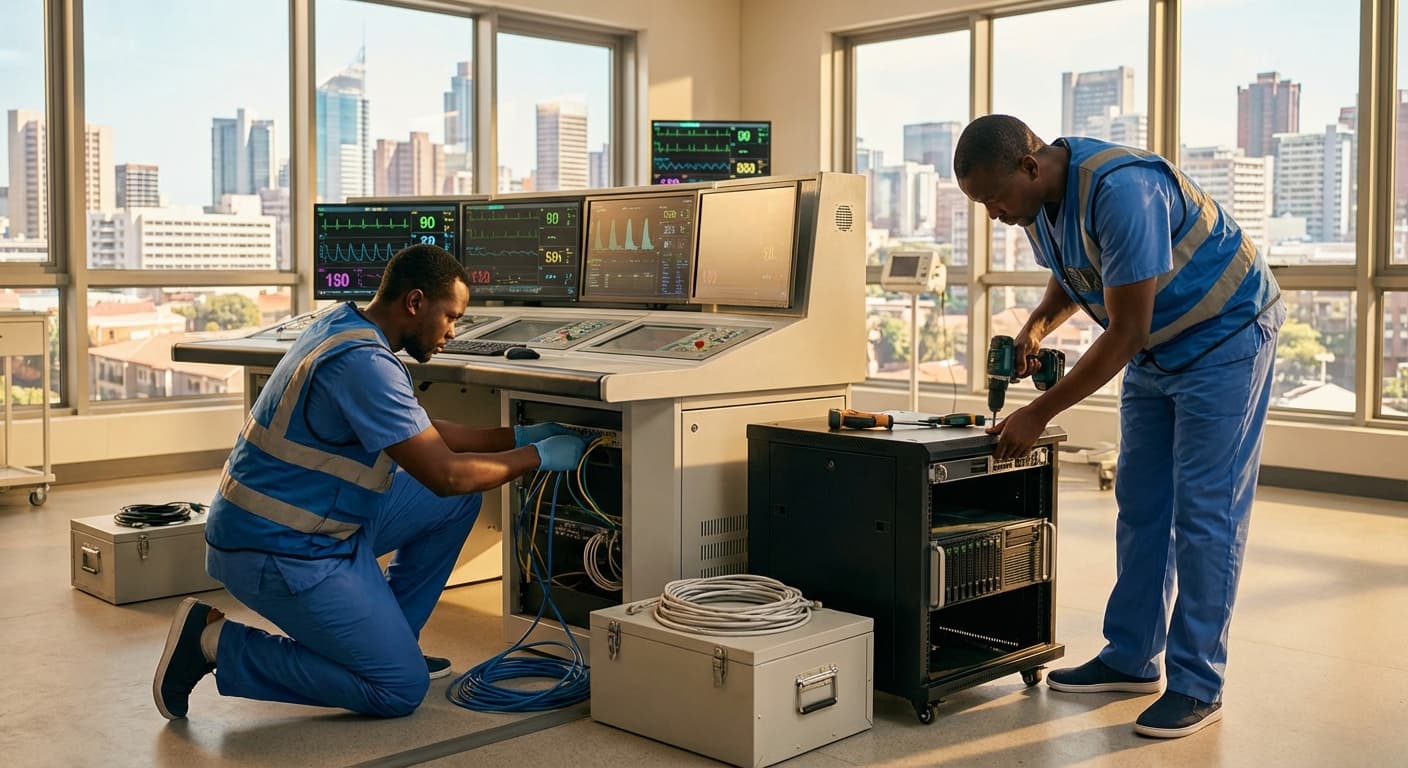
ICU Central Monitoring Station Installation Service in Sudan
Engineering Excellence & Technical Support
ICU Central Monitoring Station Installation Service High-standard technical execution following OEM protocols and local regulatory frameworks.
Robust & Reliable Infrastructure
Our Sudan-based installation ensures a resilient and dependable ICU central monitoring infrastructure, minimizing downtime and maximizing patient safety through meticulously planned cabling, power redundancy, and secure network architecture.
Scalable & Future-Proof Solutions
We design and implement ICU central monitoring systems in Sudan with inherent scalability, accommodating future growth in patient beds and technological advancements, ensuring long-term value and adaptability for your healthcare facility.
Expert Localized Installation & Support
Leveraging specialized technical expertise and a deep understanding of the Sudanese healthcare landscape, our team provides efficient, compliant, and localized installation, coupled with ongoing technical support for seamless operation of your ICU central monitoring systems.
What Is Icu Central Monitoring Station Installation Service In Sudan?
ICU Central Monitoring Station Installation Service in Sudan refers to the specialized process of designing, procuring, integrating, and commissioning a centralized system for continuous physiological monitoring of intensive care unit (ICU) patients within healthcare facilities in Sudan. This service ensures that critical patient data, such as vital signs, are collected, transmitted, and displayed in a unified location, enabling rapid clinical response and enhanced patient management. The installation encompasses the setup of a network infrastructure, server hardware, software applications, display consoles, and the necessary interfaces to connect individual patient monitoring devices within the ICU to the central station. It also includes configuration, calibration, testing, and training for healthcare personnel.
| Service Aspect | Description | Relevance in Sudan Context |
|---|---|---|
| Needs Assessment and Site Survey | Evaluating the existing infrastructure, power stability, network capacity, and specific monitoring requirements of the ICU. | Crucial due to varying infrastructure quality and potential for power disruptions, necessitating robust planning for resilience. |
| System Design and Architecture | Developing a scalable and reliable architecture for the central monitoring system, considering patient load, data security, and future expansion. | Aims to provide a sustainable solution that can adapt to evolving healthcare needs and technological advancements in Sudan. |
| Hardware and Software Procurement | Sourcing and acquiring appropriate central monitoring units, servers, workstations, network devices, and licensed software. | Requires navigating import regulations and ensuring access to reliable, industry-standard equipment, potentially with consideration for localized support. |
| Installation and Cabling | Physical installation of all hardware components, including cabling for network connectivity and power. | Demands skilled technicians familiar with healthcare facility environments and adherence to safety standards. |
| Integration and Interoperability | Connecting patient monitors (e.g., ECG, SpO2, NIBP, respiration) to the central system and integrating with other hospital IT systems. | Essential for seamless data flow and comprehensive patient record management, improving clinical decision-making efficiency. |
| Configuration and Calibration | Setting up system parameters, alarm thresholds, user profiles, and ensuring accurate data acquisition from connected devices. | Critical for ensuring the accuracy and reliability of patient data, directly impacting clinical care quality. |
| Testing and Commissioning | Thorough testing of all system functionalities, including data transmission, alarm alerts, and redundancy, followed by formal handover. | Verifies system performance and reliability before critical patient use, ensuring operational readiness. |
| Training and Documentation | Providing comprehensive training to medical staff and IT personnel on system operation, maintenance, and troubleshooting. Delivering detailed technical documentation. | Empowers local healthcare professionals to effectively utilize and manage the system, fostering self-sufficiency. |
| Ongoing Support and Maintenance | Establishing service level agreements (SLAs) for maintenance, troubleshooting, and potential upgrades. | Ensures long-term system viability and minimizes downtime, which is paramount in critical care settings. |
Key Components of ICU Central Monitoring Station Installation Service
- Network Infrastructure Design and Deployment (LAN/WAN, Wi-Fi)
- Server and Workstation Hardware Procurement and Installation
- Central Monitoring Software Installation and Configuration
- Integration with Existing Hospital Information Systems (HIS) / Electronic Health Records (EHR)
- Patient Monitor Interface Module Configuration and Testing
- Display Console Setup and Customization
- Alarm Management System Configuration and Integration
- Data Archiving and Retrieval System Implementation
- System Calibration and Validation
- User Training (Clinicians, IT Staff)
- Post-Installation Support and Maintenance Planning
Who Needs Icu Central Monitoring Station Installation Service In Sudan?
The installation of an ICU Central Monitoring Station (CMS) service is a critical infrastructure upgrade for healthcare facilities in Sudan that are committed to providing advanced critical care. This service is essential for hospitals aiming to enhance patient safety, improve clinical outcomes, and optimize the efficiency of their Intensive Care Units. A CMS allows for the simultaneous monitoring of multiple ICU patients from a single, centralized location, enabling a dedicated team to quickly detect and respond to deteriorating patient conditions.
| Customer Type | Key Motivations for CMS Installation | Relevant Departments |
|---|---|---|
| Public Hospitals | Improving patient outcomes, increasing capacity, standardizing care, fulfilling national health objectives. | ICU, Administration, Biomedical Engineering, IT |
| Private Hospitals | Enhancing service quality, attracting specialized medical talent, competitive advantage, patient satisfaction, revenue generation. | ICU, Cardiology, Neurology, Surgery, Administration, Biomedical Engineering, IT |
| Tertiary/Referral Hospitals | Managing complex and critically ill patients, facilitating efficient patient management, supporting specialized procedures. | ICU, all specialized departments, Administration, Biomedical Engineering, IT |
| Teaching Hospitals | Providing advanced learning environments, exposing students to cutting-edge technology, research capabilities. | ICU, all clinical departments, Medical Education, Administration, Biomedical Engineering, IT |
| Humanitarian/NGO Medical Facilities | Providing essential critical care in challenging environments, rapid response to mass casualty incidents, efficient resource utilization. | ICU, Emergency, Administration, Biomedical Engineering |
Target Customers and Departments for ICU Central Monitoring Station Installation Service in Sudan
- Hospitals with existing or planned ICU facilities.
- Government-funded public hospitals aiming to upgrade their critical care capabilities.
- Private hospitals and healthcare groups seeking to offer premium critical care services.
- Tertiary care hospitals that serve as referral centers for complex medical cases.
- Teaching hospitals that require state-of-the-art equipment for training medical professionals.
- Hospitals in urban and semi-urban centers with a higher patient load and the potential for specialized medical services.
- Organizations involved in humanitarian aid and medical missions that require robust monitoring solutions.
- Hospitals undergoing significant renovation or expansion projects that include the development or enhancement of their ICU.
- The following hospital departments are the primary beneficiaries and key stakeholders:
- Intensive Care Unit (ICU) itself
- Cardiology Department (especially for CCU/ICU overlap)
- Nephrology Department (for renal ICU needs)
- Pulmonology Department (for respiratory ICU needs)
- Neurosurgery/Neurology Department (for neuro-ICU needs)
- Surgical Departments (for post-operative critical care)
- Emergency Department (for immediate transfer and monitoring continuity)
- Biomedical Engineering Department (for maintenance and integration)
- Information Technology (IT) Department (for network integration and data management)
- Hospital Administration and Management (for strategic investment and resource allocation)
Icu Central Monitoring Station Installation Service Process In Sudan
This document outlines the standard workflow for installing an ICU Central Monitoring Station service in Sudan, from the initial customer inquiry to the final execution and handover. The process is designed to be efficient, transparent, and tailored to the specific needs of healthcare facilities in the region.
| Step | Description | Responsible Party | Deliverables |
|---|---|---|---|
| Client expresses interest and provides initial requirements. | Client | Initial Request |
| Understanding client's specific needs, current infrastructure, and site conditions. | Service Provider (Technical Sales/Consultant) | Needs Analysis Report, Site Survey Findings |
| Detailed technical proposal, equipment list, installation plan, and cost breakdown. | Service Provider | Formal Proposal, Bill of Quantities (BoQ), Quotation |
| Formal contract negotiation and signing. | Client & Service Provider | Signed Service Agreement |
| Sourcing, purchasing, and shipping of all required hardware and software to Sudan. | Service Provider | Procured Equipment, Shipment Tracking |
| Physical installation of the central monitoring station, network setup, and software configuration. | Service Provider (Installation Engineers) | Installed Central Monitoring Station, Configured Network |
| Comprehensive testing of all system functionalities, data integrity, and alarm management. | Service Provider (Engineers/Quality Assurance) | Test Reports, Validation Certificates |
| Training for clinical staff on system operation, maintenance, and troubleshooting. | Service Provider (Trainer) | Training Materials, Training Attendance Records |
| Official handover of the operational system and provision of all necessary documentation. | Service Provider | Handover Certificate, User Manuals, Warranty Information |
| Ongoing technical support, maintenance, and potential software updates as per contract. | Service Provider (Support Team) | Support Tickets, Maintenance Reports, Service Level Agreement (SLA) |
ICU Central Monitoring Station Installation Service Process in Sudan
- {"title":"Phase 1: Inquiry and Initial Consultation","description":"The process begins with a potential client in Sudan expressing interest in an ICU Central Monitoring Station installation. This phase focuses on understanding their requirements and providing preliminary information."}
- {"title":"Phase 2: Needs Assessment and Site Survey","description":"A detailed assessment of the client's facility is conducted to understand the existing infrastructure, specific ICU requirements, and any unique environmental factors."}
- {"title":"Phase 3: Proposal and Quotation","description":"Based on the needs assessment, a comprehensive proposal and quotation are prepared, detailing the scope of work, equipment, software, installation timeline, and associated costs."}
- {"title":"Phase 4: Contract Agreement","description":"Once the client accepts the proposal, a formal contract is established, outlining the terms and conditions of the service agreement."}
- {"title":"Phase 5: Equipment Procurement and Logistics","description":"All necessary equipment and software are procured and prepared for shipment to Sudan. This includes managing customs clearance and local transportation."}
- {"title":"Phase 6: Installation and Configuration","description":"The installation team arrives on-site and proceeds with the physical installation of the central monitoring station, connecting it to existing patient monitors and other relevant devices. Software configuration and network integration are performed."}
- {"title":"Phase 7: Testing and Validation","description":"Thorough testing of all system components and functionalities is conducted to ensure optimal performance, accuracy, and reliability. This includes simulated patient scenarios."}
- {"title":"Phase 8: Training","description":"Comprehensive training is provided to the healthcare staff responsible for operating and maintaining the central monitoring station, covering system operation, alarm management, data interpretation, and basic troubleshooting."}
- {"title":"Phase 9: Handover and Documentation","description":"Upon successful installation, testing, and training, the system is officially handed over to the client. All relevant documentation, including user manuals and maintenance guides, is provided."}
- {"title":"Phase 10: Post-Installation Support","description":"Ongoing technical support, maintenance services, and software updates are offered as per the service agreement to ensure the continuous optimal performance of the ICU Central Monitoring Station."}
Icu Central Monitoring Station Installation Service Cost In Sudan
Installing an ICU Central Monitoring Station (CMS) in Sudan involves a multifaceted cost structure, influenced by several key factors. The complexity of the system, the number of patient monitoring units, the brand and features of the equipment, and the scope of installation services all play a significant role in determining the final price. Additionally, factors like geographical location within Sudan, accessibility of the installation site, and the prevailing economic conditions, including currency fluctuations, will impact the overall expenditure. It's crucial to obtain detailed quotes from multiple reputable suppliers and installers to get an accurate understanding of the cost.
| Category | Estimated Range (SDG) | Notes |
|---|---|---|
| Basic ICU CMS (e.g., 4-6 beds, standard parameters) | 500,000 - 1,500,000 | Covers essential monitoring equipment and standard installation. May include fewer features or less advanced brands. |
| Mid-Range ICU CMS (e.g., 8-12 beds, comprehensive parameters, some advanced features) | 1,500,000 - 5,000,000 | Includes more patient monitors, advanced diagnostic capabilities, and potentially a basic central server. Brand reputation plays a larger role here. |
| High-End/Advanced ICU CMS (e.g., 12+ beds, full suite of parameters, integrated software, sophisticated networking) | 5,000,000 - 15,000,000+ | For larger ICUs with critical care needs, demanding the latest technology, robust data management, and seamless integration with hospital information systems. Significant investment in premium brands and complex installations. |
| Installation Service Fee (separate from equipment) | 100,000 - 500,000+ | This is highly variable based on the complexity, duration, and scope of the installation services, including training and customization. |
| Contingency (for unforeseen issues, currency fluctuations) | 10% - 15% of total estimated cost | Recommended to buffer against unexpected expenses. |
Key Pricing Factors for ICU Central Monitoring Station Installation in Sudan
- Equipment Costs:
- Central Monitoring Unit (CMU): The core of the system, its capabilities (display size, number of waveforms, data storage, networking) dictate its price.
- Patient Monitors: The number of bedside monitors required, their specific parameters (ECG, SpO2, NIBP, temperature, invasive pressures, respiration, etc.), and advanced features (e.g., anesthesia modules, capnography) significantly influence cost.
- Connectivity & Networking: Cables, network switches, wireless access points, and integration software for seamless data flow between bedside monitors and the CMU.
- Server & Software: If a central server is required for long-term data storage and analysis, its cost and associated licensing fees will be added.
- Accessories: Articulating arms, wall mounts, rolling stands for monitors, and other essential peripherals.
- Installation Service Costs:
- Site Survey & Planning: Initial assessment of the ICU layout, power requirements, and network infrastructure.
- Hardware Installation: Mounting and physical setup of the CMU and bedside monitors.
- System Configuration & Integration: Setting up software, configuring parameters, and ensuring interoperability between devices.
- Network Cabling & Setup: Installation of wired or wireless network infrastructure.
- Testing & Calibration: Thorough testing of all functionalities and calibration of sensors for accuracy.
- Training: On-site training for medical staff on the operation and maintenance of the CMS.
- Warranty & Support: The duration and scope of the warranty, and the availability of ongoing technical support.
- Other Influencing Factors:
- Brand & Manufacturer: Reputable international brands typically command higher prices but often offer better reliability and support.
- Number of Beds/Units: The more patient monitoring points, the higher the overall equipment and installation cost.
- Complexity of ICU: Specialized ICUs might require more advanced monitoring capabilities.
- Location: Installation in remote areas may incur additional travel and logistical costs.
- Import Duties & Taxes: Applicable taxes and customs duties on imported medical equipment in Sudan.
- Currency Exchange Rates: Fluctuations in the Sudanese Pound (SDG) against major currencies (USD, EUR) will affect imported equipment costs.
- Supplier & Installer Reputation: Established and experienced providers may charge more for their expertise and reliability.
Affordable Icu Central Monitoring Station Installation Service Options
Installing an ICU Central Monitoring Station (CMS) is a critical investment for any healthcare facility, ensuring continuous patient oversight and rapid response capabilities. While the initial outlay can seem significant, understanding the available service options, value bundles, and cost-saving strategies can make this essential upgrade more accessible and financially viable. This guide explores how to achieve affordable CMS installation without compromising on quality or functionality.
| Service/Bundle Option | Description | Potential Value/Cost Savings |
|---|---|---|
| Basic Installation Package | Includes hardware setup, basic network configuration, and initial system testing. Often the most straightforward and budget-friendly option. | Lower upfront cost. Suitable for facilities with simpler monitoring needs or existing robust IT infrastructure. |
| Integrated Solutions Bundle | Combines CMS installation with EMR/EHR integration, networking upgrades, and potentially other patient care technologies. A comprehensive, all-in-one approach. | Streamlined implementation, reduced compatibility issues, potential discounts for bundled services. Saves time and resources on separate integration projects. |
| Extended Support & Training Bundle | Includes extended warranty periods, on-site training for clinical and IT staff, and proactive system maintenance. Focuses on long-term operational efficiency. | Minimizes unexpected repair costs, improves staff proficiency leading to better utilization and fewer errors. Reduces downtime and associated financial losses. |
| Refurbished Equipment Option | Utilizing high-quality, certified refurbished monitoring devices and workstations where appropriate, paired with new central station software. | Significant reduction in hardware acquisition costs. Careful selection ensures reliability and performance. |
| Managed Services Agreement | Outsourcing the ongoing maintenance, monitoring, and technical support of the CMS to a third-party provider. | Predictable monthly costs, frees up internal IT resources, access to specialized expertise. Reduces the need for in-house specialized staff and equipment. |
Key Considerations for Affordable ICU CMS Installation
- Needs Assessment: Accurately determining the required number of beds, monitoring parameters, and integration needs is crucial to avoid overspending on unnecessary features.
- Technology Scalability: Opting for systems that can grow with your facility's future needs reduces the likelihood of costly upgrades down the line.
- Vendor Reputation and Support: Choosing established vendors with a proven track record for reliable equipment and excellent post-installation support is essential for long-term cost-effectiveness.
- Integration with Existing Infrastructure: Ensuring seamless integration with current EMR/EHR systems, PACS, and other hospital IT can prevent expensive custom development or workarounds.
- Training and User Adoption: Proper training for clinical staff is vital for efficient system utilization, minimizing errors and maximizing the return on investment.
- Phased Implementation: For larger facilities, a phased rollout can distribute costs over time and allow for iterative improvements based on early feedback.
Verified Providers In Sudan
In Sudan's evolving healthcare landscape, identifying truly Verified Providers is crucial for ensuring quality and trustworthy medical services. Franance Health stands out as a premier organization, distinguished by its rigorous credentialing process and commitment to upholding the highest standards. This dedication makes them the optimal choice for individuals and organizations seeking reliable healthcare partners in Sudan.
| Franance Health Credentialing Aspect | Benefit to Patients/Clients | Franance Health's Approach |
|---|---|---|
| Academic and Professional Qualifications Verification | Ensures providers possess the necessary theoretical knowledge and practical skills. | Meticulous checks of degrees, diplomas, certifications, and residency completion. |
| Licensing and Regulatory Compliance | Guarantees that providers are legally authorized to practice medicine in Sudan. | Verification of current and valid medical licenses with relevant Sudanese authorities. |
| Work Experience and Employment History | Confirms practical experience and a track record of competent service. | Thorough verification of past and present employment, including references where applicable. |
| Ethical Conduct and Professional Reputation | Assures that providers operate with integrity and respect for patients. | Checks for any disciplinary actions or adverse findings from professional bodies or past employers. |
| Specialty Competency Assessment | Confirms expertise in specific medical fields. | Review of board certifications, fellowship training, and peer endorsements for specialized areas. |
| Commitment to Patient-Centered Care | Ensures a focus on patient well-being, communication, and satisfaction. | Emphasis on providers demonstrating empathy, effective communication, and a commitment to ethical patient management. |
Why Franance Health Represents the Best Choice:
- Unwavering Commitment to Verification: Franance Health employs a multi-layered verification system that goes beyond superficial checks. This includes thorough background checks, verification of educational qualifications, licensing status, and professional experience of all healthcare providers within their network.
- Stringent Selection Criteria: Only providers who meet Franance Health's exacting standards for clinical expertise, ethical conduct, and patient care are accepted. This ensures that all listed providers are not only qualified but also dedicated to delivering exceptional service.
- Continuous Quality Assurance: Franance Health's commitment doesn't end with initial verification. They implement ongoing monitoring and feedback mechanisms to ensure that their providers consistently maintain high-quality care and adhere to best practices.
- Focus on Patient Safety and Trust: The core of Franance Health's mission is to build trust within the Sudanese healthcare system. By rigorously vetting their providers, they directly contribute to improved patient safety and confidence in the services received.
- Comprehensive Network: Franance Health offers access to a diverse range of verified medical professionals across various specialties, making it easier to find the right care for specific needs.
- Transparency and Accountability: Franance Health promotes transparency in its operations, allowing users to understand the verification process. This also fosters accountability among their network of providers.
Scope Of Work For Icu Central Monitoring Station Installation Service
This Scope of Work (SOW) outlines the requirements for the installation services of an Intensive Care Unit (ICU) Central Monitoring Station (CMS). The service includes the supply, installation, configuration, testing, and commissioning of a new CMS, integrated with existing or new patient monitoring devices within the ICU. The goal is to provide a reliable and efficient system for real-time observation and management of critically ill patients.
| Phase | Activity | Description | Deliverables |
|---|---|---|---|
| Site Survey & Assessment | On-site assessment of the ICU environment, including power, network infrastructure, and space requirements. Finalization of integration points with existing equipment. | Site Survey Report, Updated System Design Document |
| System Architecture Design | Development of the detailed CMS architecture, including network topology, server requirements, and data storage strategy. | Final System Architecture Diagram, Network Configuration Plan |
| Equipment Procurement | Sourcing and procurement of all CMS hardware (servers, workstations, displays, network switches) and software licenses as per specifications. | Procurement Records, Equipment Inventory List |
| Pre-installation Testing (Staging) | Bench testing of all procured CMS components and software in a controlled environment to ensure functionality before on-site deployment. | Staging Test Report, Configuration Scripts |
| Hardware Installation | Physical installation of CMS servers, workstations, displays, and associated networking equipment in designated locations within the ICU and/or a central control room. | Installed CMS Hardware, Cable Management Plan |
| Network Configuration | Configuration of network switches, routers, and firewalls to establish secure and reliable communication between the CMS and patient monitoring devices. | Configured Network Devices, Network Connectivity Test Results |
| Software Installation & Configuration | Installation and configuration of the CMS software, including operating systems, middleware, and the core monitoring application. Setting up user accounts and access controls. | Installed CMS Software, User Account List, Access Control Matrix |
| Device Integration | Establishing communication and data transfer protocols between the CMS and specified patient monitoring devices. This may involve driver installation or API integration. | Integrated Patient Monitoring Devices, Device Integration Test Report |
| Data Synchronization & Display Configuration | Configuring the CMS to accurately receive, process, and display patient data in real-time. Customizing display layouts and alarm parameters. | Configured Data Streams, Display Layout Templates, Alarm Configuration Profiles |
| System Functional Testing | Conducting comprehensive tests to verify all CMS functionalities, including data acquisition, display, alarming, trend analysis, and data logging. | Functional Test Cases, Functional Test Report |
| Integration Testing | Testing the seamless integration of all components, from patient monitors to the CMS, to ensure accurate and timely data flow. | Integration Test Report |
| Performance & Load Testing | Simulating expected patient loads to assess system performance, responsiveness, and stability under various conditions. | Performance Test Report, System Throughput Metrics |
| User Acceptance Testing (UAT) | Facilitating and supporting UAT by designated hospital clinical staff to confirm the system meets their operational requirements. | UAT Sign-off Document |
| Commissioning & Handover | Formal handover of the fully installed, tested, and commissioned CMS to the hospital. Including final documentation and training. | Commissioning Report, Handover Certificate |
| Operator Training | Providing training sessions for ICU nurses and physicians on operating the CMS, interpreting data, managing alarms, and basic troubleshooting. | Training Materials, Attendance Records |
| Technical Documentation | Delivering comprehensive technical documentation, including system design, installation guides, configuration manuals, and maintenance procedures. | System Manuals, As-Built Drawings, Maintenance Guide |
Key Objectives
- Install and configure the Central Monitoring Station hardware and software.
- Integrate the CMS with specified patient monitoring devices (e.g., ventilators, ECG monitors, SpO2 sensors).
- Ensure seamless data flow and display of critical patient parameters.
- Conduct comprehensive testing to validate system functionality and reliability.
- Provide training to relevant hospital staff on CMS operation and basic troubleshooting.
- Deliver all required technical documentation and specifications.
Service Level Agreement For Icu Central Monitoring Station Installation Service
This Service Level Agreement (SLA) outlines the response times and uptime guarantees for the installation services of the ICU Central Monitoring Station. This SLA is effective from the date of project commencement and remains valid until the successful completion and handover of the installation.
| Severity Level | Description | Initial Response Time | Resolution Target Time | Escalation Trigger |
|---|---|---|---|---|
| Critical (Severity 1) | Complete system failure or major functionality loss impacting patient care. Immediate and severe risk. | Within 15 minutes | Within 4 hours | 30 minutes without progress |
| High (Severity 2) | Significant system degradation or loss of non-critical functionality, impacting efficiency but not directly patient care. Moderate risk. | Within 1 hour | Within 8 hours | 2 hours without progress |
| Medium (Severity 3) | Minor functionality issues, performance degradation, or cosmetic defects that do not impact core operations. Low risk. | Within 4 business hours | Within 24 business hours | 8 business hours without progress |
| Low (Severity 4) | General inquiries, feature requests, or minor bugs with no impact on system operation. No risk. | Within 1 business day | As prioritized by project management | N/A |
Key Performance Indicators (KPIs) and Guarantees
- Response Times: Refer to Table 1 for defined response times based on incident severity.
- Uptime Guarantee: The ICU Central Monitoring Station, once fully operational and commissioned, will be guaranteed to have a minimum uptime of 99.9% during operational hours (24/7/365).
- Maintenance Windows: Scheduled maintenance will be communicated at least 7 days in advance and will be performed during off-peak hours whenever possible to minimize disruption. During scheduled maintenance, the uptime guarantee is suspended.
Frequently Asked Questions

Ready when you are
Let's scope your ICU Central Monitoring Station Installation Service in Sudan project in Sudan.

Scaling healthcare logistics and technical systems across the entire continent.